Golden and Silver Dark Sirens for precise H0 measurement with HETDEX
Pith reviewed 2026-05-22 12:04 UTC · model grok-4.3
The pith
Dark sirens paired with HETDEX spectroscopic follow-up can constrain H0 to a few percent after one year of upgraded LIGO observations.
A machine-rendered reading of the paper's core claim, the machinery that carries it, and where it could break.
Core claim
The authors establish that VIRUS exposures at standard HETDEX depth supply precise redshifts and exquisite completeness for galaxies at z < 0.2, which enables reliable statistical host associations for both golden and silver dark sirens; when applied to the sample expected after one year of LIGO-A# observations, this yields a few-percent constraint on H0.
What carries the argument
Statistical association of dark sirens with host galaxies using precise spectroscopic redshifts from VIRUS at standard HETDEX depth within z < 0.2.
If this is right
- Upgraded LIGO networks will generate enough low-redshift dark sirens for few-percent H0 measurements when combined with spectroscopic galaxy data.
- Both rare golden events with dominant single hosts and common silver events with multiple hosts contribute usefully to the final constraint.
- Spectroscopic surveys supply the galaxy catalog completeness required to turn dark sirens into a practical cosmological tool.
- This route to H0 is fully independent of electromagnetic distance ladders and can test the current tension in expansion-rate measurements.
Where Pith is reading between the lines
- Similar spectroscopic follow-up strategies could be applied to other ongoing or future galaxy surveys to enlarge the usable dark-siren sample.
- The same association technique might be validated first with existing LIGO events before relying on the full upgraded network predictions.
- If the few-percent precision is achieved, it would directly inform whether the local H0 value differs from early-universe inferences without assuming any particular cosmological model.
Load-bearing premise
VIRUS exposures of standard HETDEX depth deliver precise redshifts and high completeness for galaxies within z = 0.2, allowing effective statistical links between dark sirens and their hosts.
What would settle it
If one year of LIGO-A# data plus VIRUS follow-up produces an H0 posterior wider than a few percent, or if VIRUS completeness within z = 0.2 falls short of the assumed level, the predicted constraint would not hold.
Figures





read the original abstract
Gravitational waves (GWs) from compact binary coalescences are standard sirens that provide a direct measure of the source's luminosity distance, enabling an independent measurement of the Hubble constant (H0). While a bright siren -- a GW event with an identified electromagnetic (EM) counterpart -- provided the first such constraint, most detections, currently dominated by black hole mergers, lack EM signatures. A measurement of H0 is still possible with these dark sirens by statistically associating GW events with galaxies in existing catalogs based on the sky localization. In this work, we explore the potential of two subsets of sirens: rare golden dark sirens, for which a single galaxy dominates the H0 posterior, and silver dark sirens, which are far more common but have a larger set of plausible host galaxies. Using the fifth internal data release of the Hobby-Eberly Telescope Dark Energy Experiment (HETDEX), we assess the suitability of the Visible Integral-field Replicable Unit Spectrograph (VIRUS) for spectroscopic follow-up of dark sirens. VIRUS exposures of the standard HETDEX depth provide precise redshifts and exquisite completeness within z = 0.2. After a single year of observations with the upgraded LIGO-A# network, the combined sample of golden and silver dark sirens with z < 0.2 and follow-up VIRUS observations can potentially yield a few-percent constraint on H0. Our predictions suggest that spectroscopic redshift surveys such as HETDEX can play a key role in realizing high-precision cosmology with dark sirens in the near future. Standard-siren distance measurements offer a critical, fully independent path to the local value of H0 to resolve the Hubble tension.
Editorial analysis
A structured set of objections, weighed in public.
Referee Report
Summary. The manuscript forecasts that golden and silver dark sirens from compact binary coalescences, localized by the upgraded LIGO-A# network and followed up spectroscopically with VIRUS on HETDEX, can yield a few-percent constraint on H0 after one year of observations for events at z < 0.2. It argues that VIRUS exposures at standard HETDEX depth deliver precise redshifts and high completeness, enabling statistical host-galaxy association for both rare golden sirens (single dominant host) and more common silver sirens (multiple plausible hosts).
Significance. If the forecast is robust, the work shows how existing spectroscopic surveys can contribute to independent H0 measurements that help address the Hubble tension, complementing bright-siren and other dark-siren approaches. The use of the fifth internal HETDEX data release to evaluate VIRUS performance is a concrete strength.
major comments (2)
- [§4] §4 (Forecast methodology): The central few-percent H0 claim rests on the assumption that VIRUS at standard HETDEX depth yields uniform 'exquisite completeness' and precise redshifts for all galaxy types within z = 0.2. No quantitative assessment of redshift success rate versus stellar mass, emission-line strength, or fiber allocation is provided, so the impact on the silver-siren host-probability prior (and thus on the width or bias of the combined H0 posterior) cannot be evaluated.
- [§3.2] §3.2 (Event-rate and localization modeling): The expected numbers of golden and silver dark sirens are taken from external LIGO rate estimates without an explicit Monte Carlo validation or sensitivity test against current O4 localization volumes and selection effects; this directly scales the forecasted precision and must be shown to be stable under reasonable variations.
minor comments (2)
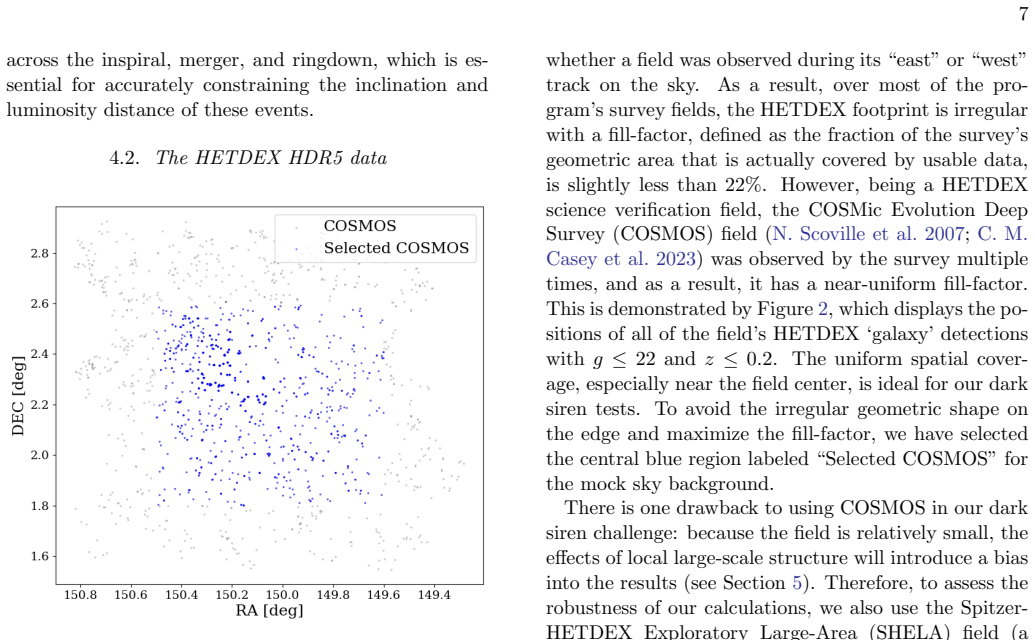
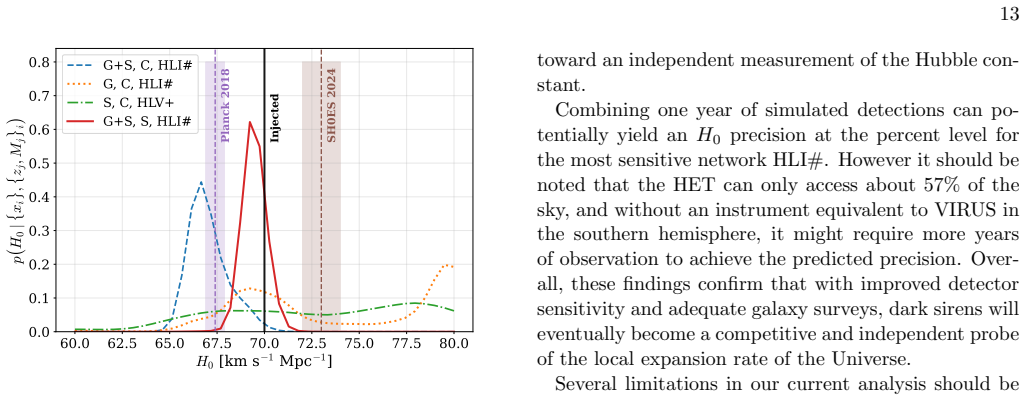
- [Figure 2] Figure 2 caption: the distinction between golden and silver sirens in the plotted posteriors is not labeled on the curves themselves, making it hard to connect the visual to the text description.
- [Abstract] The abstract states 'exquisite completeness' without a numerical value; a quantitative completeness fraction (e.g., >95 % for M* > 10^9 M⊙) should be stated in the main text for reproducibility.
Simulated Author's Rebuttal
We thank the referee for their constructive and detailed comments on our manuscript. We address each major comment below and have revised the manuscript to strengthen the presentation of our forecasts.
read point-by-point responses
-
Referee: [§4] §4 (Forecast methodology): The central few-percent H0 claim rests on the assumption that VIRUS at standard HETDEX depth yields uniform 'exquisite completeness' and precise redshifts for all galaxy types within z = 0.2. No quantitative assessment of redshift success rate versus stellar mass, emission-line strength, or fiber allocation is provided, so the impact on the silver-siren host-probability prior (and thus on the width or bias of the combined H0 posterior) cannot be evaluated.
Authors: We agree that an explicit quantitative breakdown of redshift success rates strengthens the justification for our completeness assumptions. In the revised manuscript we have expanded §4 with a new analysis drawn from the fifth internal HETDEX data release. We now report redshift success fractions as functions of stellar mass, emission-line equivalent width, and fiber allocation statistics for galaxies at z < 0.2. The results confirm that completeness remains high (>95 %) across the relevant range of galaxy properties, with only modest variation that propagates to a negligible broadening of the silver-siren host-probability priors. Consequently the combined H0 posterior width is essentially unchanged. revision: yes
-
Referee: [§3.2] §3.2 (Event-rate and localization modeling): The expected numbers of golden and silver dark sirens are taken from external LIGO rate estimates without an explicit Monte Carlo validation or sensitivity test against current O4 localization volumes and selection effects; this directly scales the forecasted precision and must be shown to be stable under reasonable variations.
Authors: The baseline event rates are taken from published LIGO-Virgo-KAGRA rate estimates, as is standard for such forecasts. To address the request for explicit validation, the revised §3.2 now includes a Monte Carlo sensitivity study. We resample localization volumes and selection functions consistent with published O4 results, varying the median sky-area and distance uncertainty within observed ranges. The resulting distributions of golden and silver siren counts remain stable to within ~15 %, and the forecasted H0 precision stays at the few-percent level under all tested variations. revision: yes
Circularity Check
Forecast relies on external LIGO rates, localization, and HETDEX survey specs with no reduction to self-defined or fitted inputs
full rationale
The paper presents a prospective forecast for H0 precision from future golden and silver dark sirens observed with upgraded LIGO-A# and followed up by VIRUS on HETDEX. The derivation uses externally tabulated GW merger rates, expected sky localization areas, and the stated completeness and redshift precision of standard-depth VIRUS exposures at z < 0.2; these quantities are taken as given inputs rather than fitted to or defined by the target H0 constraint. No equation chain equates the final few-percent precision to a parameter that was itself extracted from the same H0 posterior, and no load-bearing step reduces to a self-citation whose justification is internal to the present work. The use of the fifth internal HETDEX data release serves only to validate survey suitability, not to calibrate the forecast result itself.
Axiom & Free-Parameter Ledger
free parameters (2)
- Expected number of detectable golden and silver dark sirens
- Host galaxy association probabilities
axioms (2)
- domain assumption Statistical association of GW events with galaxies in redshift catalogs can constrain H0
- domain assumption VIRUS at standard HETDEX depth delivers precise redshifts and high completeness at z < 0.2
Lean theorems connected to this paper
-
IndisputableMonolith/Foundation/RealityFromDistinction.leanreality_from_one_distinction unclear?
unclearRelation between the paper passage and the cited Recognition theorem.
VIRUS exposures of the standard HETDEX depth provide precise redshifts and exquisite completeness within z = 0.2... combined sample of golden and silver dark sirens with z < 0.2... few-percent constraint on H0
What do these tags mean?
- matches
- The paper's claim is directly supported by a theorem in the formal canon.
- supports
- The theorem supports part of the paper's argument, but the paper may add assumptions or extra steps.
- extends
- The paper goes beyond the formal theorem; the theorem is a base layer rather than the whole result.
- uses
- The paper appears to rely on the theorem as machinery.
- contradicts
- The paper's claim conflicts with a theorem or certificate in the canon.
- unclear
- Pith found a possible connection, but the passage is too broad, indirect, or ambiguous to say the theorem truly supports the claim.
Forward citations
Cited by 1 Pith paper
-
Not too close! Evaluating the impact of the baseline on the localization of binary black holes by next-generation gravitational-wave detectors
Baselines of 8-11 ms light travel time for two CE detectors provide a reasonable compromise for BBH sky localization, with third detectors eliminating multimodality for most or all events.
Reference graph
Works this paper leans on
-
[1]
GWTC-4.0: Population Properties of Merging Compact Binaries
Abac, A. G., et al. 2025, https://arxiv.org/abs/2508.18083
work page internal anchor Pith review Pith/arXiv arXiv 2025
-
[2]
P., et al., 2017b, @doi [Nature] 10.1038/nature24471 , 551, 85
Abbott, B. P., Abbott, R., Abbott, T. D., et al. 2017a, Nature, 551, 85, doi: 10.1038/nature24471
-
[3]
Abbott, B. P., Abbott, R., Abbott, T. D., et al. 2017b, ApJL, 848, L12, doi: 10.3847/2041-8213/aa91c9 16
-
[4]
Abbott, B. P., et al. 2019, ApJL, 882, L24, doi: 10.3847/2041-8213/ab3800
-
[5]
Abbott, R., et al. 2021, ApJL, 913, L7, doi: 10.3847/2041-8213/abe949
-
[6]
Abbott, R., et al. 2023, Phys. Rev. X, 13, 011048, doi: 10.1103/PhysRevX.13.011048
-
[7]
Afroz, S., & Mukherjee, S. 2024, Mon. Not. Roy. Astron. Soc., 534, 1283, doi: 10.1093/mnras/stae2139
-
[8]
Aghanim, N., et al. 2020, A&A, 641, A6, doi: 10.1051/0004-6361/201833910
-
[9]
Aihara, H., AlSayyad, Y., Ando, M., et al. 2022, PASJ, 74, 247, doi: 10.1093/pasj/psab122
-
[10]
Alfradique, V., Bom, C. R., & Castro, T. 2025, PhRvD, 112, 063561, doi: 10.1103/vd36-3mys
-
[11]
Ashton, G., et al. 2019, ApJS, 241, 27, doi: 10.3847/1538-4365/ab06fc
-
[12]
Bailes, M., et al. 2021, Nature Rev. Phys., 3, 344, doi: 10.1038/s42254-021-00303-8
-
[13]
2016, The Journal of Open Source Software, 1, 58, doi: 10.21105/joss.00058
Barbary, K. 2016, The Journal of Open Source Software, 1, 58, doi: 10.21105/joss.00058
-
[14]
Barsotti, L., Fritschel, P., Evans, M., & Gras, S. 2018, Updated Advanced LIGO sensitivity design curve, Technical Notes, LIGO-T1800044,, https://dcc.ligo.org/LIGO-T1800044/public https://dcc.ligo.org/LIGO-T1800044/public
work page 2018
-
[15]
Bell, E. F., McIntosh, D. H., Katz, N., & Weinberg, M. D. 2003, ApJS, 149, 289, doi: 10.1086/378847
work page internal anchor Pith review doi:10.1086/378847 2003
-
[16]
2020, ApJ, 902, 79, doi: 10.3847/1538-4357/abb4e0
Bera, S., Rana, D., More, S., & Bose, S. 2020, ApJ, 902, 79, doi: 10.3847/1538-4357/abb4e0
-
[17]
Blanton, M. R., et al. 2003, ApJ, 592, 819, doi: 10.1086/375776
-
[18]
2021, Classical and Quantum Gravity, 38, 175014, doi: 10.1088/1361-6382/ac1618
Borhanian, S. 2021, Classical and Quantum Gravity, 38, 175014, doi: 10.1088/1361-6382/ac1618
-
[19]
Sathyaprakash, B. S. 2020, ApJL, 905, L28, doi: 10.3847/2041-8213/abcaf5
-
[20]
2023, JCAP, 07, 068, doi: 10.1088/1475-7516/2023/07/068
Branchesi, M., et al. 2023, JCAP, 07, 068, doi: 10.1088/1475-7516/2023/07/068
-
[21]
Casey, C. M., et al. 2023, ApJ, 954, 31, doi: 10.3847/1538-4357/acc2bc
-
[22]
2025, JCAP, 2025, 076, doi: 10.1088/1475-7516/2025/07/076
Chen, A. 2025, JCAP, 2025, 076, doi: 10.1088/1475-7516/2025/07/076
-
[23]
Chen, H.-Y., Fishbach, M., & Holz, D. E. 2018, Nature, 562, 545, doi: 10.1038/s41586-018-0606-0
-
[24]
Ciardullo, R., Gronwall, C., Adams, J. J., et al. 2013, ApJ, 769, 83, doi: 10.1088/0004-637X/769/1/83
-
[25]
Collaboration, T. L. S., Aasi, J., Abbott, B. P., et al. 2015, Class. Quant. Gravity, 32, 074001, doi: 10.1088/0264-9381/32/7/074001
-
[26]
Cornish, N. J. 2010, https://arxiv.org/abs/1007.4820
work page internal anchor Pith review Pith/arXiv arXiv 2010
-
[27]
Cousins, B., Schumacher, K., Chung, A. K.-W., et al. 2025, https://arxiv.org/abs/2503.01997
-
[28]
Cross-Parkin, M. L., Howlett, C., Davis, T. M., & Khetan, N. 2025, Dark sirens and the impact of redshift precision, arXiv, doi: 10.48550/arXiv.2502.17747 D´ alya, G., Galg´ oczi, G., Dobos, L., et al. 2018, Mon. Not. Roy. Astron. Soc., 479, 2374, doi: 10.1093/mnras/sty1703 D´ alya, G., et al. 2022, Mon. Not. Roy. Astron. Soc., 514, 1403, doi: 10.1093/mnr...
-
[29]
Davis, D., Gebhardt, K., Cooper, E. M., et al. 2023, ApJ, 946, 86, doi: 10.3847/1538-4357/acb0ca
-
[30]
Dey, A., Schlegel, D. J., Lang, D., et al. 2019, AJ, 157, 168, doi: 10.3847/1538-3881/ab089d Di Valentino, E., Melchiorri, A., & Silk, J. 2019, Nature Astron., 4, 196, doi: 10.1038/s41550-019-0906-9 Di Valentino, E., Mena, O., Pan, S., et al. 2021, Class. Quant. Grav., 38, 153001, doi: 10.1088/1361-6382/ac086d Di Valentino, E., et al. 2025, Phys. Dark Uni...
-
[31]
Driver, S. P., et al. 2022, Mon. Not. Roy. Astron. Soc., 513, 439, doi: 10.1093/mnras/stac472
-
[32]
Ezquiaga, J. M., & Holz, D. E. 2022, Phys. Rev. Lett., 129, 061102, doi: 10.1103/PhysRevLett.129.061102
-
[33]
Fishbach, M., Gray, R., Hernandez, I. M., et al. 2019, ApJ, 871, L13, doi: 10.3847/2041-8213/aaf96e
-
[34]
R., Ghosh, A., Gray, R., et al
Gair, J. R., Ghosh, A., Gray, R., et al. 2023, AJ, 166, 22, doi: 10.3847/1538-3881/acca78
-
[35]
E., Zamorano, J., Arag´ on-Salamanca, A., & Rego, M
Gallego, J., Garc´ ıa-Dab´ o, C. E., Zamorano, J., Arag´ on-Salamanca, A., & Rego, M. 2002, ApJL, 570, L1, doi: 10.1086/340830 Garc´ ıa-Quir´ os, C., Colleoni, M., Husa, S., et al. 2020, PhRvD, 102, 064002, doi: 10.1103/PhysRevD.102.064002
-
[36]
2021, ApJ, 923, 217, doi: 10.3847/1538-4357/ac2e03
Gebhardt, K., Mentuch Cooper, E., Ciardullo, R., et al. 2021, ApJ, 923, 217, doi: 10.3847/1538-4357/ac2e03
-
[37]
2021, Phd thesis, University of Glasgow, Glasgow, United Kingdom
Gray, R. 2021, Phd thesis, University of Glasgow, Glasgow, United Kingdom. https://theses.gla.ac.uk/82438/
work page 2021
-
[38]
2020, PhRvD, 101, 122001, doi: 10.1103/PhysRevD.101.122001
Gray, R., et al. 2020, PhRvD, 101, 122001, doi: 10.1103/PhysRevD.101.122001
-
[39]
2023, MNRAS, 524, 3537, doi: 10.1093/mnras/stad2115
Gupta, I. 2023, MNRAS, 524, 3537, doi: 10.1093/mnras/stad2115
-
[40]
Harris, C. R., Millman, K. J., van der Walt, S. J., et al. 2020, Nature, 585, 357–362, doi: 10.1038/s41586-020-2649-2
-
[41]
2021, ApJ, 911, 108, doi: 10.3847/1538-4357/abe9bd
Hawkins, K., Zeimann, G., Sneden, C., et al. 2021, ApJ, 911, 108, doi: 10.3847/1538-4357/abe9bd
-
[42]
Hill, G. J., Lee, H., MacQueen, P. J., et al. 2021, AJ, 162, 298, doi: 10.3847/1538-3881/ac2c02
-
[43]
Holz, D. E., & Hughes, S. A. 2005, ApJ, 629, 15, doi: 10.1086/431341 17
-
[44]
Huchra, J., & Sargent, W. L. W. 1973, ApJ, 186, 433, doi: 10.1086/152510
-
[45]
Hunter, J. D. 2007, Computing in Science and Engineering, 9, 90, doi: 10.1109/MCSE.2007.55
-
[46]
2023, https://arxiv.org/abs/2312.06009
Krishna, K., Vijaykumar, A., Ganguly, A., et al. 2023, https://arxiv.org/abs/2312.06009
-
[47]
Kuns, K., & Fritschel, P. 2023, A# Strain Sensitivity, Technical Notes, LIGO-T2300041,, https://dcc.ligo.org/LIGO-T2300041/public https://dcc.ligo.org/LIGO-T2300041/public
work page 2023
-
[48]
Leung, G. C. K., Finkelstein, S. L., Weaver, J. R., et al. 2023, ApJS, 269, 46, doi: 10.3847/1538-4365/acfe78
-
[49]
Madau, P. 1997, AIP Conf. Proc., 393, 481, doi: 10.1063/1.52821
-
[50]
2014, Annual Review of Astronomy and Astrophysics, 52, 415, doi: 10.1146/annurev-astro-081811-125615
Madau, P., & Dickinson, M. 2014, ARA&A, 52, 415, doi: 10.1146/annurev-astro-081811-125615
work page internal anchor Pith review doi:10.1146/annurev-astro-081811-125615 2014
-
[51]
Mastrogiovanni, S., Leyde, K., Karathanasis, C., et al. 2021, PhRvD, 104, 062009, doi: 10.1103/PhysRevD.104.062009
-
[52]
Mastrogiovanni, S., Laghi, D., Gray, R., et al. 2023, Phys. Rev. D, 108, 042002, doi: 10.1103/PhysRevD.108.042002 Mentuch Cooper, E., Gebhardt, K., Davis, D., et al. 2023, ApJ, 943, 177, doi: 10.3847/1538-4357/aca962
-
[53]
DESI DR2 Galaxy Luminosity Functions
Moore, S. G., Cole, S., Wilson, M., et al. 2025, arXiv e-prints, arXiv:2511.01803, doi: 10.48550/arXiv.2511.01803
work page internal anchor Pith review Pith/arXiv arXiv doi:10.48550/arxiv.2511.01803 2025
-
[54]
D., Silk J., 2024, @doi [Astrophys
Mukherjee, S., Krolewski, A., Wandelt, B. D., & Silk, J. 2024, ApJ, 975, 189, doi: 10.3847/1538-4357/ad7d90
-
[55]
Mukherjee, S., Wandelt, B. D., Nissanke, S. M., & Silvestri, A. 2021, Phys. Rev. D, 103, 043520, doi: 10.1103/PhysRevD.103.043520
-
[56]
Mukherjee, S., Wandelt, B. D., & Silk, J. 2020, Mon. Not. Roy. Astron. Soc., 494, 1956, doi: 10.1093/mnras/staa827
-
[57]
2016, PhRvL, 116, 121302, doi: 10.1103/PhysRevLett.116.121302
Namikawa, T., Nishizawa, A., & Taruya, A. 2016, PhRvL, 116, 121302, doi: 10.1103/PhysRevLett.116.121302
-
[58]
Palenzuela, C., Liebling, S. L., Neilsen, D., et al. 2015, PhRvD, 92, 044045, doi: 10.1103/PhysRevD.92.044045
-
[59]
Papovich, C., Shipley, H. V., Mehrtens, N., et al. 2016, ApJS, 224, 28, doi: 10.3847/0067-0049/224/2/28
-
[60]
L., Karwal, T., & Kamionkowski, M
Poulin, V., Smith, T. L., Karwal, T., & Kamionkowski, M. 2019, PhRvL, 122, 221301, doi: 10.1103/PhysRevLett.122.221301
-
[61]
Price-Whelan, A. M., Sip˝ ocz, B. M., G¨ unther, H. M., et al. 2018, The Astronomical Journal, 156, 123, doi: 10.3847/1538-3881/aabc4f
-
[62]
Ramsey, L. W., Adams, M. T., Barnes, T. G., et al. 1998, in Society of Photo-Optical Instrumentation Engineers (SPIE) Conference Series, Vol. 3352, Advanced Technology Optical/IR Telescopes VI, ed. L. M. Stepp, 34–42, doi: 10.1117/12.319287
-
[63]
G., et al., 2022, @doi [The Astrophysical Journal Letters] 10.3847/2041-8213/ac5c5b , 934, L7
Riess, A. G., et al. 2022, ApJL, 934, L7, doi: 10.3847/2041-8213/ac5c5b
-
[64]
Riess, A. G., Li, S., Anand, G. S., et al. 2025, ApJL, 992, L34, doi: 10.3847/2041-8213/ae0ad6
-
[65]
J., Gronwall, C., Lipovetsky, V
Salzer, J. J., Gronwall, C., Lipovetsky, V. A., et al. 2000, AJ, 120, 80, doi: 10.1086/301418
-
[66]
Schechter, P. 1976, Astrophys. J., 203, 297, doi: 10.1086/154079
-
[67]
Schlafly, E. F., & Finkbeiner, D. P. 2011, ApJ, 737, 103, doi: 10.1088/0004-637X/737/2/103
work page internal anchor Pith review doi:10.1088/0004-637x/737/2/103 2011
-
[68]
Maps of Dust IR Emission for Use in Estimation of Reddening and CMBR Foregrounds
Schlegel, D. J., Finkbeiner, D. P., & Davis, M. 1998, ApJ, 500, 525, doi: 10.1086/305772
work page internal anchor Pith review doi:10.1086/305772 1998
-
[69]
, year = 1968, month = feb, volume =
Schmidt, M. 1968, ApJ, 151, 393, doi: 10.1086/149446
-
[70]
Schutz, B. F. 1986, Nature, 323, 310, doi: 10.1038/323310a0
-
[71]
Schutz, B. F. 2011, Class. Quant. Grav., 28, 125023, doi: 10.1088/0264-9381/28/12/125023
-
[72]
2006, The Cosmic Evolution Survey (COSMOS) – Overview, doi: 10.1086/516585
Scoville, N., et al. 2007, ApJS, 172, 1, doi: 10.1086/516585
-
[73]
Taylor, S. R., & Gair, J. R. 2012, PhRvD, 86, 023502, doi: 10.1103/PhysRevD.86.023502
-
[74]
Verde, L., Treu, T., & Riess, A. G. 2019, Nature Astron., 3, 891, doi: 10.1038/s41550-019-0902-0
work page internal anchor Pith review doi:10.1038/s41550-019-0902-0 2019
-
[75]
Virtanen, P., Gommers, R., Oliphant, T. E., et al. 2020, Nature Methods, 17, 261–272, doi: 10.1038/s41592-019-0686-2
-
[76]
2019, PhRvD, 100, 043012, doi: 10.1103/PhysRevD.100.043012
Wysocki, D., Lange, J., & O’Shaughnessy, R. 2019, PhRvD, 100, 043012, doi: 10.1103/PhysRevD.100.043012
-
[77]
Relative Binning and Fast Likelihood Evaluation for Gravitational Wave Parameter Estimation
Zackay, B., Dai, L., & Venumadhav, T. 2018, https://arxiv.org/abs/1806.08792
work page internal anchor Pith review Pith/arXiv arXiv 2018
-
[78]
Zeimann, G. R., Debski, M. H., Schneider, D. P., et al. 2024, ApJ, 966, 14, doi: 10.3847/1538-4357/ad35b8
-
[79]
2025, https://arxiv.org/abs/2508.00291
Zhang, H., Kokubo, M., MacBride, S., et al. 2025, https://arxiv.org/abs/2508.00291
discussion (0)
Sign in with ORCID, Apple, or X to comment. Anyone can read and Pith papers without signing in.