Recognition: unknown
Not too close! Evaluating the impact of the baseline on the localization of binary black holes by next-generation gravitational-wave detectors
Pith reviewed 2026-05-10 15:22 UTC · model grok-4.3
The pith
Baselines of 2300-3300 km give mostly usable sky localizations for binary black holes in next-generation detector networks.
A machine-rendered reading of the paper's core claim, the machinery that carries it, and where it could break.
Core claim
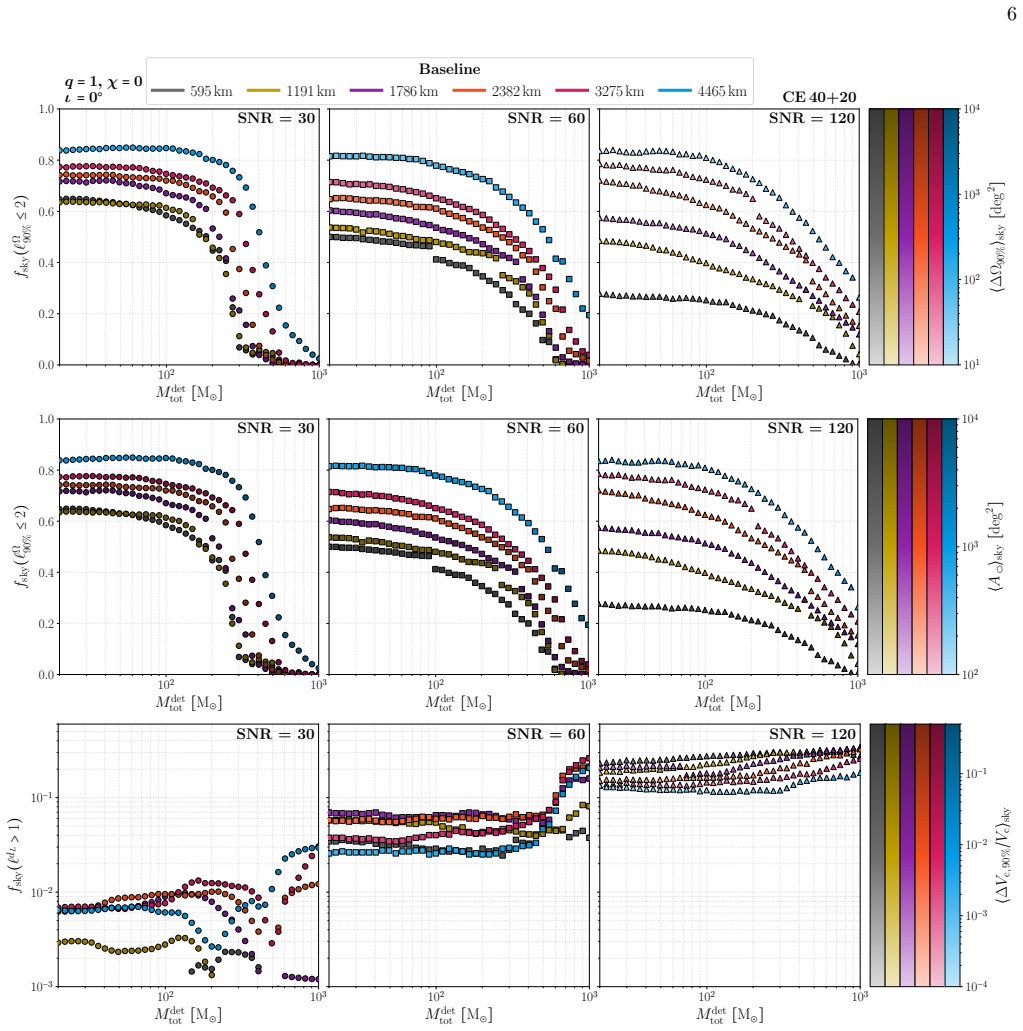
In a two-detector Cosmic Explorer network, baselines corresponding to light travel times of 8-11 ms (~2300-3300 km) offer a reasonable compromise for localizing binary black holes with detector-frame total masses up to ~100 solar masses, yielding predominantly unimodal or bimodal sky maps suitable for follow-up observations. Shorter baselines degrade performance, especially at high signal-to-noise ratio. Networks including a third detector, such as LIGO-India or the Einstein Telescope, substantially reduce multimodality.
What carries the argument
Timing triangulation across the light-travel-time baseline between detectors, which converts measured arrival-time differences into sky-position constraints for signals that remain in band for only a few minutes.
If this is right
- Shorter baselines significantly degrade localization, particularly for high signal-to-noise events.
- A network of two Cosmic Explorers plus LIGO-India yields unimodal posteriors for a good fraction of events.
- Two Cosmic Explorers plus the Einstein Telescope yields unimodal posteriors for essentially all events.
- Baselines of 8-11 ms support both electromagnetic follow-up and statistical host-galaxy cross-correlation studies.
Where Pith is reading between the lines
- Network planners may need to accept some logistical cost to achieve separations near 3000 km rather than clustering facilities more closely.
- Statistical host-galaxy studies could still proceed if the fraction of events with usable (unimodal or bimodal) maps remains high.
- The large improvement from adding a third distant detector suggests prioritizing global distribution over concentrating multiple next-generation instruments in one region.
Load-bearing premise
Localization of most binary black hole signals will continue to rely primarily on timing triangulation because the signals spend at most a few minutes in the sensitivity band.
What would settle it
A high signal-to-noise binary black hole event recorded on a short-baseline two-detector network that still shows persistent multimodal sky localization after full parameter estimation.
Figures




read the original abstract
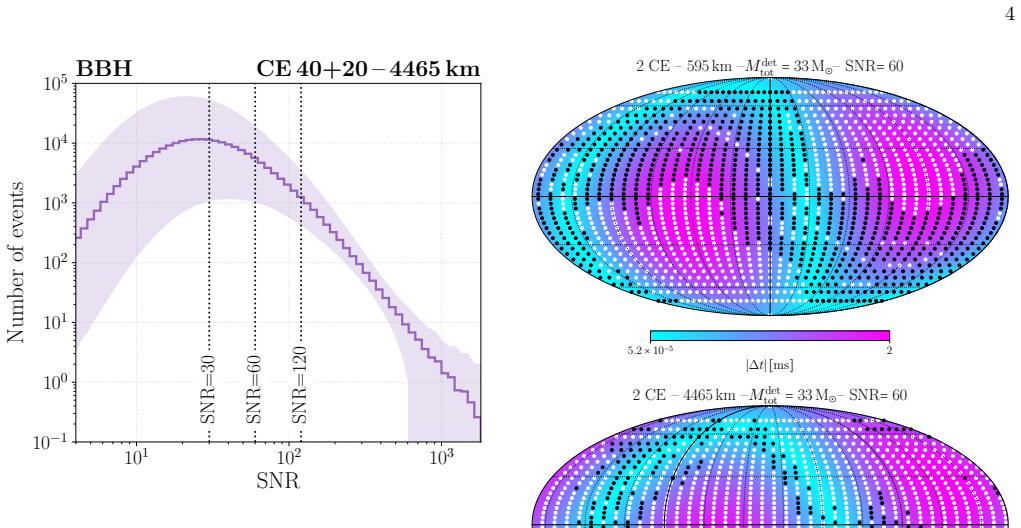
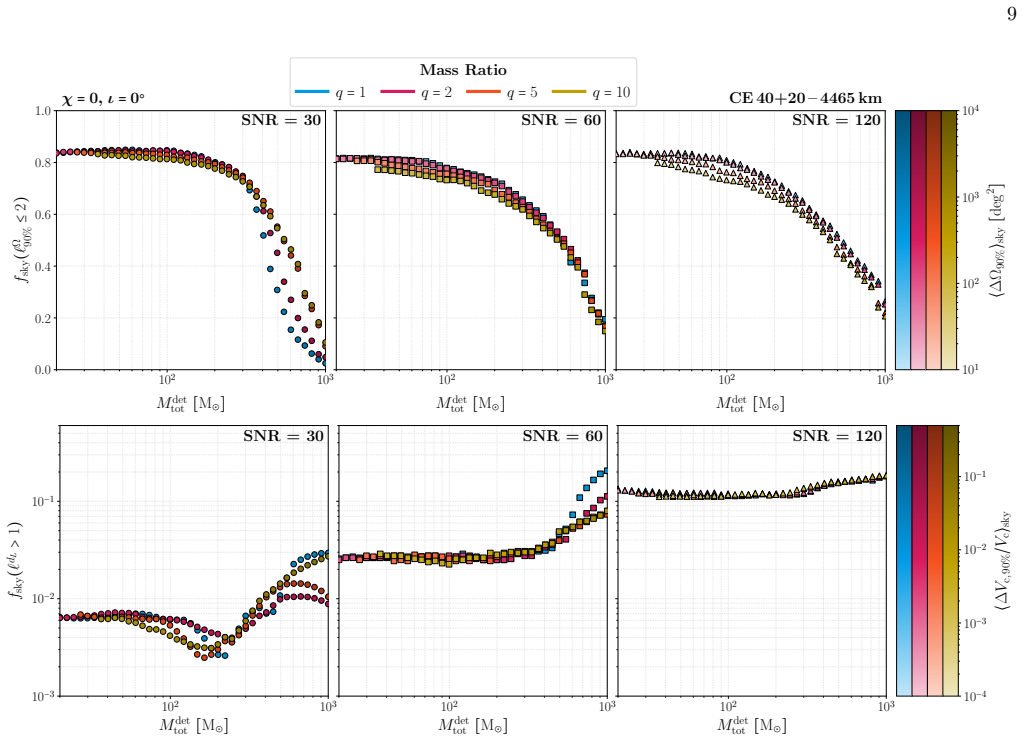
Next-generation (XG) gravitational-wave detectors, such as Cosmic Explorer (CE) and the Einstein Telescope (ET), will observe compact binary coalescences at unprecedented rates and signal-to-noise ratios (SNRs). Accurate sky localization of these sources is crucial for several aspects of the science case of CE and ET. The localization of most binary black hole (BBH) signals, which will spend at most a few minutes within the XG detector's effective sensitivity band, will continue to rely primarily on timing triangulation across a network of detectors. A key design choice for triangulation is the baseline between instruments. We investigate how the baseline affects the localization capabilities of a two-detector CE network, analyzing both fixed-parameter injections and a realistic BBH population consistent with the latest GWTC-4 results. For detector-frame total masses up to $\sim\!100\,{\rm M}_\odot$, we find that baselines corresponding to light travel times of $8-11$ ms ($\sim\!2300-3300$ km) offer a reasonable compromise, producing predominantly unimodal or bimodal sky localizations suitable for electromagnetic follow-up and statistical host galaxy identification and galaxy cross-correlation studies. Shorter baselines significantly degrade localization, particularly for high SNR events. Crucially, we find that adding a third detector to the network eliminates localization multimodality for a substantial fraction of sources. A network with two CEs and LIGO-India provides unimodal posteriors for a good fraction of events, whereas two CEs plus ET would provide unimodal posteriors for essentially all of them. These considerations should be useful to inform the development of the XG detector network.
Editorial analysis
A structured set of objections, weighed in public.
Referee Report
Summary. The manuscript examines the effect of baseline separation in a two-detector Cosmic Explorer network on sky localization of binary black hole mergers. Using fixed-parameter injections and a realistic BBH population drawn from GWTC-4, it concludes that light-travel times of 8-11 ms (~2300-3300 km) yield predominantly unimodal or bimodal posteriors suitable for electromagnetic follow-up and statistical host-galaxy studies for detector-frame total masses up to ~100 M_⊙. It further shows that adding a third detector (LIGO-India or ET) largely eliminates multimodality.
Significance. If the results hold, the work supplies concrete guidance for siting next-generation detectors to support multi-messenger and statistical cosmology applications. The dual use of targeted injections and a full population study, together with the explicit demonstration that a third detector resolves most degeneracies, constitutes a practical contribution to network design.
major comments (2)
- [§3] §3 (Methods): The assumption that BBH signals remain in band for at most a few minutes (justifying pure timing triangulation) is scoped to M_det ≲ 100 M_⊙, but an explicit verification of in-band duration for the highest-mass events using the adopted CE noise curve would confirm the approximation holds across the simulated population.
- [§4] §4 (Results): The central claim that 8-11 ms baselines produce 'predominantly' unimodal or bimodal localizations requires the exact fractions (or cumulative distributions) of localization types versus baseline for the GWTC-4 population; without these numbers the quantitative support for the compromise region is incomplete.
minor comments (3)
- [Abstract] Abstract: the parenthetical distance conversion (~2300-3300 km) should state the precise value of c employed or the formula used.
- [Figure captions] Figure captions (sky-posterior figures): include a brief statement of the quantitative criterion used to label a posterior as unimodal versus bimodal.
- [§5] §5 (Discussion): the trade-off between localization performance and other siting constraints (cost, seismic environment) is mentioned only qualitatively; a short table or paragraph summarizing these factors would help readers weigh the recommendation.
Simulated Author's Rebuttal
We thank the referee for the positive evaluation and the helpful suggestions that will improve the clarity and quantitative support of our manuscript. We address each major comment below.
read point-by-point responses
-
Referee: [§3] §3 (Methods): The assumption that BBH signals remain in band for at most a few minutes (justifying pure timing triangulation) is scoped to M_det ≲ 100 M_⊙, but an explicit verification of in-band duration for the highest-mass events using the adopted CE noise curve would confirm the approximation holds across the simulated population.
Authors: We agree that an explicit verification strengthens the methods section. In the revised manuscript we will add a short paragraph (or footnote) in §3 that computes the in-band duration for the highest-mass events in our GWTC-4 population (detector-frame total mass up to 100 M_⊙) using the adopted CE noise curve, confirming that all such signals remain in band for at most a few minutes and thereby justifying the timing-triangulation approximation. revision: yes
-
Referee: [§4] §4 (Results): The central claim that 8-11 ms baselines produce 'predominantly' unimodal or bimodal localizations requires the exact fractions (or cumulative distributions) of localization types versus baseline for the GWTC-4 population; without these numbers the quantitative support for the compromise region is incomplete.
Authors: We accept that providing the exact fractions will make the quantitative support more complete. While the existing figures already demonstrate the trends, we will add a new table (or cumulative-distribution panel) in §4 that reports the precise fractions of unimodal, bimodal, and multimodal sky localizations as a function of baseline for the full GWTC-4 population. This addition will directly substantiate the 8–11 ms compromise region. revision: yes
Circularity Check
No significant circularity detected
full rationale
The manuscript derives its conclusions on optimal baselines (8-11 ms light-travel time) exclusively from numerical injections and Bayesian parameter estimation on simulated signals, using both fixed-mass cases and a population drawn from external GWTC-4 statistics. No equation or result is obtained by fitting a parameter to a subset of the same data and then relabeling the fit as a prediction; no self-citation supplies a uniqueness theorem or ansatz that is then treated as external; the triangulation assumption is scoped explicitly to the short in-band durations of the simulated events and is tested by adding a third detector. All load-bearing steps are therefore independent of the paper's own outputs.
Axiom & Free-Parameter Ledger
axioms (2)
- domain assumption BBH signals spend at most a few minutes within the XG detector's effective sensitivity band
- domain assumption Localization of most BBH signals relies primarily on timing triangulation across a network
Reference graph
Works this paper leans on
-
[1]
silver dark sirens
We repeat step 4 for a realistic population of BBH sources. In this case, we simulate a population corresponding to 1yr of mergers using the maximum likelihood hyperparameter sample from the latest LVK results [5], and the same distributions used for generating the catalogs in step 3. We restrict our study to systems with aligned spins, using again theIMR...
2000
-
[2]
J. Aasiet al.(LIGO Scientific), Class. Quant. Grav.32, 074001 (2015), arXiv:1411.4547 [gr-qc]
work page internal anchor Pith review arXiv 2015
-
[3]
F.Acerneseet al.(Virgo),Class.Quant.Grav.32,024001 (2015), arXiv:1408.3978 [gr-qc]
work page internal anchor Pith review arXiv 2015
- [4]
- [5]
-
[6]
A. G. Abacet al.(LIGO Scientific, Virgo, KAGRA), (2025), arXiv:2508.18083 [astro-ph.HE]
work page internal anchor Pith review Pith/arXiv arXiv 2025
-
[7]
Tests of General Relativity with GWTC-3
R. Abbottet al.(LIGO Scientific, Virgo, KAGRA), Phys. Rev. D112, 084080 (2025), arXiv:2112.06861 [gr-qc]
work page internal anchor Pith review arXiv 2025
-
[8]
A. G. Abacet al.(LIGO Scientific, Virgo, KAGRA), Phys. Rev. Lett.135, 111403 (2025), arXiv:2509.08054 [gr-qc]
work page internal anchor Pith review arXiv 2025
-
[9]
B. P. Abbottet al.(LIGO Scientific, Virgo), Phys. Rev. Lett.119, 161101 (2017), arXiv:1710.05832 [gr-qc]. 21
work page internal anchor Pith review arXiv 2017
-
[10]
R. Abbottet al.(LIGO Scientific, Virgo, KAGRA), Astrophys. J.949, 76 (2023), arXiv:2111.03604 [astro- ph.CO]
- [11]
-
[12]
Punturoet al., Class
M. Punturoet al., Class. Quant. Grav.27, 194002 (2010)
2010
-
[13]
Hild et al.,Sensitivity Studies for Third-Generation Gravitational Wave Observatories,Class
S. Hildet al., Class. Quantum Grav.28, 094013 (2011), arXiv:1012.0908 [gr-qc]
-
[14]
The Science of the Einstein Telescope
A. Abacet al.(ET), JCAP2026(3), 081, arXiv:2503.12263 [gr-qc]
work page internal anchor Pith review Pith/arXiv arXiv
-
[15]
Cosmic Explorer: The U.S. Contribution to Gravitational-Wave Astronomy beyond LIGO
D. Reitzeet al., Bull. Am. Astron. Soc.51, 035 (2019), arXiv:1907.04833 [astro-ph.IM]
work page internal anchor Pith review arXiv 2019
-
[16]
A Horizon Study for Cosmic Explorer: Science, Observatories, and Community
M. Evanset al., (2021), arXiv:2109.09882 [astro-ph.IM]
work page internal anchor Pith review arXiv 2021
-
[17]
Evans et al., arXiv e-prints arXiv:2306.13745 (2023), 2306.13745
M. Evanset al., (2023), arXiv:2306.13745 [astro-ph.IM]
-
[18]
Listening to the Universe with next generation ground-based 404 gravitational-wave detectors,
S. Borhanian and B. S. Sathyaprakash, Phys. Rev. D 110, 083040 (2024), arXiv:2202.11048 [gr-qc]
-
[19]
S. Ronchini, M. Branchesi, G. Oganesyan, B. Banerjee, U. Dupletsa, G. Ghirlanda, J. Harms, M. Mapelli, and F. Santoliquido, Astron. Astrophys.665, A97 (2022), arXiv:2204.01746 [astro-ph.HE]
-
[20]
F. Iacovelli, M. Mancarella, S. Foffa, and M. Maggiore, Astrophys. J.941, 208 (2022), arXiv:2207.02771 [gr-qc]
-
[21]
M. Pieroni, A. Ricciardone, and E. Barausse, Sci. Rep. 12, 17940 (2022), arXiv:2203.12586 [astro-ph.CO]
-
[22]
Characterizing gravitational wave detector networks: from A♯ to cosmic explorer,
I. Guptaet al., Class. Quant. Grav.41, 245001 (2024), arXiv:2307.10421 [gr-qc]
-
[23]
B. F. Schutz, Nature323, 310 (1986)
1986
-
[24]
C. L. MacLeod and C. J. Hogan, Phys. Rev. D77, 043512 (2008), arXiv:0712.0618 [astro-ph]
work page Pith review arXiv 2008
-
[25]
W. Del Pozzo, Phys. Rev. D86, 043011 (2012), arXiv:1108.1317 [astro-ph.CO]
work page Pith review arXiv 2012
-
[26]
M. Fishbachet al.(LIGO Scientific, Virgo), Astrophys. J. Lett.871, L13 (2019), arXiv:1807.05667 [astro-ph.CO]
work page Pith review arXiv 2019
-
[27]
R. Grayet al., Phys. Rev. D101, 122001 (2020), arXiv:1908.06050 [gr-qc]
- [28]
-
[29]
Dark Sirens to Resolve the Hubble–Lemaˆ ıtre Tension,
S. Borhanian, A. Dhani, A. Gupta, K. G. Arun, and B. S. Sathyaprakash, Astrophys. J. Lett.905, L28 (2020), arXiv:2007.02883 [astro-ph.CO]
- [30]
- [31]
-
[32]
C. Van Den Broeck, J. Phys. Conf. Ser.484, 012008 (2014), arXiv:1303.7393 [gr-qc]
- [33]
- [34]
-
[35]
M. Branchesiet al., JCAP2023(07), 068, arXiv:2303.15923 [gr-qc]
-
[36]
B. J. Carr, Astrophys. J.201, 1 (1975)
1975
-
[37]
T. Kinugawa, K. Inayoshi, K. Hotokezaka, D. Nakauchi, and T. Nakamura, Mon. Not. R. Astron. Soc.442, 2963 (2014), arXiv:1402.6672 [astro-ph.HE]
-
[38]
T. Hartwig, M. Volonteri, V. Bromm, R. S. Klessen, E. Barausse, M. Magg, and A. Stacy, Mon. Not. Roy. Astron. Soc.460, L74 (2016), arXiv:1603.05655 [astro- ph.GA]
-
[39]
K. Belczynski, T. Ryu, R. Perna, E. Berti, T. L. Tanaka, and T. Bulik, Mon. Not. R. Astron. Soc.471, 4702 (2017), arXiv:1612.01524 [astro-ph.HE]
-
[40]
Primordial Black Holes - Perspectives in Gravitational Wave Astronomy -
M. Sasaki, T. Suyama, T. Tanaka, and S. Yokoyama, Class. Quantum Grav.35, 063001 (2018), arXiv:1801.05235 [astro-ph.CO]
work page Pith review arXiv 2018
- [41]
-
[42]
G. Franciolini, R. Cotesta, N. Loutrel, E. Berti, P. Pani, and A. Riotto, Phys. Rev. D105, 063510 (2022), arXiv:2112.10660 [astro-ph.CO]
-
[43]
M. Mancarella, F. Iacovelli, and D. Gerosa, Phys. Rev. D107, L101302 (2023), arXiv:2303.16323 [gr-qc]
-
[44]
G. Franciolini, F. Iacovelli, M. Mancarella, M. Maggiore, P. Pani, and A. Riotto, Phys. Rev. D108, 043506 (2023), arXiv:2304.03160 [gr-qc]
-
[45]
F. Santoliquido, U. Dupletsa, J. Tissino, M. Branchesi, F. Iacovelli, G. Iorio, M. Mapelli, D. Gerosa, J. Harms, and M. Pasquato, Astron. Astrophys.690, A362 (2024), arXiv:2404.10048 [astro-ph.HE]
-
[46]
B. Mestichelli, M. Mapelli, S. Torniamenti, M. A. Sedda, M. Branchesi, G. Costa, G. Iorio, and F. Santoliquido, Astron. Astrophys.690, A106 (2024), arXiv:2405.06037 [astro-ph.GA]
-
[47]
G. Franciolini, K. Kritos, L. Reali, F. Broekgaar- den, and E. Berti, Phys. Rev. D110, 023036 (2024), arXiv:2401.13038 [astro-ph.HE]
-
[48]
C. Plunkett, M. Mould, and S. Vitale, Phys. Rev. D112, 023039 (2025), arXiv:2504.18615 [gr-qc]
- [49]
-
[50]
Nakar , journal volume 886 , pages 1 ( year 2020 ), 1912.05659
E. Nakar, Phys. Rept.886, 1 (2020), arXiv:1912.05659 [astro-ph.HE]
-
[51]
S. Ascenzi, G. Oganesyan, M. Branchesi, and R. Ciolfi, J. Plasma Phys.87, 845870102 (2021), arXiv:2011.04001 [astro-ph.HE]
-
[52]
B. P. Abbottet al.(LIGO Scientific, Virgo, Fermi- GBM, INTEGRAL), Astrophys. J. Lett.848, L13 (2017), arXiv:1710.05834 [astro-ph.HE]
work page Pith review arXiv 2017
-
[53]
V. Connaughtonet al., Astrophys. J. Lett.826, L6 (2016), arXiv:1602.03920 [astro-ph.HE]
- [54]
- [55]
- [56]
-
[57]
Short Gamma-Ray Bursts from the Merger of Two Black Holes,
R. Perna, D. Lazzati, and B. Giacomazzo, Astrophys. J. Lett.821, L18 (2016), arXiv:1602.05140 [astro-ph.HE]
- [58]
-
[59]
B. McKernan, K. E. S. Ford, I. Bartos, M. J. Graham, W. Lyra, S. Marka, Z. Marka, N. P. Ross, D. Stern, and Y. Yang, Astrophys. J. Lett.884, L50 (2019), arXiv:1907.03746 [astro-ph.HE]
- [60]
- [61]
- [62]
-
[63]
B. Zhang, Astrophys. J. Lett.827, L31 (2016), arXiv:1602.04542 [astro-ph.HE]
- [64]
-
[65]
Triangulation of gravitational wave sources with a network of detectors,
S. Fairhurst, New J. Phys.11, 123006 (2009), [Erratum: New J.Phys. 13, 069602 (2011)], arXiv:0908.2356 [gr-qc]
- [66]
-
[67]
S. Fairhurst, Class. Quant. Grav.28, 105021 (2011), arXiv:1010.6192 [gr-qc]
-
[68]
B. P. Abbottet al.(LIGO Scientific, Virgo), Phys. Rev. X9, 031040 (2019), arXiv:1811.12907 [astro-ph.HE]
work page internal anchor Pith review arXiv 2019
-
[69]
R. Abbottet al.(LIGO Scientific, Virgo), Phys. Rev. X 11, 021053 (2021), arXiv:2010.14527 [gr-qc]
work page internal anchor Pith review arXiv 2021
-
[70]
R. Abbottet al.(KAGRA, Virgo, LIGO Scientific), Phys. Rev. X13, 041039 (2023), arXiv:2111.03606 [gr-qc]
work page internal anchor Pith review arXiv 2023
-
[71]
A. G. Abacet al.(LIGO Scientific, Virgo, KAGRA), (2025), arXiv:2508.18082 [gr-qc]
work page internal anchor Pith review arXiv 2025
- [72]
- [73]
- [74]
-
[75]
N. Singh and T. Bulik, Phys. Rev. D104, 043014 (2021), arXiv:2011.06336 [astro-ph.HE]
-
[76]
N. Singh and T. Bulik, Phys. Rev. D106, 123014 (2022), arXiv:2107.11198 [astro-ph.HE]
-
[77]
F. Santoliquidoet al., Phys. Rev. D112, 103015 (2025), arXiv:2504.21087 [astro-ph.HE]
-
[78]
F. Santoliquido, J. Tissino, U. Dupletsa, M. Branchesi, and J. Harms, (2025), arXiv:2512.20699 [gr-qc]
work page internal anchor Pith review Pith/arXiv arXiv 2025
-
[79]
B. Iyer, T. Souradeep, C. Unnikrishnan, S. Dhurandhar, S. Raja, and A. Sengupta, LIGO-India, Proposal of the Consortium for Indian Initiative in Gravitational-wave Observations (IndIGO), Tech. Rep. M1100296-v2 (2011)
2011
-
[80]
K. Chandra, Class. Quant. Grav.42, 025003 (2025), arXiv:2407.21109 [gr-qc]
discussion (0)
Sign in with ORCID, Apple, or X to comment. Anyone can read and Pith papers without signing in.