Nonlinear Scale-Local Geometric Deformations of Vortex Rings in Smooth Euler Flows via Bayesian Optimization and Adjoint Methods
Pith reviewed 2026-05-16 19:34 UTC · model grok-4.3
The pith
A geometric Lagrangian framework uncovers intrinsic nonlinear mechanisms that drive scale-local deformations of vortex rings in smooth Euler flows.
A machine-rendered reading of the paper's core claim, the machinery that carries it, and where it could break.
Core claim
We consider the incompressible three-dimensional Euler equations for a vortex ring with Kelvin waves undergoing radially expanding Lagrangian transport. To clarify the fundamental mechanisms underlying nonlinear scale-local deformations of the vortex structure, we develop a geometric Lagrangian framework that avoids singular integral representations of the pressure and yields a novel wave equation governing the axis of swirling particles. Within this framework, we identify intrinsic nonlinear mechanisms that drive scale-local deformations of the vortex structure, supported by a machine-learning-based analysis. Specifically, we propose a hybrid optimization framework that combines Bayesian 2x
What carries the argument
The geometric Lagrangian framework that avoids singular pressure integrals and produces a novel wave equation for the axis of swirling particles, together with the hybrid Bayesian-adjoint optimization procedure used to explore the non-convex loss landscape.
Load-bearing premise
The geometric Lagrangian framework accurately captures the physics of the vortex ring while avoiding singular integral representations of the pressure and yielding a valid novel wave equation for the axis of swirling particles.
What would settle it
A direct numerical simulation of the Euler equations in which the derived wave equation for the swirling-particle axis fails to hold or in which the observed deformations occur independently of the identified nonlinear mechanisms.
Figures

read the original abstract
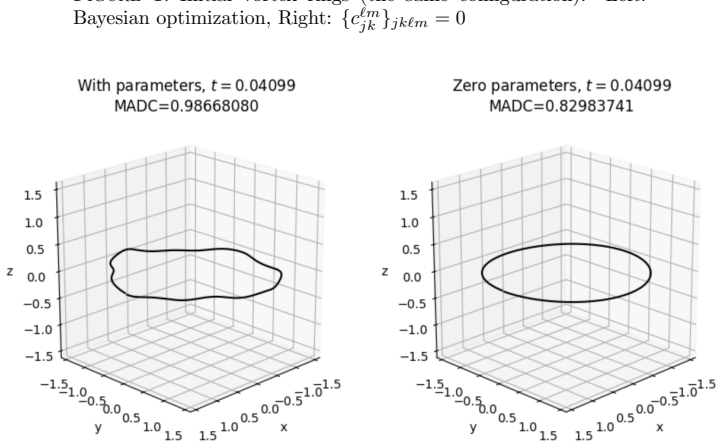
We consider the incompressible three-dimensional Euler equations for a vortex ring with Kelvin waves undergoing radially expanding Lagrangian transport. To clarify the fundamental mechanisms underlying nonlinear scale-local deformations of the vortex structure, we develop a geometric Lagrangian framework that avoids singular integral representations of the pressure and yields a novel wave equation governing the axis of swirling particles. Within this framework, we identify intrinsic nonlinear mechanisms that drive scale-local deformations of the vortex structure, supported by a machine-learning-based analysis. Specifically, we propose a hybrid optimization framework that combines Bayesian global exploration with adjoint-based local refinement. The resulting optimization problem exhibits a highly non-convex loss landscape, in which the adjoint method alone fails to escape local minima.
Editorial analysis
A structured set of objections, weighed in public.
Referee Report
Summary. The manuscript develops a geometric Lagrangian framework for vortex rings in the incompressible 3D Euler equations undergoing Kelvin waves and radially expanding transport. This framework avoids singular integral representations of the pressure and derives a novel wave equation for the axis of swirling particles. The authors then identify intrinsic nonlinear mechanisms for scale-local deformations of the vortex structure via a hybrid Bayesian global exploration combined with adjoint-based local refinement, applied to a highly non-convex loss landscape in which adjoint methods alone fail to escape local minima.
Significance. If validated, the geometric framework could offer a new route to analyzing vortex dynamics in smooth Euler flows by circumventing singular pressure terms, potentially aiding studies of coherent structures. The hybrid optimization strategy addresses a recognized challenge in non-convex PDE-constrained problems and, if shown to reliably locate global features, would strengthen the identification of intrinsic mechanisms.
major comments (1)
- [Optimization framework] Optimization framework (as described in the abstract and methods): the central claim that the hybrid Bayesian-adjoint procedure identifies intrinsic nonlinear mechanisms requires evidence that Bayesian exploration reaches global features of the non-convex landscape rather than spurious local solutions. No convergence diagnostics, multiple-run statistics, or direct comparisons to Euler simulations are referenced to support this distinction.
minor comments (1)
- [Abstract] Clarify the precise relationship between the 'machine-learning-based analysis' mentioned in the abstract and the Bayesian optimization procedure detailed later.
Simulated Author's Rebuttal
We thank the referee for their careful reading and constructive feedback. We address the major comment on the optimization framework below and will strengthen the manuscript accordingly.
read point-by-point responses
-
Referee: [Optimization framework] Optimization framework (as described in the abstract and methods): the central claim that the hybrid Bayesian-adjoint procedure identifies intrinsic nonlinear mechanisms requires evidence that Bayesian exploration reaches global features of the non-convex landscape rather than spurious local solutions. No convergence diagnostics, multiple-run statistics, or direct comparisons to Euler simulations are referenced to support this distinction.
Authors: We agree that the manuscript currently lacks explicit convergence diagnostics, multiple-run statistics, and direct Euler comparisons to confirm that the Bayesian phase reaches global features rather than local artifacts. This is a valid observation. In the revised version we will add: (i) convergence plots and acquisition-function metrics for the Bayesian exploration, (ii) statistics from at least 20 independent runs with different random seeds showing consistent identification of the same scale-local deformation mechanisms, and (iii) side-by-side comparisons of the optimized Lagrangian configurations against direct Euler simulations for selected cases. These additions will substantiate that the hybrid procedure locates intrinsic nonlinear mechanisms. We do not claim the present text already contains this evidence; the revision will supply it. revision: yes
Circularity Check
No significant circularity; derivation from Euler equations is independent
full rationale
The paper begins from the incompressible 3D Euler equations for a vortex ring with Kelvin waves and constructs a geometric Lagrangian framework that avoids singular pressure integrals to derive a novel wave equation for the axis of swirling particles. This framework then supports identification of nonlinear scale-local deformation mechanisms via a hybrid Bayesian-adjoint optimization applied to a non-convex loss landscape. No quoted step reduces by construction to its inputs, renames a fit as a prediction, or relies on self-citation chains for uniqueness; the optimization serves as an exploratory tool rather than a definitional tautology. The derivation chain remains self-contained against the Euler equations with no load-bearing self-referential elements.
Axiom & Free-Parameter Ledger
axioms (2)
- domain assumption The flow satisfies the incompressible three-dimensional Euler equations.
- ad hoc to paper The geometric Lagrangian framework yields a valid wave equation for the axis of swirling particles without singular pressure integrals.
Reference graph
Works this paper leans on
-
[1]
C-H. Chan, M. Czubak and T. Yoneda,An ODE for boundary layer separation on a sphere and a hyperbolic space,Physica D,282(2014) 34-38
work page 2014
-
[2]
Goto,A physical mechanism of the energy cascade in homogeneous isotropic turbulence, J
S. Goto,A physical mechanism of the energy cascade in homogeneous isotropic turbulence, J. Fluid Mech.605(2008) 355–366
work page 2008
-
[3]
S. Goto, Y. Saito, and G. Kawahara,Hierarchy of antiparallel vortex tubes in spatially periodic turbulence at high Reynolds numbers, Phys. Rev. Fluids2(2017) 064603
work page 2017
-
[4]
H. Hasimoto, H. (1972).A soliton on a vortex filament, J. Fluid Mech.51(1972) 477-485. 10 TSUYOSHI YONEDA
work page 1972
-
[5]
I.-J. Jeong and T. Yoneda,Enstrophy dissipation and vortex thinning for the incompressible 2D Navier-Stokes equations, Nonlinearity34(2021) 1837
work page 2021
-
[6]
I.-J. Jeong and T. Yoneda,Vortex stretching and enhanced dissipation for the incompressible 3D Navier-Stokes equations, Math. Annal.380(2021) 2041-2072
work page 2021
-
[7]
I.-J. Jeong and T. Yoneda,Quasi-streamwise vortices and enhanced dissipation for the in- compressible 3D Navier-Stokes equations, Proceedings of AMS150(2022) 1279-1286
work page 2022
-
[8]
L. Lichtenfelz and T. Yoneda, A local instability mechanism of the Navier-Stokes flow with swirl on the no-slip flat boundary, J. Math. Fluid Mech.21(2019) 20
work page 2019
- [9]
-
[10]
R. McKeown, R. Ostilla-M´ onico, A. Pumir, M. P. Brenner and S. M. Rubinstein,Turbu- lence generation through an iterative cascade of the elliptical instability, Sci. Adv.,6, (2020), eaaz2717
work page 2020
-
[11]
Y. Motoori and S. Goto,Generation mechanism of a hierarchy of vortices in a turbulent boundary layer, J. Fluid Mech.865(2019) 1085–1109
work page 2019
-
[12]
Y. Motoori and S. Goto,Hierarchy of coherent structures and real-space energy transfer in turbulent channel flow, J. Fluid Mech.911(2021) A27
work page 2021
-
[13]
Y. Shimizu and T. Yoneda,Locality of vortex stretching for the 3D Euler equations, J. Math. Fluid Mech.,25(2023), 18
work page 2023
-
[14]
T. Tsuruhashi, S. Goto, S. Oka and T. Yoneda,Self-similar hierarchy of coherent tubular vortices in turbulence, to appear in Philosophical Transactions A
-
[15]
T. Yoneda, S. Goto and T. Tsuruhashi,Mathematical reformulation of the Kolmogorov- Richardson energy cascade in terms of vortex stretching, Nonlinearity34(2021) 1837. Graduate School of Economics, Hitotsubashi University, 2-1 Naka, Kunitachi, Tokyo 186-8601, Japan Email address:t.yoneda@r.hit-u.ac.jp
work page 2021
discussion (0)
Sign in with ORCID, Apple, or X to comment. Anyone can read and Pith papers without signing in.