Splitting schemes and estimators for stochastic differential equations with H\"older multiplicative noise
Pith reviewed 2026-05-19 20:09 UTC · model grok-4.3
The pith
Splitting schemes based on the Lamperti transform produce strongly convergent and state-space-preserving pseudo-likelihood estimators for SDEs with Hölder multiplicative noise.
A machine-rendered reading of the paper's core claim, the machinery that carries it, and where it could break.
Core claim
We introduce the first explicit pseudo-likelihood estimators based on numerical splitting schemes that are both strong mean-square convergent and state space preserving for this class of SDEs. Our approach is based on a novel decomposition of the SDE that exploits reducibility and the Lamperti transform, leading to Lie-Trotter (LT) and Strang splitting schemes yielding explicit pseudo-likelihoods and maximum likelihood estimators based on them. We prove strong mean-square convergence, state space preservation, and improved robustness with respect to the discretisation step compared to Euler-Maruyama-based methods. We further establish consistency and asymptotic normality of the LT estimator.
What carries the argument
Lamperti transform to reduce multiplicative noise to additive form, followed by Lie-Trotter and Strang splitting to explicitly separate and simulate drift and diffusion for pseudo-likelihood construction.
If this is right
- The Lie-Trotter estimator is consistent and asymptotically normal, enabling reliable confidence intervals and inference.
- State space preservation by the schemes supports modeling of processes that must remain in a restricted domain such as positive values.
- Improved robustness to discretization step size permits larger steps without loss of accuracy compared to Euler-Maruyama.
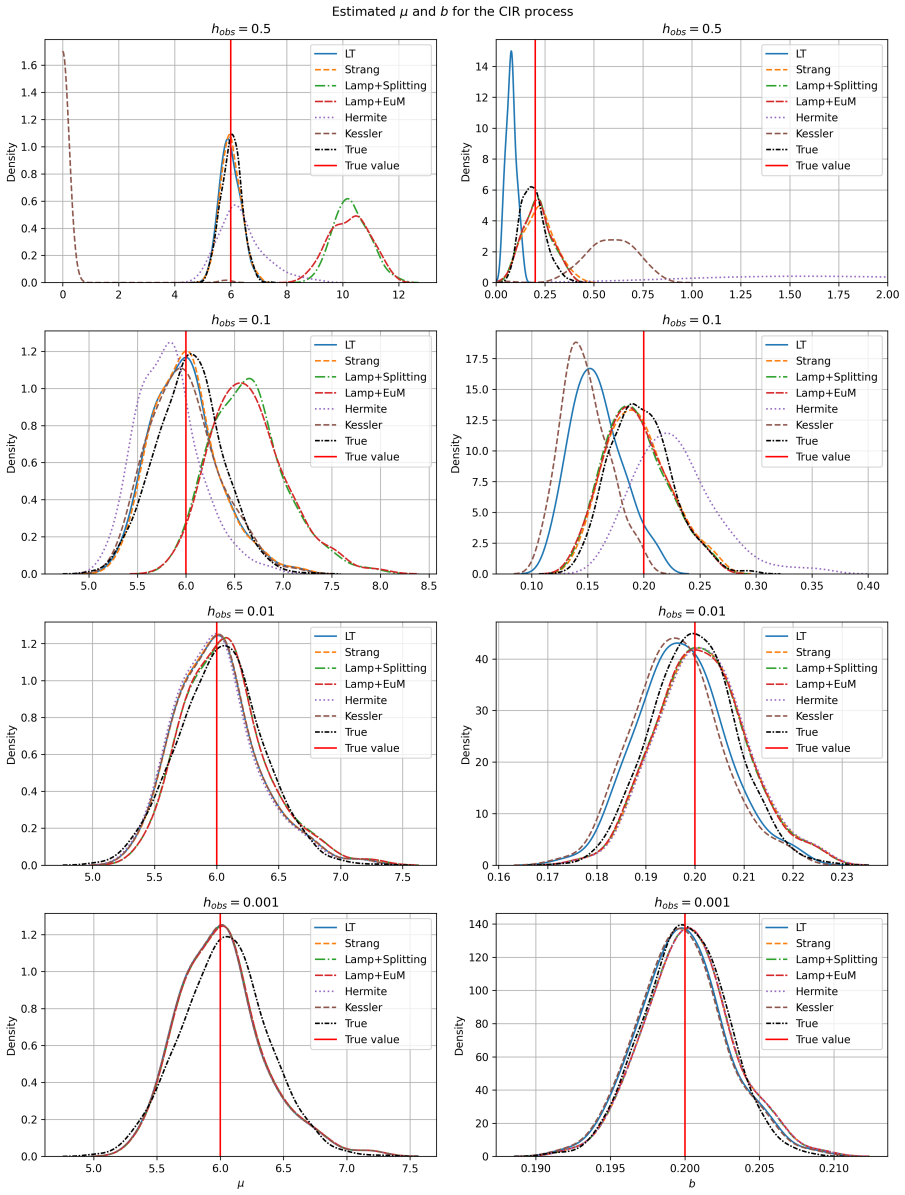
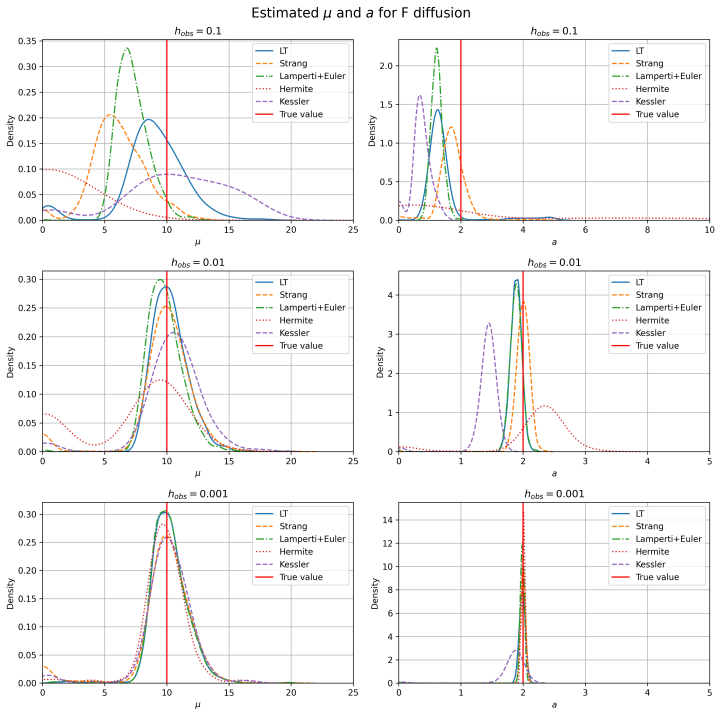
- Simulations confirm higher accuracy and lower computational cost than existing approximation-based estimators.
- The new asymptotic techniques handle the coupling between drift and diffusion parameters in the pseudo-likelihood.
Where Pith is reading between the lines
- The same Lamperti-plus-splitting construction may extend to other reducible SDE classes if the transform preserves the required regularity.
- Long-horizon simulations in applications could become cheaper by using larger stable time steps while retaining convergence.
- Multivariate versions would be a direct test if analogous reducibility can be established for vector noise.
- Empirical studies on real data sets from finance or biology could quantify gains in estimate stability over current practice.
Load-bearing premise
The SDE admits a reducible decomposition via the Lamperti transform that allows explicit splitting into drift and diffusion components while preserving the Hölder regularity and local Lipschitz conditions needed for the convergence and likelihood derivations.
What would settle it
A simulation on a concrete test SDE with Hölder multiplicative diffusion in which the mean-square error of trajectories from the splitting scheme fails to decrease proportionally to the time step size would falsify the strong convergence result.
Figures






read the original abstract
We study parameter estimation for univariate stochastic differential equations with locally Lipschitz drift and H\"older continuous multiplicative diffusion, a class commonly arising in several applications. Existing inference methods typically rely on either the Euler-Maruyama discretisation, despite its lack of strong convergence and failure to preserve the state space, or on approximations, e.g. Gaussian approximation or truncation of Hermite's expansions, impacting on their stability and computational efficiency. We introduce the first explicit pseudo-likelihood estimators based on numerical splitting schemes that are both strong mean-square convergent and state space preserving for this class of SDEs. Our approach is based on a novel decomposition of the SDE that exploits reducibility and the Lamperti transform, leading to Lie-Trotter (LT) and Strang splitting schemes yielding explicit pseudo-likelihoods and maximum likelihood estimators based on them. We prove strong mean-square convergence, state space preservation, and improved robustness with respect to the discretisation step compared to Euler-Maruyama-based methods. We further establish consistency and asymptotic normality of the LT estimator. Because the proposed numerical scheme couples drift and diffusion parameters in the pseudo-likelihood, the asymptotic analysis requires new proof techniques. Extensive simulations demonstrate that the proposed estimators outperform existing methods in both accuracy and computational efficiency.
Editorial analysis
A structured set of objections, weighed in public.
Referee Report
Summary. The paper develops explicit pseudo-likelihood estimators for univariate SDEs with locally Lipschitz drift and Hölder multiplicative diffusion. It exploits reducibility via the Lamperti transform to obtain an additive-noise equation, then constructs Lie-Trotter and Strang splitting schemes that yield closed-form transition densities for the pseudo-likelihood. The authors prove strong mean-square convergence and state-space preservation of the schemes, establish consistency and asymptotic normality of the Lie-Trotter estimator (requiring new techniques because drift and diffusion parameters are coupled), and report simulation evidence of improved accuracy and robustness relative to Euler-Maruyama-based estimators.
Significance. If the regularity and convergence claims hold, the work supplies the first explicit, strongly convergent, state-space-preserving pseudo-likelihood estimators for this important class of SDEs. The proofs of strong convergence, state-space preservation, consistency, and asymptotic normality, together with the explicit splitting-based likelihoods, constitute a substantive methodological advance for applications in which standard discretizations fail.
major comments (2)
- [§3] §3 (Lamperti decomposition): the argument that the transformed drift remains locally Lipschitz (or satisfies the precise regularity needed for the splitting convergence theory) when the original diffusion coefficient is merely α-Hölder with α<1 is not fully detailed. The Itô correction term arising from the Lamperti map can have a local Lipschitz constant controlled by the Hölder modulus of σ; explicit bounds or counter-example checks are required to confirm that the conditions invoked for the Lie-Trotter/Strang convergence theorems remain satisfied on the relevant state-space regions.
- [§5] §5 (asymptotic normality of the LT estimator): the proof must rigorously control the discretization bias induced by the splitting scheme inside the coupled pseudo-likelihood. Because the estimator jointly depends on drift and diffusion parameters, the usual martingale or ergodic arguments need to be adapted; the manuscript should state the precise rate at which the splitting step-size h_n → 0 relative to the sample size n so that the asymptotic normality statement holds.
minor comments (2)
- [Simulations] Table 1 and Figure 2: the reported MSE values for the Strang scheme appear sensitive to the choice of initial step-size; add a brief sensitivity plot or table entry for h = 0.01, 0.05, 0.1 to illustrate the claimed robustness.
- [Notation] Notation: the Hölder exponent α is introduced in the abstract and §2 but is not carried explicitly into the statements of Theorems 3.1 and 4.2; make the dependence on α visible in the convergence rates.
Simulated Author's Rebuttal
We thank the referee for the thorough review and valuable suggestions. We address the major comments point by point below, indicating where revisions will be made to strengthen the manuscript.
read point-by-point responses
-
Referee: §3 (Lamperti decomposition): the argument that the transformed drift remains locally Lipschitz (or satisfies the precise regularity needed for the splitting convergence theory) when the original diffusion coefficient is merely α-Hölder with α<1 is not fully detailed. The Itô correction term arising from the Lamperti map can have a local Lipschitz constant controlled by the Hölder modulus of σ; explicit bounds or counter-example checks are required to confirm that the conditions invoked for the Lie-Trotter/Strang convergence theorems remain satisfied on the relevant state-space regions.
Authors: We acknowledge that the details on the regularity of the transformed drift could be expanded for clarity. The Lamperti transform applied to the multiplicative noise SDE yields an additive noise equation where the new drift includes an Itô correction term involving the derivative of the inverse transform and the diffusion coefficient. Since σ is α-Hölder continuous with α < 1, its derivative may not exist, but the correction term's Lipschitz property can be established locally using the Hölder modulus. In the revised manuscript, we will include an additional lemma that provides explicit bounds showing that the local Lipschitz constant of the transformed drift is bounded by a constant depending on the Hölder constant of σ and the distance to the boundary of the state space. This will verify that the assumptions for the strong convergence of the splitting schemes hold. revision: yes
-
Referee: §5 (asymptotic normality of the LT estimator): the proof must rigorously control the discretization bias induced by the splitting scheme inside the coupled pseudo-likelihood. Because the estimator jointly depends on drift and diffusion parameters, the usual martingale or ergodic arguments need to be adapted; the manuscript should state the precise rate at which the splitting step-size h_n → 0 relative to the sample size n so that the asymptotic normality statement holds.
Authors: We agree that specifying the rate is important for the asymptotic result. Our current proof adapts ergodic theorems and martingale central limit theorems to handle the coupling between drift and diffusion parameters in the pseudo-likelihood. The discretization bias from the Lie-Trotter scheme is controlled by the strong convergence order of the scheme. To address the referee's point, we will revise the statement of the asymptotic normality theorem to explicitly require that the step-size satisfies h_n = o(n^{-1/2}), ensuring the bias term vanishes in the limit. We will also add a brief explanation of how the bias is bounded in the proof. revision: yes
Circularity Check
Derivation chain is self-contained with independent proofs and novel techniques
full rationale
The paper introduces explicit pseudo-likelihood estimators for SDEs with locally Lipschitz drift and Hölder multiplicative diffusion by applying the Lamperti transform to obtain a reducible decomposition, then constructing Lie-Trotter and Strang splitting schemes. It proves strong mean-square convergence, state-space preservation, consistency, and asymptotic normality using new proof techniques necessitated by the coupling of drift and diffusion parameters in the pseudo-likelihood. These steps are derived from stated assumptions on the SDE class and do not reduce by construction to fitted inputs, self-definitions, or load-bearing self-citations; the central results rest on independent derivations rather than tautological equivalences with the estimator definitions.
Axiom & Free-Parameter Ledger
axioms (1)
- domain assumption The SDE admits a Lamperti transform that yields an equivalent additive-noise equation under the given local Lipschitz drift and Hölder diffusion conditions.
Lean theorems connected to this paper
-
IndisputableMonolith/Foundation/RealityFromDistinction.leanreality_from_one_distinction unclear?
unclearRelation between the paper passage and the cited Recognition theorem.
Our approach is based on a novel decomposition of the SDE that exploits reducibility and the Lamperti transform, leading to Lie-Trotter (LT) and Strang splitting schemes yielding explicit pseudo-likelihoods
-
IndisputableMonolith/Cost/FunctionalEquation.leanwashburn_uniqueness_aczel unclear?
unclearRelation between the paper passage and the cited Recognition theorem.
We prove strong mean-square convergence, state space preservation...
What do these tags mean?
- matches
- The paper's claim is directly supported by a theorem in the formal canon.
- supports
- The theorem supports part of the paper's argument, but the paper may add assumptions or extra steps.
- extends
- The paper goes beyond the formal theorem; the theorem is a base layer rather than the whole result.
- uses
- The paper appears to rely on the theorem as machinery.
- contradicts
- The paper's claim conflicts with a theorem or certificate in the canon.
- unclear
- Pith found a possible connection, but the passage is too broad, indirect, or ambiguous to say the theorem truly supports the claim.
Reference graph
Works this paper leans on
- [1]
-
[2]
Y. Ait-Sahalia. Maximum Likelihood Estimation of Discretely Sampled Diffusions: A Closed-form Approximation Approach. Econometrica, 70(1):223–262, 2002. ISSN 0012- 9682, 1468-0262. doi: 10.1111/1468-0262.00274. URLhttp://doi.wiley.com/10.1111/ 1468-0262.00274
-
[3]
N. Berglund and D. Landon. Mixed-mode oscillations and interspike interval statistics in the stochastic fitzhugh-nagumo model. Nonlinearity, 25:2303–2335, 2012
work page 2012
- [4]
-
[5]
B. M. Bibby and M. Sørensen. Martingale Estimation Functions for Discretely Observed Diffusion Processes. Bernoulli, 1(1/2):17–39, 1995. ISSN 1350-7265. doi: 10.2307/3318679. URLhttps://www.jstor.org/stable/3318679
-
[6]
E. Buckwar, M. Tamborrino, and I. Tubikanec. Spectral density-based and measure- preserving ABC for partially observed diffusion processes. An illustration on Hamiltonian SDEs. Stat. Comput., 30(3):627–648, 2020. ISSN 0960-3174, 1573-1375. doi: 10.1007/ s11222-019-09909-6. URLhttp://link.springer.com/10.1007/s11222-019-09909-6
-
[7]
E. Buckwar, A. Samson, M. Tamborrino, and I. Tubikanec. A splitting method for SDEs with locally Lipschitz drift: Illustration on the FitzHugh-Nagumo model. Appl. Numer. Math., 179:191–220, 2022. ISSN 01689274. doi: 10.1016/j.apnum.2022.04.018. URLhttps: //linkinghub.elsevier.com/retrieve/pii/S0168927422001118
-
[8]
A. G. Casanova and D. Span` o. Duality and fixation in Ξ-Wright–Fisher processes with frequency-dependent selection. The Annals of Applied Probability, 28(1):250 – 284, 2018. doi: 10.1214/17-AAP1305. URLhttps://doi.org/10.1214/17-AAP1305
-
[9]
K. C. Chat, G. A. Karolyi, F. A., and A. B. Sanders. An empirical comparison of alternative models of the short-term interest rate. The Journal of Finance, 3:1209—-1227, July 1992
work page 1992
-
[10]
L. Chen and S. Gan. Strong convergence and stationary distribution of an explicit scheme for the Wright–Fisher model. J. Comput. Appl. Math., 424:115017, 2023. ISSN 03770427. doi: 10.1016/j.cam.2022.115017. URLhttps://linkinghub.elsevier.com/retrieve/ pii/S037704272200615X. 22
-
[11]
J. C. Cox, J. E. Ingersoll, and S. A. Ross. A Theory of the Term Structure of Interest Rates. Econometrica, 53(2):385–407, 1985. ISSN 0012-9682. doi: 10.2307/1911242. URL https://www.jstor.org/stable/1911242
-
[12]
I. Crimaldi and L. Pratelli. Convergence results for multivariate martingales. Stochastic processes and their applications, 115(4):571–577, 2005
work page 2005
-
[13]
P. Ditlevsen and S. Ditlevsen. Warning of a forthcoming collapse of the Atlantic meridional overturning circulation. Nat. Commun., 14(1):4254, 2023. ISSN 2041-1723. doi: 10.1038/ s41467-023-39810-w. URLhttps://www.nature.com/articles/s41467-023-39810-w
work page 2023
-
[14]
S. Ditlevsen, M. Tamborrino, and I. Tubikanec. Network inference via approximate Bayesian computation. Illustration on a stochastic multipopulation neural mass model. The Annals of Applied Statistics, 19(4):3304 – 3329, 2025. doi: 10.1214/25-AOAS2084. URLhttps: //doi.org/10.1214/25-AOAS2084
-
[15]
G. D’Onofrio, M. Tamborrino, and P. Lansky. The Jacobi diffusion process as a neuronal model. Chaos, 28(10):103119, 2018. ISSN 1054-1500, 1089-7682. doi: 10.1063/1.5051494. URLhttps://pubs.aip.org/aip/cha/article/856273
-
[16]
D. Florens-zmirou. Approximate discrete-time schemes for statistics of diffusion processes. Statistics, 20(4):547–557, 1989. ISSN 0233-1888, 1029-4910. doi: 10.1080/02331888908802205. URLhttp://www.tandfonline.com/doi/abs/10.1080/ 02331888908802205
-
[17]
J. L. Forman and M. Sørensen. The Pearson Diffusions: A Class of Statistically Tractable Diffusion Processes. Scand. J. Stat., 35(3):438–465, 2008. ISSN 03036898, 14679469. doi: 10. 1111/j.1467-9469.2007.00592.x. URLhttps://onlinelibrary.wiley.com/doi/10.1111/ j.1467-9469.2007.00592.x
-
[18]
J. Foster, G. d. Reis, and C. Strange. High order splitting methods for SDEs satisfying a commutativity condition. SIAM J. Numer. Anal., 62(1):500–532, 2024. doi: 10.1137/ 23M155147X. URLhttps://doi.org/10.1137/23M155147X
-
[19]
V. Genon-Catalot and J. Jacod. On the estimation of the diffusion coefficient for multi- dimensional diffusion processes. Ann. Inst. Henri Poincar´ eProbab. Stat., pages 119–151, 1993
work page 1993
-
[20]
V. L. Ginzburg. On superconductivity and superfluidity: a scientific autobiography. Springer-Verlag, Berlin, 2009. ISBN 978-3-540-68004-8 978-3-540-68008-6
work page 2009
-
[21]
A. Gloter. Parameter estimation for a discretely observed integrated diffusion process. Scand. J. Stat., 33(1):83–104, 2006
work page 2006
-
[22]
R. C. Griffiths and D. Span´ o. Diffusion processes and coalescent trees. In N. H. Bing- ham and C. M. Goldie, editors, Probability and Mathematical Genetics, pages 358–
-
[23]
ISBN 978-0-521-14577-0 978-1-139- 10717-4
Cambridge University Press, 1 edition, 2010. ISBN 978-0-521-14577-0 978-1-139- 10717-4. doi: 10.1017/CBO9781139107174.017. URLhttps://www.cambridge.org/core/ product/identifier/CBO9781139107174A100/type/book_part
-
[24]
N. Halidias. Semi-discrete approximations for stochastic differential equations and appli- cations. Int. J. Comput. Math., 89(6):780–794, 2012. ISSN 0020-7160, 1029-0265. doi: 10.1080/00207160.2012.658380. URLhttp://www.tandfonline.com/doi/abs/10.1080/ 00207160.2012.658380. 23
-
[25]
D. J. Higham, X. Mao, and A. M. Stuart. Strong Convergence of Euler-Type Methods for Nonlinear Stochastic Differential Equations. SIAM J. Numer. Anal., 40(3):1041–1063,
-
[26]
doi: 10.1137/S0036142901389530
ISSN 0036-1429, 1095-7170. doi: 10.1137/S0036142901389530. URLhttp://epubs. siam.org/doi/10.1137/S0036142901389530
- [27]
-
[28]
M. Hutzenthaler, A. Jentzen, and P. E. Kloeden. Strong and weak divergence in finite time of Euler’s method for stochastic differential equations with non-globally Lipschitz continuous coefficients. Proc. R. Soc. Lond. Ser. A Math. Phys. Eng. Sci., 467(2130): 1563–1576, 2011. ISSN 1364-5021, 1471-2946. doi: 10.1098/rspa.2010.0348. URLhttps: //royalsociety...
-
[29]
M. Hutzenthaler, A. Jentzen, and P. E. Kloeden. Strong convergence of an explicit numerical method for SDEs with nonglobally Lipschitz continuous coefficients. The Annals of Applied Probability, 22(4):1611 – 1641, 2012. doi: 10.1214/11-AAP803. URLhttps://doi.org/ 10.1214/11-AAP803
-
[30]
S. M. Iacus. Simulation and Inference for Stochastic Differential Equations: With R Examples, volume 1 of Springer Series in Statistics. Springer New York, New York, NY,
-
[31]
doi: 10.1007/978-0-387-75839-8
ISBN 978-0-387-75838-1 978-0-387-75839-8. doi: 10.1007/978-0-387-75839-8. URL https://link.springer.com/10.1007/978-0-387-75839-8
-
[32]
Y. Iguchi and A. Beskos. A Closed-Form Transition Density Expansion for Elliptic and Hypo-Elliptic SDEs, 2025. URLhttp://arxiv.org/abs/2502.07047. arXiv:2502.07047 [math]
-
[33]
P. Jovanovski, A. Golightly, U. Picchini, and M. Tamborrino. Simulation-based infer- ence using splitting schemes for partially observed diffusions in chemical reaction net- works. arXiv:2508.11438, 2025. doi: https://doi.org/10.48550/arXiv.2508.11438. URL https://arxiv.org/abs/2508.11438
-
[34]
S. Karlin and H. M. Taylor. A second course in stochastic processes. Academic Press, New York, 1981. ISBN 978-0-12-398650-4
work page 1981
-
[35]
C. Kelly and G. J. Lord. An adaptive splitting method for the Cox-Ingersoll-Ross process. Appl. Numer. Math., 186:252–273, 2023. ISSN 01689274. doi: 10.1016/j.apnum.2023.01
-
[36]
URLhttps://linkinghub.elsevier.com/retrieve/pii/S0168927423000144
- [37]
-
[38]
M. Kessler, A. Lindner, and M. Sørensen. Statistical Methods for Stochastic Differential Equations. Chapman and Hall/CRC, 2012
work page 2012
-
[39]
R. Khasminskii. Stochastic Stability of Differential Equations, volume 66 of Stochastic Modelling and Applied Probability. Springer Berlin Heidelberg, Berlin, Heidelberg, 2012. ISBN 978-3-642-23279-4 978-3-642-23280-0. doi: 10.1007/978-3-642-23280-0. URLhttps: //link.springer.com/10.1007/978-3-642-23280-0
-
[40]
J. L. Kirkby, D. H. Nguyen, D. Nguyen, and N. Nguyen. pymle: A python package for maximum likelihood estimation and simulation of stochastic differential equations. Journal of Statistical Software, 113:1–40, 2025. 24
work page 2025
-
[41]
P. E. Kloeden and E. Platen. Numerical Solution of Stochastic Differential Equations. Springer Berlin Heidelberg, Berlin, Heidelberg, 1992. ISBN 978-3-642-08107-1 978-3-662- 12616-5. doi: 10.1007/978-3-662-12616-5. URLhttp://link.springer.com/10.1007/ 978-3-662-12616-5
-
[42]
J. Koskela, K. Latuszy´ nski, and D. Span` o. Bernoulli factories and duality in wright–fisher and allen–cahn models of population genetics. Theoretical Population Biology, 156:40– 45, 2024. ISSN 0040-5809. doi: https://doi.org/10.1016/j.tpb.2024.01.002. URLhttps: //www.sciencedirect.com/science/article/pii/S0040580924000091
-
[43]
A. Lambert. The branching process with logistic growth. Ann. Appl. Probab., 15(2), 2005. ISSN 1050-5164. doi: 10.1214/105051605000000098. URLhttp://arxiv.org/abs/math/ 0505249. arXiv:math/0505249
work page internal anchor Pith review Pith/arXiv arXiv doi:10.1214/105051605000000098 2005
-
[44]
J. Lamperti. Semi-stable Markov processes. I. Z. Wahrsch. Verw. Gebiete, 22(3):205– 225, 1972. ISSN 0044-3719, 1432-2064. doi: 10.1007/BF00536091. URLhttp://link. springer.com/10.1007/BF00536091
-
[45]
H. Liu, B. Shi, and F. Wu. Tamed Euler–Maruyama approximation of McKean–Vlasov stochastic differential equations with super-linear drift and H¨ older diffusion coefficients. Appl. Numer. Math., 183:56–85, 2023. ISSN 01689274. doi: 10.1016/j.apnum.2022.08.012. URLhttps://linkinghub.elsevier.com/retrieve/pii/S0168927422002173
-
[46]
X. Mao. Stochastic differential equations and applications. Woodhead Publishing, Oxford,
- [47]
-
[48]
X. Mao. The truncated Euler–Maruyama method for stochastic differential equations. J. Comput. Appl. Math., 290:370–384, 2015. ISSN 03770427. doi: 10.1016/j.cam.2015.06.002. URLhttps://linkinghub.elsevier.com/retrieve/pii/S0377042715003210
-
[49]
X. Mao and L. Szpruch. Strong convergence rates for backward Euler–Maruyama method for non-linear dissipative-type stochastic differential equations with super-linear diffusion coefficients. Stochastics, 85(1):144–171, 2013. ISSN 1744-2508, 1744-2516. doi: 10. 1080/17442508.2011.651213. URLhttps://www.tandfonline.com/doi/full/10.1080/ 17442508.2011.651213
-
[50]
G. N. Milstein. Approximate Integration of Stochastic Differential Equations. Theory Probab. Appl., 19(3):557–562, 1975. ISSN 0040-585X, 1095-7219. doi: 10.1137/1119062. URLhttp://epubs.siam.org/doi/10.1137/1119062
-
[51]
G. N. Milstein. Numerical Integration of Stochastic Differential Equations. Springer Netherlands, Dordrecht, 1995. ISBN 978-90-481-4487-7 978-94-015-8455-5. doi: 10.1007/ 978-94-015-8455-5. URLhttp://link.springer.com/10.1007/978-94-015-8455-5
-
[52]
T. Misawa. Numerical integration of stochastic differential equations by composition meth- ods. Surikaisekikenkyusho Kokyuroku, pages 166–190, 2000
work page 2000
-
[53]
M. Ninomiya and S. Ninomiya. A new higher-order weak approximation scheme for stochastic differential equations and the Runge–Kutta method. Finance Stoch., 13(3): 415–443, 2009. ISSN 0949-2984, 1432-1122. doi: 10.1007/s00780-009-0101-4. URL http://link.springer.com/10.1007/s00780-009-0101-4
-
[54]
T. Ozaki. Statistical identification of storage models with application to stochastic hydrol- ogy. Journal of The American Water Resources Association, pages 663––675, 1985. 25
work page 1985
-
[55]
P. Pilipovic, A. Samson, and S. Ditlevsen. Parameter estimation in nonlin- ear multivariate stochastic differential equations based on splitting schemes. Ann. Statist., 52(2), 2024. ISSN 0090-5364. doi: 10.1214/24-AOS2371. URL https://projecteuclid.org/journals/annals-of-statistics/volume-52/issue-2/ Parameter-estimation-in-nonlinear-multivariate-stochast...
-
[56]
P. Pilipovic, A. Samson, and S. Ditlevsen. Strang splitting for parametric inference in second-order stochastic differential equations. Stoch. Proc. Appl., page 104650, 2025
work page 2025
-
[57]
P. Pilipovi´ c, A. Samson, and S. Ditlevsen. Strang splitting estimator for nonlin- ear multivariate stochastic differential equations with pearson-type multiplicative noise. arXiv:2604.16645, 2026. URLhttps://arxiv.org/abs/2604.16645
work page internal anchor Pith review Pith/arXiv arXiv 2026
-
[58]
S. Sabanis. Euler approximations with varying coefficients: The case of superlinearly growing diffusion coefficients. Ann. Appl. Probab., 26(4):2083 – 2105, 2016. doi: 10.1214/15-AAP1140. URLhttps://doi.org/10.1214/15-AAP1140
- [59]
-
[60]
S. Shurz. An axiomatic approach to numerical approximations of stochastic processes. International Journal of Numerical Analysis and Modeling, 3(4):459–480, Mar. 2006. URL https://www.global-sci.com/ijnam/article/view/9802
work page 2006
-
[61]
T. C. Sideris. Ordinary Differential Equations and Dynamical Systems, volume 2 of Atlantis Studies in Differential Equations. Atlantis Press, Paris, 2013. ISBN 978-94-6239-020-1 978-94-6239-021-8. doi: 10.2991/978-94-6239-021-8. URLhttps://www.atlantis-press. com/doi/10.2991/978-94-6239-021-8
-
[62]
M. Sørensen and M. Uchida. Small-diffusion asymptotics for discretely sampled stochastic differential equations. Bernoulli, 9(6):1051–1069, 2003
work page 2003
- [63]
-
[64]
I. Stamatiou. A boundary preserving numerical scheme for the Wright–Fisher model. J. Comput. Appl. Math., 328:132–150, 2018. ISSN 03770427. doi: 10.1016/j.cam.2017.07.011. URLhttps://linkinghub.elsevier.com/retrieve/pii/S0377042717303527
-
[65]
I. S. Stamatiou. The Semi-discrete Method for the Approximation of the Solution of Stochastic Differential Equations. In T. M. Rassias, editor, Nonlinear Analysis, Differential Equations, and Applications, volume 173, pages 625–638. Springer International Publishing, Cham, 2021. ISBN 978-3-030-72562-4 978-3-030-72563-1. doi: 10.1007/978-3-030-72563-1
-
[66]
Series Title: Springer Optimization and Its Applications
URLhttps://link.springer.com/10.1007/978-3-030-72563-1_23. Series Title: Springer Optimization and Its Applications
-
[67]
G. Strang. On the Construction and Comparison of Difference Schemes. SIAM J. Numer. Anal., 5(3):506–517, 1968. ISSN 0036-1429. URLhttps://www.jstor.org/stable/ 2949700
work page 1968
-
[68]
Y. Tian and M. Fan. Nonlinear integral inequality with power and its application in delay integro-differential equations. Advances in Difference Equations, 2020(1):142, 2020. 26
work page 2020
- [69]
-
[70]
H. F. Trotter. On the Product of Semi-Groups of Operators. Proc. Amer. Math. Soc., Vol. 10(No.4):545–551, 1959
work page 1959
-
[71]
I. Tubikanec, M. Tamborrino, P. Lansky, and E. Buckwar. Qualitative properties of different numerical methods for the inhomogeneous geometric brownian motion,
-
[72]
URLhttps://www.sciencedirect.com/science/article/pii/ S0377042721005616
ISSN 0377-0427. URLhttps://www.sciencedirect.com/science/article/pii/ S0377042721005616
-
[73]
G. E. Uhlenbeck and L. S. Ornstein. On the Theory of the Brownian Motion. Phys. Rev., 36(5):823–841, 1930. ISSN 0031-899X. doi: 10.1103/PhysRev.36.823. URLhttps: //link.aps.org/doi/10.1103/PhysRev.36.823
-
[74]
J. Ulander. Boundary-preserving Lamperti-splitting schemes for some stochastic differ- ential equations. J. Comput. Dyn., 11(3):289–317, 2024. ISSN 2158-2491, 2158-2505. doi: 10.3934/jcd.2024015. URLhttps://www.aimsciences.org//article/doi/10.3934/ jcd.2024015
-
[75]
O. Vasicek. An equilibrium characterization of the term structure. Journal of Financial Economics, 5(2):177–188, 1977. ISSN 0304-405X. doi: https://doi.org/10.1016/ 0304-405X(77)90016-2. URLhttps://www.sciencedirect.com/science/article/pii/ 0304405X77900162
work page 1977
- [76]
-
[77]
M. B. Vovchanskyi. A quick probability-oriented introduction to operator splitting methods. Theory of Stochastic Processes, 28(44):50–110, 2024
work page 2024
-
[78]
T. Yamada and S. Watanabe. On the uniqueness of solutions of stochas- tic differential equations. Kyoto J. Math., 11(1), 1971. ISSN 2156-
work page 1971
-
[79]
doi: 10.1215/kjm/1250523691. URLhttps://projecteuclid. org/journals/kyoto-journal-of-mathematics/volume-11/issue-1/ On-the-uniqueness-of-solutions-of-stochastic-differential-equations/10. 1215/kjm/1250523691.full
-
[80]
H. Yang, F. Wu, P. E. Kloeden, and X. Mao. The truncated Euler–Maruyama method for stochastic differential equations with H¨ older diffusion coefficients. J. Comput. Appl. Math., 366:112379, 2020. ISSN 03770427. doi: 10.1016/j.cam.2019.112379. URLhttps: //linkinghub.elsevier.com/retrieve/pii/S0377042719303826
discussion (0)
Sign in with ORCID, Apple, or X to comment. Anyone can read and Pith papers without signing in.