REVIEW 4 major objections 4 minor 2 cited by
The paper's central claim is that embedding search directly inside the diffusion denoising process solves the mode-averaging problem of compositional generative models, allowing short-horizon diffusion models to compose into coherent long-h
Reviewed by Pith at T0; open to challenge. T0 means a machine referee read the full paper against a public rubric. the ladder, T0–T4 →
T0 review · deepseek-v4-flash
2026-08-03 13:08 UTC pith:DFI3LUJO
load-bearing objection A useful, genuinely combined inference-time sampler for compositional diffusion, but the pruning metric that sets it apart is validated only on a toy and the TAMP version of the method leans on an auxiliary forward-dynamics model that isn't in the main algorithm. the 4 major comments →
Compositional Diffusion with Guided Search for Long-Horizon Planning
The pith
A machine-rendered reading of the paper's core claim, the machinery that carries it, and where it could break.
Core claim
CDGS's central claim is that mode averaging arises because naïve score averaging over composed local distributions merges incompatible modes, and that this can be avoided by embedding a guided search in the denoising loop. At every diffusion step the algorithm draws a batch of candidate global plans from the compositional score, applies iterative resampling over overlapping segments so constraints propagate across the chain, ranks candidates by the summed squared time-derivative of the score network along each local segment's DDIM-inversion trajectory, keeps the best K, and repopulates the batch. The paper argues that low-curvature inversion paths indicate high-likelihood local segments, so
What carries the argument
The central object is the CDGS guided-search sampler, built on two interacting parts. Iterative resampling repeatedly re-noises and denoises overlapping variables so that messages propagate along the chain, analogous to belief propagation across factors. The pruning metric is J(τ) = ∏_m exp(-g(y_m)), where g(y) = ∑_i ||∂ ε_θ(y^{(i-1)}, i)/∂i||^2 is the curvature of the DDIM-inversion trajectory of a local segment through the pretrained local score network. This curvature is the paper's proxy for closeness to a mode of the training distribution; pruning by it is what removes mode-averaged, locally infeasible candidates. The mechanism is plug-and-play because it queries only the existing score
Load-bearing premise
The load-bearing premise is that the curvature of a local segment's DDIM-inversion path through the score network reliably ranks whether that segment is locally feasible, so pruning by that curvature removes mode-averaged plans rather than good ones; for the TAMP tasks, the ranking also depends on learned per-skill forward-dynamics models overwriting predicted next states before the metric is applied.
What would settle it
Run CDGS on a suite of long-horizon tasks with known mode sequences and replace the curvature-based ranking with random selection of the same elite fraction at the same batch size; if random selection matches CDGS's success on the seven manipulation tasks, the feasibility signal is not doing the causal work. A cleaner check is to label which mode sequence each candidate plan belongs to and test whether plans retained by J(τ) are the feasible mode sequences more often than chance.
If this is right
- Compositional diffusion can solve long-horizon tasks without long-horizon training data, matching planners that are given an oracle task plan.
- The same inference-time sampler transfers across domains, producing text-guided panoramas and extending short video clips to hundreds of frames with improved subject consistency.
- Performance scales with inference compute: larger candidate batches and more resampling steps increase success on harder, longer-horizon tasks, and both resampling and pruning are needed together.
- The composition stage is training-free; CDGS can wrap an existing pretrained local diffusion score function and improve on plain compositional sampling without modifying the model.
Where Pith is reading between the lines
- The curvature metric and the search structure are separable: a natural extension is to replace the DDIM-curvature proxy with any learned or learned-free feasibility verifier, turning CDGS into a general inference-time search wrapper.
- Because resampling is belief-propagation-like, one could test how many resampling rounds are needed for goal information to reach the start as the horizon grows, potentially yielding a sharper compute-versus-horizon tradeoff than the linear scaling reported.
- The TAMP version overwrites predicted next states with learned per-skill forward dynamics before ranking; an ablation that removes that overwrite, or swaps in a dynamics-free verifier, would reveal how much of the reported TAMP success is due to search rather than to the auxiliary dynamics model.
Editorial analysis
A structured set of objections, weighed in public.
Referee Report
Summary. The paper proposes CDGS, an inference-time algorithm that augments compositional diffusion sampling of long-horizon sequences with (i) iterative resampling between overlapping local factors and (ii) population-based pruning of candidate global plans using a DDIM-inversion curvature metric that approximates local likelihood. The method is evaluated on OGBench tasks, a six-task TAMP suite, panoramic image stitching with Stable Diffusion, and long video generation with CogVideoX. The central claim is that CDGS removes the mode-averaging failure of score-averaging composition, producing locally feasible, globally coherent plans without long-horizon training data.
Significance. If the pruning metric is reliable, CDGS is a significant training-free advance for compositional diffusion: it requires only pretrained local score networks, provides adaptive inference-time compute, and is evaluated across robotics, image, and video domains. The paper includes pseudocode, an anonymized code release, external baselines (OGBench, STAP, VBench), and hardware experiments, which are concrete strengths. The significance is conditional on the DDIM-curvature ranking being valid in high-dimensional domains and on the TAMP results reflecting the method as described in the main text; neither is fully established.
major comments (4)
- [Sec. 3.1, Eq. (5), Algorithm 1] There is a sign inconsistency in the pruning objective. Eq. (5) defines J as a product of exp(-g(y_m)); a high curvature g (low likelihood) gives a small J. The text then states "Low-quality plans have high J values," and Algorithm 1 selects the K plans minimizing J. Under Eq. (5), minimizing J selects high-curvature (bad) plans. Either the sign in Eq. (5) should be flipped, or the selection should maximize J. Since this is the central pruning mechanism, the inconsistency affects the interpretation of all pruning results.
- [Sec. 3.1, Eq. (5), App. D.1] The claim that the DDIM-inversion curvature g(y) ranks local feasibility is validated only on a 1D mixture-of-intervals toy in App. D.1. In TAMP, the local transitions are high-dimensional pose vectors over multiple objects with geometric and symbolic constraints. No experiment shows that curvature correlates with ground-truth transition feasibility in a real domain. Please add a direct evaluation (e.g., correlation of g with ground-truth success, or an ablation replacing the curvature ranking with reconstruction-error or restoration-gap ranking) to support the load-bearing claim.
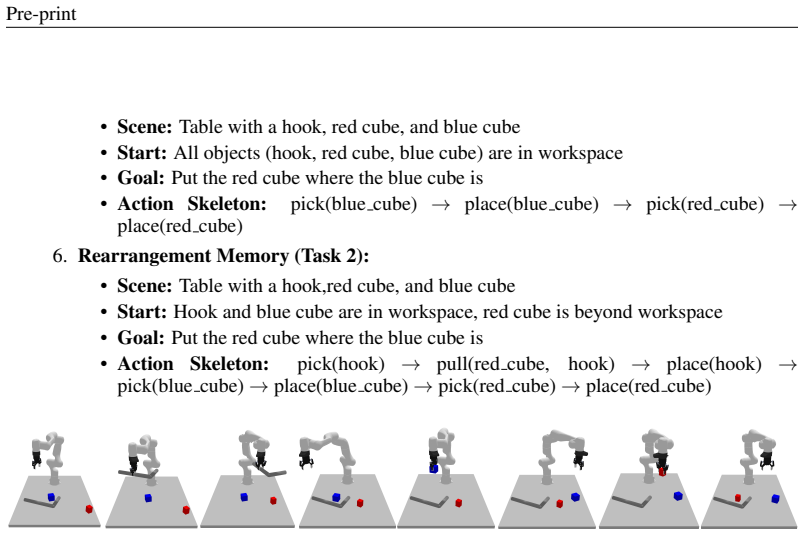
- [Appendix M, Algorithm 3] The TAMP evaluation pipeline is not the algorithm described in the main text. Appendix M states that before computing J, every predicted next state is overwritten with a learned per-skill forward dynamics model f_pi(s_i,a_i), and Algorithm 3 includes this step as line 6. This correction is absent from Algorithm 1 and from the method description in Sec. 3.1. Since Table 2 reports six of the robot tasks, the reported successes may be attributable to this auxiliary correction rather than to the curvature-based pruning. Please add an ablation of CDGS on TAMP without the forward-dynamics overwrite, or incorporate the overwrite into the main method and discuss its necessity.
- [Abstract, Sec. 4, Table 2] The abstract's claim that CDGS "matches oracle performance on seven robot manipulation tasks" is not supported by Table 2. On every TAMP task, CDGS is below "GSC (Original) Oracle task plan" (e.g., 0.18 vs 0.48 on Rearrangement Memory Task 2; 0.42 vs 0.82 on Rearrangement Memory Task 1). Even if GSC (Original) uses an oracle task plan and CDGS does not, the wording should be revised to reflect the actual comparison, e.g., "competitive with privileged baselines" or "substantially outperforms LLM/VLM baselines on the most challenging TAMP tasks."
minor comments (4)
- [App. F.4.2] The line "Random CEM samples the prior from a uniform distribution? (double-check)" contains an internal query and should be removed or resolved.
- [Table 1] The column header "CD" is not defined in the main text; the text refers to CompDiffuser [40], so please use a consistent name and define it in the caption.
- [App. L, Eq. (6)] The NFE formula in App. L (T*U + T*T) is inconsistent with the scheduled NFE expression in App. F.2. Please reconcile the two formulas and clarify whether pruning is performed at every step or only in the latter part of denoising.
- [Fig. 5 caption] "(H-7) denotes performance averaged over tasks of horizon 7" is confusing typography; please write "H=7".
Circularity Check
No circularity found: the pruning metric is an externally validated OOD heuristic, and the TAMP forward-dynamics discrepancy is a validation gap rather than a circular reduction.
full rationale
The paper's derivation chain is not circular at the level of its own equations. The compositional score (Eq. 3) is a standard factor-graph/Bethe score average, and the guided-search claims are checked against external task success (Tables 1-2), panorama metrics (Table 3), and VBench video metrics (Table 4), not against the pruning objective itself. The DDIM-inversion curvature metric (Eq. 5) is an OOD/likelihood heuristic adopted from cited external work [18]; it is not fitted to the target tasks and it is used to rank candidates, while the headline 'matches oracle' claims are grounded in physical task outcomes. Using the same learned score model both to propose plans and to score them is self-referential in an algorithmic sense, but it is not a definitional reduction: feasibility is not defined as low J; it is evaluated externally. The self-citations to GSC [43] and CompDiffuser [40] are baselines and prior compositional formulations, not load-bearing authorities that force the current result, and no uniqueness theorem is imported from the authors' prior work. The main legitimate concern is an implementation/evaluation mismatch: Appendix M (Algorithm 3) overwrites predicted next states with learned per-skill forward dynamics before applying the pruning metric, a component absent from Algorithm 1 and Section 3.1. This is a correctness/attribution risk for the TAMP results, but it is not a circular equivalence of a prediction to its inputs by construction. Accordingly, no circularity step meets the evidentiary bar, and the appropriate score is 0.
Axiom & Free-Parameter Ledger
free parameters (3)
- TAMP sampling hyperparameters (B, K, U_T, k_e, k_p, P) =
B=50/100, K=0.2B, U_T=40/50, k_e=0.7, k_p=0.3, P=0.4T
- Image/video sampling hyperparameters (B, U_T, k_e, k_p, P, gamma) =
B=10, U_T=10, k_e=0.2/0.3, k_p=0.5/0.6, P=0.5T, gamma=0.5
- lambda_t in guided sampling distribution =
unspecified
axioms (6)
- domain assumption Bethe approximation (Eq. 1) represents p(tau) as a product of local factor distributions divided by marginals, with overlaps modeled as degree-2 variables.
- ad hoc to paper Overlapping variable scores are approximated by the average of the two adjacent factor conditional scores (Sec. 2).
- domain assumption A global plan is feasible iff all local transitions are feasible, and high likelihood under p(y) implies local feasibility (Sec. 3.1).
- ad hoc to paper DDIM-inversion curvature g(y) ranks samples by closeness to modes of p(y) (Eq. 5, App. D).
- ad hoc to paper For TAMP, per-skill learned forward dynamics models are available and overwrite predicted next states before pruning (App. M).
- domain assumption Training data for each skill is diverse enough that precondition-effect overlaps between all skills needed for a plan exist (App. F.1).
read the original abstract
Generative models have emerged as powerful tools for planning, with compositional approaches offering particular promise for modeling long-horizon task distributions by composing together local, modular generative models. This compositional paradigm spans diverse domains, from multi-step manipulation planning to panoramic image synthesis to long video generation. However, compositional generative models face a critical challenge: when local distributions are multimodal, existing composition methods average incompatible modes, producing plans that are neither locally feasible nor globally coherent. We propose Compositional Diffusion with Guided Search (CDGS), which addresses this mode averaging problem by embedding search directly within the diffusion denoising process. Our method explores diverse combinations of local modes through population-based sampling, prunes infeasible candidates using likelihood-based filtering, and enforces global consistency through iterative resampling between overlapping segments. CDGS matches oracle performance on seven robot manipulation tasks, outperforming baselines that lack compositionality or require long-horizon training data. The approach generalizes across domains, enabling coherent text-guided panoramic images and long videos through effective local-to-global message passing. More details: https://cdgsearch.github.io/
Figures




Forward citations
Cited by 2 Pith papers
-
Energy-based Compositional Diffusion Planning
ECD reformulates compositional diffusion planning as energy minimization over local bridge potentials, adding a boundary reaction term and a Markov score approximation that runs in linear time.
-
Plan First, Diffuse Later: Extrinsic Graph Guidance for Long-Horizon Diffusion Planning
XDiffuser combines extrinsic graph planning with diffusion models to guide denoising and improve performance on long-horizon robotic tasks including multi-agent coordination and TSP-style problems.
Reference graph
Works this paper leans on
-
[1]
Taps: Task-agnostic policy sequencing.arXiv preprint arXiv:2210.12250, 2022
Christopher Agia, Toki Migimatsu, Jiajun Wu, and Jeannette Bohg. Taps: Task-agnostic policy sequencing.arXiv preprint arXiv:2210.12250, 2022
Pith/arXiv arXiv 2022
-
[2]
Stap: Sequencing task- agnostic policies
Christopher Agia, Toki Migimatsu, Jiajun Wu, and Jeannette Bohg. Stap: Sequencing task- agnostic policies. In2023 IEEE International Conference on Robotics and Automation (ICRA), pp. 7951–7958. IEEE, 2023
2023
-
[3]
Tenenbaum, Tommi S
Anurag Ajay, Yilun Du, Abhi Gupta, Joshua B. Tenenbaum, Tommi S. Jaakkola, and Pulkit Agrawal. Is conditional generative modeling all you need for decision making? InThe 10 Pre-print Eleventh International Conference on Learning Representations, 2023. URLhttps:// openreview.net/forum?id=sP1fo2K9DFG
2023
-
[4]
Multidiffusion: Fusing diffusion paths for controlled image generation
Omer Bar-Tal, Lior Yariv, Yaron Lipman, and Tali Dekel. Multidiffusion: Fusing diffusion paths for controlled image generation. 2023
2023
-
[5]
Diffusion forcing: Next-token prediction meets full-sequence diffusion.Advances in Neural Information Processing Systems, 37:24081–24125, 2024
Boyuan Chen, Diego Mart ´ı Mons ´o, Yilun Du, Max Simchowitz, Russ Tedrake, and Vincent Sitzmann. Diffusion forcing: Next-token prediction meets full-sequence diffusion.Advances in Neural Information Processing Systems, 37:24081–24125, 2024
2024
-
[6]
Chang Chen, Hany Hamed, Doojin Baek, Taegu Kang, Yoshua Bengio, and Sungjin Ahn. Extendable long-horizon planning via hierarchical multiscale diffusion.arXiv preprint arXiv:2503.20102, 2025
arXiv 2025
-
[7]
Seine: Short-to-long video diffusion model for generative transition and prediction
Xinyuan Chen, Yaohui Wang, Lingjun Zhang, Shaobin Zhuang, Xin Ma, Jiashuo Yu, Yali Wang, Dahua Lin, Yu Qiao, and Ziwei Liu. Seine: Short-to-long video diffusion model for generative transition and prediction. InThe Twelfth International Conference on Learning Representations, 2023
2023
-
[8]
Diffusion policy: Visuomotor policy learning via action diffusion
Cheng Chi, Siyuan Feng, Yilun Du, Zhenjia Xu, Eric Cousineau, Benjamin Burchfiel, and Shu- ran Song. Diffusion policy: Visuomotor policy learning via action diffusion. InProceedings of Robotics: Science and Systems (RSS), 2023
2023
-
[9]
Diffusion models beat gans on image synthesis
Prafulla Dhariwal and Alexander Nichol. Diffusion models beat gans on image synthesis. Advances in Neural Information Processing Systems, 34:8780–8794, 2021
2021
-
[10]
Position: Compositional generative modeling: A single model is not all you need
Yilun Du and Leslie Pack Kaelbling. Position: Compositional generative modeling: A single model is not all you need. InForty-first International Conference on Machine Learning, 2024
2024
-
[11]
Compositional visual generation with energy based models.Advances in Neural Information Processing Systems, 33:6637–6647, 2020
Yilun Du, Shuang Li, and Igor Mordatch. Compositional visual generation with energy based models.Advances in Neural Information Processing Systems, 33:6637–6647, 2020
2020
-
[12]
Reduce, reuse, recycle: Compositional generation with energy-based diffusion models and mcmc
Yilun Du, Conor Durkan, Robin Strudel, Joshua B Tenenbaum, Sander Dieleman, Rob Fergus, Jascha Sohl-Dickstein, Arnaud Doucet, and Will Sussman Grathwohl. Reduce, reuse, recycle: Compositional generation with energy-based diffusion models and mcmc. InInternational conference on machine learning, pp. 8489–8510. PMLR, 2023
2023
-
[13]
Automatic goal generation for reinforcement learning agents
Carlos Florensa, David Held, Xinyang Geng, and Pieter Abbeel. Automatic goal generation for reinforcement learning agents. InInternational conference on machine learning, pp. 1515–
-
[14]
Integrated task and motion planning.Annual review of control, robotics, and autonomous systems, 4(1):265–293, 2021
Caelan Reed Garrett, Rohan Chitnis, Rachel Holladay, Beomjoon Kim, Tom Silver, Leslie Pack Kaelbling, and Tom´as Lozano-P´erez. Integrated task and motion planning.Annual review of control, robotics, and autonomous systems, 4(1):265–293, 2021
2021
-
[15]
Leon A. Gatys, Alexander S. Ecker, and Matthias Bethge. Image style transfer using convolu- tional neural networks. In2016 IEEE Conference on Computer Vision and Pattern Recognition (CVPR), pp. 2414–2423, 2016. doi: 10.1109/CVPR.2016.265
-
[16]
Long video generation with time-agnostic vqgan and time-sensitive trans- former
Songwei Ge, Thomas Hayes, Harry Yang, Xi Yin, Guan Pang, David Jacobs, Jia-Bin Huang, and Devi Parikh. Long video generation with time-agnostic vqgan and time-sensitive trans- former. InEuropean Conference on Computer Vision, pp. 102–118. Springer, 2022
2022
-
[17]
Learning to reach goals via iterated supervised learning.arXiv preprint arXiv:1912.06088, 2019
Dibya Ghosh, Abhishek Gupta, Ashwin Reddy, Justin Fu, Coline Devin, Benjamin Eysenbach, and Sergey Levine. Learning to reach goals via iterated supervised learning.arXiv preprint arXiv:1912.06088, 2019
Pith/arXiv arXiv 1912
-
[18]
Out-of-distribution detection with a single unconditional diffu- sion model.Advances in Neural Information Processing Systems, 37:43952–43974, 2024
Alvin Heng, Harold Soh, et al. Out-of-distribution detection with a single unconditional diffu- sion model.Advances in Neural Information Processing Systems, 37:43952–43974, 2024
2024
-
[19]
Streamingt2v: Consistent, dynamic, and extendable long video generation from text
Roberto Henschel, Levon Khachatryan, Hayk Poghosyan, Daniil Hayrapetyan, Vahram Tade- vosyan, Zhangyang Wang, Shant Navasardyan, and Humphrey Shi. Streamingt2v: Consistent, dynamic, and extendable long video generation from text. InProceedings of the Computer Vision and Pattern Recognition Conference, pp. 2568–2577, 2025
2025
-
[20]
Classifier-free diffusion guidance.arXiv preprint arXiv:2207.12598, 2022
Jonathan Ho and Tim Salimans. Classifier-free diffusion guidance.arXiv preprint arXiv:2207.12598, 2022
Pith/arXiv arXiv 2022
-
[21]
Denoising diffusion probabilistic models.Ad- vances in neural information processing systems, 33:6840–6851, 2020
Jonathan Ho, Ajay Jain, and Pieter Abbeel. Denoising diffusion probabilistic models.Ad- vances in neural information processing systems, 33:6840–6851, 2020. 11 Pre-print
2020
-
[22]
Vbench: Comprehensive benchmark suite for video generative models
Ziqi Huang, Yinan He, Jiashuo Yu, Fan Zhang, Chenyang Si, Yuming Jiang, Yuanhan Zhang, Tianxing Wu, Qingyang Jin, Nattapol Chanpaisit, et al. Vbench: Comprehensive benchmark suite for video generative models. InProceedings of the IEEE/CVF Conference on Computer Vision and Pattern Recognition, pp. 21807–21818, 2024
2024
-
[23]
Estimation of non-normalized statistical models by score matching.Journal of Machine Learning Research, 6(4), 2005
Aapo Hyv ¨arinen and Peter Dayan. Estimation of non-normalized statistical models by score matching.Journal of Machine Learning Research, 6(4), 2005
2005
-
[24]
Planning with diffusion for flexible behavior synthesis
Michael Janner, Yilun Du, Joshua Tenenbaum, and Sergey Levine. Planning with diffusion for flexible behavior synthesis. InInternational Conference on Machine Learning, 2022
2022
-
[25]
Planning with diffusion for flexible behavior synthesis
Michael Janner, Yilun Du, Joshua Tenenbaum, and Sergey Levine. Planning with diffusion for flexible behavior synthesis. In Kamalika Chaudhuri, Stefanie Jegelka, Le Song, Csaba Szepesvari, Gang Niu, and Sivan Sabato (eds.),Proceedings of the 39th International Con- ference on Machine Learning, volume 162 ofProceedings of Machine Learning Research, pp. 9902...
2022
-
[26]
Cubediff: Repurposing diffusion-based image models for panorama generation
Nikolai Kalischek, Michael Oechsle, Fabian Manhardt, Philipp Henzler, Konrad Schindler, and Federico Tombari. Cubediff: Repurposing diffusion-based image models for panorama generation. InThe Thirteenth International Conference on Learning Representations, 2025
2025
-
[27]
Elucidating the design space of diffusion-based generative models.Advances in neural information processing systems, 35: 26565–26577, 2022
Tero Karras, Miika Aittala, Timo Aila, and Samuli Laine. Elucidating the design space of diffusion-based generative models.Advances in neural information processing systems, 35: 26565–26577, 2022
2022
-
[28]
Fifo-diffusion: Generating infinite videos from text without training.Advances in Neural Information Processing Systems, 37:89834–89868, 2024
Jihwan Kim, Junoh Kang, Jinyoung Choi, and Bohyung Han. Fifo-diffusion: Generating infinite videos from text without training.Advances in Neural Information Processing Systems, 37:89834–89868, 2024
2024
-
[29]
Subin Kim, Seoung Wug Oh, Jui-Hsien Wang, Joon-Young Lee, and Jinwoo Shin. Tuning- free multi-event long video generation via synchronized coupled sampling.arXiv preprint arXiv:2503.08605, 2025
Pith/arXiv arXiv 2025
-
[30]
MIT press, 2009
Daphne Koller and Nir Friedman.Probabilistic graphical models: principles and techniques. MIT press, 2009
2009
-
[31]
Offline reinforcement learning with implicit q-learning.arXiv preprint arXiv:2110.06169, 2021
Ilya Kostrikov, Ashvin Nair, and Sergey Levine. Offline reinforcement learning with implicit q-learning.arXiv preprint arXiv:2110.06169, 2021
Pith/arXiv arXiv 2021
-
[32]
State-covering trajectory stitching for diffusion planners.arXiv preprint arXiv:2506.00895, 2025
Kyowoon Lee and Jaesik Choi. State-covering trajectory stitching for diffusion planners.arXiv preprint arXiv:2506.00895, 2025
arXiv 2025
-
[33]
Syncdiffusion: Coherent mon- tage via synchronized joint diffusions.Advances in Neural Information Processing Systems, 36:50648–50660, 2023
Yuseung Lee, Kunho Kim, Hyunjin Kim, and Minhyuk Sung. Syncdiffusion: Coherent mon- tage via synchronized joint diffusions.Advances in Neural Information Processing Systems, 36:50648–50660, 2023
2023
-
[34]
Guanghe Li, Yixiang Shan, Zhengbang Zhu, Ting Long, and Weinan Zhang. Diffstitch: Boost- ing offline reinforcement learning with diffusion-based trajectory stitching.arXiv preprint arXiv:2402.02439, 2024
Pith/arXiv arXiv 2024
-
[35]
Hierarchical diffusion for offline decision making
Wenhao Li, Xiangfeng Wang, Bo Jin, and Hongyuan Zha. Hierarchical diffusion for offline decision making. In Andreas Krause, Emma Brunskill, Kyunghyun Cho, Barbara Engelhardt, Sivan Sabato, and Jonathan Scarlett (eds.),Proceedings of the 40th International Conference on Machine Learning, volume 202 ofProceedings of Machine Learning Research, pp. 20035– 200...
2023
-
[36]
Text2motion: From natural language instructions to feasible plans.Autonomous Robots, 47 (8):1345–1365, 2023
Kevin Lin, Christopher Agia, Toki Migimatsu, Marco Pavone, and Jeannette Bohg. Text2motion: From natural language instructions to feasible plans.Autonomous Robots, 47 (8):1345–1365, 2023
2023
-
[37]
Compositional visual generation with composable diffusion models
Nan Liu, Shuang Li, Yilun Du, Antonio Torralba, and Joshua B Tenenbaum. Compositional visual generation with composable diffusion models. InEuropean Conference on Computer Vision, pp. 423–439. Springer, 2022
2022
-
[38]
Freelong: Training-free long video gen- eration with spectralblend temporal attention.Advances in Neural Information Processing Systems, 37:131434–131455, 2024
Yu Lu, Yuanzhi Liang, Linchao Zhu, and Yi Yang. Freelong: Training-free long video gen- eration with spectralblend temporal attention.Advances in Neural Information Processing Systems, 37:131434–131455, 2024. 12 Pre-print
2024
-
[39]
Repaint: Inpainting using denoising diffusion probabilistic models
Andreas Lugmayr, Martin Danelljan, Andres Romero, Fisher Yu, Radu Timofte, and Luc Van Gool. Repaint: Inpainting using denoising diffusion probabilistic models. InProceedings of the IEEE/CVF Conference on Computer Vision and Pattern Recognition, pp. 11461–11471, 2022
2022
-
[40]
Generative trajectory stitching through diffusion composition.arXiv preprint arXiv:2503.05153, 2025
Yunhao Luo, Utkarsh A Mishra, Yilun Du, and Danfei Xu. Generative trajectory stitching through diffusion composition.arXiv preprint arXiv:2503.05153, 2025
Pith/arXiv arXiv 2025
-
[41]
Learning latent plans from play
Corey Lynch, Mohi Khansari, Ted Xiao, Vikash Kumar, Jonathan Tompson, Sergey Levine, and Pierre Sermanet. Learning latent plans from play. InConference on robot learning, pp. 1113–1132. PMLR, 2020
2020
-
[42]
Nanye Ma, Shangyuan Tong, Haolin Jia, Hexiang Hu, Yu-Chuan Su, Mingda Zhang, Xuan Yang, Yandong Li, Tommi Jaakkola, Xuhui Jia, et al. Inference-time scaling for diffusion models beyond scaling denoising steps.arXiv preprint arXiv:2501.09732, 2025
Pith/arXiv arXiv 2025
-
[43]
Generative skill chain- ing: Long-horizon skill planning with diffusion models
Utkarsh Aashu Mishra, Shangjie Xue, Yongxin Chen, and Danfei Xu. Generative skill chain- ing: Long-horizon skill planning with diffusion models. In7th Annual Conference on Robot Learning, 2023. URLhttps://openreview.net/forum?id=HtJE9ly5dT
2023
-
[44]
Generative skill chain- ing: Long-horizon skill planning with diffusion models
Utkarsh Aashu Mishra, Shangjie Xue, Yongxin Chen, and Danfei Xu. Generative skill chain- ing: Long-horizon skill planning with diffusion models. InConference on Robot Learning, pp. 2905–2925. PMLR, 2023
2023
-
[45]
Generative factor chaining: Coordi- nated manipulation with diffusion-based factor graph
Utkarsh Aashu Mishra, Yongxin Chen, and Danfei Xu. Generative factor chaining: Coordi- nated manipulation with diffusion-based factor graph. In8th Annual Conference on Robot Learning, 2024. URLhttps://openreview.net/forum?id=p6Wq6TjjHH
2024
-
[46]
s1: Simple test-time scaling.arXiv preprint arXiv:2501.19393, 2025
Niklas Muennighoff, Zitong Yang, Weijia Shi, Xiang Lisa Li, Li Fei-Fei, Hannaneh Hajishirzi, Luke Zettlemoyer, Percy Liang, Emmanuel Cand `es, and Tatsunori Hashimoto. s1: Simple test-time scaling.arXiv preprint arXiv:2501.19393, 2025
Pith/arXiv arXiv 2025
-
[47]
Zizheng Pan, Bohan Zhuang, De-An Huang, Weili Nie, Zhiding Yu, Chaowei Xiao, Jianfei Cai, and Anima Anandkumar. T-stitch: Accelerating sampling in pre-trained diffusion models with trajectory stitching.arXiv preprint arXiv:2402.14167, 2024
Pith/arXiv arXiv 2024
-
[48]
Ogbench: Benchmark- ing offline goal-conditioned rl.arXiv preprint arXiv:2410.20092, 2024
Seohong Park, Kevin Frans, Benjamin Eysenbach, and Sergey Levine. Ogbench: Benchmark- ing offline goal-conditioned rl.arXiv preprint arXiv:2410.20092, 2024
Pith/arXiv arXiv 2024
-
[49]
Hiql: Offline goal- conditioned rl with latent states as actions.Advances in Neural Information Processing Sys- tems, 36, 2024
Seohong Park, Dibya Ghosh, Benjamin Eysenbach, and Sergey Levine. Hiql: Offline goal- conditioned rl with latent states as actions.Advances in Neural Information Processing Sys- tems, 36, 2024
2024
-
[50]
Learning transferable visual models from natural language supervision
Alec Radford, Jong Wook Kim, Chris Hallacy, Aditya Ramesh, Gabriel Goh, Sandhini Agar- wal, Girish Sastry, Amanda Askell, Pamela Mishkin, Jack Clark, et al. Learning transferable visual models from natural language supervision. InInternational conference on machine learning, pp. 8748–8763. PMLR, 2021
2021
-
[51]
High-resolution image synthesis with latent diffusion models
Robin Rombach, Andreas Blattmann, Dominik Lorenz, Patrick Esser, and Bj ¨orn Ommer. High-resolution image synthesis with latent diffusion models. InProceedings of the IEEE/CVF Conference on Computer Vision and Pattern Recognition (CVPR), pp. 10684–10695, June 2022
2022
-
[52]
Raghav Singhal, Zachary Horvitz, Ryan Teehan, Mengye Ren, Zhou Yu, Kathleen McKeown, and Rajesh Ranganath. A general framework for inference-time scaling and steering of diffu- sion models.arXiv preprint arXiv:2501.06848, 2025
Pith/arXiv arXiv 2025
-
[53]
Weiss, Niru Maheswaranathan, and Surya Ganguli
Jascha Sohl-Dickstein, Eric A. Weiss, Niru Maheswaranathan, and Surya Ganguli. Deep Un- supervised Learning using Nonequilibrium Thermodynamics, November 2015. URLhttp: //arxiv.org/abs/1503.03585. arXiv:1503.03585 [cs]
Pith/arXiv arXiv 2015
-
[54]
Denoising diffusion implicit models.arXiv preprint arXiv:2010.02502, 2020
Jiaming Song, Chenlin Meng, and Stefano Ermon. Denoising diffusion implicit models.arXiv preprint arXiv:2010.02502, 2020
Pith/arXiv arXiv 2010
-
[55]
Yang Song, Jascha Sohl-Dickstein, Diederik P Kingma, Abhishek Kumar, Stefano Ermon, and Ben Poole. Score-based generative modeling through stochastic differential equations.arXiv preprint arXiv:2011.13456, 2020
Pith/arXiv arXiv 2011
-
[56]
Fu-Yun Wang, Wenshuo Chen, Guanglu Song, Han-Jia Ye, Yu Liu, and Hongsheng Li. Gen-l-video: Multi-text to long video generation via temporal co-denoising.arXiv preprint arXiv:2305.18264, 2023. 13 Pre-print
Pith/arXiv arXiv 2023
-
[57]
Apriltag 2: Efficient and robust fiducial detection
John Wang and Edwin Olson. Apriltag 2: Efficient and robust fiducial detection. In2016 IEEE/RSJ International Conference on Intelligent Robots and Systems (IROS), pp. 4193–4198,
-
[58]
Chain-of-thought prompting elicits reasoning in large language models
Jason Wei, Xuezhi Wang, Dale Schuurmans, Maarten Bosma, Fei Xia, Ed Chi, Quoc V Le, Denny Zhou, et al. Chain-of-thought prompting elicits reasoning in large language models. Advances in neural information processing systems, 35:24824–24837, 2022
2022
-
[59]
Chenfei Wu, Jian Liang, Xiaowei Hu, Zhe Gan, Jianfeng Wang, Lijuan Wang, Zicheng Liu, Yuejian Fang, and Nan Duan. Nuwa-infinity: Autoregressive over autoregressive generation for infinite visual synthesis.arXiv preprint arXiv:2207.09814, 2022
Pith/arXiv arXiv 2022
-
[60]
Progressive autoregressive video diffusion models
Desai Xie, Zhan Xu, Yicong Hong, Hao Tan, Difan Liu, Feng Liu, Arie Kaufman, and Yang Zhou. Progressive autoregressive video diffusion models. InProceedings of the Computer Vision and Pattern Recognition Conference, pp. 6322–6332, 2025
2025
-
[61]
Long video diffusion generation with segmented cross-attention and content-rich video data curation
Xin Yan, Yuxuan Cai, Qiuyue Wang, Yuan Zhou, Wenhao Huang, and Huan Yang. Long video diffusion generation with segmented cross-attention and content-rich video data curation. InProceedings of the Computer Vision and Pattern Recognition Conference, pp. 3184–3194, 2025
2025
-
[62]
Zhuoyi Yang, Jiayan Teng, Wendi Zheng, Ming Ding, Shiyu Huang, Jiazheng Xu, Yuanming Yang, Wenyi Hong, Xiaohan Zhang, Guanyu Feng, et al. Cogvideox: Text-to-video diffusion models with an expert transformer.arXiv preprint arXiv:2408.06072, 2024
Pith/arXiv arXiv 2024
-
[63]
Compositional diffusion-based continuous constraint solvers.arXiv preprint arXiv:2309.00966, 2023
Zhutian Yang, Jiayuan Mao, Yilun Du, Jiajun Wu, Joshua B Tenenbaum, Tom´as Lozano-P´erez, and Leslie Pack Kaelbling. Compositional diffusion-based continuous constraint solvers.arXiv preprint arXiv:2309.00966, 2023
Pith/arXiv arXiv 2023
-
[64]
Constructing free-energy approx- imations and generalized belief propagation algorithms.IEEE Transactions on information theory, 51(7):2282–2312, 2005
Jonathan S Yedidia, William T Freeman, and Yair Weiss. Constructing free-energy approx- imations and generalized belief propagation algorithms.IEEE Transactions on information theory, 51(7):2282–2312, 2005
2005
-
[65]
Monte carlo tree diffusion for system 2 planning.arXiv preprint arXiv:2502.07202, 2025
Jaesik Yoon, Hyeonseo Cho, Doojin Baek, Yoshua Bengio, and Sungjin Ahn. Monte carlo tree diffusion for system 2 planning.arXiv preprint arXiv:2502.07202, 2025
arXiv 2025
-
[66]
Diffcollage: Parallel generation of large content with diffusion models
Qinsheng Zhang, Jiaming Song, Xun Huang, Yongxin Chen, and Ming-Yu Liu. Diffcollage: Parallel generation of large content with diffusion models. InProceedings of the IEEE/CVF Conference on Computer Vision and Pattern Recognition (CVPR), pp. 10188–10198, June 2023
2023
-
[67]
The unrea- sonable effectiveness of deep features as a perceptual metric
Richard Zhang, Phillip Isola, Alexei A Efros, Eli Shechtman, and Oliver Wang. The unrea- sonable effectiveness of deep features as a perceptual metric. InProceedings of the IEEE conference on computer vision and pattern recognition, pp. 586–595, 2018
2018
-
[68]
T-scend: Test-time scalable mcts- enhanced diffusion model.arXiv preprint arXiv:2502.01989, 2025
Tao Zhang, Jia-Shu Pan, Ruiqi Feng, and Tailin Wu. T-scend: Test-time scalable mcts- enhanced diffusion model.arXiv preprint arXiv:2502.01989, 2025
arXiv 2025
-
[69]
Xiangcheng Zhang, Haowei Lin, Haotian Ye, James Zou, Jianzhu Ma, Yitao Liang, and Yilun Du. Inference-time scaling of diffusion models through classical search.arXiv preprint arXiv:2505.23614, 2025
arXiv 2025
-
[70]
Yifeng Zhu, Abhishek Joshi, Peter Stone, and Yuke Zhu. Viola: Imitation learning for vision- based manipulation with object proposal priors.arXiv preprint arXiv:2210.11339, 2022. doi: 10.48550/arXiv.2210.11339. 14 Pre-print CONTENTS 1 Introduction 1 2 Background 2 3 Method 3 3.1 Compositional Diffusion with Guided Search . . . . . . . . . . . . . . . . . ...
-
[72]
The dirt road curves gently into the distance, with no other cars or vehicles in sight
The camera follows behind a white vintage SUV with a black roof rack as it speeds up a steep dirt road surrounded by pine trees on a steep mountain slope, dust kicks up from it’s tires, the sunlight shines on the SUV as it speeds along the dirt road, casting a warm glow over the scene. The dirt road curves gently into the distance, with no other cars or v...
-
[73]
The panda’s fluffy paws strum a miniature acoustic guitar, produc- ing soft, melodic tunes, move hands, singings
A cute happy panda, dressed in a small, red jacket and a tiny hat, sits on a wooden stool in a serene bamboo forest. The panda’s fluffy paws strum a miniature acoustic guitar, produc- ing soft, melodic tunes, move hands, singings. Nearby, a few other pandas gather, watching curiously and some clapping in rhythm. Sunlight filters through the tall bamboo, c...
-
[74]
Dozens of balloons in various bright colors and patterns slowly rise into the pink and orange sky
A group of colorful hot air balloons take off at dawn in Cappadocia, Turkey. Dozens of balloons in various bright colors and patterns slowly rise into the pink and orange sky. Be- low them, the unique landscape of Cappadocia unfolds, with its distinctive ’fairy chimneys’ - tall, cone-shaped rock formations scattered across the valley. The rising sun casts...
-
[75]
The ship’s hull is painted a rich brown, with tiny windows
A detailed wooden toy ship with intricately carved masts and sails is seen gliding smoothly over a plush, blue carpet that mimics the waves of the sea. The ship’s hull is painted a rich brown, with tiny windows. The carpet, soft and textured, provides a perfect backdrop, resembling an oceanic expanse. Surrounding the ship are various other toys and childr...
-
[76]
She seems to be lost in thought, and the camera focuses on her face
A young woman with beautiful and clear eyes and blonde hair standing and white dress in a forest wearing a crown. She seems to be lost in thought, and the camera focuses on her face. The video is of high quality, and the view is very clear. High quality, masterpiece, best quality, highres, ultra-detailed, fantastic. realism, lifelike
-
[77]
A woman walks away from a white Jeep parked on a city street at night, then ascends a staircase and knocks on a door. The woman, wearing a dark jacket and jeans, walks away from the Jeep parked on the left side of the street, her back to the camera; she walks at a steady pace, her arms swinging slightly by her sides; the street is dimly lit, with streetli...
-
[78]
The raised suspension allowed the huge explosion-proof tires to flip freely on the mud, and the mud splashed on the roll cage
At sunset, a modified Ford F-150 Raptor roared past on the off-road track. The raised suspension allowed the huge explosion-proof tires to flip freely on the mud, and the mud splashed on the roll cage
-
[79]
The cat is carefully measuring flour, while the dog is stirring the batter with a wooden spoon
A cat and a dog baking a cake together in a kitchen. The cat is carefully measuring flour, while the dog is stirring the batter with a wooden spoon. The kitchen is cozy, with sunlight streaming through the window. 18 Pre-print C COMPOSITIONALSCORECOMPUTATION: CDGS’S RELATION TO EXISTING LITERATURE Composing the distributions defined by multiple diffusion ...
-
[80]
Score-Averaging: approaches like GSC [44] and CDGS partitionτinto overlapping seg- ments where the score for regions of overlap can be obtained by score-averaging: p(τ)∝ p(x1,x 2,x 3)p(x3,x 4,x 5). . . p(x3)
-
[81]
For TAMP, the key difference between CDGS and GSC is that individual skill-level transitions for GSC are already conditioned on the task plan
Conditioning: CompDiffuser [40] partitionsτinto non-overlapping segments that are con- ditioned on adjacent segments p(τ)∝p(x 1|x2)p(xN|xN−1) N−1 ∏ i=2 p(xi|xi−1,x i+1) Since CompDiffuser [40] requires training a model with conditions, we follow the more plug-n- play format of GSC [43]. For TAMP, the key difference between CDGS and GSC is that individual ...
discussion (0)
Sign in with ORCID, Apple, or X to comment. Anyone can read and Pith papers without signing in.