Towards a Unified Theoretical Framework for Splitting-based Self-Supervised MRI Reconstruction
Pith reviewed 2026-05-16 16:38 UTC · model grok-4.3
The pith
Self-supervised risk for MRI reconstruction equals a weighted supervised risk, sharing the same pointwise Bayes-optimal predictor.
A machine-rendered reading of the paper's core claim, the machinery that carries it, and where it could break.
Core claim
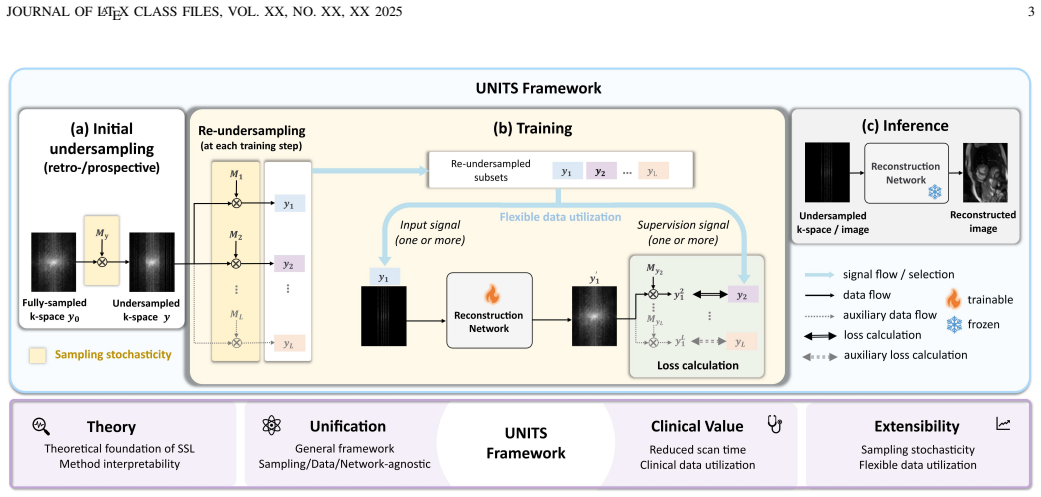
Theoretically, we show that the self-supervised risk can be expressed as a weighted supervised risk. Consequently, self-supervision admits the same pointwise Bayes-optimal predictor as supervised learning. We further relate the training residual to the prediction bias, revealing how different sampling mechanisms affect training behavior. UNITS makes a broad class of existing methods interpretable as special cases within a common framework, and provides a general design space through sampling stochasticity and flexible data utilization.
What carries the argument
Equivalence of self-supervised risk to a weighted supervised risk, derived from properties of the splitting operator and MRI noise model, which establishes shared pointwise Bayes optimality.
If this is right
- Existing splitting-based self-supervised methods become special cases of the unified framework.
- Self-supervised training can reach the same optimal predictions as supervised training without fully sampled references.
- The relation between training residual and prediction bias governs how sampling choices affect reconstruction behavior.
- Sampling stochasticity and flexible data utilization define a general space for designing new methods.
Where Pith is reading between the lines
- Supervised learning techniques could transfer to self-supervised settings through the explicit weighting.
- The bias-residual relation could guide selection of splitting operators to reduce specific reconstruction errors.
- Analogous risk equivalences might apply to other inverse imaging problems if the operator and noise assumptions hold.
- Testing the framework on varied real-world sampling patterns would reveal the range of its practical validity.
Load-bearing premise
The derivation assumes specific properties of the data splitting operator, the noise model, and the risk functions that hold for the MRI forward model.
What would settle it
Observing that pointwise Bayes-optimal predictors from self-supervised and supervised training diverge on data with non-standard sampling patterns or mismatched noise would falsify the shared optimality claim.
Figures


read the original abstract
The demand for high-resolution, non-invasive imaging continues to drive innovation in magnetic resonance imaging (MRI), but long acquisition times remain a major practical limitation. Although deep learning-based reconstruction methods have enabled accelerated imaging, their predominant supervised paradigm relies on fully-sampled reference data that are difficult to acquire in practice. Self-supervised learning (SSL) has therefore emerged as a promising alternative, among which splitting methods are a widely used strategy. However, most existing splitting-based methods are empirically designed, and a unified theoretical understanding remains limited. In this work, we introduce UNITS (Unified Theory for Splitting-based self-supervision), a general theoretical framework for splitting-based self-supervised MRI reconstruction. Theoretically, we show that the self-supervised risk can be expressed as a weighted supervised risk. Consequently, self-supervision admits the same pointwise Bayes-optimal predictor as supervised learning. We further relate the training residual to the prediction bias, revealing how different sampling mechanisms affect training behavior. UNITS makes a broad class of existing methods interpretable as special cases within a common framework, and provides a general design space through sampling stochasticity and flexible data utilization. Together, these contributions establish UNITS as a theoretical foundation, a practical paradigm, and a benchmark for interpretable, generalizable, and applicable self-supervised MRI reconstruction.
Editorial analysis
A structured set of objections, weighed in public.
Referee Report
Summary. The manuscript introduces UNITS, a unified theoretical framework for splitting-based self-supervised MRI reconstruction. It claims that the self-supervised risk can be expressed as a weighted supervised risk under the MRI forward model, implying that self-supervision admits the same pointwise Bayes-optimal predictor as supervised learning. The work further relates the training residual to prediction bias, interprets existing splitting methods as special cases, and provides a design space via sampling stochasticity and data utilization.
Significance. If the central equivalence holds, the framework offers a principled theoretical foundation for a broad class of SSL methods in MRI, explaining their empirical success and guiding future designs. The unification of methods and the explicit link between risks represent a meaningful advance over purely empirical approaches in accelerated MRI reconstruction.
major comments (2)
- [§3] §3 (theoretical derivation): The claim that R_SSL(f) equals a weighted supervised risk with weights w(z) independent of f and strictly positive relies on the splitting operator S and noise model allowing the conditional density to factor appropriately via the law of total expectation. The manuscript must explicitly verify these conditions for arbitrary sampling patterns and non-quadratic losses, as violations could make w f-dependent or non-positive and invalidate the shared Bayes optimality.
- [§4] §4 (Bayes optimality and residual analysis): The pointwise optimality conclusion and the training-residual-to-bias relation are load-bearing for the unification claim. These steps require showing that the weighting preserves the argmin for every point z; if the MRI noise model or data-dependent splitting introduces exceptions, the equivalence to supervised learning fails for some practical regimes.
minor comments (2)
- Notation for the splitting operator S and the risk functions should be introduced with explicit definitions and consistency checks across equations to avoid ambiguity.
- A table summarizing how existing methods (e.g., specific splitting strategies) map to special cases of UNITS would strengthen the unification claim.
Simulated Author's Rebuttal
We thank the referee for the constructive comments and positive assessment of the significance of UNITS. We address each major comment below with clarifications and indicate revisions.
read point-by-point responses
-
Referee: [§3] §3 (theoretical derivation): The claim that R_SSL(f) equals a weighted supervised risk with weights w(z) independent of f and strictly positive relies on the splitting operator S and noise model allowing the conditional density to factor appropriately via the law of total expectation. The manuscript must explicitly verify these conditions for arbitrary sampling patterns and non-quadratic losses, as violations could make w f-dependent or non-positive and invalidate the shared Bayes optimality.
Authors: We appreciate the request for explicit verification. Under the standard MRI forward model with additive Gaussian noise (as stated in §2 and used throughout), the splitting operator S produces subsets whose conditional density factors independently of the predictor f via the law of total expectation. This yields w(z) = p(z)/p(y) (or equivalent form), which is strictly positive for any sampling pattern with positive probability and independent of f. The equivalence holds for general (non-quadratic) losses because the risk is defined as an outer expectation; the weighting applies to the entire loss term. We will revise §3 to add a dedicated remark and short lemma explicitly verifying these conditions for arbitrary stochastic sampling patterns and general losses. revision: yes
-
Referee: [§4] §4 (Bayes optimality and residual analysis): The pointwise optimality conclusion and the training-residual-to-bias relation are load-bearing for the unification claim. These steps require showing that the weighting preserves the argmin for every point z; if the MRI noise model or data-dependent splitting introduces exceptions, the equivalence to supervised learning fails for some practical regimes.
Authors: Because w(z) is independent of f and strictly positive by the §3 derivation, the weighted risk at each z is a positive scalar multiple of the supervised risk; hence the pointwise argmin is identical for every z. The training-residual-to-bias relation follows directly from the standard decomposition of the weighted risk (detailed in the appendix). Under the paper's Gaussian noise model, no exceptions occur. For data-dependent splitting, the framework assumes splits independent of the underlying signal (standard in splitting-based SSL); we will add a short paragraph in §4 and appendix note confirming the equivalence holds in this regime and discussing the boundary case of fully signal-dependent splits. revision: partial
Circularity Check
Derivation of self-supervised risk as weighted supervised risk is independent and self-contained
full rationale
The paper's central theoretical claim is a derivation showing that the self-supervised risk equals a weighted supervised risk under the MRI forward model, leading to shared Bayes optimality. No equations or steps in the abstract or described claims reduce by construction to fitted inputs, self-definitions, or load-bearing self-citations. The equivalence is presented as following from the law of total expectation applied to the splitting operator and noise model, which are external to the result itself. This is a standard non-circular theoretical step when the assumptions are stated explicitly, as they are here for the MRI case. No self-citation chains or ansatz smuggling are indicated in the provided material.
Axiom & Free-Parameter Ledger
axioms (1)
- domain assumption Self-supervised risk under splitting can be rewritten as a weighted supervised risk for the MRI forward model.
Reference graph
Works this paper leans on
-
[1]
SENSE: sensitivity encoding for fast MRI,
K.P . Pruessmann, M. Weiger, M.B. Scheidegger, and P . Boe siger. “SENSE: sensitivity encoding for fast MRI,” in Magnetic Resonance in Medicine, vol. 42, no. 5, pp. 952–962, 1999
work page 1999
-
[2]
Generalized autocalibratin g partially parallel acquisitions (GRAPPA),
M.A. Griswold, P .M. Jakob, R.M. Heidemann, M. Nittka, V . Jellus, J. Wang, B. Kiefer, and A. Haase. “Generalized autocalibratin g partially parallel acquisitions (GRAPPA),” in Magnetic Resonance in Medicine , vol. 47, no. 6, pp. 1202–1210, 2002
work page 2002
-
[3]
SPIRiT: iterative self-cons istent parallel imaging reconstruction from arbitrary k-space,
M. Lustig, and J.M. Pauly. “SPIRiT: iterative self-cons istent parallel imaging reconstruction from arbitrary k-space,” in Magnetic Resonance in Medicine , vol. 64, no. 2, pp. 457–471, 2010
work page 2010
-
[4]
ESPIRiT—an eigenvalue approac h to au- tocalibrating parallel MRI: where SENSE meets GRAPPA,
M. Uecker, P . Lai, M.J. Murphy, P . Virtue, M. Elad, J.M. Pa uly, S.S. V asanawala, and M. Lustig. “ESPIRiT—an eigenvalue approac h to au- tocalibrating parallel MRI: where SENSE meets GRAPPA,” in Magnetic Resonance in Medicine , vol. 71, no. 3, pp. 990–1001, 2014
work page 2014
-
[5]
D.L. Donoho. “Compressed sensing,” in IEEE Transactions on Informa- tion Theory , vol. 52, no. 4, pp. 1289–1306, 2006
work page 2006
-
[6]
Sparse MRI: The app lication of compressed sensing for rapid MR imaging,
M. Lustig, D. Donoho, and J.M. Pauly. “Sparse MRI: The app lication of compressed sensing for rapid MR imaging,” in Magnetic Resonance in Medicine, vol. 58, no. 6, pp. 1182–1195, 2007
work page 2007
-
[7]
M. Lustig, D.L. Donoho, J.M. Santos, and J.M. Pauly. “Com pressed sensing MRI,” in IEEE Signal Processing Magazine , vol. 25, no. 2, pp. 72–82, 2008
work page 2008
-
[8]
Compressed sensing MRI: a review from signal pr ocessing perspective,
J.C. Y e. “Compressed sensing MRI: a review from signal pr ocessing perspective,” in BMC Biomedical Engineering , vol. 1, no. 1, pp. 8, 2019
work page 2019
-
[9]
Accelerating magnetic resonance imaging via deep l earning,
S. Wang, Z. Su, L. Ying, X. Peng, S. Zhu, F. Liang, D. Feng, a nd D. Liang. “Accelerating magnetic resonance imaging via deep l earning,” in 2016 IEEE 13th International Symposium on Biomedical Imagi ng (ISBI) , pp. 514–517, 2016
work page 2016
-
[10]
Learning a variational network for reco nstruction of accelerated MRI data,
K. Hammernik, T. Klatzer, E. Kobler, M.P . Recht, D.K. So dickson, T. Pock, and F. Knoll. “Learning a variational network for reco nstruction of accelerated MRI data,” in Magnetic Resonance in Medicine , vol. 79, no. 6, pp. 3055–3071, 2018
work page 2018
-
[11]
T. K¨ ustner, N. Fuin, K. Hammernik, A. Bustin, H. Qi, R. H ajhosseiny, P .G. Masci, R. Neji, D. Rueckert, R.M. Botnar, and C. Prieto. “CINENet: deep learning-based 3D cardiac CINE MRI reconstruction wit h multi-coil complex-valued 4D spatio-temporal convolutions,” in Scientific Reports , vol. 10, no. 1, pp. 13710, 2020
work page 2020
-
[12]
K. Hammernik, T. K¨ ustner, B. Y aman, Z. Huang, D. Ruecke rt, F. Knoll, and M. Akc ¸akaya. “Physics-driven deep learning for computational magnetic resonance imaging: Combining physics and machine learning for improved medical imaging,” in IEEE Signal Processing Magazine , vol. 40, no. 1, pp. 98–114, 2023
work page 2023
-
[13]
Deep learning for accelerated and robust MRI reconstruction,
R. Heckel, M. Jacob, A. Chaudhari, O. Perlman, and E. Shi mron. “Deep learning for accelerated and robust MRI reconstruction,” i n Magnetic Resonance Materials in Physics, Biology and Medicine , vol. 37, no. 3, pp. 335–368, 2024
work page 2024
-
[14]
S. Xu, K. Hammernik, A. Lingg, J. K¨ ubler, P . Krumm, D. Ru eckert, S. Gatidis, and T. K¨ ustner. “Attention incorporated network for sharing low- rank, image and k-space information during MR image reconst ruction to achieve single breath-hold cardiac Cine imaging,” in Computerized Medical Imaging and Graphics , vol. 120, pp. 102475, 2025
work page 2025
-
[15]
fastmri: An open dataset and benchmarks for accelerated mri,
J. Zbontar, F. Knoll, A. Sriram, T. Murrell, Z. Huang, M. J. Muckley, A. Defazio, R. Stern, P . Johnson, M. Bruno, and M. Parente. “f astMRI: An open dataset and benchmarks for accelerated MRI,” in arXiv preprint arXiv:1811.08839, 2018
-
[16]
OCMR (v1. 0)–open-access multi-coil k-space dataset for cardiovascular magnetic resonance imaging,
C. Chen, Y . Liu, P . Schniter, M. Tong, K. Zareba, O. Simon etti, L. Potter, and R. Ahmad. “OCMR (v1. 0)–open-access multi-coil k-space dataset for cardiovascular magnetic resonance imaging,” i n arXiv preprint arXiv:2008.03410, 2020
-
[17]
C. Wang, J. Lyu, S. Wang, C. Qin, K. Guo, X. Zhang, X. Y u, Y . Li, F. Wang, J. Jin, and Z. Shi. “CMRxRecon: A publicly available k-space dataset and benchmark to advance deep learning for cardiac M RI,” in Scientific Data , vol. 11, no. 1, pp. 687, 2024
work page 2024
-
[18]
Common artefacts encountered on ima ges acquired with combined compressed sensing and SENSE,
T. Sartoretti, C. Reischauer, E. Sartoretti, C. Binker t, A. Najafi, and S. Sartoretti-Schefer. “Common artefacts encountered on ima ges acquired with combined compressed sensing and SENSE,” in Insights into Imag- ing, vol. 9, no. 6, pp. 1107–1115, 2018
work page 2018
-
[19]
B. Y aman, S.A.H. Hosseini, S. Moeller, J. Ellermann, K. U˘ gurbil, and M. Akc ¸akaya. “Self-supervised learning of physics-guide d reconstruction neural networks without fully sampled reference data,” in Magnetic Resonance in Medicine , vol. 84, no. 6, pp. 3172–3191, 2020
work page 2020
-
[20]
Zero-sho t self- supervised learning for MRI reconstruction,
B. Y aman, S.A.H. Hosseini, and M. Akc ¸akaya. “Zero-sho t self- supervised learning for MRI reconstruction,” in arXiv preprint arXiv:2102.07737, 2021
-
[21]
Self-score: Self-supervised learning on score-ba sed models for mri reconstruction,
Z. X. Cui, C. Cao, S. Liu, Q. Zhu, J. Cheng, H. Wang, Y . Zhu, and D. Liang. “Self-score: Self-supervised learning on score-ba sed models for mri reconstruction,” in arXiv preprint arXiv:2209.00835 , 2022
-
[22]
B. Y aman, H. Gu, S.A.H. Hosseini, O.B. Demirel, S. Moell er, J. Ellermann, K. U˘ gurbil, and M. Akc ¸akaya. “Multi-mask self -supervised learning for physics-guided neural networks in highly acce lerated mag- netic resonance imaging,” in NMR in Biomedicine , vol. 35, no. 12, pp. e4798, 2022
work page 2022
-
[23]
Dual-domain self-supervised learni ng for accel- erated non-Cartesian MRI reconstruction,
B. Zhou, J. Schlemper, N. Dey, S.S.M. Salehi, K. Sheth, C . Liu, J.S. Duncan, and M. Sofka. “Dual-domain self-supervised learni ng for accel- erated non-Cartesian MRI reconstruction,” in Medical Image Analysis , vol. 81, pp. 102538, 2022
work page 2022
-
[24]
J. Cho, Y . Jun, X. Wang, C. Kobayashi, and B. Bilgic. “Imp roved multi- shot diffusion-weighted mri with zero-shot self-supervis ed learning recon- struction,” in International Conference on Medical Image Computing and Computer-Assisted Intervention, pp. 457–466, 2023
work page 2023
-
[25]
Self-supervised MRI reconstruction with unrolled diffusion models,
Y . Korkmaz, T. Cukur, V .M. Patel. “Self-supervised MRI reconstruction with unrolled diffusion models,” in International Conference on Medical Image Computing and Computer-Assisted Intervention , pp. 491–501, 2023
work page 2023
-
[26]
Implicit neural representation in med ical imaging: A comparative survey,
A. Molaei, A. Aminimehr, A. Tavakoli, A. Kazerouni, B. A zad, R. Azad, and D. Merhof. “Implicit neural representation in med ical imaging: A comparative survey,” in Proceedings of the IEEE/CVF International Conference on Computer Vision , pp. 2381–2391, 2023
work page 2023
-
[27]
K-band: self-supervised MRI reconstruction via stoc hastic gradient descent over k-space subsets,
F. Wang, H. Qi, A. De Goyeneche, R. Heckel, M. Lustig, and E. Shim- ron. “K-band: self-supervised MRI reconstruction via stoc hastic gradient descent over k-space subsets,” in arXiv preprint arXiv:2308.02958 , 2023
-
[28]
Subspace implici t neural representations for real-time cardiac cine MR imaging,
W. Huang, V . Spieker, S. Xu, G. Cruz, C. Prieto, J.A. Schn abel, K. Hammernik, T. K¨ ustner, and D. Rueckert. “Subspace implici t neural representations for real-time cardiac cine MR imaging,” in International Conference on Information Processing in Medical Imaging , pp. 168–183, 2025
work page 2025
-
[29]
Self-supervised fe ature learning for cardiac Cine MR image reconstruction,
S. Xu, M. Fr¨ uh, K. Hammernik, A. Lingg, J. K¨ ubler, P . Kr umm, D. Rueckert, S. Gatidis, and T. K¨ ustner. “Self-supervised fe ature learning for cardiac Cine MR image reconstruction,” in IEEE Transactions on Medical Imaging , 2025
work page 2025
-
[30]
Bilevel Optimized Implicit Neural Representation for Scan-Specific Accelerated MRI Reconstruction
H. Y u, J.A. Fessler, and Y . Jiang. “Bilevel optimized im plicit neural representation for scan-specific accelerated mri reconstr uction,” in arXiv preprint arXiv:2502.21292, 2025
work page internal anchor Pith review Pith/arXiv arXiv 2025
-
[31]
Self-supervised le arning for MRI reconstruction: a review and new perspective,
X. Li, J. Huang, G. Sun, and Z. Y ang. “Self-supervised le arning for MRI reconstruction: a review and new perspective,” in Magnetic Resonance Materials in Physics, Biology and Medicine , pp. 1–22, 2025
work page 2025
-
[32]
Benchmarking Self-Supervised Methods for Accelerated MRI Reconstruction,
A. Wang, and M. Davies. “Benchmarking Self-Supervised Methods for Accelerated MRI Reconstruction,” in arXiv e-prints , pp. arXiv–2502, 2025
work page 2025
-
[33]
C. Millard, and M. Chiew. “A theoretical framework for s elf-supervised MR image reconstruction using sub-sampling via variable de nsity Nois- ier2Noise,” in IEEE Transactions on Computational Imaging , vol. 9, pp. 707–720, 2023
work page 2023
-
[34]
Probabilistic machine learning: an intr oduction,
K.P . Murphy. “Probabilistic machine learning: an intr oduction,” 2022
work page 2022
-
[35]
PARCEL: Physics-based unsupervised contrastive r epresentation learning for multi-coil MR imaging,
S. Wang, R. Wu, C. Li, J. Zou, Z. Zhang, Q. Liu, Y . Xi, and H. Zheng. “PARCEL: Physics-based unsupervised contrastive r epresentation learning for multi-coil MR imaging,” in IEEE/ACM Transactions on Computational Biology and Bioinformatics , vol. 20, no. 5, pp. 2659– 2670, 2022
work page 2022
-
[36]
ENSU RE: A general approach for unsupervised training of deep image re construction algorithms,
H.K. Aggarwal, A. Pramanik, M. John, and M. Jacob. “ENSU RE: A general approach for unsupervised training of deep image re construction algorithms,” in IEEE Transactions on Medical Imaging , vol. 42, no. 4, pp. 1133–1144, 2022
work page 2022
-
[37]
Self-supervise d federated learning for fast MR imaging,
J. Zou, T. Pei, C. Li, R. Wu, and S. Wang. “Self-supervise d federated learning for fast MR imaging,” in IEEE Transactions on Instrumentation and Measurement, vol. 73, pp. 1–11, 2023
work page 2023
-
[38]
Noise2Noise: Learning Image Restoration without Clean Data
J. Lehtinen, J. Munkberg, J. Hasselgren, S. Laine, T. Ka rras, M. Aittala, and T. Aila. “Noise2Noise: Learning image restoration with out clean data,” in arXiv preprint arXiv:1803.04189 , 2018
work page internal anchor Pith review Pith/arXiv arXiv 2018
-
[39]
RARE: Image reconstruction using deep priors learned without gro undtruth,
J. Liu, Y . Sun, C. Eldeniz, W. Gan, H. An, and U.S. Kamilov . “RARE: Image reconstruction using deep priors learned without gro undtruth,” in IEEE Journal of Selected Topics in Signal Processing , vol. 14, no. 6, pp. 1088–1099, 2020. JOURNAL OF LATEX CLASS FILES, VOL. XX, NO. XX, XX 2025 13
work page 2020
-
[40]
V ariable density incoherent spatiotemporal acquisition (VISTA) for highly accelerated cardiac MRI,
R. Ahmad, H. Xue, S. Giri, Y . Ding, J. Craft, and O.P . Simo netti. “V ariable density incoherent spatiotemporal acquisition (VISTA) for highly accelerated cardiac MRI,” in Magnetic Resonance in Medicine , vol. 74, no. 5, pp. 1266–1278, 2015
work page 2015
-
[41]
V ariable d ensity incoherent spatiotemporal acquisition (VISTA) for highly accelerated cardiac MRI,
M. Uecker, J.I. Tamir, F. Ong, and M. Lustig. “V ariable d ensity incoherent spatiotemporal acquisition (VISTA) for highly accelerated cardiac MRI,” in Proceedings of the International Society for Magnetic Resonance in Medicine. , vol. 24, pp. 1, 2016
work page 2016
-
[42]
C. Trabelsi, O. Bilaniuk, Y . Zhang, D. Serdyuk, S. Subra manian, J.F. Santos, S. Mehri, N. Rostamzadeh, Y . Bengio, and C.J. Pal. “D eep complex networks,” in arXiv preprint arXiv:1705.09792 , 2017
work page internal anchor Pith review Pith/arXiv arXiv 2017
-
[43]
Unitary evolution recurrent neural networks,
M. Arjovsky, A. Shah, and Y . Bengio. “Unitary evolution recurrent neural networks,” in International Conference on Machine Learning , 2017
work page 2017
-
[44]
Machine enhanced recon struction learning and interpretation networks (MERLIN),
K. Hammernik, and T. K¨ ustner. “Machine enhanced recon struction learning and interpretation networks (MERLIN),” in Proceedings of the International Society for Magnetic Resonance in Medicine. , 2022
work page 2022
-
[45]
Adam: A Method for Stochastic Optimization
D.P . Kingma. “Adam: A method for stochastic optimizati on,” in arXiv preprint arXiv:1412.6980, 2014
work page internal anchor Pith review Pith/arXiv arXiv 2014
-
[46]
T. K¨ ustner, K. Hammernik, D. Rueckert, T. Hepp, and S. G atidis. “Predictive uncertainty in deep learning–based MR image re construction using deep ensembles: evaluation on the fastMRI data set,” i n Magnetic Resonance in Medicine , vol. 92, no. 1, pp. 289–302, 2024. JOURNAL OF LATEX CLASS FILES, VOL. XX, NO. XX, XX 2025 1 SUPPLEMENTAL FIGURES This supp...
work page 2024
discussion (0)
Sign in with ORCID, Apple, or X to comment. Anyone can read and Pith papers without signing in.