RL-AWB: Deep Reinforcement Learning for Auto White Balance Correction in Low-Light Night-time Scenes
Pith reviewed 2026-05-16 15:57 UTC · model grok-4.3
The pith
A reinforcement learning agent learns to tune a statistical white balance estimator per image for better color correction in night scenes.
A machine-rendered reading of the paper's core claim, the machinery that carries it, and where it could break.
Core claim
By casting auto white balance parameter selection as a reinforcement learning task whose state is supplied by a nighttime-specific statistical illumination estimator, an agent can discover dynamic correction policies that outperform both pure statistical baselines and prior learning-based methods on low-light color constancy while maintaining accuracy on standard illumination.
What carries the argument
The reinforcement learning agent that receives the statistical estimator's output vector as state and selects parameter adjustments as actions to maximize a color accuracy reward.
Load-bearing premise
The statistical nighttime illumination estimator produces a sufficiently stable and informative state that allows the reinforcement learning agent to learn useful parameter policies.
What would settle it
Training the same reinforcement learning agent on raw image pixels without the statistical preprocessing step and showing that it fails to match or exceed the hybrid method's accuracy on the multi-sensor nighttime test set.
Figures




read the original abstract
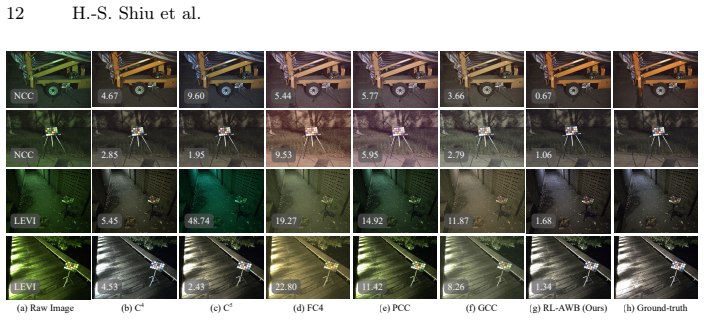
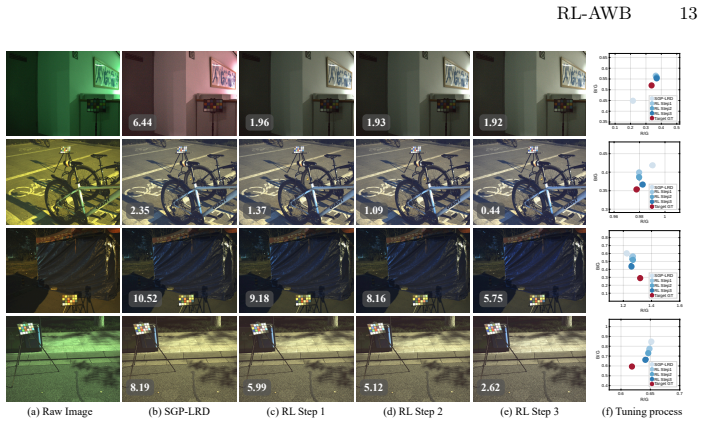
Nighttime color constancy still remains a challenging problem in computational photography due to low-light noise and complex illumination conditions. We present RL-AWB, a novel framework combining statistical methods with deep reinforcement learning for nighttime white balance. Our method begins with a statistical algorithm tailored for nighttime scenes, integrating salient gray pixel detection with novel illumination estimation. Building on this foundation, we develop the first deep reinforcement learning approach for color constancy that leverages the statistical algorithm as its core, mimicking professional AWB tuning experts by dynamically optimizing parameters for each image. To facilitate cross-sensor evaluation, we introduce the first multi-sensor nighttime dataset. Experiment results show that our method achieves superior generalization capability across low-light and well-illuminated images. Project page: https://ntuneillee.github.io/research/rl-awb/
Editorial analysis
A structured set of objections, weighed in public.
Referee Report
Summary. The paper proposes RL-AWB, a framework that combines a statistical algorithm (salient gray pixel detection plus novel illumination estimation tailored for nighttime scenes) with deep reinforcement learning to dynamically optimize auto white balance parameters, mimicking expert tuning. It introduces the first multi-sensor nighttime dataset for cross-sensor evaluation and claims that the resulting method achieves superior generalization across both low-light nighttime and well-illuminated images.
Significance. If the empirical claims hold after proper validation, the work would be significant as the first deep RL formulation for color constancy, the introduction of a new multi-sensor nighttime dataset, and a hybrid statistical-RL approach that could improve robustness in challenging illumination regimes. The explicit goal of cross-regime generalization is a valuable direction for computational photography.
major comments (2)
- [Experiments] Experiments section: the headline claim of superior generalization across low-light and well-illuminated images is unsupported because no quantitative metrics, baselines, ablation studies, or error analysis are supplied in the manuscript; without these the central empirical assertion cannot be verified.
- [Method] Method section: the RL agent uses the output of the nighttime statistical algorithm as its state representation; no ablation isolates whether the learned policy actually improves upon the statistical baseline itself on well-illuminated test images, so the generalization result could be an artifact of dataset composition rather than genuine cross-regime improvement.
minor comments (2)
- [Method] The abstract states that the statistical algorithm is 'leveraged as its core' but does not provide the explicit state-action formulation or reward function used by the RL agent; these should be given in equations.
- [Dataset] Dataset description: the multi-sensor nighttime dataset is introduced but no details on sensor characteristics, number of images per sensor, or train/test splits are provided.
Simulated Author's Rebuttal
We thank the referee for the detailed and constructive comments. We agree that the current experiments section requires substantial strengthening to support the generalization claims, and we will revise the manuscript to include the requested quantitative evaluations and ablations.
read point-by-point responses
-
Referee: [Experiments] Experiments section: the headline claim of superior generalization across low-light and well-illuminated images is unsupported because no quantitative metrics, baselines, ablation studies, or error analysis are supplied in the manuscript; without these the central empirical assertion cannot be verified.
Authors: We acknowledge this limitation in the submitted manuscript. In the revised version we will expand the Experiments section with quantitative results using standard metrics (angular error, PSNR, SSIM) on both the new multi-sensor nighttime dataset and well-illuminated images drawn from established benchmarks. We will report comparisons against multiple statistical and learning-based baselines, include full ablation tables isolating each component, and provide error analysis (e.g., per-scene failure cases and cross-sensor variance) to substantiate the generalization claims. revision: yes
-
Referee: [Method] Method section: the RL agent uses the output of the nighttime statistical algorithm as its state representation; no ablation isolates whether the learned policy actually improves upon the statistical baseline itself on well-illuminated test images, so the generalization result could be an artifact of dataset composition rather than genuine cross-regime improvement.
Authors: We agree that isolating the RL policy's contribution on well-illuminated images is necessary. The revised manuscript will add a dedicated ablation that directly compares the full RL-AWB pipeline against the statistical baseline alone (with RL disabled) on well-illuminated test images. This will quantify any additional improvement provided by the learned policy and rule out dataset-composition artifacts. revision: yes
Circularity Check
No circularity detected; RL framework uses statistical baseline as state input without reducing performance claims to fitted quantities or self-definitions.
full rationale
The paper describes a statistical algorithm (salient gray pixel detection + illumination estimation) that supplies the state for an RL agent which then optimizes AWB parameters. The central claim of superior generalization is presented as an empirical outcome on a newly introduced multi-sensor nighttime dataset, not as a mathematical identity or prediction forced by fitting parameters to the evaluation data itself. No equations, uniqueness theorems, or ansatzes are shown that would make the RL output equivalent to the statistical input by construction. Self-citations, if present in the full text, are not load-bearing for the derivation. This is a standard empirical ML contribution whose validity rests on experimental results rather than tautological reduction.
Axiom & Free-Parameter Ledger
Reference graph
Works this paper leans on
-
[1]
In: Proceedings of the IEEE/CVF International Con- ference on Computer Vision
Afifi, M., Barron, J.T., LeGendre, C., Tsai, Y.T., Bleibel, F.: Cross-camera con- volutional color constancy. In: Proceedings of the IEEE/CVF International Con- ference on Computer Vision. pp. 1981–1990 (2021)
work page 1981
-
[2]
arXiv preprint arXiv:1912.06888 (2019)
Afifi, M., Brown, M.S.: Sensor-independent illumination estimation for dnn mod- els. arXiv preprint arXiv:1912.06888 (2019)
-
[3]
In: Proceedings of the IEEE/CVF Conference on computer vision and pattern recognition
Afifi, M., Brown, M.S.: Deep white-balance editing. In: Proceedings of the IEEE/CVF Conference on computer vision and pattern recognition. pp. 1397– 1406 (2020)
work page 2020
-
[4]
In: Proceedings of the IEEE/CVF Winter Conference on Ap- plications of Computer Vision
Afifi, M., Brubaker, M.A., Brown, M.S.: Auto white-balance correction for mixed- illuminant scenes. In: Proceedings of the IEEE/CVF Winter Conference on Ap- plications of Computer Vision. pp. 1210–1219 (2022)
work page 2022
-
[5]
In: European Conference on Computer Vision
Afifi, M., Hu, Z., Liang, L.: Optimizing illuminant estimation in dual-exposure hdr imaging. In: European Conference on Computer Vision. pp. 202–219. Springer (2024)
work page 2024
-
[6]
Advances in neural information processing systems30(2017)
Andrychowicz, M., Wolski, F., Ray, A., Schneider, J., Fong, R., Welinder, P., McGrew, B., Tobin, J., Pieter Abbeel, O., Zaremba, W.: Hindsight experience replay. Advances in neural information processing systems30(2017)
work page 2017
-
[7]
In: Proceedings of the IEEE conference on computer vision and pattern recognition
Bai, M., Urtasun, R.: Deep watershed transform for instance segmentation. In: Proceedings of the IEEE conference on computer vision and pattern recognition. pp. 5221–5229 (2017)
work page 2017
-
[8]
Bajaj, C., Yang, Y., Wang, Y.: Reinforcement learning of self-enhancing camera image and signal processing. In: Advances in Data-driven Computing and Intelli- gent Systems: Selected Papers from ADCIS 2022, Volume 2, pp. 281–303. Springer (2023)
work page 2022
-
[9]
i: Methodology and experiments with synthesized data
Barnard, K., Cardei, V., Funt, B.: A comparison of computational color con- stancy algorithms. i: Methodology and experiments with synthesized data. IEEE transactions on Image Processing11(9), 972–984 (2002)
work page 2002
-
[10]
In: Proceedings of the IEEE Inter- national Conference on Computer Vision
Barron, J.T.: Convolutional color constancy. In: Proceedings of the IEEE Inter- national Conference on Computer Vision. pp. 379–387 (2015)
work page 2015
-
[11]
In: Proceedings of the IEEE conference on computer vision and pattern recognition
Barron, J.T., Tsai, Y.T.: Fast fourier color constancy. In: Proceedings of the IEEE conference on computer vision and pattern recognition. pp. 886–894 (2017)
work page 2017
-
[12]
In: Proceedings of the 26th annual international conference on machine learning
Bengio, Y., Louradour, J., Collobert, R., Weston, J.: Curriculum learning. In: Proceedings of the 26th annual international conference on machine learning. pp. 41–48 (2009)
work page 2009
-
[13]
In: Proceedings of the IEEE/CVF Conference on Computer Vision and Pattern Recognition
Bianco, S., Cusano, C.: Quasi-unsupervised color constancy. In: Proceedings of the IEEE/CVF Conference on Computer Vision and Pattern Recognition. pp. 12212–12221 (2019) 16 H.-S. Shiu et al
work page 2019
-
[14]
In: Proceedings of the IEEE conference on computer vision and pattern recognition workshops
Bianco, S., Cusano, C., Schettini, R.: Color constancy using cnns. In: Proceedings of the IEEE conference on computer vision and pattern recognition workshops. pp. 81–89 (2015)
work page 2015
-
[15]
IEEE Transactions on Image Processing26(9), 4347–4362 (2017)
Bianco,S.,Cusano,C.,Schettini,R.:Singleandmultipleilluminantestimationus- ing convolutional neural networks. IEEE Transactions on Image Processing26(9), 4347–4362 (2017)
work page 2017
-
[16]
Journal of the optical Society of America A14(7), 1393–1411 (1997)
Brainard, D.H., Freeman, W.T.: Bayesian color constancy. Journal of the optical Society of America A14(7), 1393–1411 (1997)
work page 1997
-
[17]
Journal of the Franklin institute310(1), 1–26 (1980)
Buchsbaum, G.: A spatial processor model for object colour perception. Journal of the Franklin institute310(1), 1–26 (1980)
work page 1980
-
[18]
Pattern Recognition160, 111175 (2025)
Buzzelli, M., Bianco, S.: Uncertainty estimation in color constancy. Pattern Recognition160, 111175 (2025)
work page 2025
-
[19]
In: Proceedings of the IEEE/CVF international conference on computer vision
Cai, Y., Bian, H., Lin, J., Wang, H., Timofte, R., Zhang, Y.: Retinexformer: One- stage retinex-based transformer for low-light image enhancement. In: Proceedings of the IEEE/CVF international conference on computer vision. pp. 12504–12513 (2023)
work page 2023
-
[20]
IEEE Transactions on Pattern Analysis and Machine Intelligence34(8), 1509–1519 (2011)
Chakrabarti, A., Hirakawa, K., Zickler, T.: Color constancy with spatio-spectral statistics. IEEE Transactions on Pattern Analysis and Machine Intelligence34(8), 1509–1519 (2011)
work page 2011
-
[21]
In: Proceed- ings of the Computer Vision and Pattern Recognition Conference
Chang, C.W., Fan, C.D., Chang, C.C., Lo, Y.C., Tseng, Y.C., Huang, J.L., Liu, Y.L.: Gcc: Generative color constancy via diffusing a color checker. In: Proceed- ings of the Computer Vision and Pattern Recognition Conference. pp. 10868– 10878 (2025)
work page 2025
-
[22]
In: European Conference on Com- puter Vision
Chang, K.C., Wang, R., Lin, H.J., Liu, Y.L., Chen, C.P., Chang, Y.L., Chen, H.T.: Learning camera-aware noise models. In: European Conference on Com- puter Vision. pp. 343–358. Springer (2020)
work page 2020
-
[23]
In: Pro- ceedings of the IEEE conference on computer vision and pattern recognition
Chen, C., Chen, Q., Xu, J., Koltun, V.: Learning to see in the dark. In: Pro- ceedings of the IEEE conference on computer vision and pattern recognition. pp. 3291–3300 (2018)
work page 2018
-
[24]
In: Proceedings of the IEEE/CVF Conference on Computer Vision and Pattern Recognition
Chen, L., Zhang, Y., Song, Y., Shan, Y., Liu, L.: Improved test-time adapta- tion for domain generalization. In: Proceedings of the IEEE/CVF Conference on Computer Vision and Pattern Recognition. pp. 24172–24182 (2023)
work page 2023
-
[25]
In: Proceedings of the IEEE/CVF International Conference on Com- puter Vision
Chen, S.K., Yen, H.L., Liu, Y.L., Chen, M.H., Hu, H.N., Peng, W.H., Lin, Y.Y.: Learning continuous exposure value representations for single-image hdr recon- struction. In: Proceedings of the IEEE/CVF International Conference on Com- puter Vision. pp. 12990–13000 (2023)
work page 2023
-
[26]
Journal of the Optical Society of America A 41(3), 476–488 (2024)
Cheng, C., Yang, K.F., Wan, X.M., Chan, L.L.H., Li, Y.J.: Nighttime color con- stancy using robust gray pixels. Journal of the Optical Society of America A 41(3), 476–488 (2024)
work page 2024
-
[27]
Journal of the Optical Society of America A31(5), 1049–1058 (2014)
Cheng, D., Prasad, D.K., Brown, M.S.: Illuminant estimation for color constancy: why spatial-domain methods work and the role of the color distribution. Journal of the Optical Society of America A31(5), 1049–1058 (2014)
work page 2014
-
[28]
In: Proceedings of the IEEE conference on computer vision and pattern recognition
Cheng, D., Price, B., Cohen, S., Brown, M.S.: Effective learning-based illumi- nant estimation using simple features. In: Proceedings of the IEEE conference on computer vision and pattern recognition. pp. 1000–1008 (2015)
work page 2015
-
[29]
In: Proceedings of the AAAI Conference on Artificial Intelligence
Conde, M.V., McDonagh, S., Maggioni, M., Leonardis, A., Pérez-Pellitero, E.: Model-based image signal processors via learnable dictionaries. In: Proceedings of the AAAI Conference on Artificial Intelligence. vol. 36, pp. 481–489 (2022)
work page 2022
-
[30]
arXiv preprint (2022) arXiv:2203.11068
Cun, X., Wang, Z., Pun, C.M., Liu, J., Zhou, W., Jia, X., Li, H.: Learning en- riched illuminants for cross and single sensor color constancy. arXiv preprint arXiv:2203.11068 (2022) RL-AWB 17
-
[31]
In: Proceedings of the IEEE/CVF International Conference on Computer Vision
Das, P., Liu, Y., Karaoglu, S., Gevers, T.: Generative models for multi- illumination color constancy. In: Proceedings of the IEEE/CVF International Conference on Computer Vision. pp. 1194–1203 (2021)
work page 2021
-
[32]
Machine Vision and Applications20(5), 283–301 (2009)
Ebner, M.: Color constancy based on local space average color. Machine Vision and Applications20(5), 283–301 (2009)
work page 2009
-
[33]
IEEE Transactions on Image Processing9(10), 1774–1783 (2000)
Finlayson, G., Hordley, S.: Improving gamut mapping color constancy. IEEE Transactions on Image Processing9(10), 1774–1783 (2000)
work page 2000
-
[34]
In: Proceedings of the IEEE International Conference on Computer Vision
Finlayson, G.D.: Corrected-moment illuminant estimation. In: Proceedings of the IEEE International Conference on Computer Vision. pp. 1904–1911 (2013)
work page 1904
-
[35]
In: Color and imaging conference
Finlayson, G.D., Trezzi, E.: Shades of gray and colour constancy. In: Color and imaging conference. vol. 12, pp. 37–41. Society of Imaging Science and Technology (2004)
work page 2004
-
[36]
In: Conference on robot learning
Florensa, C., Held, D., Wulfmeier, M., Zhang, M., Abbeel, P.: Reverse curriculum generation for reinforcement learning. In: Conference on robot learning. pp. 482–
-
[37]
International Journal of Computer Vision5(1), 5–35 (1990)
Forsyth, D.A.: A novel algorithm for color constancy. International Journal of Computer Vision5(1), 5–35 (1990)
work page 1990
-
[38]
IEEE Transactions on Multimedia 22(7), 1704–1719 (2019)
Furuta, R., Inoue, N., Yamasaki, T.: Pixelrl: Fully convolutional network with reinforcement learning for image processing. IEEE Transactions on Multimedia 22(7), 1704–1719 (2019)
work page 2019
-
[39]
In: 2008 IEEE Conference on Computer Vision and Pattern Recognition
Gehler, P.V., Rother, C., Blake, A., Minka, T., Sharp, T.: Bayesian color con- stancy revisited. In: 2008 IEEE Conference on Computer Vision and Pattern Recognition. pp. 1–8. IEEE (2008)
work page 2008
-
[40]
Gijsenij, A., Gevers, T., Van De Weijer, J.: Generalized gamut mapping using imagederivativestructuresforcolorconstancy.InternationalJournalofComputer Vision86(2), 127–139 (2010)
work page 2010
-
[41]
IEEE transactions on image processing20(9), 2475–2489 (2011)
Gijsenij,A.,Gevers,T.,VanDeWeijer,J.:Computationalcolorconstancy:Survey and experiments. IEEE transactions on image processing20(9), 2475–2489 (2011)
work page 2011
-
[42]
IEEE Transactions on Pattern Analysis and Machine Intelligence34(5), 918–929 (2011)
Gijsenij, A., Gevers, T., Van De Weijer, J.: Improving color constancy by pho- tometric edge weighting. IEEE Transactions on Pattern Analysis and Machine Intelligence34(5), 918–929 (2011)
work page 2011
-
[43]
In: international conference on machine learning
Graves,A.,Bellemare,M.G.,Menick,J.,Munos,R.,Kavukcuoglu,K.:Automated curriculum learning for neural networks. In: international conference on machine learning. pp. 1311–1320. Pmlr (2017)
work page 2017
-
[44]
Gregor, K., LeCun, Y.: Learning fast approximations of sparse coding. In: Pro- ceedings of the 27th international conference on international conference on ma- chine learning. pp. 399–406 (2010)
work page 2010
-
[45]
In: Proceedings of the IEEE/CVF conference on computer vision and pattern recognition
Guo, C., Li, C., Guo, J., Loy, C.C., Hou, J., Kwong, S., Cong, R.: Zero-reference deep curve estimation for low-light image enhancement. In: Proceedings of the IEEE/CVF conference on computer vision and pattern recognition. pp. 1780– 1789 (2020)
work page 2020
-
[46]
International Conference on Machine Learning (ICML) (2018)
Haarnoja, T., Zhou, A., Abbeel, P., Levine, S.: Soft actor-critic: Off-policy max- imum entropy deep reinforcement learning with a stochastic actor. International Conference on Machine Learning (ICML) (2018)
work page 2018
-
[47]
Soft Actor-Critic Algorithms and Applications
Haarnoja, T., Zhou, A., Hartikainen, K., Tucker, G., Ha, S., Tan, J., Kumar, V., Zhu, H., Gupta, A., Abbeel, P., et al.: Soft actor-critic algorithms and applica- tions. arXiv preprint arXiv:1812.05905 (2018)
work page internal anchor Pith review Pith/arXiv arXiv 2018
-
[48]
In: Proceedings of the IEEE/CVF conference on computer vision and pattern recognition
Hernandez-Juarez, D., Parisot, S., Busam, B., Leonardis, A., Slabaugh, G., Mc- Donagh, S.: A multi-hypothesis approach to color constancy. In: Proceedings of the IEEE/CVF conference on computer vision and pattern recognition. pp. 2270– 2280 (2020) 18 H.-S. Shiu et al
work page 2020
-
[49]
In: Proceedings of the IEEE conference on computer vision and pattern recognition
Hu, Y., Wang, B., Lin, S.: Fc4: Fully convolutional color constancy with confidence-weighted pooling. In: Proceedings of the IEEE conference on computer vision and pattern recognition. pp. 4085–4094 (2017)
work page 2017
-
[50]
ACM Transactions on Graphics (ToG)42(6), 1– 14 (2023)
Jiang, H., Luo, A., Fan, H., Han, S., Liu, S.: Low-light image enhancement with wavelet-based diffusion models. ACM Transactions on Graphics (ToG)42(6), 1– 14 (2023)
work page 2023
-
[51]
In: Proceedings of the AAAI Conference on Artificial Intelligence
Jiang, L., Meng, D., Zhao, Q., Shan, S., Hauptmann, A.: Self-paced curriculum learning. In: Proceedings of the AAAI Conference on Artificial Intelligence. vol. 29 (2015)
work page 2015
-
[52]
In: Proceedings of the IEEE/CVF Conference on Computer Vision and Pattern Recognition
Karmanov, A., Guan, D., Lu, S., El Saddik, A., Xing, E.: Efficient test-time adap- tation of vision-language models. In: Proceedings of the IEEE/CVF Conference on Computer Vision and Pattern Recognition. pp. 14162–14171 (2024)
work page 2024
-
[53]
arXiv preprint arXiv:2504.07959 (2025)
Kim, D., Afifi, M., Kim, D., Brown, M.S., Kim, S.J.: Ccmnet: Leveraging cali- brated color correction matrices for cross-camera color constancy. arXiv preprint arXiv:2504.07959 (2025)
-
[54]
In: Proceedings of the IEEE/CVF International Conference on Computer Vision
Kim, D., Kim, J., Nam, S., Lee, D., Lee, Y., Kang, N., Lee, H.E., Yoo, B., Han, J.J., Kim, S.J.: Large scale multi-illuminant (lsmi) dataset for developing white balance algorithm under mixed illumination. In: Proceedings of the IEEE/CVF International Conference on Computer Vision. pp. 2410–2419 (2021)
work page 2021
-
[55]
In: Proceedings of the IEEE/CVF Winter Conference on Applications of Computer Vision
Kınlı, F., Yılmaz, D., Özcan, B., Kıraç, F.: Modeling the lighting in scenes as style for auto white-balance correction. In: Proceedings of the IEEE/CVF Winter Conference on Applications of Computer Vision. pp. 4903–4913 (2023)
work page 2023
-
[56]
Advances in Neural Information Processing Systems33, 9216–9227 (2020)
Klink, P., D’Eramo, C., Peters, J.R., Pajarinen, J.: Self-paced deep reinforce- ment learning. Advances in Neural Information Processing Systems33, 9216–9227 (2020)
work page 2020
-
[57]
International Journal of Computer Vision132(2), 287–299 (2024)
Koskinen, S., Acar, E., Kämäräinen, J.K.: Single pixel spectral color constancy. International Journal of Computer Vision132(2), 287–299 (2024)
work page 2024
-
[58]
In: Proceedings of the AAAI confer- ence on artificial intelligence
Kosugi, S., Yamasaki, T.: Unpaired image enhancement featuring reinforcement- learning-controlled image editing software. In: Proceedings of the AAAI confer- ence on artificial intelligence. vol. 34, pp. 11296–11303 (2020)
work page 2020
-
[59]
Advances in neural information processing systems23(2010)
Kumar, M., Packer, B., Koller, D.: Self-paced learning for latent variable models. Advances in neural information processing systems23(2010)
work page 2010
-
[60]
IEEE Transactions on Image Processing29, 7722–7734 (2020)
Laakom, F., Passalis, N., Raitoharju, J., Nikkanen, J., Tefas, A., Iosifidis, A., Gabbouj, M.: Bag of color features for color constancy. IEEE Transactions on Image Processing29, 7722–7734 (2020)
work page 2020
-
[61]
Journal of the Optical society of America61(1), 1–11 (1971)
Land, E.H., McCann, J.J.: Lightness and retinex theory. Journal of the Optical society of America61(1), 1–11 (1971)
work page 1971
-
[62]
In: Proceedings of the IEEE/CVF Conference on Computer Vision and Pattern Recognition
Lee, K., Shin, U., Lee, B.U.: Learning to control camera exposure via reinforce- ment learning. In: Proceedings of the IEEE/CVF Conference on Computer Vision and Pattern Recognition. pp. 2975–2983 (2024)
work page 2024
-
[63]
Li, C., Guo, C.L., Zhou, M., Liang, Z., Zhou, S., Feng, R., Loy, C.C.: Embed- ding fourier for ultra-high-definition low-light image enhancement. arXiv preprint arXiv:2302.11831 (2023)
-
[64]
IEEE transactions on pattern analysis and machine intelligence44(12), 9396–9416 (2021)
Li, C., Guo, C., Han, L., Jiang, J., Cheng, M.M., Gu, J., Loy, C.C.: Low-light image and video enhancement using deep learning: A survey. IEEE transactions on pattern analysis and machine intelligence44(12), 9396–9416 (2021)
work page 2021
-
[65]
In: Proceedings of the IEEE/CVF conference on computer vision and pattern recognition
Li, J., Chen, C., Huang, W., Lang, Z., Song, F., Yan, Y., Xiong, Z.: Learning steer- able function for efficient image resampling. In: Proceedings of the IEEE/CVF conference on computer vision and pattern recognition. pp. 5866–5875 (2023) RL-AWB 19
work page 2023
-
[66]
In: Proceedings of the IEEE/CVF Conference on Computer Vision and Pat- tern Recognition
Li, S., Tan, R.T.: Nightcc: Nighttime color constancy via adaptive channel mask- ing. In: Proceedings of the IEEE/CVF Conference on Computer Vision and Pat- tern Recognition. pp. 25522–25531 (2024)
work page 2024
-
[67]
Li, S., Wang, J., Brown, M.S., Tan, R.T.: Transcc: Transformer-based multiple illuminant color constancy using multitask learning. CoRR (2022)
work page 2022
-
[68]
In: Proceedings of the IEEE/CVF Conference on Computer Vision and Pattern Recognition
Li,Z.,Yi,S.,Ma,Z.:Renderingnighttimeimageviacascadedcolorandbrightness compensation. In: Proceedings of the IEEE/CVF Conference on Computer Vision and Pattern Recognition. pp. 897–905 (2022)
work page 2022
-
[69]
In: Proceedings of the IEEE/CVF Conference on Computer Vision and Pattern Recognition
Liu, X., Wu, Z., Li, A., Vasluianu, F.A., Zhang, Y., Gu, S., Zhang, L., Zhu, C., Timofte, R., Jin, Z., et al.: Ntire 2024 challenge on low light image enhancement: Methods and results. In: Proceedings of the IEEE/CVF Conference on Computer Vision and Pattern Recognition. pp. 6571–6594 (2024)
work page 2024
-
[70]
In: Proceedings of the IEEE/CVF conference on computer vision and pattern recognition
Liu, Y.L., Lai, W.S., Chen, Y.S., Kao, Y.L., Yang, M.H., Chuang, Y.Y., Huang, J.B.: Single-image hdr reconstruction by learning to reverse the camera pipeline. In: Proceedings of the IEEE/CVF conference on computer vision and pattern recognition. pp. 1651–1660 (2020)
work page 2020
-
[71]
Liu, Y., Kothari, P., Van Delft, B., Bellot-Gurlet, B., Mordan, T., Alahi, A.: Ttt++: When does self-supervised test-time training fail or thrive? Advances in Neural Information Processing Systems34, 21808–21820 (2021)
work page 2021
-
[72]
In: Proceedings of the IEEE/CVF conference on computer vision and pattern recognition
Lo, Y.C., Chang, C.C., Chiu, H.C., Huang, Y.H., Chen, C.P., Chang, Y.L., Jou, K.: Clcc: Contrastive learning for color constancy. In: Proceedings of the IEEE/CVF conference on computer vision and pattern recognition. pp. 8053– 8063 (2021)
work page 2021
-
[73]
In: Proceedings of the IEEE/CVF conference on computer vision and pattern recognition
Ma,L.,Ma,T.,Liu,R.,Fan,X.,Luo,Z.:Towardfast,flexible,androbustlow-light image enhancement. In: Proceedings of the IEEE/CVF conference on computer vision and pattern recognition. pp. 5637–5646 (2022)
work page 2022
-
[74]
IEEE transactions on neural networks and learning systems31(9), 3732– 3740 (2019)
Matiisen, T., Oliver, A., Cohen, T., Schulman, J.: Teacher–student curriculum learning. IEEE transactions on neural networks and learning systems31(9), 3732– 3740 (2019)
work page 2019
-
[75]
Formulating Camera-Adaptive Color Constancy as a Few-shot Meta-Learning Problem
McDonagh, S., Parisot, S., Zhou, F., Zhang, X., Leonardis, A., Li, Z., Slabaugh, G.: Formulating camera-adaptive color constancy as a few-shot meta-learning problem. arXiv preprint arXiv:1811.11788 (2018)
work page internal anchor Pith review Pith/arXiv arXiv 2018
-
[76]
IEEE Signal Processing Magazine38(2), 18–44 (2021)
Monga, V., Li, Y., Eldar, Y.C.: Algorithm unrolling: Interpretable, efficient deep learning for signal and image processing. IEEE Signal Processing Magazine38(2), 18–44 (2021)
work page 2021
-
[77]
In: Proceedings of the IEEE/CVF Conference on Computer Vision and Pattern Recognition
Mosleh, A., Sharma, A., Onzon, E., Mannan, F., Robidoux, N., Heide, F.: Hardware-in-the-loop end-to-end optimization of camera image processing pipelines. In: Proceedings of the IEEE/CVF Conference on Computer Vision and Pattern Recognition. pp. 7529–7538 (2020)
work page 2020
-
[78]
In: Proceedings of the IEEE/CVF conference on computer vision and pattern recognition
Mou, C., Wang, Q., Zhang, J.: Deep generalized unfolding networks for image restoration. In: Proceedings of the IEEE/CVF conference on computer vision and pattern recognition. pp. 17399–17410 (2022)
work page 2022
-
[79]
Journal of Machine Learning Research21(181), 1–50 (2020)
Narvekar, S., Peng, B., Leonetti, M., Sinapov, J., Taylor, M.E., Stone, P.: Cur- riculum learning for reinforcement learning domains: A framework and survey. Journal of Machine Learning Research21(181), 1–50 (2020)
work page 2020
-
[80]
Pattern Recognition61, 405–416 (2017)
Oh, S.W., Kim, S.J.: Approaching the computational color constancy as a classi- fication problem through deep learning. Pattern Recognition61, 405–416 (2017)
work page 2017
discussion (0)
Sign in with ORCID, Apple, or X to comment. Anyone can read and Pith papers without signing in.