From Fixed to Flexible: Shaping AI Personality in Context-Sensitive Interaction
Pith reviewed 2026-05-16 15:35 UTC · model grok-4.3
The pith
Allowing users to adjust AI agent personality across contexts produces distinct profiles and raises trust.
A machine-rendered reading of the paper's core claim, the machinery that carries it, and where it could break.
Core claim
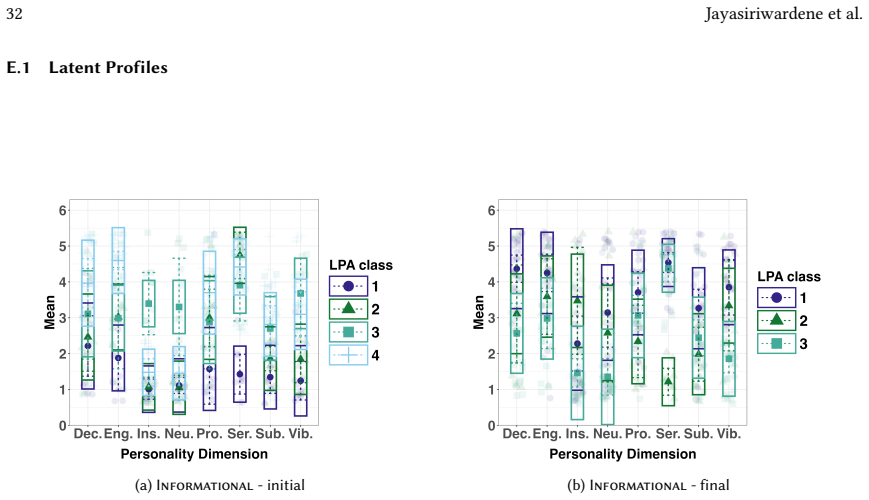
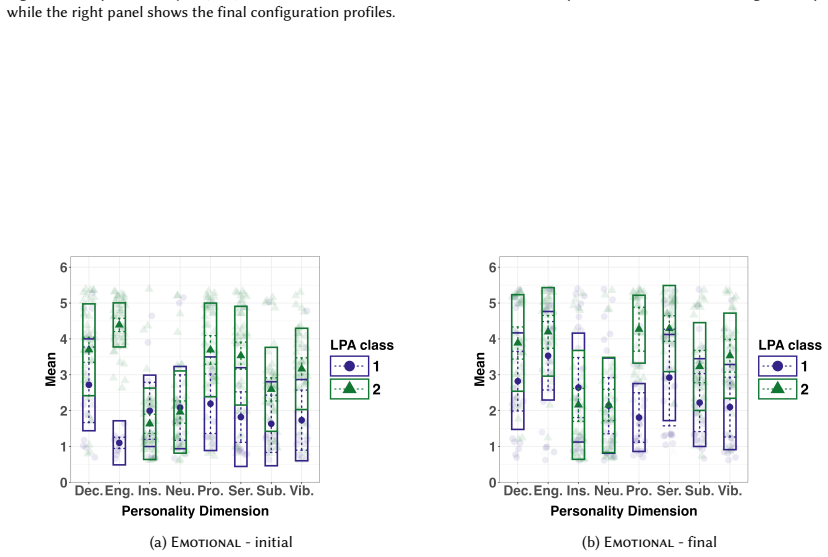
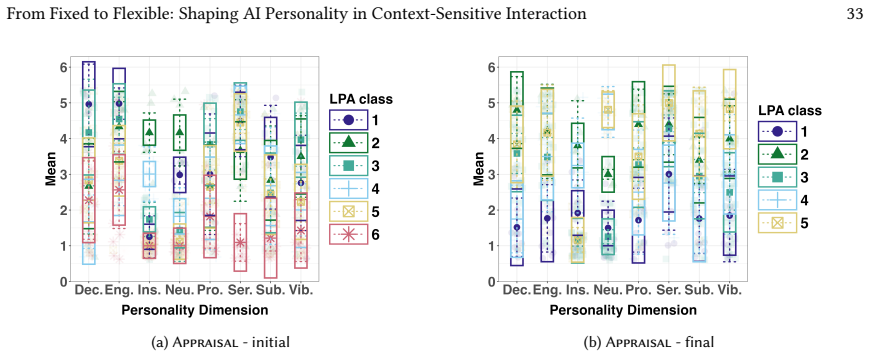
Users formed distinct personality profiles at the start and end of sessions, followed adjustment trajectories shaped by the specific task context, and reported valuing the control, seeing the agent as more anthropomorphic, and placing greater trust in it when personality could be changed dynamically.
What carries the argument
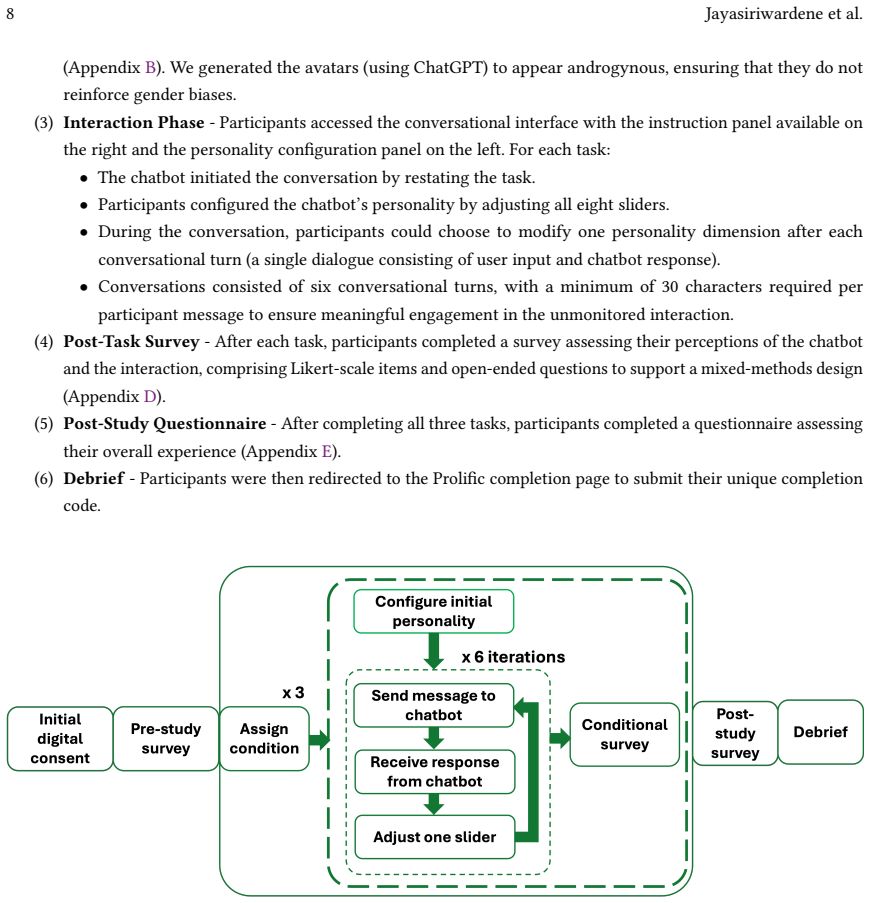
A prototype interface letting users adjust an agent's personality along eight dimensions in three task contexts, analyzed through latent profile analysis for groupings and trajectory analysis for change patterns.
If this is right
- Distinct personality profiles appear at initial and final configuration stages.
- Adjustment trajectories vary systematically with task context.
- Participants report greater perceived autonomy and anthropomorphism.
- Trust in the agent increases when adjustment is possible.
- Context-sensitive flexibility matters more than a single static setting.
Where Pith is reading between the lines
- Designers could add live personality controls to existing chat systems without major architecture changes.
- The same adjustment logic might apply to non-conversational AI, such as recommendation or tutoring agents.
- Longer studies could check whether repeated use stabilizes or further shifts preferred profiles.
- Cultural or demographic differences in adjustment patterns remain open for targeted testing.
Load-bearing premise
The eight personality dimensions and the three selected task contexts capture enough of real user expectations to stand in for broader interactions.
What would settle it
A controlled comparison in which fixed-personality agents produce equal or higher trust and anthropomorphism scores than adjustable ones would undermine the reported benefit.
Figures






read the original abstract
Conversational agents are increasingly expected to adapt across contexts and evolve their personalities through interactions, yet most remain static once configured. We present an exploratory study of how user expectations form and evolve when agent personality is made dynamically adjustable. To investigate this, we designed a prototype conversational interface that enabled users to adjust an agent's personality along eight research-grounded dimensions across three task contexts: informational, emotional, and appraisal. We conducted an online mixed-methods study with 60 participants, employing latent profile analysis to characterize personality classes and trajectory analysis to trace evolving patterns of personality adjustment. These approaches revealed distinct personality profiles at initial and final configuration stages, and adjustment trajectories, shaped by context-sensitivity. Participants also valued the autonomy, perceived the agent as more anthropomorphic, and reported greater trust. Our findings highlight the importance of designing conversational agents that adapt alongside their users, advancing more responsive and human-centred AI.
Editorial analysis
A structured set of objections, weighed in public.
Referee Report
Summary. The paper reports an exploratory mixed-methods study with 60 participants using a prototype conversational agent whose personality can be adjusted along eight research-grounded dimensions in three task contexts (informational, emotional, appraisal). Latent profile analysis identifies distinct initial and final personality profiles, while trajectory analysis traces context-sensitive adjustment patterns. Participants reported valuing autonomy, higher anthropomorphism, and greater trust after interaction.
Significance. If the central claims hold after addressing design limitations, the work provides initial empirical grounding for shifting conversational agents from static to context-sensitive, user-adjustable personalities. The fresh participant data, use of standard latent profile and trajectory methods, and focus on autonomy and trust perceptions offer a concrete step toward more responsive human-centered AI design, though the exploratory scope limits immediate generalizability.
major comments (3)
- [§3] §3 (Experimental Design): No between-subjects static-personality control condition is present; all 60 participants used only the dynamic-adjustment interface. Consequently, the reported gains in trust, anthropomorphism, and autonomy valuation (§4.2) cannot be isolated from novelty effects, demand characteristics, or general positive response to any agent.
- [§4.1] §4.1 (Latent Profile and Trajectory Results): The analysis lacks error bars, baseline comparisons, or effect-size reporting for the identified profiles and trajectories. This weakens the claim that the patterns are distinctly shaped by context-sensitivity rather than random variation within the single condition.
- [§2.2] §2.2 (Personality Dimensions and Contexts): The selection of exactly eight dimensions and three task contexts is presented without validation data or justification against broader real-world interaction scenarios, making the generalizability of the context-sensitivity findings a load-bearing assumption that requires explicit testing or limitation.
minor comments (3)
- [Figures 1-2] Figure 1 and Figure 2: Axis labels, legend clarity, and participant count annotations are insufficient for readers to assess the stability of the reported profiles and trajectories.
- [§5] §5 (Discussion): The manuscript would benefit from a dedicated limitations subsection explicitly addressing the single-condition design and online exploratory format.
- [References] References: Several recent works on adaptive conversational agents and personality modeling in HCI are absent; adding them would better situate the contribution.
Simulated Author's Rebuttal
We thank the referee for their constructive and detailed feedback on our exploratory study. We address each major comment below, indicating planned revisions to the manuscript.
read point-by-point responses
-
Referee: §3 (Experimental Design): No between-subjects static-personality control condition is present; all 60 participants used only the dynamic-adjustment interface. Consequently, the reported gains in trust, anthropomorphism, and autonomy valuation (§4.2) cannot be isolated from novelty effects, demand characteristics, or general positive response to any agent.
Authors: We agree that the lack of a static control condition limits causal attribution of the reported gains in trust, anthropomorphism, and autonomy valuation. As the study was explicitly exploratory and focused on within-subject adjustment patterns, a between-subjects control was not included. In revision we will add an explicit limitations subsection discussing novelty effects and demand characteristics, tone down causal language in §4.2, and frame the results as preliminary evidence that motivates future controlled experiments. revision: partial
-
Referee: §4.1 (Latent Profile and Trajectory Results): The analysis lacks error bars, baseline comparisons, or effect-size reporting for the identified profiles and trajectories. This weakens the claim that the patterns are distinctly shaped by context-sensitivity rather than random variation within the single condition.
Authors: We thank the referee for this observation. In the revised manuscript we will add error bars to all profile and trajectory visualizations, report effect sizes (Cohen’s d and partial eta-squared) for differences between profiles, and include baseline comparisons against neutral or uniform profiles. These additions will clarify that the observed context-sensitive patterns exceed random variation. revision: yes
-
Referee: §2.2 (Personality Dimensions and Contexts): The selection of exactly eight dimensions and three task contexts is presented without validation data or justification against broader real-world interaction scenarios, making the generalizability of the context-sensitivity findings a load-bearing assumption that requires explicit testing or limitation.
Authors: The eight dimensions and three contexts were chosen on the basis of established HCI and personality-psychology literature. We will expand §2.2 with additional citations and explicit rationale. We will also add a limitations paragraph acknowledging that these selections may not generalize to all real-world scenarios and that further validation studies are needed. revision: partial
Circularity Check
No significant circularity in empirical user study
full rationale
The paper reports an exploratory mixed-methods study with 60 participants using a new prototype interface for dynamic personality adjustment across three contexts. Central claims about distinct profiles, adjustment trajectories, autonomy valuation, anthropomorphism, and trust derive directly from fresh participant data and latent profile/trajectory analyses. No mathematical derivations, fitted parameters renamed as predictions, self-citation chains, or ansatzes that reduce results to inputs by construction appear. The work is self-contained against external benchmarks.
Axiom & Free-Parameter Ledger
axioms (2)
- standard math Standard assumptions of latent profile analysis and trajectory analysis hold for the collected data.
- domain assumption The eight personality dimensions and three task contexts capture relevant user expectations.
Lean theorems connected to this paper
-
IndisputableMonolith/Cost/FunctionalEquation.leanwashburn_uniqueness_aczel unclear?
unclearRelation between the paper passage and the cited Recognition theorem.
We conducted an online mixed-methods study with 60 participants, employing latent profile analysis to characterize personality classes and trajectory analysis to trace evolving patterns of personality adjustment.
-
IndisputableMonolith/Foundation/RealityFromDistinction.leanreality_from_one_distinction unclear?
unclearRelation between the paper passage and the cited Recognition theorem.
Participants also valued the autonomy, perceived the agent as more anthropomorphic, and reported greater trust.
What do these tags mean?
- matches
- The paper's claim is directly supported by a theorem in the formal canon.
- supports
- The theorem supports part of the paper's argument, but the paper may add assumptions or extra steps.
- extends
- The paper goes beyond the formal theorem; the theorem is a base layer rather than the whole result.
- uses
- The paper appears to rely on the theorem as machinery.
- contradicts
- The paper's claim conflicts with a theorem or certificate in the canon.
- unclear
- Pith found a possible connection, but the passage is too broad, indirect, or ambiguous to say the theorem truly supports the claim.
Reference graph
Works this paper leans on
-
[1]
Raian Ahmad, Dominik Siemon, Ulrich Gnewuch, et al. 2022. Designing Personality-Adaptive Conversational Agents for Mental Health Care. Information Systems Frontiers24 (2022), 923–943. doi:10.1007/s10796-022-10254-9
-
[2]
Gabriella Airenti. 2015. The Cognitive Bases of Anthropomorphism: From Relatedness to Empathy.International Journal of Social Robotics7 (2015), 117 – 127. https://api.semanticscholar.org/CorpusID:260263
work page 2015
-
[3]
Reece Akhtar, Lara Boustani, Dimitrios Tsivrikos, and Tomas Chamorro-Premuzic. 2015. The engageable personality: Personality and trait EI as predictors of work engagement.Personality and Individual Differences73 (2015), 44–49. doi:10.1016/j.paid.2014.08.040
-
[4]
Serhat Akogul and Meral Erisoglu. 2017. An Approach for Determining the Number of Clusters in a Model-Based Cluster Analysis.Entropy19, 9 (2017), 452. doi:10.3390/e19090452
-
[5]
Maryam Alimardani, Robyn de Roode, Julija Vaitonyte, and Max M. Louwerse. 2024. Effect of a Virtual Agent’s Appearance and Voice on Uncanny Valley and Trust in Human-Agent Collaboration. InProceedings of the 24th ACM International Conference on Intelligent Virtual Agents(GLASGOW, United Kingdom)(IV A ’24). Association for Computing Machinery, New York, NY...
-
[6]
Ars Technica. 2024. Deepfake scammer walks off with $25 million in first-of-its-kind AI heist. https://arstechnica.com/information-technology/ 2024/02/deepfake-scammer-walks-off-with-25-million-in-first-of-its-kind-ai-heist/?utm_source=chatgpt.com. Accessed: 2025-08-14
work page 2024
-
[7]
J.E. Barbuto. 1997. A Critique of the Myers-Briggs Type Indicator and its Operationalization of Carl Jung’s Psychological Types.Psychological Reports80, 2 (1997), 611–625. doi:10.2466/pr0.1997.80.2.611
-
[8]
2016.Microsoft chatbot is taught to swear on Twitter
BBC News. 2016.Microsoft chatbot is taught to swear on Twitter. https://www.bbc.com/news/technology-35902104 Accessed: 2025-09-09
work page 2016
-
[9]
Markus Blut, Chieh-Yu Wang, Nancy V. Wünderlich, et al. 2021. Understanding Anthropomorphism in Service Provision: A Meta-Analysis of Physical Robots, Chatbots, and Other AI.Journal of the Academy of Marketing Science49 (2021), 632–658. doi:10.1007/s11747-020-00762-y
-
[10]
Emily Campbell. [n. d.]. Personality Patterns Framework: Understanding Traits in AI. https://www.linkedin.com/pulse/personality-patterns- framework-understanding-traits-ai-emily-campbell-3klac/. Accessed: 2025-08-14
work page 2025
-
[11]
Amanda Cercas Curry, Judy Robertson, and Verena Rieser. 2020. Conversational Assistants and Gender Stereotypes: Public Perceptions and Desiderata for Voice Personas. InProceedings of the Second Workshop on Gender Bias in Natural Language Processing. Association for Computational Linguistics, Barcelona, Spain (Online), 72–78. https://aclanthology.org/2020....
work page 2020
-
[12]
CFO.com. 2024. Deepfake CFO in Hong Kong scams firm out of $25 million in cyber crime. https://www.cfo.com/news/deepfake-cfo-hong-kong- 25-million-fraud-cyber-crime/706529/?utm_source=chatgpt.com. Accessed: 2025-08-14
work page 2024
-
[13]
Frank Chang and Damith Herath. 2025. From Interaction to Relationship: The Role of Memory, Learning, and Emotional Intelligence in AI-Embodied Human Engagement. InProceedings of the 2025 ACM/IEEE International Conference on Human-Robot Interaction(Melbourne, Australia)(HRI ’25). IEEE Press, 1269–1273
work page 2025
- [14]
-
[15]
Xusen Cheng, Xiaoping Zhang, Jason Cohen, and Jian Mou. 2022. Human vs. AI: Understanding the Impact of Anthropomorphism on Consumer Response to Chatbots from the Perspective of Trust and Relationship Norms.Information Processing & Management59, 3 (2022), 102940. doi:10.1016/j.ipm.2022.102940
-
[16]
Alexander Chernev, Ulf Böckenholt, and Joseph Goodman. 2015. Choice Overload: A Conceptual Review and Meta-Analysis.Journal of Consumer Psychology25, 2 (2015), 333–358. doi:10.1016/j.jcps.2014.08.002 24 Jayasiriwardene et al
-
[17]
Hyungjun Cho, Jiyeon Amy Seo, Jiwon Lee, Chang-Min Kim, and Tek-Jin Nam. 2025. ShamAIn: Designing Superior Conversational AI Inspired by Shamanism. InProceedings of the 2025 CHI Conference on Human Factors in Computing Systems (CHI ’25). Association for Computing Machinery, New York, NY, USA, Article 985, 18 pages. doi:10.1145/3706598.3714297
-
[18]
Lara Christoforakos, Nina Feicht, Simone Hinkofer, Annalena Löscher, Sonja F. Schlegl, and Sarah Diefenbach. 2021. Connect With Me: Exploring Influencing Factors in a Human–Technology Relationship Based on Regular Chatbot Use.Frontiers in Digital Health3 (2021). doi:10.3389/fdgth. 2021.689999
-
[19]
Louisa Christoforakos, Alessia Gallucci, Tea Surmava-Große, Daniel Ullrich, and Sarah Diefenbach. 2021. Can Robots Earn Our Trust the Same Way Humans Do? A Systematic Exploration of Competence, Warmth, and Anthropomorphism as Determinants of Trust Development in HRI. Frontiers in Robotics and AI8 (2021), 640444. doi:10.3389/frobt.2021.640444
-
[20]
Leon Ciechanowski, Aleksandra Przegalinska, Mikolaj Magnuski, and Peter Gloor. 2019. In the Shades of the Uncanny Valley: An Experimental Study of Human–Chatbot Interaction.Future Generation Computer Systems92 (2019), 539–548. doi:10.1016/j.future.2018.01.055
-
[21]
Google Cloud. 2025. What is Prompt Engineering? https://cloud.google.com/discover/what-is-prompt-engineering Accessed: 2025-08-14
work page 2025
-
[22]
Carolyn E. Cutrona and Julie A. Suhr. 1992. Controllability of Stressful Events and Satisfaction With Spouse Support Behaviors.Communication Research19, 2 (1992), 154–174. doi:10.1177/009365092019002002
-
[23]
John Dawes. 2008. Do Data Characteristics Change According to the Number of Scale Points Used? An Experiment Using 5-Point, 7-Point and 10-Point Scales.International Journal of Market Research50, 1 (2008), 61–104. doi:10.1177/147078530805000106
-
[24]
E. J. de Visser, S. S. Monfort, R. McKendrick, M. A. B. Smith, P. E. McKnight, F. Krueger, and R. Parasuraman. 2016. Almost Human: Anthropomor- phism Increases Trust Resilience in Cognitive Agents.Journal of Experimental Psychology: Applied22, 3 (2016), 331–349. doi:10.1037/xap0000092
-
[25]
Smit Desai, Mateusz Dubiel, Nima Zargham, Thomas Mildner, and Laura Spillner. 2025. Personas Evolved: Designing Ethical LLM-Based Conversational Agent Personalities. InProceedings of the 7th ACM Conference on Conversational User Interfaces (CUI ’25). Association for Computing Machinery, New York, NY, USA, Article 32, 4 pages. doi:10.1145/3719160.3728624
-
[26]
Alexander Diel and Michael Lewis. 2024. Deviation from Typical Organic Voices Best Explains a Vocal Uncanny Valley.Computers in Human Behavior Reports14 (2024), 100430. doi:10.1016/j.chbr.2024.100430
-
[27]
Mateusz Dubiel, Sylvain Daronnat, and Luis A. Leiva. 2022. Conversational Agents Trust Calibration: A User-Centred Perspective to Design. In Proceedings of the 4th Conference on Conversational User Interfaces(Glasgow, United Kingdom)(CUI ’22). Association for Computing Machinery, New York, NY, USA, Article 30, 6 pages. doi:10.1145/3543829.3544518
-
[28]
Cathy Mengying Fang, Auren R. Liu, Valdemar Danry, Eunhae Lee, Samantha W. T. Chan, Pat Pataranutaporn, Pattie Maes, Jason Phang, Michael Lampe, Lama Ahmad, and Sandhini Agarwal. 2025. How AI and Human Behaviors Shape Psychosocial Effects of Chatbot Use: A Longitudinal Randomized Controlled Study. arXiv:2503.17473 [cs.HC] https://arxiv.org/abs/2503.17473
work page internal anchor Pith review arXiv 2025
-
[29]
Asbjørn Følstad, Effie L.-C. Law, and Nena van As. 2024. Conversational Breakdown in a Customer Service Chatbot: Impact of Task Order and Criticality on User Trust and Emotion.ACM Trans. Comput.-Hum. Interact.31, 5, Article 66 (Nov. 2024), 52 pages. doi:10.1145/3690383
-
[30]
Susan Fournier. 1998. Consumers and Their Brands: Developing Relationship Theory in Consumer Research.Journal of Consumer Research24, 4 (1998), 343–373. doi:10.1086/209515
-
[31]
Susan Fournier and Claudio Alvarez. 2012. Brands as Relationship Partners: Warmth, Competence, and In-Between.Journal of Consumer Psychology 22, 2 (2012), 177–185. doi:10.1016/j.jcps.2011.10.003
-
[32]
Asbjørn Følstad and Petter B. Brandtzaeg. 2020. Users’ Experiences with Chatbots: Findings from a Questionnaire Study.Quality and User Experience5 (2020), 3. doi:10.1007/s41233-020-00033-2
-
[33]
Simret Araya Gebreegziabher, Zheng Zhang, Xiaohang Tang, Yihao Meng, Elena L Glassman, and Toby Jia-Jun Li. 2023. Patat: Human-ai collaborative qualitative coding with explainable interactive rule synthesis. InProceedings of the 2023 CHI Conference on Human Factors in Computing Systems. 1–19
work page 2023
-
[34]
Lewis R. Goldberg. 1990. An alternative “description of personality”: The Big-Five factor structure.Journal of Personality and Social Psychology59, 6 (1990), 1216–1229. doi:10.1037/0022-3514.59.6.1216
-
[35]
Juhye Ha, Hyeon Jeon, Daeun Han, Jinwook Seo, and Changhoon Oh. 2024. CloChat: Understanding How People Customize, Interact, and Experience Personas in Large Language Models. InProceedings of the 2024 CHI Conference on Human Factors in Computing Systems(Honolulu, HI, USA)(CHI ’24). Association for Computing Machinery, New York, NY, USA, Article 305, 24 pa...
-
[36]
John A. Hartigan and Manchek A. Wong. 1979. Algorithm AS 136: A k-means clustering algorithm.Journal of the Royal Statistical Society. Series C (Applied Statistics)28, 1 (1979), 100–108. doi:10.2307/2346830
-
[37]
Javier Hernandez, Jina Suh, Judith Amores, Kael Rowan, Gonzalo Ramos, and Mary Czerwinski. 2023. Affective Conversational Agents: Under- standing Expectations and Personal Influences. (October 2023). https://www.microsoft.com/en-us/research/publication/affective-conversational- agents-understanding-expectations-and-personal-influences/ ArXiv
work page 2023
-
[38]
Jiaxiong Hu, Yun Huang, Xiaozhu Hu, and Yingqing Xu. 2021. Enhancing the Perceived Emotional Intelligence of Conversational Agents through Acoustic Cues. InExtended Abstracts of the 2021 CHI Conference on Human Factors in Computing Systems(Yokohama, Japan)(CHI EA ’21). Association for Computing Machinery, New York, NY, USA, Article 282, 7 pages. doi:10.11...
-
[39]
Yuanhui Huang, Quan Zhou, and Anne Marie Piper. 2025. Designing Conversational AI for Aging: A Systematic Review of Older Adults’ Perceptions and Needs. InProceedings of the 2025 CHI Conference on Human Factors in Computing Systems (CHI ’25). Association for Computing Machinery, New York, NY, USA, Article 181, 20 pages. doi:10.1145/3706598.3713578 From Fi...
-
[40]
H. Humaira and R. Rasyidah. 2020. Determining the Appropriate Cluster Number Using Elbow Method for K-Means Algorithm. InProceedings of the 2nd Workshop on Multimedia Applications (WMA-2). EAI. doi:10.4108/eai.24-1-2018.2292388
-
[41]
Gilhwan Hwang, Jeewon Lee, Cindy Yoonjung Oh, and Joonhwan Lee. 2019. It Sounds Like A Woman: Exploring Gender Stereotypes in South Korean Voice Assistants. InExtended Abstracts of the 2019 CHI Conference on Human Factors in Computing Systems(Glasgow, Scotland Uk)(CHI EA ’19). Association for Computing Machinery, New York, NY, USA, 1–6. doi:10.1145/329060...
-
[42]
Independent Community Bankers of America. 2025. Report: Romance scams grew 40% in 2024. https://www.icba.org/newsroom/news-and- articles/2025/02/14/report-romance-scams-grew-40-in-2024?utm_source=chatgpt.com. Accessed: 2025-08-14
work page 2025
-
[43]
Shakyani Jayasiriwardene, Benjamin Tag, Anusha Withana, and Zhanna Sarsenbayeva. 2025. More Than Words: The Impact of Voice Assistant Personality Traits on Failure Mitigation.Proceedings of the ACM on Interactive, Mobile, Wearable and Ubiquitous Technologies(2025). doi:10.1145/ 3749518 To appear
work page 2025
-
[44]
Jiangyu Y. Jian, Ann M. Bisantz, and Colin G. Drury. 2000. Foundations for an Empirically Determined Scale of Trust in Automated Systems. International Journal of Cognitive Ergonomics4, 1 (2000), 53–71. doi:10.1207/S15327566IJCE0401_04
-
[45]
Carl Jung and John Beebe. 2016.Psychological Types. Routledge
work page 2016
-
[46]
Ji-Youn Jung and Alessandro Bozzon. 2023. Are Female Chatbots More Empathic? - Discussing Gendered Conversational Agent through Empathic Design. InProceedings of the 2nd Empathy-Centric Design Workshop(Hamburg, Germany)(EmpathiCH ’23). Association for Computing Machinery, New York, NY, USA, Article 3, 5 pages. doi:10.1145/3588967.3588970
-
[47]
Gulnara Z. Karimova. 2025. Not in Our Image: Rethinking Anthropomorphism in Expert Chatbot Design.AI & Society(2025). doi:10.1007/s00146- 025-02438-z
- [48]
-
[49]
Kirk, Iason Gabriel, Christopher Summerfield, et al
Hannah R. Kirk, Iason Gabriel, Christopher Summerfield, et al. 2025. Why Human–AI Relationships Need Socioaffective Alignment.Humanities and Social Sciences Communications12 (2025), 728. doi:10.1057/s41599-025-04532-5
-
[50]
Michael Klenk. 2024. Ethics of Generative AI and Manipulation: A Design-Oriented Research Agenda.Ethics and Information Technology26 (2024),
work page 2024
-
[51]
doi:10.1007/s10676-024-09745-x
-
[52]
Nikola Kovačević, Christian Holz, Markus Gross, and Rafael Wampfler. 2024. The Personality Dimensions GPT-3 Expresses During Human-Chatbot Interactions.Proc. ACM Interact. Mob. Wearable Ubiquitous Technol.8, 2, Article 61 (May 2024), 36 pages. doi:10.1145/3659626
-
[53]
Philipp Kulms and Stefan Kopp. 2019. More Human-Likeness, More Trust? The Effect of Anthropomorphism on Self-Reported and Behavioral Trust in Continued and Interdependent Human-Agent Cooperation. InProceedings of Mensch Und Computer 2019(Hamburg, Germany)(MuC ’19). Association for Computing Machinery, New York, NY, USA, 31–42. doi:10.1145/3340764.3340793
-
[54]
Sunok Lee, Dasom Choi, Lucy Truong, Nitin Sawhney, and Henna Paakki. 2025. Into the Unknown: Leveraging Conversational AI in Supporting Young Migrants’ Journeys Towards Cultural Adaptation. InProceedings of the 2025 CHI Conference on Human Factors in Computing Systems (CHI ’25). Association for Computing Machinery, New York, NY, USA, Article 169, 19 pages...
-
[55]
Chia-Hui Lin and Yu Huang. 2018. How Self-Construals Affect Responses to Anthropomorphic Brands, With a Focus on the Three-Factor Relationship Between the Brand, the Gift-Giver and the Recipient.Frontiers in Psychology9 (2018), 2070. doi:10.3389/fpsyg.2018.02070
-
[56]
Xingyu Bruce Liu, Shitao Fang, Weiyan Shi, Chien-Sheng Wu, Takeo Igarashi, and Xiang ’Anthony’ Chen. 2025. Proactive Conversational Agents with Inner Thoughts. InProceedings of the 2025 CHI Conference on Human Factors in Computing Systems (CHI ’25). Association for Computing Machinery, New York, NY, USA, Article 184, 19 pages. doi:10.1145/3706598.3713760
-
[57]
Bailing Lyu, Chenglu Li, Hai Li, Hyunju Oh, Yukyeong Song, Wangda Zhu, and Wanli Xing. 2025. The Role of Teachable Agents’ Personality Traits on Student–AI Interactions and Math Learning.Computers & Education234 (2025), 105314. doi:10.1016/j.compedu.2025.105314
-
[58]
2025.cluster: Cluster Analysis Basics and Extensions
Martin Maechler, Peter Rousseeuw, Anja Struyf, Mia Hubert, and Kurt Hornik. 2025.cluster: Cluster Analysis Basics and Extensions. https://CRAN.R- project.org/package=cluster R package version 2.1.8
work page 2025
-
[59]
G. Marvin, N. Hellen, D. Jjingo, and J. Nakatumba-Nabende. 2024. Prompt Engineering in Large Language Models. InData Intelligence and Cognitive Informatics, I. J. Jacob, S. Piramuthu, and P. Falkowski-Gilski (Eds.). Springer, Singapore. doi:10.1007/978-981-99-7962-2_30 ICDICI 2023
-
[60]
Robert R. McCrae and Oliver P. John. 1992. An Introduction to the Five-Factor Model and Its Applications.Journal of Personality60, 2 (1992), 175–215. doi:10.1111/j.1467-6494.1992.tb00970.x arXiv:https://onlinelibrary.wiley.com/doi/pdf/10.1111/j.1467-6494.1992.tb00970.x
-
[61]
2018.Much more than a chatbot: China’s Xiaoice mixes AI with emotions and wins over millions of fans
Microsoft News Center Asia. 2018.Much more than a chatbot: China’s Xiaoice mixes AI with emotions and wins over millions of fans. https://news. microsoft.com/apac/features/much-more-than-a-chatbot-chinas-xiaoice-mixes-ai-with-emotions-and-wins-over-millions-of-fans/ Accessed: 2025-09-09
work page 2018
-
[62]
Joonas Moilanen, Aku Visuri, Sharadhi Alape Suryanarayana, Andy Alorwu, Koji Yatani, and Simo Hosio. 2022. Measuring the Effect of Mental Health Chatbot Personality on User Engagement. InProceedings of the 21st International Conference on Mobile and Ubiquitous Multimedia(Lisbon, Portugal)(MUM ’22). Association for Computing Machinery, New York, NY, USA, 1...
-
[63]
Masahiro Mori, Karl F. MacDorman, and Norri Kageki. 2012. The Uncanny Valley [From the Field].IEEE Robotics & Automation Magazine19, 2 (2012), 98–100. doi:10.1109/MRA.2012.2192811
-
[64]
1962.The Myers-Briggs Type Indicator
Isabel Briggs Myers. 1962.The Myers-Briggs Type Indicator. Vol. 34. Consulting Psychologists Press, Palo Alto, CA
work page 1962
-
[65]
Daniel S. Nagin. 1999. Analyzing Developmental Trajectories: A Semiparametric, Group-Based Approach.Psychological Methods4, 2 (1999), 139–157. doi:10.1037/1082-989X.4.2.139 26 Jayasiriwardene et al
-
[66]
Clifford Nass and Youngme Moon. 2000. Machines and Mindlessness: Social Responses to Computers.Journal of Social Issues56, 1 (2000), 81–103. doi:10.1111/0022-4537.00153
-
[67]
Clifford Nass, Youngme Moon, B. J. Fogg, Byron Reeves, and Chris Dryer. 1995. Can computer personalities be human personalities?. InConference Companion on Human Factors in Computing Systems(Denver, Colorado, USA)(CHI ’95). Association for Computing Machinery, New York, NY, USA, 228–229. doi:10.1145/223355.223538
-
[68]
Clifford Nass, Jonathan Steuer, and Ellen R. Tauber. 1994. Computers are social actors. InProceedings of the SIGCHI Conference on Human Factors in Computing Systems(Boston, Massachusetts, USA)(CHI ’94). Association for Computing Machinery, New York, NY, USA, 72–78. doi:10.1145/191666.191703
-
[69]
Humza Naveed, Asad Ullah Khan, Shi Qiu, Muhammad Saqib, Saeed Anwar, Muhammad Usman, Naveed Akhtar, Nick Barnes, and Ajmal Mian
-
[70]
A Comprehensive Overview of Large Language Models.ACM Trans. Intell. Syst. Technol.(June 2025). doi:10.1145/3744746 Just Accepted
-
[71]
Nora Ni Loideain and Rachel Adams. 2018.From Alexa to Siri and the GDPR: The Gendering of Virtual Personal Assistants and the Role of EU Data Protection Law. Legal Studies Research Paper Series. King’s College London Dickson Poon School of Law. doi:10.2139/ssrn.3281807
-
[72]
Jakob Nielsen. 1994. Enhancing the explanatory power of usability heuristics. InProceedings of the SIGCHI Conference on Human Factors in Computing Systems(Boston, Massachusetts, USA)(CHI ’94). Association for Computing Machinery, New York, NY, USA, 152–158. doi:10.1145/191666.191729
-
[73]
Hello, This Is a Voice Assistant Calling
Jeesun Oh, Yunjae Choi, and Sangsu Lee. 2025. “Hello, This Is a Voice Assistant Calling”: When a Human Voice Calls Claiming to Be a Machine on an Ordinary Day. InProceedings of the 2025 ACM Designing Interactive Systems Conference (DIS ’25). Association for Computing Machinery, New York, NY, USA, 825–841. doi:10.1145/3715336.3735763
-
[74]
OpenAI. 2024. GPT-4.1. https://openai.com/index/gpt-4-1/?utm_source=chatgpt.com. Accessed: 2025-08-14
work page 2024
-
[75]
OpenAI. 2025. Introducing GPT-5. https://openai.com/index/introducing-gpt-5/ Accessed: 2025-08-14
work page 2025
-
[76]
OpenAI. 2025. Prompt Engineering. https://platform.openai.com/docs/guides/prompt-engineering Accessed: 2025-08-14
work page 2025
-
[77]
Cliodhna O’Connor and Helene Joffe. 2020. Intercoder reliability in qualitative research: Debates and practical guidelines.International journal of qualitative methods19 (2020), 1609406919899220
work page 2020
-
[78]
Shuyi Pan and Maartje M.A. de Graaf. 2025. Developing a Social Support Framework: Understanding the Reciprocity in Human-Chatbot Relationship. InProceedings of the 2025 CHI Conference on Human Factors in Computing Systems (CHI ’25). Association for Computing Machinery, New York, NY, USA, Article 182, 13 pages. doi:10.1145/3706598.3713503
-
[79]
Minyoung Park, Bogyeom Park, and Kyoungwon Seo. 2025. How Self-Disclosing Chatbots Influence Student Engagement, Assessment Accuracy, and Self-Reflection in Academic Stress Assessment. InProceedings of the Extended Abstracts of the CHI Conference on Human Factors in Computing Systems (CHI EA ’25). Association for Computing Machinery, New York, NY, USA, Ar...
-
[80]
Zaki Ramadan, Maya F. Farah, and Lara El Essrawi. 2021. From Amazon.com to Amazon.love: How Alexa is Redefining Companionship and Interdependence for People with Special Needs.Psychology & Marketing38 (2021), 596–609. doi:10.1002/mar.21441
discussion (0)
Sign in with ORCID, Apple, or X to comment. Anyone can read and Pith papers without signing in.