Near-optimal discrimination of displaced squeezed binary signals using displacement, inverse-squeezing, and photon-number-resolving detection
Pith reviewed 2026-05-16 15:10 UTC · model grok-4.3
The pith
An inverse-squeezing Kennedy receiver converts transmitter squeezing into enhanced photon-number contrast for near-optimal discrimination of displaced squeezed binary signals.
A machine-rendered reading of the paper's core claim, the machinery that carries it, and where it could break.
Core claim
The receiver achieves its performance gain because the inverse-squeezing stage converts transmitter-side squeezing into enhanced photon-number contrast that can be directly exploited by photon-number-resolving detectors and a threshold rule, yielding discrimination error rates that lie below both the standard quantum limit for squeezed-state binary phase-shift keying and the Helstrom bound for coherent-state binary phase-shift keying at low source energies.
What carries the argument
The orthogonally oriented inverse-squeezing operation after Kennedy nulling displacement, which converts input squeezing into an effective coherent-state energy gain for photon-number contrast.
If this is right
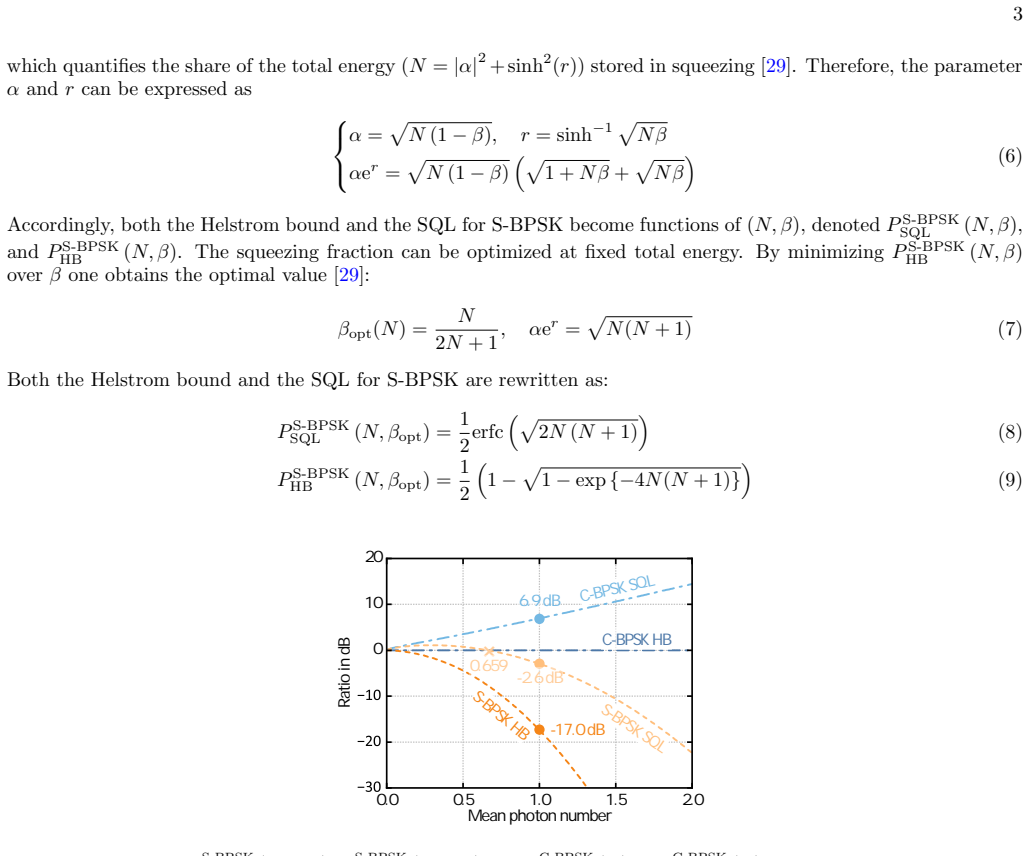
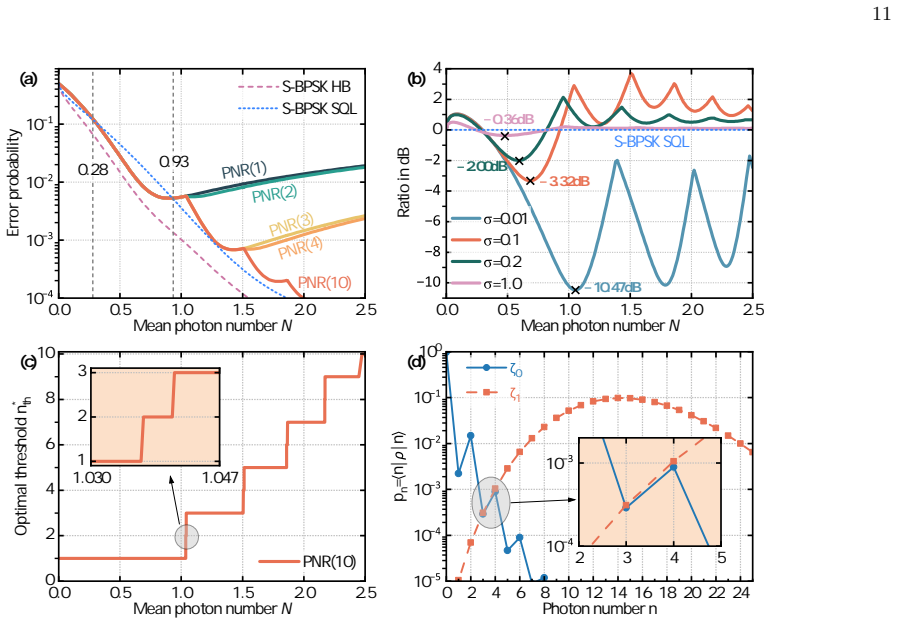
- The receiver surpasses the standard quantum limit for squeezed-state binary phase-shift keying at mean photon number N approximately 0.3.
- It outperforms the Helstrom bound of coherent-state binary phase-shift keying at N approximately 0.4.
- It reaches the 1 percent error level near N approximately 0.6 under ideal equal-prior conditions.
- Adaptive thresholding keeps performance robust against finite detector efficiency, dark counts, channel phase diffusion, and receiver thermal noise.
- Transmission loss progressively reduces the squeezing-enabled advantage, making the receiver most useful in the low-loss regime.
Where Pith is reading between the lines
- Matching the degree of receiver inverse-squeezing to the transmitter squeezing parameter could be optimized to extend the performance advantage into moderately lossy channels.
- The same conversion of squeezing into photon-count contrast may apply to other modulation formats that use displaced squeezed states.
- Low-energy squeezed sources paired with this receiver could support lower-power quantum key distribution links when channel loss is small.
- The architecture illustrates how tailored non-Gaussian measurements can extract more information from squeezed light than standard homodyne or direct-detection schemes.
Load-bearing premise
The inverse-squeezing operation can be realized with negligible added noise in the low-loss regime for the fixed source parametrization chosen in the work.
What would settle it
An experiment that measures the bit error rate of the proposed receiver at mean photon number N approximately 0.3 under ideal conditions and checks whether the rate lies below the standard quantum limit curve for squeezed-state binary phase-shift keying.
Figures






read the original abstract
We propose an inverse-squeezing Kennedy receiver for discriminating binary phase-shift-keyed displaced squeezed vacuum states. The receiver combines a Kennedy-type nulling displacement, an orthogonally oriented inverse-squeezing operation and photon-number-resolving detection with a maximum-a-\emph{posteriori} threshold rule. Its key mechanism is that the inverse-squeezing stage converts transmitter-side squeezing into enhanced photon-number contrast, or equivalently an effective coherent-state energy gain, that can be directly exploited at the measurement stage. Under ideal equal-prior conditions, the receiver surpasses the standard quantum limit for squeezed-state binary phase-shift keying at approximately $N\approx 0.3$, outperforms the Helstrom bound of coherent-state binary phase-shift keying at approximately $N\approx 0.4$, and reaches the 1\% error level near $N\approx 0.6$. We further analyze its performance under realistic imperfections, including finite detector efficiency, dark counts, channel phase diffusion, receiver thermal noise and transmission loss. The results show that adaptive thresholding preserves robust performance against detector and noise imperfections over practical parameter ranges, whereas transmission loss progressively suppresses the squeezing-enabled advantage. These findings indicate that, for the fixed source parametrization adopted in this work, the proposed receiver is most advantageous in the low-loss regime, especially at low source energies.
Editorial analysis
A structured set of objections, weighed in public.
Referee Report
Summary. The manuscript proposes an inverse-squeezing Kennedy receiver for discriminating binary phase-shift-keyed displaced squeezed vacuum states. The receiver combines a Kennedy-type nulling displacement, an orthogonally oriented inverse-squeezing operation, and photon-number-resolving detection with a maximum-a-posteriori threshold rule. Under ideal equal-prior conditions, the receiver is claimed to surpass the standard quantum limit for squeezed-state BPSK at N≈0.3, outperform the Helstrom bound of coherent-state BPSK at N≈0.4, and reach the 1% error level near N≈0.6. The work further analyzes performance under imperfections including finite detector efficiency, dark counts, channel phase diffusion, receiver thermal noise, and transmission loss, concluding that the advantage is most pronounced in the low-loss regime for the adopted source parametrization.
Significance. If the central performance thresholds are robust, the work provides a concrete receiver architecture that converts transmitter squeezing into measurable photon-number contrast, offering a pathway toward quantum-limited discrimination at low mean photon numbers. The explicit treatment of multiple realistic imperfections adds practical value for assessing feasibility in quantum communication protocols.
major comments (1)
- [Performance analysis (ideal and imperfect cases)] The headline thresholds (surpassing SQL at N≈0.3 and Helstrom coherent bound at N≈0.4) rest on modeling the inverse-squeezing stage as an ideal noiseless unitary. While the manuscript analyzes receiver thermal noise and other imperfections, it does not report quantitative sensitivity of the crossing points to modest added noise or loss (0.05–0.2 dB) specifically within the inverse-squeezing operation itself; this modeling choice is load-bearing for the low-N claims.
minor comments (2)
- [Abstract] The abstract refers to a 'fixed source parametrization' without specifying the relation between squeezing parameter and mean photon number N; adding one sentence or a reference to the relevant equation would improve clarity.
- [Figures] Figure captions and axis labels should explicitly state whether curves include the MAP threshold optimization or assume a fixed threshold, to avoid ambiguity when comparing to the reported numerical thresholds.
Simulated Author's Rebuttal
We thank the referee for their careful reading of the manuscript and for highlighting the importance of assessing robustness in the inverse-squeezing stage. We address the major comment below and will incorporate the requested analysis in the revised version.
read point-by-point responses
-
Referee: [Performance analysis (ideal and imperfect cases)] The headline thresholds (surpassing SQL at N≈0.3 and Helstrom coherent bound at N≈0.4) rest on modeling the inverse-squeezing stage as an ideal noiseless unitary. While the manuscript analyzes receiver thermal noise and other imperfections, it does not report quantitative sensitivity of the crossing points to modest added noise or loss (0.05–0.2 dB) specifically within the inverse-squeezing operation itself; this modeling choice is load-bearing for the low-N claims.
Authors: We agree that the headline thresholds rely on an ideal model of the inverse-squeezing operation and that explicit quantification of sensitivity to small added loss or noise in that stage is needed to support the low-N claims. In the revised manuscript we will add a dedicated subsection that introduces a loss parameter (0.05–0.2 dB) and a small thermal-noise term directly into the inverse-squeezing unitary, recomputes the error-probability curves, and reports the resulting shifts in the crossing points with both the squeezed-state SQL and the coherent-state Helstrom bound. We will also include a brief discussion of how these shifts affect the 1 % error threshold near N≈0.6. This addition will be placed immediately after the ideal-case analysis and before the existing imperfect-detector and channel-loss sections. revision: yes
Circularity Check
No significant circularity; performance metrics derived from independent quantum-optical calculations
full rationale
The paper evaluates receiver error rates by applying the standard quantum-optical expressions for displaced squeezed vacuum states, displacement operations, inverse squeezing, and photon-number-resolving detection to compute success probabilities and compare them against the Helstrom bound and SQL. These calculations use fixed source parameters (mean photon number N and squeezing level) as inputs and produce output error curves directly; no parameters are fitted to the target crossing points, no result is defined in terms of itself, and no load-bearing premise reduces to a self-citation or author-specific ansatz. The ideal inverse-squeezing assumption is stated as an explicit modeling choice for the low-loss regime rather than derived from the performance figures. The derivation therefore remains self-contained against external benchmarks.
Axiom & Free-Parameter Ledger
free parameters (1)
- mean photon number N
axioms (1)
- standard math Quantum mechanics of displaced squeezed vacuum states and photon-number-resolving detection
Reference graph
Works this paper leans on
-
[1]
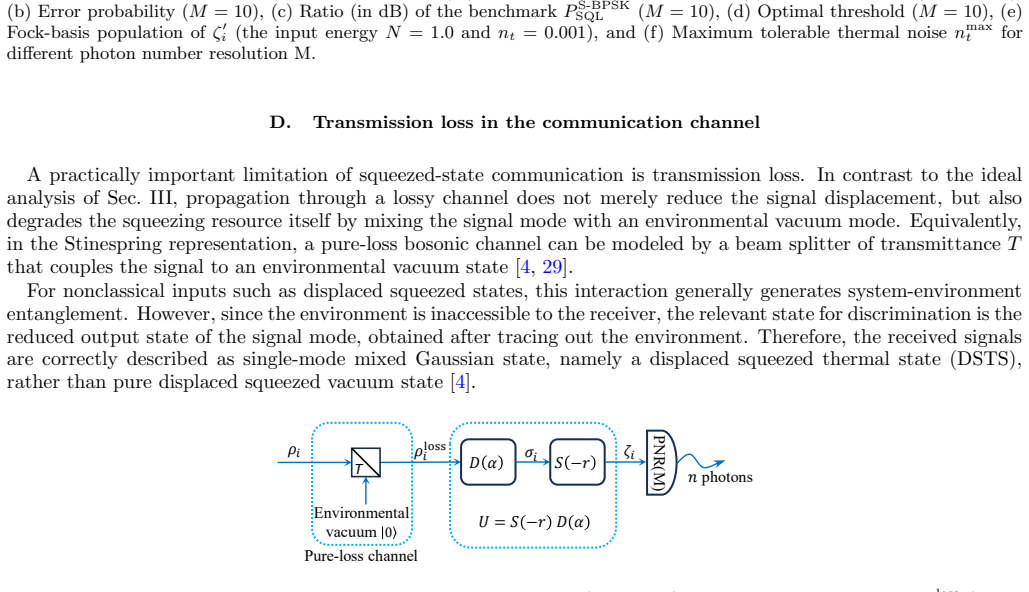
Input Gaussian-state description.The S-BPSK input alphabet of pure-loss channel is|ψ i⟩=D[(−1) i+1α]S(r)|0⟩ withα, r∈R +. As shown in Appendix A, each displaced squeezed state is a single-mode Gaussian state fully char- acterized by its displacement vector and covariance matrix. In the quadrature basis ( ˆX, ˆP) one has ⃗di = (−1)i+1√ 2α 0 ,V= 1 2 e−2r 0 ...
-
[2]
Pure-loss channel as a Gaussian map.We model propagation by a pure-loss bosonic channel with transmittance T∈[0,1] (see Fig. 11). At the operator level, the channel can be represented as ˆaout = √ Tˆain + √ 1−Tˆv,(46) where ˆvis an environmental vacuum mode [4]. For displaced squeezed vacuum state, this channel acts linearly on first and second moments: ⃗...
-
[3]
Equivalent squeezed-thermal parametrization.It is convenient to rewriteV (T) in the standard squeezed-thermal form V(T) = nT + 1 2 e−2rT 0 0e 2rT .(48) By comparing matrix elements, the residual squeezing parameterr T and the equivalent thermal photon numbern T are obtained as rT = 1 4 ln 1−T+T e 2r 1−T+T e −2r , nT = 1 2 hp (1−T+T e −2r)(1−T+T e 2r)−1 i ...
-
[4]
Matched IS-Kennedy processing after a lossy channel.In the ideal receiver of Sec. III, the nulling displacement D(α) and the inverse-squeezingS(−r) are matched to the transmitted state. After a lossy channel, the received hypotheses are centered at± √ T α, rather than at±α, and exhibit residual squeezingr T rather thanr. Therefore, the matched version of ...
-
[5]
V. Giovannetti, S. Guha, S. Lloyd, L. Maccone, J. H. Shapiro, and H. P. Yuen, Classical capacity of the lossy bosonic channel: The exact solution, Phys. Rev. Lett.92, 027902 (2004)
work page 2004
-
[6]
M. M. Wolf, D. P´ erez-Garc´ ıa, and G. Giedke, Quantum capacities of bosonic channels, Phys. Rev. Lett.98, 130501 (2007)
work page 2007
-
[7]
L. Lami, K. K. Sabapathy, and A. Winter, All phase-space linear bosonic channels are approximately gaussian dilatable, New J. Phys.20, 113012 (2018)
work page 2018
-
[8]
C. Weedbrook, S. Pirandola, R. Garc´ ıa-Patr´ on, N. J. Cerf, T. C. Ralph, J. H. Shapiro, and S. Lloyd, Gaussian quantum information, Rev. Mod. Phys.84, 621 (2012)
work page 2012
-
[9]
R. S. Kennedy, A near-optimum receiver for the binary coherent state quantum channel, Research Laboratory of Electronics, MIT, Quarterly Progress Report108, 219 (1973)
work page 1973
-
[10]
M. Takeoka and M. Sasaki, Discrimination of the binary coherent signal: Gaussian-operation limit and simple non-gaussian near-optimal receivers, Phys. Rev. A78, 022320 (2008)
work page 2008
-
[11]
V. A. Vilnrotter, Quantum receiver for distinguishing between binary coherent-state signals with partitioned-interval detection and constant-intensity local lasers, NASA IPN Progress Report42, 189 (2012)
work page 2012
- [12]
-
[13]
T. Chen, K. Li, Y. Zuo, and B. Zhu, Hybrid quantum receiver for quadrature amplitude modulation coherent-state discrimination beating the classical limit, Appl. Opt.57, 817 (2018)
work page 2018
-
[14]
R. Nair, S. Guha, and S.-H. Tan, A realizable receiver for discriminating arbitrary coherent states near the quantum limit, in2013 IEEE International Symposium on Information Theory(IEEE, 2013) pp. 729–733
work page 2013
-
[15]
Y. Zuo, T. Chen, and B. Zhu, Conditional pulse nulling receiver for multi-pulse PPM and binary quantum coding signals, inFourth International Conference on Wireless and Optical Communications, Vol. 9902, International Society for Optics and Photonics (SPIE, 2016) p. 99020V
work page 2016
-
[16]
C. R. M¨ uller, M. A. Usuga, C. Wittmann, M. Takeoka, C. Marquardt, U. L. Andersen, and G. Leuchs, Quadrature phase shift keying coherent state discrimination via a hybrid receiver, New J. Phys.14, 083009 (2012)
work page 2012
- [17]
-
[18]
M. N. Notarnicola, M. G. A. Paris, and S. Olivares, Hybrid near-optimum binary receiver with realistic photon-number- resolving detectors, J. Opt. Soc. Am. B40, 705 (2023)
work page 2023
-
[19]
Y. Zuo, K. Li, and B. Zhu, 16-qam quantum receiver with hybrid structure outperforming the standard quantum limit, MATEC Web of Conferences61, 06008 (2016)
work page 2016
-
[20]
C. W. Helstrom, Quantum detection and estimation theory, J. Stat. Phys.1, 231 (1969)
work page 1969
-
[21]
A. S. Holevo, Bounds for the quantity of information transmitted by a quantum communication channel, Probl. Peredachi Inf.9, 3 (1973)
work page 1973
-
[22]
M. DiMario and F. Becerra, Demonstration of optimal non-projective measurement of binary coherent states with photon counting, npj Quantum Inf.8, 84 (2022)
work page 2022
-
[23]
J. S. Sidhu, M. S. Bullock, S. Guha, and C. Lupo, Linear optics and photodetection achieve near-optimal unambiguous coherent state discrimination, Quantum7, 1025 (2023)
work page 2023
-
[24]
E. Bai, T. Wu, F. Sun, J. Peng, Z. Zhou, C. Dong, and Z. Zhang, Heterodyne-like feedforward partitioned-displacement hybrid receiver for qpsk coherent state discrimination with realistic photon-number-resolving detectors, Opt. Express33, 54816 (2025)
work page 2025
-
[25]
F. Sun, E. Bai, Z. Zhou, J. Peng, C. Dong, and Z. Zhang, Multichannel optimal squeezing-displacement feedforward receiver with realistic photon-number-resolving detectors, Opt. Express34, 8522 (2026)
work page 2026
- [26]
-
[27]
M. Rosati, Performance of coherent frequency-shift keying for classical communication on quantum channels, in2021 IEEE International Symposium on Information Theory (ISIT)(IEEE, 2021) p. 902–905
work page 2021
-
[28]
J. S. Sidhu, S. Izumi, J. S. Neergaard-Nielsen, C. Lupo, and U. L. Andersen, Quantum receiver for phase-shift keying at the single-photon level, PRX Quantum2, 010332 (2021)
work page 2021
-
[29]
M. Rosati and A. Solana, Joint-detection learning for optical communication at the quantum limit, Optica Quantum2, 390 (2024)
work page 2024
-
[30]
C. Cui, W. Horrocks, S. Hao, S. Guha, N. Peyghambarian, Q. Zhuang, and Z. Zhang, Quantum receiver enhanced by adaptive learning, Light Sci. Appl.11, 344 (2022)
work page 2022
- [31]
-
[32]
M. G. A. Paris, Nearly ideal binary communication in squeezed channels, Phys. Rev. A64, 014304 (2001). 20
work page 2001
- [33]
- [34]
-
[35]
I. A. Burenkov, M. V. Jabir, and S. V. Polyakov, Practical quantum-enhanced receivers for classical communication, AVS Quantum Sci.3, 025301 (2021)
work page 2021
-
[36]
S. M. Barnett, L. S. Phillips, and D. T. Pegg, Imperfect photodetection as projection onto mixed states, Opt. Commun. 158, 45 (1998)
work page 1998
- [37]
-
[38]
C. Ding, X. Zhang, J. Xiong, Y. Xiao, T. Zhang, J. Huang, H. Xu, X. Liu, L. You, Z. Wang, and H. Li, Photon-number- resolving single-photon detector with a system detection efficiency of 98% and photon-number resolution of 32, ACS Photonics12, 4924 (2025)
work page 2025
- [39]
- [40]
-
[41]
M. N. Notarnicola and S. Olivares, A robust hybrid receiver for binary phase-shift keying discrimination in the presence of phase noise, Int. J. Quantum Inf.22, 2450008 (2024)
work page 2024
-
[42]
R. Yuan, M. Zhao, S. Han, and J. Cheng, Kennedy receiver using threshold detection and optimized displacement under thermal noise, IEEE Commun. Lett.24, 1313 (2020)
work page 2020
-
[43]
M. Zhao, R. Yuan, J. Cheng, and S. Han, Security of binary modulated continuous variable quantum key distribution using optimally displaced threshold detection, IEEE Commun. Lett.25, 1089 (2021)
work page 2021
-
[44]
R. Yuan, M. Zhao, S. Han, and J. Cheng, Optimally displaced threshold detection for discriminating binary coherent states using imperfect devices, IEEE Trans. Commun.69, 2546 (2021)
work page 2021
-
[45]
G. Cariolaro and G. Pierobon, Performance of quantum data transmission systems in the presence of thermal noise, IEEE Trans. Commun.58, 623 (2010)
work page 2010
-
[46]
M. Heid and N. L¨ utkenhaus, Efficiency of coherent-state quantum cryptography in the presence of loss: Influence of realistic error correction, Phys. Rev. A73, 052316 (2006)
work page 2006
-
[47]
J. F. Dynes, S. J. Kindness, S. W.-B. Tam, A. Plews, A. W. Sharpe, M. Lucamarini, B. Fr¨ ohlich, Z. L. Yuan, R. V. Penty, and A. J. Shields, Quantum key distribution over multicore fiber, Opt. Express24, 8081 (2016)
work page 2016
discussion (0)
Sign in with ORCID, Apple, or X to comment. Anyone can read and Pith papers without signing in.