Variable coherence model for free-electron laser pulses
Pith reviewed 2026-05-16 14:04 UTC · model grok-4.3
The pith
The variable coherence model lets researchers dial the noise level in simulated free-electron laser pulses while leaving average bandwidth and other pulse properties unchanged.
A machine-rendered reading of the paper's core claim, the machinery that carries it, and where it could break.
Core claim
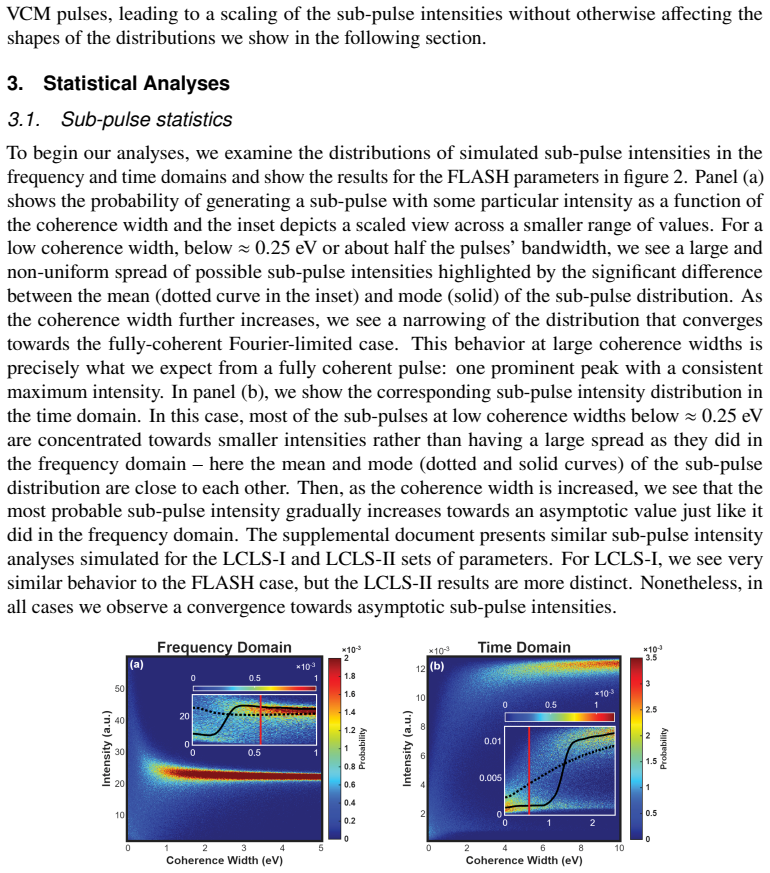
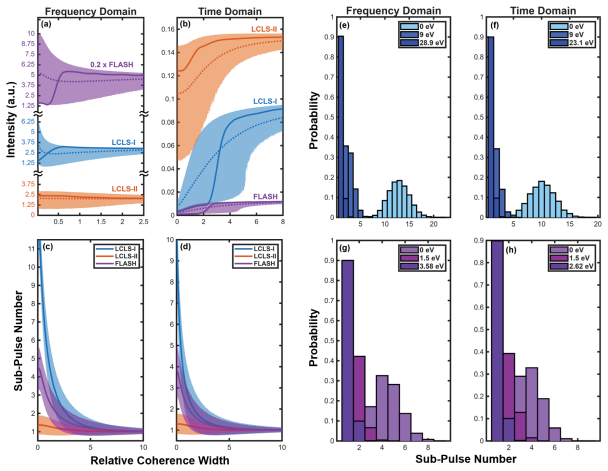
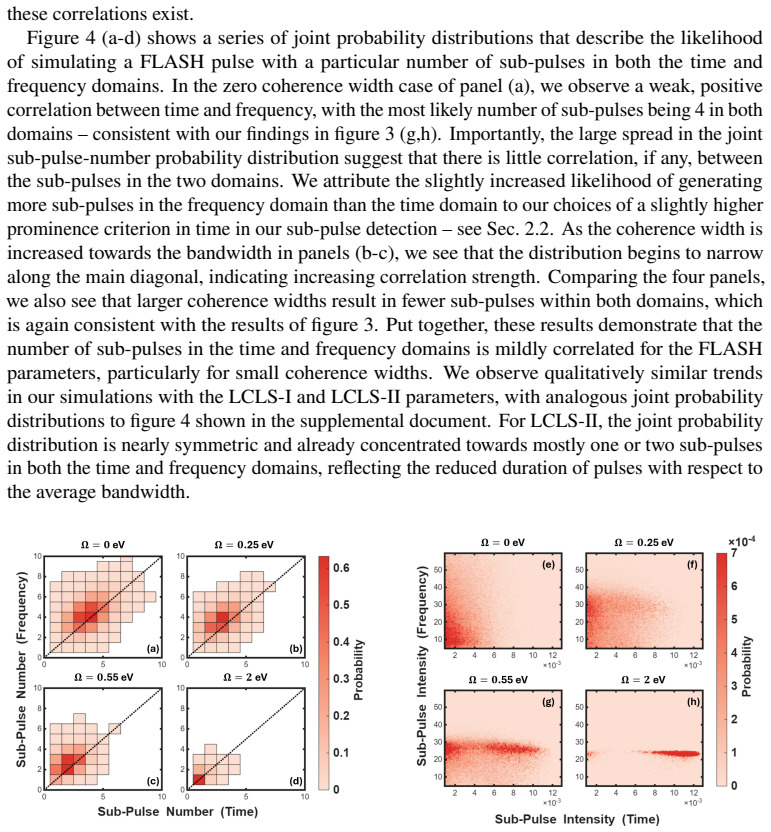
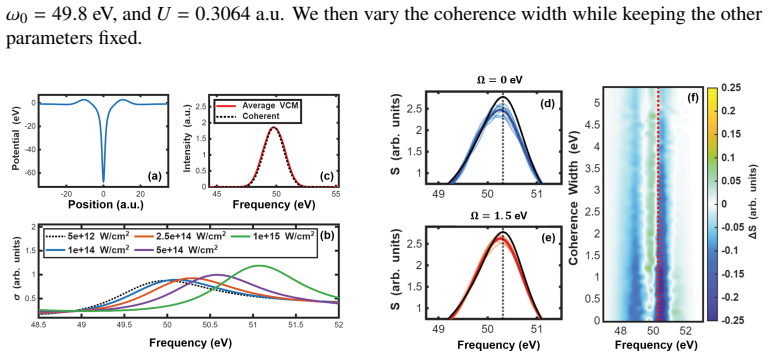
The variable coherence model extends the partial coherence framework by introducing an adjustable coherence width that continuously varies the characteristic noise of FEL pulses from maximally random to fully coherent while the ensemble-averaged bandwidth and other mean pulse parameters remain fixed; statistical distributions of intensity and sub-pulse number in time and frequency domains respond systematically to this width across multiple FEL regimes, and the width also modulates results in an absorption simulation.
What carries the argument
The coherence width parameter, which defines the temporal interval over which successive field slices remain phase-correlated and thereby sets the number and randomness of intensity sub-pulses.
If this is right
- Pulses generated by the model span the full range from maximally random to fully coherent behavior.
- Sub-pulse counts and intensity fluctuations in both time and frequency domains vary continuously and predictably with the coherence width.
- The model can be inserted into absorption or other interaction simulations while keeping average bandwidth and fluence fixed.
- The same control works across at least three distinct FEL parameter regimes.
Where Pith is reading between the lines
- Experimenters could use the width parameter to match simulated noise statistics to the measured output of a specific FEL beamline without recalibrating the entire pulse model.
- The approach might be adapted to other partially coherent sources such as high-harmonic generation or synchrotron radiation where similar noise control is desired.
- By isolating noise as an independent variable, the model enables systematic studies of how pulse randomness affects nonlinear processes or imaging resolution.
- One could test whether the same width parameter also governs higher-order statistics such as pulse-to-pulse correlation functions not examined in the present work.
Load-bearing premise
The coherence width can be changed independently without unintentionally shifting other pulse statistics beyond the intended noise level, and the underlying partial coherence description remains accurate in the tested regimes.
What would settle it
Measured FEL pulse trains from a facility whose observed noise level fails to follow the predicted monotonic dependence on coherence width would falsify the model.
Figures

read the original abstract
We introduce the variable coherence model (VCM) for simulating free-electron laser (FEL) pulses generated through self-amplified spontaneous emission. Building on the established partial coherence model of [T. Pfeifer et. al, Opt. Lett. 35, 3441 (2010)], we demonstrate that the implementation of a variable coherence width allows for continuous control over the pulses' characteristic noise, while keeping the average pulse parameters such as the bandwidth fixed. We demonstrate this through systematic statistical analyses of the intensity and number of sub-pulses in VCM pulses, in both time and frequency. In particular, we analyze how the sub-pulse statistics are affected by the coherence width parameter. We perform our analyses across three distinct regimes of FEL parameters and demonstrate how the VCM can generate pulses that range from maximally random to fully coherent. Finally, we illustrate the effect of the VCM variable coherence width on an absorption simulation.
Editorial analysis
A structured set of objections, weighed in public.
Referee Report
Summary. The paper introduces the Variable Coherence Model (VCM) for simulating SASE FEL pulses, extending the 2010 partial-coherence framework of Pfeifer et al. by making the coherence width a tunable parameter. The central claim is that this allows continuous control over pulse noise statistics (intensity fluctuations and sub-pulse counts in time and frequency) while holding average parameters such as bandwidth fixed. The authors demonstrate the approach through statistical analyses across three FEL regimes spanning maximally random to fully coherent pulses and apply the model to an absorption simulation.
Significance. If the decoupling between coherence width and bandwidth holds, the VCM supplies a simple, one-parameter extension that lets users generate FEL pulse ensembles with prescribed noise levels at fixed mean spectral and temporal properties. This would be useful for modeling experiments sensitive to shot-to-shot fluctuations, such as nonlinear spectroscopy or imaging, and for bridging fully stochastic and coherent simulation regimes. The systematic multi-regime statistics and the absorption example provide concrete evidence of practical utility.
major comments (2)
- [Model definition / §2] Model construction (likely §2): The claim that bandwidth remains fixed when the coherence width is varied is load-bearing for the central result. Because temporal coherence and spectral width are Fourier conjugates, the normalization and filtering steps used to implement the variable width must be shown explicitly not to shift the FWHM or RMS bandwidth. The manuscript should include a direct verification—e.g., a plot or table of measured bandwidth versus coherence width across the three regimes—together with the precise normalization formula.
- [Statistical analyses] Statistical analysis section: The counting procedure for sub-pulses (both temporal and spectral) is not fully specified. Without an unambiguous definition of a “sub-pulse” (threshold, width criterion, etc.) and the number of independent realizations used to compute means and variances, it is difficult to assess whether the reported continuous control is robust or sensitive to post-processing choices.
minor comments (2)
- [Abstract] Abstract: The three FEL regimes should be characterized at least by their nominal pulse duration, peak power, or central wavelength so readers can map the results onto their own experimental conditions.
- [Figures] Figure captions and legends: All panels that vary the coherence width parameter should state the numerical values used and the number of shots averaged.
Simulated Author's Rebuttal
We thank the referee for the careful reading and constructive comments. We address the two major points below and will revise the manuscript to incorporate the requested clarifications and verifications.
read point-by-point responses
-
Referee: [Model definition / §2] Model construction (likely §2): The claim that bandwidth remains fixed when the coherence width is varied is load-bearing for the central result. Because temporal coherence and spectral width are Fourier conjugates, the normalization and filtering steps used to implement the variable width must be shown explicitly not to shift the FWHM or RMS bandwidth. The manuscript should include a direct verification—e.g., a plot or table of measured bandwidth versus coherence width across the three regimes—together with the precise normalization formula.
Authors: We agree that an explicit verification strengthens the central claim. In the VCM the variable coherence width is realized by multiplying the base spectrum by a tunable Gaussian filter whose integral is normalized to unity before the inverse Fourier transform; this construction is designed to leave the RMS bandwidth unchanged. We will add a new panel (or table) in §2 that plots both FWHM and RMS bandwidth versus coherence width for all three regimes, together with the exact normalization formula used in the filtering step. revision: yes
-
Referee: [Statistical analyses] Statistical analysis section: The counting procedure for sub-pulses (both temporal and spectral) is not fully specified. Without an unambiguous definition of a “sub-pulse” (threshold, width criterion, etc.) and the number of independent realizations used to compute means and variances, it is difficult to assess whether the reported continuous control is robust or sensitive to post-processing choices.
Authors: We thank the referee for highlighting this omission. Sub-pulses are identified with a peak-finding routine that applies a 10 % intensity threshold relative to the global maximum and a minimum temporal/spectral width set by the coherence time (or coherence length) of the pulse. All statistics are computed from 1000 independent realizations per parameter point. We will insert a concise but complete description of this procedure, including the exact threshold and width criteria, into the revised statistical-analysis section. revision: yes
Circularity Check
No significant circularity
full rationale
The derivation extends an external 2010 partial-coherence model (Pfeifer et al.) by adding one tunable coherence-width parameter. Central claims of independent noise control at fixed bandwidth are supported by explicit statistical analyses of intensity profiles and sub-pulse counts across three FEL regimes, rather than by redefinition or fitting that forces the outcome. No load-bearing self-citation, ansatz smuggling, or reduction of predictions to inputs by construction appears in the chain.
Axiom & Free-Parameter Ledger
free parameters (1)
- coherence width
axioms (1)
- domain assumption The partial coherence model of Pfeifer et al. (2010) provides an accurate base description of SASE FEL pulse statistics.
invented entities (1)
-
Variable Coherence Model (VCM)
no independent evidence
Reference graph
Works this paper leans on
-
[1]
Tunableisolatedattosecondx -raypulseswithgigawattpeakpowerfromafree -electron laser,
J.Duris,S.Li,T.Driveret al.,“Tunableisolatedattosecondx -raypulseswithgigawattpeakpowerfromafree -electron laser,” Nat. Photonics14, 30–36 (2020)
work page 2020
-
[2]
Free-electron lasers: New avenues in molecular physics and photochemistry,
J. Ullrich, A. Rudenko, and R. Moshammer, “Free-electron lasers: New avenues in molecular physics and photochemistry,” Annu. Rev. Phys. Chem.63, 635–660 (2012)
work page 2012
-
[3]
Terawatt-attosecond hard x-ray free-electron laser at high repetition rate,
J. Yan, W. Qin, Y. Chenet al., “Terawatt-attosecond hard x-ray free-electron laser at high repetition rate,” Nat. Photonics18, 1293–1298 (2024)
work page 2024
-
[4]
The physics of x-ray free-electron lasers,
C. Pellegrini, A. Marinelli, and S. Reiche, “The physics of x-ray free-electron lasers,” Rev. Mod. Phys.88, 015006 (2016)
work page 2016
-
[5]
F. Lever, D. Mayer, J. Metjeet al., “Core-level spectroscopy of 2-thiouracil at the sulfur l1- and l2,3-edges utilizing a sase free-electron laser,” Molecules26(2021)
work page 2021
-
[6]
Experimental demonstration of attosecond pump–probe spectroscopy with an x-ray free-electron laser,
Z. Guo, T. Driver, S. Beauvarletet al., “Experimental demonstration of attosecond pump–probe spectroscopy with an x-ray free-electron laser,” Nat. Photon.18, 691–697 (2024)
work page 2024
-
[7]
The development of attosecond xfels for understanding ultrafast electron motion,
J. P. Cryan, T. Driver, J. Duriset al., “The development of attosecond xfels for understanding ultrafast electron motion,” inAdvances in Atomic, Molecular, and Optical Physics,vol. 71 ofAdvances In Atomic, Molecular, and Optical PhysicsL. F. DiMauro, H. Perrin, and S. F. Yelin, eds. (Academic Press, 2022), pp. 1–64
work page 2022
-
[8]
N. Berrah, J. Cryan, R. R. Robleset al., “Attosecond x-ray sources, methods, and applications at present and future free-electron lasers: tutorial,” Adv. Opt. Photon.17, 623–725 (2025)
work page 2025
-
[9]
S. Li, Z. Zhang, S. Alversonet al., ““beam à la carte”: Laser heater shaping for attosecond pulses in a multiplexed x-ray free-electron laser,” Appl. Phys. Lett.125, 191101 (2024)
work page 2024
-
[10]
Spectrotemporal shaping of attosecond x-ray pulses with a fresh-slice free-electron laser,
R. R. Robles, K. A. Larsen, D. Cesaret al., “Spectrotemporal shaping of attosecond x-ray pulses with a fresh-slice free-electron laser,” Phys. Rev. Lett.134, 115001 (2025)
work page 2025
-
[11]
Free electron lasers: Present status and future challenges,
W. A. Barletta, J. Bisognano, J. Corlettet al., “Free electron lasers: Present status and future challenges,” Nucl. Instruments Methods Phys. Res. Sect. A: Accel. Spectrometers, Detect. Assoc. Equip.618, 69–96 (2010)
work page 2010
-
[12]
On spectral and temporal coherence of x-ray free-electron laser beams,
L. Ahad, I. Vartiainen, T. Setäläet al., “On spectral and temporal coherence of x-ray free-electron laser beams,” Opt. Express24, 13081–13090 (2016)
work page 2016
-
[13]
Study of temporal, spectral, arrival time and energy fluctuations of sase fel pulses,
I. J. B. Macias, S. Düsterer, R. Ivanovet al., “Study of temporal, spectral, arrival time and energy fluctuations of sase fel pulses,” Opt. Express29, 10491–10508 (2021)
work page 2021
-
[14]
N. Berrah, J. Bozek, J. Costelloet al., “Non-linear processes in the interaction of atoms and molecules with intense euv and x-ray fields from sase free electron lasers (fels),” J. Mod. Opt.57, 1015–1040 (2010)
work page 2010
-
[15]
Multi-photon ionization of molecular nitrogen by femtosecond soft x-ray fel pulses,
A. A. Sorokin, S. V. Bobashev, K. Tiedtkeet al., “Multi-photon ionization of molecular nitrogen by femtosecond soft x-ray fel pulses,” J. Phys. B: At. Mol. Opt. Phys.39, L299 (2006)
work page 2006
-
[16]
X-ray nonlinear optical processes using a self-amplified spontaneous emission free-electron laser,
N. Rohringer and R. Santra, “X-ray nonlinear optical processes using a self-amplified spontaneous emission free-electron laser,” Phys. Rev. A76, 033416 (2007)
work page 2007
-
[17]
Transmission spectroscopy ofcf4 molecules in intense x-ray fields,
R. Jin, A. Fouda, A. Maguniaet al., “Transmission spectroscopy ofcf4 molecules in intense x-ray fields,” Phys. Rev. A111, 012808 (2025)
work page 2025
-
[18]
Quantifying noise in ultrafast laser sources and its effect on nonlinear applications,
V. V. Lozovoy, G. Rasskazov, D. Pestovet al., “Quantifying noise in ultrafast laser sources and its effect on nonlinear applications,” Opt. Express23, 12037–12044 (2015)
work page 2015
-
[19]
Femtosecond covariance spectroscopy,
J. O. Tollerud, G. Sparapassi, A. Montanaroet al., “Femtosecond covariance spectroscopy,” Proc. National Acad. Sci. 116, 5383–5386 (2019)
work page 2019
-
[20]
Two-dimensionalcorrelationanalysisforx-rayphotoelectronspectroscopy,
S.Li,T.Driver,andA.o.A.AlHaddad,“Two-dimensionalcorrelationanalysisforx-rayphotoelectronspectroscopy,” J. Phys. B: At. Mol. Opt. Phys.54, 144005 (2021)
work page 2021
-
[21]
Sase-fel stochastic spectroscopy investigation on xuv absorption and emission dynamics in silicon,
D. D. Angelis, E. Principi, D. Faustiet al., “Sase-fel stochastic spectroscopy investigation on xuv absorption and emission dynamics in silicon,” inProceedings of the 40th International Free Electron Laser Conference (FEL2022), (2023), p. 103
work page 2023
-
[22]
Pump-probe ghost imaging with sase fels,
D. Ratner, J. P. Cryan, T. J. Laneet al., “Pump-probe ghost imaging with sase fels,” Phys. Rev. X9, 011045 (2019)
work page 2019
-
[23]
Ghost imaging at an xuv free-electron laser,
Y. Y. Kim, L. Gelisio, G. Mercurioet al., “Ghost imaging at an xuv free-electron laser,” Phys. Rev. A101, 013820 (2020)
work page 2020
-
[24]
Partial-coherence method to model experimental free-electron laser pulse statistics,
T. Pfeifer, Y. Jiang, S. Düstereret al., “Partial-coherence method to model experimental free-electron laser pulse statistics,” Opt. Lett.35, 3441–3443 (2010)
work page 2010
-
[25]
Resonant propagation of x rays from the linear to the nonlinear regime,
K. Li, M. Labeye, P. J. Hoet al., “Resonant propagation of x rays from the linear to the nonlinear regime,” Phys. Rev. A102, 053113 (2020)
work page 2020
-
[26]
Atomic inner-shell x-ray laser at 1.46 nanometres pumped by an x-ray free-electron laser,
N. Rohringer, D. Ryan, R. A. Londonet al., “Atomic inner-shell x-ray laser at 1.46 nanometres pumped by an x-ray free-electron laser,” Nature481, 488–491 (2012)
work page 2012
-
[27]
J. T. O’Neal, E. G. Champenois, S. Oberliet al., “Electronic population transfer via impulsive stimulated x-ray raman scattering with attosecond soft-x-ray pulses,” Phys. Rev. Lett.125, 073203 (2020)
work page 2020
-
[28]
Z. Zhang, J. Duris, J. P. MacArthuret al., “Experimental demonstration of enhanced self-amplified spontaneous emission by photocathode temporal shaping and self-compression in a magnetic wiggler,” New J. Phys.22, 083066 (2020)
work page 2020
-
[29]
Signal processing toolbox version: 9.4 (r2025b),
The MathWorks Inc., “Signal processing toolbox version: 9.4 (r2025b),” (2025)
work page 2025
-
[30]
Numericalsimulationsofmultiphotonionizationandabove-thresholdelectron spectra,
J.Javanainen,J.H.Eberly,andQ.Su,“Numericalsimulationsofmultiphotonionizationandabove-thresholdelectron spectra,” Phys. Rev. A38, 3430–3446 (1988)
work page 1988
-
[31]
Attosecond timing of electron emission from a molecular shape resonance,
S. Nandi, E. Plésiat, S. Zhonget al., “Attosecond timing of electron emission from a molecular shape resonance,” Sci. Adv.6, eaba7762 (2020)
work page 2020
-
[32]
Qmol-grid: A matlab package for quantum-mechanical simulations in atomic and molecular systems,
F. Mauger and C. Chandre, “Qmol-grid: A matlab package for quantum-mechanical simulations in atomic and molecular systems,” SoftwareX28, 101968 (2024)
work page 2024
-
[33]
Orbital energy analysis with respect to lda and self-interaction corrected exchange-only potentials,
J. Garza, R. Vargas, J. A. Nicholset al., “Orbital energy analysis with respect to lda and self-interaction corrected exchange-only potentials,” The J. Chem. Phys.114, 639–651 (2001)
work page 2001
-
[34]
Probing ultrafast dynamics with attosecond transient absorption,
A. R. Beck, D. M. Neumark, and S. R. Leone, “Probing ultrafast dynamics with attosecond transient absorption,” Chem. Phys. Lett.624, 119–130 (2015)
work page 2015
-
[35]
Theory of strong-field attosecond transient absorption,
M. Wu, S. Chenet al., “Theory of strong-field attosecond transient absorption,” J. Phys. B: At. Mol. Opt. Phys.49, 062003 (2016). Supplemental document Additional sub-pulse statistics Figure S1 shows the simulated sub-pulse intensity distributions as a function of the coherence width for the LCLS-I parameter set. As mentioned in section 3.1 of the main do...
work page 2016
discussion (0)
Sign in with ORCID, Apple, or X to comment. Anyone can read and Pith papers without signing in.