Recognition: no theorem link
A Low-Complexity Framework for Multi-access Coded Caching Systems with Arbitrary User-cache Access Topology
Pith reviewed 2026-05-16 14:37 UTC · model grok-4.3
The pith
Graph neural networks color conflict graphs to deliver multi-access coded caching at loads close to the index-coding bound with low complexity.
A machine-rendered reading of the paper's core claim, the machinery that carries it, and where it could break.
Core claim
By representing packet delivery conflicts in an arbitrary MACC system as edges in a conflict graph and using a GNN to assign colors, the framework constructs a set of coded transmissions whose total length is close to the information-theoretic minimum for any given user-cache access topology and request pattern.
What carries the argument
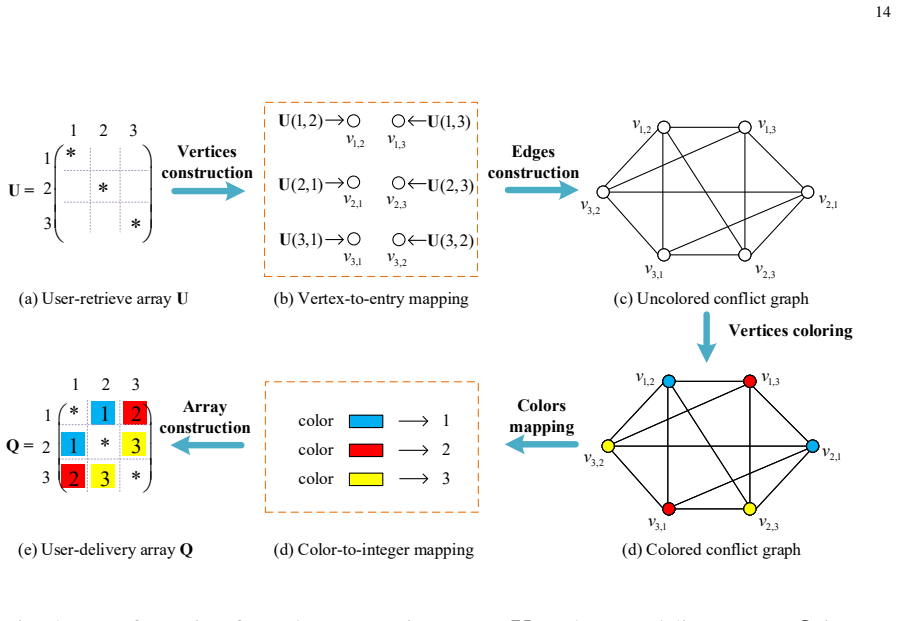
The conflict graph whose vertices are requested packets and whose edges encode decoding conflicts among users; its minimum coloring directly determines the minimal number of multicast transmissions needed.
If this is right
- The GNN method scales to system sizes where exact coloring algorithms become intractable.
- Coded caching remains feasible for arbitrary rather than only combinatorially structured access patterns.
- The greedy approximation supplies a simple baseline that already lies close to the information-theoretic limit.
- Delivery schemes can be computed once per topology class and reused without redesign.
Where Pith is reading between the lines
- Learned graph-coloring heuristics may replace combinatorial solvers in other index-coding or network-coding settings that admit a conflict-graph formulation.
- If the generalization holds, the same trained model could support online topology changes without full retraining.
- The reduction to graph coloring suggests that progress on scalable graph algorithms directly improves practical coded caching performance.
Load-bearing premise
A single GNN trained on a finite collection of topologies and user counts will continue to produce near-optimal colorings on completely new arbitrary access topologies without retraining.
What would settle it
A test set of previously unseen access topologies and user counts on which the GNN's achieved transmission load exceeds the extended index-coding bound by a margin larger than the gap observed with DSatur.
Figures






read the original abstract
This paper studies the multi-access coded caching (MACC) problem with arbitrary user-cache access topology, which extends existing MACC models that rely on highly structured and combinatorially designed topologies. We consider a MACC system consisting of a single server, $\Lambda$ cache-nodes, and $K$ user-nodes. The server stores $N$ equal-size files, each cache-node has a storage capacity of $M$ files, and each user-node $k\in[K]$ can access an arbitrary subset of cache-nodes $\mathcal{A}_k\subseteq[\Lambda]$ and retrieve the cached content stored in cache-nodes $\mathcal{A}_k$. The objective is to design a universal framework for the MACC delivery problem. Decoding conflicts among the requested packets are captured by a conflict graph, and the design of the delivery is reduced to a graph coloring problem, where achieving a lower transmission load corresponds to coloring the graph using fewer colors. Under this formulation, the classical DSatur algorithm achieves a transmission load close to the index-coding (IC) converse bound, thereby providing a practical benchmark. However, its computational complexity becomes prohibitive for large-scale graphs. To overcome this limitation, we develop a learning-driven approach using graph neural networks (GNNs) that efficiently constructs coded multicast transmissions with performance close to the theoretical bounds and generalizes across different user-cache access topologies and numbers of users. In addition, we extend the IC converse bound to MACC systems with arbitrary access topology and propose a low-complexity greedy approximation that closely matches the IC converse bound. Numerical results demonstrate that the proposed approach achieves performance close to the DSatur algorithm and the IC converse bound, while significantly reducing computational complexity, making it well-suited for large-scale MACC systems.
Editorial analysis
A structured set of objections, weighed in public.
Referee Report
Summary. The paper studies multi-access coded caching (MACC) with arbitrary user-cache access topologies A_k. It models the delivery phase as a graph-coloring problem on the induced conflict graph, replaces the high-complexity DSatur heuristic with a GNN-based solver, extends the index-coding converse bound to this setting, and introduces a low-complexity greedy approximation to the bound. Numerical experiments are claimed to show that the GNN produces transmission loads close to both DSatur and the extended IC bound while scaling to large K and Lambda.
Significance. If the GNN generalizes reliably, the work supplies a practical, low-complexity algorithmic framework for MACC systems whose access patterns are not combinatorially structured, together with a matching converse and a simple greedy benchmark. The reduction to conflict-graph coloring and the explicit extension of the IC bound are technically clean contributions that could be reused beyond the GNN component.
major comments (2)
- [Numerical Results] Numerical Results section: the headline claim that the GNN 'achieves performance close to the DSatur algorithm and the IC converse bound' is stated without any tabulated transmission-load values, ratios, standard deviations, or explicit description of the test-set generation process (distribution over Lambda, K, and A_k). Because the central performance assertion rests on these numbers, their absence prevents verification of the generalization claim.
- [GNN Approach] GNN training and generalization paragraph: the manuscript asserts that a single trained model works for 'different user-cache access topologies and numbers of users,' yet provides no details on the training distribution, whether test instances are drawn from the same generative process, or any out-of-distribution experiments with pathological A_k or K larger than the training range. This is load-bearing for the 'arbitrary topology' claim.
minor comments (2)
- [Abstract] The abstract and introduction use 'close to' without defining a quantitative tolerance; a precise statement (e.g., within X % of DSatur load) would improve clarity.
- [IC Bound Extension] Notation for the extended IC bound is introduced without an explicit equation number in the main text; cross-referencing the bound expression would help readers.
Simulated Author's Rebuttal
We thank the referee for the constructive comments, which highlight important aspects of clarity and verifiability in our numerical evaluation and GNN generalization claims. We address each point below and will revise the manuscript to incorporate the requested details.
read point-by-point responses
-
Referee: [Numerical Results] Numerical Results section: the headline claim that the GNN 'achieves performance close to the DSatur algorithm and the IC converse bound' is stated without any tabulated transmission-load values, ratios, standard deviations, or explicit description of the test-set generation process (distribution over Lambda, K, and A_k). Because the central performance assertion rests on these numbers, their absence prevents verification of the generalization claim.
Authors: We agree that the current presentation of the numerical results lacks sufficient quantitative detail for independent verification. In the revised manuscript we will add explicit tables reporting average transmission loads (with ratios to both DSatur and the extended IC bound), standard deviations over repeated trials, and a precise description of the test-set generation process, including the ranges and sampling distributions used for Lambda, K, and the random access topologies A_k. revision: yes
-
Referee: [GNN Approach] GNN training and generalization paragraph: the manuscript asserts that a single trained model works for 'different user-cache access topologies and numbers of users,' yet provides no details on the training distribution, whether test instances are drawn from the same generative process, or any out-of-distribution experiments with pathological A_k or K larger than the training range. This is load-bearing for the 'arbitrary topology' claim.
Authors: We acknowledge the need for greater transparency on the training regime to substantiate the generalization statements. The revised version will specify the exact training distribution over topologies and system sizes, confirm that the reported test instances are drawn from the same generative process, and add out-of-distribution experiments (including larger K and atypical or pathological A_k) to quantify the model's robustness beyond the training range. revision: yes
Circularity Check
No circularity; standard graph reduction plus empirical GNN heuristic with separate training/test sets
full rationale
The derivation reduces MACC delivery to coloring the conflict graph induced by arbitrary A_k access sets (standard modeling step, not self-referential). The IC converse bound is extended mathematically to the arbitrary-topology case and used as an external benchmark rather than fitted from the same numerical results. DSatur serves as an independent algorithmic reference. The GNN is trained on finite sampled topologies and evaluated on held-out instances; reported closeness is an empirical observation, not a quantity defined by construction from the training data or from the bound itself. No equation, parameter fit, or self-citation chain collapses the claimed transmission load back onto the inputs.
Axiom & Free-Parameter Ledger
axioms (2)
- domain assumption The delivery problem can be exactly modeled as a conflict graph whose chromatic number equals the minimum number of multicast transmissions.
- domain assumption The index-coding converse bound remains valid after extension to arbitrary access topologies.
Reference graph
Works this paper leans on
-
[1]
The role of caching in future communication systems and networks,
G. S. Paschos, G. Iosifidis, M. Tao, D. Towsley, and G. Caire, “The role of caching in future communication systems and networks,”IEEE Journal on Selected Areas in Communications, vol. 36, no. 6, pp. 1111–1125, 2018
work page 2018
-
[2]
Fundamental limits of caching,
M. A. Maddah-Ali and U. Niesen, “Fundamental limits of caching,”IEEE Transactions on information theory, vol. 60, no. 5, pp. 2856–2867, 2014
work page 2014
-
[3]
An index coding approach to caching with uncoded cache placement,
K. Wan, D. Tuninetti, and P. Piantanida, “An index coding approach to caching with uncoded cache placement,”IEEE Transactions on Information Theory, vol. 66, no. 3, pp. 1318–1332, 2020
work page 2020
-
[4]
On the placement delivery array design for centralized coded caching scheme,
Q. Yan, M. Cheng, X. Tang, and Q. Chen, “On the placement delivery array design for centralized coded caching scheme,” IEEE Transactions on Information Theory, vol. 63, no. 9, pp. 5821–5833, 2017
work page 2017
-
[5]
A framework of constructing placement delivery arrays for centralized coded caching,
M. Cheng, J. Wang, X. Zhong, and Q. Wang, “A framework of constructing placement delivery arrays for centralized coded caching,”IEEE Transactions on Information Theory, vol. 67, no. 11, pp. 7121–7131, 2021. 43
work page 2021
-
[6]
Placement delivery array construction via cartesian product for coded caching,
J. Wang, M. Cheng, K. Wan, and G. Caire, “Placement delivery array construction via cartesian product for coded caching,” IEEE Transactions on Information Theory, vol. 69, no. 12, pp. 7602–7626, 2023
work page 2023
-
[7]
A framework of constructing pda via union of cache configurations from cartesian product,
——, “A framework of constructing pda via union of cache configurations from cartesian product,” in2025 IEEE International Symposium on Information Theory (ISIT). IEEE, 2025, pp. 1–6
work page 2025
-
[8]
H. Wei, M. Cheng, and K. Leung, “A novel construction of coded caching schemes with polynomial subpacketizations via projective geometry,” in2024 IEEE Information Theory Workshop (ITW). IEEE, 2024, pp. 496–501
work page 2024
-
[9]
Improved constructions of coded caching schemes for combination networks,
M. Cheng, Y . Li, X. Zhong, and R. Wei, “Improved constructions of coded caching schemes for combination networks,” IEEE Transactions on Communications, vol. 68, no. 10, pp. 5965–5975, 2020
work page 2020
-
[10]
Fundamental limits of caching in wireless d2d networks,
M. Ji, G. Caire, and A. F. Molisch, “Fundamental limits of caching in wireless d2d networks,”IEEE Transactions on Information Theory, vol. 62, no. 2, pp. 849–869, 2015
work page 2015
-
[11]
Combinatorial designs for coded caching on hierarchical networks,
Y . Kong, Y . Wu, and M. Cheng, “Combinatorial designs for coded caching on hierarchical networks,” in2023 IEEE Wireless Communications and Networking Conference (WCNC). IEEE, 2023, pp. 1–6
work page 2023
-
[12]
Multiple-antenna placement delivery array for cache-aided miso systems,
T. Yang, K. Wan, M. Cheng, R. C. Qiu, and G. Caire, “Multiple-antenna placement delivery array for cache-aided miso systems,”IEEE Transactions on Information Theory, 2023
work page 2023
-
[13]
Adding transmitters dramatically boosts coded-caching gains for finite file sizes,
E. Lampiris and P. Elia, “Adding transmitters dramatically boosts coded-caching gains for finite file sizes,”IEEE Journal on Selected Areas in Communications, vol. 36, no. 6, pp. 1176–1188, 2018
work page 2018
-
[14]
Fundamental limits of cache-aided interference management,
N. Naderializadeh, M. A. Maddah-Ali, and A. S. Avestimehr, “Fundamental limits of cache-aided interference management,” IEEE Transactions on Information Theory, vol. 63, no. 5, pp. 3092–3107, 2017
work page 2017
-
[15]
Extended placement delivery arrays for multi-antenna coded caching scheme,
K. K. Namboodiri, E. Peter, and B. S. Rajan, “Extended placement delivery arrays for multi-antenna coded caching scheme,”IEEE Transactions on Communications, 2023
work page 2023
-
[16]
Low-complexity high-performance cyclic caching for large miso systems,
M. Salehi, E. Parrinello, S. P. Shariatpanahi, P. Elia, and A. Tölli, “Low-complexity high-performance cyclic caching for large miso systems,”IEEE Transactions on Wireless Communications, vol. 21, no. 5, pp. 3263–3278, 2021
work page 2021
-
[17]
Reflecting intelligent surfaces-assisted multiple-antenna coded caching,
X. Niu, M. Cheng, K. Wan, R. C. Qiu, and G. Caire, “Reflecting intelligent surfaces-assisted multiple-antenna coded caching,” in2024 IEEE Information Theory Workshop (ITW). IEEE, 2024, pp. 490–495
work page 2024
-
[18]
A novel transformation approach of shared-link coded caching schemes for multiaccess networks,
M. Cheng, K. Wan, D. Liang, M. Zhang, and G. Caire, “A novel transformation approach of shared-link coded caching schemes for multiaccess networks,”IEEE Transactions on Communications, vol. 69, no. 11, pp. 7376–7389, 2021
work page 2021
-
[19]
Multi-access coded caching scheme with linear sub-packetization using pdas,
S. Sasi and B. S. Rajan, “Multi-access coded caching scheme with linear sub-packetization using pdas,”IEEE Transactions on Communications, vol. 69, no. 12, pp. 7974–7985, 2021
work page 2021
-
[20]
J. Wang, M. Cheng, Y . Wu, and X. Li, “Multi-access coded caching with optimal rate and linear subpacketization under pda and consecutive cyclic placement,”IEEE Transactions on Communications, vol. 71, no. 6, pp. 3178–3190, 2023
work page 2023
-
[21]
Coded caching for two-dimensional multi-access networks,
M. Zhang, K. Wan, M. Cheng, and G. Caire, “Coded caching for two-dimensional multi-access networks,” in2022 IEEE International Symposium on Information Theory (ISIT). IEEE, 2022, pp. 1707–1712
work page 2022
-
[22]
Coded caching for multi-level popularity and access,
J. Hachem, N. Karamchandani, and S. N. Diggavi, “Coded caching for multi-level popularity and access,”IEEE Transactions on Information Theory, vol. 63, no. 5, pp. 3108–3141, 2017
work page 2017
-
[23]
Structured index coding problem and multi-access coded caching,
K. S. Reddy and N. Karamchandani, “Structured index coding problem and multi-access coded caching,”IEEE Journal on Selected Areas in Information Theory, vol. 2, no. 4, pp. 1266–1281, 2021
work page 2021
-
[24]
Fundamental limits of combinatorial multi-access caching,
F. Brunero and P. Elia, “Fundamental limits of combinatorial multi-access caching,”IEEE Transactions on Information Theory, vol. 69, no. 2, pp. 1037–1056, 2022
work page 2022
-
[25]
Combinatorial multi-access coded caching: Improved rate-memory trade-off with coded placement,
K. K. Namboodiri and B. S. Rajan, “Combinatorial multi-access coded caching: Improved rate-memory trade-off with coded placement,”IEEE Transactions on Information Theory, vol. 70, no. 3, pp. 1787–1805, 2024
work page 2024
-
[26]
Multi-access coded caching schemes from cross resolvable designs,
D. Katyal, P. N. Muralidhar, and B. S. Rajan, “Multi-access coded caching schemes from cross resolvable designs,”IEEE Transactions on Communications, vol. 69, no. 5, pp. 2997–3010, 2021. 44
work page 2021
-
[27]
Multi-access coded caching schemes from maximal cross resolvable designs,
N. Das and B. S. Rajan, “Multi-access coded caching schemes from maximal cross resolvable designs,” in2022 IEEE International Symposium on Information Theory (ISIT). IEEE, 2022, pp. 1719–1724
work page 2022
-
[28]
Multi-access coded caching from a new class of cross resolvable designs,
P. N. Muralidhar and B. S. Rajan, “Multi-access coded caching from a new class of cross resolvable designs,” in2021 IEEE International Symposium on Information Theory (ISIT). IEEE, 2021, pp. 855–860
work page 2021
-
[29]
Coded caching schemes for multiaccess topologies via combinatorial design,
M. Cheng, K. Wan, P. Elia, and G. Caire, “Coded caching schemes for multiaccess topologies via combinatorial design,” IEEE Transactions on Information Theory, 2025
work page 2025
-
[30]
Deep learning for wireless coded caching with unknown and time-variant content popularity,
Z. Zhang and M. Tao, “Deep learning for wireless coded caching with unknown and time-variant content popularity,”IEEE Transactions on Wireless Communications, vol. 20, no. 2, pp. 1152–1163, 2020
work page 2020
-
[31]
Deep reinforcement learning based coded caching scheme in fog radio access networks,
Y . Zhou, M. Peng, S. Yan, and Y . Sun, “Deep reinforcement learning based coded caching scheme in fog radio access networks,” in2018 IEEE/CIC International Conference on Communications in China (ICCC Workshops). IEEE, 2018, pp. 309–313
work page 2018
-
[32]
Learning distributed caching strategies in small cell networks,
A. Sengupta, S. Amuru, R. Tandon, R. M. Buehrer, and T. C. Clancy, “Learning distributed caching strategies in small cell networks,” in2014 11th International Symposium on Wireless Communications Systems (ISWCS). IEEE, 2014, pp. 917–921
work page 2014
-
[33]
Multi-agent reinforcement learning for cooperative coded caching via homotopy optimization,
X. Wu, J. Li, M. Xiao, P. Ching, and H. V . Poor, “Multi-agent reinforcement learning for cooperative coded caching via homotopy optimization,”IEEE Transactions on Wireless Communications, vol. 20, no. 8, pp. 5258–5272, 2021
work page 2021
-
[34]
S. Gao, P. Dong, Z. Pan, and G. Y . Li, “Reinforcement learning based cooperative coded caching under dynamic popularities in ultra-dense networks,”IEEE Transactions on Vehicular Technology, vol. 69, no. 5, pp. 5442–5456, 2020
work page 2020
-
[35]
Learning-based content caching and sharing for wireless networks,
J. Song, M. Sheng, T. Q. Quek, C. Xu, and X. Wang, “Learning-based content caching and sharing for wireless networks,” IEEE Transactions on Communications, vol. 65, no. 10, pp. 4309–4324, 2017
work page 2017
-
[36]
Z. Zhang, H. Chen, M. Hua, C. Li, Y . Huang, and L. Yang, “Double coded caching in ultra dense networks: Caching and multicast scheduling via deep reinforcement learning,”IEEE Transactions on Communications, vol. 68, no. 2, pp. 1071–1086, 2019
work page 2019
-
[37]
Learning to code: Coded caching via deep reinforcement learning,
N. Naderializadeh and S. M. Asghari, “Learning to code: Coded caching via deep reinforcement learning,” in2019 53rd Asilomar Conference on Signals, Systems, and Computers. IEEE, 2019, pp. 1774–1778
work page 2019
-
[38]
Revisiting topological interference management: A learning-to-code on graphs perspective,
Z. Shan, X. Yi, H. Yu, C.-S. Liao, and S. Jin, “Revisiting topological interference management: A learning-to-code on graphs perspective,”arXiv preprint arXiv:2502.09344, 2025
-
[39]
J. A. Bondy, U. S. R. Murtyet al.,Graph theory with applications. Macmillan London, 1976, vol. 290
work page 1976
-
[40]
J. Hartmanis, “Computers and intractability: a guide to the theory of np-completeness (michael r. garey and david s. johnson),”Siam Review, vol. 24, no. 1, p. 90, 1982
work page 1982
-
[41]
Maddah-ali-niesen scheme for multi-access coded caching,
P. N. Muralidhar, D. Katyal, and B. S. Rajan, “Maddah-ali-niesen scheme for multi-access coded caching,” in2021 IEEE Information Theory Workshop (ITW). IEEE, 2021, pp. 1–6
work page 2021
-
[42]
Rate-memory trade-off for multi-access coded caching with uncoded placement,
K. S. Reddy and N. Karamchandani, “Rate-memory trade-off for multi-access coded caching with uncoded placement,” IEEE Transactions on Communications, vol. 68, no. 6, pp. 3261–3274, 2020
work page 2020
-
[43]
New methods to color the vertices of a graph,
D. Brélaz, “New methods to color the vertices of a graph,”Communications of the ACM, vol. 22, no. 4, pp. 251–256, 1979
work page 1979
-
[44]
A deep learning guided memetic framework for graph coloring problems,
O. Goudet, C. Grelier, and J.-K. Hao, “A deep learning guided memetic framework for graph coloring problems,” Knowledge-Based Systems, vol. 258, p. 109986, 2022
work page 2022
-
[45]
Rethinking graph neural networks for graph coloring,
W. Li, R. Li, Y . Ma, S. O. Chan, and B. Yu, “Rethinking graph neural networks for graph coloring,” 2020
work page 2020
-
[46]
Graph coloring with physics-inspired graph neural networks,
M. J. Schuetz, J. K. Brubaker, Z. Zhu, and H. G. Katzgraber, “Graph coloring with physics-inspired graph neural networks,” Physical Review Research, vol. 4, no. 4, p. 043131, 2022. 45
work page 2022
-
[47]
Using graph isomorphism network to solve graph coloring problem,
Y . Zhang, K. Zhang, and N. Wu, “Using graph isomorphism network to solve graph coloring problem,” in2024 4th International Conference on Consumer Electronics and Computer Engineering (ICCECE). IEEE, 2024, pp. 209–215
work page 2024
-
[48]
F.-Y . Wu, “The potts model,”Reviews of modern physics, vol. 54, no. 1, p. 235, 1982
work page 1982
-
[49]
Semi-Supervised Classification with Graph Convolutional Networks
T. Kipf, “Semi-supervised classification with graph convolutional networks,”arXiv preprint arXiv:1609.02907, 2016
work page internal anchor Pith review Pith/arXiv arXiv 2016
-
[50]
Using tabu search techniques for graph coloring,
A. Hertz and D. de Werra, “Using tabu search techniques for graph coloring,”Computing, vol. 39, no. 4, pp. 345–351, 1987
work page 1987
-
[51]
Rethinking graph neural networks for the graph coloring problem,
W. Li, R. Li, Y . Ma, S. O. Chan, D. Pan, and B. Yu, “Rethinking graph neural networks for the graph coloring problem,” arXiv preprint arXiv:2208.06975, 2022
-
[52]
Graph coloring algorithm based on minimal cost graph neural network,
M. Gao and J. Hu, “Graph coloring algorithm based on minimal cost graph neural network,”IEEE Access, 2024
work page 2024
-
[53]
Solving graph coloring problem via graph neural network (gnn),
A. Z. Ijaz, R. H. Ali, N. Ali, T. Laique, and T. A. Khan, “Solving graph coloring problem via graph neural network (gnn),” in2022 17th International Conference on Emerging Technologies (ICET). IEEE, 2022, pp. 178–183
work page 2022
-
[54]
On the capacity region for index coding,
F. Arbabjolfaei, B. Bandemer, Y .-H. Kim, E. ¸ Sa¸ so˘glu, and L. Wang, “On the capacity region for index coding,” in2013 IEEE International Symposium on Information Theory. IEEE, 2013, pp. 962–966
work page 2013
discussion (0)
Sign in with ORCID, Apple, or X to comment. Anyone can read and Pith papers without signing in.