Computer Generation of Disordered Networks with Targeted Structural Properties
Pith reviewed 2026-05-16 14:27 UTC · model grok-4.3
The pith
A modified Wooten-Weaire-Winer algorithm uses maximum bond repulsion to generate disordered networks of arbitrary coordination number and targets specific order metrics via a feedforward neural network.
A machine-rendered reading of the paper's core claim, the machinery that carries it, and where it could break.
Core claim
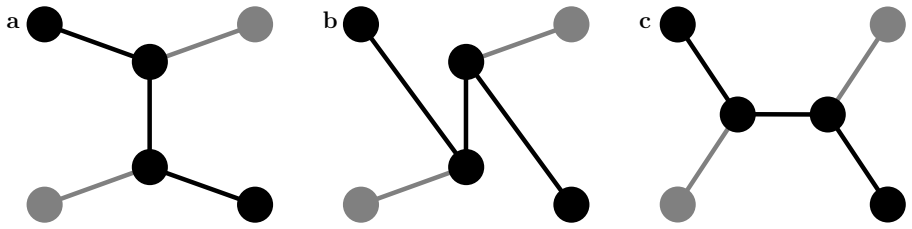
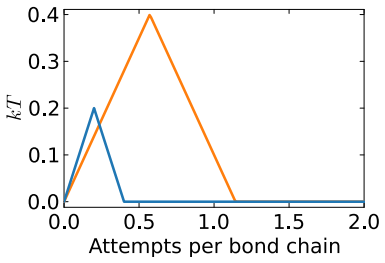
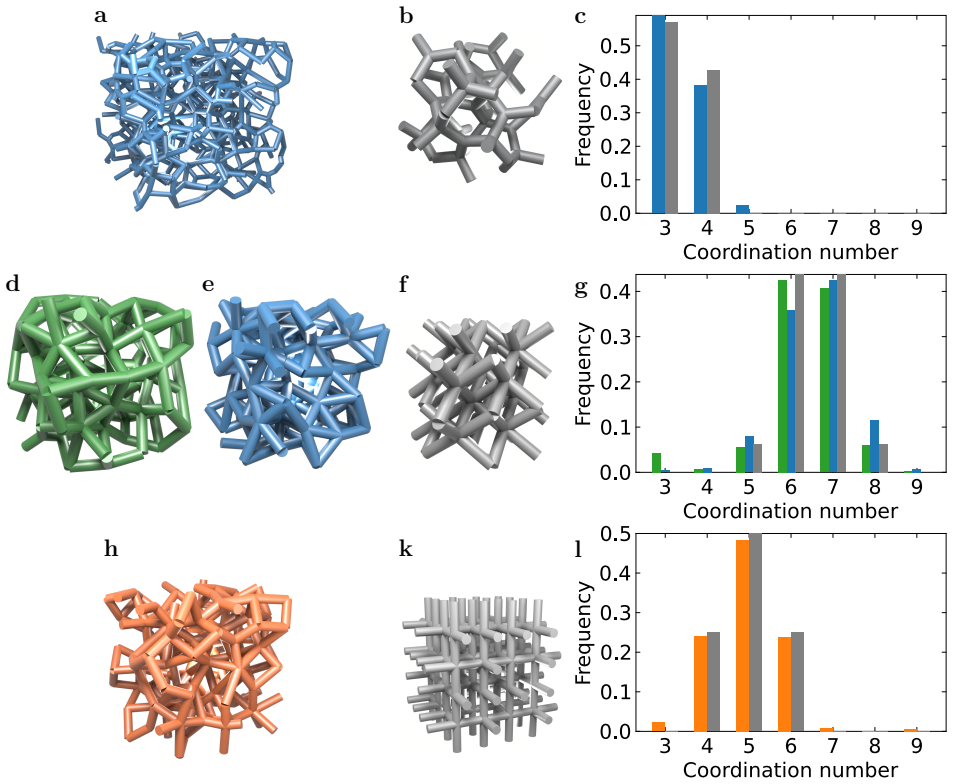
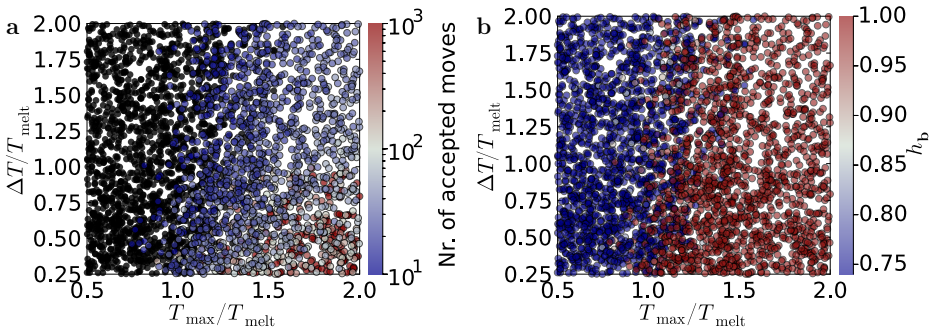
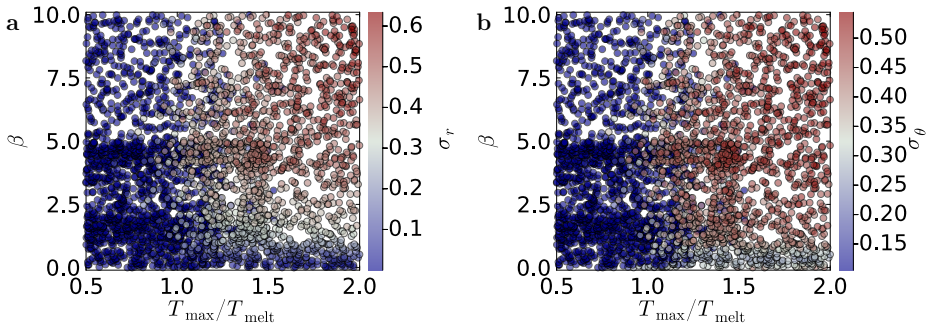
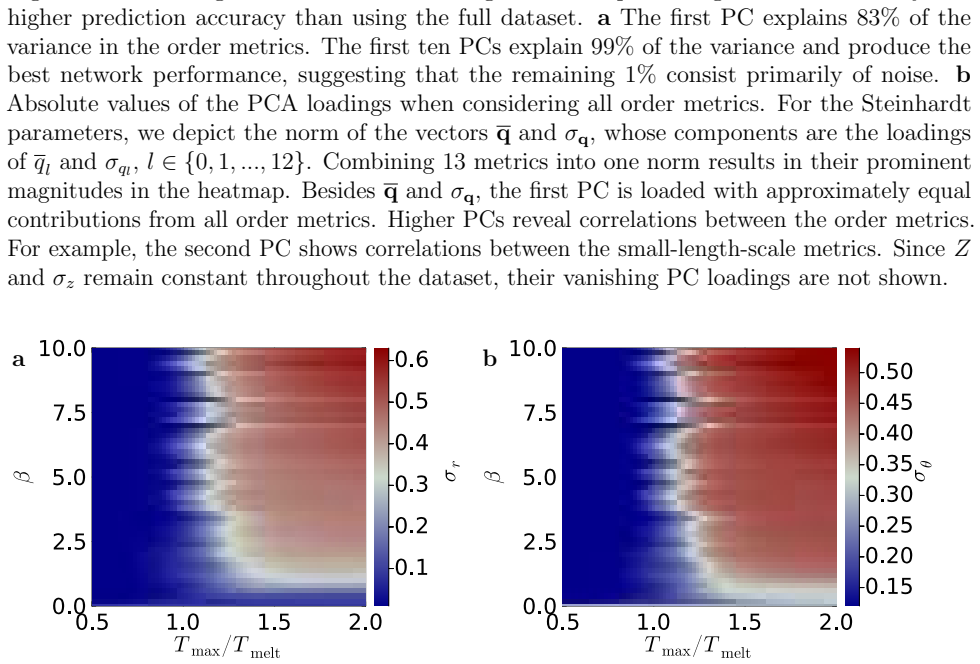
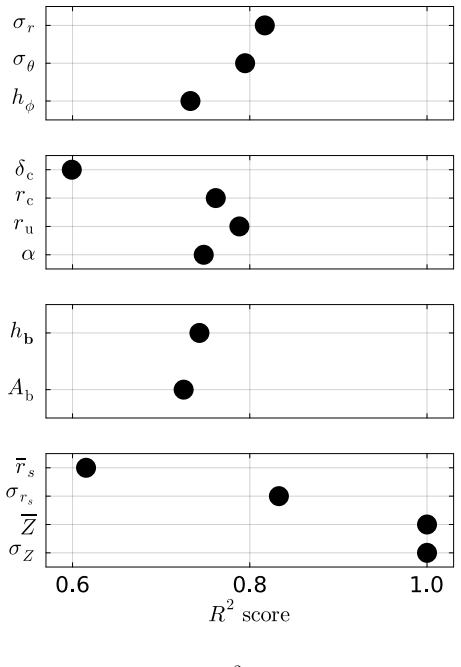
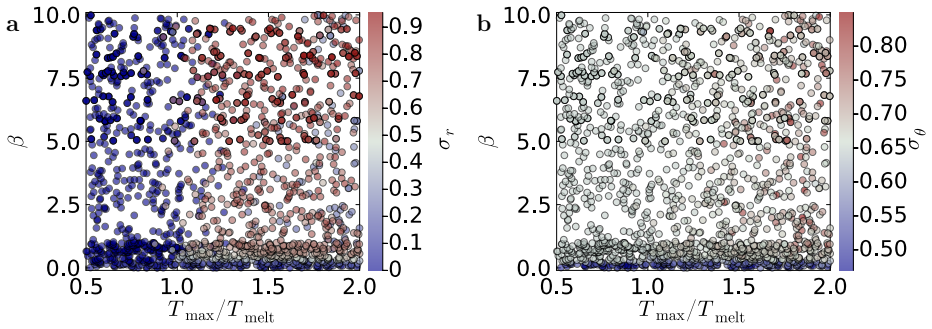
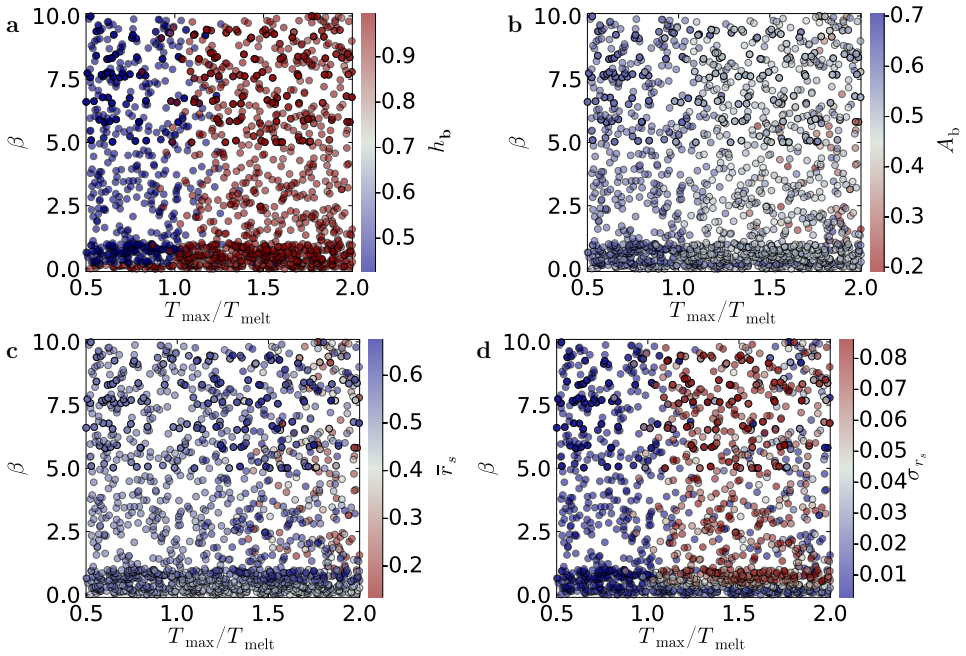
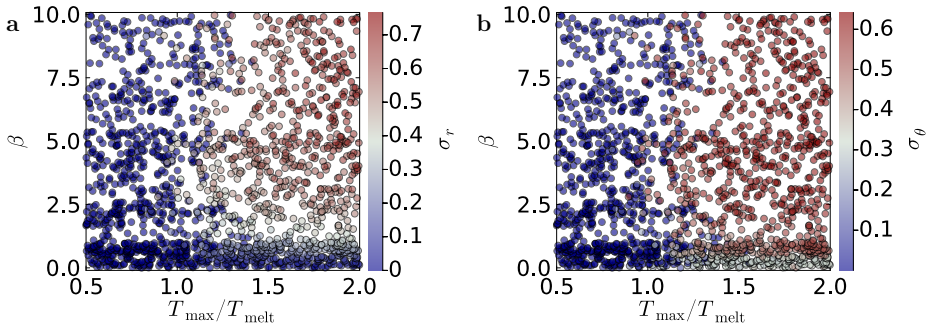
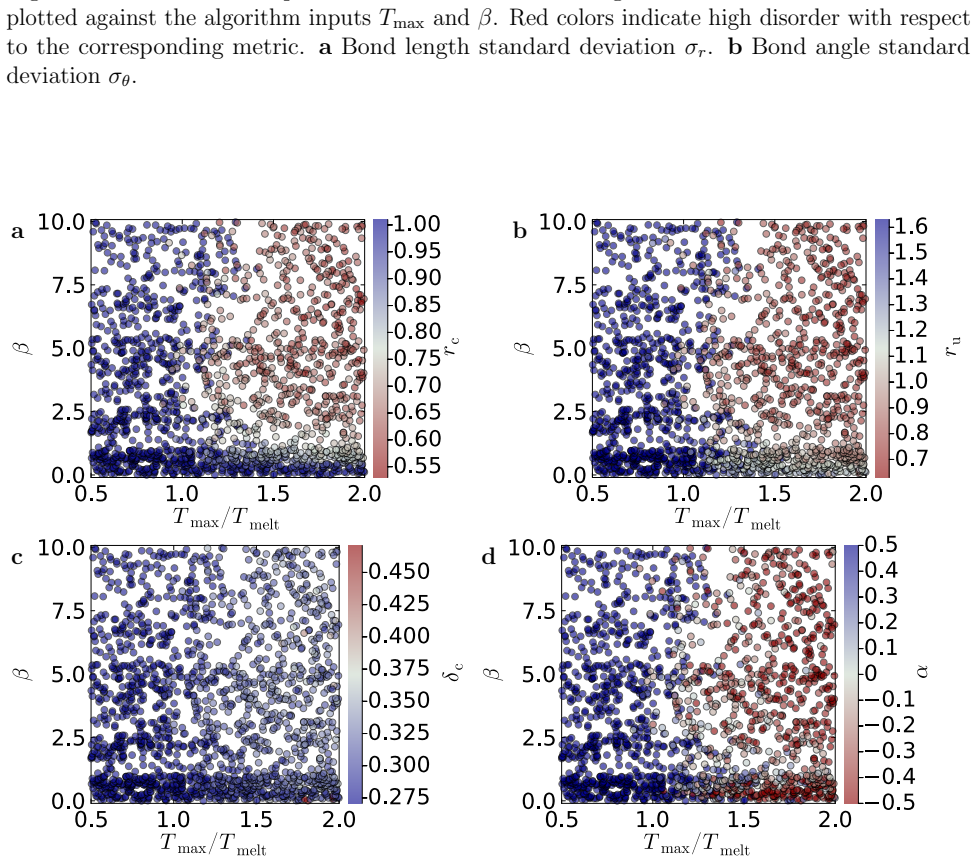
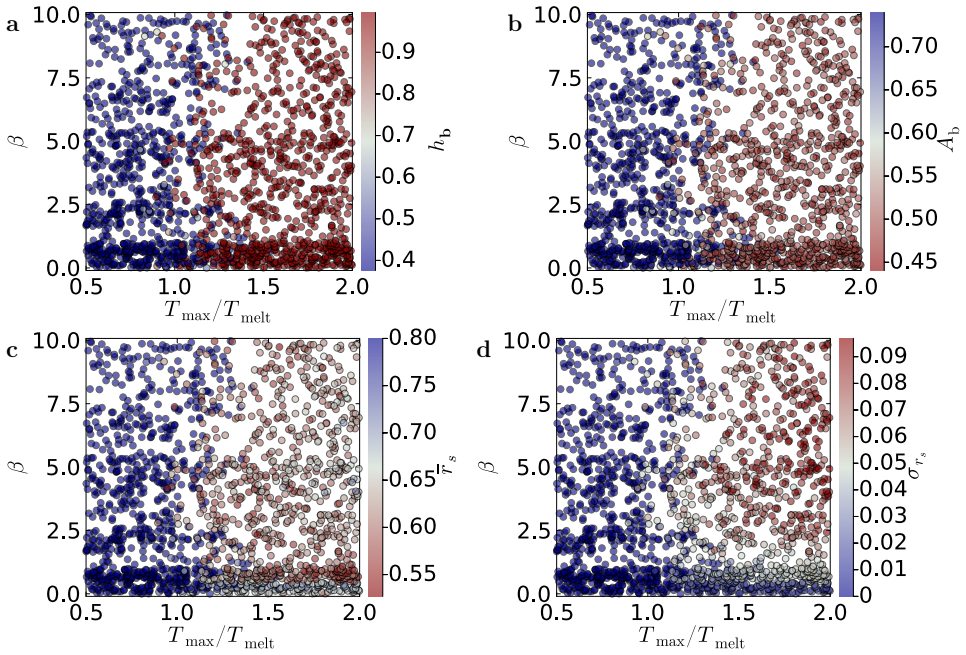
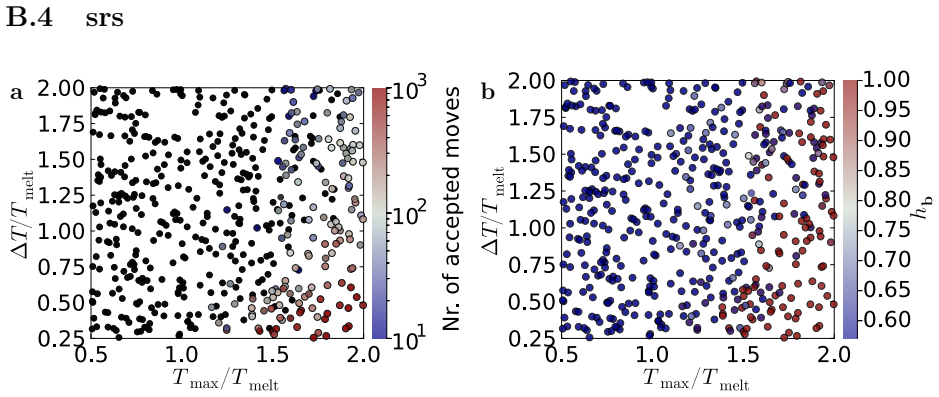
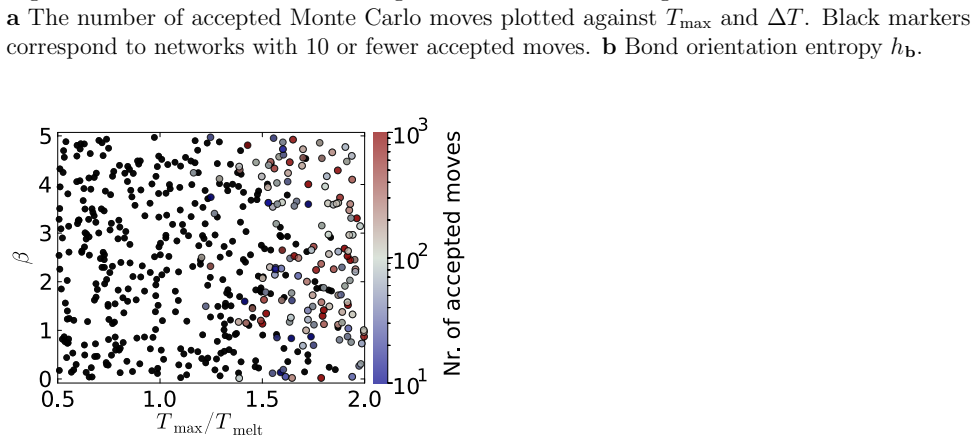
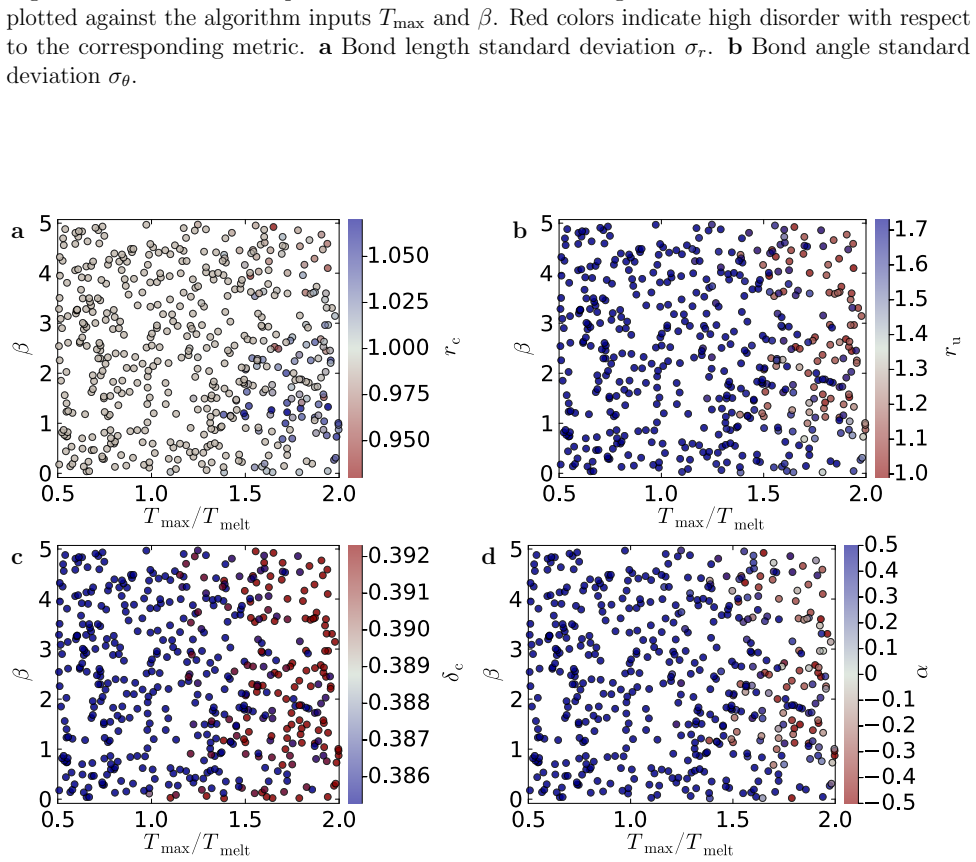
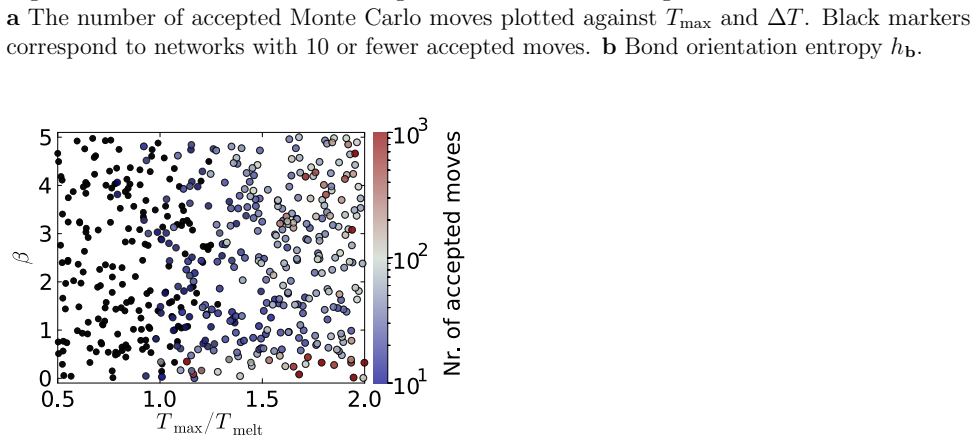
We introduce a maximum bond repulsion term into the strain energy of the Wooten-Weaire-Winer algorithm, enabling generation of spatial networks with arbitrary coordination number. The degree and type of disorder are controlled by the bond-bending force constant and the temperature profile during bond-switch moves. Structural characteristics are quantified by a collection of order metrics in direct and reciprocal space, and a feedforward neural network is trained to predict these metrics from the algorithm inputs, permitting efficient targeted network generation. As a demonstration, four disordered biophotonic networks that exhibit structural color are statistically reproduced.
What carries the argument
Maximum bond repulsion term added to the strain energy, combined with a feedforward neural network that maps bond-bending constant and temperature profile to a vector of real-space and reciprocal-space order metrics.
If this is right
- Networks with coordination numbers higher than four become accessible for scattering and localization studies.
- Targeted structural color can be obtained by feeding desired order-metric values into the trained neural network and running the algorithm once.
- Systematic variation of the bending stiffness and temperature schedule produces families of networks whose disorder can be classified along a single continuous parameter axis.
- The same workflow can be applied to other wave-transport problems in which both real-space connectivity and reciprocal-space correlations control the physics.
Where Pith is reading between the lines
- The neural-network surrogate could be inverted to perform direct design of network topology for prescribed optical response without iterative simulation.
- The method supplies a controllable test-bed for studying how specific real-space and reciprocal-space correlations separately affect Anderson localization or photonic band gaps.
- Extension to time-dependent or active networks is possible by replacing the static strain energy with a time-varying repulsion term.
Load-bearing premise
The chosen order metrics in direct and reciprocal space are sufficient to capture all structural features that matter for the wave-scattering behavior the networks are intended to model.
What would settle it
Generate networks using the reported input parameters and compare their pair-correlation functions, structure factors, or higher-order correlation measures against the original biophotonic samples using metrics not included in the training set; systematic mismatch would falsify the claim that the method reproduces the targeted structures.
Figures















read the original abstract
Disordered spatial networks describe structures and interactions across multiple length scales. The scattering and interference of waves within these networks result in structural phase transitions, localization, diffusion, and band gaps. Studying these phenomena requires efficient numerical methods for generating disordered networks with specific structural properties. The Wooten-Weaire-Winer algorithm is an established method that introduces disorder into an initial network through a series of bond switch moves. However, the strain energies that govern this evolution are conventionally limited to three-dimensional networks with coordination numbers of no more than four. We here introduce a maximum bond repulsion to produce networks with an arbitrary coordination number. We control the degree and type of disorder by adjusting the bond-bending force constant in the strain energy and the temperature profile. The effects of these variables are quantified through a list of order metrics that capture both direct and reciprocal space. A feedforward neural network predicts the structural characteristics from the algorithm inputs, enabling efficient targeted network generation. As a case study, we statistically reproduce four disordered biophotonic networks that exhibit structural color. This work presents a versatile method for generating disordered networks with tailored structural properties. It will provide new insights into structure-property relations.
Editorial analysis
A structured set of objections, weighed in public.
Referee Report
Summary. The paper extends the Wooten-Weaire-Winer (WWW) algorithm by introducing a maximum bond repulsion term to generate disordered networks with arbitrary coordination numbers. Disorder type and degree are controlled by tuning the bond-bending force constant in the strain energy and the temperature profile during bond-switch moves. A set of direct- and reciprocal-space order metrics quantifies the resulting structures, and a feedforward neural network is trained to predict these metrics from the algorithm inputs, enabling efficient targeted generation. The method is demonstrated in a case study by statistically reproducing four real disordered biophotonic networks known to exhibit structural color.
Significance. If the chosen order metrics prove sufficient proxies for the structural features governing wave interference, the approach supplies a practical, tunable generator for disordered networks with prescribed coordination and disorder characteristics. The neural-network acceleration step is a clear efficiency gain for iterative design workflows in biophotonics and related fields where structure-property mapping is central.
major comments (1)
- [Case study] Case study section: the claim that the generated networks statistically reproduce the four biophotonic networks (and thereby their structural color) rests solely on agreement of the selected order metrics; no direct optical observable such as reflectance spectrum, photonic density of states, or localization length is compared between real and synthetic networks. This gap is load-bearing because the central utility asserted is reproduction of wave-scattering behavior.
minor comments (2)
- [Abstract] Abstract and methods: quantitative error bars, cross-validation statistics, and explicit comparison against alternative network-generation algorithms are not reported, making it difficult to assess the neural-network prediction accuracy and the incremental benefit of the new repulsion term.
- [Methods] The manuscript does not specify the neural-network architecture details (layer sizes, activation functions, training-set size, or regularization) or the precise definition of the order metrics, both of which are needed for reproducibility.
Simulated Author's Rebuttal
We thank the referee for their careful reading and constructive feedback on our manuscript. We address the major comment below and have revised the manuscript to strengthen the presentation of the case study.
read point-by-point responses
-
Referee: [Case study] Case study section: the claim that the generated networks statistically reproduce the four biophotonic networks (and thereby their structural color) rests solely on agreement of the selected order metrics; no direct optical observable such as reflectance spectrum, photonic density of states, or localization length is compared between real and synthetic networks. This gap is load-bearing because the central utility asserted is reproduction of wave-scattering behavior.
Authors: We agree that direct comparison of optical observables would provide stronger validation of the wave-scattering reproduction. The order metrics were selected because prior literature has established their correlation with the structural features that govern interference and color in these specific biophotonic networks. To address the referee's concern, the revised manuscript now includes additional calculations of reflectance spectra and photonic density of states for both the real and generated networks, demonstrating quantitative agreement. We have also added a brief discussion clarifying the link between the chosen metrics and optical behavior. revision: yes
Circularity Check
No circularity: algorithmic extension plus NN surrogate on generated data remains self-contained
full rationale
The paper extends the established WWW bond-switch algorithm by adding an explicit maximum bond repulsion term to allow arbitrary coordination numbers, then tunes disorder via the bond-bending force constant and temperature schedule. Structural features are measured with a fixed list of direct- and reciprocal-space order metrics that are computed independently from the generated networks. A feedforward neural network is trained in the standard supervised manner on input-parameter to metric pairs produced by the algorithm itself, then used only as a fast surrogate for targeting. No equation reduces a reported metric or prediction to a quantity defined by the same fitted parameters, no uniqueness theorem is imported from self-citation, and the central claim (statistical reproduction of four external biophotonic networks via the chosen metrics) rests on direct numerical comparison rather than definitional closure. The derivation chain is therefore self-contained.
Axiom & Free-Parameter Ledger
free parameters (2)
- bond-bending force constant
- temperature profile
axioms (1)
- domain assumption Network evolution under the strain energy with added bond repulsion yields topologically valid disordered networks
Lean theorems connected to this paper
-
IndisputableMonolith/Cost/FunctionalEquation.leanwashburn_uniqueness_aczel (J-cost uniqueness) unclear?
unclearRelation between the paper passage and the cited Recognition theorem.
We modify the Keating energy to generate networks with any desired coordination number statistic... setting the equilibrium angle to θeqm = 180°, regardless of the coordination number... E = 3/16 Σ (r²ij − 1)² + 3/8 β Σ (rij rik cos(θjik) + 1)²
-
IndisputableMonolith/Foundation/AlexanderDuality.leanalexander_duality_circle_linking (D=3 forcing) unclear?
unclearRelation between the paper passage and the cited Recognition theorem.
In three dimensions, networks with valencies of up to four are exceptional cases... we overcome the limitations... by setting the equilibrium angle to 180° for all vertices
What do these tags mean?
- matches
- The paper's claim is directly supported by a theorem in the formal canon.
- supports
- The theorem supports part of the paper's argument, but the paper may add assumptions or extra steps.
- extends
- The paper goes beyond the formal theorem; the theorem is a base layer rather than the whole result.
- uses
- The paper appears to rely on the theorem as machinery.
- contradicts
- The paper's claim conflicts with a theorem or certificate in the canon.
- unclear
- Pith found a possible connection, but the passage is too broad, indirect, or ambiguous to say the theorem truly supports the claim.
Reference graph
Works this paper leans on
-
[1]
J. Medvedeva, D. Buchholz, R. Chang,Advanced Electronic Materials2017,31700082
-
[2]
Y. Gu, J. Zhao, J. A. Johnson,Angewandte Chemie International Edition2020,59, 13 5022
- [3]
-
[4]
C. W. Lynn, D. S. Bassett,Nature Reviews Physics2019,1, 5 318
-
[5]
J. Wang, X. Huang, J. Xu, Z. Zhang, S. Wang, Y. Li,Engineering Geology2023,318 107103
- [6]
- [7]
-
[8]
C. Gan, M. Voda, K. Wang, L. Chen, J. Ye,Journal of Hospitality and Tourism Management 2021,47124
work page 2021
-
[9]
Jackle,Reports on Progress in Physics1986,49, 2 171
J. Jackle,Reports on Progress in Physics1986,49, 2 171
-
[10]
L. Berthier, D. R. Reichman,Nature Reviews Physics2023,5, 2 102, publisher: Nature Publishing Group
- [11]
-
[12]
Y. Zhu, Z. D. Hood, H. Paik, P. B. Groszewicz, S. P. Emge, F. N. Sayed, C. Sun, M. Balaish, D. Ehre, L. J. Miara, A. I. Frenkel, I. Lubomirsky, C. P. Grey, J. L. M. Rupp,Matter 2024,7, 2 500
work page 2024
- [13]
-
[14]
F. Scheffold, J. Haberko, S. Magkiriadou, L. S. Froufe-P´ erez,Physical Review Letters2022, 129, 15 157402
-
[15]
M. E. J. Newman, G. T. Barkema,Monte Carlo Methods in Statistical Physics, Oxford University Press,1999. 29
work page 1999
- [16]
-
[17]
W. H. Zachariasen,Journal of the American Chemical Society1932,54, 10 3841, publisher: American Chemical Society
-
[18]
L. P. O’Mard,Modelling and Simulation in Materials Science and Engineering1993,1, 4 485
-
[19]
G. T. Barkema, N. Mousseau,Physical Review B2000,62, 8 4985
-
[20]
Y. Tu, J. Tersoff, G. Grinstein, D. Vanderbilt,Physical Review Letters1998,81, 22 4899, publisher: American Physical Society
-
[21]
S. M. Nakhmanson, N. Mousseau,Journal of Physics: Condensed Matter2002,14, 26 6627
-
[22]
R. L. C. Vink,The Journal of Chemical Physics2014,140, 10 104509
-
[23]
B. R. Djordjevi´ c, M. F. Thorpe, F. Wooten,Physical Review B1995,52, 8 5685, publisher: American Physical Society
-
[24]
R. L. C. Vink, G. T. Barkema, M. A. Stijnman, R. H. Bisseling,Phys. Rev. B2001,64 245214
-
[25]
R. L. C. Vink, G. T. Barkema,Physical Review B2003,67, 24 245201, publisher: American Physical Society
-
[26]
Y. Tu, J. Tersoff,Physical Review Letters2000,84, 19 4393, publisher: American Physical Society
-
[27]
R. Cabriolu, M. G. D. P´ opolo, P. Ballone,Physical Chemistry Chemical Physics2009,11, 46 10820, publisher: The Royal Society of Chemistry
-
[28]
P. N. Keating,Physical Review1966,145, 2 637, publisher: American Physical Society
-
[29]
F. H. Stillinger, T. A. Weber,Phys. Rev. B1985,315262
-
[30]
M. H. J. Bailey, D. O. Morley, M. Wilson,RSC Advances2020,10, 63 38275, publisher: The Royal Society of Chemistry
-
[31]
S. R. Sellers, W. Man, S. Sahba, M. Florescu,Nature Communications2017,8, 1 14439
-
[32]
O. Delgado-Friedrichs, M. O’Keeffe, srd,2025, URLhttp://rcsr.net/nets/ctn
work page 2025
-
[33]
H. Yin, B. Dong, X. Liu, T. Zhan, L. Shi, J. Zi, E. Yablonovitch,Proceedings of the National Academy of Sciences2012,109, 27 10798
-
[34]
K. Djeghdi, U. Steiner, B. D. Wilts,Advanced Science2022,9, 26 2202145, eprint: https://onlinelibrary.wiley.com/doi/pdf/10.1002/advs.202202145
-
[35]
V. V. Vogler-Neuling, M. Saba, I. Gunkel, J. O. Zoppe, U. Steiner, B. D. Wilts, A. Dodero, Advanced Functional Materials2023, 2306528
-
[36]
V. Bauernfeind, K. Djeghdi, I. Gunkel, U. Steiner, B. D. Wilts,Advanced Functional Materials2023,n/a2302720, eprint: https://onlinelibrary.wiley.com/doi/pdf/10.1002/adfm.202302720. 30
-
[37]
V. Bauernfeind, V. Saranathan, K. Djeghdi, E. Longo, S. Flenner, I. Greving, U. Steiner, B. D. Wilts,Materials Today Advances2024,23
-
[38]
O. Delgado-Friedrichs, M. O’Keeffe, Rcsr,2025, URLhttp://rcsr.net/nets/
work page 2025
- [39]
-
[40]
N. Metropolis, A. W. Rosenbluth, M. N. Rosenbluth, A. H. Teller, E. Teller,The Journal of Chemical Physics1953,21, 6 1087
-
[41]
S. von Alfthan, A. Kuronen, K. Kaski,Physical Review B2003,68, 7 073203, publisher: American Physical Society
- [42]
-
[43]
L. L. Whyte,The American Mathematical Monthly1952,59, 9 606
-
[44]
P. J. Steinhardt, D. R. Nelson, M. Ronchetti,Physical Review B1983,28, 2 784, publisher: American Physical Society
-
[45]
A. Blondel, M. Karplus,Journal of Computational Chemistry1996,17, 9 1132, eprint: https://onlinelibrary.wiley.com/doi/pdf/10.1002/%28SICI%291096- 987X%2819960715%2917%3A9%3C1132%3A%3AAID-JCC5%3E3.0.CO%3B2-T
-
[46]
R. I. Cukier,The Journal of Physical Chemistry B2015,119, 9 3621, publisher: American Chemical Society
-
[47]
Torquato,Physics Reports2018,7451, hyperuniform States of Matter
S. Torquato,Physics Reports2018,7451, hyperuniform States of Matter
-
[48]
L. D. Gelb, K. E. Gubbins,Langmuir1999,15, 2 305, publisher: American Chemical Society
-
[49]
S. Song, Q. Ding, J. Wei,Physical Review E2019,100, 5 053314, publisher: American Physical Society
-
[50]
M. A. Klatt, R. M. Ziff, S. Torquato,Physical Review E2021,104, 1 014127, publisher: American Physical Society
-
[51]
S. Torquato,Random Heterogeneous Materials: Microstructure and Macroscopic Properties, Interdisciplinary Applied Mathematics. Springer New York,2013
work page 2013
-
[52]
S. Agrawal, S. Galmarini, M. Kr¨ oger,Physical Review E2023,107, 1 015307, publisher: American Physical Society
- [53]
- [54]
-
[55]
Torquato,Physical Review E2021,104, 5 054102, publisher: American Physical Society
S. Torquato,Physical Review E2021,104, 5 054102, publisher: American Physical Society
-
[56]
Prager,Chemical Engineering Science1963,18, 4 227
S. Prager,Chemical Engineering Science1963,18, 4 227
- [57]
-
[58]
F. Tampieri, In D. KIRK, editor,Graphics Gems III (IBM Version), 231–232. Morgan Kauf- mann, San Francisco, ISBN 978-0-12-409673-8,1992, URL https://www.sciencedirect. com/science/article/pii/B978008050755250052X
work page 1992
-
[59]
J. D. Joannopoulos, S. G. Johnson, J. N. Winn, R. D. Meade,Photonic Crystals: Molding the Flow of Light - Second Edition, Princeton University Press, rev - revised, 2 edition, 2008
work page 2008
-
[60]
R. K. Cersonsky, J. Antonaglia, B. D. Dice, S. C. Glotzer,Nature Communications2021, 12, 1 2543, publisher: Nature Publishing Group
-
[61]
K. Michielsen, D. Stavenga,Journal of the Royal Society, Interface / the Royal Society 2007,585
work page 2007
- [62]
- [63]
-
[64]
O. U. Uche, S. Torquato, F. H. Stillinger,Physical Review E2006,74, 3 031104, publisher: American Physical Society
-
[65]
A. Paszke, S. Gross, F. Massa, A. Lerer, J. Bradbury, G. Chanan, T. Killeen, Z. Lin, N. Gimelshein, L. Antiga, A. Desmaison, A. Kopf, E. Yang, Z. DeVito, M. Raison, A. Tejani, S. Chilamkurthy, B. Steiner, L. Fang, J. Bai, S. Chintala, In H. Wal- lach, H. Larochelle, A. Beygelzimer, F. d'Alch´ e-Buc, E. Fox, R. Garnett, editors, Advances in Neural Informat...
work page 2019
-
[66]
Jolliffe,Principal Component Analysis, Springer Series in Statistics
I. Jolliffe,Principal Component Analysis, Springer Series in Statistics. Springer,2002
work page 2002
- [67]
-
[68]
M. E. Tipping, C. M. Bishop,Journal of the Royal Statistical Society Series B: Statistical Methodology2002,61, 3 611
-
[69]
Pytorch documentation, URLhttps://pytorch.org/docs/stable/index.html
-
[70]
A. J. Hughes, D. E. Grawoig,Statistics: A Foundation for Analysis, 344–345, Addison- Wesley Publishing Company, Reading, Mass., ISBN 0201030217,1971
work page 1971
-
[71]
L. S. Froufe-P´ erez, M. Engel, P. F. Damasceno, N. Muller, J. Haberko, S. C. Glotzer, F. Scheffold,Physical Review Letters2016,117, 5 053902
- [72]
- [73]
- [74]
-
[75]
F. Hemmann, Computer-generation of disordered networks with targeted structural properties,2026, URLhttps://doi.org/10.5281/zenodo.17979317. 32
-
[76]
F. Hemmann, V. Glauser, M. Saba, NCCR Bio-Inspired Materials, Disordered network generation and analysis,2026, URL https://github.com/florinhem/ disordered-network-gen-analysis. 33 Appendices A List of order metrics Order metric Meaning Network primitives σr Bond length standard deviation σθ Bond angle standard deviation ql for alll∈ {0,1, . . . ,12}Mean ...
work page 2026
discussion (0)
Sign in with ORCID, Apple, or X to comment. Anyone can read and Pith papers without signing in.