Complete Weierstrass elliptic function solutions and canonical coordinates for four-wave mixing in nonlinear optical fibres
Pith reviewed 2026-05-22 12:52 UTC · model grok-4.3
The pith
Four-wave mixing in nonlinear optical fibres admits complete analytic solutions using Weierstrass elliptic functions for arbitrary initial conditions.
A machine-rendered reading of the paper's core claim, the machinery that carries it, and where it could break.
Core claim
Complete analytic solutions to quasi-continuous-wave four-wave mixing in nonlinear optical fibres are presented in terms of Weierstrass elliptic ℘, ζ, and σ functions, providing the full complex envelopes for all four waves under arbitrary initial conditions. A sequence of coordinate transformations reveals a canonical form with universal parameter-free structure. These transformations depend explicitly on the propagation variable yet preserve the structural form of the differential equations, an invariance property not previously reported for four-wave mixing. In the canonical coordinates, solutions become single-valued meromorphic Kronecker theta functions, establishing connections with其他可
What carries the argument
The sequence of propagation-dependent coordinate transformations that produces a universal parameter-free canonical system solved by Weierstrass elliptic ℘, ζ, and σ functions.
If this is right
- Exact complex envelopes for every wave are available in closed form for any initial conditions.
- The canonical coordinates expose a structural invariance under propagation distance that had not been noted before.
- Solutions are single-valued meromorphic Kronecker theta functions that link four-wave mixing to other integrable nonlinear optical systems.
- Hamiltonian conservation is recovered directly from the Frobenius-Stickelberger determinant identity.
Where Pith is reading between the lines
- The same transformation sequence may simplify analysis of other four-wave or multi-wave mixing problems governed by similar ODEs.
- The parameter-free canonical form could reduce the computational cost of numerical surveys by collapsing many physical regimes onto one universal equation set.
- Laboratory tests in short fibres under narrow-band conditions would provide a direct experimental check of the predicted envelopes.
Load-bearing premise
The quasi-continuous-wave approximation is valid so that four-wave mixing reduces to ordinary differential equations without temporal pulse shaping or higher-order dispersion.
What would settle it
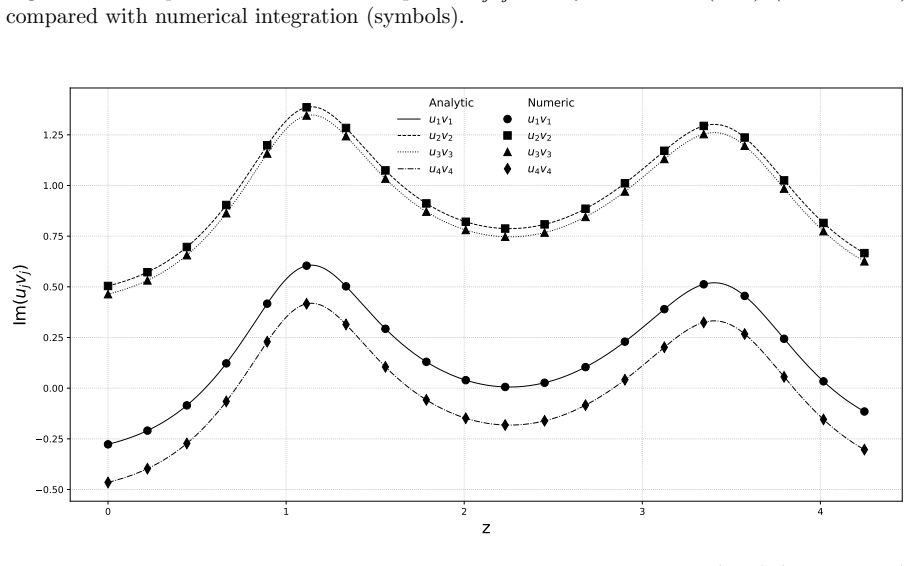
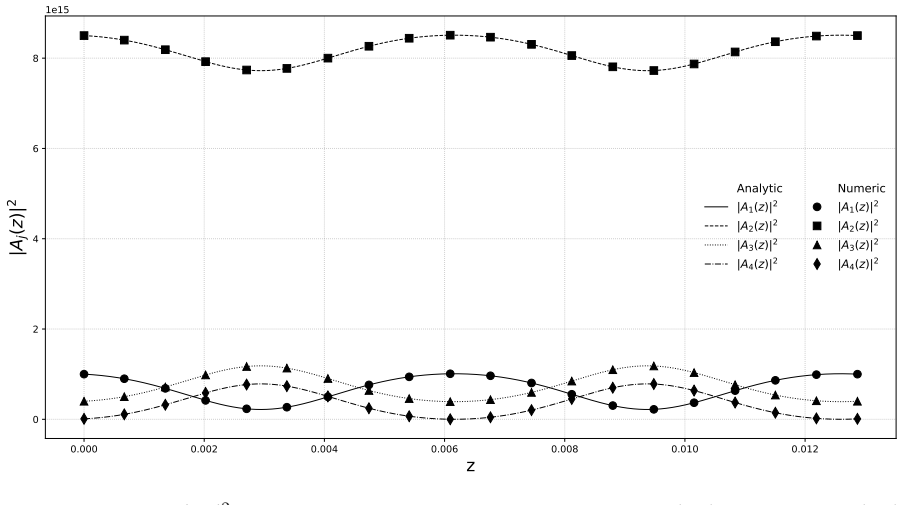
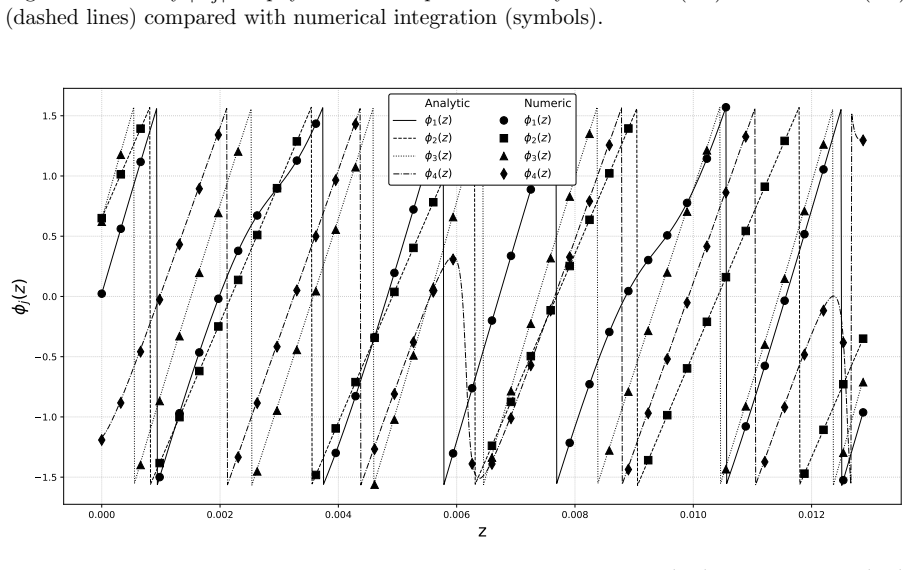
Direct numerical integration of the original four-wave mixing ODEs with chosen initial conditions and comparison of the resulting complex amplitudes against the closed-form Weierstrass expressions.
Figures

read the original abstract
Complete analytic solutions to quasi-continuous-wave four-wave mixing in nonlinear optical fibres are presented in terms of Weierstrass elliptic $\wp$, $\zeta$, and $\sigma$ functions, providing the full complex envelopes for all four waves under arbitrary initial conditions. A sequence of coordinate transformations reveals a canonical form with universal parameter-free structure. Remarkably, these transformations depend explicitly on the propagation variable yet preserve the structural form of the differential equations, an invariance property not previously reported for four-wave mixing. In the canonical coordinates, solutions become single-valued meromorphic Kronecker theta functions, establishing connections with other integrable nonlinear optical systems. The Hamiltonian conservation is shown to arise from the Frobenius-Stickelberger determinant. Numerical validation confirms the solutions using open-source Python libraries.
Editorial analysis
A structured set of objections, weighed in public.
Referee Report
Summary. The manuscript claims to derive complete analytic solutions for the quasi-continuous-wave four-wave mixing (FWM) system in nonlinear optical fibres, expressed via Weierstrass elliptic ℘, ζ, and σ functions (and equivalent Kronecker theta representations) that furnish the full complex envelopes for all four waves under arbitrary initial conditions. A sequence of coordinate transformations, some explicitly dependent on the propagation distance z, is asserted to reduce the original ODEs to a universal parameter-free canonical form whose integrability follows from known properties of elliptic functions; the Hamiltonian conservation law is identified with the Frobenius-Stickelberger determinant identity, and numerical checks with open-source Python libraries are reported.
Significance. Should the z-dependent transformations be shown to map the physical FWM equations exactly onto the claimed integrable structure, the work would supply the first closed-form solutions covering the entire solution manifold for quasi-CW FWM, including all initial-condition cases. This would strengthen the catalogue of integrable nonlinear-optical models and furnish exact benchmarks for numerical codes. The explicit linkage to Kronecker theta functions and the conservation-law interpretation via the Frobenius-Stickelberger determinant are technically attractive features.
major comments (2)
- [§3] §3 (Coordinate transformations): the central claim that the z-dependent changes of variables leave the four-wave mixing ODEs in a parameter-free canonical form without extraneous terms must be verified by explicit substitution. The chain-rule contributions arising from the z-dependence of the new coordinates must be shown to cancel identically; any residual z- or field-dependent terms would imply that the subsequent Weierstrass solutions solve a different system, not the original quasi-CW FWM equations.
- [§4] §4 (Reduction to elliptic functions): the mapping from the canonical system to the Weierstrass ℘ equation (or its equivalent first-order form) must be accompanied by an explicit statement of the integration constants and the inversion procedure that recovers the original four complex envelopes. Without this, it is unclear whether the solutions are complete for arbitrary initial conditions or only for a restricted subset.
minor comments (2)
- [Numerical validation section] The abstract states that numerical validation was performed with open-source Python libraries; the corresponding section should specify the integrator, tolerance settings, and the precise initial-condition sets used for comparison.
- [§2] Notation for the four complex amplitudes (A1–A4 or similar) should be introduced once at the beginning of §2 and used consistently; occasional re-labeling in later sections impairs readability.
Simulated Author's Rebuttal
We thank the referee for the careful reading of the manuscript and for the constructive comments. We respond to each major comment below.
read point-by-point responses
-
Referee: [§3] §3 (Coordinate transformations): the central claim that the z-dependent changes of variables leave the four-wave mixing ODEs in a parameter-free canonical form without extraneous terms must be verified by explicit substitution. The chain-rule contributions arising from the z-dependence of the new coordinates must be shown to cancel identically; any residual z- or field-dependent terms would imply that the subsequent Weierstrass solutions solve a different system, not the original quasi-CW FWM equations.
Authors: We agree that an explicit verification of the substitution is necessary to establish the exact equivalence. Section 3 derives the sequence of transformations and asserts that they preserve the structural form of the ODEs. In the revised manuscript we will add a dedicated appendix containing the full chain-rule calculation, which confirms that all z-dependent contributions cancel identically owing to the specific functional form chosen for the coordinate shifts. This addition will make the invariance property fully transparent without changing the reported results. revision: yes
-
Referee: [§4] §4 (Reduction to elliptic functions): the mapping from the canonical system to the Weierstrass ℘ equation (or its equivalent first-order form) must be accompanied by an explicit statement of the integration constants and the inversion procedure that recovers the original four complex envelopes. Without this, it is unclear whether the solutions are complete for arbitrary initial conditions or only for a restricted subset.
Authors: The manuscript states that the four integration constants permit arbitrary initial conditions. To address the request for explicit detail, the revised Section 4 will include a clear tabulation of the constants expressed directly in terms of the initial complex amplitudes together with the step-by-step inversion from the Weierstrass ℘, ζ and σ functions back to the original envelopes. This will confirm that the solution manifold is complete. revision: yes
Circularity Check
No significant circularity; derivation relies on explicit transformations and known identities
full rationale
The paper derives canonical coordinates via a sequence of z-dependent transformations asserted to preserve the original FWM ODE structure, then reduces the resulting system to Weierstrass ℘, ζ, σ functions using standard elliptic-function methods. No quoted step defines a quantity in terms of itself or renames a fitted parameter as a prediction. The Hamiltonian conservation is explicitly linked to the Frobenius-Stickelberger determinant, an external mathematical identity. The central claim is a constructive derivation under the quasi-CW approximation rather than a self-referential loop; the transformations are presented as verifiable substitutions whose residuals cancel, not as definitions that presuppose the solution form. This is the most common honest non-finding for analytic solution papers.
Axiom & Free-Parameter Ledger
axioms (1)
- domain assumption The quasi-continuous-wave four-wave mixing dynamics obey a closed set of ordinary differential equations derived from the nonlinear Schrödinger equation.
Lean theorems connected to this paper
-
IndisputableMonolith/Cost/FunctionalEquation.leanwashburn_uniqueness_aczel unclear?
unclearRelation between the paper passage and the cited Recognition theorem.
A sequence of coordinate transformations reveals a canonical form with universal parameter-free structure. Remarkably, these transformations depend explicitly on the propagation variable yet preserve the structural form of the differential equations
What do these tags mean?
- matches
- The paper's claim is directly supported by a theorem in the formal canon.
- supports
- The theorem supports part of the paper's argument, but the paper may add assumptions or extra steps.
- extends
- The paper goes beyond the formal theorem; the theorem is a base layer rather than the whole result.
- uses
- The paper appears to rely on the theorem as machinery.
- contradicts
- The paper's claim conflicts with a theorem or certificate in the canon.
- unclear
- Pith found a possible connection, but the passage is too broad, indirect, or ambiguous to say the theorem truly supports the claim.
Forward citations
Cited by 1 Pith paper
-
Complete Weierstrass elliptic function solutions for coherent couplers and their relation to degenerate four-wave mixing
Complete Weierstrass elliptic function solutions are derived for coherent couplers with arbitrary parameters, with a projection linking them to single-valued Kronecker theta function solutions in degenerate four-wave mixing.
Reference graph
Works this paper leans on
-
[1]
Agrawal.Nonlinear Fiber Optics
Govind P. Agrawal.Nonlinear Fiber Optics. en-US. 6th ed. Academic Press, Aug. 2019. isbn: 978-0-12-817042-7.url:https://shop.elsevier.com/books/nonlinear-fiber- optics/agrawal/978-0-12-817042-7(visited on 12/30/2025)
work page 2019
-
[2]
Four-photon parametric mixing in optical fibers: effect of pump depletion
Yijiang Chen and Allan W. Snyder. “Four-photon parametric mixing in optical fibers: effect of pump depletion”. EN. In:Optics Letters14.1 (Jan. 1989), pp. 87–89.issn: 1539- 4794.doi:10.1364/OL.14.000087.url:https://opg.optica.org/ol/abstract.cfm? uri=ol-14-1-87(visited on 01/10/2026)
work page doi:10.1364/ol.14.000087.url:https://opg.optica.org/ol/abstract.cfm 1989
-
[3]
Four-wave mixing in optical fibers: exact solution
Yijiang Chen. “Four-wave mixing in optical fibers: exact solution”. EN. In:JOSA B6.11 (Nov. 1989), pp. 1986–1993.issn: 1520-8540.doi:10 . 1364 / JOSAB . 6 . 001986.url: https://opg.optica.org/josab/abstract.cfm?uri=josab- 6- 11- 1986(visited on 12/30/2025)
work page 1989
-
[4]
Analytic solutions for the phases of waves coupled by degenerate or nondegenerate four-wave mixing
Michel E. Marhic. “Analytic solutions for the phases of waves coupled by degenerate or nondegenerate four-wave mixing”. EN. In:JOSA B30.1 (Jan. 2013), pp. 62–70.issn: 1520-8540.doi:10.1364/JOSAB.30.000062.url:https://opg.optica.org/josab/ abstract.cfm?uri=josab-30-1-62(visited on 12/30/2025)
work page doi:10.1364/josab.30.000062.url:https://opg.optica.org/josab/ 2013
-
[5]
E. T. Whittaker and G. N. Watson.A Course of Modern Analysis. Ed. by Victor H. Moll. 5th ed. Cambridge: Cambridge University Press, 2021.isbn: 978-1-316-51893-9.doi: 10.1017/9781009004091.url:https://www.cambridge.org/core/books/course-of- modern-analysis/B2DDAE32B565419FA452C51FA03F6F3D(visited on 12/31/2025)
work page doi:10.1017/9781009004091.url:https://www.cambridge.org/core/books/course-of- 2021
-
[6]
Zur Theorie der elliptischen Functionen
F. G. Frobenius and L Stickelberger. “Zur Theorie der elliptischen Functionen”. ger. In:Journal f¨ ur die reine und angewandte Mathematik(1877).url:https : / / www . digizeitschriften.de/id/243919689_0083
-
[7]
General complex envelope solutions of coupled-mode optics with quadratic or cubic nonlinearity
Graham D. Hesketh. “General complex envelope solutions of coupled-mode optics with quadratic or cubic nonlinearity”. EN. In:JOSA B32.12 (Dec. 2015), pp. 2391–2399.issn: 1520-8540.doi:10.1364/JOSAB.32.002391.url:https://opg.optica.org/josab/ abstract.cfm?uri=josab-32-12-2391(visited on 12/30/2025)
work page doi:10.1364/josab.32.002391.url:https://opg.optica.org/josab/ 2015
-
[8]
Parametric amplification and frequency conversion in optical fibers
R. Stolen and J. Bjorkholm. “Parametric amplification and frequency conversion in optical fibers”. In:IEEE Journal of Quantum Electronics18.7 (July 1982), pp. 1062–1072.issn: 1558-1713.doi:10.1109/JQE.1982.1071660.url:https://ieeexplore.ieee.org/ document/1071660(visited on 12/30/2025)
work page doi:10.1109/jqe.1982.1071660.url:https://ieeexplore.ieee.org/ 1982
-
[9]
Amarendra K. Sarma et al. “Continuous and discrete Schr\”odinger systems with parity- time-symmetric nonlinearities”. In:Physical Review E89.5 (May 2014), p. 052918.doi: 10.1103/PhysRevE.89.052918.url:https://link.aps.org/doi/10.1103/PhysRevE. 89.052918(visited on 01/13/2026). 22
work page doi:10.1103/physreve.89.052918.url:https://link.aps.org/doi/10.1103/physreve 2014
-
[10]
V. I. Arnold.Mathematical Methods of Classical Mechanics. Vol. 60. Graduate Texts in Mathematics. New York, NY: Springer, 1989.isbn: 978-1-4419-3087-3 978-1-4757-2063-1. doi:10.1007/978-1-4757-2063-1.url:http://link.springer.com/10.1007/978- 1-4757-2063-1(visited on 01/15/2026)
work page doi:10.1007/978-1-4757-2063-1.url:http://link.springer.com/10.1007/978- 1989
-
[11]
Graham D. Hesketh and Periklis Petropoulos. “Minimizing inter-channel cross-phase mod- ulation with optical phase conjugation in asymmetric fibre links”. EN. In:Optics Express 24.18 (Sept. 2016), pp. 20270–20280.issn: 1094-4087.doi:10 . 1364 / OE . 24 . 020270. url:https://opg.optica.org/oe/abstract.cfm?uri=oe- 24- 18- 20270(visited on 01/15/2026)
work page 2016
-
[12]
Andr´ e Weil.Elliptic Functions according to Eisenstein and Kronecker. en. Berlin, Hei- delberg: Springer, 1976.isbn: 978-3-540-65036-2 978-3-642-66209-6.doi:10.1007/978- 3- 642- 66209- 6.url:https://link.springer.com/10.1007/978- 3- 642- 66209- 6 (visited on 01/11/2026)
-
[13]
Elliptic Functions According to Eisenstein and Kronecker: An Update
Pierre Charollois and Robert Sczech. “Elliptic Functions According to Eisenstein and Kronecker: An Update”. en. In:EMS Newsletter2016-9.101 (2016), pp. 8–14.issn: 1027- 488X.doi:10.4171/NEWS/101/4.url:https://ems.press/doi/10.4171/news/101/4 (visited on 08/04/2025)
work page doi:10.4171/news/101/4.url:https://ems.press/doi/10.4171/news/101/4 2016
-
[14]
2022.url:https://pyweierstrass.readthedocs.io/ en/latest/
St´ ephane Laurent.pyweierstrass. 2022.url:https://pyweierstrass.readthedocs.io/ en/latest/. [15]mpmath: a Python library for arbitrary-precision floating-point arithmetic (version 1.3.0). 2023.url:http://mpmath.org/
work page 2022
-
[15]
SciPy 1.0: fundamental algorithms for scientific computing in Python
Pauli Virtanen et al. “SciPy 1.0: fundamental algorithms for scientific computing in Python”. en. In:Nature Methods17.3 (Mar. 2020), pp. 261–272.issn: 1548-7105.doi: 10.1038/s41592-019-0686-2.url:https://www.nature.com/articles/s41592-019- 0686-2(visited on 01/11/2026)
work page doi:10.1038/s41592-019-0686-2.url:https://www.nature.com/articles/s41592-019- 2020
-
[16]
Nonlinear effects in multimode optical fibers
Graham Hesketh. “Nonlinear effects in multimode optical fibers”. en. phd. University of Southampton, Nov. 2014.url:https://eprints.soton.ac.uk/374911/(visited on 12/31/2025)
work page 2014
-
[17]
original-date: 2025-11-30T21:44:18Z
Graham Hesketh.HeskethGD/fwm-paper. original-date: 2025-11-30T21:44:18Z. Jan. 2026. url:https://github.com/HeskethGD/fwm-paper(visited on 01/16/2026)
work page 2025
-
[18]
SymPy: symbolic computing in Python
Aaron Meurer et al. “SymPy: symbolic computing in Python”. en. In:PeerJ Computer Science3 (Jan. 2017), e103.issn: 2376-5992.doi:10.7717/peerj-cs.103.url:https: //peerj.com/articles/cs-103(visited on 01/16/2026). 23
discussion (0)
Sign in with ORCID, Apple, or X to comment. Anyone can read and Pith papers without signing in.