REVIEW 3 major objections 4 minor 18 references
Plan, Verify and Fill: A Structured Parallel Decoding Approach for Diffusion Language Models
T0 review · 3 major / 4 minor · reviewed 2026-08-03 · deepseek-v4-flash
Pith's one-line read PVF, a training-free decode strategy for diffusion language models, locks in structural tokens first and cuts the number of forward passes by up to 65% while matching accuracy.
desk verdict Solid new decoding protocol for diffusion LMs, but the efficiency headline needs wall-clock evidence before I'd believe the 40-65% speedups. read the letter →
The pith
A machine-rendered reading of the paper's core claim, the machinery that carries it, and where it could break.
The reading
What carries the argument
Planning tokens: a compact vocabulary of content-neutral structural markers (logical connectives, code keywords, punctuation, capitalized first words, and EOS) discovered via an LLM distillation prompt plus deterministic rules. Impact set: the masked positions in the current block where the model already has high confidence (≥ τ_high); a proposed planning token is accepted only if adding it does not flip any top-1 prediction on this set. Two-filter verification: Filter 1 enforces top-1 invariance on the impact set; Filter 2 selects the consistent candidate with the highest total confidence on the remaining masked positions. AR fallback: a speculative mechanism that tries fixing the 1, 2, or
What would settle it
Run PVF and the confidence-threshold baseline on identical sequences with wall-clock timing per completed response on the same GPU used in the paper. If a batched forward pass containing the base plus three planning candidates takes materially longer than a single forward pass (say, 10–20% overhead), the reported 40–65% NFE reductions will shrink when measured as end-to-end latency, and the practical speedup claim would need to be re-quantified.
Extended reading notes
Core claim
The central claim is that structural tokens are intrinsically safer early commits than arbitrary content tokens, and that this asymmetry suffices to accelerate diffusion decoding without retraining. PVF operationalises the claim: it tentatively injects planning tokens at a low confidence threshold, then accepts only those injections under which the model's top-1 predictions on the high-confidence masked positions—the impact set—stay unchanged. It then commits the accepted candidate that maximises total confidence over the remaining masked positions. When no planning token passes, an AR fallback commits the longest span of autoregressive predictions that remain stable, and a cross-block revel
Load-bearing premise
The load-bearing premise is the 'free lunch' assumption: that computing the model once on a batch of four candidate sequences is no slower than one forward pass; if batched inference is not effectively free, the claimed efficiency gains are overstated in wall-clock terms.
Editorial extensions
If this is right
- PVF, being training-free and model-agnostic, can be dropped into any masked diffusion language model without fine-tuning or extra supervision, making parallel decoding faster across architectures.
- Decoding budgets are redirected toward genuinely ambiguous content decisions, since structural anchors are committed early and the model spends fewer forward passes on low-value context.
- The consistency protocol—rejecting any early commit that changes the model's high-confidence top-1 predictions—provides a general safety test usable with any parallel-decoding heuristic.
- If the reported Pareto dominance holds, PVF gives a single operating point that beats confidence-threshold decoding on both accuracy and forward-pass count, so the efficiency gain is not bought with an accuracy sacrifice.
Reading between the lines
- The planning-token set likely extends beyond the specific vocabulary used here; any token class that is cross-instance stable and content-neutral (section markers, formula delimiters, citation keys) may show similar early-commit safety, which could be tested by swapping the token set.
- Because the method is training-free, its gains are orthogonal to model compression; combining PVF with distillation or quantization could compound speedups without retraining.
- The NFE metric assumes batched candidate evaluation costs no extra wall-clock time; if the batch-of-four 'free lunch' degrades on memory-bandwidth-bound hardware, retuning to a smaller batch or to single-candidate selection would trade some of the gain for guaranteed latency benefits.
- The verification principle—checking whether a structural commit changes the model's top-1 predictions on high-confidence positions—could serve as a general heuristic for any early-commit decoding scheme, including threshold-based or draft-verify methods.
Editorial analysis
A structured set of objections, weighed in public.
Referee Report
Summary. The paper proposes Plan-Verify-Fill (PVF), a training-free decoding strategy for diffusion language models. PVF separates generation into a planning route that commits low-confidence 'planning tokens' (verified by a top-1-invariance check over an impact set) and an AR fallback route that fills local content. The authors claim that PVF reduces the number of function evaluations (NFE) by 40–65% relative to Fast-dLLM at matched accuracy on GSM8K, MMLU-Pro, ARC-C, WinoGrande, HumanEval, and MATH, using LLaDA-8B-Instruct and Dream-7B-Instruct. The paper also provides ablations isolating the planning and AR-fallback components, a sensitivity analysis of thresholds, and Pareto-frontier comparisons.
Significance. If the efficiency claim holds, PVF would be a practically useful, training-free decoding improvement for diffusion LMs, and the paper's ablations are notably careful: Table 2 matches both exploration rate and average confidence when comparing planning tokens against random low-confidence commits, and Figure 6 compares Pareto frontiers rather than isolated operating points. The two-model evaluation supports model-agnosticism. However, the headline result is expressed in NFE under an explicit 'free lunch' batch-latency assumption that is not validated on the hardware used in the experiments. Because the central contribution is efficiency, the absence of wall-clock validation is a load-bearing gap.
major comments (3)
- [§4.1, §5.2, Appendix A.4] The headline efficiency claim is measured in NFE, but each PVF forward pass evaluates a batch of four trajectories (§4.1, Eq. (6), Algorithm 1 line 14), and NFE counts that batched pass as one evaluation. The 'free lunch' premise is supported by latency evidence on NVIDIA B200 (Fu et al., 2025), while all experiments run on H200 (§5.1). Appendix A.4 varies batch size but reports only NFE, not wall-clock time. If batch-4 latency is 2× batch-1 on H200, the reported ~2.86× NFE speedup on GSM8K falls to ~1.43×; at 3× it disappears. Please report end-to-end wall-clock latency/throughput for the Table 1 configurations, or at least measure batch-1 vs batch-4 forward latency on H200. Without this, the 'unlocking superior efficiency' claim in the abstract is not substantiated.
- [§3, Appendix A.1, Eq. (4)] The planning-token vocabulary is not content-neutral as claimed. Appendix A.1 adds 'Capitalized Initial Words: Any token starting with a capital letter' to the planning set P. This class includes proper nouns, pronouns, and content words, not just structural markers such as 'Therefore'. The safety argument in §3 ('Structure Forcing Low Risk') depends on content neutrality; using an over-broad P undermines the conceptual basis for the ablation in Fig. 1 and the candidate filter in Eq. (4). Either restrict P to genuinely content-neutral discourse markers, or provide empirical evidence that capitalization is a safe proxy across all six benchmarks. As written, the 'planning token' intervention is not sharply defined.
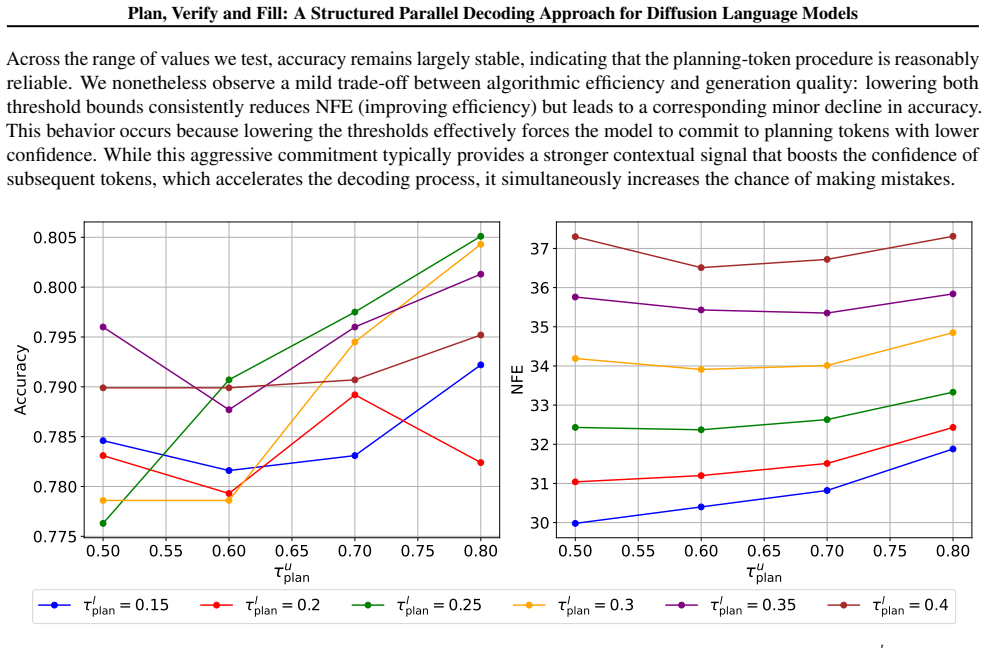
- [§5.2, Table 4, Appendix A.6] The main results use benchmark-specific hyperparameters: (τ_l_plan, τ_u_plan) = (0.2, 0.65) for MMLU-Pro/ARC-C/WinoGrande/GSM8K but (0.8, 0.9) for HumanEval/MATH, and τ_l_AR and N_s differ as well. The statement that 'PVF-specific hyperparameters are fixed' applies only to the Pareto sweep, not to Table 1. Since the sensitivity curves in Appendix A.3.2 show that NFE varies with these thresholds, it is unclear whether the reported 40–65% reductions survive without per-benchmark tuning. Please provide a fixed hyperparameter configuration or a principled selection rule and report sensitivity on the two code/math benchmarks.
minor comments (4)
- [Table 1] The PVF rows have run-together numbers (e.g., '79.6231.3436.4029.55'), making the table difficult to read. Please add spacing or separate columns.
- [§5.1] After the MMLU-Pro citation, the text contains a corrupted path-like string ('/uni00000029/...'). This appears to be a broken reference or embedded link and should be fixed.
- [Algorithm 1] Line 14 writes 'Pθ({z_base, z_plan1, ...} | y_{t-1})', which is not standard notation for a batched conditional forward pass. Clarify that the model is applied to each candidate trajectory separately in a batch.
- [§5.2 / Figure 6] The Pareto frontier for MATH is computed on a 1000-example subset. Please state the variance or confidence intervals for those points, since the full benchmark is 5000 examples.
Circularity Check
Efficiency comparison depends on a self-cited, unverified 'free lunch' batch-size assumption on H200, though the core NFE and accuracy measurements remain empirical.
-
self citation load bearing
[Section 4.1 (Planning Route Phase I) and Section 5.1 (Experiment Settings)]
"Recent studies indicate that on modern accelerators, inference latency for small batch sizes (e.g., 1 vs. 4) is virtually identical due to memory bandwidth saturation (Wu & Zhang, 2025; Fu et al., 2025). ... Empirically (Fu et al., 2025) demonstrates that on NVIDIA B200, the forward-pass latency for a batch size of 4 is effectively identical to that of a single sample. This configuration allows us to evaluate three planned candidates alongside the single baseline trajectory (a total batch size of 4), maximizing structural exploration without incurring runtime penalty."
The paper's headline efficiency claim ('PVF reduces NFE ... unlocking superior efficiency') counts a PVF batch-of-4 forward pass as one NFE, assumed to cost the same as a single baseline forward pass. The only hardware-specific evidence cited for this equivalence is the authors' own previous preprint (Fu et al., 2025), co-authored by PVF authors Hengyu Fu and Baihe Huang, and it was measured on NVIDIA B200, not the H200 GPU used in all experiments. No wall-clock measurements are reported anywhere, so the central NFE comparison is meaningful only if the self-cited 'free lunch' assumption holds. The efficiency argument thus reduces to an unverified load-bearing self-citation.
full rationale
Apart from the batch-size issue, the paper's derivation chain is largely empirical and self-contained. The planning-token safety premise is tested against random low-confidence commits with matched average token confidence (Table 2 and Section A.2), which is independent evidence rather than a definitional identity. The impact-set verification and confidence-maximization filters are algorithmic design choices, not fitted predictions, and the headline NFE/accuracy numbers in Table 1 are measured on external benchmarks. The planning-token vocabulary is produced by an external LLM prompt and then evaluated, not derived from the reported results. The only significant circularity concern is the 'free lunch' batched-inference assumption: it is load-bearing for translating PVF's batched NFE counts into efficiency against single-trajectory baselines, and its direct cited evidence comes from an overlapping-author preprint measured on different hardware. This warrants a moderate score but does not make the central empirical NFE measurements themselves circular.
Assumptions & free parameters
free parameters (8)
- τ_high =
0.9
- τl_plan =
0.2 (GSM8K/MMLU-Pro/ARC-C/WinoGrande), 0.8 (HumanEval/MATH)
- τu_plan =
0.65 (most), 0.9 (HumanEval/MATH)
- τl_AR =
0.1 (most), 0.5 (HumanEval), 0.35 (MATH)
- N_s =
5 (most), 0 (HumanEval/MATH)
- L, B =
512, 64
- Planning token vocabulary P =
Gemini 3 Pro prompt output + capitalized initial tokens + EOS
- Batch size (k=3 candidates + base) =
4
assumptions (5)
- domain assumption Planning tokens are content-neutral and can be safely committed at lower confidence than arbitrary tokens.
- domain assumption A batch of 4 forward passes costs approximately the same wall-clock time as a single forward pass.
- domain assumption NFE is a faithful proxy for decoding efficiency.
- ad hoc to paper Top-1 invariance over the impact set is a sufficient condition for a planning token to be safe.
- standard math Standard masked-diffusion ELBO training and semi-autoregressive blockwise decoding from prior work.
invented entities (1)
-
Planning token set P
Cite this review
Pith. "Pith review of Plan, Verify and Fill: A Structured Parallel Decoding Approach for Diffusion Language Models." pith.science (2026). https://pith.science/paper/T7RLCRCT
@misc{pith2026260112247,
  author       = {Pith},
  title        = {Pith review of: Plan, Verify and Fill: A Structured Parallel Decoding Approach for Diffusion Language Models},
  year         = {2026},
  howpublished = {\url{https://pith.science/paper/T7RLCRCT}},
  note         = {Machine review of arXiv:2601.12247}
}
read the original abstract
Diffusion Language Models (DLMs) present a promising non-sequential paradigm for text generation, distinct from standard autoregressive (AR) approaches. However, current decoding strategies often adopt a reactive stance, underutilizing the global bidirectional context to dictate global trajectories. To address this, we propose Plan-Verify-Fill (PVF), a training-free paradigm that grounds planning via quantitative validation. PVF actively constructs a hierarchical skeleton by prioritizing high-leverage semantic anchors and employs a verification protocol to operationalize pragmatic structural stopping where further deliberation yields diminishing returns. Extensive evaluations on LLaDA-8B-Instruct and Dream-7B-Instruct demonstrate that PVF reduces the Number of Function Evaluations (NFE) by up to 65% compared to confidence-based parallel decoding across benchmark datasets, unlocking superior efficiency without compromising accuracy.
Figures


Figures from the paper (7 more)




Reference graph
Works this paper leans on
-
[1]
DoNOTinclude variable names (e.g., i, x, data), common string literals, or domain-specific business logic words
Content Neutrality:The list mustONLYcontain language primitives (keywords, operators, built-ins, standard delimiters). DoNOTinclude variable names (e.g., i, x, data), common string literals, or domain-specific business logic words
-
[2]
Specifically,NOnewlines ( \n), tabs (\t), carriage returns (\r), or solitary whitespace tokens
Syntax Safety: EXCLUDEall invisible formatting or whitespace tokens. Specifically,NOnewlines ( \n), tabs (\t), carriage returns (\r), or solitary whitespace tokens. Every token must be a visible, functional anchor
-
[3]
High Frequency:These must be the most ubiquitous tokens in the language, required for almost any valid file. Anchoring Logical Pivots via Sentence-Initial TokensIn addition, note that in multi-step reasoning domains, specific discourse markers—such asTherefore,Thus,However, orStep 1—serve as high-leveragelogical pivots. These tokens explicitly delimit the...
2025
-
[4]
Control Flow & Structure (The Skeleton) def, class, return, import, from, as, if, elif, else, for, while, break, continue, pass, try, except, raise,finally,with,assert,lambda,yield,global,nonlocal,del
-
[5]
Logical & Comparison Operators (The Decision Makers) and,or,not,is,in,==,!=,>=,<=,>,<
-
[6]
Critical Punctuation (The Syntax Glue) :,(,),[,],{,},,,.,->,@
-
[7]
Built-in Functions (Action Anchors) len, range, enumerate, zip, sorted, reversed, int, float, str, list, dict, set, tuple, bool, sum, max, min, abs, round, pow, divmod, print, input, open, map, filter, all, any, isinstance, issubclass, type
-
[8]
Common Methods (Data Structure Anchors) append, extend, insert, remove, pop, clear, index, count, sort, reverse, get, keys, values, items, update, add, union, intersection, difference, split, join, strip, replace, format, startswith, endswith,lower,upper
Show all 18 references
-
[9]
Reasoning, Math, & Comment Anchors #,=,+,-, *,/,//,%, **,+=,-=, *=,/=
-
[10]
Dynamic & Special Anchors (Context-Aware) •End of Text Token (EOS):(<|endoftext|>) •Capitalized Initial Words:Any token starting with a capital letter (e.g.,Therefore,If,Let). A.2. Additional Details of Ablation Studies Ablation setting (Section 3).We evaluate two exploration ...
-
[11]
High-confidence commits.We first commit all masked positions that satisfy the static Fast-dLLM unmasking rule (Wu et al., 2025b) with thresholdτ high = 0.9
-
[12]
free lunch
Low-confidence exploration within a confidence bin.Let [τ l, τu] denote the active confidence range (bin). Among the remaining masked positions in the current active block whose top-1 posterior confidence lies in [τ l, τu], we commit exactly one additional token using one of t...
2025
-
[15]
Find the total number of articles she wrote over the three days
-
[16]
**Step 1: Calculate the number of articles she wrote on Tuesday.** Meredith wrote 5 articles on Monday
Calculate the total number of hours she spent writing the articles. **Step 1: Calculate the number of articles she wrote on Tuesday.** Meredith wrote 5 articles on Monday. On Tuesday, she wrote \( \frac{2}{5} \) times more articles than on Monday. Therefore, the number of arti...
-
[17]
Calculate the number of articles she wrote on Tuesday
-
[18]
Calculate the number of articles she wrote on Wednesday
-
[19]
Find the total number of articles written each day
-
[20]
**Step 1: Calculate the number of articles written on Tuesday.** Meredith wrote 5 articles on Monday
Calculate the total number of hours spent writing over the three days. **Step 1: Calculate the number of articles written on Tuesday.** Meredith wrote 5 articles on Monday. On Tuesday, she wrote \( \frac{2}{5} \) times more articles than on Monday. Therefore, the number of art...
Reviewed August 3, 2026 · model on record in the stance chip above.
Discussion (0). Continue with ORCID to comment.