Radio-frequency pulse design in local rotating frame in magnetic resonance imaging
Pith reviewed 2026-05-16 13:55 UTC · model grok-4.3
The pith
A local rotating frame cancels gradient fields voxel by voxel to simplify RF pulse design in MRI.
A machine-rendered reading of the paper's core claim, the machinery that carries it, and where it could break.
Core claim
By defining a local rotating frame in which the total longitudinal field (B0 plus instantaneous gradient) vanishes at each spatial location, the Bloch equations are transformed so that the gradient waveforms are removed by integration, leaving dynamics governed solely by the applied RF fields. Recasting conventional RF design problems in this frame recovers the same excitation profiles while yielding analytically and numerically simpler expressions for 2D spatial pulses, SLR filter design, slice-phase residuals, and multi-coil iterative solutions.
What carries the argument
The local rotating frame, defined so that the effective longitudinal field is zero at every voxel by absorbing the position-dependent gradient into the frame rotation.
If this is right
- Bloch simulations of RF pulses become substantially faster, making iterative optimization practical for parallel-transmit arrays.
- Existing analytic design methods such as Shinnar-Le Roux and excitation k-space can be performed with reduced computational overhead.
- Residual phase maps after slice-selective excitation acquire a simpler closed-form expression in the new frame.
- Multi-dimensional and multi-coil pulse design problems inherit the same speed-up without change in the resulting RF waveforms.
Where Pith is reading between the lines
- The speed-up could allow inclusion of more detailed relaxation or off-resonance maps inside real-time pulse optimizers on clinical scanners.
- The frame transformation may extend to other time-varying field problems in NMR spectroscopy or electron paramagnetic resonance.
- Numerical stability limits would need explicit testing for very rapid gradient switching or strong multi-coil interference.
Load-bearing premise
The local rotating frame transformation stays valid and numerically stable for arbitrary time-dependent gradient waveforms and multi-coil RF fields without adding untracked phase or relaxation terms.
What would settle it
A side-by-side Bloch simulation of a standard slice-selective RF pulse plus gradient waveform, comparing final magnetization profiles obtained in the global rotating frame versus the local rotating frame to within floating-point precision.
Figures
read the original abstract
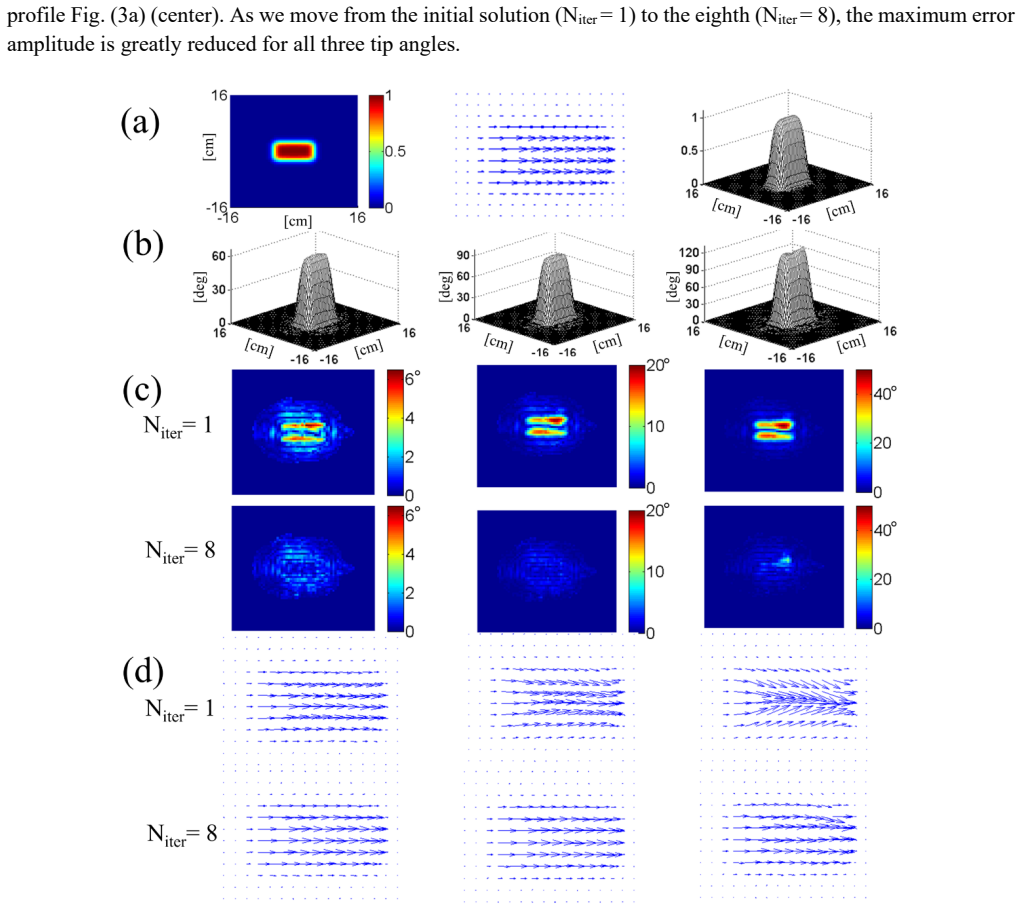
The problem of spatially selective radio-frequency (RF) pulse design in magnetic resonance imaging (MRI) is typically stated in the form of determining, analytically or numerically, RF waveforms to be applied in synchrony with one or more predetermined gradient waveforms. In most cases, the dynamics of the nuclear spin magnetization under the RF and gradient fields is described in a global rotating frame that cancels the effect of the static (main) magnetic field B0. In this work, we consider an alternative frame of reference, which can be called a local rotating frame where total longitudinal magnetic field (B0 plus gradient) in every voxel is zero. In this frame, the effect of time-dependent gradient field is integrated out, and the remaining magnetization dynamics, governed by much weaker RF fields, becomes both simpler and slower. We show that recasting existing RF design methods in such a frame provides useful insights and techniques that are not obvious in the conventional description. The methods we consider include (i) two-dimensional spatial RF pulse design in the excitation k-space, (ii) Shinnar-Le Roux RF design, (iii) residual phase calculation in slice-selective excitation, and (iv) iterative and numerical solutions for multi-coil RF pulse design. In particular, we show that the new formalism can substantially reduce the Bloch simulation time which can greatly benefit iterative pulse designs in parallel transmit. In all, the proposed framework provides considerable theoretical insights and practical utility for RF pulse design in MRI.
Editorial analysis
A structured set of objections, weighed in public.
Referee Report
Summary. The paper proposes a local rotating frame for each voxel in which the combined effects of B0 and the time-dependent, position-dependent gradient fields are exactly canceled, so that magnetization dynamics are driven solely by the (much weaker) RF fields. It recasts four standard RF pulse design techniques—2D k-space excitation, Shinnar-Le Roux, residual-phase calculation for slice-selective pulses, and iterative multi-coil parallel-transmit design—within this frame and asserts that the resulting Bloch simulations run substantially faster, thereby benefiting iterative optimization.
Significance. If the claimed reduction in Bloch simulation time is realized without hidden approximations or loss of accuracy, the framework would provide both practical computational relief for parallel-transmit pulse design and new analytic insight into existing methods; the transformation is exact by construction and preserves relaxation terms, so the potential gain is high for any workflow that repeatedly solves the Bloch equations.
major comments (1)
- The central claim of substantial Bloch-simulation speedup (Abstract) is load-bearing yet unsupported by any reported timing benchmarks or scaling plots in the provided text; without such data it is impossible to judge whether the expected O(1/|B1|) reduction is actually obtained once full time-dependent multi-coil waveforms are included.
minor comments (2)
- Notation for the local-frame RF phase modulation (integral of γG(t)·r) should be introduced with an explicit equation number and shown to be identical to the conventional rotating-frame expression before any design method is recast.
- The manuscript should state explicitly that relaxation operators remain invariant under the unitary frame change and confirm that no additional phase or relaxation artifacts arise when mapping solutions back to the laboratory frame.
Simulated Author's Rebuttal
We thank the referee for the positive evaluation and the recommendation for minor revision. The single major comment is addressed point-by-point below; we will revise the manuscript accordingly.
read point-by-point responses
-
Referee: The central claim of substantial Bloch-simulation speedup (Abstract) is load-bearing yet unsupported by any reported timing benchmarks or scaling plots in the provided text; without such data it is impossible to judge whether the expected O(1/|B1|) reduction is actually obtained once full time-dependent multi-coil waveforms are included.
Authors: We agree that the manuscript does not contain explicit timing benchmarks or scaling plots to support the speedup claim. While the local rotating frame is exact by construction and the reduced effective field magnitude permits larger integration time steps (scaling as O(|B0 + G·r| / |B1|)), we acknowledge that empirical evidence is required to confirm the practical gain for full multi-coil, time-dependent waveforms. In the revised manuscript we will add a dedicated results subsection with CPU timing comparisons and scaling plots for representative cases (2D k-space excitation, SLR pulses, slice-selective excitation, and iterative parallel-transmit design), directly comparing the conventional and local rotating frames. revision: yes
Circularity Check
No significant circularity detected
full rationale
The paper's core step is a standard unitary frame transformation that subtracts the integrated gradient-induced phase (gamma * integral G(t)·r dt) from each voxel's magnetization evolution, leaving only the RF field to drive the Bloch dynamics. This follows directly from the rotating-frame definition in the Bloch equations without any fitted parameters, self-referential definitions, or load-bearing self-citations. The claimed reduction in simulation time is a direct consequence of the weaker effective fields (RF << gradients), not a tautology. Recasting of existing methods (k-space, SLR, iterative PTx) in the new frame preserves their independent mathematical content and does not reduce to the input by construction.
Axiom & Free-Parameter Ledger
axioms (1)
- domain assumption A local rotating frame exists in which the total longitudinal field (B0 plus gradient) is identically zero in every voxel at every time.
invented entities (1)
-
local rotating frame
no independent evidence
Lean theorems connected to this paper
-
IndisputableMonolith/Foundation/RealityFromDistinction.leanreality_from_one_distinction unclear?
unclearRelation between the paper passage and the cited Recognition theorem.
the local rotating frame where total longitudinal magnetic field (B0 plus gradient) in every voxel is zero... the effect of time-dependent gradient field is integrated out
-
IndisputableMonolith/Cost/FunctionalEquation.leanwashburn_uniqueness_aczel unclear?
unclearRelation between the paper passage and the cited Recognition theorem.
Eq. (5) ... Riccati form ... d f / d t = i γ B - i γ B* f² / 4
What do these tags mean?
- matches
- The paper's claim is directly supported by a theorem in the formal canon.
- supports
- The theorem supports part of the paper's argument, but the paper may add assumptions or extra steps.
- extends
- The paper goes beyond the formal theorem; the theorem is a base layer rather than the whole result.
- uses
- The paper appears to rely on the theorem as machinery.
- contradicts
- The paper's claim conflicts with a theorem or certificate in the canon.
- unclear
- Pith found a possible connection, but the passage is too broad, indirect, or ambiguous to say the theorem truly supports the claim.
Reference graph
Works this paper leans on
-
[1]
Parallel excitation with an array of transmit coils,
Y. Zhu, “Parallel excitation with an array of transmit coils,” Magn. Reson. Med., vol. 51, no. 4, pp. 775–784, Apr. 2004, doi: 10.1002/mrm.20011
-
[2]
U. Katscher, P. Börnert, C. Leussler, and J. S. Van Den Brink, “Transmit SENSE,” Magn. Reson. Med., vol. 49, no. 1, pp. 144–150, Jan. 2003, doi: 10.1002/mrm.10353
-
[3]
Joint design of trajectory and RF pulses for parallel excitation,
C. Yip, W. A. Grissom, J. A. Fessler, and D. C. Noll, “Joint design of trajectory and RF pulses for parallel excitation,” Magn. Reson. Med., vol. 58, no. 3, pp. 598–604, Sep. 2007, doi: 10.1002/mrm.21262
-
[4]
Sparse parallel transmit pulse design using orthogonal matching pursuit method,
D. Chen, M. Bornemann, M. W. Vogel, L. I. Sacolick, G. Kudielka, and Y. Zhu, “Sparse parallel transmit pulse design using orthogonal matching pursuit method,” presented at the 17th Annual Meeting of ISMRM, Honolulu, HI, USA: ISMRM, 2009, p. 171
work page 2009
-
[5]
Magnetic resonance described in the excitation dependent rotating frame of reference,
B. Tahayori, L. A. Johnston, I. M. Y. Mareels, and P. M. Farrell, “Magnetic resonance described in the excitation dependent rotating frame of reference,” in 2008 30th Annual International Conference of the IEEE Engineering in Medicine and Biology Society, Vancouver, BC, Canada: IEEE, Aug. 2008, pp. 5769–5773. doi: 10.1109/IEMBS.2008.4650525
-
[6]
General solution to the NMR excitation problem for noninteracting spins,
J. T. Ngo and P. G. Morris, “General solution to the NMR excitation problem for noninteracting spins,” Magn. Reson. Med., vol. 5, no. 3, pp. 217–237, Sep. 1987, doi: 10.1002/mrm.1910050303
-
[7]
Additive angle method for fast large‐tip‐ angle RF pulse design in parallel excitation,
W. A. Grissom, C. Yip, S. M. Wright, J. A. Fessler, and D. C. Noll, “Additive angle method for fast large‐tip‐ angle RF pulse design in parallel excitation,” Magn. Reson. Med., vol. 59, no. 4, pp. 779–787, Apr. 2008, doi: 10.1002/mrm.21510
-
[8]
D. Xu, K. F. King, Y. Zhu, G. C. McKinnon, and Z. Liang, “Designing multichannel, multidimensional, arbitrary flip angle RF pulses using an optimal control approach,” Magn. Reson. Med., vol. 59, no. 3, pp. 547–560, Mar. 2008, doi: 10.1002/mrm.21485
-
[9]
Highly selective and π pulse generation,
M. S. Silver, R. I. Joseph, and D. I. Hoult, “Highly selective and π pulse generation,” J. Magn. Reson., vol. 59, no. 2, pp. 347–351, Sep. 1984, doi: 10.1016/0022-2364(84)90181-1
-
[10]
M. S. Silver, R. I. Joseph, and D. I. Hoult, “Selective spin inversion in nuclear magnetic resonance and coherent optics through an exact solution of the Bloch-Riccati equation,” Phys. Rev. A, vol. 31, no. 4, pp. 2753–2755, Apr. 1985, doi: 10.1103/PhysRevA.31.2753
-
[11]
D. E. Rourke, M. J. W. Prior, P. G. Morris, and J. A. B. Lohman, “Stereographic Projection Method of Exactly Calculating Selective Pulses,” J. Magn. Reson. A, vol. 107, no. 2, pp. 203–214, Apr. 1994, doi: 10.1006/jmra.1994.1069
-
[12]
D. E. Rourke and P. G. Morris, “The inverse scattering transform and its use in the exact inversion of the Bloch equation for noninteracting spins,” J. Magn. Reson., vol. 99, pp. 118–138, 1992
work page 1992
-
[13]
RF pulse design using the inverse scattering transform,
M. H. Buonocore, “RF pulse design using the inverse scattering transform,” Magn. Reson. Med., vol. 29, no. 4, pp. 470–477, Apr. 1993, doi: 10.1002/mrm.1910290408
-
[14]
Minimum energy pulse synthesis via the inverse scattering transform,
C. L. Epstein, “Minimum energy pulse synthesis via the inverse scattering transform,” J. Magn. Reson., vol. 167, no. 2, pp. 185–210, Apr. 2004, doi: 10.1016/j.jmr.2003.12.014
-
[15]
Exact half pulse synthesis via the inverse scattering transform,
J. Magland and C. L. Epstein, “Exact half pulse synthesis via the inverse scattering transform,” J. Magn. Reson., vol. 171, no. 2, pp. 305–313, Dec. 2004, doi: 10.1016/j.jmr.2004.09.004
-
[16]
Practical pulse synthesis via the discrete inverse scattering transform,
J. Magland and C. L. Epstein, “Practical pulse synthesis via the discrete inverse scattering transform,” J. Magn. Reson., vol. 172, no. 1, pp. 63–78, Jan. 2005, doi: 10.1016/j.jmr.2004.09.022
-
[17]
Selective rotation pulses calculated with an inverse scattering algorithm,
D. E. Rourke and C. O. Bretschneider, “Selective rotation pulses calculated with an inverse scattering algorithm,” J. Magn. Reson., vol. 186, no. 1, pp. 123–130, May 2007, doi: 10.1016/j.jmr.2007.02.002
-
[18]
A k-space analysis of small-tip-angle excitation,
J. Pauly, D. Nishimura, and A. Macovski, “A k-space analysis of small-tip-angle excitation,” J. Magn. Reson. 1969, vol. 81, no. 1, pp. 43–56, Jan. 1989, doi: 10.1016/0022-2364(89)90265-5. 22
-
[19]
Iterative RF pulse design for multidimensional, small‐tip‐angle selective excitation,
C. Yip, J. A. Fessler, and D. C. Noll, “Iterative RF pulse design for multidimensional, small‐tip‐angle selective excitation,” Magn. Reson. Med., vol. 54, no. 4, pp. 908–917, Oct. 2005, doi: 10.1002/mrm.20631
-
[20]
Spatial domain method for the design of RF pulses in multicoil parallel excitation,
W. Grissom, C. Yip, Z. Zhang, V. A. Stenger, J. A. Fessler, and D. C. Noll, “Spatial domain method for the design of RF pulses in multicoil parallel excitation,” Magn. Reson. Med., vol. 56, no. 3, pp. 620–629, Sep. 2006, doi: 10.1002/mrm.20978
-
[21]
D. Xu, K. F. King, Y. Zhu, G. C. McKinnon, and Z. Liang, “A noniterative method to design large‐tip‐angle multidimensional spatially‐selective radio frequency pulses for parallel transmission,” Magn. Reson. Med., vol. 58, no. 2, pp. 326–334, Aug. 2007, doi: 10.1002/mrm.21314
-
[22]
A linear class of large-tip-angle selective excitation pulses,
J. Pauly, D. Nishimura, and A. Macovski, “A linear class of large-tip-angle selective excitation pulses,” J. Magn. Reson., vol. 82, no. 3, pp. 571–587, May 1989, doi: 10.1016/0022-2364(89)90219-9
-
[23]
Matrix Treatment of Nuclear Induction,
E. T. Jaynes, “Matrix Treatment of Nuclear Induction,” Phys. Rev., vol. 98, no. 4, pp. 1099–1105, May 1955, doi: 10.1103/PhysRev.98.1099
-
[24]
Solution of Bloch equations involving amplitude and frequency modulations,
F. T. Hioe, “Solution of Bloch equations involving amplitude and frequency modulations,” Phys. Rev. A, vol. 30, no. 4, pp. 2100–2103, Oct. 1984, doi: 10.1103/PhysRevA.30.2100
-
[25]
Application of spinors to solving the Bloch equations,
G. Town and D. Rosenfeld, “Application of spinors to solving the Bloch equations,” Phys. Rev. A, vol. 40, no. 6, pp. 3429–3430, Sep. 1989, doi: 10.1103/PhysRevA.40.3429
-
[26]
Goldstein, Classical mechanics, 2
H. Goldstein, Classical mechanics, 2. ed. in Addison-Wesley series in physics. Lebanon, Indiana, USA: Addison-Wesley, 1980
work page 1980
-
[27]
J. Pauly, P. Le Roux, D. Nishimura, and A. Macovski, “Parameter relations for the Shinnar-Le Roux selective excitation pulse design algorithm (NMR imaging),” IEEE Trans. Med. Imaging, vol. 10, no. 1, pp. 53–65, Mar. 1991, doi: 10.1109/42.75611
-
[28]
M. A. Bernstein, K. F. King, and X. J. Zhou, Eds., Handbook of MRI pulse sequences. Amsterdam Boston: Academic Press, 2010
work page 2010
-
[29]
Iterative RF pulse refinement for magnetic resonance imaging,
E. T. Lebsack and S. M. Wright, “Iterative RF pulse refinement for magnetic resonance imaging,” IEEE Trans. Biomed. Eng., vol. 49, no. 1, pp. 41–48, Jan. 2002, doi: 10.1109/10.972838
-
[30]
Construction of universal rotations from point-to-point transformations,
B. Luy, K. Kobzar, T. E. Skinner, N. Khaneja, and S. J. Glaser, “Construction of universal rotations from point-to-point transformations,” J. Magn. Reson., vol. 176, no. 2, pp. 179–186, Oct. 2005, doi: 10.1016/j.jmr.2005.06.002
-
[31]
RF Concatenation with Spiral In-and-Out Trajectory for Two-Dimensional Large-Tip-Angle Excitation,
S.-K. Lee, D. Xu, W. A. Grissom, I. Hancu, and M. W. Vogel, “RF Concatenation with Spiral In-and-Out Trajectory for Two-Dimensional Large-Tip-Angle Excitation,” presented at the 18th Annual Meeting of ISMRM, Stockholm, Sweden: ISMRM, 2010, p. 4945
work page 2010
-
[32]
Optimal Control Solutions to the Magnetic Resonance Selective Excitation Problem,
S. Conolly, D. Nishimura, and A. Macovski, “Optimal Control Solutions to the Magnetic Resonance Selective Excitation Problem,” IEEE Trans. Med. Imaging, vol. 5, no. 2, pp. 106–115, Jun. 1986, doi: 10.1109/TMI.1986.4307754
-
[33]
Optimal control design of phase-relaxed parallel transmission RF pulses for arbitrary flip angles,
D. Xu, K. F. King, and Z. P. Liang, “Optimal control design of phase-relaxed parallel transmission RF pulses for arbitrary flip angles,” presented at the 16th Annual Meeting of ISMRM, Toronto, ON, Canada: ISMRM, 2008, p. 618
work page 2008
-
[34]
Bloch solver simulation realization on a graphics-processing unit (GPU),
S. M. Lechner, D. Butnaru, H.-J. Bungartz, D. Chen, and M. W. Vogel, “Bloch solver simulation realization on a graphics-processing unit (GPU),” presented at the 17th Annual Meeting of ISMRM, Honolulu, HI, USA: ISMRM, p. 2695
-
[35]
A Method for Improving the Robustness of linear Kramers- Kronig Validity Tests,
M. Schönleber, D. Klotz, and E. Ivers-Tiffée, “A Method for Improving the Robustness of linear Kramers- Kronig Validity Tests,” Electrochimica Acta, vol. 131, pp. 20–27, Jun. 2014, doi: 10.1016/j.electacta.2014.01.034
discussion (0)
Sign in with ORCID, Apple, or X to comment. Anyone can read and Pith papers without signing in.