DiSPA: Differential Substructure-Pathway Attention for Drug Response Prediction
Pith reviewed 2026-05-16 12:41 UTC · model grok-4.3
The pith
DiSPA uses differential cross-attention to model interactions between drug substructures and cellular pathways for improved response prediction.
A machine-rendered reading of the paper's core claim, the machinery that carries it, and where it could break.
Core claim
DiSPA achieves state-of-the-art performance on the GDSC benchmark by modeling bidirectional interactions between chemical substructures and pathway-level gene expression through differential cross-attention, which suppresses spurious associations and enhances context-relevant interactions, leading to more selective attention patterns and improved generalization in disjoint and drug-blind settings.
What carries the argument
Differential cross-attention mechanism that suppresses spurious associations while enhancing context-relevant interactions between chemical substructures and pathway gene expressions.
If this is right
- Stronger performance when predicting responses for drugs absent from the training set.
- More consistent results across random and drug-blind data splits.
- Attention maps that concentrate on fewer, more relevant substructure-pathway pairs.
- Better ranking of predefined target-related pathways.
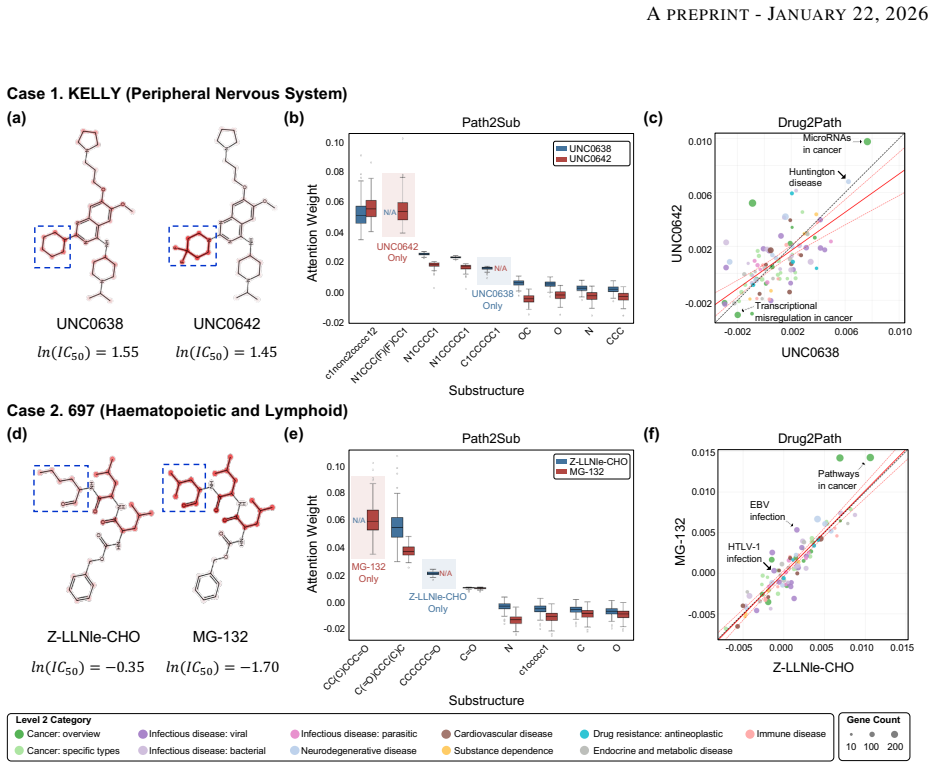
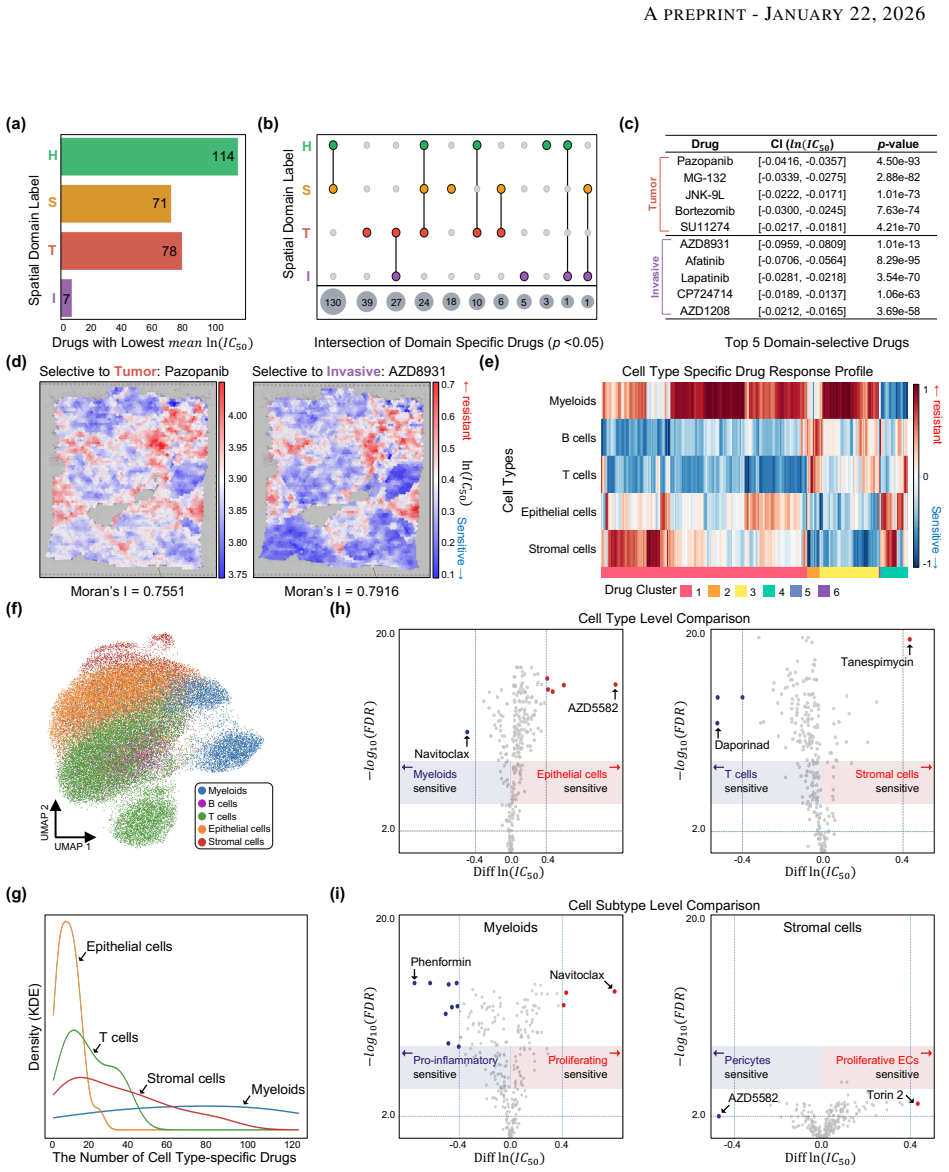
- Initial generalization to external benchmarks such as CTRP and zero-shot application to spatial transcriptomics.
Where Pith is reading between the lines
- The selective attention could help identify which chemical features drive sensitivity in specific cell states.
- The same differential mechanism might transfer to other structure-omics prediction tasks.
- Testing the model on patient-derived samples would reveal whether cell-line gains translate to clinical settings.
- Incorporating additional modalities such as proteomics could further constrain the attention to true mechanisms.
Load-bearing premise
The differential cross-attention mechanism captures genuine biological interactions rather than fitting to dataset-specific noise.
What would settle it
If DiSPA shows no accuracy gain over standard cross-attention baselines on a new independent dataset with altered noise profiles, or if its attention weights fail to align with known drug-target pathway links in controlled experiments, the central claim would not hold.
Figures


read the original abstract
Accurate prediction of drug response in precision medicine requires models that capture how specific chemical substructures interact with cellular pathway states. However, most existing deep learning approaches treat chemical and transcriptomic modalities independently or combine them only at late stages, limiting their ability to model fine-grained, context-dependent mechanisms of drug action. In addition, vanilla attention mechanisms are often sensitive to noise and sparsity in high-dimensional biological networks, hindering both generalization and interpretability. We present DiSPA (Differential Substructure-Pathway Attention), a framework that models bidirectional interactions between chemical substructures and pathway-level gene expression. DiSPA introduces differential cross-attention to suppress spurious associations while enhancing context-relevant interactions. On the GDSC benchmark, DiSPA achieves state-of-the-art performance, with strong improvements in the disjoint setting. These gains are consistent across random and drug-blind splits, suggesting improved robustness. Analyses of attention patterns indicate more selective and concentrated interactions compared to standard cross-attention. Exploratory evaluation shows that differential attention better prioritizes predefined target-related pathways, although this does not constitute mechanistic validation. DiSPA also shows promising generalization on external datasets (CTRP) and cross-dataset settings, although further validation is needed. It further enables zero-shot application to spatial transcriptomics, providing exploratory insights into region-specific drug sensitivity patterns without ground-truth validation.
Editorial analysis
A structured set of objections, weighed in public.
Referee Report
Summary. The manuscript introduces DiSPA, a multimodal deep learning model for drug response prediction that employs differential cross-attention to model bidirectional interactions between chemical substructures and pathway-level gene expression profiles. The central claims are state-of-the-art performance on the GDSC benchmark (with gains in both random and drug-blind disjoint splits), improved robustness relative to prior methods, more selective attention patterns, and exploratory evidence of better prioritization of target-related pathways, plus generalization tests on CTRP and zero-shot application to spatial transcriptomics.
Significance. If the performance gains and robustness claims are substantiated, DiSPA would advance multimodal integration in precision oncology by addressing noise sensitivity in high-dimensional biological data and late-fusion limitations. The differential attention design and reported improvements in unseen-drug settings could inform more generalizable models, though the explicitly exploratory status of the interpretability results constrains immediate biological or clinical impact.
major comments (3)
- [Results] Results section: The SOTA and robustness claims on GDSC (random and drug-blind splits) are presented without error bars, statistical significance tests against baselines, or full details on exact architectures, loss functions, and hyperparameter selection, preventing assessment of whether the reported gains exceed what would be expected from capacity differences alone.
- [Methods and Results] Methods and Results: No ablation experiments are described that replace differential cross-attention with vanilla cross-attention while holding other components fixed; without such controls, it is impossible to attribute the disjoint-set improvements specifically to the noise-suppression mechanism rather than overall model expressivity or split-specific correlations.
- [Interpretability analysis] Interpretability analysis: The claim that differential attention better prioritizes target-related pathways rests on qualitative attention pattern observations and is explicitly labeled exploratory without mechanistic validation; quantitative enrichment against external drug-pathway databases or permutation tests on pathway labels are absent, leaving open the possibility that patterns reflect dataset artifacts.
minor comments (1)
- [Abstract and Methods] Abstract and Methods: The description of the differential cross-attention formulation would benefit from an explicit equation or pseudocode block to clarify how the suppression of spurious associations is implemented.
Simulated Author's Rebuttal
We thank the referee for their constructive feedback. We address each major comment below and have revised the manuscript to strengthen the statistical reporting, add necessary controls, and enhance the interpretability analysis while preserving its exploratory framing.
read point-by-point responses
-
Referee: [Results] Results section: The SOTA and robustness claims on GDSC (random and drug-blind splits) are presented without error bars, statistical significance tests against baselines, or full details on exact architectures, loss functions, and hyperparameter selection, preventing assessment of whether the reported gains exceed what would be expected from capacity differences alone.
Authors: We agree that the original presentation lacked sufficient statistical detail. In the revised manuscript we now report all GDSC metrics as mean ± standard deviation across five independent runs with different random seeds. We have added paired t-tests (with p-values) comparing DiSPA to each baseline on both random and drug-blind splits. The Methods section has been expanded with complete architecture specifications, the loss function (MSE plus L2 regularization), and the full hyperparameter search protocol together with the final selected values. revision: yes
-
Referee: [Methods and Results] Methods and Results: No ablation experiments are described that replace differential cross-attention with vanilla cross-attention while holding other components fixed; without such controls, it is impossible to attribute the disjoint-set improvements specifically to the noise-suppression mechanism rather than overall model expressivity or split-specific correlations.
Authors: We concur that an isolated ablation is required. We have added the requested experiment in which differential cross-attention is replaced by standard vanilla cross-attention while freezing every other architectural component, loss, optimizer, and hyperparameter. The new results, presented in a dedicated subsection and table, show that the differential formulation yields further gains specifically in the drug-blind setting, consistent with a noise-suppression benefit beyond raw expressivity. revision: yes
-
Referee: [Interpretability analysis] Interpretability analysis: The claim that differential attention better prioritizes target-related pathways rests on qualitative attention pattern observations and is explicitly labeled exploratory without mechanistic validation; quantitative enrichment against external drug-pathway databases or permutation tests on pathway labels are absent, leaving open the possibility that patterns reflect dataset artifacts.
Authors: The manuscript already qualifies the analysis as exploratory and explicitly states that it does not provide mechanistic validation. To further address the concern we have supplemented the section with quantitative enrichment: hypergeometric tests against curated drug-pathway associations from KEGG/Reactome and 1,000-label permutation tests to evaluate whether the observed prioritization exceeds chance. These statistics are reported alongside the original qualitative visualizations while retaining the exploratory designation. revision: partial
Circularity Check
No circularity detected; model and claims are empirically grounded on external benchmarks
full rationale
The paper defines DiSPA via an explicit architecture (differential cross-attention between substructures and pathways) and evaluates its performance claims solely through comparisons on held-out external data (GDSC random/drug-blind splits, CTRP, cross-dataset). No equation or result reduces by construction to a fitted parameter, self-referential definition, or load-bearing self-citation; attention analyses are presented as exploratory without being used to justify the performance numbers. The derivation chain is therefore self-contained against independent benchmarks.
Axiom & Free-Parameter Ledger
free parameters (1)
- model hyperparameters
Lean theorems connected to this paper
-
IndisputableMonolith/Cost/FunctionalEquation.leanwashburn_uniqueness_aczel unclear?
unclearRelation between the paper passage and the cited Recognition theorem.
differential cross-attention module that suppresses spurious pathway-substructure associations while amplifying contextually relevant interactions
What do these tags mean?
- matches
- The paper's claim is directly supported by a theorem in the formal canon.
- supports
- The theorem supports part of the paper's argument, but the paper may add assumptions or extra steps.
- extends
- The paper goes beyond the formal theorem; the theorem is a base layer rather than the whole result.
- uses
- The paper appears to rely on the theorem as machinery.
- contradicts
- The paper's claim conflicts with a theorem or certificate in the canon.
- unclear
- Pith found a possible connection, but the passage is too broad, indirect, or ambiguous to say the theorem truly supports the claim.
Forward citations
Cited by 1 Pith paper
-
Training distribution determines the ceiling of drug-blind cancer sensitivity prediction
Drug-blind cancer sensitivity prediction is limited by evaluation metric and training distribution rather than drug representation complexity.
Reference graph
Works this paper leans on
-
[1]
G. Adam, L. Rampášek, Z. Safikhani, P. Smirnov, B. Haibe-Kains, and A. Goldenberg. Machine learning approaches to drug response prediction: challenges and recent progress.NPJ precision oncology, 4(1):19, 2020
work page 2020
-
[2]
D. Baptista, P. G. Ferreira, and M. Rocha. Deep learning for drug response prediction in cancer.Briefings in bioinformatics, 22(1):360–379, 2021
work page 2021
-
[3]
A. Bellver-Sanchis, Q. Geng, G. Navarro, P. A. Ávila-López, J. Companys-Alemany, L. Marsal-García, R. Larramona-Arcas, L. Miró, A. Perez-Bosque, D. Ortuño-Sahagún, et al. G9a inhibition promotes neuro- protection through gmfb regulation in alzheimer’s disease.Aging and disease, 15(1):311, 2024
work page 2024
- [4]
-
[5]
Z. Fan, W.-H. Lin, C. Liang, Y . Li, C.-J. Peng, J.-S. Luo, W.-Y . Tang, L.-M. Zheng, D.-P. Huang, Z.-Y . Ke, et al. Mg132 inhibits proliferation and induces apoptosis of acute lymphoblastic leukemia via akt/foxo3a/bim pathway. Human & Experimental Toxicology, 43:09603271241303030, 2024
work page 2024
-
[6]
F. Firoozbakht, B. Yousefi, and B. Schwikowski. An overview of machine learning methods for monotherapy drug response prediction.Briefings in bioinformatics, 23(1), 2022. 11 APREPRINT- JANUARY22, 2026
work page 2022
-
[7]
M. Kanehisa and S. Goto. Kegg: kyoto encyclopedia of genes and genomes.Nucleic acids research, 28(1):27–30, 2000
work page 2000
-
[8]
H.-J. Lee, Y . Hong, H. E. Etlioglu, Y . B. Cho, V . Pomella, B. Van den Bosch, J. Vanhecke, S. Verbandt, D. W. Hong, J.-W. Min, et al. Lineage-dependent gene expression programs influence the immune landscape of colorectal cancer.Nature Genetics, 52(6):594–603, 2020
work page 2020
-
[9]
M. Pak, S. Lee, I. Sung, B. Koo, and S. Kim. Improved drug response prediction by drug target data integration via network-based profiling.Briefings in Bioinformatics, 24(2):bbad034, 2023
work page 2023
-
[10]
M. Schubert, B. Klinger, M. Klünemann, A. Sieber, F. Uhlitz, S. Sauer, M. J. Garnett, N. Blüthgen, and J. Saez-Rodriguez. Perturbation-response genes reveal signaling footprints in cancer gene expression.Nature communications, 9(1):20, 2018
work page 2018
-
[11]
B. Shen, F. Feng, K. Li, P. Lin, L. Ma, and H. Li. A systematic assessment of deep learning methods for drug response prediction: from in vitro to clinical applications.Briefings in Bioinformatics, 24(1):bbac605, 2023
work page 2023
-
[12]
D. Stumpfe and J. Bajorath. Exploring activity cliffs in medicinal chemistry: miniperspective.Journal of medicinal chemistry, 55(7):2932–2942, 2012
work page 2012
-
[13]
F. Xia, J. Allen, P. Balaprakash, T. Brettin, C. Garcia-Cardona, A. Clyde, J. Cohn, J. Doroshow, X. Duan, V . Dubinkina, et al. A cross-study analysis of drug response prediction in cancer cell lines.Briefings in bioinformatics, 23(1):bbab356, 2022
work page 2022
-
[14]
Z. Xun, X. Ding, Y . Zhang, B. Zhang, S. Lai, D. Zou, J. Zheng, G. Chen, B. Su, L. Han, et al. Reconstruction of the tumor spatial microenvironment along the malignant-boundary-nonmalignant axis.Nature Communications, 14(1):933, 2023
work page 2023
-
[15]
T. Ye, L. Dong, Y . Xia, Y . Sun, Y . Zhu, G. Huang, and F. Wei. Differential transformer. InThe Thirteenth International Conference on Learning Representations, 2025. URL https://openreview.net/forum?id= OvoCm1gGhN. 12
work page 2025
discussion (0)
Sign in with ORCID, Apple, or X to comment. Anyone can read and Pith papers without signing in.