FBApro: A fast, simple linear transformation for diverse metabolic modeling tasks
Pith reviewed 2026-05-22 12:09 UTC · model grok-4.3
The pith
FBApro finds the closest steady-state flux vector to any reference using one linear operation.
A machine-rendered reading of the paper's core claim, the machinery that carries it, and where it could break.
Core claim
For any given vector of reference fluxes, FBApro finds the closest flux vector within the steady-state subspace, and accounts for both partially given reference fluxes and exact constraints on reactions. While FBApro is the solution to a quadratic program, it can be implemented as a single linear operation using orthogonal projections to corresponding affine spaces and sets of linear equations.
What carries the argument
Orthogonal projection of a reference flux vector onto the affine space defined by the model's steady-state linear constraints, expressed in closed form as a linear map.
Load-bearing premise
The flux distribution that is closest in distance to the reference vector inside the steady-state subspace is the one that best represents the biological state.
What would settle it
Direct comparison of FBApro-projected fluxes against measured fluxes in cancer cell line experiments where the projected values deviate systematically from independent validation data.
Figures



read the original abstract
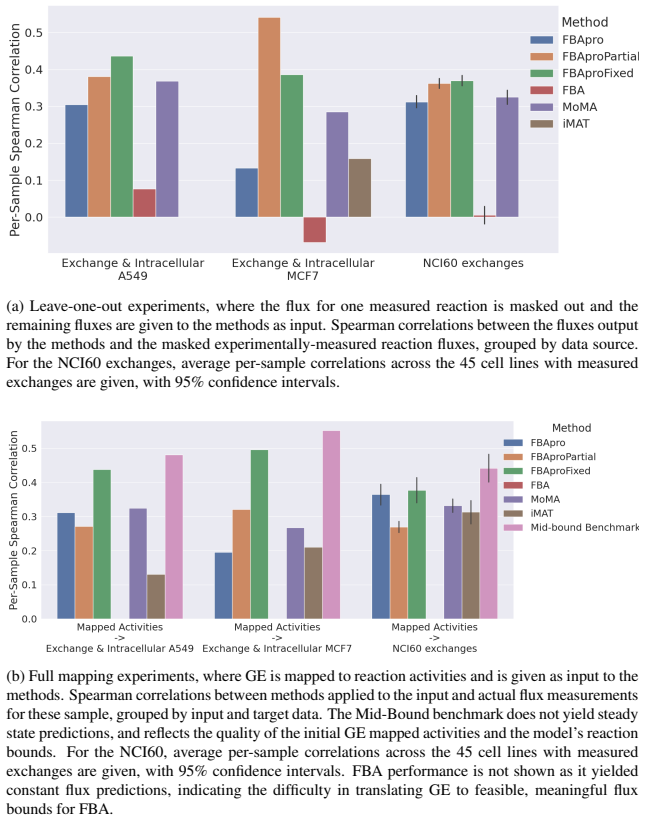
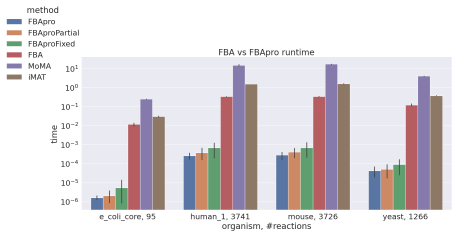
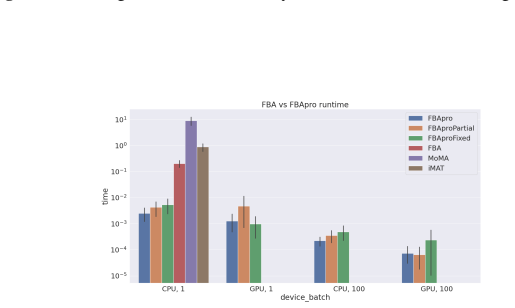
Constraint-based metabolic modeling is the predominant framework for simulating cellular metabolism. The central assumption of these models is that metabolism operates at a steady state, meaning that the production and consumption rates of each metabolite are balanced. This assumption imposes linear constraints on the fluxes of biochemical reactions. Flux Balance Analysis (FBA), a fundamental method in the field, is formulated as an optimization problem maximizing a cellular objective (e.g., growth) over the resulting linear subspace of steady state fluxes. Many other methods in the field are expressed either as a modification to FBA, or use FBA as a black box within an algorithm. Here, we propose a general alternative to optimization called FBApro. For any given vector of reference fluxes, FBApro finds the closest flux vector within the steady-state subspace, and accounts for both partially given reference fluxes and exact constraints on reactions. While FBApro is the solution to a quadratic program, we show that it can be implemented as a single linear operation using orthogonal projections to corresponding affine spaces and sets of linear equations. The overall approach is computationally efficient, does not require a cellular objective, and is easy to implement. We formally derive the closed-form expressions for FBApro and simpler variants, and validate it on both synthetic and real cancer cell line data.
Editorial analysis
A structured set of objections, weighed in public.
Referee Report
Summary. The manuscript introduces FBApro as a method that, for a given reference flux vector, computes the closest flux vector in the steady-state subspace defined by the stoichiometric matrix S (i.e., solving the quadratic program min ||v - r||_2 s.t. S v = 0, with extensions for partial references and exact equality constraints on reactions). It derives closed-form expressions showing that this projection can be implemented as a single linear operation via orthogonal projections onto the nullspace of S or corresponding affine spaces, and validates the approach on synthetic data plus real cancer cell line models. The method is positioned as a fast, objective-free alternative to optimization-based techniques such as FBA for diverse metabolic modeling tasks.
Significance. If the central claim holds, FBApro would provide a computationally efficient, linear-map alternative for flux projection tasks in constraint-based modeling, enabling rapid handling of partial data or exact constraints without repeated optimizations or specification of a biomass objective. The explicit closed-form derivation and validation on both synthetic and real datasets are strengths supporting reproducibility and potential utility in large-scale models.
major comments (1)
- In the formal derivation (as referenced in the abstract and the section on formal derivation and validation), the orthogonal projection onto the steady-state subspace (or its affine translate for exact constraints) solves the stated QP but does not incorporate the standard inequality bounds lb ≤ v ≤ ub. Consequently, the resulting fluxes can violate irreversibility or capacity constraints, and the cancer cell line validation only confirms geometric closeness rather than biological feasibility under the full polytope.
minor comments (1)
- The abstract and derivation sections would benefit from an explicit statement of the scope regarding inequality constraints to better delineate when the linear map is guaranteed to produce valid fluxes.
Simulated Author's Rebuttal
We thank the referee for their careful reading and insightful comments on our manuscript. The major comment raises an important point about the scope of the projection, and we address it directly below. We have revised the manuscript to incorporate clarifications on this limitation.
read point-by-point responses
-
Referee: In the formal derivation (as referenced in the abstract and the section on formal derivation and validation), the orthogonal projection onto the steady-state subspace (or its affine translate for exact constraints) solves the stated QP but does not incorporate the standard inequality bounds lb ≤ v ≤ ub. Consequently, the resulting fluxes can violate irreversibility or capacity constraints, and the cancer cell line validation only confirms geometric closeness rather than biological feasibility under the full polytope.
Authors: We agree with the referee that the FBApro derivation solves the unconstrained (or equality-constrained) quadratic program min ||v - r||_2 s.t. Sv = 0 (or with additional exact equalities), without enforcing the inequality bounds lb ≤ v ≤ ub that define the feasible flux polytope. This is by design: the method is intended to provide a closed-form linear transformation for rapid projection onto the steady-state subspace, which can be computed via a single matrix multiplication without iterative optimization. Incorporating bounds would convert the problem into a quadratic program with inequalities, which in general lacks a simple closed-form linear solution and would require numerical QP solvers, undermining the computational advantages highlighted in the paper. The synthetic and cancer cell line validations confirm that the projected fluxes are the nearest points in the affine subspace (i.e., geometric closeness), as stated in the manuscript. For use cases requiring strict adherence to bounds, FBApro can serve as an efficient initial projection or warm start, after which bounds can be enforced via clipping, post-processing, or a subsequent optimization step. We have added a new paragraph in the Discussion section of the revised manuscript explicitly acknowledging this scope limitation, contrasting it with standard FBA, and outlining practical ways to combine FBApro with bound-aware methods. revision: yes
Circularity Check
No circularity: derivation applies standard orthogonal projection to steady-state nullspace
full rationale
The paper derives FBApro directly from the definition of the Euclidean closest point in the affine space defined by S v = 0 (plus exact equality constraints). Closed-form linear expressions follow from the standard formula for orthogonal projection onto the nullspace of S, which is a textbook linear-algebra result independent of the paper's own data or prior claims. No parameters are fitted and then renamed as predictions, no self-citation chain carries the central step, and no ansatz is smuggled in. The method is self-contained against external linear-algebra benchmarks; validation on synthetic and cancer-cell data tests application rather than the derivation itself.
Axiom & Free-Parameter Ledger
axioms (1)
- domain assumption Metabolism operates at steady state, imposing linear constraints on reaction fluxes.
Lean theorems connected to this paper
-
IndisputableMonolith/Cost/FunctionalEquation.leanwashburn_uniqueness_aczel unclear?
unclearRelation between the paper passage and the cited Recognition theorem.
FBApro(v) = (I - S^+ S)v ... orthogonal projection to the kernel ... expressed as a single linear operation using orthogonal projections to corresponding affine spaces
-
IndisputableMonolith/Foundation/BranchSelection.leanbranch_selection unclear?
unclearRelation between the paper passage and the cited Recognition theorem.
FBApro is the solution to a quadratic program ... implemented as a single linear operation
What do these tags mean?
- matches
- The paper's claim is directly supported by a theorem in the formal canon.
- supports
- The theorem supports part of the paper's argument, but the paper may add assumptions or extra steps.
- extends
- The paper goes beyond the formal theorem; the theorem is a base layer rather than the whole result.
- uses
- The paper appears to rely on the theorem as machinery.
- contradicts
- The paper's claim conflicts with a theorem or certificate in the canon.
- unclear
- Pith found a possible connection, but the passage is too broad, indirect, or ambiguous to say the theorem truly supports the claim.
Reference graph
Works this paper leans on
-
[1]
Eleftherios Terry Papoutsakis and Charles L Meyer. Equations and calculations of product yields and preferred pathways for butanediol and mixed-acid fermentations.Biotechnology and bioengineering, 27(1):50–66, 1985
work page 1985
-
[2]
What is flux balance analysis?Nature biotechnology, 28(3):245–248, 2010
Jeffrey D Orth, Ines Thiele, and Bernhard Ø Palsson. What is flux balance analysis?Nature biotechnology, 28(3):245–248, 2010
work page 2010
-
[3]
Fat synthesis in adipose tissue
David A Fell and J Rankin Small. Fat synthesis in adipose tissue. an examination of stoichiometric constraints.Biochemical journal, 238(3):781–786, 1986
work page 1986
-
[4]
Charles J Norsigian, Neha Pusarla, John Luke McConn, James T Yurkovich, Andreas DrÃCger, Bernhard O Palsson, and Zachary King. Bigg models 2020: multi-strain genome-scale models and expansion across the phylogenetic tree.Nucleic Acids Research, 48(D1):D402–D406, 11 2019
work page 2020
-
[5]
Metabolic modelling of microbes: the flux- balance approach.Environmental microbiology, 4(3), 2002
Jeremy S Edwards, Markus Covert, and Bernhard Palsson. Metabolic modelling of microbes: the flux- balance approach.Environmental microbiology, 4(3), 2002
work page 2002
-
[6]
Karthik Raman and Nagasuma Chandra. Flux balance analysis of biological systems: applications and challenges.Briefings in bioinformatics, 10(4):435–449, 2009
work page 2009
-
[7]
Michael Kohlstedt, Judith Becker, and Christoph Wittmann. Metabolic fluxes and beyond–systems biology understanding and engineering of microbial metabolism.Applied microbiology and biotechnology, 88(5):1065–1075, 2010
work page 2010
-
[8]
Nathan E Lewis, Harish Nagarajan, and Bernhard O Palsson. Constraining the metabolic genotype– phenotype relationship using a phylogeny of in silico methods.Nature Reviews Microbiology, 10(4):291– 305, 2012
work page 2012
-
[9]
Daniel Segre, Dennis Vitkup, and George M Church. Analysis of optimality in natural and perturbed metabolic networks.Proceedings of the national academy of sciences, 99(23):15112–15117, 2002
work page 2002
-
[10]
Tomer Shlomi, Omer Berkman, and Eytan Ruppin. Regulatory on/off minimization of metabolic flux changes after genetic perturbations.Proceedings of the national academy of sciences, 102(21):7695–7700, 2005
work page 2005
-
[11]
Daniel J Cook and Jens Nielsen. Genome-scale metabolic models applied to human health and disease.Wiley Interdisciplinary Reviews: Systems Biology and Medicine, 9(6):e1393, 2017
work page 2017
-
[12]
Scott A Becker and Bernhard O Palsson. Context-specific metabolic networks are consistent with experiments.PLoS computational biology, 4(5):e1000082, 2008
work page 2008
-
[13]
Tomer Shlomi, Moran N Cabili, Markus J Herrgård, Bernhard Ø Palsson, and Eytan Ruppin. Network-based prediction of human tissue-specific metabolism.Nature biotechnology, 26(9):1003–1010, 2008
work page 2008
-
[14]
Livnat Jerby, Tomer Shlomi, and Eytan Ruppin. Computational reconstruction of tissue-specific metabolic models: application to human liver metabolism.Molecular systems biology, 6(1):401, 2010
work page 2010
-
[15]
Rasmus Agren, Sergio Bordel, Adil Mardinoglu, Natapol Pornputtapong, Intawat Nookaew, and Jens Nielsen. Reconstruction of genome-scale active metabolic networks for 69 human cell types and 16 cancer types using init.PLoS computational biology, 8(5):e1002518, 2012
work page 2012
-
[16]
Allon Wagner, Chao Wang, Johannes Fessler, David DeTomaso, Julian Avila-Pacheco, James Kaminski, Sarah Zaghouani, Elena Christian, Pratiksha Thakore, Brandon Schellhaass, et al. Metabolic modeling of single th17 cells reveals regulators of autoimmunity.Cell, 184(16):4168–4185, 2021
work page 2021
-
[17]
John Jumper, Richard Evans, Alexander Pritzel, Tim Green, Michael Figurnov, Olaf Ronneberger, Kathryn Tunyasuvunakool, Russ Bates, Augustin ÅœÃdek, Anna Potapenko, Alex Bridgland, Clemens Meyer, Simon A. A. Kohl, Andrew J. Ballard, Andrew Cowie, Bernardino Romera-Paredes, Stanislav Nikolov, Rishub Jain, Jonas Adler, Trevor Back, Stig Petersen, David Reima...
work page 2021
-
[18]
Sean R Hackett, Vito RT Zanotelli, Wenxin Xu, Jonathan Goya, Junyoung O Park, David H Perlman, Patrick A Gibney, David Botstein, John D Storey, and Joshua D Rabinowitz. Systems-level analysis of mechanisms regulating yeast metabolic flux.Science, 354(6311):aaf2786, 2016
work page 2016
-
[19]
Cobrapy: constraints-based reconstruction and analysis for python.BMC systems biology, 7:1–6, 2013
Ali Ebrahim, Joshua A Lerman, Bernhard O Palsson, and Daniel R Hyduke. Cobrapy: constraints-based reconstruction and analysis for python.BMC systems biology, 7:1–6, 2013
work page 2013
-
[20]
Markus W Covert, Christophe H Schilling, and Bernhard Palsson. Regulation of gene expression in flux balance models of metabolism.Journal of theoretical biology, 213(1):73–88, 2001
work page 2001
-
[21]
Joshua AM Kaste and Yair Shachar-Hill. Accurate flux predictions using tissue-specific gene expression in plant metabolic modeling.Bioinformatics, 39(5):btad186, 2023
work page 2023
-
[22]
Daniel Machado and Markus Herrgård. Systematic evaluation of methods for integration of transcriptomic data into constraint-based models of metabolism.PLoS computational biology, 10(4):e1003580, 2014
work page 2014
-
[23]
& Odell P. L. Piziak R. Affine projections.Computers and Mathematics with Applications, 2004
work page 2004
-
[24]
Anthony P Burgard, Shankar Vaidyaraman, and Costas D Maranas. Minimal reaction sets for escherichia coli metabolism under different growth requirements and uptake environments.Biotechnology progress, 17(5):791–797, 2001
work page 2001
-
[25]
Radhakrishnan Mahadevan and Chrisophe H Schilling. The effects of alternate optimal solutions in constraint-based genome-scale metabolic models.Metabolic engineering, 5(4):264–276, 2003
work page 2003
-
[26]
M. Jain, R. Nilsson, S. Sharma, N. Madhusudhan, T. Kitami, A.L. Souza, and V .K. Mootha. Metabolite profiling identifies a key role for glycine in rapid cancer cell proliferation.Science, 336(6084):1040–1044, 2012
work page 2012
-
[27]
Christian M Metallo, Jason L Walther, and Gregory Stephanopoulos. Evaluation of 13c isotopic tracers for metabolic flux analysis in mammalian cells.Journal of biotechnology, 144(3):167–174, 2009
work page 2009
-
[28]
Neil S Forbes, Adam L Meadows, Douglas S Clark, and Harvey W Blanch. Estradiol stimulates the biosynthetic pathways of breast cancer cells: detection by metabolic flux analysis.Metabolic engineering, 8(6):639–652, 2006
work page 2006
-
[29]
Zielinski, Neema Jamshidi, Amanda J
Daniel C. Zielinski, Neema Jamshidi, Amanda J. Corbett, Aarash Bordbar, Allison Thomas, and Bernhard ø. Palsson. Systems biology analysis of drivers underlying hallmarks of cancer cell metabolism.Scientific Reports, 7(1):41241, 2017
work page 2017
-
[30]
Jordi Barretina, Giordano Caponigro, Nicolas Stransky, Kavitha Venkatesan, Adam A Margolin, Sungjoon Kim, Christopher J Wilson, Joseph Lehár, Gregory V Kryukov, Dmitriy Sonkin, et al. The cancer cell line encyclopedia enables predictive modelling of anticancer drug sensitivity.Nature, 483(7391):603–607, 2012
work page 2012
-
[31]
The cancer genome atlast program (tcga).https://www.cancer.gov/tcga
National Cancer Institute. The cancer genome atlast program (tcga).https://www.cancer.gov/tcga. Accessed: 2025-12-11
work page 2025
-
[32]
Drake.Python 3 Reference Manual
Guido Van Rossum and Fred L. Drake.Python 3 Reference Manual. CreateSpace, Scotts Valley, CA, 2009
work page 2009
-
[33]
Troppo-a python framework for the reconstruction of context-specific metabolic models
Jorge Ferreira, Vítor Vieira, Jorge Gomes, Sara Correia, and Miguel Rocha. Troppo-a python framework for the reconstruction of context-specific metabolic models. InPractical Applications of Computational Biology and Bioinformatics, 13th International Conference, pages 146–153. Springer, 2020
work page 2020
-
[34]
Pauli Virtanen, Ralf Gommers, Travis E. Oliphant, Matt Haberland, Tyler Reddy, David Cournapeau, Evgeni Burovski, Pearu Peterson, Warren Weckesser, Jonathan Bright, Stéfan J. van der Walt, Matthew Brett, Joshua Wilson, K. Jarrod Millman, Nikolay Mayorov, Andrew R. J. Nelson, Eric Jones, Robert Kern, Eric Larson, C J Carey, ˙Ilhan Polat, Yu Feng, Eric W. M...
work page 2020
-
[35]
Charles R. Harris, K. Jarrod Millman, Stéfan J. van der Walt, Ralf Gommers, Pauli Virtanen, David Cournapeau, Eric Wieser, Julian Taylor, Sebastian Berg, Nathaniel J. Smith, Robert Kern, Matti Picus, Stephan Hoyer, Marten H. van Kerkwijk, Matthew Brett, Allan Haldane, Jaime Fernández del Río, Mark Wiebe, Pearu Peterson, Pierre Gérard-Marchant, Kevin Shepp...
work page 2020
-
[36]
Adam Paszke, Sam Gross, Francisco Massa, Adam Lerer, James Bradbury, Gregory Chanan, Trevor Killeen, Zeming Lin, Natalia Gimelshein, Luca Antiga, et al. Pytorch: An imperative style, high-performance deep learning library.Advances in neural information processing systems, 32, 2019
work page 2019
-
[37]
pandas-dev/pandas: Pandas, February 2020
The pandas development team. pandas-dev/pandas: Pandas, February 2020
work page 2020
-
[38]
Data Structures for Statistical Computing in Python
Wes McKinney. Data Structures for Statistical Computing in Python. In Stéfan van der Walt and Jarrod Millman, editors,Proceedings of the 9th Python in Science Conference, pages 56 – 61, 2010
work page 2010
-
[39]
Michael L. Waskom. seaborn: statistical data visualization.Journal of Open Source Software, 6(60):3021, 2021
work page 2021
-
[40]
J. D. Hunter. Matplotlib: A 2d graphics environment.Computing in Science & Engineering, 9(3):90–95, 2007
work page 2007
-
[41]
Jupyter notebooks - a publishing format for reproducible computational workflows
Thomas Kluyver, Benjamin Ragan-Kelley, Fernando Pérez, Brian Granger, Matthias Bussonnier, Jonathan Frederic, Kyle Kelley, Jessica Hamrick, Jason Grout, Sylvain Corlay, Paul Ivanov, Damián Avila, Safia Abdalla, Carol Willing, and Jupyter development team. Jupyter notebooks - a publishing format for reproducible computational workflows. In Fernando Loizide...
work page 2016
-
[42]
Miha MoÅ¡kon and Tadeja ReÅŸen. Context-specific genome-scale metabolic modelling and its application to the analysis of covid-19 metabolic signatures.Metabolites, 13(1), 2023. Appendix A Background A.1 Constraint-Based Metabolic Modeling and Flux Balance Analysis LetS∈R m×r be a stoichiometric matrix whose rows correspond to metabolites and columns to re...
work page 2023
discussion (0)
Sign in with ORCID, Apple, or X to comment. Anyone can read and Pith papers without signing in.