MSA-3D: Connecting the Chemical and Kinematic Structures of Galaxies at z sim 1
Pith reviewed 2026-05-16 12:18 UTC · model grok-4.3
The pith
Dynamically hotter disks show flatter metallicity gradients in galaxies at z~1.
A machine-rendered reading of the paper's core claim, the machinery that carries it, and where it could break.
Core claim
In 21 star-forming galaxies at 0.5 < z < 1.7 observed with JWST/NIRSpec, metallicity gradients are uniformly shallow and show a moderate anti-correlation with v/σ (r=-0.43) that strengthens to r=-0.59 when using Re/σ as a proxy for cumulative radial mixing timescale, indicating that turbulent mixing in kinematically settled disks directly regulates chemical stratification.
What carries the argument
Re/σ as proxy for radial mixing timescale, which carries a stronger anti-correlation with metallicity gradients than v/σ and indicates that mixing time regulates chemical stratification.
Load-bearing premise
Re/σ serves as a reliable proxy for radial mixing timescale without being driven by stellar mass covariances or measurement systematics in the sample of 21 galaxies.
What would settle it
A larger sample of similar galaxies in which the anti-correlation between Re/σ and metallicity gradient vanishes or reverses while holding stellar mass fixed.
Figures




read the original abstract
We investigate the connection between ionized gas kinematics and gas-phase metallicity gradients in 21 star-forming galaxies at $0.5 < z < 1.7$ from the MSA-3D survey, using spatially resolved JWST/NIRSpec slit-stepping observations. Galaxy kinematics are characterized by the ratio of rotational velocity to intrinsic velocity dispersion, $v/\sigma$, measured at $1.5\,R_e$, where $R_e$ is the effective radius. We find that dynamically hotter disks exhibit systematically flatter metallicity gradients, with a moderate anti-correlation between metallicity gradient and $v/\sigma$ (Pearson $r=-0.43$, $p=0.05$) and a linear fit yields a slope of $\sim 0.005$ dex per dex in $v/\sigma$, weaker than the dependence on stellar mass. A significantly stronger anti-correlation is observed with $R_e/\sigma$, interpreted as a proxy for the radial mixing timescale ($r=-0.59$, $p=0.005$), indicating that cumulative radial mixing more directly regulates chemical stratification. The metallicity gradients in our sample are uniformly shallow, indicating that efficient turbulent mixing in kinematically settled disks regulates the chemical structure of typical star-forming galaxies at $z\sim1$.
Editorial analysis
A structured set of objections, weighed in public.
Referee Report
Summary. The manuscript reports observations of 21 star-forming galaxies at 0.5 < z < 1.7 using JWST/NIRSpec slit-stepping data. It measures ionized-gas kinematics via v/σ at 1.5 Re and gas-phase metallicity gradients, finding a moderate anti-correlation between the gradient and v/σ (Pearson r = -0.43, p = 0.05) with a linear-fit slope of ~0.005 dex per dex, and a stronger anti-correlation with Re/σ (r = -0.59, p = 0.005). The gradients are uniformly shallow; the authors interpret Re/σ as a proxy for cumulative radial-mixing timescale that more directly regulates chemical stratification than v/σ alone.
Significance. If the correlations survive controls for stellar mass and selection, the result supplies direct observational evidence linking disk kinematics to chemical evolution at the peak of cosmic star formation. The JWST spatially resolved spectroscopy and the uniform shallowness of the gradients are notable strengths that could constrain turbulent-mixing models.
major comments (2)
- [Results / correlation analysis] The central claim that 'cumulative radial mixing more directly regulates chemical stratification' rests on Re/σ showing a stronger anti-correlation than v/σ. No partial-correlation coefficients or multivariate regression controlling for stellar mass (explicitly noted in the text as driving steeper trends) are presented; without this control the causal interpretation is not yet secured.
- [Methods and statistical analysis] N = 21 is modest; the reported p = 0.005 for the Re/σ correlation requires explicit robustness checks (bootstrap or jackknife uncertainties on r, or leave-one-out tests) to demonstrate that the result is not driven by a few points or by sample selection.
minor comments (2)
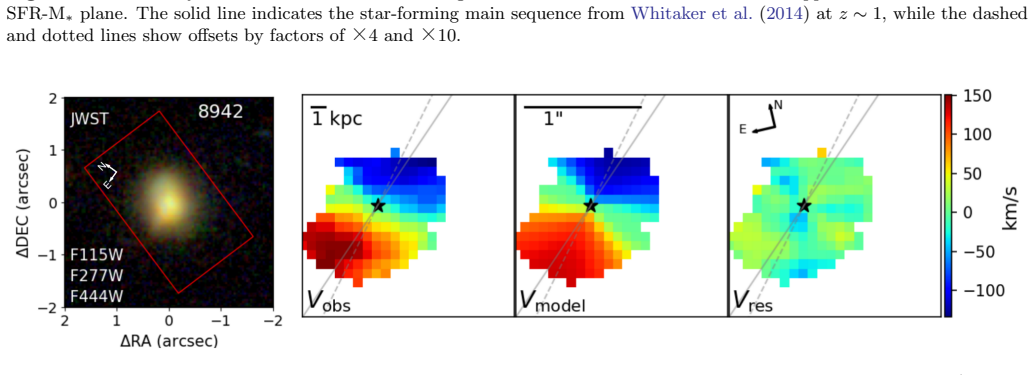
- [Abstract and Results] The linear-fit slope is quoted as '~0.005 dex per dex' without formal uncertainties or the exact fitting method (ordinary least squares, errors-in-variables, etc.); these details should be supplied.
- [Figures] Figures showing gradient versus v/σ and Re/σ should include individual-point error bars, the fitted line with confidence band, and the Pearson r and p values directly on the panels for clarity.
Simulated Author's Rebuttal
We thank the referee for the constructive comments, which help strengthen the statistical robustness and causal interpretation of our results. We address each major point below and will revise the manuscript accordingly.
read point-by-point responses
-
Referee: The central claim that 'cumulative radial mixing more directly regulates chemical stratification' rests on Re/σ showing a stronger anti-correlation than v/σ. No partial-correlation coefficients or multivariate regression controlling for stellar mass (explicitly noted in the text as driving steeper trends) are presented; without this control the causal interpretation is not yet secured.
Authors: We agree that explicit controls for stellar mass are needed to secure the interpretation that Re/σ more directly regulates chemical stratification. In the revised manuscript we will add partial-correlation coefficients between metallicity gradient and Re/σ (controlling for stellar mass) and a multivariate linear regression that includes both Re/σ and stellar mass as predictors. These analyses will quantify the independent contribution of Re/σ and will be reported in the results section with updated figures and tables. revision: yes
-
Referee: N = 21 is modest; the reported p = 0.005 for the Re/σ correlation requires explicit robustness checks (bootstrap or jackknife uncertainties on r, or leave-one-out tests) to demonstrate that the result is not driven by a few points or by sample selection.
Authors: We acknowledge the modest sample size and the importance of demonstrating robustness. In the revision we will include bootstrap resampling (with 10,000 iterations) and jackknife estimates of the Pearson r and its uncertainty for the Re/σ correlation, together with leave-one-out tests that show the correlation coefficient and p-value remain stable when any single galaxy is removed. These checks will be added to the methods and results sections. revision: yes
Circularity Check
No significant circularity: purely observational correlations from new data
full rationale
The paper reports direct measurements of v/σ and Re/σ from JWST/NIRSpec observations of 21 galaxies, then computes Pearson correlations and a linear fit slope against independently measured metallicity gradients. No equations, predictions, or parameters are defined in terms of the target result; the reported anti-correlations (r = -0.43 and -0.59) are statistical outputs from the data, not inputs renamed as outputs. No self-citations, uniqueness theorems, or ansatzes are invoked to justify the central claims. The analysis is self-contained against external benchmarks and does not reduce any derivation to its own fitted values by construction.
Axiom & Free-Parameter Ledger
free parameters (1)
- linear fit slope ~0.005 dex per dex
axioms (2)
- domain assumption v/σ measured at 1.5 Re accurately represents the dynamical state of the disk
- domain assumption Re/σ serves as a proxy for radial mixing timescale
Lean theorems connected to this paper
-
IndisputableMonolith/Cost/FunctionalEquation.leanwashburn_uniqueness_aczel unclear?
unclearRelation between the paper passage and the cited Recognition theorem.
dynamically hotter disks exhibit systematically flatter metallicity gradients... anti-correlation between metallicity gradient and v/σ (Pearson r=-0.43, p=0.05) and ... Re/σ (r=-0.59, p=0.005)
-
IndisputableMonolith/Foundation/DimensionForcing.leanalexander_duality_circle_linking unclear?
unclearRelation between the paper passage and the cited Recognition theorem.
metallicity gradients in our sample are uniformly shallow, indicating that efficient turbulent mixing in kinematically settled disks regulates the chemical structure
What do these tags mean?
- matches
- The paper's claim is directly supported by a theorem in the formal canon.
- supports
- The theorem supports part of the paper's argument, but the paper may add assumptions or extra steps.
- extends
- The paper goes beyond the formal theorem; the theorem is a base layer rather than the whole result.
- uses
- The paper appears to rely on the theorem as machinery.
- contradicts
- The paper's claim conflicts with a theorem or certificate in the canon.
- unclear
- Pith found a possible connection, but the passage is too broad, indirect, or ambiguous to say the theorem truly supports the claim.
Reference graph
Works this paper leans on
-
[1]
Amvrosiadis, A., Wardlow, J. L., Birkin, J. E., et al. 2025, MNRAS, 536, 3757, doi: 10.1093/mnras/stae2760 Bariˇ si´ c, I., Jones, T., Mortensen, K., et al. 2025, ApJ, 983, 139, doi: 10.3847/1538-4357/ada617
-
[2]
Bellardini, M. A., Wetzel, A., Loebman, S. R., & Bailin, J. 2022, MNRAS, 514, 4270, doi: 10.1093/mnras/stac1637
-
[3]
Bellardini, M. A., Wetzel, A., Loebman, S. R., et al. 2021, MNRAS, 505, 4586, doi: 10.1093/mnras/stab1606
-
[4]
Brammer, G. B., van Dokkum, P. G., Franx, M., et al. 2012, ApJS, 200, 13, doi: 10.1088/0067-0049/200/2/13
-
[5]
Burkert, A., F¨ orster Schreiber, N. M., Genzel, R., et al. 2016, ApJ, 826, 214, doi: 10.3847/0004-637X/826/2/214
-
[6]
2010, Nature, 467, 811, doi: 10.1038/nature09451
Cresci, G., Mannucci, F., Maiolino, R., et al. 2010, Nature, 467, 811, doi: 10.1038/nature09451
-
[7]
L., Tacchella, S., Übler, H., et al
Danhaive, A. L., Tacchella, S., ¨Ubler, H., et al. 2025, MNRAS, 543, 3249, doi: 10.1093/mnras/staf1540
-
[8]
Davies, R. I., Tacconi, L. J., & Genzel, R. 2004, ApJ, 602, 148, doi: 10.1086/380995 de Graaff, A., Rix, H.-W., Carniani, S., et al. 2024, A&A, 684, A87, doi: 10.1051/0004-6361/202347755
-
[9]
Esparza-Arredondo, D., Ramos Almeida, C., Audibert, A., et al. 2025, A&A, 693, A174, doi: 10.1051/0004-6361/202452488 Faucher-Gigu` ere, C.-A., Kereˇ s, D., & Ma, C.-P. 2011, MNRAS, 417, 2982, doi: 10.1111/j.1365-2966.2011.19457.x
-
[10]
Forbes, J. C., Krumholz, M. R., Burkert, A., & Dekel, A. 2014, MNRAS, 438, 1552, doi: 10.1093/mnras/stt2294 F¨ orster Schreiber, N. M., Renzini, A., Mancini, C., et al. 2018, ApJS, 238, 21, doi: 10.3847/1538-4365/aadd49
-
[11]
Furlanetto, S. R. 2021, MNRAS, 500, 3394, doi: 10.1093/mnras/staa3451
-
[12]
M., Torrey, P., Bhagwat, A., et al
Garcia, A. M., Torrey, P., Bhagwat, A., et al. 2025, arXiv e-prints, arXiv:2503.03804, doi: 10.48550/arXiv.2503.03804
-
[13]
Gibson, B. K., Pilkington, K., Brook, C. B., Stinson, G. S., & Bailin, J. 2013, A&A, 554, A47, doi: 10.1051/0004-6361/201321239
-
[14]
Gillman, S., Swinbank, A. M., Tiley, A. L., et al. 2019, MNRAS, 486, 175, doi: 10.1093/mnras/stz765
-
[15]
Gillman, S., Tiley, A. L., Swinbank, A. M., et al. 2021, MNRAS, 500, 4229, doi: 10.1093/mnras/staa3400
-
[16]
Girard, M., Mason, C. A., Fontana, A., et al. 2020, MNRAS, 497, 173, doi: 10.1093/mnras/staa1907
-
[17]
Hemler, Z. S., Torrey, P., Qi, J., et al. 2021, MNRAS, 506, 3024, doi: 10.1093/mnras/stab1803
-
[18]
2010, ApJL, 725, L176, doi: 10.1088/2041-8205/725/2/L176
Jones, T., Ellis, R., Jullo, E., & Richard, J. 2010, ApJL, 725, L176, doi: 10.1088/2041-8205/725/2/L176
-
[19]
Jones, T., Ellis, R. S., Richard, J., & Jullo, E. 2013, ApJ, 765, 48, doi: 10.1088/0004-637X/765/1/48
-
[20]
2022, ApJ, 938, 96, doi: 10.3847/1538-4357/ac9056
Ju, M., Yin, J., Liu, R., et al. 2022, ApJ, 938, 96, doi: 10.3847/1538-4357/ac9056
-
[21]
2025, ApJL, 978, L39, doi: 10.3847/2041-8213/ada150
Ju, M., Wang, X., Jones, T., et al. 2025, ApJL, 978, L39, doi: 10.3847/2041-8213/ada150
-
[22]
Kassin, S. A., Weiner, B. J., Faber, S. M., et al. 2007, ApJL, 660, L35, doi: 10.1086/517932 —. 2012, ApJ, 758, 106, doi: 10.1088/0004-637X/758/2/106
-
[23]
Koekemoer, A. M., Faber, S. M., Ferguson, H. C., et al. 2011, ApJS, 197, 36, doi: 10.1088/0067-0049/197/2/36
-
[24]
Lange, J. U. 2023, Monthly Notices of the Royal Astronomical Society, 525, 3181, doi: 10.1093/mnras/stad2441
-
[25]
Lee, L. L., F¨ orster Schreiber, N. M., Price, S. H., et al. 2025, ApJ, 978, 14, doi: 10.3847/1538-4357/ad90b5 MSA-3D: gas kinematics and metallicity gradients inz∼1galaxies13 Figure A1.A comprehensive spatially-resolved view of our galaxy sample with gas kinematic information. For galaxies that have converged kinematic fits, the top row shows (from left ...
-
[26]
Leethochawalit, N., Jones, T. A., Ellis, R. S., et al. 2016, ApJ, 820, 84, doi: 10.3847/0004-637X/820/2/84
-
[27]
Li, Z., Cai, Z., Wang, X., et al. 2025, ApJS, 280, 62, doi: 10.3847/1538-4365/adfa70
-
[28]
Ma, X., Hopkins, P. F., Feldmann, R., et al. 2017, MNRAS, 466, 4780, doi: 10.1093/mnras/stx034
-
[29]
Maiolino, R., & Mannucci, F. 2019, A&A Rv, 27, 3, doi: 10.1007/s00159-018-0112-2
-
[30]
Gnerucci, A. 2010, MNRAS, 408, 2115, doi: 10.1111/j.1365-2966.2010.17291.x
-
[31]
H., Bundy, K., Sullivan, M., Ellis, R
Miller, S. H., Bundy, K., Sullivan, M., Ellis, R. S., & Treu, T. 2011, ApJ, 741, 115, doi: 10.1088/0004-637X/741/2/115
-
[32]
Miller, S. H., Ellis, R. S., Sullivan, M., et al. 2012, ApJ, 753, 74, doi: 10.1088/0004-637X/753/1/74 16Ju et al. Figure A1.continued MSA-3D: gas kinematics and metallicity gradients inz∼1galaxies17 Figure A1.continued 18Ju et al. Figure A1.continued MSA-3D: gas kinematics and metallicity gradients inz∼1galaxies19 Figure A1.continued 20Ju et al. Figure A1...
-
[33]
Momcheva, I. G., Brammer, G. B., van Dokkum, P. G., et al. 2016, ApJS, 225, 27, doi: 10.3847/0067-0049/225/2/27
-
[34]
Ostriker, E. C., & Shetty, R. 2011, ApJ, 731, 41, doi: 10.1088/0004-637X/731/1/41
-
[35]
Peng, C. Y., Ho, L. C., Impey, C. D., & Rix, H.-W. 2002, AJ, 124, 266, doi: 10.1086/340952 —. 2010, AJ, 139, 2097, doi: 10.1088/0004-6256/139/6/2097
work page internal anchor Pith review doi:10.1086/340952 2002
-
[36]
Pettini, M., & Pagel, B. E. J. 2004, MNRAS, 348, L59, doi: 10.1111/j.1365-2966.2004.07591.x
-
[37]
2012, A&A, 539, A93, doi: 10.1051/0004-6361/201117718
Queyrel, J., Contini, T., Kissler-Patig, M., et al. 2012, A&A, 539, A93, doi: 10.1051/0004-6361/201117718
-
[38]
2025, A&A, 698, A267, doi: 10.1051/0004-6361/202452658
Ratcliffe, B., Khoperskov, S., Minchev, I., et al. 2025, A&A, 698, A267, doi: 10.1051/0004-6361/202452658
-
[39]
Roy, N., Henry, A., Jones, T., et al. 2025, arXiv e-prints, arXiv:2510.11326, doi: 10.48550/arXiv.2510.11326 MSA-3D: gas kinematics and metallicity gradients inz∼1galaxies27 Figure A1.continued 28Ju et al. Figure A1.continued MSA-3D: gas kinematics and metallicity gradients inz∼1galaxies29 Figure A1.continued
-
[40]
Sharda, P., Wisnioski, E., Krumholz, M. R., & Federrath, C. 2021, MNRAS, 506, 1295, doi: 10.1093/mnras/stab1836
-
[41]
C., Papovich, C., Momcheva, I., et al
Simons, R. C., Papovich, C., Momcheva, I., et al. 2021, ApJ, 923, 203, doi: 10.3847/1538-4357/ac28f4
-
[42]
Skelton, R. E., Whitaker, K. E., Momcheva, I. G., et al. 2014, ApJS, 214, 24, doi: 10.1088/0067-0049/214/2/24
-
[43]
2025, ApJ, 986, 179, doi: 10.3847/1538-4357/addab5
Sun, X., Wang, X., Ma, X., et al. 2025, ApJ, 986, 179, doi: 10.3847/1538-4357/addab5
-
[44]
Swinbank, A. M., Papadopoulos, P. P., Cox, P., et al. 2011, ApJ, 742, 11, doi: 10.1088/0004-637X/742/1/11
-
[45]
J., Neri, R., Genzel, R., et al
Tacconi, L. J., Neri, R., Genzel, R., et al. 2013, ApJ, 768, 74, doi: 10.1088/0004-637X/768/1/74
-
[46]
Thielemann, F. K., Eichler, M., Panov, I. V., & Wehmeyer, B. 2017, Annual Review of Nuclear and Particle Science, 67, 253, doi: 10.1146/annurev-nucl-101916-123246
-
[47]
L., Gillman, S., Cortese, L., et al
Tiley, A. L., Gillman, S., Cortese, L., et al. 2021, MNRAS, 506, 323, doi: 10.1093/mnras/stab1692
-
[48]
B., Rosas-Guevara, Y., Sillero, E., et al
Tissera, P. B., Rosas-Guevara, Y., Sillero, E., et al. 2022, MNRAS, 511, 1667, doi: 10.1093/mnras/stab3644
-
[49]
The Origin of the Mass--Metallicity Relation: Insights from 53,000 Star-Forming Galaxies in the SDSS
Tremonti, C. A., Heckman, T. M., Kauffmann, G., et al. 2004, ApJ, 613, 898, doi: 10.1086/423264
-
[50]
2025, MNRAS, 540, 3493, doi: 10.1093/mnras/staf604
Tsukui, T., Wisnioski, E., Bland-Hawthorn, J., & Freeman, K. 2025, MNRAS, 540, 3493, doi: 10.1093/mnras/staf604
-
[51]
Tully, R. B., & Fisher, J. R. 1977, A&A, 54, 661 ¨Ubler, H., Genzel, R., Wisnioski, E., et al. 2019, ApJ, 880, 48, doi: 10.3847/1538-4357/ab27cc van den Bosch, F. C. 2002, MNRAS, 331, 98, doi: 10.1046/j.1365-8711.2002.05171.x
-
[52]
2024, A&A, 691, A19, doi: 10.1051/0004-6361/202449855
Venturi, G., Carniani, S., Parlanti, E., et al. 2024, A&A, 691, A19, doi: 10.1051/0004-6361/202449855
-
[53]
2024a, ApJL, 973, L29, doi: 10.3847/2041-8213/ad772d
Wang, B., Peng, Y., Cappellari, M., Gao, H., & Mo, H. 2024a, ApJL, 973, L29, doi: 10.3847/2041-8213/ad772d
-
[54]
2024b, ApJ, 970, 34, doi: 10.3847/1538-4357/ad5952
Wang, E., Lian, J., Peng, Y., & Wang, X. 2024b, ApJ, 970, 34, doi: 10.3847/1538-4357/ad5952
-
[55]
Wang, E., & Lilly, S. J. 2023, ApJ, 955, 55, doi: 10.3847/1538-4357/acecfd
-
[56]
Wang, X., Jones, T. A., Treu, T., et al. 2017, ApJ, 837, 89, doi: 10.3847/1538-4357/aa603c —. 2019, ApJ, 882, 94, doi: 10.3847/1538-4357/ab3861 —. 2020, ApJ, 900, 183, doi: 10.3847/1538-4357/abacce
-
[57]
2022, ApJL, 938, L16, doi: 10.3847/2041-8213/ac959e
Wang, X., Jones, T., Vulcani, B., et al. 2022, ApJL, 938, L16, doi: 10.3847/2041-8213/ac959e
-
[58]
E., Franx, M., Leja, J., et al
Whitaker, K. E., Franx, M., Leja, J., et al. 2014, ApJ, 795, 104, doi: 10.1088/0004-637X/795/2/104
-
[59]
Wisnioski, E., Mendel, J. T., Leaman, R., et al. 2025, MNRAS, 544, 2777, doi: 10.1093/mnras/staf1606 30Ju et al
-
[60]
Wisnioski, E., F¨ orster Schreiber, N. M., Wuyts, S., et al. 2015, ApJ, 799, 209, doi: 10.1088/0004-637X/799/2/209
-
[61]
Wuyts, S., F¨ orster Schreiber, N. M., Wisnioski, E., et al. 2016, ApJ, 831, 149, doi: 10.3847/0004-637X/831/2/149
-
[62]
2012, ApJ, 758, 48, doi: 10.1088/0004-637X/758/1/48
Yang, C.-C., & Krumholz, M. 2012, ApJ, 758, 48, doi: 10.1088/0004-637X/758/1/48
-
[63]
2024, MNRAS, 528, 5295, doi: 10.1093/mnras/stae335
Yang, M., Zhu, L., Lei, Y., et al. 2024, MNRAS, 528, 5295, doi: 10.1093/mnras/stae335
-
[64]
Yuan, T. T., Kewley, L. J., Swinbank, A. M., Richard, J., & Livermore, R. C. 2011, ApJL, 732, L14, doi: 10.1088/2041-8205/732/1/L14
discussion (0)
Sign in with ORCID, Apple, or X to comment. Anyone can read and Pith papers without signing in.