Recognition: 2 theorem links
· Lean TheoremReconstructing Toponium using Recursive Jigsaw Reconstruction
Pith reviewed 2026-05-16 11:16 UTC · model grok-4.3
The pith
Recursive Jigsaw Reconstruction isolates the toponium bound state near the top-quark pair threshold.
A machine-rendered reading of the paper's core claim, the machinery that carries it, and where it could break.
Core claim
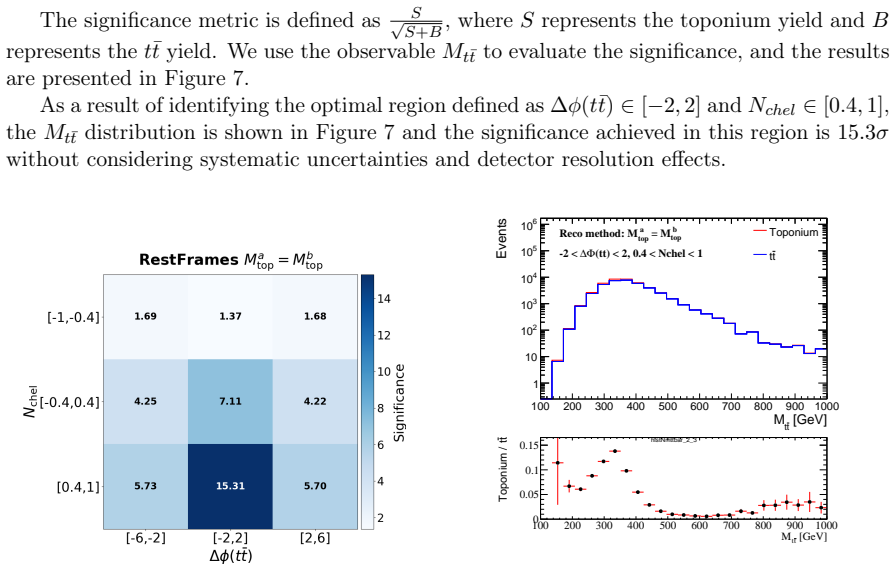
We present a method relying on Recursive Jigsaw Reconstruction to reconstruct the toponium bound state at the ttbar threshold region. We propose incorporating two variables in the analysis that can improve sensitivity to the toponium signal. Our results indicate that this method may be useful to gain additional insights into the physics phenomenology of the ttbar threshold region.
What carries the argument
Recursive Jigsaw Reconstruction, a kinematic algorithm that recursively decomposes an event into parent and child particles by imposing missing-energy and mass-shell constraints to reconstruct the full decay chain of the toponium resonance.
If this is right
- The reconstruction allows direct measurement of toponium mass and width in the threshold region.
- The two added variables increase the signal-to-background ratio for toponium events.
- The approach supplies a practical tool for studying quantum-chromodynamic binding at the heaviest quark mass scale.
- Improved sensitivity opens the possibility of measuring the toponium production cross section with reduced uncertainty.
Where Pith is reading between the lines
- The same reconstruction variables could be tested on other near-threshold resonances such as bottomonium or hypothetical new particles.
- Successful application would reduce reliance on simulation-based background subtraction in threshold analyses.
- The method could be combined with machine-learning classifiers to further suppress irreducible backgrounds.
Load-bearing premise
Hints from ATLAS and CMS data truly correspond to a toponium bound state and Recursive Jigsaw Reconstruction plus the two proposed variables can isolate it from background without introducing large systematic biases.
What would settle it
Applying the method to existing LHC data yields no statistically significant excess at the expected toponium mass or shows no improvement in signal sensitivity from the two variables.
Figures


read the original abstract
The results from the ATLAS and CMS experiment at the Large Hadron Collider indicate the existence of a top-quark pair bound state near the $\ttbar$ threshold region. We present a method relying on Recursive Jigsaw Reconstruction to reconstruct the toponium bound state at the $\ttbar$ threshold region. We propose incorporating two variables in the analysis that can improve sensitivity to the toponium signal. Our results indicate that this method may be useful to gain additional insights into the physics phenomenology of the $\ttbar$ threshold region.
Editorial analysis
A structured set of objections, weighed in public.
Referee Report
Summary. The manuscript proposes using Recursive Jigsaw Reconstruction (RJR) to reconstruct a toponium bound state in the ttbar threshold region, motivated by hints from ATLAS and CMS data. It suggests incorporating two additional variables into the analysis to improve sensitivity to the toponium signal relative to background and concludes that the approach may yield useful insights into ttbar threshold phenomenology.
Significance. If the RJR method plus the two variables can be shown to deliver measurable gains in signal significance or purity without large systematics, the work would provide a concrete reconstruction tool for a potentially interesting QCD bound state. At present the absence of any performance numbers, plots, or baseline comparisons keeps the significance preliminary and exploratory.
major comments (2)
- [Abstract] Abstract: the statement that 'our results indicate that this method may be useful' is unsupported because the manuscript supplies no quantitative metrics (efficiency, purity, significance improvement, ROC curves, or comparison to standard ttbar reconstruction), no validation plots, and no error estimates. This leaves the central claim without visible evidence.
- [Method] The two variables proposed to enhance sensitivity are never defined or motivated with explicit selection criteria, kinematic definitions, or expected distributions, making it impossible to assess whether they are independent of the RJR procedure or introduce circularity.
minor comments (1)
- The manuscript should include a brief description of the Recursive Jigsaw Reconstruction algorithm as applied to this topology, including any free parameters or assumptions about the toponium decay.
Simulated Author's Rebuttal
We thank the referee for the constructive comments on our manuscript. We address the major points below and will revise the paper to strengthen the presentation and provide the requested evidence.
read point-by-point responses
-
Referee: [Abstract] Abstract: the statement that 'our results indicate that this method may be useful' is unsupported because the manuscript supplies no quantitative metrics (efficiency, purity, significance improvement, ROC curves, or comparison to standard ttbar reconstruction), no validation plots, and no error estimates. This leaves the central claim without visible evidence.
Authors: We agree that the abstract claim is not supported by quantitative evidence in the current version. The manuscript is an exploratory proposal for applying RJR to toponium reconstruction at threshold, motivated by ATLAS/CMS hints, without including simulation results. In the revised manuscript we will add quantitative metrics (efficiencies, purities, significance gains, ROC curves, direct comparisons to standard ttbar reconstruction), validation plots, and error estimates to substantiate the claim. revision: yes
-
Referee: [Method] The two variables proposed to enhance sensitivity are never defined or motivated with explicit selection criteria, kinematic definitions, or expected distributions, making it impossible to assess whether they are independent of the RJR procedure or introduce circularity.
Authors: We acknowledge that the two variables lack explicit definitions and motivation in the present text. In the revised version we will supply their full kinematic definitions, selection criteria, expected distributions, and a discussion of their motivation and statistical independence from the RJR variables to demonstrate that no circularity is introduced. revision: yes
Circularity Check
No significant circularity detected
full rationale
The paper is a method proposal for applying Recursive Jigsaw Reconstruction to ttbar threshold events to reconstruct toponium, augmented by two unspecified variables. No equations, derivations, or quantitative claims appear in the provided abstract or description that reduce any sensitivity gain to a fitted parameter, self-definition, or self-citation chain. The central claim remains an independent reconstruction technique whose validity would be tested against external data or simulation, with no load-bearing step that collapses to its own inputs by construction.
Axiom & Free-Parameter Ledger
Lean theorems connected to this paper
-
IndisputableMonolith/Cost/FunctionalEquation.leanwashburn_uniqueness_aczel unclear?
unclearRelation between the paper passage and the cited Recognition theorem.
We present a method relying on Recursive Jigsaw Reconstruction to reconstruct the toponium bound state at the ttbar threshold region. We propose incorporating two variables in the analysis that can improve sensitivity to the toponium signal.
-
IndisputableMonolith/Foundation/AlexanderDuality.leanalexander_duality_circle_linking unclear?
unclearRelation between the paper passage and the cited Recognition theorem.
The reconstruction is challenging owing to both - pairing b-jet with the leptons (combinatoric challenge) and to deal with unmeasured particles (two neutrinos).
What do these tags mean?
- matches
- The paper's claim is directly supported by a theorem in the formal canon.
- supports
- The theorem supports part of the paper's argument, but the paper may add assumptions or extra steps.
- extends
- The paper goes beyond the formal theorem; the theorem is a base layer rather than the whole result.
- uses
- The paper appears to rely on the theorem as machinery.
- contradicts
- The paper's claim conflicts with a theorem or certificate in the canon.
- unclear
- Pith found a possible connection, but the passage is too broad, indirect, or ambiguous to say the theorem truly supports the claim.
Reference graph
Works this paper leans on
-
[1]
V. S. Fadin and V. A. Khoze, Threshold Behavior of Heavy Top Production ine+e− Collisions, JETP Lett.46(1987) 525
work page 1987
-
[2]
V. S. Fadin, V. A. Khoze and T. Sjöstrand, On the Threshold Behavior of Heavy Top Production, Z. Phys. C48(1990) 613.doi:10.1007/BF01614696. 6
- [3]
-
[4]
CMSCollaboration, Observationofapseudoscalarexcessatthetopquarkpairproduction threshold, Rept. Prog. Phys.88(2025) 087801.doi:10.1088/1361-6633/adf7d3
-
[5]
G. Aadet al.(ATLAS Collaboration), “Observation of a cross-section enhancement near thet ¯tproduction threshold in √s= 13TeVppcollisions with the ATLAS detector,” arXiv:2601.11780 [hep-ex], (2026)
work page internal anchor Pith review Pith/arXiv arXiv 2026
-
[6]
B. A. Betchart, R. Demina and A. Harel, Analytic solutions for neutrino momenta in decay of top quarks, Nucl. Instrum. Meth. A736(2014) 169–178.doi:10.1016/j.nima. 2013.10.039
-
[7]
Sonnenschein, Algebraic approach to solvet ¯tdilepton equations, Phys
L. Sonnenschein, Algebraic approach to solvet ¯tdilepton equations, Phys. Rev. D72 (2005) 095020.doi:10.1103/PhysRevD.72.095020
-
[8]
Sonnenschein, Analytical solution oft¯tdilepton equations, Phys
L. Sonnenschein, Analytical solution oft¯tdilepton equations, Phys. Rev. D73(2006) 054015; Erratum Phys. Rev. D78(2008) 079902
work page 2006
-
[9]
P. Jackson and C. Rogan, Recursive Jigsaw Reconstruction: HEP event analysis in the presence of kinematic and combinatoric ambiguities, Phys. Rev. D96(2017) 112007. doi:10.1103/PhysRevD.96.112007
-
[10]
B. Fuks, K. Hagiwara, K. Ma and Y.-J. Zheng, Simulating toponium formation signals at the LHC, Eur. Phys. J. C85(2025) 157.doi:10.1140/epjc/s10052-025-13853-3
-
[11]
J. Alwallet al., The automated computation of tree-level and next-to-leading order differ- ential cross sections, and their matching to parton shower simulations, JHEP07(2014) 079.doi:10.1007/JHEP07(2014)079
-
[12]
Bierlichet al., A comprehensive guide to the physics and usage of PYTHIA 8.3, SciPost Phys
C. Bierlichet al., A comprehensive guide to the physics and usage of PYTHIA 8.3, SciPost Phys. Codebases2022(2022) 8.doi:10.21468/SciPostPhysCodeb.8
-
[13]
P. Artoisenetet al., Automatic spin-entangled decays of heavy resonances in Monte Carlo simulations, JHEP03(2013) 015.doi:10.1007/JHEP03(2013)015
-
[14]
M. Cacciari, G. P. Salam and G. Soyez, The anti-kt jet clustering algorithm, JHEP04 (2008) 063.doi:10.1088/1126-6708/2008/04/063
-
[15]
M. Cacciari, G. P. Salam and G. Soyez, FastJet User Manual, Eur. Phys. J. C72(2012) 1896.doi:10.1140/epjc/s10052-012-1896-2
-
[16]
E. Conte and B. Fuks, Confronting new physics theories to LHC data with MADANAL- YSIS 5, Int. J. Mod. Phys. A33(2018) 1830027.doi:10.1142/S0217751X18300272
-
[17]
J. Y. Araz, B. Fuks and G. Polykratis, Simplified fast detector simulation in MADANAL- YSIS 5, Eur. Phys. J. C81(2021) 329.doi:10.1140/epjc/s10052-021-09052-5. 7
-
[18]
ATLAS Collaboration, Measurement of thet¯tcross section and its ratio to theZproduc- tion cross section using pp collisions at√s= 13.6TeV, Phys. Lett. B848(2024) 138376. doi:10.1016/j.physletb.2023.138376
-
[19]
CMS Collaboration, First measurement of the top quark pair production cross section in proton-proton collisions at √s= 13.6TeV, JHEP08(2023) 204.doi:10.1007/ JHEP08(2023)204. 8
work page 2023
discussion (0)
Sign in with ORCID, Apple, or X to comment. Anyone can read and Pith papers without signing in.