Transversal gates of the ((3,3,2)) qutrit code and local symmetries of the absolutely maximally entangled state of four qutrits
Pith reviewed 2026-05-16 10:49 UTC · model grok-4.3
The pith
A bijection maps local unitary orbits of absolutely maximally entangled states with even parties to orbits of ((n-1,D,n/2))_D quantum error-correcting codes.
A machine-rendered reading of the paper's core claim, the machinery that carries it, and where it could break.
Core claim
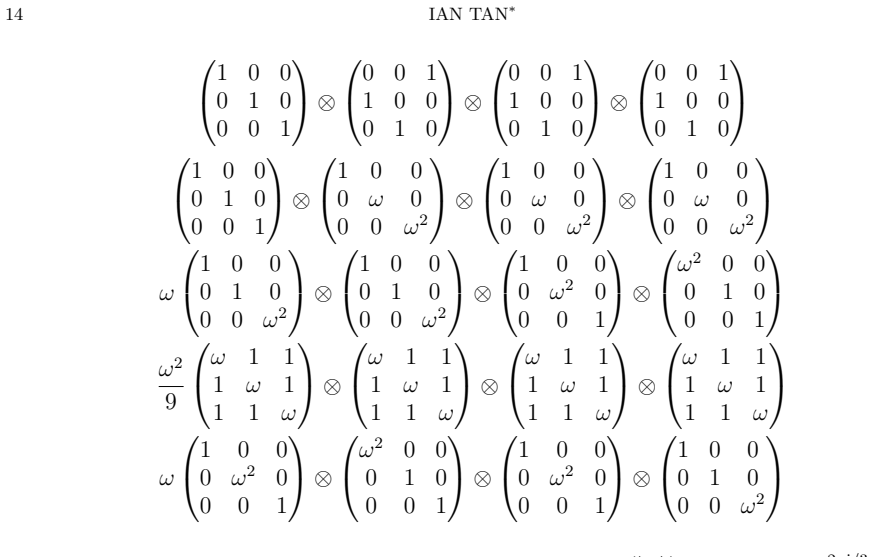
We prove that there exists a bijection between local unitary orbits of absolutely maximally entangled states in (C^D)^⊗n where n is even, also known as perfect tensors, and LU orbits of ((n-1,D,n/2))_D quantum error correcting codes. Furthermore, there is a close connection between the local symmetries of an AME state and the transversal gates of its corresponding quantum error correcting code. We explore in detail the 4-qutrit AME state and its corresponding ((3,3,2))_3 qutrit code, showing both are unique up to local unitaries and finding generators for the local symmetry group and the transversal gate group.
What carries the argument
The bijection between local unitary orbits of absolutely maximally entangled states (perfect tensors) for even n and the orbits of ((n-1,D,n/2))_D codes, together with the mapping from local symmetry groups of the states to transversal gate groups of the codes.
If this is right
- The transversal gates available on the code are fixed once the local symmetries of the corresponding AME state are known.
- Any classification of AME states for even n immediately classifies the matching family of quantum error-correcting codes.
- Uniqueness of the four-qutrit AME state up to local unitaries implies the same uniqueness for the ((3,3,2))_3 code.
- Explicit generators give concrete descriptions of allowed fault-tolerant operations and of the state's reachability under local operations.
Where Pith is reading between the lines
- Entanglement features of the AME state may translate into concrete bounds on the error-correction performance of the associated code.
- The same orbit-matching idea might apply to codes with different distance or to odd numbers of parties, though that case is not treated here.
- The Lie-algebra approach used for the four-qutrit symmetry group could be applied to classify local symmetries of other AME states in higher dimensions.
Load-bearing premise
The bijection and uniqueness results depend on earlier classification theorems for AME states and codes established by other authors.
What would settle it
An absolutely maximally entangled state for some even n and dimension D whose local unitary orbit does not correspond to any orbit of a ((n-1,D,n/2))_D code would disprove the bijection.
Figures

read the original abstract
The group of transversal gates and the group of local symmetries are important features of quantum error correcting codes and pure quantum states, respectively; the former provides fault-tolerant operations on a code while the latter tells us about a state's reachability via stochastic local operations with classical communication. We prove that there exists a bijection between local unitary (LU) orbits of absolutely maximally entangled (AME) states in $(\mathbb{C}^D)^{\otimes n}$ where $n$ is even, also known as perfect tensors, and LU orbits of $((n-1,D,n/2))_D$ quantum error correcting codes. Furthermore, there is a close connection between the local symmetries of an AME state and the transversal gates of its corresponding quantum error correcting code. We explore in detail the 4-qutrit AME state $|\Phi\rangle$ and its corresponding $((3,3,2))_3$ qutrit code $\mathcal{C}$. We show that $|\Phi\rangle$ and $\mathcal{C}$ are both unique up to the action of the LU group. We find generators of the local symmetry group of $|\Phi\rangle$ and the group of transversal gates on $\mathcal{C}$. Our proofs rely on prior results by Huber and Grassl (2020), Hebenstreit et al. (2016), and Rather et al. (2023). We use Vinberg's theory of Lie algebras to study the special case of $|\Phi\rangle$ and $\mathcal{C}$.
Editorial analysis
A structured set of objections, weighed in public.
Referee Report
Summary. The manuscript proves a bijection between local unitary (LU) orbits of absolutely maximally entangled (AME) states (perfect tensors) in (C^D)^⊗n for even n and LU orbits of ((n-1,D,n/2))_D quantum error-correcting codes. It establishes a correspondence between the local symmetries of an AME state and the transversal gates of the associated code. For the 4-qutrit AME state |Φ⟩ and the ((3,3,2))_3 code C, both are shown to be unique up to LU, with explicit generators for the local symmetry group of |Φ⟩ and the transversal gate group of C obtained via Vinberg's theory of Lie algebras; all proofs rely on prior results by Huber-Grassl (2020), Hebenstreit et al. (2016), and Rather et al. (2023).
Significance. If the bijection holds, the result supplies a systematic link between the classification of AME states/perfect tensors and the structure of quantum codes, which may streamline the search for states with prescribed symmetries and for codes admitting nontrivial transversal gates. The concrete 4-qutrit analysis, including uniqueness and generator lists, supplies a verifiable benchmark for qutrit AME states and could guide extensions to higher D or n.
major comments (2)
- [§3] The central bijection (stated in the abstract and proved in §3) is obtained by direct appeal to Theorem 3 of Rather et al. (2023) together with results from Huber-Grassl (2020) and Hebenstreit et al. (2016). The manuscript does not reproduce the hypotheses of those theorems or verify that the even-n AME condition maps exactly onto the distance-n/2 code condition for arbitrary D; an explicit check for the general case is required to confirm the bijection is free of hidden restrictions.
- [§4.3] In §4.3 the uniqueness of |Φ⟩ up to LU and the explicit generators of its local symmetry group are derived from Vinberg's classification of the Lie algebra of local symmetries. The text does not state which specific Vinberg theorem is invoked nor confirm that the 4-qutrit AME representation satisfies the irreducibility or grading conditions needed for the classification to apply without additional case-by-case analysis.
minor comments (2)
- [Abstract] The code notation ((3,3,2))_3 is used without a brief reminder of the standard [[n,k,d]]_q convention; a parenthetical definition on first use would aid readability.
- [Figure 1] Figure 1 (the circuit diagram for the transversal gates) lacks a caption explaining the ordering of the qutrits and the precise action of each gate; this makes cross-reference with the generator list in Table 2 difficult.
Simulated Author's Rebuttal
We thank the referee for the careful reading and constructive suggestions. The central bijection follows from the cited theorems, but we agree that explicit verification of hypotheses and conditions will strengthen the manuscript. We address each major comment below and will incorporate the necessary clarifications in the revision.
read point-by-point responses
-
Referee: [§3] The central bijection (stated in the abstract and proved in §3) is obtained by direct appeal to Theorem 3 of Rather et al. (2023) together with results from Huber-Grassl (2020) and Hebenstreit et al. (2016). The manuscript does not reproduce the hypotheses of those theorems or verify that the even-n AME condition maps exactly onto the distance-n/2 code condition for arbitrary D; an explicit check for the general case is required to confirm the bijection is free of hidden restrictions.
Authors: We agree that recalling the hypotheses improves clarity. In the revised version we will insert a short subsection in §3 that states the relevant hypotheses from Rather et al. (2023, Thm. 3), Huber-Grassl (2020), and Hebenstreit et al. (2016), and explicitly verifies that the even-n AME (perfect-tensor) condition is equivalent to the distance-n/2 condition for the code ((n-1,D,n/2))_D for arbitrary D, with no hidden restrictions. This verification uses only the definitions already present in the manuscript and the cited papers. revision: yes
-
Referee: [§4.3] In §4.3 the uniqueness of |Φ⟩ up to LU and the explicit generators of its local symmetry group are derived from Vinberg's classification of the Lie algebra of local symmetries. The text does not state which specific Vinberg theorem is invoked nor confirm that the 4-qutrit AME representation satisfies the irreducibility or grading conditions needed for the classification to apply without additional case-by-case analysis.
Authors: We thank the referee for noting this omission. The derivation in §4.3 applies Vinberg’s theorem on the classification of semisimple Lie algebras equipped with a grading (specifically the result on irreducible graded representations under the action of the local unitary group, as used in the context of AME states). In the revision we will (i) cite the precise Vinberg theorem invoked, (ii) confirm that the 4-qutrit AME representation is irreducible and satisfies the required grading conditions (which follow directly from the uniqueness of |Φ⟩ already proved via Huber-Grassl (2020) and the explicit stabilizer computation), and (iii) note that no further case-by-case analysis is needed beyond the generators already listed. These additions will be placed at the beginning of §4.3. revision: yes
Circularity Check
No significant circularity
full rationale
The paper asserts a bijection between LU orbits of even-n AME states (perfect tensors) and LU orbits of ((n-1,D,n/2))_D codes by direct appeal to external theorems in Huber-Grassl (2020), Hebenstreit et al. (2016), and Rather et al. (2023). The 4-qutrit uniqueness and generators follow from applying Vinberg's Lie-algebra classification to the known AME state. No equations or definitions reduce the claimed bijection or uniqueness to fitted parameters, self-referential constructions, or self-citations; all load-bearing steps rest on independent prior results with no author overlap.
Axiom & Free-Parameter Ledger
axioms (2)
- standard math Standard results from finite group theory and representation theory of unitary groups
- domain assumption Existence and uniqueness theorems for AME states and QECCs from Huber-Grassl 2020, Hebenstreit 2016, Rather 2023
Lean theorems connected to this paper
-
IndisputableMonolith/Foundation/AlexanderDuality.leanalexander_duality_circle_linking unclear?
unclearRelation between the paper passage and the cited Recognition theorem.
there exists a bijection between local unitary (LU) orbits of absolutely maximally entangled (AME) states in (C^D)^⊗n where n is even... and LU orbits of ((n-1,D,n/2))_D quantum error correcting codes
-
IndisputableMonolith/Foundation/AbsoluteFloorClosure.leanabsolute_floor_iff_bare_distinguishability unclear?
unclearRelation between the paper passage and the cited Recognition theorem.
C is simultaneously a ((3,3,2))_3 code and a Cartan subspace... Weyl group of C
What do these tags mean?
- matches
- The paper's claim is directly supported by a theorem in the formal canon.
- supports
- The theorem supports part of the paper's argument, but the paper may add assumptions or extra steps.
- extends
- The paper goes beyond the formal theorem; the theorem is a base layer rather than the whole result.
- uses
- The paper appears to rely on the theorem as machinery.
- contradicts
- The paper's claim conflicts with a theorem or certificate in the canon.
- unclear
- Pith found a possible connection, but the passage is too broad, indirect, or ambiguous to say the theorem truly supports the claim.
Reference graph
Works this paper leans on
-
[1]
S. Aravinda, S. A. Rather, and A. Lakshminarayan,From dual-unitary to quantum Bernoulli circuits: Role of the entangling power in constructing a quantum ergodic hierarchy, Phys. Rev. Res.3(2021), 043034
work page 2021
-
[2]
Bacon,Introduction to quantum error correction(D
D. Bacon,Introduction to quantum error correction(D. A. Lidar and T. A. E. Brun, eds.), Cambridge University Press, 2013
work page 2013
-
[3]
M. Bremner, J. Hu, and L. Oeding,The 3×3×3 Hyperdeterminant as a Polynomial in the Fundamental Invariants forSL 3(C)×SL 3(C)×SL 3(C), Mathematics in Computer Science8(2014), 147–156
work page 2014
-
[4]
M. R. Bremner and J. Hu,Fundamental invariants for the action ofSL 3(C)×SL 3(C)×SL 3(C)on 3 ×3×3 arrays, Math. Comput.82(2013), 2421–2438. TRANSVERSAL GATES AND LOCAL SYMMETRIES 15
work page 2013
- [5]
- [6]
-
[7]
A. Burchardt and Z. Raissi,Stochastic local operations with classical communication of absolutely max- imally entangled states, Phys. Rev. A102(2020), 022413
work page 2020
-
[8]
Normal Forms and Tensor Ranks of Pure States of Four Qubits
O. Chterental and D. Djokovic,Normal Forms and Tensor Ranks of Pure States of Four Qubits, Linear Algebra Research Advances, 2007, pp. 133–167. doi:10.48550/arXiv.quant-ph/0612184
work page internal anchor Pith review Pith/arXiv arXiv doi:10.48550/arxiv.quant-ph/0612184 2007
-
[9]
L. Clarisse, S. Ghosh, S. Severini, and A. Sudbery,Entangling power of permutations, Phys. Rev. A72 (2005), 012314
work page 2005
-
[10]
A. M. Cohen,Finite complex reflection groups, Annales scientifiques de l’ ´Ecole Normale Sup´ erieureSer. 4, 9(1976), no. 3, 379–436 (en)
work page 1976
-
[11]
S. Di Trani, W. A de Graaf, and A. Marrani,Classification of real and complex three-qutrit states, J. Math. Phys.64(2023). doi:10.1063/5.0156805
-
[12]
H. Dietrich, W. A de Graaf, A. Marrani, and M. Origlia,Classification of four qubit states and their stabilisers under SLOCC operations, J. Phys. A (2022)
work page 2022
- [13]
- [14]
-
[15]
Stabilizer Codes and Quantum Error Correction
D. Gottesman,Stabilizer codes and quantum error correction, PhD thesis, Caltech, 1997. Available at https://arxiv.org/abs/quant-ph/9705052
work page internal anchor Pith review Pith/arXiv arXiv 1997
-
[16]
Manuscript, Univer- sity of Maryland
,Surviving as a quantum computer in a classical world, 2024. Manuscript, Univer- sity of Maryland. Accessed: 2025-11-12https://www.cs.umd.edu/class/spring2024/cmsc858G/ QECCbook-2024-ch1-15.pdf
work page 2024
-
[17]
G. Gour and N. R. Wallach,All maximally entangled four-qubit states, Journal of Mathematical Physics 51(201011), no. 11, 112201
- [18]
-
[19]
,Classification of multipartite entanglement of all finite dimensionality, Phys. Rev. Lett.111 (2013), 060502
work page 2013
-
[20]
D. Goyeneche, D. Alsina, J. I. Latorre, A. Riera, and K. ˙Zyczkowski,Absolutely maximally entangled states, combinatorial designs, and multiunitary matrices, Phys. Rev. A92(2015), 032316
work page 2015
-
[21]
M. Hebenstreit, C. Spee, and B. Kraus,Maximally entangled set of tripartite qutrit states and pure state separable transformations which are not possible via local operations and classical communication, Phys. Rev. A93(2016), 012339
work page 2016
-
[22]
Helwig,Absolutely maximally entangled qudit graph states, 2013
W. Helwig,Absolutely maximally entangled qudit graph states, 2013
work page 2013
-
[23]
,Absolutely maximally entangled qudit graph states, 2013
work page 2013
- [24]
-
[25]
A. Higuchi and A. Sudbery,How entangled can two couples get?, Physics Letters A273(2000), no. 4, 213–217
work page 2000
-
[26]
F. Huber and M. Grassl,Quantum codes of maximal distance and highly entangled subspaces, Quantum 4(202006), 284
-
[27]
H. Jaffali, F. Holweck, and L. Oeding,Maximally entangled real states and SLOCC invariants: the 3-qutrit case, Journal of Physics A: Mathematical and Theoretical57(2024), no. 14, 145301
work page 2024
- [28]
-
[29]
J.-G. Luque and J.-Y. Thibon,Algebraic invariants of five qubits, Journal of Physics A: Mathematical and General39(2005), no. 2, 371
work page 2005
-
[30]
M. A. Nielsen and I. L. Chuang,Quantum computation and quantum information, Massachusetts Insti- tute of Technology, 2010
work page 2010
-
[31]
A G Nurmiev,Orbits and invariants of cubic matrices of order three, Sbornik: Mathematics191(2000), no. 5, 717. 16 IAN TAN ∗
work page 2000
-
[32]
L. Oeding and I. Tan,Four-qubit critical states, Journal of Physics A: Mathematical and Theoretical 58(2025), no. 26, 265301
work page 2025
-
[33]
F. Pastawski, B. Yoshida, D. Harlow, and J. Preskill,Holographic quantum error-correcting codes: toy models for the bulk/boundary correspondence, Journal of High Energy Physics2015(2015), no. 6, 149
work page 2015
-
[34]
E. M. Rains,Nonbinary quantum codes, IEEE Transactions on Information Theory45(1999), no. 6, 1827–1832
work page 1999
-
[35]
,Quantum codes of minimum distance two, IEEE Transactions on Information Theory45(1999), no. 1, 266–271
work page 1999
-
[36]
E. M. Rains,Quantum weight enumerators, IEEE Trans. Inf. Theory44(1996), 1388–1394
work page 1996
-
[37]
N Ramadas and A. Lakshminarayan,Local unitary equivalence of absolutely maximally entangled states constructed from orthogonal arrays, Journal of Physics A: Mathematical and Theoretical58(2025), no. 12, 125301
work page 2025
-
[38]
S. A. Rather, A. Burchardt, W. Bruzda, G. Rajchel-Mieldzio´ c, A. Lakshminarayan, and K.˙Zyczkowski, Thirty-six entangled officers of Euler: Quantum solution to a classically impossible problem, Phys. Rev. Lett.128(2022), 080507
work page 2022
-
[39]
S. A. Rather, N. Ramadas, V. Kodiyalam, and A. Lakshminarayan,Absolutely maximally entangled state equivalence and the construction of infinite quantum solutions to the problem of 36 officers of Euler, Phys. Rev. A108(2023), 032412
work page 2023
-
[40]
G. C. Shephard and J. A. Todd,Finite unitary reflection groups, Canadian Journal of Mathematics6 (1954), 274–304
work page 1954
- [41]
-
[42]
P. Shor and R. Laflamme,Quantum Analog of the MacWilliams Identities for Classical Coding Theory, Phys. Rev. Lett.78(1997), 1600–1602
work page 1997
- [43]
-
[44]
C. Spee, J. I. de Vicente, D. Sauerwein, and B. Kraus,Entangled pure state transformations via local operations assisted by finitely many rounds of classical communication, Phys. Rev. Lett.118(2017), 040503
work page 2017
-
[45]
Classification of five-qubit absolutely maximally entangled states
I. Tan,Classification of four-qubit pure codes and five-qubit absolutely maximally entangled states, 2025. https://arxiv.org/abs/2507.02185
work page internal anchor Pith review arXiv 2025
-
[46]
´E B Vinberg,The Weyl group of a graded Lie algebra, Mathematics of the USSR-Izvestiya10(1976), no. 3, 463
work page 1976
-
[47]
`E. B. Vinberg and A. G. `Elaˇ svili,A classification of the three-vectors of nine-dimensional space, Trudy Sem. Vektor. Tenzor. Anal.18(1978), 197–233
work page 1978
-
[48]
N. R. Wallach,Geometric Invariant Theory: Over the Real and Complex Numbers, Springer Cham, 2017
work page 2017
discussion (0)
Sign in with ORCID, Apple, or X to comment. Anyone can read and Pith papers without signing in.