Anytime-Valid Quantum State Tomography via Confidence Sequences
Pith reviewed 2026-05-21 15:05 UTC · model grok-4.3
The pith
Quantum state tomography can now attach confidence sets to point estimates that remain valid at any stopping time during sequential measurements.
A machine-rendered reading of the paper's core claim, the machinery that carries it, and where it could break.
Core claim
Existing quantum state tomography techniques can be augmented by associating their current point estimates with anytime-valid confidence sequences, producing sets that contain the true quantum state with a pre-specified probability at any time during incremental data acquisition, without requiring a fixed sample size in advance.
What carries the argument
Anytime-valid confidence sequences, which are sequences of sets constructed so that the true state remains inside at least one of them with the target probability uniformly over all possible stopping times.
If this is right
- Standard QST estimators can be used as-is while gaining sequential validity guarantees.
- The coverage probability holds regardless of data-dependent stopping rules or adaptive measurement choices.
- Uncertainty quantification becomes available after every new measurement rather than only at the end of a fixed batch.
- The approach preserves the accuracy properties of the underlying point estimator while adding the anytime-valid property.
Where Pith is reading between the lines
- This could allow quantum experiments to allocate measurements more efficiently by stopping once the confidence set is small enough for the intended purpose.
- Similar wrapping techniques might apply to other sequential quantum tasks such as process tomography or parameter estimation in quantum sensing.
- In practice the method could support real-time feedback loops where further measurements are decided based on the current width of the confidence set.
Load-bearing premise
Advances in anytime-valid inference from classical statistics transfer directly to quantum state estimation without quantum-specific changes that would break the coverage guarantee.
What would settle it
Repeated trials of the procedure where, at the stopping time chosen by the experimenter, the true state falls outside the reported confidence set more often than the nominal error probability.
Figures


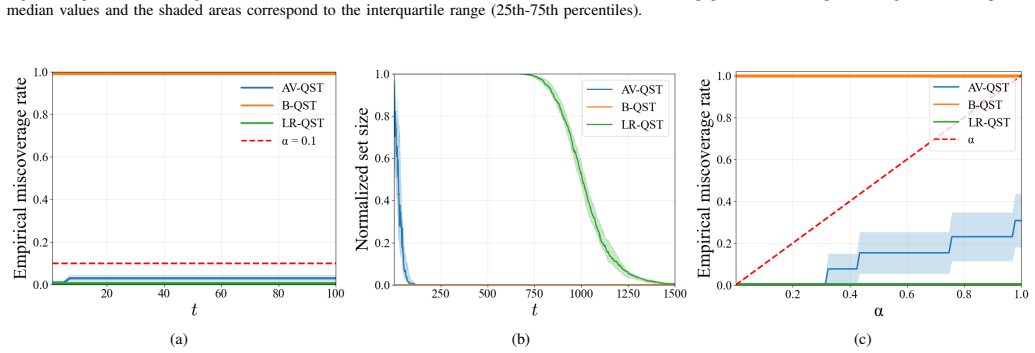
read the original abstract
In this letter, we address the problem of developing quantum state tomography (QST) methods that remain valid at any time during a sequence of measurements. Specifically, the aim is to provide a rigorous quantification of the uncertainty associated with the current state estimate as data are acquired incrementally. To this end, the proposed framework augments existing QST techniques by associating current point estimates of the state with confidence sets that are guaranteed to contain the true quantum state with a user-defined probability. The methodology is grounded in recent statistical advances in anytime-valid confidence sequences. Numerical results confirm the theoretical coverage properties of the proposed anytime-valid QST.
Editorial analysis
A structured set of objections, weighed in public.
Referee Report
Summary. The manuscript proposes a framework for anytime-valid quantum state tomography (QST) that augments standard point-estimation techniques with confidence sequences derived from recent advances in sequential statistics. The central claim is that the resulting confidence sets contain the true density operator with user-specified probability at any time during incremental measurements, with numerical experiments presented as confirmation of the coverage properties.
Significance. If the coverage guarantees are rigorously established for the quantum setting, the work would provide a practical tool for adaptive or online QST protocols in quantum information processing, allowing valid inference without fixed sample sizes. It attempts to transfer classical anytime-valid inference tools to a constrained parameter space, which could be useful if the transfer is shown to preserve the required martingale properties.
major comments (2)
- Abstract: The claim that the methodology is 'grounded in recent statistical advances in anytime-valid confidence sequences' and that numerical results 'confirm the theoretical coverage properties' is load-bearing for the central contribution. However, the presentation does not indicate whether the classical supermartingale constructions (e.g., via Ville's inequality or betting) are applied verbatim to an unconstrained embedding of the density matrix or whether quantum-specific adjustments are introduced to preserve the supermartingale property after projection onto the PSD + trace-1 set. Without this clarification or derivation, the coverage guarantee for the constrained quantum parameter is not yet supported.
- Abstract and methodology description: The augmentation of 'existing QST techniques' is described at a high level, but no explicit construction is given showing how the observations (POVM outcomes whose probabilities are linear in ρ) are mapped to the filtration and increment conditions required by the classical anytime-valid theorems. This omission directly affects whether the anytime-valid property holds for the final confidence sets on valid quantum states.
minor comments (1)
- The abstract refers to 'user-defined probability' but does not specify the exact form of the confidence sequence (e.g., width scaling or dependence on the number of measurements) that would be needed for practical implementation.
Simulated Author's Rebuttal
We thank the referee for the constructive and insightful comments, which help clarify the presentation of our framework. We address each major comment below and will incorporate the requested clarifications and derivations into the revised manuscript.
read point-by-point responses
-
Referee: Abstract: The claim that the methodology is 'grounded in recent statistical advances in anytime-valid confidence sequences' and that numerical results 'confirm the theoretical coverage properties' is load-bearing for the central contribution. However, the presentation does not indicate whether the classical supermartingale constructions (e.g., via Ville's inequality or betting) are applied verbatim to an unconstrained embedding of the density matrix or whether quantum-specific adjustments are introduced to preserve the supermartingale property after projection onto the PSD + trace-1 set. Without this clarification or derivation, the coverage guarantee for the constrained quantum parameter is not yet supported.
Authors: We appreciate the referee's emphasis on this foundational point. Our construction applies the classical supermartingale (via a betting or Ville-type process) directly to the vectorized Hermitian matrix representation of the state, where the trace-1 constraint is enforced as an affine restriction on the parameter space from the outset. The POVM probabilities are linear functionals, so the martingale increments are defined on these observables without requiring post-hoc projection of the confidence set; the valid quantum states are recovered by intersecting the resulting ellipsoid (or other set) with the PSD cone. We will add a dedicated paragraph deriving that the supermartingale property is preserved under this linear embedding, thereby supporting the coverage guarantee for the constrained parameter. This will appear in Section II of the revision. revision: yes
-
Referee: Abstract and methodology description: The augmentation of 'existing QST techniques' is described at a high level, but no explicit construction is given showing how the observations (POVM outcomes whose probabilities are linear in ρ) are mapped to the filtration and increment conditions required by the classical anytime-valid theorems. This omission directly affects whether the anytime-valid property holds for the final confidence sets on valid quantum states.
Authors: We agree that an explicit mapping is essential for rigor. The filtration is the natural one generated by the sequence of POVM outcomes up to step t. The increment of the underlying martingale is the centered outcome (observed minus its conditional expectation under the current state estimate), scaled by the design matrix whose rows are the vectorized POVM elements. Because these probabilities are affine in ρ, the classical supermartingale theorems apply verbatim to this process. We will expand the methodology section with the precise definitions of the filtration, the form of the betting function, and the resulting anytime-valid confidence set update rule, including a short proof sketch that the required conditions hold due to linearity. This addition will directly confirm the validity of the final sets on quantum states. revision: yes
Circularity Check
No significant circularity; external statistical tools applied to QST
full rationale
The paper frames its contribution as augmenting existing QST techniques with anytime-valid confidence sequences drawn from recent statistical advances. The abstract explicitly states that the methodology is grounded in these external advances and that numerical results confirm the theoretical coverage properties. No equations or steps are presented that reduce a claimed prediction or coverage guarantee to a fitted parameter, self-definition, or load-bearing self-citation chain. The derivation chain therefore remains self-contained by direct transfer of established classical results, with the quantum application serving as the independent content.
Axiom & Free-Parameter Ledger
axioms (1)
- domain assumption Anytime-valid confidence sequences from recent statistical literature apply to quantum state estimation without loss of coverage guarantees.
Lean theorems connected to this paper
-
IndisputableMonolith/Cost/FunctionalEquation.leanwashburn_uniqueness_aczel unclear?
unclearRelation between the paper passage and the cited Recognition theorem.
the likelihood ratio R_t(ρ*) ... is a test martingale ... By Ville’s inequality ... P(∀t≥1, R_t(ρ*)≤1/α)≥1−α
-
IndisputableMonolith/Foundation/RealityFromDistinction.leanreality_from_one_distinction unclear?
unclearRelation between the paper passage and the cited Recognition theorem.
augments existing QST techniques by associating current point estimates ... with confidence sets
What do these tags mean?
- matches
- The paper's claim is directly supported by a theorem in the formal canon.
- supports
- The theorem supports part of the paper's argument, but the paper may add assumptions or extra steps.
- extends
- The paper goes beyond the formal theorem; the theorem is a base layer rather than the whole result.
- uses
- The paper appears to rely on the theorem as machinery.
- contradicts
- The paper's claim conflicts with a theorem or certificate in the canon.
- unclear
- Pith found a possible connection, but the passage is too broad, indirect, or ambiguous to say the theorem truly supports the claim.
Reference graph
Works this paper leans on
-
[1]
Statistical methods for quantum state verification and fidelity estimation,
X.-D. Yu, J. Shang, and O. G ¨uhne, “Statistical methods for quantum state verification and fidelity estimation,”Advanced Quantum Technologies, vol. 5, no. 5, p. 2100126, 2022
work page 2022
-
[2]
Optimal, reliable estimation of quantum states,
R. Blume-Kohout, “Optimal, reliable estimation of quantum states,” New Journal of Physics, vol. 12, no. 4, p. 043034, Apr. 2010. [Online]. Available: http://dx.doi.org/10.1088/1367-2630/12/4/043034
-
[3]
Z. Hradil, “Quantum-state estimation,”Phys. Rev. A, vol. 55, pp. R1561–R1564, Mar 1997. [Online]. Available: https://link.aps.org/doi/ 10.1103/PhysRevA.55.R1561
-
[4]
Adaptive Bayesian quantum tomogra- phy,
F. Husz ´ar and N. M. Houlsby, “Adaptive Bayesian quantum tomogra- phy,”Physical Review A, vol. 85, no. 5, p. 052120, 2012
work page 2012
-
[5]
Quantum state tomography via compressed sensing,
D. Gross, Y .-K. Liu, S. T. Flammia, S. Becker, and J. Eisert, “Quantum state tomography via compressed sensing,”Physical Review Letters, vol. 105, no. 15, p. 150401, 2010
work page 2010
-
[6]
Neural-network quantum state tomography,
G. Torlai, G. Mazzola, J. Carrasquilla, M. Troyer, R. Melko, and G. Carleo, “Neural-network quantum state tomography,”Nature Physics, vol. 14, no. 5, pp. 447–450, 2018
work page 2018
-
[7]
Reconstructing quantum states with generative models,
J. Carrasquilla, G. Torlai, R. G. Melko, and L. Aolita, “Reconstructing quantum states with generative models,”Nature Machine Intelligence, vol. 1, no. 3, pp. 155–161, 2019
work page 2019
-
[8]
Generalized quantum state tomography with hybrid denoising priors,
D. Xue, W. Dai, Z. Zheng, C. Li, J. Zou, and H. Xiong, “Generalized quantum state tomography with hybrid denoising priors,”Trans. Sig. Proc., vol. 73, p. 1532–1548, Jan. 2025. [Online]. Available: https://doi.org/10.1109/TSP.2025.3546655
-
[9]
A. Elben, S. T. Flammia, H.-Y . Huang, R. Kueng, J. Preskill, B. Vermersch, and P. Zoller, “The randomized measurement toolbox,” Nature Reviews Physics, vol. 5, no. 1, p. 9–24, Dec. 2022. [Online]. Available: http://dx.doi.org/10.1038/s42254-022-00535-2
-
[10]
Robust error bars for quantum tomography
R. Blume-Kohout, “Robust error bars for quantum tomography,”arXiv preprint arXiv:1202.5270, 2012
work page internal anchor Pith review Pith/arXiv arXiv 2012
-
[11]
Reliable quantum state tomography,
M. Christandl and R. Renner, “Reliable quantum state tomography,” Phys. Rev. Lett., vol. 109, p. 120403, Sep 2012. [Online]. Available: https://link.aps.org/doi/10.1103/PhysRevLett.109.120403
-
[12]
Time-uniform, nonparametric, nonasymptotic confidence sequences,
S. R. Howard, A. Ramdas, J. McAuliffe, and J. Sekhon, “Time-uniform, nonparametric, nonasymptotic confidence sequences,”The Annals of Statistics, vol. 49, no. 2, pp. 1055–1085, 2021
work page 2021
-
[13]
Hypothesis testing with e-values,
A. Ramdas and R. Wang, “Hypothesis testing with e-values,”Founda- tions and Trends® in Statistics, vol. 1, no. 1–2, p. 1–390, 2025
work page 2025
-
[14]
Induced measures in the space of mixed quantum states,
K. Zyczkowski and H.-J. Sommers, “Induced measures in the space of mixed quantum states,”Journal of Physics A: Mathematical and General, vol. 34, no. 35, p. 7111, 2001
work page 2001
-
[15]
Sym- metric informationally complete quantum measurements,
J. M. Renes, R. Blume-Kohout, A. J. Scott, and C. M. Caves, “Sym- metric informationally complete quantum measurements,”Journal of Mathematical Physics, vol. 45, no. 6, p. 2171–2180, Jun. 2004
work page 2004
-
[16]
Quantum conformal prediction for reliable uncertainty quantification in quantum machine learning,
S. Park and O. Simeone, “Quantum conformal prediction for reliable uncertainty quantification in quantum machine learning,”IEEE Trans- actions on Quantum Engineering, vol. 5, pp. 1–24, 2023
work page 2023
-
[17]
Quantum sequential universal hypothesis testing,
M. Zecchin, O. Simeone, and A. Ramdas, “Quantum sequential universal hypothesis testing,”arXiv preprint arXiv:2508.21594, 2025
-
[18]
Reducing sequential change detection to sequential estimation,
S. Shekhar and A. Ramdas, “Reducing sequential change detection to sequential estimation,” 2023. [Online]. Available: https://arxiv.org/abs/ 2309.09111
-
[19]
Sequential changepoint detection via backward confidence sequences,
——, “Sequential changepoint detection via backward confidence sequences,” inProceedings of the 40th International Conference on Machine Learning, ser. Proceedings of Machine Learning Research, A. Krause, E. Brunskill, K. Cho, B. Engelhardt, S. Sabato, and J. Scarlett, Eds., vol. 202. PMLR, 23–29 Jul 2023, pp. 30 908–30 930. [Online]. Available: https://pr...
work page 2023
discussion (0)
Sign in with ORCID, Apple, or X to comment. Anyone can read and Pith papers without signing in.