REVIEW 2 major objections 6 minor 1 cited by
Two distinct 4d N=1 gauge theories can share the same quiver, the same chiral fields, and the same vacuum moduli space, differing only in their superpotentials, with the transition realized by a single 'tilting' mutation of the brane tiling
Reviewed by Pith at T0; open to challenge. T0 means a machine referee read the full paper against a public rubric. the ladder, T0–T4 →
T0 review · deepseek-v4-flash
2026-08-03 07:09 UTC pith:LYYFGF4J
load-bearing objection Solid, checkable example pair of brane tilings sharing a quiver and mesonic moduli space, but the advertised Seiberg-duality decomposition of the tilting move is asserted without the intermediate steps; read the central claim as a conjecture until that sequence is shown. the 2 major comments →
Quiver-Invariant Dualities between Brane Tilings
The pith
A machine-rendered reading of the paper's core claim, the machinery that carries it, and where it could break.
Core claim
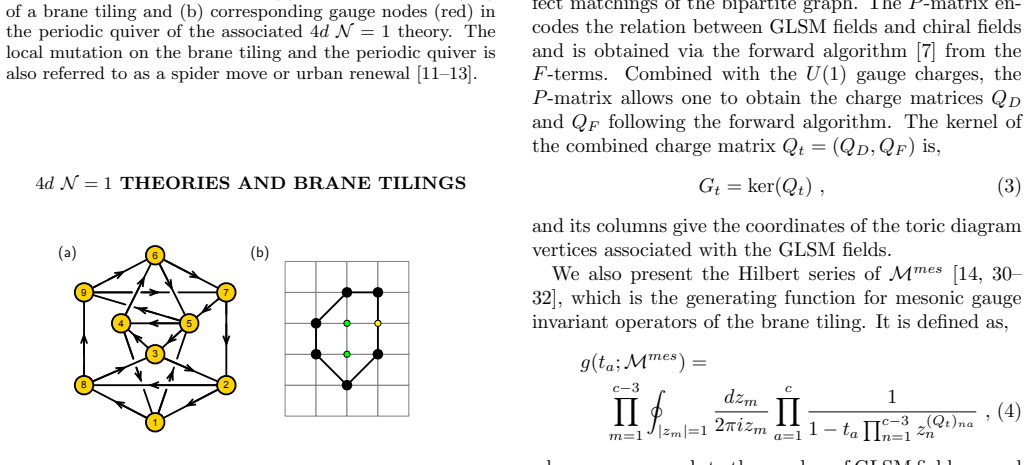
The central claim is that Models A and B, defined by brane tilings on a 2-torus, are distinct 4d N=1 theories whose quivers and chiral fields coincide but whose superpotentials do not. They are connected by a 'tilting' mutation that slides diagonals across hexagonal faces of the tiling; this move preserves the quiver as a directed graph (including node labels) and preserves the mesonic moduli space, which for abelian theories is the toric Calabi-Yau 3-fold itself. The authors show the moduli spaces agree by matching toric diagrams, Hilbert series, and the GLSM data, and they assert that the single tilting move decomposes into two consecutive Seiberg dualities at faces 1 and 5, followed by re
What carries the argument
Brane tilings: bipartite graphs on a 2-torus whose faces are U(N) gauge groups, edges are chiral bifundamental fields, and vertices specify superpotential terms; the dual graph is the periodic quiver. The 'tilting' mutation: a local move that draws diagonals through hexagonal faces, rearranging how fields are contracted while keeping the face adjacency, hence the quiver, intact. Seiberg duality (here called a spider move or urban renewal): the standard local mutation on quadrilateral faces that changes the quiver but leaves the mesonic moduli space invariant; the paper's assertion is that tilting is a sequence of such moves whose net effect is quiver-invariant. Zig-zag paths—oriented paths t
Load-bearing premise
The argument hinges on a move that is drawn but not computed: the paper says the 'tilting' mutation can be done as two Seiberg dualities plus relabeling, yet it never shows the intermediate quiver or superpotential, so if that step does not actually reproduce Model B the main identification collapses.
What would settle it
Write out the intermediate quiver and superpotential after applying one Seiberg duality at face 1 and then another at face 5 to Model A (with the specified relabeling), and compare the result with W_B in Eq. (13). If the final superpotential does not match Model B, or if the intermediate quiver is not the shared quiver, then the identification of the tilting move with a sequence of Seiberg dualities fails.
If this is right
- A 4d N=1 theory is not fixed by its quiver plus its mesonic moduli space; the superpotential carries independent information even when both are held fixed.
- Sequences of Seiberg dualities can act on a quiver in a way that returns the same directed graph (up to relabeling), so 'quiver-invariant' dualities form a nontrivial class worth classifying.
- The tilting move generates an infinite family of brane tilings all sharing one toric Calabi-Yau 3-fold and one quiver, giving a combinatorial handle on the possible superpotentials for a fixed vacuum geometry.
- The same chiral field can carry different superconformal R-charges in two theories with identical moduli spaces, so R-charge assignments are not fixed by the vacuum geometry alone.
- Because the same GLSM generators appear as different chiral-field composites in the two models, the map between perfect matchings and mesonic operators is theory-dependent even when the Hilbert series is not.
Where Pith is reading between the lines
- If the tilting–Seiberg identification holds, the move could serve as a generator of quiver-invariant dualities in any tiling with adjacent hexagonal faces, so the example would be a proof of concept rather than an isolated curiosity.
- The observed exchange of three parallel zig-zag paths suggests a braid-like permutation on perfect matchings; tracking these permutations under repeated tilting could turn the correspondence into a group action and is a natural next calculation.
- The paper leaves open whether Models A and B are connected by an RG flow or are distinct UV completions of the same IR fixed point; that distinction matters for interpreting the duality physically.
- The claimed infinite family can be tested by constructing a third tiling in the same moduli space/quiver class and verifying the invariants; the paper does not provide such a construction.
Editorial analysis
A structured set of objections, weighed in public.
Referee Report
Summary. The paper studies 4d N=1 quiver gauge theories realized by brane tilings on a 2-torus. It presents two explicit models, A and B, that share the same quiver and chiral field content but differ in their superpotentials (Eqs. (5) and (13)). For these two models the authors provide perfect matching matrices, F- and D-term charge matrices, toric data, and a Hilbert series for the mesonic moduli space, and they state the equality of the refined Hilbert series for Models A and B in Eq. (18). They further propose that the two models are related by a single local 'tilting' mutation along diagonals of hexagonal faces, which they claim is equivalent to a specific sequence of two Seiberg dualities at gauge nodes 1 and 5 followed by a node relabeling. The paper also discusses zig-zag paths, a-maximization R-charges, and the plethystic logarithm of the shared Hilbert series.
Significance. If the claims are correct, the paper would exhibit a new type of duality between 4d N=1 theories: distinct superpotentials with identical quiver and identical mesonic moduli space, realized by a combinatorial mutation of the brane tiling. The evidence for the agreement of the moduli spaces is substantial: explicit P-matrices, charge matrices, toric diagrams, and Hilbert series data are provided, and the R-charges are outputs of a-maximization rather than inputs tuned to force agreement. This computational core is a strength of the paper. However, the central interpretive claim — that the tilting mutation is realized by a concrete sequence of Seiberg dualities — is not demonstrated, and the claim that the two models are genuinely inequivalent theories is not checked against quiver automorphisms. These gaps are load-bearing for the title and abstract.
major comments (2)
- ['Tilting mutation and zig-zag paths' section, near 'two consecutive Seiberg dualities'] The central claim that the tilting mutation is equivalent to a sequence of two Seiberg dualities at faces 1 and 5 (plus relabeling) is asserted but not demonstrated. The paper gives the initial superpotential W_A in Eq. (5) and the final superpotential W_B in Eq. (13), but provides no intermediate quiver, no intermediate superpotential, and no explicit spider-move steps. Without these data, the decomposition is a conjecture, and the paper's main interpretive claim — that the tilting move is a quiver-invariant composite of Seiberg dualities — is unverified. I request an explicit step-by-step construction, including the intermediate periodic quiver and superpotential after each duality and the node relabeling, or a clear statement that this equivalence is conjectural and not yet proven.
- [Model A and Model B, Tables II and III] The paper claims Models A and B are distinct 4d N=1 theories, but it does not rule out the possibility that W_B is obtained from W_A by a permutation of the chiral fields induced by an automorphism of the common quiver. Since the quiver is identical as a directed graph, a node relabeling could map one superpotential to the other, in which case the two 'theories' would be isomorphic and the example would be vacuous. The captions of Tables II and III note that charges agree 'up to a re-ordering of charges,' which makes this concern concrete. The authors should either exhibit a quiver automorphism that maps W_A to W_B, or demonstrate that no such automorphism exists (for example, by checking the finite automorphism group of the quiver or by showing that the R-charge assignments are incompatible under any plausible relabeling).
minor comments (6)
- [Model B, Eq. (18)] The refined Hilbert series for Model B is not displayed; only its equality to Model A is stated. To make Eq. (18) independently checkable, please include the analog of Eq. (10) for Model B or refer to supplementary material with the computation.
- [Figure 1 and 'Tilting mutation' section] The 'tilting' mutation is defined only pictorially. A precise combinatorial definition — which diagonals are added, how the bipartite graph changes, and how faces are renumbered — would make the later discussion of its decomposition into spider moves testable.
- [Tables II and III] The phrase 'up to a re-ordering of charges' is vague. Please specify whether the re-ordering is over gauge node labels, over the list of chiral fields, or over global symmetry charges. This is important for the inequivalence question raised in the major comments.
- [Table IV] Table IV is dense and hard to read. Defining the notation for products of GLSM fields and for chiral-field monomials, and indicating clearly which columns correspond to Model A and Model B, would significantly improve usability.
- [References] Reference [31] contains a typo: 'N=2 braine surgery' should read 'N=2 brane surgery.'
- [Discussion] The statement that the two models 'belong to an infinite family' is not supported by any construction or argument in this manuscript. Please either provide a concrete family or label this as a conjecture for future work.
Circularity Check
No significant circularity: the shared-moduli-space equality is an independent computation, and the unshown Seiberg-duality decomposition is a verification gap rather than a circular step.
full rationale
The paper's central claim that Models A and B share the same quiver, chiral field content, and mesonic moduli space is supported by explicit independent constructions: the superpotentials W_A and W_B in Eqs. (5) and (13), the distinct P-matrices in Eqs. (6) and (14), the F- and D-term charge matrices in Eqs. (7)-(8) and (15)-(16), and the toric data G_A^t and G_B^t in Eqs. (9) and (17). The equality of Hilbert series g_A = g_B in Eq. (18) is presented as a computed result from these independent data, not as an input used to define either model. No fitted parameter is renamed as a prediction: the U(1)_R charges are outputs of a-maximization/volume minimization and are not tuned to force equality of the moduli spaces. Self-citations appear in background and speculative discussion (e.g., refs. [24], [45], [53], [54]) but are not load-bearing for the example's shared-moduli-space computation. The one notable weakness is the asserted decomposition of the 'tilting' mutation into two consecutive Seiberg dualities on faces 1 and 5; the paper does not display the intermediate quiver or superpotential. That is an unsupported claim and a correctness risk, but it is not circular: the shared-moduli-space result does not depend on that decomposition, and the decomposition is not derived from the equality it is meant to explain. Accordingly, no step in the derivation reduces by construction to its own inputs.
Axiom & Free-Parameter Ledger
axioms (6)
- domain assumption Brane tilings (bipartite graphs on T^2) encode 4d N=1 quiver gauge theories: faces correspond to U(N) gauge groups, edges to chiral fields, and plaquettes to superpotential terms.
- domain assumption The mesonic moduli space of an abelian brane-tiling theory is Spec(C[X_ij]/I_irr)//U(1)^{G-1}, and for U(N) gauge groups it is the N-th symmetric product of the abelian moduli space.
- domain assumption The forward algorithm correctly computes the P-matrix, F-term and D-term charge matrices, the toric diagram, and the Hilbert series from the superpotential.
- domain assumption Seiberg duality is realized by spider moves / urban renewal on quadrilateral faces and leaves the mesonic moduli space invariant.
- domain assumption Superconformal U(1)_R charges are determined by a-maximization / volume minimization, and the shared GLSM fields carry the same R-charges because they correspond to the same toric Calabi-Yau.
- domain assumption Zig-zag path winding numbers on T^2 encode the normal directions of toric diagram edges; preservation of the mesonic moduli space implies preservation of the winding-number data.
read the original abstract
We study pairs of 4d N=1 supersymmetric gauge theories that share the same vacuum moduli space and the same chiral field content, encoded by a common quiver, but differ in their superpotentials. These theories arise as worldvolume theories on a D3-brane probing a toric Calabi-Yau 3-fold and admit a description in terms of bipartite graphs on a 2-torus, known as brane tilings. Using an explicit example, we show that the correspondence is realized by a single `tilting' mutation along the diagonals of hexagonal faces in the brane tiling, which is equivalent to a specific sequence of Seiberg dualities performed at distinct gauge nodes in the quiver.
Figures




Forward citations
Cited by 1 Pith paper
-
Abelian Orbifolds for Brane Brick Models
A construction procedure that induces an abelian orbifold action on the fields and J/E-terms of a parent brane brick model for a toric CY4, yielding explicit orbifolded theories that preserve consistency conditions.
Reference graph
Works this paper leans on
-
[1]
S. Franco, A. Hanany, K. D. Kennaway, D. Vegh and B. Wecht,Brane dimers and quiver gauge theories, JHEP01(2006) 096, [hep-th/0504110]
Pith/arXiv arXiv 2006
-
[2]
A. Hanany and K. D. Kennaway,Dimer models and toric diagrams,hep-th/0503149
-
[3]
S. Franco, A. Hanany, D. Martelli, J. Sparks, D. Vegh and B. Wecht,Gauge theories from toric geometry and brane tilings,JHEP01(2006) 128, [hep-th/0505211]
Pith/arXiv arXiv 2006
-
[4]
R. Kenyon,An introduction to the dimer model,arXiv Mathematics e-prints(Oct., 2003) math/0310326, [math/0310326]
Pith/arXiv arXiv 2003
-
[5]
qt8iXpFC+gSdXxx0OYZsKTaga4U=
We note, however, that the ‘tilting’ mutation preserves the quiver together with its node labels, whereas the se- quence of Seiberg dualities preserves only the shape of the quiver. To make the sequence of Seiberg dualities equivalent to the ‘tilting’ mutation on the brane tiling, one must therefore perform an appropriate relabelling of the gauge nodes in...
2025
-
[6]
6qi8+0nDjRldHmFpACus+EnwLf4=
,(10) wheret a is the fugacity corresponding to the GLSM fields pa associated to the extremal vertices of the toric dia- gram in Figure 4. We also have the fugacitiesy q,y s and yu, which correspond to products of GLSM fieldsq 1q2, s1 . . . s10, andu 1 . . . u12, respectively, that are associated to non-extremal vertices of the toric diagram. The nu- mera...
-
[7]
Kasteleyn,Graph theory and crystal physics,Graph theory and theoretical physics(1967) 43–110
P. Kasteleyn,Graph theory and crystal physics,Graph theory and theoretical physics(1967) 43–110
1967
-
[8]
Seiberg,Electric - magnetic duality in supersymmetric nonAbelian gauge theories,Nucl
N. Seiberg,Electric - magnetic duality in supersymmetric nonAbelian gauge theories,Nucl. Phys. B435(1995) 129–146, [hep-th/9411149]
Pith/arXiv arXiv 1995
-
[9]
B. Feng, A. Hanany and Y.-H. He,D-brane gauge theories from toric singularities and toric duality,Nucl. Phys. B595(2001) 165–200, [hep-th/0003085]
Pith/arXiv arXiv 2001
-
[10]
B. Feng, A. Hanany, Y.-H. He and A. M. Uranga,Toric duality as Seiberg duality and brane diamonds,JHEP 12(2001) 035, [hep-th/0109063]
Pith/arXiv arXiv 2001
-
[11]
B. Feng, A. Hanany and Y.-H. He,Phase structure of D-brane gauge theories and toric duality,JHEP08 (2001) 040, [hep-th/0104259]
Pith/arXiv arXiv 2001
-
[12]
B. Feng, S. Franco, A. Hanany and Y.-H. He, Symmetries of toric duality,JHEP12(2002) 076, [hep-th/0205144]
Pith/arXiv arXiv 2002
-
[13]
A. B. Goncharov and R. Kenyon,Dimers and cluster integrable systems,arXiv e-prints(July, 2011) arXiv:1107.5588, [1107.5588]
Pith/arXiv arXiv 2011
-
[14]
Ciucu,A complementation theorem for perfect matchings of graphs having a cellular completion, Journal of Combinatorial Theory, Series A81(1998) 34–68
M. Ciucu,A complementation theorem for perfect matchings of graphs having a cellular completion, Journal of Combinatorial Theory, Series A81(1998) 34–68
1998
-
[15]
R. W. Kenyon, J. G. Propp and D. B. Wilson,Trees and Matchings,arXiv Mathematics e-prints(Mar.,
-
[16]
D. Forcella, A. Hanany, Y.-H. He and A. Zaffaroni, Mastering the Master Space,Lett. Math. Phys.85 (2008) 163–171, [0801.3477]
Pith/arXiv arXiv 2008
-
[17]
A. Butti, D. Forcella, A. Hanany, D. Vegh and A. Zaffaroni,Counting Chiral Operators in Quiver Gauge Theories,JHEP11(2007) 092, [0705.2771]
Pith/arXiv arXiv 2007
-
[18]
D. Forcella, A. Hanany, Y.-H. He and A. Zaffaroni,The Master Space of N=1 Gauge Theories,JHEP08(2008) 012, [0801.1585]
Pith/arXiv arXiv 2008
-
[19]
S. Franco and R.-K. Seong,Twin theories, polytope mutations and quivers for GTPs,JHEP07(2023) 034, [2302.10951]
Pith/arXiv arXiv 2023
-
[20]
M. Bianchi, S. Cremonesi, A. Hanany, J. F. Morales, D. Ricci Pacifici and R.-K. Seong,Mass-deformed Brane Tilings,JHEP10(2014) 027, [1408.1957]
Pith/arXiv arXiv 2014
-
[21]
A. Higashitani and Y. Nakajima,Deformations of Dimer Models,SIGMA18(Apr., 2022) 030, [1903.01636]
Pith/arXiv arXiv 2022
-
[22]
S. Franco and D. Rodriguez-Gomez,Quiver tails and brane webs,JHEP10(2024) 118, [2310.10724]
Pith/arXiv arXiv 2024
-
[23]
S. Cremonesi and J. S´ a,Zig-zag deformations of toric quiver gauge theories. Part I. Reflexive polytopes,JHEP 05(2024) 114, [2312.13909]
Pith/arXiv arXiv 2024
-
[24]
G. Arias-Tamargo, S. Franco and D. Rodr ´ ıguez-G´ omez, The geometry of GTPs and 5d SCFTs,JHEP07(2024) 159, [2403.09776]
Pith/arXiv arXiv 2024
-
[25]
A. Hanany and R.-K. Seong,Brane Tilings and Specular Duality,JHEP08(2012) 107, [1206.2386]
Pith/arXiv arXiv 2012
-
[26]
I. Carre˜ no Bolla, S. Franco and D. Rodr ´ ıguez-G´ omez, The 5d tangram: brane webs, 7-branes and primitive T-cones,JHEP05(2025) 175, [2411.01510]
Pith/arXiv arXiv 2025
-
[27]
M. Kho, N. Lee and R.-K. Seong,Birational transformations on dimer integrable systems,Phys. Rev. D112(2025) L041901, [2504.21081]
Pith/arXiv arXiv 2025
-
[28]
D. Cox, J. Little and H. Schenck,Graduate studies in mathematics, 2011
2011
-
[29]
R. Kenyon,Local statistics of lattice dimers,Annales de L’Institut Henri Poincare Section (B) Probability and Statistics33(Jan., 1997) 591–618, [math/0105054]
Pith/arXiv arXiv 1997
-
[30]
Fulton,Introduction to toric varieties
W. Fulton,Introduction to toric varieties. No. 131. Princeton university press, 1993
1993
-
[31]
A. Hanany and C. Romelsberger,Counting BPS operators in the chiral ring of N=2 supersymmetric gauge theories or N=2 braine surgery,Adv. Theor. Math. Phys.11(2007) 1091–1112, [hep-th/0611346]
Pith/arXiv arXiv 2007
-
[32]
Witten,Phases of N=2 theories in two-dimensions, Nucl
E. Witten,Phases of N=2 theories in two-dimensions, Nucl. Phys. B403(1993) 159–222, [hep-th/9301042]
Pith/arXiv arXiv 1993
-
[33]
S. Benvenuti, B. Feng, A. Hanany and Y.-H. He, Counting BPS Operators in Gauge Theories: Quivers, Syzygies and Plethystics,JHEP11(2007) 050, [hep-th/0608050]
Pith/arXiv arXiv 2007
-
[34]
A. Butti and A. Zaffaroni,R-charges from toric diagrams and the equivalence of a-maximization and Z-minimization,JHEP11(2005) 019, [hep-th/0506232]
Pith/arXiv arXiv 2005
-
[35]
B. Feng, A. Hanany and Y.-H. He,Counting gauge invariants: The Plethystic program,JHEP03(2007) 090, [hep-th/0701063]
Pith/arXiv arXiv 2007
-
[36]
K. A. Intriligator and B. Wecht,The Exact superconformal R symmetry maximizes a,Nucl. Phys. B 667(2003) 183–200, [hep-th/0304128]
Pith/arXiv arXiv 2003
-
[37]
D. Martelli, J. Sparks and S.-T. Yau,Sasaki-Einstein manifolds and volume minimisation,Commun. Math. Phys.280(2008) 611–673, [hep-th/0603021]
Pith/arXiv arXiv 2008
-
[38]
A. Butti and A. Zaffaroni,From toric geometry to quiver gauge theory: The Equivalence of a-maximization and Z-minimization,Fortsch. Phys.54(2006) 309–316, [hep-th/0512240]
Pith/arXiv arXiv 2006
-
[39]
R. P. Stanley,Hilbert functions of graded algebras, Advances in Mathematics28(1978) 57–83
1978
-
[40]
J. Bao, E. Choi, Y.-H. He, R.-K. Seong and S.-T. Yau, Futaki invariants and reflexive polygons,J. Math. Phys. 66(2025) 102302, [2410.18476]
arXiv 2025
-
[41]
D. Martelli, J. Sparks and S.-T. Yau,The Geometric dual of a-maximisation for Toric Sasaki-Einstein manifolds,Commun. Math. Phys.268(2006) 39–65, [hep-th/0503183]
Pith/arXiv arXiv 2006
-
[42]
A. Butti, D. Forcella and A. Zaffaroni,Counting BPS baryonic operators in CFTs with Sasaki-Einstein duals, JHEP06(2007) 069, [hep-th/0611229]
Pith/arXiv arXiv 2007
-
[43]
C. Closset and M. Del Zotto,On 5D SCFTs and their BPS quivers. Part I: B-branes and brane tilings,Adv. Theor. Math. Phys.26(2022) 37–142, [1912.13502]
Pith/arXiv arXiv 2022
-
[44]
A. Hanany and D. Vegh,Quivers, tilings, branes and rhombi,JHEP10(2007) 029, [hep-th/0511063]
Pith/arXiv arXiv 2007
-
[45]
N. Broomhead,Dimer models and Calabi-Yau algebras, arXiv e-prints(Jan., 2009) arXiv:0901.4662, [0901.4662]
Pith/arXiv arXiv 2009
-
[46]
S. Franco, D. Ghim, S. Lee, R.-K. Seong and D. Yokoyama,2d (0,2) Quiver Gauge Theories and D-Branes,JHEP09(2015) 072, [1506.03818]
Pith/arXiv arXiv 2015
-
[47]
R. Eager, S. Franco and K. Schaeffer,Dimer Models and Integrable Systems,JHEP06(2012) 106, [1107.1244]. 9
Pith/arXiv arXiv 2012
-
[48]
M. Kho, N. Lee and R.-K. Seong,Classification and Birational Equivalence of Dimer Integrable Systems for Reflexive Polygons,2510.12290
-
[49]
S. Franco and R.-K. Seong,Fano 3-folds, reflexive polytopes and brane brick models,JHEP08(2022) 008, [2203.15816]
Pith/arXiv arXiv 2022
-
[50]
S. Franco, S. Lee and R.-K. Seong,Brane Brick Models, Toric Calabi-Yau 4-Folds and 2d (0,2) Quivers,JHEP 02(2016) 047, [1510.01744]
Pith/arXiv arXiv 2016
-
[51]
S. Franco, S. Lee, R.-K. Seong and C. Vafa,Brane Brick Models in the Mirror,JHEP02(2017) 106, [1609.01723]
Pith/arXiv arXiv 2017
-
[52]
M. Carcamo, S. Franco, D. Ghim, G. P. Goulas and R.-K. Seong,Relevant Deformations, Brane Brick Models and Triality,2510.05517
-
[53]
M. Kho and R.-K. Seong,On the master space for brane brick models,JHEP09(2023) 150, [2306.16616]
Pith/arXiv arXiv 2023
-
[54]
S. Franco, D. Ghim, G. P. Goulas and R.-K. Seong, Mass deformations of brane brick models,JHEP09 (2023) 176, [2307.03220]
Pith/arXiv arXiv 2023
-
[56]
D. Ghim, M. Kho and R.-K. Seong,Combinatorial and algebraic mutations of toric Fano 3-folds and mass deformations of 2d(0,2) quiver gauge theories,Phys. Rev. D110(2024) 086001, [2407.19924]
Pith/arXiv arXiv 2024
-
[57]
D. Ghim, M. Kho and R.-K. Seong,Birational transformations and 2d (0, 2) quiver gauge theories beyond toric Fano 3-folds,JHEP06(2025) 032, [2502.08741]
Pith/arXiv arXiv 2025
-
[1999]
math/9903025, [math/9903025]
discussion (0)
Sign in with ORCID, Apple, or X to comment. Anyone can read and Pith papers without signing in.