Recognition: no theorem link
Constraining dimension-6 SMEFT with higher-order predictions for p p to t W
Pith reviewed 2026-05-16 10:12 UTC · model grok-4.3
The pith
Higher-order QCD calculations for single-top-plus-W production constrain dimension-6 SMEFT operators up to effective scales of 2 TeV at the LHC.
A machine-rendered reading of the paper's core claim, the machinery that carries it, and where it could break.
Core claim
We study single-top production in association with a W boson at the LHC as a probe of dimension-6 SMEFT at leading order, next-to-leading order, and approximate next-to-next-to-leading order accuracy in QCD. The process is sensitive to operators that modify the top-quark weak and chromomagnetic dipole interactions, and we perform three-parameter linear and quadratic SMEFT fits using doubly differential top-quark distributions in transverse momentum and rapidity for the Run II and Run III configurations at the LHC. We find that effective scales up to 2 TeV can be probed in nonmarginalized fits, while in marginalized fits the corresponding scales are around 0.5 and 1.5 TeV for linear and quadr
What carries the argument
Three-parameter linear and quadratic SMEFT fits to doubly differential top-quark pT and rapidity distributions, evaluated at LO, NLO, and approximate NNLO in QCD.
If this is right
- Run II and Run III LHC data on top-plus-W production can directly bound the coefficients of the three relevant dimension-6 operators.
- Approximate NNLO QCD corrections reduce theoretical uncertainties and tighten the resulting limits compared with lower orders.
- Nonmarginalized fits yield stronger scale reach than marginalized fits because they do not account for possible cancellations with other operators.
- The same differential distributions provide a handle to separate linear from quadratic operator contributions.
Where Pith is reading between the lines
- These constraints could be combined with global SMEFT fits that include other top-quark processes to reduce allowed parameter space further.
- The method of using approximate NNLO predictions for differential distributions may extend to other rare top-production channels at the LHC.
- If the 2 TeV scale is confirmed or exceeded, it would imply that new physics affecting top weak couplings lies within the kinematic reach of a future high-energy collider.
Load-bearing premise
The dimension-6 SMEFT truncation remains valid at the probed scales and only the three chosen operators contribute significantly without substantial interference from higher-dimensional terms.
What would settle it
A precise measurement of the doubly differential top-quark transverse-momentum and rapidity distributions in pp to tW that deviates from the predicted SMEFT contributions by more than the quoted uncertainties at scales near 1 TeV would falsify the extracted constraints.
Figures







read the original abstract
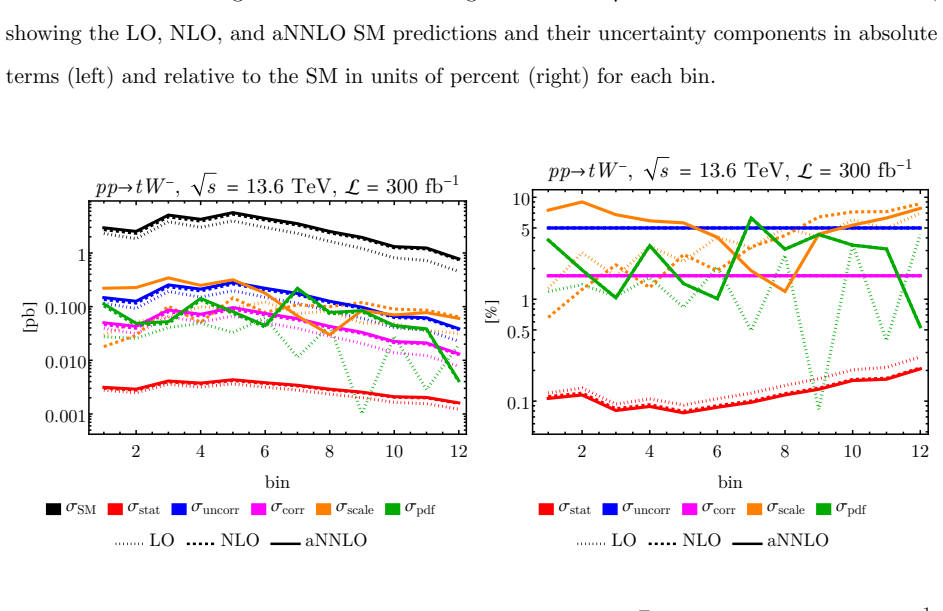
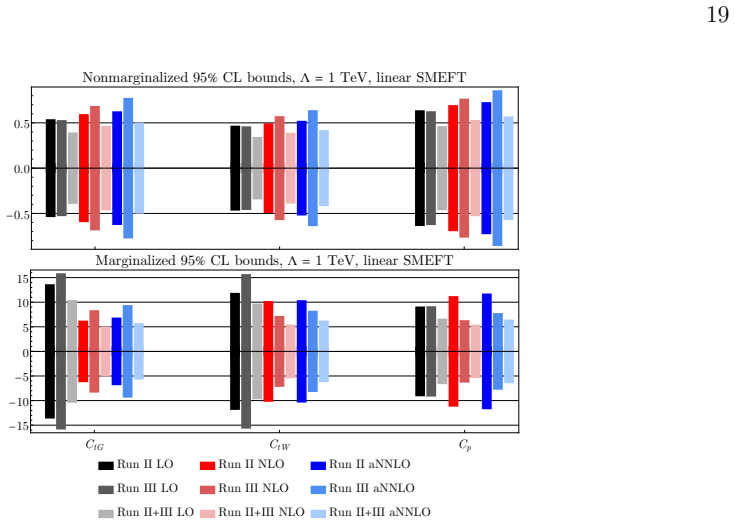
We study single-top production in association with a $W$ boson at the Large Hadron Collider (LHC) as a probe of dimension-6 Standard Model effective field theory (SMEFT) at leading order, next-to-leading order, and approximate next-to-next-to-leading order accuracy in quantum chromodynamics (QCD). The process is sensitive to operators that modify the top-quark weak and chromomagnetic dipole interactions, and we perform three-parameter linear and quadratic SMEFT fits using doubly differential top-quark distributions in transverse momentum and rapidity for the Run II and Run III configurations at the LHC. We provide a detailed account of the uncertainties and quantify the impact of the different uncertainty components across bins and perturbative orders. We find that effective scales up to 2 TeV can be probed in nonmarginalized fits, while in marginalized fits the corresponding scales are around 0.5 and 1.5 TeV for linear and quadratic fits, respectively.
Editorial analysis
A structured set of objections, weighed in public.
Referee Report
Summary. The manuscript studies single-top production in association with a W boson (pp → tW) at the LHC as a probe of dimension-6 SMEFT. It computes the process at LO, NLO, and approximate NNLO in QCD, focusing on operators modifying top-quark weak and chromomagnetic dipole interactions. Three-parameter linear and quadratic SMEFT fits are performed to doubly differential distributions in top-quark transverse momentum and rapidity for Run II and Run III configurations, with a detailed uncertainty breakdown. The central claim is that effective scales up to 2 TeV can be probed in non-marginalized fits, while marginalized fits yield scales of ~0.5 TeV (linear) and ~1.5 TeV (quadratic).
Significance. If the EFT truncation assumptions hold, the work strengthens SMEFT constraints by incorporating approximate NNLO QCD predictions and a thorough quantification of uncertainty components across bins and perturbative orders. The use of differential distributions and explicit uncertainty propagation represents a methodological advance that could improve the robustness of limits on top-quark operators in global fits.
major comments (2)
- [Abstract and results section] Abstract and results section (fits to doubly differential pT–y distributions): The headline sensitivity claim (non-marginalized reach to 2 TeV) is load-bearing for the paper but assumes the dimension-6 truncation remains valid in the high-pT tails. In these bins, partonic energies are comparable to or exceed the quoted Λ, yet no estimate or bound is given for the size of omitted dimension-8 contributions or for the perturbativity of the linear/quadratic terms.
- [Operator selection and fit setup] Section on operator selection and fit setup: The restriction to three specific operators is reasonable but the justification for neglecting interference from other dimension-6 operators (especially in the marginalized fits) is not quantified. This affects the interpretation of the linear vs. quadratic scale differences.
minor comments (2)
- [Uncertainty tables/figures] The breakdown of individual uncertainty sources (scale, PDF, etc.) in the tables and figures would benefit from more explicit labeling or a dedicated summary table to improve clarity.
- [Notation] Notation for Wilson coefficients and the definition of the effective scale Λ could be standardized more consistently between the text, equations, and fit results.
Simulated Author's Rebuttal
We thank the referee for the positive assessment of our work and for the constructive comments, which have helped us strengthen the manuscript. We address each major point below, indicating where revisions have been made.
read point-by-point responses
-
Referee: [Abstract and results section] The headline sensitivity claim (non-marginalized reach to 2 TeV) assumes the dimension-6 truncation remains valid in the high-pT tails. In these bins, partonic energies are comparable to or exceed the quoted Λ, yet no estimate or bound is given for the size of omitted dimension-8 contributions or for the perturbativity of the linear/quadratic terms.
Authors: We agree that the validity of the EFT truncation in the high-p_T tails is an important consideration for interpreting the quoted sensitivity. While our primary focus is on dimension-6 operators, we have added a new paragraph in the results section that provides a naive dimensional analysis estimate of dimension-8 contributions. For the relevant bins and Λ values around 1–2 TeV, the relative suppression factor (E/Λ)^2 is typically 0.1–0.4, indicating that omitted terms remain subdominant but are not negligible in the extreme tails. We also discuss the perturbativity of the quadratic terms, noting that they already incorporate part of the higher-order EFT effects. This addition provides context without altering the numerical results or central claims, which are presented under the standard dimension-6 assumption. revision: yes
-
Referee: [Operator selection and fit setup] The restriction to three specific operators is reasonable but the justification for neglecting interference from other dimension-6 operators (especially in the marginalized fits) is not quantified. This affects the interpretation of the linear vs. quadratic scale differences.
Authors: The three operators (those modifying the top-quark weak and chromomagnetic dipole interactions) were chosen because they generate the dominant tree-level contributions to pp → tW. Other dimension-6 operators, particularly four-fermion ones, do not interfere with the SM amplitude in this final state due to quantum number conservation or are suppressed by additional powers of the top Yukawa or small CKM elements. In the marginalized fits we set all other coefficients to zero, which is the standard procedure for a focused three-parameter analysis. To make this explicit, we have expanded the operator selection subsection with a brief quantification: we note that cross-interference terms with the full Warsaw basis are either identically zero or contribute below the per-mille level to the differential distributions used in the fit. This clarifies that the difference between linear and quadratic results arises primarily from self-interference within the selected operators rather than from neglected external interferences. revision: partial
Circularity Check
Fits to external LHC data yield scale constraints without definitional circularity
full rationale
The paper computes higher-order QCD predictions for pp → tW and performs three-parameter linear/quadratic fits of dimension-6 SMEFT operators directly to measured doubly differential pT–y distributions from LHC Run II/III data. The quoted reach (non-marginalized Λ up to 2 TeV; marginalized 0.5–1.5 TeV) is an output of those external-data fits, not a quantity defined by the fitted coefficients themselves. Any self-citations pertain to prior cross-section calculations that are independently verifiable and do not reduce the central constraint result to a tautology. No self-definitional, fitted-input-renamed-as-prediction, or uniqueness-imported steps appear in the derivation chain.
Axiom & Free-Parameter Ledger
free parameters (1)
- SMEFT Wilson coefficients
axioms (2)
- domain assumption Validity of dimension-6 SMEFT truncation
- standard math Reliability of approximate NNLO QCD corrections
Reference graph
Works this paper leans on
-
[1]
Next, we present 95% CL bounds onC tG,C tW , andC p for linear and quadratic SMEFT fits
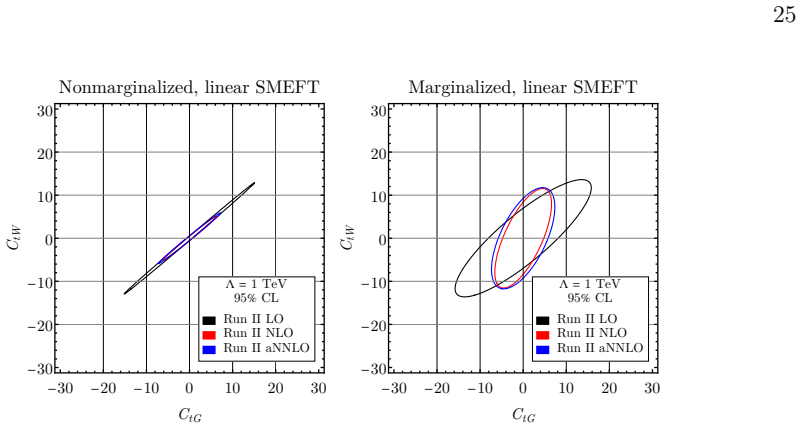
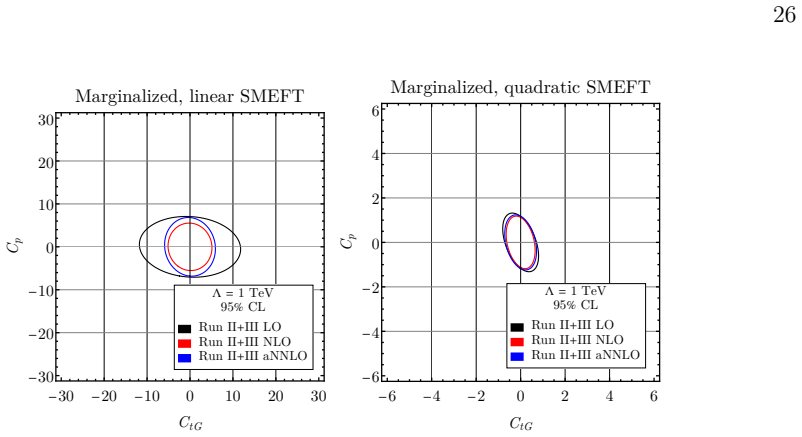
We have checked that this approximation is sufficient at the level of precision targeted in this work. Next, we present 95% CL bounds onC tG,C tW , andC p for linear and quadratic SMEFT fits. Fig. 9 shows the nonmarginalized and marginalized bounds for the linear fit, and Fig. 10 shows the same for the quadratic fit. Here, the band of colors on the left i...
-
[2]
0.62 0.14 CtG CtW Cp CtG CtW Cp Run II LO, quadratic SMEFT -0.46 0.58 1.0 0.35 1.0 0.58 1.0 0.35 -0.46 CtG CtW Cp CtG CtW Cp Run II NLO, quadratic SMEFT -0.46 0.69 1.0 0.14 1.0 0.69 1.0 0.14 -0.46 CtG CtW Cp CtG CtW Cp Run II aNNLO, quadratic SMEFT -0.48 0.67 1.0 0.15 1. 0.67 1.0 0.15 -0.48 FIG. 13. Correlation matrices for the marginalized linear (top) a...
-
[3]
0.92 0.14 CtG CtW Cp CtG CtW Cp Run III NLO, linear SMEFT -0.28 0.35 1. 0.80 1.0 0.35
-
[4]
0.42 1.0 0.76 -0.27 CtG CtW Cp CtG CtW Cp Run III LO, quadratic SMEFT -0.46 0.62 1
0.80 -0.28 CtG CtW Cp CtG CtW Cp Run III aNNLO, linear SMEFT -0.27 0.42 1.0 0.76 1. 0.42 1.0 0.76 -0.27 CtG CtW Cp CtG CtW Cp Run III LO, quadratic SMEFT -0.46 0.62 1. 0.31 1.0 0.62 1.0 0.31 -0.46 CtG CtW Cp CtG CtW Cp Run III NLO, quadratic SMEFT -0.10 0.72 1.0 0.44 1.0 0.72 1.0 0.44 -0.10 CtG CtW Cp CtG CtW Cp Run III aNNLO, quadratic SMEFT -0.089 0.71 ...
-
[5]
0.45 -0.089 FIG. 14. The same as Fig. 13 but for Run III. CtG CtW Cp CtG CtW Cp Run II +III LO, linear SMEFT -0.077 0.39 1.0 0.89 1. 0.39 1.0 0.89 -0.077 CtG CtW Cp CtG CtW Cp Run II +III NLO, linear SMEFT -0.039 0.66 1.0 0.72 1. 0.66 1.0 0.72 -0.039 CtG CtW Cp CtG CtW Cp Run II +III aNNLO, linear SMEFT -0.067 0.68 1. 0.68 1.0 0.68
-
[6]
0.68 -0.067 CtG CtW Cp CtG CtW Cp Run II +III LO, quadratic SMEFT -0.46 0.60 1.0 0.33 1.0 0.60 1.0 0.33 -0.46 CtG CtW Cp CtG CtW Cp Run II +III NLO, quadratic SMEFT -0.31 0.70 1. 0.28 1.0 0.70 1.0 0.28 -0.31 CtG CtW Cp CtG CtW Cp Run II +III aNNLO, quadratic SMEFT -0.31 0.68 1.0 0.29 1. 0.68 1.0 0.29 -0.31 FIG. 15. The same as Fig. 13 but for Run II+III. ...
-
[7]
Dimension-Six Terms in the Standard Model Lagrangian
B. Grzadkowski, M. Iskrzynski, M. Misiak, and J. Rosiek, Dimension-Six Terms in the Stan- dard Model Lagrangian, JHEP10, 085, arXiv:1008.4884 [hep-ph]. 34
work page internal anchor Pith review Pith/arXiv arXiv
-
[8]
Towards the Ultimate SM Fit to Close in on Higgs Physics
A. Pomarol and F. Riva, Towards the Ultimate SM Fit to Close in on Higgs Physics, JHEP 01, 151, arXiv:1308.2803 [hep-ph]
work page internal anchor Pith review Pith/arXiv arXiv
-
[9]
Effective field theory approach to LHC Higgs data
A. Falkowski, Effective field theory approach to LHC Higgs data, Pramana87, 39 (2016), arXiv:1505.00046 [hep-ph]
work page internal anchor Pith review Pith/arXiv arXiv 2016
- [10]
- [11]
- [12]
-
[13]
Hilbert series and operator bases with derivatives in effective field theories
B. Henning, X. Lu, T. Melia, and H. Murayama, Hilbert series and operator bases with deriva- tives in effective field theories, Commun. Math. Phys.347, 363 (2016), arXiv:1507.07240 [hep-th]
work page internal anchor Pith review Pith/arXiv arXiv 2016
-
[14]
B. Henning, X. Lu, T. Melia, and H. Murayama, 2, 84, 30, 993, 560, 15456, 11962, 261485, ...: Higher dimension operators in the SM EFT, JHEP08, 016, [Erratum: JHEP 09, 019 (2019)], arXiv:1512.03433 [hep-ph]
- [15]
- [16]
-
[17]
Feynman Rules for the Standard Model Effective Field Theory in $R_\xi$-gauges
A. Dedes, W. Materkowska, M. Paraskevas, J. Rosiek, and K. Suxho, Feynman rules for the Standard Model Effective Field Theory in R ξ -gauges, JHEP06, 143, arXiv:1704.03888 [hep-ph]
work page internal anchor Pith review Pith/arXiv arXiv
- [18]
- [19]
- [20]
-
[21]
Brivio, SMEFTsim 3.0 — a practical guide, JHEP04, 073, arXiv:2012.11343 [hep-ph]
I. Brivio, SMEFTsim 3.0 — a practical guide, JHEP04, 073, arXiv:2012.11343 [hep-ph]
-
[22]
M. J. Baker, J. Fuentes-Mart´ ın, G. Isidori, and M. K¨ onig, High-p T signatures in vec- tor–leptoquark models, Eur. Phys. J. C79, 334 (2019), arXiv:1901.10480 [hep-ph]
work page internal anchor Pith review Pith/arXiv arXiv 2019
-
[23]
C. Zhang and S.-Y. Zhou, Convex Geometry Perspective on the (Standard Model) Effective Field Theory Space, Phys. Rev. Lett.125, 201601 (2020), arXiv:2005.03047 [hep-ph]
-
[24]
C. de Rham, S. Kundu, M. Reece, A. J. Tolley, and S.-Y. Zhou, Snowmass White Paper: UV Constraints on IR Physics, inSnowmass 2021(2022) arXiv:2203.06805 [hep-th]
-
[25]
A. Biek¨ otter, L. E. G. Maskos, and B. D. Pecjak, Threshold corrections in SMEFT, (2026), arXiv:2601.15901 [hep-ph]
-
[26]
The Standard Model as an Effective Field Theory
I. Brivio and M. Trott, The Standard Model as an Effective Field Theory, Phys. Rept.793, 1 (2019), arXiv:1706.08945 [hep-ph]
work page internal anchor Pith review Pith/arXiv arXiv 2019
-
[27]
Effective Theory Analysis of Precision Electroweak Data
Z. Han and W. Skiba, Effective theory analysis of precision electroweak data, Phys. Rev. D 71, 075009 (2005), arXiv:hep-ph/0412166
work page internal anchor Pith review Pith/arXiv arXiv 2005
-
[28]
Non-standard Charged Current Interactions: beta decays versus the LHC
V. Cirigliano, M. Gonzalez-Alonso, and M. L. Graesser, Non-standard Charged Current Interactions: beta decays versus the LHC, JHEP02, 046, arXiv:1210.4553 [hep-ph]
work page internal anchor Pith review Pith/arXiv arXiv
-
[29]
C.-Y. Chen, S. Dawson, and C. Zhang, Electroweak Effective Operators and Higgs Physics, Phys. Rev. D89, 015016 (2014), arXiv:1311.3107 [hep-ph]
work page internal anchor Pith review Pith/arXiv arXiv 2014
-
[30]
Complete Higgs Sector Constraints on Dimension-6 Operators
J. Ellis, V. Sanz, and T. You, Complete Higgs Sector Constraints on Dimension-6 Operators, JHEP07, 036, arXiv:1404.3667 [hep-ph]
work page internal anchor Pith review Pith/arXiv arXiv
-
[31]
J. D. Wells and Z. Zhang, Precision Electroweak Analysis after the Higgs Boson Discovery, Phys. Rev. D90, 033006 (2014), arXiv:1406.6070 [hep-ph]
work page internal anchor Pith review Pith/arXiv arXiv 2014
-
[32]
The $Z$ decay width in the SMEFT: $y_t$ and $\lambda$ corrections at one loop
C. Hartmann, W. Shepherd, and M. Trott, TheZdecay width in the SMEFT:y t andλ corrections at one loop, JHEP03, 060, arXiv:1611.09879 [hep-ph]
work page internal anchor Pith review Pith/arXiv arXiv
-
[33]
Constraining the top-Higgs sector of the Standard Model Effective Field Theory
V. Cirigliano, W. Dekens, J. de Vries, and E. Mereghetti, Constraining the top-Higgs sector of the Standard Model Effective Field Theory, Phys. Rev. D94, 034031 (2016), arXiv:1605.04311 [hep-ph]
work page internal anchor Pith review Pith/arXiv arXiv 2016
-
[34]
Compilation of low-energy constraints on 4-fermion operators in the SMEFT
A. Falkowski, M. Gonz´ alez-Alonso, and K. Mimouni, Compilation of low-energy constraints on 4-fermion operators in the SMEFT, JHEP08, 123, arXiv:1706.03783 [hep-ph]. 36
work page internal anchor Pith review Pith/arXiv arXiv
-
[35]
J. de Blas, M. Ciuchini, E. Franco, S. Mishima, M. Pierini, L. Reina, and L. Silvestrini, Electroweak precision observables and Higgs-boson signal strengths in the Standard Model and beyond: present and future, JHEP12, 135, arXiv:1608.01509 [hep-ph]
-
[36]
N. P. Hartland, F. Maltoni, E. R. Nocera, J. Rojo, E. Slade, E. Vryonidou, and C. Zhang, A Monte Carlo global analysis of the Standard Model Effective Field Theory: the top quark sector, JHEP04, 100, arXiv:1901.05965 [hep-ph]
work page internal anchor Pith review Pith/arXiv arXiv 1901
-
[37]
The Gauge-Higgs Legacy of the LHC Run II
A. Biek¨ otter, T. Corbett, and T. Plehn, The Gauge-Higgs Legacy of the LHC Run II, SciPost Phys.6, 064 (2019), arXiv:1812.07587 [hep-ph]
work page internal anchor Pith review Pith/arXiv arXiv 2019
-
[38]
C. Grojean, M. Montull, and M. Riembau, Diboson at the LHC vs LEP, JHEP03, 020, arXiv:1810.05149 [hep-ph]
work page internal anchor Pith review Pith/arXiv arXiv
- [39]
-
[40]
R. Boughezal, F. Petriello, and D. Wiegand, Removing flat directions in standard model EFT fits: How polarized electron-ion collider data can complement the LHC, Phys. Rev. D 101, 116002 (2020), arXiv:2004.00748 [hep-ph]
-
[41]
R. Boughezal, C.-Y. Chen, F. Petriello, and D. Wiegand, Four-leptonZboson decay con- straints on the standard model EFT, Phys. Rev. D103, 055015 (2021), arXiv:2010.06685 [hep-ph]
- [42]
-
[43]
S. Carrazza, C. Degrande, S. Iranipour, J. Rojo, and M. Ubiali, Can New Physics hide inside the proton?, Phys. Rev. Lett.123, 132001 (2019), arXiv:1905.05215 [hep-ph]
-
[44]
Updated Global SMEFT Fit to Higgs, Diboson and Electroweak Data
J. Ellis, C. W. Murphy, V. Sanz, and T. You, Updated Global SMEFT Fit to Higgs, Diboson and Electroweak Data, JHEP06, 146, arXiv:1803.03252 [hep-ph]
work page internal anchor Pith review Pith/arXiv arXiv
-
[45]
SMEFT and the Drell-Yan Process at High Energy
S. Dawson, P. P. Giardino, and A. Ismail, Standard model EFT and the Drell-Yan process at high energy, Phys. Rev. D99, 035044 (2019), arXiv:1811.12260 [hep-ph]
work page internal anchor Pith review Pith/arXiv arXiv 2019
- [46]
-
[47]
R. Boughezal, E. Mereghetti, and F. Petriello, Dilepton production in the SMEFT at O(1/Λ4), Phys. Rev. D104, 095022 (2021), arXiv:2106.05337 [hep-ph]
- [48]
- [49]
- [50]
-
[51]
A. Tumasyanet al.(CMS), Measurement of the mass dependence of the transverse momen- tum of lepton pairs in Drell-Yan production in proton-proton collisions at √s= 13 TeV, Eur. Phys. J. C83, 628 (2023), arXiv:2205.04897 [hep-ex]
-
[52]
NLO QCD Corrections to Higgs Pair Production including Dimension-6 Operators
R. Grober, M. Muhlleitner, M. Spira, and J. Streicher, NLO QCD Corrections to Higgs Pair Production including Dimension-6 Operators, JHEP09, 092, arXiv:1504.06577 [hep-ph]
work page internal anchor Pith review Pith/arXiv arXiv
-
[53]
Single Top Production at Next-to-Leading Order in the Standard Model Effective Field Theory
C. Zhang, Single Top Production at Next-to-Leading Order in the Standard Model Effective Field Theory, Phys. Rev. Lett.116, 162002 (2016), arXiv:1601.06163 [hep-ph]
work page internal anchor Pith review Pith/arXiv arXiv 2016
-
[54]
The Standard Model Effective Field Theory and Next to Leading Order
G. Passarino and M. Trott, The Standard Model Effective Field Theory and Next to Leading Order, (2016), arXiv:1610.08356 [hep-ph]
work page internal anchor Pith review Pith/arXiv arXiv 2016
-
[55]
C. Englert, P. Galler, and C. D. White, Effective field theory and scalar extensions of the top quark sector, Phys. Rev. D101, 035035 (2020), arXiv:1908.05588 [hep-ph]
- [56]
-
[57]
L. Bellafronte, S. Dawson, C. Del Pio, M. Forslund, and P. P. Giardino, Complete NLO SMEFT Electroweak Corrections to Higgs Decays, (2025), arXiv:2508.14966 [hep-ph]
-
[58]
L. Bellafronte, S. Dawson, C. Del Pio, M. Forslund, and P. P. Giardino, Higgs Decays at NLO in the SMEFT, (2026), arXiv:2601.09599 [hep-ph]
-
[59]
J. Alwall, R. Frederix, S. Frixione, V. Hirschi, F. Maltoni, O. Mattelaer, H. S. Shao, T. Stelzer, P. Torrielli, and M. Zaro, The automated computation of tree-level and next- to-leading order differential cross sections, and their matching to parton shower simulations, JHEP07, 079, arXiv:1405.0301 [hep-ph]. 38
work page internal anchor Pith review Pith/arXiv arXiv
-
[60]
C. Degrande, G. Durieux, F. Maltoni, K. Mimasu, E. Vryonidou, and C. Zhang, Automated one-loop computations in the standard model effective field theory, Phys. Rev. D103, 096024 (2021), arXiv:2008.11743 [hep-ph]
-
[61]
N. Kidonakis and A. Tonero, SMEFT chromomagnetic dipole operator contributions tot t production at approximate NNLO in QCD, Eur. Phys. J. C84, 591 (2024), arXiv:2309.16758 [hep-ph]
-
[62]
Evidence for the associated production of a W boson and a top quark in ATLAS at sqrt(s) = 7 TeV
G. Aadet al.(ATLAS), Evidence for the associated production of aWboson and a top quark in ATLAS at √s= 7 TeV, Phys. Lett. B716, 142 (2012), arXiv:1205.5764 [hep-ex]
work page internal anchor Pith review Pith/arXiv arXiv 2012
-
[63]
S. Chatrchyanet al.(CMS), Evidence for Associated Production of a Single Top Quark and W Boson inppCollisions at √s= 7 TeV, Phys. Rev. Lett.110, 022003 (2013), arXiv:1209.3489 [hep-ex]
work page internal anchor Pith review Pith/arXiv arXiv 2013
-
[64]
S. Chatrchyanet al.(CMS), Observation of the Associated Production of a Single Top Quark and aWBoson inppCollisions at √s=8 TeV, Phys. Rev. Lett.112, 231802 (2014), arXiv:1401.2942 [hep-ex]
work page internal anchor Pith review Pith/arXiv arXiv 2014
-
[65]
G. Aadet al.(ATLAS), Measurement of the production cross-section of a single top quark in association with aWboson at 8 TeV with the ATLAS experiment, JHEP01, 064, arXiv:1510.03752 [hep-ex]
work page internal anchor Pith review Pith/arXiv arXiv
-
[66]
M. Aaboudet al.(ATLAS), Measurement of the cross-section for producing a W boson in association with a single top quark in pp collisions at √s= 13 TeV with ATLAS, JHEP01, 063, arXiv:1612.07231 [hep-ex]
work page internal anchor Pith review Pith/arXiv arXiv
-
[67]
M. Aaboudet al.(ATLAS), Measurement of differential cross-sections of a single top quark produced in association with aWboson at √s= 13 TeV with ATLAS, Eur. Phys. J. C78, 186 (2018), arXiv:1712.01602 [hep-ex]
work page internal anchor Pith review Pith/arXiv arXiv 2018
-
[68]
A. M. Sirunyanet al.(CMS), Measurement of the production cross section for single top quarks in association with W bosons in proton-proton collisions at √s= 13 TeV, JHEP10, 117, arXiv:1805.07399 [hep-ex]
work page internal anchor Pith review Pith/arXiv arXiv
- [69]
-
[70]
G. Aadet al.(ATLAS), Measurement of single top-quark production in association with a Wboson in the single-lepton channel at √s= 8 TeV with the ATLAS detector, Eur. Phys. 39 J. C81, 720 (2021), arXiv:2007.01554 [hep-ex]
-
[71]
A. Tumasyanet al.(CMS), Observation of tW production in the single-lepton channel in pp collisions at √s= 13 TeV, JHEP11, 111, arXiv:2109.01706 [hep-ex]
- [72]
-
[73]
G. Aadet al.(ATLAS), Measurement of single top-quark production in association with a W boson in pp collisions at s=13 TeV with the ATLAS detector, Phys. Rev. D110, 072010 (2024), arXiv:2407.15594 [hep-ex]
- [74]
-
[75]
G. A. Ladinsky and C. P. Yuan, The W - top background to heavy Higgs production, Phys. Rev. D43, 789 (1991)
work page 1991
-
[76]
Single top quarks at the Fermilab Tevatron
A. Heinson, A. S. Belyaev, and E. E. Boos, Single top quarks at the Fermilab Tevatron, Phys. Rev. D56, 3114 (1997), arXiv:hep-ph/9612424
work page internal anchor Pith review Pith/arXiv arXiv 1997
-
[77]
S. Moretti, Single top production in the t W+- channel and Higgs signals via H —>W+ W- at the Large Hadron Collider, Phys. Rev. D56, 7427 (1997), arXiv:hep-ph/9705388
work page internal anchor Pith review Pith/arXiv arXiv 1997
-
[78]
A. S. Belyaev, E. E. Boos, and L. V. Dudko, Single top quark at future hadron colliders: Com- plete signal and background study, Phys. Rev. D59, 075001 (1999), arXiv:hep-ph/9806332
work page internal anchor Pith review Pith/arXiv arXiv 1999
-
[79]
T. M. P. Tait, ThetW − mode of single top production, Phys. Rev. D61, 034001 (1999), arXiv:hep-ph/9909352
work page internal anchor Pith review Pith/arXiv arXiv 1999
-
[80]
Single top quark tW+X production at the LHC: a closer look
A. Belyaev and E. Boos, Single top quark tW + X production at the CERN LHC: A Closer look, Phys. Rev. D63, 034012 (2001), arXiv:hep-ph/0003260
work page internal anchor Pith review Pith/arXiv arXiv 2001
discussion (0)
Sign in with ORCID, Apple, or X to comment. Anyone can read and Pith papers without signing in.