REVIEW 2 major objections 6 minor 1 cited by
A 1-millisecond tidal resonance in a neutron-star merger is detectable at signal-to-noise 8.
Reviewed by Pith at T0; open to challenge. T0 means a machine referee read the full paper against a public rubric. the ladder, T0–T4 →
T0 review · deepseek-v4-flash
2026-08-03 07:06 UTC pith:THAJREKS
load-bearing objection A careful, mostly sound paper that corrects earlier resonance-detectability forecasts, but its sharp-resonance idealization needs a robustness check before the headline numbers are taken as final. the 2 major comments →
Rethinking Resonance Detectability during Binary Neutron Star Inspiral: Accurate Mismatch Computations for Low-lying Dynamical Tides
The pith
A machine-rendered reading of the paper's core claim, the machinery that carries it, and where it could break.
Core claim
The central claim is that tidal resonance leaves a Heaviside time-advance in the post-resonance waveform: after the binary sweeps through f_res, the waveform is the unperturbed waveform shifted earlier by Δt_res = ΔE_res / F(v_res), producing a phase perturbation ΔΨ(f) = 2π(f − f_res) Δt_res Θ(f − f_res). Because the curvature of this phase is non-negative, it is consistent with one-way energy loss, whereas the step-function phase jump used in earlier work is not. With this model the authors compute mismatch thresholds and find that Δt_res ≈ 1 ms at f_res ≈ 100 Hz gives a mismatch of about 1%, detectable at SNR 8 with a planned detector upgrade, corresponding to an energy transfer of about 1
What carries the argument
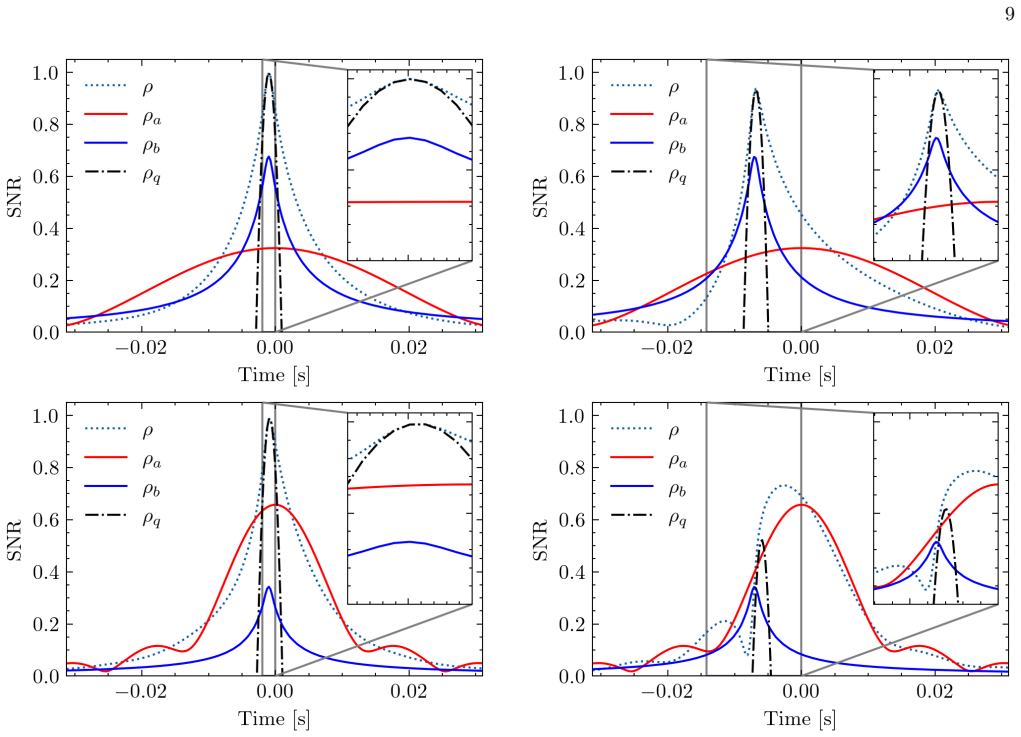
The load-bearing object is the sharp-resonance phase model ΔΨ(f) = 2π(f − f_res) Δt_res Θ(f − f_res), built from a delta-function excess energy flux ΔF(f) = F_res δ(f − f_res). This turns the physical energy loss into a pure time advance of the post-resonance inspiral. Detectability is quantified by the match between resonant and non-resonant waveforms; the paper computes it two ways that agree: a quadratic approximation whose coefficient g_ΨΨ is expressed through noise-weighted moment integrals of the unperturbed spectrum, and an optimized numerical match that avoids the grid-sampling bias of a standard FFT match calculation.
Load-bearing premise
The load-bearing premise is that the resonance is instantaneous—the entire orbital-energy loss happens at one frequency, so the post-resonance waveform is exactly the unperturbed waveform advanced by a fixed time; if the mode has finite width or damping, the phase perturbation is not a Heaviside ramp and the computed thresholds could shift.
What would settle it
Compute the mismatch for a finite-width resonance, e.g., replace the delta-function flux with a Lorentzian of width γ centered at f_res and compare to the sharp-resonance result at Δt_res = 1 ms; if a width of order 0.1 Hz changes the mismatch by more than ~10%, the sharp-resonance assumption is the limiting step. Observationally, if a stack of binary neutron star events at SNR ≈ 8 shows no time-advance signature at the predicted 1% mismatch level, the claimed detectability threshold is contradicted.
If this is right
- A resonance that advances merger by ~1 ms at ~100 Hz is detectable at SNR 8 by planned ground-based detector upgrades, provided the mode drains a few percent of the gravitational-wave energy flux.
- Future non-detections of such resonances across a population of binary neutron star events will place constraints on mode frequencies and energy-transfer efficiencies that are an order of magnitude weaker than previously claimed.
- The moment-integral match method applies to any small, amplitude-preserving phase perturbation, so it can be reused for other subtle waveform deformations, not just tidal resonances.
- Because the phase-jump parameterization is inconsistent with one-way energy loss, published detectability limits based on it should be recomputed with the time-advance model.
- A measured time advance directly fixes the energy deposited in the stellar mode, converting a gravitational-wave observation into a probe of neutron-star interior physics.
Where Pith is reading between the lines
- If the resonance has finite width or appreciable damping, the phase perturbation will be smeared and the mismatch is likely to weaken; a concrete test is to repeat the calculation with a Lorentzian flux profile of increasing width and see where the sharp-resonance thresholds break.
- The same time-advance formalism could be adapted to eccentric binaries, where the resonance crossing is faster and the energy transfer depends on dwell time rather than a single sweep.
- Because the paper assumes the waveform amplitude is unchanged, it cannot capture resonant amplitude modulation; adding an amplitude perturbation would require a two-parameter mismatch analysis and might shift the detectability threshold.
- The paper's agnostic parameter study covers all possible mode frequencies and time advances, so the next step is to fold in nuclear-physics priors on which modes can realistically transfer a percent of the luminosity; the strongest candidates are the low-lying g-modes and interface modes.
Editorial analysis
A structured set of objections, weighed in public.
Referee Report
Summary. The paper develops a formalism for computing the mismatch between binary neutron star inspiral waveforms with and without a low-lying dynamical tidal resonance. The resonance is idealized as a delta-function excess energy flux at a single frequency (Eq. 34), which produces a Heaviside time advance and a linear frequency-domain phase ramp after resonance (Eqs. 39–41). The authors derive a quadratic approximation to the match using noise-weighted moment integrals (Eqs. 17–18), validate it against numerical PyCBC match calculations, and connect it to the Lindblom indistinguishability criterion (Eq. 52). Applying this to an equal-mass 1.4+1.4 solar mass binary, they claim that a merger time advance of order 1 ms at f_res ~ 100 Hz is detectable by O5 (A+) detectors at SNR 8, and that the single-frequency approximation of Read (Eq. 55) overestimates resonance detectability by up to an order of magnitude. They also argue that phase-jump parameterizations used in previous work are inconsistent with the condition that no energy is recovered from the mode (Eq. 44).
Significance. If the sharp-resonance idealization is adequate, this paper provides a valuable correction to earlier resonance detectability estimates and introduces a fast and accurate computational tool (moment-integral quadratic approximation) that can be reused for future mode models. The cross-validation of the quadratic approximation with numerical match, and the careful treatment of time/phase maximization, are strengths. The parameter study is explicitly agnostic to neutron-star microphysics and covers a plausible range of f_res and Δt_res. However, the central delta-function assumption is not quantitatively tested, and a normalization error in the transcription of the Read criterion affects the specific overestimate claim. These issues need to be addressed before the central conclusions can be regarded as fully established.
major comments (2)
- [Sec. IV B; Eqs. (34), (39)–(41); Sec. VI A; Sec. VII] The delta-function resonance model is load-bearing for every quantitative result, including the 1 ms O5 detectability threshold (Sec. VI A) and the comparison in Fig. 7. The paper acknowledges in Sec. IV C that finite-width effects and post-resonance flux oscillations are expected, and Sec. VII defers a detailed mode model to future work. But because the mismatch (Eq. 17) is a noise-weighted second moment after removing the best-fit time and phase, a finite resonance width will smooth the Heaviside ramp; for the same total energy transfer the asymptotic time advance is unchanged, yet the frequency-localized residual phase can differ substantially. The authors should provide a quantitative robustness check, e.g., model ΔF as a Lorentzian or Gaussian of width δf around f_res with fixed total energy and show how the mismatch at Δt_res = 1 ms and the SNR = 8 threshold vary with δf, or derive
- [Sec. VI C, Eqs. (53)–(55)] The transcription of the Read criterion contains a normalization error. With the inner product defined in Eq. (2), ⟨δh, δh⟩ for δh = h0(e^{i δϕ} − 1) equals 8∫ |h0|²(1−cos δϕ)/Sn df, not 2∫ ... as written in Eq. (53). Consequently Eq. (54) is too small by a factor of 4, and the threshold in Eq. (55) is too large by √2. The comparison in Fig. 7 and the statement that the single-frequency approximation overestimates detectability by up to an order of magnitude depend on this normalization. Please correct the factor and confirm whether the claimed order-of-magnitude discrepancy survives. This is not a mere typo, as it affects the quantitative comparison with previous work.
minor comments (6)
- [Sec. IV C] The statement that 'small oscillations in the transferred energy flux are expected after the resonance' and that 'the energy transferred tends to average to zero' is too vague. Please quantify the expected amplitude or time/frequency scale, or cite a specific mode-damping model.
- [Sec. VI A / Abstract] The abstract says the detectability requires 'an excess energy-flux that is a few percent of the gravitational wave emission', while Sec. VI A quotes a flux fraction of ~1%. Please make the definition of 'flux fraction' explicit; in the delta-function model ΔF is singular, so the integrated quantity needs to be defined (e.g., ΔE_res divided by F(v_res) times a resonance crossing time).
- [Sec. V] The 'optimized version of the standard numerical match function' in PyCBC is not described in enough detail. Please state the algorithm (e.g., subsample interpolation or iterative maximization) and the numerical tolerance used, or provide a reference.
- [Eq. (43)] The derivation of Eq. (43) is terse. Adding a line showing dΔt/df obtained from Eq. (31) before substituting into d²ΔΨ/df² would improve readability.
- [Fig. 2 caption] The phrase 'fading continuous curves' is unclear. Define the line styles explicitly (e.g., solid, dotted, dot-dashed) and state which curve corresponds to which method.
- [General] Minor typos: 'equivanlently' in Sec. I; 'imporved' appears elsewhere. Also, in Sec. VI C the conversion from Eq. (55) to the Δt threshold plotted in Fig. 7 should be written out (how δϕ is mapped to Δt_res).
Circularity Check
No significant circularity: the mismatch claims are forward calculations from an explicit resonance model, not fitted outputs or self-citation loops.
full rationale
The paper's load-bearing results (mismatch vs Δt_res, O5 detectability at 1 ms, and the factor-of-several overestimate of Read's single-frequency approximation) are computed by evaluating the explicitly stated phase perturbation ΔΨ(f)=2π(f−f_res)Δt_resΘ(f−f_res) (Eq. 41) inside the match formalism. Δt_res and f_res are scanned inputs, not retrofitted parameters; the paper never fits a parameter to the mismatch values it reports. The agreement between the quadratic/analytic moment-integral method and the PyCBC optimized FFT match is a cross-check of two independent implementations of the same forward model, not circular. The comparison with [34] is a mathematical comparison of approximations using the same phase model. Self-citations ([22], [29]-[31]) appear only in background discussions of flares and r-modes; none supports the central derivation. The sharp-delta resonance assumption (Eq. 34) is a stated physical idealization, with finite-width effects acknowledged but deferred; this is a robustness limitation, not a circularity. Hence no circular step can be exhibited and the score is 0.
Axiom & Free-Parameter Ledger
free parameters (3)
- Δt_res (merger time advance) =
scanned from ~10^-4 s to ~10^-2 s; 1 ms for the headline O5 case
- f_res (resonance frequency) =
50–400 Hz in figures; 100 Hz for the 1 ms headline
- F_res (delta-flux strength) =
implied by Δt_res through Eq. (40), e.g. ~1e48 erg total energy for 1 ms at 100 Hz
axioms (8)
- ad hoc to paper Resonant energy loss occurs instantaneously: ΔF(f)=F_res δ(f−f_res) (Eq. 34)
- domain assumption No energy is transferred back from the mode to the orbit: ΔF(f) ≥ 0 (Eq. 42)
- domain assumption Resonance changes only the waveform phase, not the amplitude: h_ε(f)=h_0(f) e^{i ε ΔΨ(f)} (Eq. 7)
- domain assumption Circular, adiabatic inspiral with leading-order Newtonian E(v)=−η M v²/2 and F(v)=32/5 η² v^10 (Eq. 21)
- standard math Stationary phase approximation for the frequency-domain inspiral waveform (Eq. 27)
- domain assumption Detector noise is Gaussian and stationary and templates are searched only over time and phase offsets (Eqs. 1–6)
- domain assumption Lindblom et al. distinguishability criterion, ⟨δh,δh⟩ > n_σ², sets the detectability threshold (Eq. 48)
- domain assumption IMRPhenomD waveform for m1=m2=1.4 Msun, zero spin, plus specified detector PSDs and frequency limits
read the original abstract
We compute deviations from observed gravitational wave signals, where the amplitude of the signal is unchanged. As an example, we consider the detectability of low lying dynamical tides in binary neutron star or neutron star black hole mergers. Tidal forces can excite oscillatory modes of one or both of the stars in the binary when the orbital frequency of the binary system sweeps through the resonant mode frequency dissipating energy into the vibrational mode. The orbital energy loss to the vibrational mode extracts energy from the orbital motion, advancing the time to merger. The inspiral then continues with an excess phase and a time advance. Both will cause a mismatch when fitting to a system that has not gone through the resonance. To resolve this effect, we compute the mismatch for current and planned detectors using both a quasi-analytical approach that relies on the computation of moment integrals and an optimized version of the standard numerical match function. We conclude that detectability can occur for time advances of the order of 1 ms with advanced LVK detectors for an excess energy-flux that is a few percent of the gravitational wave emission. Our results contrast with previous work, which model this effect solely as a phase shift of the waveform or by using the difference in the number of cycles induced by the resonant behavior. We show that tidal resonance effects primarily cause a time advance of the merger, rather than a phase difference, and that the single-frequency approximation commonly used in the literature significantly overestimates the detectability of this effect.
Figures




Forward citations
Cited by 1 Pith paper
-
Detecting Tidal Resonances in Binary Neutron Stars
Einstein Telescope can detect tidal resonances in binary neutron stars, identifying modes with phase shifts as small as 0.03 radians and showing that neglecting them biases tidal deformability inference.
Reference graph
Works this paper leans on
-
[1]
Hence bothM fandt/Mare unitless
A solar mass corresponds toGM ⊙/c3 = 4.925×10 −6 sec. Hence bothM fandt/Mare unitless. The binary can be parametrized in terms of the symmetric mass ratio η= (m 1m2)/M2,and the chirp massM=M η 3/5. Here M=m 1 +m 2 is the total mass andm 1 andm 2 are the component masses. We assume the orbit is circular. Binaries are expected to circularize due to gravitat...
1998
-
[2]
B. P. Abbott, R. Abbott, T. D. Abbott,et al.(LIGO Sci- entific Collaboration and Virgo Collaboration), Physical Review Letters116, 061102 (2016)
2016
-
[3]
Capote, W
E. Capote, W. Jia, N. Aritomi, M. Nakano, V. Xu, R. Ab- bott, I. Abouelfettouh, R. X. Adhikari, A. Ananyeva, et al., Phys. Rev. D111, 062002 (2025)
2025
-
[4]
A. G. Abacet al.(LIGO Scientific, VIRGO, KAGRA), (2025), arXiv:2508.18079 [gr-qc]
Pith/arXiv arXiv 2025
-
[5]
Birnholtz (LIGO, VIRGO, KAGRA), PoS HEASA2025, 011 (2025)
O. Birnholtz (LIGO, VIRGO, KAGRA), PoS HEASA2025, 011 (2025)
2025
-
[6]
B. P. Abbott, R. Abbott, T. D. Abbott, ,et al., Liv- ing Reviews in Relativity23(2020), 10.1007/s41114-020- 00026-9
-
[7]
T. L. S. Collaboration, Classical and Quantum Gravity 32, 074001 (2015)
2015
-
[8]
Acerneseet al., Classical and Quantum Gravity32, 024001 (2014)
F. Acerneseet al., Classical and Quantum Gravity32, 024001 (2014)
2014
-
[9]
Barsotti, L
L. Barsotti, L. McCuller, M. Evans, and P. Fritschel,The A+ design curve, Tech. Rep. LIGO-T1800042-v5 (LIGO Laboratory, 2018) lIGO Technical Report
2018
-
[10]
Punturoet al., Classical and Quantum Gravity27, 084007 (2010)
M. Punturoet al., Classical and Quantum Gravity27, 084007 (2010)
2010
-
[11]
B. P. Abbottet al., Classical and Quantum Gravity34, 044001 (2017)
2017
-
[12]
B. P. Abbott, R. Abbott, T. Abbott, F. Acernese, K. Ackley, C. Adams, T. Adams, P. Addesso, R. X. Ad- hikari, V. B. Adya,et al., Physical review letters119, 161101 (2017)
2017
-
[13]
B. P. Abbott, R. Abbott, T. Abbott, S. Abraham, F. Ac- ernese, K. Ackley, C. Adams, R. Adhikari, V. Adya, C. Affeldt,et al., The Astrophysical Journal892, L3 (2020)
2020
-
[14]
B. P. Abbott, R. Abbott, T. Abbott, S. Abraham, F. Ac- ernese, K. Ackley, C. Adams, R. Adhikari, V. Adya, C. Affeldt,et al., The Astrophysical Journal Letters848, L12 (2017)
2017
-
[15]
B. P. Abbott, R. Abbott, T. Abbott, F. Acernese, K. Ackley, C. Adams, T. Adams, P. Addesso, R. X. Ad- hikari, V. B. Adya,et al., Physical review letters121, 161101 (2018)
2018
-
[16]
Graber, N
V. Graber, N. Andersson, and M. Hogg, International Journal of Modern Physics D26, 1730015 (2017)
2017
-
[17]
Lai, Monthly Notices of the Royal Astronomical Soci- ety270, 611 (1994)
D. Lai, Monthly Notices of the Royal Astronomical Soci- ety270, 611 (1994)
1994
-
[18]
P. N. McDermott, H. Van Horn, and C. Hansen, As- trophysical Journal, Part 1 (ISSN 0004-637X), vol. 325, Feb. 15, 1988, p. 725-748.325, 725 (1988)
1988
-
[19]
Tsang, The Astrophysical Journal777, 103 (2013)
D. Tsang, The Astrophysical Journal777, 103 (2013)
2013
-
[20]
Neill, W
D. Neill, W. G. Newton, and D. Tsang, Monthly Notices of the Royal Astronomical Society504, 1129 (2021)
2021
-
[21]
Neill, D
D. Neill, D. Tsang, and W. G. Newton, Monthly Notices of the Royal Astronomical Society , stae1481 (2024)
2024
-
[22]
Neill, D
D. Neill, D. Tsang, C. Drischler, J. W. Holt, and W. G. Newton, Physical Review C111, 015809 (2025)
2025
-
[23]
Tsang, J
D. Tsang, J. S. Read, T. Hinderer, A. L. Piro, and R. Bondarescu, Physical Review Letters108, 011102 (2012)
2012
-
[24]
Troja, S
E. Troja, S. Rosswog, and N. Gehrels, The Astrophysical Journal723, 1711 (2010)
2010
-
[25]
Zhong, Z.-G
S.-Q. Zhong, Z.-G. Dai, J.-G. Cheng, L. Lan, and H.-M. Zhang, The Astrophysical Journal884, 25 (2019)
2019
-
[26]
Coppin, K
P. Coppin, K. D. de Vries, and N. van Eijndhoven, Phys- ical Review D102, 103014 (2020)
2020
-
[27]
H. Yu, P. Arras, and N. N. Weinberg, Physical Review D110(2024), 10.1103/physrevd.110.024039
-
[28]
Steinhoff, T
J. Steinhoff, T. Hinderer, T. Dietrich, and F. Foucart, Phys. Rev. Res.3, 033129 (2021)
2021
-
[29]
E. E. Flanagan and E. Racine, Phys. Rev. D75, 044001 (2007)
2007
-
[30]
Bondarescu and I
R. Bondarescu and I. Wasserman, The Astrophysical Journal778, 9 (2013)
2013
-
[31]
Bondarescu, S
R. Bondarescu, S. A. Teukolsky, and I. Wasserman, Physical Review D—Particles, Fields, Gravitation, and Cosmology79, 104003 (2009)
2009
-
[32]
Bondarescu, S
R. Bondarescu, S. A. Teukolsky, and I. Wasserman, Physical Review D—Particles, Fields, Gravitation, and Cosmology76, 064019 (2007)
2007
-
[33]
P. K. Gupta, A. Puecher, P. T. H. Pang, J. Janquart, G. Koekoek, and C. V. D. Broeck, “Determining the equation of state of neutron stars with einstein telescope using tidal effects and r-mode excitations from a pop- ulation of binary inspirals,” (2022), arXiv:2205.01182 [gr-qc]
Pith/arXiv arXiv 2022
-
[34]
A. R. Counsell, F. Gittins, N. Anders- son, and P. Pnigouras, Monthly Notices of the Royal Astronomical Society536, 1967 (2024), https://academic.oup.com/mnras/article- pdf/536/2/1967/61025701/stae2721.pdf
1967
-
[35]
Read, Classical and Quantum Gravity40, 135002 (2023)
J. Read, Classical and Quantum Gravity40, 135002 (2023)
2023
-
[36]
Yu and N
H. Yu and N. N. Weinberg, Monthly Notices of the Royal Astronomical Society464, 2622 (2017)
2017
-
[37]
B. Edelman, F. Rivera-Paleo, J. Merritt, B. Farr, Z. Doc- tor, J. Brink, W. M. Farr, J. Gair, J. S. Key, J. McIver, and A. B. Nielsen, Physical Review D103(2021), 10.1103/physrevd.103.042004
-
[38]
W. C. Ho and N. Andersson, Physical Review D108, 043003 (2023). 13
2023
-
[39]
B. J. Owen, Physical Review D53, 6749 (1996)
1996
-
[40]
B. J. Owen and B. S. Sathyaprakash, Physical Review D 60, 022002 (1999)
1999
-
[41]
https://github.com/gwastro/pycbc/releases, DOI: 10.5281/zenodo.10473621 (2024)
-
[42]
B. Allen, W. G. Anderson, P. R. Brady, D. A. Brown, and J. D. E. Creighton, Phys. Rev. D85, 122006 (2012), arXiv:gr-qc/0509116
Pith/arXiv arXiv 2012
-
[43]
A. H. Nitz, T. Dent, T. Dal Canton, S. Fairhurst, and D. A. Brown, Astrophys. J.849, 118 (2017), arXiv:1705.01513 [gr-qc]
Pith/arXiv arXiv 2017
-
[44]
T. Dal Cantonet al., Phys. Rev. D90, 082004 (2014), arXiv:1405.6731 [gr-qc]
Pith/arXiv arXiv 2014
-
[45]
L. Lindblom, B. J. Owen, and D. A. Brown, Physical Review D78(2008), 10.1103/physrevd.78.124020
-
[46]
T. G. Cowling, Monthly Notices of the Royal Astronom- ical Society101, 367 (1941)
1941
-
[47]
K. Kokkotas and B. Schmidt, Living Reviews in Relativ- ity2(1999), 10.12942/lrr-1999-2
-
[48]
P. B. Rau and I. Wasserman, Monthly Notices of the Royal Astronomical Society481, 4427–4444 (2018)
2018
-
[49]
Jaikumar, A
P. Jaikumar, A. Semposki, M. Prakash, and C. Con- stantinou, Physical Review D103, 123009 (2021)
2021
-
[50]
Tak´ atsy, B
J. Tak´ atsy, B. Kocsis, and P. Kov´ acs, Phys. Rev. D110, 103043 (2024)
2024
-
[51]
Buonanno, B
A. Buonanno, B. R. Iyer, E. Ochsner, Y. Pan, and B. S. Sathyaprakash, Physical Review D—Particles, Fields, Gravitation, and Cosmology80, 084043 (2009)
2009
-
[52]
S. Droz, D. J. Knapp, E. Poisson, and B. J. Owen, Phys- ical Review D59(1999), 10.1103/physrevd.59.124016
-
[53]
Poisson and C
E. Poisson and C. M. Will, Physical Review D52, 848–855 (1995)
1995
-
[54]
Analytical ad- vanced ligo o4 sensitivity curve (175 mpc): pycbc.psd.analytical.aLIGO175MpcT1800545,
PyCBC Development Team, “Analytical ad- vanced ligo o4 sensitivity curve (175 mpc): pycbc.psd.analytical.aLIGO175MpcT1800545,” Py- CBC function documentation, PyCBC v2 (2025), accessed: 2025-12-19
2025
-
[55]
Advanced ligo a+ design sensitivity noise curve,
LIGO Scientific Collaboration and Virgo Collaboration, “Advanced ligo a+ design sensitivity noise curve,” LIGO Technical Note T2000012 (2022), accessed: 2025-12-19
2022
-
[56]
Ligo a-sharp strain sen- sitivity curve,
LIGO Scientific Collaboration, “Ligo a-sharp strain sen- sitivity curve,” LIGO Document Control Center (DCC) (2023), accessed: 2025-12-19
2023
discussion (0)
Sign in with ORCID, Apple, or X to comment. Anyone can read and Pith papers without signing in.