REVIEW 4 major objections 5 minor 5 references
ECSEL: Explainable Classification via Signomial Equation Learning
T0 review · 4 major / 5 minor · reviewed 2026-08-03 · deepseek-v4-flash
Pith's one-line read ECSEL learns classification rules as compact signomial equations, recovering target formulas far more often and much faster than general-purpose symbolic regression baselines while staying interpretable.
desk verdict A straightforward signomial classifier with a genuinely useful interpretability toolbox, but the headline recovery claim is overclaimed and not reproducible as written due to negative input ranges and a circular benchmark setup. read the letter →
The pith
A machine-rendered reading of the paper's core claim, the machinery that carries it, and where it could break.
The reading
What carries the argument
The central object is the signomial function, defined as a finite sum of power-law terms with real-valued coefficients and real-valued exponents. ECSEL learns the exponents and coefficients by gradient-based optimization of cross-entropy (for classification) or mean squared error (for symbolic regression) with ℓ1 regularization on exponents to drive irrelevant features to zero. The key mathematical mechanism is the logarithmic transformation: in log-space, each signomial term becomes an exponential of a linear function, which both yields a Stone-Weierstrass universal-approximation proof and makes derivatives, elasticities, counterfactual scalings, and decision-boundary sensitivities availabl
What would settle it
Take a benchmark equation with a fractional or non-integer exponent, such as x^{0.426}, generate samples from the stated [-5,5] range, and run ECSEL exactly as described: if the method either fails to evaluate the signomial at negative x, silently discards those points, or yields non-real values, then the reported 95.86% recovery rate is not a valid statement over the stated input domain. A simpler check: compute the learned signomial at x = -1 with exponent 0.426; a real-valued method cannot produce a real output there without an explicit domain transformation.
Extended reading notes
Core claim
The paper's central discovery is that signomial functions—expressions of the form z(x) = Σ_k α_k ∏_j x_j^{β_{k,j}} with real coefficients and real exponents—are not just an expressive function class but an exploitable target for symbolic regression and explainable classification. On 58 signomial-rich benchmark equations, ECSEL achieves a global average recovery rate of 95.86%, compared with 59.10%, 58.54%, and 56% for three strong competing symbolic regression methods, while averaging 86.4 seconds per equation versus 612.9, 468.7, and 126.3 seconds for those baselines. The paper also establishes that signomials are dense in the space of continuous functions on compact subsets of the positive
Load-bearing premise
The whole framework assumes every feature input is positive after preprocessing, because real-valued exponents make signomials undefined at negative arguments; the paper lists sampling ranges such as [-5,5] and [-10,10] without specifying how negative samples are reconciled with the positivity requirement, so if such negative inputs occur in the benchmark data, the recovery results do not follow as stated.
Editorial extensions
If this is right
- If the recovery-rate result holds, signomial equation learning can be adopted as a fast first-line tool for symbolic regression on power-law-dominated scientific data, replacing much slower population-based or sequence-generation searches.
- Signomial classifiers offer a practical interpretability-conserving alternative to black-box models: the learned equation itself is the explanation, and its exponents directly quantify how features scale the class score.
- The closed-form elasticities and counterfactual formulas enable exact what-if analysis without retraining or approximation, which is directly useful in high-stakes domains like fraud detection.
- The universal approximation result on compact positive domains means the signomial form is not a fundamental capacity barrier for classifying positive-valued feature data.
- On the evaluated imbalanced datasets, ECSEL often attains higher minority-class recall than stronger overall classifiers, suggesting that signomial regularization can act as an implicit imbalance-handling mechanism.
Reading between the lines
- The large recovery-rate gap suggests that signomial structure, not search strategy, is the dominant factor in these symbolic regression benchmarks; general-purpose methods might be improved by adding signomial-constrained search phases rather than only broadening expression spaces.
- Because the method requires positive features, a natural extension is to piecewise signomial models that handle negative domains by splitting the input space or using complex-valued powers with appropriate branch choices—this would directly address the weakest assumption in the paper.
- The exponent-based interpretation could be turned into a bias-audit tool: comparing learned exponents across protected groups would yield testable claims about whether a feature's influence differs by group, extending the paper's decision-boundary analysis into fairness settings.
- ECSEL's speed on single-term signomials suggests it could serve as an automatic hypothesis proposer for scientific datasets, screening many feature subsets for power-law relationships before a researcher commits to a full model.
Editorial analysis
A structured set of objections, weighed in public.
Referee Report
Summary. The manuscript introduces ECSEL, a method that fits signomial functions of the form z_c(x)=sum_k alpha_{c,k} prod_j x_j^{beta_{c,k,j}} by gradient-based optimization with L1 regularization on exponents, converts scores to probabilities via softmax/sigmoid, and derives interpretability properties (elasticities, exact counterfactuals, margin sensitivities, and local log-space attributions). It reports two empirical bodies: (i) symbolic-regression recovery on 58 signomial benchmark equations, claiming a 95.86% global recovery rate versus DGSR (59.10%), NGGP (58.54%), and NeSymRes (56%) at lower average runtime, and (ii) classification experiments on 11 datasets plus two case studies, claiming competitive or superior F1 and minority recall relative to logistic regression, random forest, XGBoost, SVM, and MLP. The paper also proves a universal approximation theorem for signomials on compact subsets of the positive orthant and presents closed-form properties G1-G3, D1-D2, L1-L2.
Significance. If the empirical claims held as stated, a fast deterministic fitter for signomial structure would be a useful contribution to symbolic regression and interpretable classification for power-law domains. The universal approximation theorem in Appendix A is correct, and the interpretability properties are valid as mathematical identities, though they follow almost immediately from the functional form and are not empirical predictions. The main obstacles are reproducibility and comparison fairness: the symbolic-regression protocol appears to contradict the positivity requirement of signomials, no code or algebraic-equivalence protocol is supplied, and the classification evaluation lacks a natural log-feature linear baseline while tuning the decision threshold only for ECSEL. These issues are load-bearing for the headline recovery and classification claims.
major comments (4)
- [§4.1, §D.1 vs §3.1] There is a direct contradiction in the data-generation protocol. Section 3.1 requires x_ij > 0 and states that features are preprocessed via affine transformations to ensure positivity. Section D.1, however, lists input ranges including [-5,5], [-50,50], and [-10,10] for the DGSR benchmark suite, and Section 4.1 does not state that any positivity transform is applied. For real-valued exponents, negative inputs make the signomial terms in Eq. (6) undefined (NaN) for non-integer exponents, so the loss cannot be evaluated. The reported 95.86% recovery rate in Table 2 therefore is not reproducible as written. The authors must specify the exact per-equation sampling ranges, state whether and how inputs were shifted/scaled to positivity, or restrict the SR experiments to domains where the signomial is defined.
- [§4.2 / Table 2] The recovery criterion is described only as 'recovered up to algebraic equivalence.' No equivalence checker, tolerance, or protocol is provided, and no code is available. Since ECSEL optimizes continuous real coefficients and exponents, the reader cannot verify whether x^2.001 is counted as x^2, how rational powers are matched, or how constants such as pi are handled. This is essential for interpreting the aggregate recovery percentages and for comparing with baseline methods. The authors should define the equivalence metric, report tolerances, and provide the evaluation script.
- [§5.1, §E.3] The classification comparison is not yet fair. ECSEL tunes the sigmoid decision threshold on a validation set (Appendix E.3 lists threshold values 0.4-0.7), while baselines are evaluated at the default 0.5 threshold. This can explain large minority-recall differences such as ILPD (Table 8: ECSEL 42.42 vs XGBoost 6.06). In addition, a signomial with K=1 is exactly a linear model in log-transformed features, so logistic regression on log features is the natural baseline and is absent. The authors should apply the same validation-based threshold selection to all binary classifiers and add a log-feature logistic regression baseline.
- [§4.1 / Appendix D] The benchmark scope is narrower than the abstract implies. All 58 targets in Table 2 are signomials or polynomials that are signomials, so the reported recovery rate measures how well a signomial-specific optimizer fits signomial targets, not how well ECSEL discovers arbitrary symbolic structure. This is a legitimate research angle, but the abstract and conclusion should state the signomial-only scope explicitly. The higher-degree Nguyen results in Table 4 show that ECSEL does not recover non-signomial structure exactly, which should be incorporated into the main text rather than only an appendix.
minor comments (5)
- [Figure 1 caption vs Table 2 footnote] Figure 1 says DGSR timeout cases (>900s) are excluded from the time average, while Table 2 assigns 900s to 'dnf' runs. These statements should be reconciled.
- [Throughout] There are numerous typographical errors, e.g., 'decision-boudaries', 'efficent', 'mutli-term', 'encourange'. A careful proofread is needed.
- [Eq. (21)] The two-term expression in Eq. (21) is printed without explicit negative exponents, while the discussion refers to numerator/denominator structure. Use division bars or negative exponents consistently to avoid ambiguity.
- [Table 8] For LOAN, SVM and MLP rows are '–' without explanation. Please add a footnote explaining whether these methods were omitted for computational reasons or did not converge.
- [§4.2] The NeSymRes average is computed only over applicable equations (25 of 58). This is reasonable, but the main text should state it alongside the comparison, since the runtime and recovery averages are not directly comparable otherwise.
Circularity Check
SR recovery is partially circular (a signomial fitter benchmarked on signomial targets); the classification results are independently tested and do not reduce to the model definition.
-
fitted input called prediction
[Section 4.1 (Eq. 6), Section 4.1 Baselines, Section 4.2]
"For symbolic regression tasks, we adapt ECSEL by replacing the cross-entropy with Mean Squared Error (MSE), learning a continuous-valued signomial function z(x) to fit the target equation: LSR(α, β) = ... (6) ... These methods are evaluated on a collection of signomial-rich benchmarks ... ECSEL achieves a global average recovery rate of 95.86%, substantially outperforming DGSR (59.10%), NGGP (58.54%), and NeSymRes (56%)."
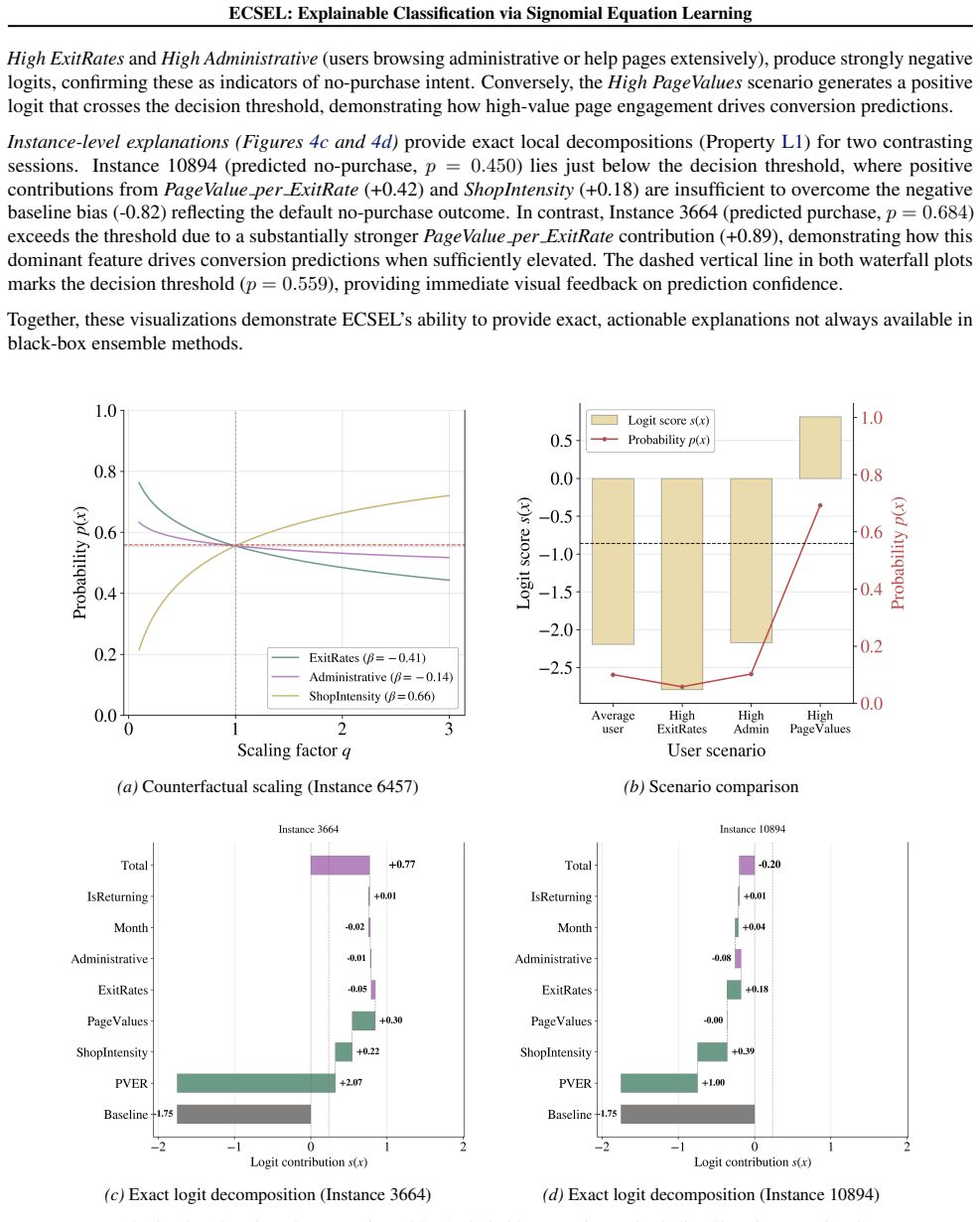
ECSEL's hypothesis class is by definition the set of signomials (Eq. 1), and every benchmark target in Table 2 is itself a signomial, selected from 'signomial-rich' benchmarks. The reported 'recovery' therefore measures how often the optimizer lands on a target inside its own predefined model class, not whether signomial structure is discovered from data. The 95.86% rate is a fitting/optimization statistic for in-class targets, so the benchmark selection builds the signomial assumption into the input. The paper's own limitation section (§7) concedes that non-signomial Nguyen polynomials are not recovered, confirming the result is class-bound. Thus the headline SR claim partially reduces to 'fit a signomial to a signomial', although it is not a formal identity because optimization can still
full rationale
The main algebraic derivation chain is self-contained: Theorem 3.1 is a valid Stone-Weierstrass argument on the log-transformed positive orthant, and Properties G1–G3, D1–D2, L1–L2 are closed-form identities obtained by differentiating the signomial score definitions. These are mathematical consequences of the model form rather than empirical predictions, so they are not themselves circular. The classification benchmark is genuinely independent: it uses 5-fold cross-validation and a held-out 20% test set against external baselines, so the competitive-accuracy claim does not reduce to the model definition. The partially circular element is the symbolic-regression headline: ECSEL is defined as a signomial estimator, and the benchmark suite is explicitly 'signomial-rich', with all 58 targets in Table 2 being signomials. Recovery therefore largely measures optimization success within the assumed class. The PaySim comparison cites a co-authored prior paper (Visbeek et al. 2023), but the claim is explicitly hedged and not load-bearing. I do not count the Appendix D.1 negative-range contradiction with the positivity requirement as circularity; that is a reproducibility/correctness issue rather than a self-referential derivation. Overall, partial circularity in the headline SR claim with independent classification support elsewhere warrants a score of 4.
Assumptions & free parameters
free parameters (4)
- K (number of signomial terms) =
1–3 (tuned via Optuna; fixed to 1 in case studies)
- λ (ℓ1 regularization strength) =
e.g., 8.64e-3 (e-commerce); stated inconsistently as 2e-4 vs 2e4 for PaySim
- Sigmoid decision threshold =
0.559 (e-commerce), 0.904 (PaySim)
- Class weight multiplier =
0.91 (e-commerce), 0.40 (PaySim)
assumptions (4)
- standard math Stone-Weierstrass theorem
- domain assumption All features are positive in the model domain
- domain assumption Target equations in the SR benchmark are signomials
- domain assumption Optimization finds near-global minima of the nonconvex objective
Cite this review
Pith. "Pith review of ECSEL: Explainable Classification via Signomial Equation Learning." pith.science (2026). https://pith.science/paper/VIRYP6P4
@misc{pith2026260121789,
  author       = {Pith},
  title        = {Pith review of: ECSEL: Explainable Classification via Signomial Equation Learning},
  year         = {2026},
  howpublished = {\url{https://pith.science/paper/VIRYP6P4}},
  note         = {Machine review of arXiv:2601.21789}
}
read the original abstract
We introduce ECSEL, an explainable classification method that learns formal expressions in the form of signomial equations, motivated by the observation that many symbolic regression benchmarks admit compact signomial structure. ECSEL directly constructs a structural, closed-form expression that serves as both a classifier and an explanation. On standard symbolic regression benchmarks, our method recovers a larger fraction of target equations than competing state-of-the-art approaches while requiring substantially less computation. Leveraging this efficiency, ECSEL achieves classification accuracy competitive with established machine learning models without sacrificing interpretability. Further, we show that ECSEL satisfies some desirable properties regarding global feature behavior, decision-boundary analysis, and local feature attributions. Experiments on benchmark datasets and two real-world case studies i.e., e-commerce and fraud detection, demonstrate that the learned equations expose dataset biases, support counterfactual reasoning, and yield actionable insights.
Figures


Figures from the paper (1 more)
Reference graph
Works this paper leans on
-
[5]
URL https://api.semanticscholar. org/CorpusID:182656421. Sakar, C. O., Polat, S. O., Katircioglu, M., and Kastro, Y . Real-time prediction of online shoppers’ purchas- ing intention using multilayer perceptron and lstm re- current neural networks.Neural Computing and Appli- cations, 31:6893 – 6908, 2018. URL https://api. semanticscholar.org/CorpusID:13682...
arXiv 2018
-
[945]
PMLR, 2021. Cranmer, M. Interpretable machine learning for science with PySR and SymbolicRegression.jl.arXiv preprint arXiv:2305.01582, 2023. Cybenko, G. Approximation by superpositions of a sig- moidal function.Mathematics of Control, Signals and Systems, 2(4):303–314, 1989. Gerwin, D. Information processing, data inferences, and scientific generalizatio...
arXiv 2021
-
[2017]
ISBN 9781510860964
Curran Associates Inc. ISBN 9781510860964. Mundhenk, T., Landajuela, M., Glatt, R., Santiago, C. P., faissol, D., and Petersen, B. K. Symbolic regression via deep reinforcement learning enhanced genetic programming seeding. In Ranzato, M., Beygelzimer, A., Dauphin, Y ., Liang, P., and Vaughan, J. W. (eds.), Advances in Neural Information Processing System...
2021
-
[2018]
Lundberg, S
URL https://openreview.net/forum? id=H1Y8hhg0b. Lundberg, S. M. and Lee, S.-I. A unified approach to inter- preting model predictions. InProceedings of the 31st In- ternational Conference on Neural Information Processing Systems, NIPS’17, pp. 4768–4777, Red Hook, NY , USA,
-
[2019]
ISSN 1532-4435. Ribeiro, M. T., Singh, S., and Guestrin, C. ”why should i trust you?”: Explaining the predictions of any classifier. InProceedings of the 22nd ACM SIGKDD International Conference on Knowledge Dis- covery and Data Mining, KDD ’16, pp. 1135–1144, New York, NY , USA, 2016. Association for Comput- ing Machinery. ISBN 9781450342322. doi: 10.114...
arXiv 2016
Reviewed August 3, 2026 · model on record in the stance chip above.
Discussion (0). Sign in to comment.