Fabrication effects on Niobium oxidation and surface contamination in Niobium-metal bilayers using X-ray photoelectron spectroscopy
Pith reviewed 2026-05-16 09:26 UTC · model grok-4.3
The pith
XPS screens 17 metal caps to identify which best block oxygen diffusion into niobium during fabrication.
A machine-rendered reading of the paper's core claim, the machinery that carries it, and where it could break.
Core claim
XPS functions as a non-destructive probe that quantifies oxygen uptake and contaminant levels in niobium-metal bilayers after each fabrication process, allowing the authors to rank the 17 caps by protective effectiveness and to select a subset whose microwave resonators show improved characteristics.
What carries the argument
X-ray photoelectron spectroscopy measurements of surface oxygen concentration and chemical state in niobium capped by different metals, used to rank resistance to diffusion under annealing, stripping, and cleaning.
If this is right
- Capping layers that keep oxygen low after all three processing steps can be carried forward into device fabrication.
- Each cap material responds differently to annealing, resist removal, and acid cleaning, so the ranking is process-specific.
- Resonator measurements serve as the final validation step for the layers that pass the XPS screen.
- The non-destructive nature of XPS allows many candidate caps to be evaluated without committing to full device runs.
Where Pith is reading between the lines
- The same XPS workflow could be applied to other oxidizable superconductors such as aluminum or tantalum films.
- If XPS oxygen readings correlate tightly with measured loss tangents, early screening could replace some cryogenic tests during material development.
- Room-temperature XPS results leave open the question of how the selected caps perform after cooldown and under prolonged operation.
Load-bearing premise
The oxidation and contamination levels seen at the surface by XPS correctly predict the dielectric losses that will appear once the same bilayers are made into complete superconducting resonators.
What would settle it
Building resonators from the XPS-downselected caps and measuring internal quality factors that show no improvement over uncapped niobium or that correlate poorly with the XPS oxygen signals.
Figures



read the original abstract
Superconducting resonators and qubits are limited by dielectric losses from surface oxides. Surface oxides are mitigated through various strategies such as the addition of a metal capping layer, surface passivation, and acid processing. In this study, we demonstrate the use of X-ray photoelectron spectroscopy (XPS) as a rapid characterization tool to study the effectiveness cap layers for niobium for further device fabrication. We non-destructively evaluate 17 capping layers to characterize their ability to prevent oxygen diffusion, and the effects of standard fabrication processes -- annealing, resist stripping, and acid cleaning. We downselect for resilient capping layers and test their microwave resonator performance.
Editorial analysis
A structured set of objections, weighed in public.
Referee Report
Summary. The manuscript describes an experimental study using X-ray photoelectron spectroscopy (XPS) as a non-destructive tool to evaluate 17 capping layers on niobium surfaces. The authors characterize the layers' ability to block oxygen diffusion and their resilience to standard fabrication steps (annealing, resist stripping, acid cleaning), downselect promising candidates, and validate selected layers via microwave resonator measurements.
Significance. If the XPS metrics are shown to correlate quantitatively with reduced dielectric loss in completed devices, the work would offer a practical, rapid screening protocol for surface passivation strategies in superconducting quantum hardware, potentially shortening iteration cycles for low-loss resonators.
major comments (2)
- [Microwave resonator performance] Microwave resonator performance section: no quantitative correlation (e.g., oxygen at.% from XPS versus measured internal Q or tan δ) is reported for the down-selected capping layers. Without this link, the claim that XPS screening predicts device-level oxidation and loss cannot be evaluated.
- [Results] Results on fabrication-process effects: the manuscript does not present control data isolating whether additional lithography or etch steps (beyond the tested annealing/resist/acid sequence) reintroduce oxygen at the buried Nb interface, which is required to confirm that the XPS protocol on simplified bilayers captures the full fabrication flow.
minor comments (2)
- [Abstract] Abstract: quantitative results (oxygen percentages, Q values, or statistical significance of downselection) are absent, limiting the reader's ability to gauge the strength of the findings from the summary alone.
- [Methods and Figures] Figure captions and methods: error bars, number of replicates, and XPS quantification details (peak-fitting routines, sensitivity factors) are not specified, hindering reproducibility.
Simulated Author's Rebuttal
We thank the referee for their insightful comments, which have helped us improve the manuscript. We address the major comments below and have made revisions where appropriate to strengthen the connection between XPS metrics and device performance as well as to clarify the fabrication process coverage.
read point-by-point responses
-
Referee: [Microwave resonator performance] Microwave resonator performance section: no quantitative correlation (e.g., oxygen at.% from XPS versus measured internal Q or tan δ) is reported for the down-selected capping layers. Without this link, the claim that XPS screening predicts device-level oxidation and loss cannot be evaluated.
Authors: We agree that a direct quantitative correlation would better support our claims. The original manuscript presented resonator performance data for the down-selected layers but did not plot it against the XPS oxygen percentages. We have added this correlation analysis in the revised manuscript (new Figure 7), showing that lower oxygen at.% from XPS corresponds to higher internal Q factors, thereby validating the predictive capability of the XPS screening protocol. revision: yes
-
Referee: [Results] Results on fabrication-process effects: the manuscript does not present control data isolating whether additional lithography or etch steps (beyond the tested annealing/resist/acid sequence) reintroduce oxygen at the buried Nb interface, which is required to confirm that the XPS protocol on simplified bilayers captures the full fabrication flow.
Authors: The referee correctly notes the absence of such control data. Our experiments were focused on the sequence of annealing, resist stripping, and acid cleaning as these are the fabrication steps that directly follow capping layer deposition and are most relevant to oxidation at the Nb interface. We have revised the manuscript to include a discussion of this scope, noting that the XPS method is a rapid screening tool for these critical steps. Additional lithography and etch steps occur on the top surface and their effects are mitigated by the capping layer; however, we acknowledge that dedicated controls for the complete flow would provide further confirmation and have added this as a noted limitation in the revised Discussion section. revision: partial
Circularity Check
Purely experimental XPS characterization study with no derivations or self-referential predictions
full rationale
The manuscript is a materials characterization study that fabricates Nb/capping-layer test coupons, subjects them to standard fabrication steps (annealing, resist strip, acid clean), performs XPS surface analysis to quantify oxygen diffusion, down-selects resilient caps on the basis of those direct measurements, and then fabricates and measures microwave resonators on the selected caps. No equations, fitted models, or predictive relations are introduced; the down-selection criterion is the observed XPS oxygen signal itself, and the final resonator data serve as an independent experimental check rather than a quantity derived from the XPS results by construction. No self-citations are invoked to justify uniqueness or to close any logical loop. The entire chain is therefore self-contained experimental observation and comparison, with no reduction of any claimed result to its own inputs.
Axiom & Free-Parameter Ledger
Reference graph
Works this paper leans on
-
[1]
We detail the identical process here for completeness
Resonator fabrication Resonators were fabricated as done in prior work [ 25]. We detail the identical process here for completeness. Wafers were prepared for deposition with an RCA clean, which is done by conducting SC-1 at 70 ◦C (1:1:6 ammo- nium hydroxide, hydrogen peroxide and water), SC-2 at 70 ◦C (1:1:6 hydrochloric acid, hydrogen peroxide and water)...
-
[2]
The fridge wiring diagram is shown in Figure S6
F ridge setup The fridge used for the resonator measurements is a Bluefors small diameter refrigerator with a base tempera- ture of 500 mK. The fridge wiring diagram is shown in Figure S6. The input lines have about 10 dB of attenua- tion from the lines themselves and 60 dB attenuation from the attenuators. The output line has an dual junction isolator, a...
-
[3]
Measurement and analysis The resonator design has a 3µm gap between the cen- ter conductor and the ground plane and has a hangar resonator configuration, with eight λ/4 resonators at fre- 300 K 50 K 4 K 500 mK Amplifier Attenuator IR Filter Attenuator ProgrammableP Isolator IR HEMT 20 dB 20 dB 20 dB VNA IR IR Sample P 5-60 dB FIG. S6. Fridge wiring diagra...
-
[4]
Survey spectra are shown in Fig
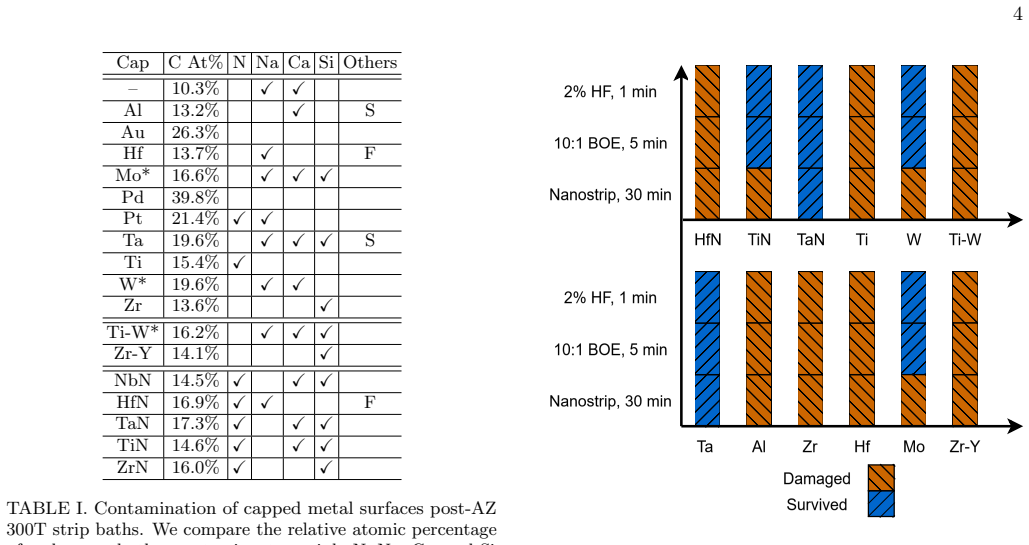
Resonator XPS To ensure consistency, one sample from each set of bilayers was measured in the XPS. Survey spectra are shown in Fig. S7 and the relative atomic percentage are given in Tab. S3. All resonators show comparable surface contamination similar to the previous measurements (Table I), however the control has the lowest carbon contamination. The Si ...
-
[5]
C. R. H. McRae, H. Wang, J. Gao, M. R. Vissers, T. Brecht, A. Dunsworth, D. P. Pappas, and J. Mutus, Review of Scientific Instruments91, 091101 (2020)
work page 2020
-
[6]
C. E. Murray, Materials Science and Engineering: R: Reports146, 100646 (2021)
work page 2021
-
[7]
M. Bal, A. A. Murthy, S. Zhu, F. Crisa, X. You, Z. Huang, T. Roy, J. Lee, D. V. Zanten, R. Pilipenko, I. Nekrashe- vich, A. Lunin, D. Bafia, Y. Krasnikova, C. J. Kopas, E. O. Lachman, D. Miller, J. Y. Mutus, M. J. Reagor, H. Cansizoglu, J. Marshall, D. P. Pappas, K. Vu, K. Ya- davalli, J.-S. Oh, L. Zhou, M. J. Kramer, F. Lecocq, D. P. Goronzy, C. G. Torre...
work page 2024
-
[8]
M. Tuokkola, Y. Sunada, H. Kivij¨ arvi, J. Albanese, L. Gr¨ onberg, J.-P. Kaikkonen, V. Vesterinen, J. Gove- nius, and M. M¨ ott¨ onen, Nature Communications16, 5421 (2025)
work page 2025
-
[9]
M. P. Bland, F. Bahrami, J. G. C. Martinez, P. H. Preste- gaard, B. M. Smitham, A. Joshi, E. Hedrick, S. Kumar, A. Yang, A. C. Pakpour-Tabrizi, A. Jindal, R. D. Chang, G. Cheng, N. Yao, R. J. Cava, N. P. De Leon, and A. A. Houck, Nature 10.1038/s41586-025-09687-4 (2025)
-
[10]
R. D. Chang, N. Shumiya, R. A. McLellan, Y. Zhang, M. P. Bland, F. Bahrami, J. Mun, C. Zhou, K. Kisslinger, G. Cheng, B. M. Smitham, A. C. Pakpour-Tabrizi, N. Yao, Y. Zhu, M. Liu, R. J. Cava, S. Gopalakrishnan, A. A. Houck, and N. P. De Leon, Physical Review Letters134, 097001 (2025)
work page 2025
-
[11]
J. Burnett, L. Faoro, and T. Lindstr¨ om, Superconductor Science and Technology29, 044008 (2016)
work page 2016
-
[12]
N. P. de Leon, K. M. Itoh, D. Kim, K. K. Mehta, T. E. Northup, H. Paik, B. S. Palmer, N. Samarth, S. Sangtawesin, and D. W. Steuerman, Science372, eabb2823 (2021)
work page 2021
-
[13]
K. D. Crowley, R. A. McLellan, A. Dutta, N. Shumiya, A. P. Place, X. H. Le, Y. Gang, T. Madhavan, M. P. Bland, R. Chang, N. Khedkar, Y. C. Feng, E. A. Umbarkar, X. Gui, L. V. Rodgers, Y. Jia, M. M. Feldman, S. A. Lyon, M. Liu, R. J. Cava, A. A. Houck, and N. P. De Leon, Physical Review X13, 041005 (2023)
work page 2023
-
[14]
A. A. Murthy, M. Bal, M. J. Bedzyk, H. Cansizoglu, R. K. Chan, V. Chandrasekhar, F. Crisa, A. Datta, Y. Deng, C. D. M. Diaz, V. P. Dravid, D. A. Garcia- Wetten, S. Garattoni, S. Ghimire, D. P. Goronzy, S. d. Graaf, S. Haeuser, M. C. Hersam, D. Isheim, K. Joshi, R. Kim, S. Kolachina, C. J. Kopas, M. J. Kramer, E. O. Lachman, J. Lee, P. G. Lim, A. Lunin, W....
-
[15]
Y. V. Krasnikova, A. A. Murthy, D. Bafia, F. Crisa, A. Clairmont, Z. Sung, J. Lee, A. Cano, M. Shinde, D. M. T. v. Zanten, M. Bal, A. Romanenko, A. Grassellino, R. Dhundwal, D. Fuchs, T. Reisinger, I. M. Pop, A. Suter, T. Prokscha, and Z. Salman, Experimental Observation of Short-Range Magnetic Correlations in Amorphous Nb2O5 and Ta2O5 Thin Films (2025), ...
work page internal anchor Pith review Pith/arXiv arXiv 2025
-
[16]
A. A. Murthy, P. Masih Das, S. M. Ribet, C. Kopas, J. Lee, M. J. Reagor, L. Zhou, M. J. Kramer, M. C. Hersam, M. Checchin, A. Grassellino, R. d. Reis, V. P. Dravid, and A. Romanenko, ACS Nano16, 17257 (2022)
work page 2022
-
[17]
A. Romanenko, R. Pilipenko, S. Zorzetti, D. Frolov, M. Awida, S. Belomestnykh, S. Posen, and A. Grassellino, Physical Review Applied13, 034032 (2020)
work page 2020
- [18]
-
[19]
M. Wenskat, J. ˇCiˇ zek, M. O. Liedke, M. Butterling, M. Stiehl, G. D. L. Semione, C. Backes, C. Bate, O. Me- likhova, E. Hirschmann, A. Wagner, H. Weise, A. Stierle, M. Aeschlimann, and W. Hillert, Physical Review B106, 094516 (2022)
work page 2022
-
[20]
M. V. P. Alto´ e, A. Banerjee, C. Berk, A. Hajr, A. Schwartzberg, C. Song, M. Alghadeer, S. Aloni, M. J. Elowson, J. M. Kreikebaum, E. K. Wong, S. M. Griffin, S. Rao, A. Weber-Bargioni, A. M. Minor, D. I. Santiago, S. Cabrini, I. Siddiqi, and D. F. Ogletree, PRX Quantum 3, 020312 (2022)
work page 2022
-
[21]
M. C. De Ory, V. Rollano, D. Rodriguez, M. T. Magaz, D. Granados, and A. Gomez, Advanced Quantum Tech- nologies , 2400699 (2025)
work page 2025
-
[22]
C. Zhou, J. Mun, J. Yao, A. K. Anbalagan, M. D. Hossain, R. A. McLellan, R. Li, K. Kisslinger, G. Li, X. Tong, A. R. Head, C. Weiland, S. L. Hulbert, A. L. Walter, Q. Li, Y. Zhu, P. V. Sushko, and M. Liu, Advanced Materials 36, 2310280 (2024)
work page 2024
-
[23]
S. K. Karuppannan, D. Huang, N. M. Kommanaboina, K. Anil, G. Yan, D. V. M. Repaka, Y. Zhang, K. E. J. Goh, W. S. Kai, N. L. Chee Beng, Y. L. K. Sherry, and M. Mukherjee, ACS Applied Electronic Materials6, 7372 (2024)
work page 2024
-
[24]
M. Alghadeer, A. Banerjee, A. Hajr, H. Hussein, H. Fari- borzi, and S. G. Rao, ACS Applied Materials & Interfaces 15, 2319 (2023)
work page 2023
- [25]
-
[26]
J. Verjauw, A. Potoˇ cnik, M. Mongillo, R. Acharya, F. Mo- hiyaddin, G. Simion, A. Pacco, T. Ivanov, D. Wan, A. Van- leenhove, L. Souriau, J. Jussot, A. Thiam, J. Swerts, X. Piao, S. Couet, M. Heyns, B. Govoreanu, and I. Radu, Physical Review Applied16, 014018 (2021)
work page 2021
-
[27]
M. A. Gingras, B. M. Niedzielski, K. A. Grossklaus, D. Miller, F. Contipelli, K. Azar, L. D. Burkhart, G. Calu- sine, D. Davis, R. D. Pi˜ nero, J. M. Gertler, T. M. Hazard, C. F. Hirjibehedin, D. K. Kim, J. M. Knecht, A. J. Melville, C. O’Connell, R. A. Rood, A. Sab- bah, H. Stickler, J. L. Yoder, W. D. Oliver, M. E. Schwartz, and K. Serniak, Improving Tr...
-
[28]
C. J. Powell, Journal of Vacuum Science & Technology A: Vacuum, Surfaces, and Films38, 023209 (2020)
work page 2020
-
[29]
M. W. Olszewski, J. T. Paustian, T. Banerjee, H. Lu, J. L. Ramirez, N. Nguyen, K. Okubo, R. Pant, A. B. Biedron, D. C. Ralph, C. J. K. Richardson, G. D. Fuchs, C. R. H. 15 McRae, I. V. Pechenezhskiy, B. L. T. Plourde, and V. Fatemi, Low-loss Nb on Si superconducting resonators from a dual-use spintronics deposition chamber and with acid-free post-processi...
-
[30]
A. P. M. Place, L. V. H. Rodgers, P. Mundada, B. M. Smitham, M. Fitzpatrick, Z. Leng, A. Premkumar, J. Bryon, A. Vrajitoarea, S. Sussman, G. Cheng, T. Mad- havan, H. K. Babla, X. H. Le, Y. Gang, B. J¨ ack, A. Gyenis, N. Yao, R. J. Cava, N. P. De Leon, and A. A. Houck, Nature Communications12, 1779 (2021)
work page 2021
-
[31]
C. G. Torres-Castanedo, D. P. Goronzy, T. Pham, A. Mc- Fadden, N. Materise, P. Masih Das, M. Cheng, D. Lebe- dev, S. M. Ribet, M. J. Walker, D. A. Garcia-Wetten, C. J. Kopas, J. Marshall, E. Lachman, N. Zhelev, J. A. Sauls, J. Y. Mutus, C. R. H. McRae, V. P. Dravid, M. J. Bedzyk, and M. C. Hersam, Advanced Functional Mate- rials , 2401365 (2024)
work page 2024
- [32]
-
[33]
M. S. Khalil, M. J. A. Stoutimore, F. C. Wellstood, and K. D. Osborn, Journal of Applied Physics111, 054510 (2012)
work page 2012
-
[34]
J. Choi, M. Olszewski, L. Zhang, Z. Baraissov, T. Baner- jee, K. Aggarwal, S. Chaudhari, T. A. Arias, D. A. Muller, V. Fatemi, and G. D. Fuchs, APL Materials13, 111103 (2025)
work page 2025
-
[35]
G. J. Dolan, Applied Physics Letters31, 337 (1977)
work page 1977
-
[36]
C. M. Quintana, A. Megrant, Z. Chen, A. Dunsworth, B. Chiaro, R. Barends, B. Campbell, Y. Chen, I.-C. Hoi, E. Jeffrey, J. Kelly, J. Y. Mutus, P. J. J. O’Malley, C. Neill, P. Roushan, D. Sank, A. Vainsencher, J. Wenner, T. C. White, A. N. Cleland, and J. M. Martinis, Applied Physics Letters105, 062601 (2014)
work page 2014
-
[37]
N. Muthusubramanian, M. Finkel, P. Duivestein, C. Zachariadis, S. L. M. Van Der Meer, H. M. Veen, M. W. Beekman, T. Stavenga, A. Bruno, and L. DiCarlo, Quantum Science and Technology9, 025006 (2024)
work page 2024
-
[38]
S. Logothetidis, E. Meletis, G. Stergioudis, and A. Ad- jaottor, Thin Solid Films338, 304 (1999)
work page 1999
-
[39]
A. V. Lubenchenko, A. B. Pavolotsky, S. Krause, O. I. Lubenchenko, D. A. Ivanov, V. Desmaris, and V. Belitsky, 30th International Symposium on Space THz Technology (2019)
work page 2019
-
[40]
M. Zier, S. Oswald, R. Reiche, and K. Wetzig, Applied Surface Science252, 234 (2005)
work page 2005
-
[41]
P. A. S. Carvalho and R. H. Miwa, Journal of Applied Physics114, 063705 (2013)
work page 2013
- [42]
-
[43]
G. Semione, A. D. Pandey, S. Tober, J. Pfrommer, A. Poulain, J. Drnec, G. Sch¨ utz, T. Keller, H. Noei, V. Vonk, B. Foster, and A. Stierle, Physical Review Ac- celerators and Beams22, 103102 (2019)
work page 2019
-
[44]
S. Chaudhari, C. M´ endez, R. Choudhary, T. Banerjee, M. W. Olszewski, J. T. Paustian, J. Choi, Z. Baraissov, R. Hernandez, D. A. Muller, B. L. T. Plourde, G. D. Fuchs, V. Fatemi, and T. A. Arias, Active-Learning In- spired$ \textit{Ab Initio}$Theory-Experiment Loop Ap- proach for Management of Material Defects: Applica- tion to Superconducting Qubits (20...
-
[45]
AZ Electronic Materials, AZ 300T Stripper Safety Data Sheet (2015)
work page 2015
-
[46]
A. A. Murthy, J. Lee, C. Kopas, M. J. Reagor, A. P. McFadden, D. P. Pappas, M. Checchin, A. Grassellino, and A. Romanenko, Applied Physics Letters120, 044002 (2022)
work page 2022
- [47]
-
[48]
T. Banerjee and V. Fatemi, Dataset for ”Fabrication ef- fects on Niobium oxidation and surface contamination in Niobium-metal bilayers using X-ray photoelectron spec- troscopy” (2026)
work page 2026
-
[49]
N. Fairley, V. Fernandez, M. Richard-Plouet, C. Guillot- Deudon, J. Walton, E. Smith, D. Flahaut, M. Greiner, M. Biesinger, S. Tougaard, D. Morgan, and J. Baltrusaitis, Applied Surface Science Advances5, 100112 (2021)
work page 2021
-
[50]
Gorham, NIST X-ray Photoelectron Spectroscopy Database - SRD 20 (2012)
J. Gorham, NIST X-ray Photoelectron Spectroscopy Database - SRD 20 (2012)
work page 2012
-
[51]
T. B. Reed,Free energy of formation of binary compounds: an atlas of charts for high-temperature chemical calcula- tions(MIT Press, Cambridge, Mass, 1971)
work page 1971
-
[52]
P. G. Baity, C. Maclean, V. Seferai, J. Bronstein, Y. Shu, T. Hemakumara, and M. Weides, Physical Review Re- search6, 013329 (2024)
work page 2024
-
[53]
S. Krinner, S. Storz, P. Kurpiers, P. Magnard, J. Heinsoo, R. Keller, J. Luetolf, C. Eichler, and A. Wallraff, EPJ Quantum Technology6, 2 (2019)
work page 2019
- [54]
-
[55]
Zmuidzinas, Annual Review of Condensed Matter Physics3, 169 (2012)
J. Zmuidzinas, Annual Review of Condensed Matter Physics3, 169 (2012)
work page 2012
-
[56]
Gao,The Physics of Superconducting Microwave Res- onators, Ph.D
J. Gao,The Physics of Superconducting Microwave Res- onators, Ph.D. thesis, California Institute of Technology, Pasadena, California (2008)
work page 2008
discussion (0)
Sign in with ORCID, Apple, or X to comment. Anyone can read and Pith papers without signing in.