Experimental Observation of Short-Range Magnetic Correlations in Amorphous Nb₂O₅ and Ta₂O₅ Thin Films
Pith reviewed 2026-05-22 16:07 UTC · model grok-4.3
The pith
Muon spin relaxation detects short-range magnetic correlations in amorphous Nb2O5 and Ta2O5 thin films at 2.8 K.
A machine-rendered reading of the paper's core claim, the machinery that carries it, and where it could break.
Core claim
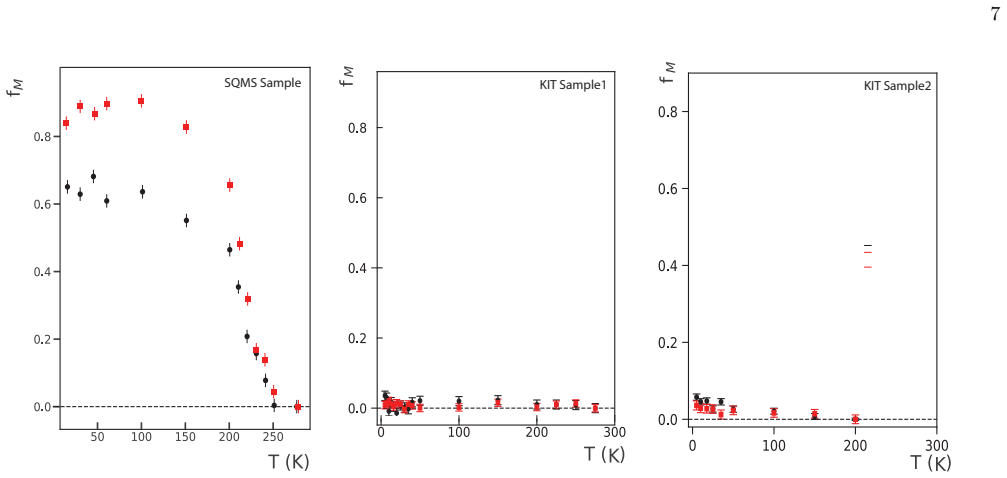
Muon spin relaxation measurements on the thin films reveal a magnetic response at 2.8 K whose character depends on crystallinity and composition, with amorphous Ta2O5 producing signatures of local static magnetism and amorphous Nb2O5 producing signatures of fluctuating, strongly disordered magnetism.
What carries the argument
Muon spin relaxation signals that register local static or fluctuating magnetic fields arising from short-range correlations inside the oxide films.
If this is right
- Differences in magnetic behavior between the two oxides may account for observed variations in coherence and loss in superconducting qubits and resonators.
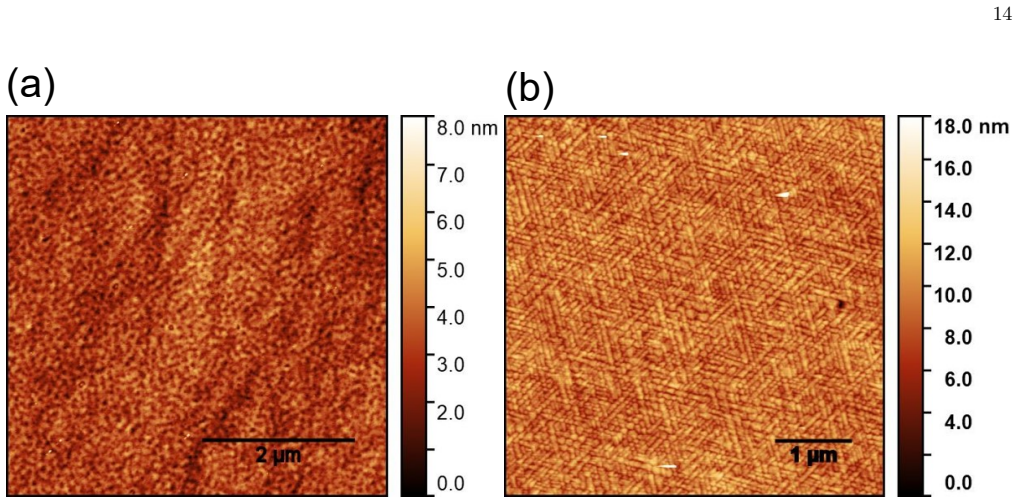
- Increasing crystallinity through thermal oxidation can suppress magnetism in Ta2O5 films.
- The stronger magnetic disorder in Nb2O5 compared with Ta2O5 implies material-specific impacts on device performance.
Where Pith is reading between the lines
- Similar short-range magnetic correlations may appear in other amorphous transition-metal oxides used in quantum electronics.
- Adjusting deposition conditions to tune the degree of amorphicity could reduce unwanted magnetism in these materials.
- Measurements at temperatures above 2.8 K would locate the energy scale at which the correlations set in.
Load-bearing premise
The muon spin relaxation signals come from intrinsic short-range magnetic correlations within the films rather than from surface contamination, substrate effects, or experimental artifacts.
What would settle it
Repeating the measurements on the same films after thorough surface cleaning or on free-standing samples that eliminate any substrate or contamination contribution and finding no magnetic signal would show the correlations are not intrinsic.
Figures





read the original abstract
We use muon spin rotation/relaxation/resonance ($\mu$SR) to investigate the magnetic properties of niobium pentoxide (Nb$_2$O$_5$) and tantalum pentoxide (Ta$_2$O$_5$) thin films. In both oxides, we observe a magnetic response at the lowest available temperature of 2.8 K. This response appears to be structurally dependent: thermally oxidized Ta$_2$O$_5$ with low crystallinity demonstrates suppressed magnetism, while fully amorphous Ta$_2$O$_5$ demonstrates local static magnetism. In contrast, amorphous Nb$_2$O$_5$ is dominated by magnetic fluctuations and is strongly magnetically disordered compared to Ta$_2$O$_5$. Our results suggest that these fundamental differences in the magnetism of Ta and Nb oxides could explain the performance limitations in superconducting qubits and resonators.
Editorial analysis
A structured set of objections, weighed in public.
Referee Report
Summary. The manuscript reports μSR measurements on Nb₂O₅ and Ta₂O₅ thin films, claiming observation of a magnetic response at 2.8 K whose character depends on material and crystallinity: suppressed magnetism in low-crystallinity thermally oxidized Ta₂O₅, local static magnetism in fully amorphous Ta₂O₅, and fluctuating disordered magnetism in amorphous Nb₂O₅. The authors suggest these differences may underlie performance limitations in superconducting qubits and resonators.
Significance. If the μSR signals are shown to be intrinsic to the films, the structural and material dependence of the short-range magnetic correlations would be a useful experimental result for understanding noise sources in quantum devices. The use of μSR is well-suited to detecting local static or dynamic magnetism, and the contrast between Nb and Ta oxides is a clear finding. Significance is limited by the absence of device-level data and by the need to rule out substrate or impurity contributions in the thin-film geometry.
major comments (2)
- [Abstract] Abstract: the reported magnetic responses lack any mention of error bars, relaxation-rate fitting procedures, or raw asymmetry spectra, which are required to evaluate the statistical significance and model dependence of the claimed static vs. fluctuating behavior.
- [Experimental methods / results] Experimental methods / results: the assignment of the observed depolarization to intrinsic short-range magnetic correlations inside the ~100 nm films is load-bearing for the central claim, yet the manuscript provides no explicit modeling of the muon stopping profile, film-thickness verification, or substrate-control measurements. Thin-film μSR geometries are known to admit substantial substrate contributions unless these factors are quantified.
minor comments (2)
- [Discussion] The suggestion that the observed magnetism explains qubit limitations is stated without any supporting resonator or qubit measurements; this could be qualified more precisely or moved to an outlook paragraph.
- [Throughout] Chemical formulas should be typeset consistently (Nb₂O₅, Ta₂O₅) in both text and figure captions.
Simulated Author's Rebuttal
We thank the referee for their detailed and constructive report. We address each major comment below, indicating the revisions we plan to incorporate to improve the clarity and rigor of the manuscript.
read point-by-point responses
-
Referee: [Abstract] Abstract: the reported magnetic responses lack any mention of error bars, relaxation-rate fitting procedures, or raw asymmetry spectra, which are required to evaluate the statistical significance and model dependence of the claimed static vs. fluctuating behavior.
Authors: We agree that the abstract, as a concise summary, would benefit from additional context on the analysis. In the revised manuscript we will add a brief clause noting that the magnetic responses are quantified via relaxation-rate fits to the asymmetry spectra, with uncertainties obtained from the statistical analysis of the raw data. The detailed fitting procedures, error bars, and representative raw asymmetry spectra are already presented in the main text and supplementary material; referencing them in the abstract will help readers assess the distinction between static and fluctuating regimes. revision: yes
-
Referee: [Experimental methods / results] Experimental methods / results: the assignment of the observed depolarization to intrinsic short-range magnetic correlations inside the ~100 nm films is load-bearing for the central claim, yet the manuscript provides no explicit modeling of the muon stopping profile, film-thickness verification, or substrate-control measurements. Thin-film μSR geometries are known to admit substantial substrate contributions unless these factors are quantified.
Authors: We acknowledge that explicit quantification of the muon stopping profile and substrate contributions is important for thin-film geometries. The original manuscript reports film thicknesses of approximately 100 nm measured by ellipsometry and relies on standard muon implantation ranges in metal oxides at the beam energies employed. To strengthen this section we will add explicit calculations of the muon stopping profile (using TRIM or equivalent) showing the fraction of muons stopping within the film, and we will include a quantitative discussion of possible substrate contributions. Substrate-control measurements were not performed in the original experiment; we will therefore add a clear statement of this limitation together with an estimate of the maximum possible substrate signal based on separate measurements of the bare substrate where available. These additions will make the intrinsic assignment more robust while remaining honest about experimental constraints. revision: partial
Circularity Check
No circularity: purely experimental μSR observations with standard analysis
full rationale
The manuscript reports direct experimental measurements of muon spin relaxation in Nb2O5 and Ta2O5 thin films at 2.8 K, attributing signals to short-range magnetic correlations based on observed depolarization rates and their dependence on crystallinity and material. No derivation chain, equations, or fitted parameters are presented that reduce by construction to the input data; the analysis follows established μSR fitting procedures without self-referential definitions or load-bearing self-citations that force the central claim. The paper is self-contained against external benchmarks for experimental interpretation, with any interpretive assumptions (e.g., muon stopping profiles) being standard and falsifiable outside the present dataset.
Axiom & Free-Parameter Ledger
axioms (1)
- domain assumption Muon spin relaxation signals can be unambiguously attributed to intrinsic magnetic moments in the film rather than extrinsic sources.
Lean theorems connected to this paper
-
IndisputableMonolith/Cost/FunctionalEquation.leanwashburn_uniqueness_aczel unclear?
unclearRelation between the paper passage and the cited Recognition theorem.
We use muon spin rotation/relaxation/resonance (µSR) to investigate the magnetic properties of niobium pentoxide (Nb₂O₅) and tantalum pentoxide (Ta₂O₅) thin films... analyzed using the dynamical Kubo-Toyabe model
-
IndisputableMonolith/Foundation/RealityFromDistinction.leanreality_from_one_distinction unclear?
unclearRelation between the paper passage and the cited Recognition theorem.
The fluctuation rate is unexpectedly high (≈100 MHz)... magnetic disorder is strongly linked to increased microwave loss
What do these tags mean?
- matches
- The paper's claim is directly supported by a theorem in the formal canon.
- supports
- The theorem supports part of the paper's argument, but the paper may add assumptions or extra steps.
- extends
- The paper goes beyond the formal theorem; the theorem is a base layer rather than the whole result.
- uses
- The paper appears to rely on the theorem as machinery.
- contradicts
- The paper's claim conflicts with a theorem or certificate in the canon.
- unclear
- Pith found a possible connection, but the passage is too broad, indirect, or ambiguous to say the theorem truly supports the claim.
Forward citations
Cited by 2 Pith papers
-
Tantalum-Encapsulated Niobium Superconducting Resonators: High Internal Quality Factor and Improved Temporal Stability via Surface Passivation
Ta encapsulation of Nb resonators raises internal quality factor to 2.4 million and improves six-month stability by reducing two-level system losses at the metal-air interface.
-
Fabrication effects on Niobium oxidation and surface contamination in Niobium-metal bilayers using X-ray photoelectron spectroscopy
XPS evaluation of 17 capping layers identifies resilient options that limit niobium oxidation during standard fabrication and improve microwave resonator performance.
Reference graph
Works this paper leans on
- [1]
-
[2]
A. Romanenko and D. I. Schuster, Understanding quality factor degradation in superconducting niobium cavities 10 at low microwave field amplitudes, Phys. Rev. Lett. 119, 264801 (2017)
work page 2017
-
[3]
A. Romanenko, R. Pilipenko, S. Zorzetti, D. Frolov, M. Awida, S. Belomestnykh, S. Posen, and A. Gras- sellino, Three-dimensional superconducting resonators at t = 20 mk with photon lifetimes up toτ = 2 s, Phys. Rev. Appl. 13, 034032 (2020)
work page 2020
-
[4]
E. H. Greener, D. H. Whitmore, and M. E. Fine, Elec- trical conductivity of near-stoichiometric α-nb2o5, The Journal of Chemical Physics 34, 1017 (1961)
work page 1961
-
[5]
R. Streiff, D. Poulton, and W. Smeltzer, Comment on the defect structure and the transport properties of nb 2o5., Oxid Met 3, 33 (1971)
work page 1971
-
[6]
R. J. Cava, B. Batlogg, J. J. Krajewski, H. F. Poulsen, P. Gammel, W. F. Peck, and L. W. Rupp, Electrical and magnetic properties of nb 2o5−δ crystallographic shear structures, Phys. Rev. B 44, 6973 (1991)
work page 1991
-
[7]
T. Proslier, M. Kharitonov, M. Pellin, J. Zasadzinski, and Ciovati, Evidence of surface paramagnetism in niobium and consequences for the superconducting cavity surface impedance, IEEE Transactions on Applied Superconduc- tivity 21, 2619 (2011)
work page 2011
-
[8]
M. Wenskat, J. ˇCiˇ zek, M. O. Liedke, and et al, Va- cancy dynamics in niobium and its native oxides and their potential implications for quantum computing and superconducting accelerators, Phys. Rev. B 106, 094516 (2022)
work page 2022
-
[9]
A. A. Murthy, P. Masih Das, S. M. Ribet, C. Kopas, J. Lee, M. J. Reagor, L. Zhou, M. J. Kramer, M. C. Hersam, M. Checchin, A. Grassellino, R. d. Reis, V. P. Dravid, and A. Romanenko, Developing a Chemical and Structural Understanding of the Surface Oxide in a Niobium Superconducting Qubit, ACS Nano 16, 17257 (2022)
work page 2022
- [10]
-
[11]
C. Wang, X. Li, H. Xu, Z. Li, J. Wang, Z. Yang, Z. Mi, X. Liang, T. Su, C. Yang, G. Wang, W. Wang, Y. Li, M. Chen, C. Li, K. Linghu, J. Han, Y. Zhang, Y. Feng, Y. Song, T. Ma, J. Zhang, R. Wang, P. Zhao, W. Liu, G. Xue, Y. Jin, and H. Yu, Towards practical quantum computers: transmon qubit with a lifetime approaching 0.5 milliseconds, npj Quantum Informat...
work page 2022
-
[12]
A. P. M. Place, L. V. H. Rodgers, P. Mundada, B. M. Smitham, M. Fitzpatrick, Z. Leng, A. Premkumar, J. Bryon, A. Vrajitoarea, S. Sussman, G. Cheng, T. Mad- havan, H. K. Babla, X. H. Le, Y. Gang, B. J¨ ack, A. Gye- nis, N. Yao, R. J. Cava, N. P. de Leon, and A. A. Houck, New material platform for superconducting transmon qubits with coherence times exceedi...
work page 2021
-
[13]
M. Bal, A. A. Murthy, S. Zhu, F. Crisa, X. You, Z. Huang, T. Roy, J. Lee, D. v. Zanten, R. Pilipenko, I. Nekrashevich, A. Lunin, D. Bafia, Y. Krasnikova, C. J. Kopas, E. O. Lachman, D. Miller, J. Y. Mutus, M. J. Reagor, H. Cansizoglu, J. Marshall, D. P. Pappas, K. Vu, K. Yadavalli, J.-S. Oh, L. Zhou, M. J. Kramer, F. Lecocq, D. P. Goronzy, C. G. Torres-Ca...
work page 2024
- [14]
-
[15]
S. J. Blundell, R. De Renzi, T. Lancaster, and F. L. Pratt, Low energy µSR, in Muon Spectroscopy: An Introduction (Oxford University Press, 2021)
work page 2021
-
[16]
E. Morenzoni, T. Prokscha, H. Saadaoui, Z. Salman, A. Suter, B. M. Wojek, J. Baglo, I. Boˇ zovi´ c, M. Hos- sain, R. F. Kiefl, G. Logvenov, and O. Ofer, Proceedings of the International Symposium on Science Explored by Ultra Slow Muon (USM2013)
-
[17]
T. Prokscha, E. Morenzoni, K. Deiters, F. Foroughi, D. George, R. Kobler, A. Suter, and V. Vrankovic, The new muE4 beam at PSI: A hybrid-type large ac- ceptance channel for the generation of a high intensity surface-muon beam, Nuclear Instruments and Methods in Physics Research Section A: Accelerators, Spectrometers, Detectors and Associated Equipment 595...
work page 2008
-
[18]
W., Computer Simulation of Ion-Solid Interactions (1991)
E. W., Computer Simulation of Ion-Solid Interactions (1991)
work page 1991
-
[19]
A. Yaouanc and P. Dalmas de Reotier, Muon spin ro- tation, relaxation, and resonance: Applications to con- densed matter, Vol. 147 (2011)
work page 2011
-
[20]
R. Chandrasekharan, I. Park, R. I. Masel, and M. A. Shannon, Thermal oxidation of tantalum films at various oxidation states from 300 to 700 °C, J. Appl. Phys. 98, 114908 (2005)
work page 2005
-
[21]
A. Suter and B. Wojek, Musrfit: a free platform- independent framework for µsr data analysis, Physics Procedia 30, 69 (2012)
work page 2012
-
[22]
S. Sendelbach, D. Hover, A. Kittel, M. M¨ uck, J. M. Martinis, and R. McDermott, Magnetism in squids at millikelvin temperatures, Phys. Rev. Lett. 100, 227006 (2008)
work page 2008
-
[23]
S. E. de Graaf, L. Faoro, L. B. Ioffe, S. Mahashabde, J. J. Burnett, T. Lindstr¨ om, S. E. Kubatkin, A. V. Danilov, and A. Y. Tzalenchuk, Two-level systems in supercon- ducting quantum devices due to trapped quasiparticles, Science Advances 6, eabc5055 (2020)
work page 2020
-
[24]
M. Venkatesan, C. Fitzgerald, and J. Coey, Unexpected magnetism in a dielectric oxide., Nature 430, 630 (2004)
work page 2004
-
[25]
G.-X. Miao and A. Gupta, Growth and properties of epitaxial chromium dioxide (cro2) thin films and het- erostructures, in Nanoscale Magnetic Materials and Ap- plications, edited by J. P. Liu, E. Fullerton, O. Gutfleisch, and D. Sellmyer (Springer US, Boston, MA, 2009) pp. 511–536
work page 2009
-
[26]
C. G. Torres-Castanedo, D. P. Goronzy, T. Pham, A. Mc- Fadden, N. Materise, P. M. Das, M. Cheng, D. Lebe- dev, S. M. Ribet, M. J. Walker, D. A. Garcia-Wetten, C. J. Kopas, J. Marshall, E. Lachman, N. Zhelev, J. A. Sauls, J. Y. Mutus, C. R. H. McRae, V. P. Dravid, M. J. Bedzyk, and M. C. Hersam, Formation and Mi- crowave Losses of Hydrides in Superconducti...
work page 2024
-
[27]
Zaumseil, High-resolution characterization of the for- bidden Si 200 and Si 222 reflections, J
P. Zaumseil, High-resolution characterization of the for- bidden Si 200 and Si 222 reflections, J. Appl. Crystallogr. 48, 528 (2015). 11 Appendix A: µSR stopping profile details Calculated muon stopping profiles for Nb 2O5 and Ta2O5. 0 20 40 60 80 100 120 140 160 180 Depth [nm] 0 1 2 3 4 5 6Normalized Stopping Profile [%/nm] 23 keV20 keV 17 keV 15 keV13 k...
work page 2015
discussion (0)
Sign in with ORCID, Apple, or X to comment. Anyone can read and Pith papers without signing in.