Synthetic Abundance Maps for Unsupervised Super-Resolution of Hyperspectral Remote Sensing Images
Pith reviewed 2026-05-16 09:50 UTC · model grok-4.3
The pith
A network trained solely on synthetic abundance maps generated by a dead leaves model can super-resolve hyperspectral images without any high-resolution ground truth.
A machine-rendered reading of the paper's core claim, the machinery that carries it, and where it could break.
Core claim
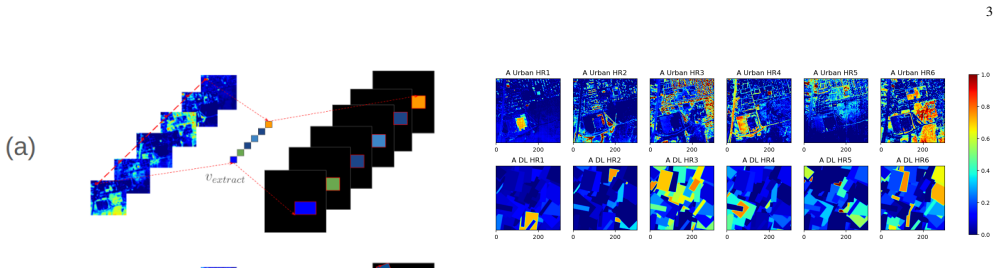
Synthetic abundance maps generated from a dead leaves model whose spatial statistics are inherited directly from the low-resolution hyperspectral image and its known point spread function supply sufficient training signal for a neural network to learn abundance super-resolution that generalizes to real data, thereby enabling complete unsupervised hyperspectral single-image super-resolution.
What carries the argument
Synthetic abundance maps produced by a dead leaves model that copies spatial characteristics from the low-resolution image and the sensor PSF.
If this is right
- Any existing hyperspectral dataset can be super-resolved without acquiring or simulating high-resolution references.
- The same trained network can be applied after the initial unmixing step to produce the final enhanced image via endmember recombination.
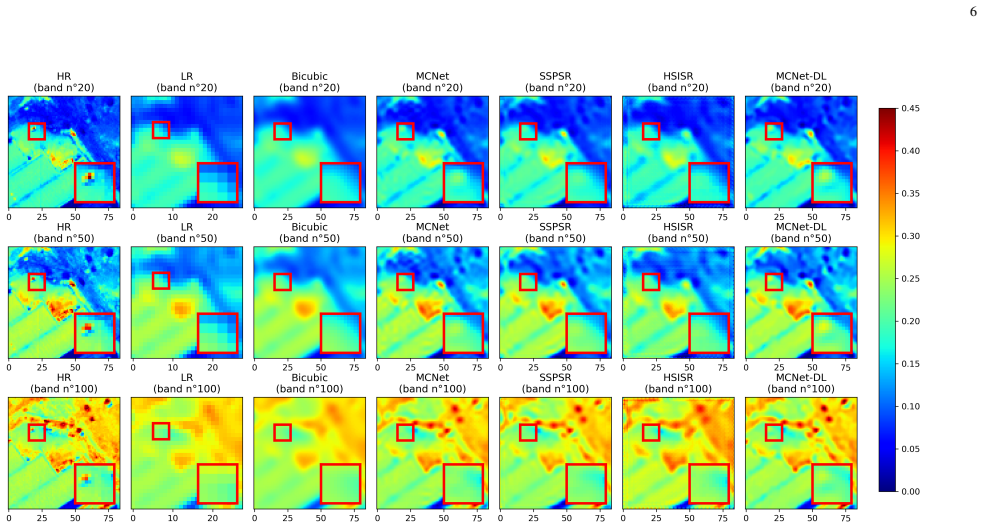
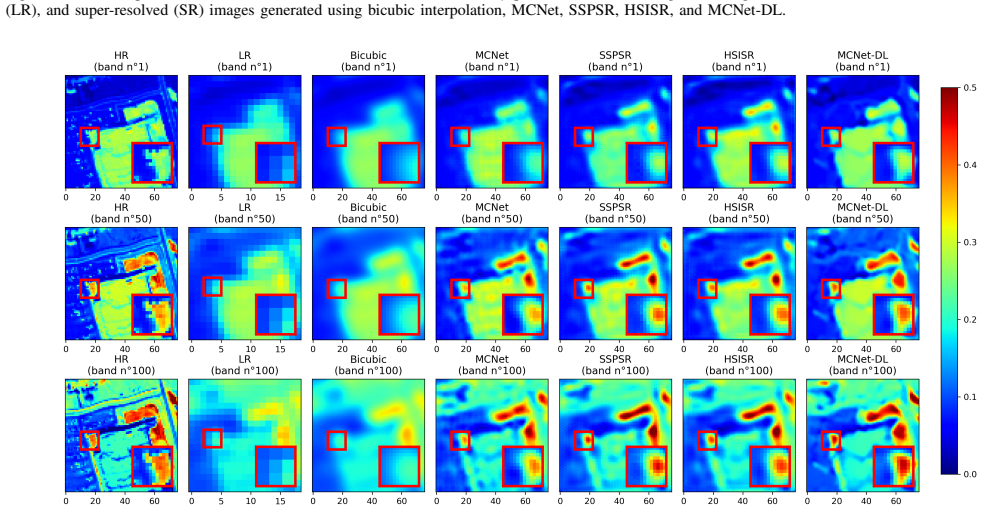
- The approach remains effective across scaling factors of 2, 4, and 8 on multiple real remote-sensing scenes.
Where Pith is reading between the lines
- The same synthetic-abundance training strategy could be tested on multispectral or other modality-specific super-resolution tasks where ground-truth pairs are scarce.
- If the dead-leaves statistics prove robust, the method might reduce the need for physics-based simulators in other remote-sensing enhancement pipelines.
- Applying the framework to time-series hyperspectral data could test whether the learned sharpening preserves temporal consistency without extra constraints.
Load-bearing premise
The dead leaves model, when given parameters taken from the low-resolution image and the known point spread function, creates synthetic abundance maps whose spatial statistics are close enough to real abundance maps that a network trained on them will perform well on actual data.
What would settle it
On any dataset that supplies high-resolution ground truth, run the method and a supervised baseline and check whether the unsupervised outputs are consistently worse in both spatial and spectral error metrics; consistent underperformance would falsify the transfer claim.
Figures




read the original abstract
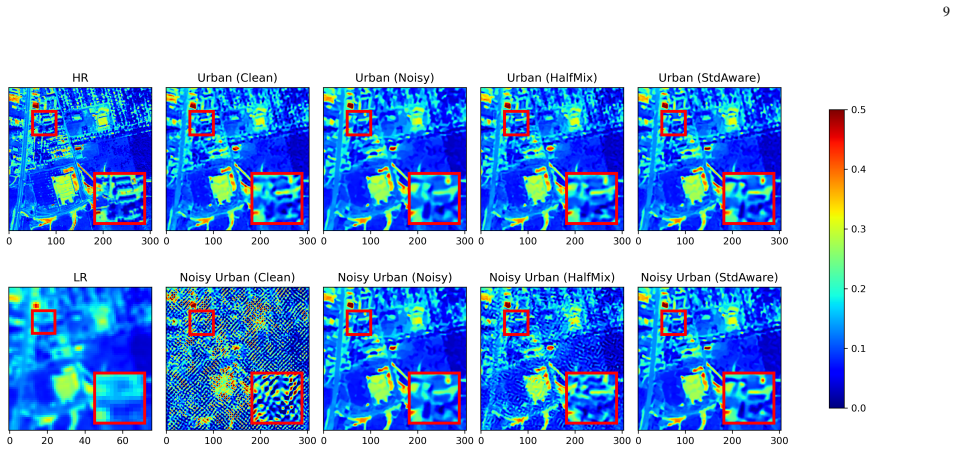
Hyperspectral single image super-resolution (HS-SISR) aims to enhance the spatial resolution of hyperspectral images to fully exploit their spectral information. While considerable progress has been made in this field, most existing methods are supervised and require ground truth data for training-data that is often unavailable in practice. To overcome this limitation, we propose a novel unsupervised training framework for HS-SISR, based on synthetic abundance data, where no high-resolution ground-truth reference is required for training. The approach begins by unmixing the hyperspectral image into endmembers and abundances. A neural network is then trained to perform abundance super-resolution using synthetic abundances only. These synthetic abundance maps are generated from a dead leaves model whose characteristics are inherited from the low-resolution image to be super-resolved and from the known point spread function (PSF) of the hyperspectral sensor. This trained network is subsequently used to enhance the spatial resolution of the original image's abundances, and the final super-resolution hyperspectral image is reconstructed by combining them with the endmembers. Experimental results demonstrate both the training value of the synthetic data and the effectiveness of the proposed method across 3 datasets, 3 scaling factors, and several evaluation metrics. The code is available at https://github.com/xinxinxu99/SISR-DL.git
Editorial analysis
A structured set of objections, weighed in public.
Referee Report
Summary. The manuscript proposes an unsupervised framework for hyperspectral single-image super-resolution (HS-SISR) that generates synthetic abundance maps using a dead-leaves model whose parameters are derived from the input low-resolution image and the sensor PSF. A neural network is trained exclusively on these synthetic maps to perform abundance super-resolution; the trained network is then applied to real abundances obtained by unmixing the LR image, and the final HR hyperspectral image is reconstructed by combining the super-resolved abundances with the original endmembers. Experiments on three datasets across three scaling factors report quantitative gains on standard metrics, with code released.
Significance. If the core assumption holds, the method offers a practical route to unsupervised HS-SISR in remote-sensing settings where high-resolution ground truth is unavailable. The physically motivated synthetic-data generation and open code are positive features that could support reproducibility and further work on abundance-specific priors.
major comments (2)
- [§4] §4 (Experiments): quantitative results are presented on three datasets and three scales, yet no direct statistical comparison (variogram, autocorrelation length, or power-spectrum match) is provided between the synthetic training abundances and real abundances extracted from held-out HR references. This comparison is load-bearing for the central claim that the dead-leaves model produces maps whose spatial statistics are sufficiently close for the network to generalize.
- [§3.2] §3.2 (Synthetic Abundance Generation): the dead-leaves model inherits parameters from the LR image, but the manuscript contains no ablation or sensitivity study showing how mismatches in these parameters (e.g., leaf-size distribution or intensity statistics) affect downstream super-resolution accuracy on real data. Without this, it remains unclear whether performance gains arise from abundance-specific structure or from generic smoothness regularization.
minor comments (2)
- [Abstract] Abstract: the phrase 'several evaluation metrics' is vague; explicitly naming the primary metrics (PSNR, SAM, etc.) would improve readability.
- [§3] Notation: the distinction between the synthetic abundance tensor A_syn and the real abundance tensor A_real is not always typographically consistent across equations and figures; a single clear definition table would help.
Simulated Author's Rebuttal
We thank the referee for the constructive feedback and for recognizing the practical advantages of our unsupervised approach along with the public code release. We respond point-by-point to the major comments below.
read point-by-point responses
-
Referee: [§4] §4 (Experiments): quantitative results are presented on three datasets and three scales, yet no direct statistical comparison (variogram, autocorrelation length, or power-spectrum match) is provided between the synthetic training abundances and real abundances extracted from held-out HR references. This comparison is load-bearing for the central claim that the dead-leaves model produces maps whose spatial statistics are sufficiently close for the network to generalize.
Authors: We agree that an explicit statistical comparison would strengthen the central claim. In the revised manuscript we will add direct comparisons (variograms, autocorrelation lengths, and power spectra) between the synthetic abundances used for training and the real abundances extracted from the held-out high-resolution reference images on all three evaluation datasets. These results will be reported in Section 4 to demonstrate that the dead-leaves model reproduces the relevant spatial statistics. revision: yes
-
Referee: [§3.2] §3.2 (Synthetic Abundance Generation): the dead-leaves model inherits parameters from the LR image, but the manuscript contains no ablation or sensitivity study showing how mismatches in these parameters (e.g., leaf-size distribution or intensity statistics) affect downstream super-resolution accuracy on real data. Without this, it remains unclear whether performance gains arise from abundance-specific structure or from generic smoothness regularization.
Authors: We acknowledge that a sensitivity study would help isolate the contribution of abundance-specific structure. In the revision we will add a limited ablation by varying the leaf-size distribution and intensity statistics of the dead-leaves model and reporting the resulting changes in super-resolution metrics on the real test data. This analysis will be placed in Section 3.2 to show that the observed gains are tied to the modeled abundance statistics rather than generic regularization. revision: yes
Circularity Check
No significant circularity detected
full rationale
The derivation proceeds by unmixing the input low-resolution hyperspectral image to obtain endmembers and abundances, generating synthetic abundance maps via a dead-leaves model whose parameters are taken from the same low-resolution image and the known PSF, training a super-resolution network solely on the synthetic maps, and finally applying that network to the real abundances before recombining with endmembers. This chain does not reduce any output quantity to a fitted parameter or redefinition of the input by construction; the network must acquire a transferable mapping from the synthetic distribution, and the paper supplies no equation or self-citation that equates the final super-resolved abundances to a direct transformation of the low-resolution statistics. No load-bearing uniqueness theorem, ansatz smuggling, or renaming of known results appears. The statistical-similarity assumption between synthetic and real abundances remains an external, falsifiable claim rather than a definitional identity.
Axiom & Free-Parameter Ledger
axioms (2)
- domain assumption Linear spectral mixing model: observed spectrum is sum of endmember spectra weighted by abundances
- domain assumption Dead leaves model can be parameterized to match spatial statistics of real abundance maps
Lean theorems connected to this paper
-
IndisputableMonolith/Cost/FunctionalEquationwashburn_uniqueness_aczel unclear?
unclearRelation between the paper passage and the cited Recognition theorem.
synthetic abundance maps are generated from a dead leaves model whose characteristics are inherited from the low-resolution image to be super-resolved and from the known point spread function (PSF)
What do these tags mean?
- matches
- The paper's claim is directly supported by a theorem in the formal canon.
- supports
- The theorem supports part of the paper's argument, but the paper may add assumptions or extra steps.
- extends
- The paper goes beyond the formal theorem; the theorem is a base layer rather than the whole result.
- uses
- The paper appears to rely on the theorem as machinery.
- contradicts
- The paper's claim conflicts with a theorem or certificate in the canon.
- unclear
- Pith found a possible connection, but the passage is too broad, indirect, or ambiguous to say the theorem truly supports the claim.
Reference graph
Works this paper leans on
-
[1]
Unrolling palm for sparse semi-blind source separation,
M. Fahes, C. Kervazo, J. Bobin, and F. Tupin, “Unrolling palm for sparse semi-blind source separation,” arXiv preprint arXiv:2112.05694 , 2021
-
[2]
Uiu-net: U-net in u-net for infrared small object detection,
X. Wu, D. Hong, and J. Chanussot, “Uiu-net: U-net in u-net for infrared small object detection,”IEEE Transactions on Image Processing, vol. 32, pp. 364–376, 2022
work page 2022
-
[3]
Evaluation of aerial remote sensing techniques for vegetation management in power-line corridors,
S. J. Mills, M. P. G. Castro, Z. Li, J. Cai, R. Hayward, L. Mejias, and R. A. Walker, “Evaluation of aerial remote sensing techniques for vegetation management in power-line corridors,” IEEE Transactions on Geoscience and Remote Sensing , vol. 48, no. 9, pp. 3379–3390, 2010
work page 2010
-
[4]
J. Yao, B. Zhang, C. Li, D. Hong, and J. Chanussot, “Extended vision transformer (exvit) for land use and land cover classification: A mul- timodal deep learning framework,” IEEE Transactions on Geoscience and Remote Sensing , vol. 61, pp. 1–15, 2023
work page 2023
-
[5]
Hyperspectral and mul- tispectral data fusion: A comparative review of the recent literature,
N. Yokoya, C. Grohnfeldt, and J. Chanussot, “Hyperspectral and mul- tispectral data fusion: A comparative review of the recent literature,” IEEE Geoscience and Remote Sensing Magazine , vol. 5, no. 2, pp. 29– 56, 2017
work page 2017
-
[6]
Hyperspectral unmixing overview: Geometrical, statistical, and sparse regression-based approaches,
J. M. Bioucas-Dias, A. Plaza, N. Dobigeon, M. Parente, Q. Du, P. Gader, and J. Chanussot, “Hyperspectral unmixing overview: Geometrical, statistical, and sparse regression-based approaches,” IEEE journal of selected topics in applied earth observations and remote sensing , vol. 5, no. 2, pp. 354–379, 2012
work page 2012
-
[7]
K. Zheng, L. Gao, W. Liao, D. Hong, B. Zhang, X. Cui, and J. Chanus- sot, “Coupled convolutional neural network with adaptive response function learning for unsupervised hyperspectral super resolution,” IEEE Transactions on Geoscience and Remote Sensing , vol. 59, no. 3, pp. 2487–2502, 2020. 10
work page 2020
-
[8]
D. Hong, J. Yao, C. Li, D. Meng, N. Yokoya, and J. Chanussot, “Decoupled-and-coupled networks: Self-supervised hyperspectral image super-resolution with subpixel fusion,” IEEE Transactions on Geo- science and Remote Sensing , vol. 61, pp. 1–12, 2023
work page 2023
-
[9]
Super-resolution reconstruction of hyperspectral images,
T. Akgun, Y . Altunbasak, and R. M. Mersereau, “Super-resolution reconstruction of hyperspectral images,” IEEE Transactions on Image processing, vol. 14, no. 11, pp. 1860–1875, 2005
work page 2005
-
[10]
On projection algorithms for solving convex feasibility problems,
H. H. Bauschke and J. M. Borwein, “On projection algorithms for solving convex feasibility problems,” SIAM review , vol. 38, no. 3, pp. 367–426, 1996
work page 1996
-
[11]
Hyperspectral image superresolution by transfer learning,
Y . Yuan, X. Zheng, and X. Lu, “Hyperspectral image superresolution by transfer learning,” IEEE Journal of Selected Topics in Applied Earth Observations and Remote Sensing , vol. 10, no. 5, pp. 1963–1974, 2017
work page 1963
-
[12]
Hyperspectral image spatial super-resolution via 3d full convolutional neural network,
S. Mei, X. Yuan, J. Ji, Y . Zhang, S. Wan, and Q. Du, “Hyperspectral image spatial super-resolution via 3d full convolutional neural network,” Remote Sensing , vol. 9, no. 11, p. 1139, 2017
work page 2017
-
[13]
Dual 1d-2d spatial- spectral cnn for hyperspectral image super-resolution,
J. Li, R. Cui, B. Li, Y . Li, S. Mei, and Q. Du, “Dual 1d-2d spatial- spectral cnn for hyperspectral image super-resolution,” in IGARSS 2019- 2019 IEEE International Geoscience and Remote Sensing Symposium . IEEE, 2019, pp. 3113–3116
work page 2019
-
[14]
Learning spatial-spectral prior for super-resolution of hyperspectral imagery,
J. Jiang, H. Sun, X. Liu, and J. Ma, “Learning spatial-spectral prior for super-resolution of hyperspectral imagery,” IEEE Transactions on Computational Imaging , vol. 6, pp. 1082–1096, 2020
work page 2020
-
[15]
Hyperspectral image super-resolution with rgb image super-resolution as an auxiliary task,
K. Li, D. Dai, and L. Van Gool, “Hyperspectral image super-resolution with rgb image super-resolution as an auxiliary task,” in Proceedings of the IEEE/CVF Winter Conference on Applications of Computer Vision , 2022, pp. 3193–3202
work page 2022
-
[16]
Mixed 2d/3d convolutional network for hyperspectral image super-resolution,
Q. Li, Q. Wang, and X. Li, “Mixed 2d/3d convolutional network for hyperspectral image super-resolution,” Remote sensing , vol. 12, no. 10, p. 1660, 2020
work page 2020
-
[17]
Generative adversarial net- works for realistic synthesis of hyperspectral samples,
N. Audebert, B. Le Saux, and S. Lef `evre, “Generative adversarial net- works for realistic synthesis of hyperspectral samples,” in IGARSS 2018- 2018 IEEE International Geoscience and Remote Sensing Symposium . IEEE, 2018, pp. 4359–4362
work page 2018
-
[18]
Diverse hyperspectral remote sensing image synthesis with diffusion models,
L. Liu, B. Chen, H. Chen, Z. Zou, and Z. Shi, “Diverse hyperspectral remote sensing image synthesis with diffusion models,” IEEE Transac- tions on Geoscience and Remote Sensing , vol. 61, pp. 1–16, 2023
work page 2023
-
[19]
Usgs spectral library version 7,
R. F. Kokaly, R. N. Clark, G. A. Swayze, K. E. Livo, T. M. Hoefen, N. C. Pearson, R. A. Wise, W. Benzel, H. A. Lowers, R. L. Driscoll et al. , “Usgs spectral library version 7,” US Geological Survey, Tech. Rep., 2017
work page 2017
-
[20]
Flownet: Learning optical flow with convolutional networks,
A. Dosovitskiy, P. Fischer, E. Ilg, P. Hausser, C. Hazirbas, V . Golkov, P. Van Der Smagt, D. Cremers, and T. Brox, “Flownet: Learning optical flow with convolutional networks,” in Proceedings of the IEEE international conference on computer vision , 2015, pp. 2758–2766
work page 2015
-
[21]
Stablerep: Synthetic images from text-to-image models make strong visual repre- sentation learners,
Y . Tian, L. Fan, P. Isola, H. Chang, and D. Krishnan, “Stablerep: Synthetic images from text-to-image models make strong visual repre- sentation learners,” Advances in Neural Information Processing Systems , vol. 36, pp. 48 382–48 402, 2023
work page 2023
-
[22]
Modele s ´equentiel de partition al ´eatoire,
G. Matheron, “Modele s ´equentiel de partition al ´eatoire,” Technical report, CMM, Tech. Rep., 1968
work page 1968
-
[23]
The size of objects in natural and artificial images,
L. Alvarez, Y . Gousseau, and J.-M. Morel, “The size of objects in natural and artificial images,” in Advances in Imaging and Electron Physics . Elsevier, 1999, vol. 111, pp. 167–242
work page 1999
-
[24]
Fully synthetic training for image restoration tasks,
R. Achddou, Y . Gousseau, and S. Ladjal, “Fully synthetic training for image restoration tasks,” Computer Vision and Image Understanding , vol. 233, p. 103723, 2023
work page 2023
-
[25]
Provably robust blind source separation of linear-quadratic near-separable mixtures,
C. Kervazo, N. Gillis, and N. Dobigeon, “Provably robust blind source separation of linear-quadratic near-separable mixtures,” SIAM Journal on Imaging Sciences , vol. 14, no. 4, pp. 1848–1889, 2021
work page 2021
-
[26]
Successive nonnegative projection algorithm for robust non- negative blind source separation,
N. Gillis, “Successive nonnegative projection algorithm for robust non- negative blind source separation,” SIAM Journal on Imaging Sciences , vol. 7, no. 2, pp. 1420–1450, 2014
work page 2014
-
[27]
The dead leaves model: a general tessellation modeling occlusion,
C. Bordenave, Y . Gousseau, and F. Roueff, “The dead leaves model: a general tessellation modeling occlusion,” Advances in applied probabil- ity, vol. 38, no. 1, pp. 31–46, 2006
work page 2006
-
[28]
Occlusion models for natural images: A statistical study of a scale-invariant dead leaves model,
A. B. Lee, D. Mumford, and J. Huang, “Occlusion models for natural images: A statistical study of a scale-invariant dead leaves model,” International Journal of Computer Vision , vol. 41, pp. 35–59, 2001
work page 2001
-
[29]
Modeling occlusion and scaling in natural images,
Y . Gousseau and F. Roueff, “Modeling occlusion and scaling in natural images,” Multiscale Modeling & Simulation , vol. 6, no. 1, pp. 105–134, 2007
work page 2007
-
[30]
Perfect simulation in stochastic geom- etry,
W. S. Kendall and E. Th ¨onnes, “Perfect simulation in stochastic geom- etry,” Pattern recognition, vol. 32, no. 9, pp. 1569–1586, 1999
work page 1999
-
[31]
Ffdnet: Toward a fast and flexible solution for cnn-based image denoising,
K. Zhang, W. Zuo, and L. Zhang, “Ffdnet: Toward a fast and flexible solution for cnn-based image denoising,” IEEE Transactions on Image Processing, vol. 27, no. 9, pp. 4608–4622, 2018
work page 2018
-
[32]
Convolutional autoen- coder for spectral–spatial hyperspectral unmixing,
B. Palsson, M. O. Ulfarsson, and J. R. Sveinsson, “Convolutional autoen- coder for spectral–spatial hyperspectral unmixing,” IEEE Transactions on Geoscience and Remote Sensing , vol. 59, no. 1, pp. 535–549, 2020
work page 2020
-
[33]
Hyperspectral Unmixing: Ground Truth Labeling, Datasets, Benchmark Performances and Survey
F. Zhu, “Hyperspectral unmixing: ground truth labeling, datasets, bench- mark performances and survey,”arXiv preprint arXiv:1708.05125, 2017
work page internal anchor Pith review Pith/arXiv arXiv 2017
-
[34]
Ntire 2017 challenge on single image super-resolution: Dataset and study,
E. Agustsson and R. Timofte, “Ntire 2017 challenge on single image super-resolution: Dataset and study,” in Proceedings of the IEEE con- ference on computer vision and pattern recognition workshops , 2017, pp. 126–135
work page 2017
-
[35]
Residual dense net- work for image super-resolution,
Y . Zhang, Y . Tian, Y . Kong, B. Zhong, and Y . Fu, “Residual dense net- work for image super-resolution,” inProceedings of the IEEE conference on computer vision and pattern recognition , 2018, pp. 2472–2481. Xinxin Xu received the engineering degree from Institut d’Optique Graduate School, France, in 2023. He is currently pursuing the Ph.D. degree with...
work page 2018
discussion (0)
Sign in with ORCID, Apple, or X to comment. Anyone can read and Pith papers without signing in.