REVIEW 3 major objections 4 minor 1 cited by
MPC-Flow recasts inference-time guidance of flow-based generative models as a sequence of short-horizon optimal-control sub-problems, making it scalable to massive architectures without backpropagation through the full trajectory.
Reviewed by Pith at T0; open to challenge. T0 means a machine referee read the full paper against a public rubric. the ladder, T0–T4 →
T0 review · deepseek-v4-flash
2026-08-03 06:08 UTC pith:YXVGFMA6
load-bearing objection Useful MPC framing with a real 32B scaling demo, but the Theorem 3.2 guarantee has a factor-of-λ slip and the fast K=1 variant fails on null-space problems—worth refereeing after a fix. the 3 major comments →
Solving Inverse Problems with Flow-based Models via Model Predictive Control
The pith
A machine-rendered reading of the paper's core claim, the machinery that carries it, and where it could break.
Core claim
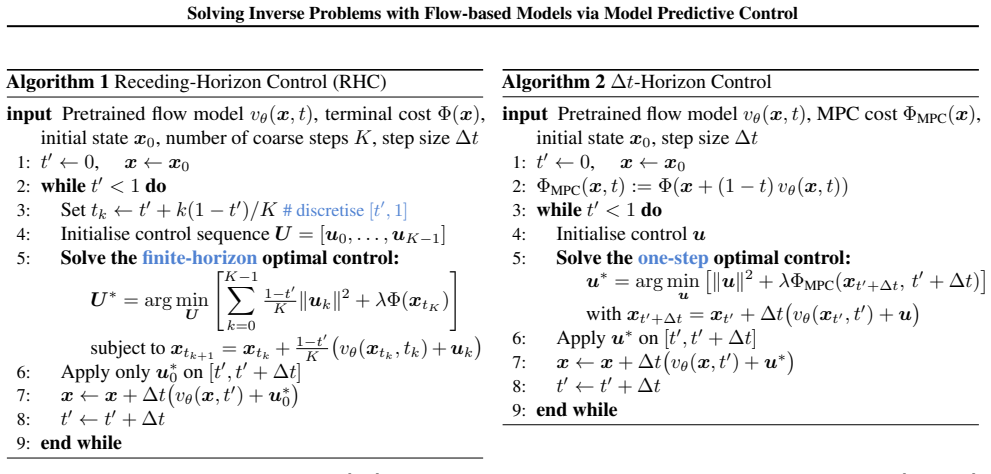
The paper establishes that conditional generation with pre-trained flow models, normally formulated as a single optimal-control problem over the whole generation interval, can be decomposed into a sequence of receding-horizon sub-problems without sacrificing optimality in the ideal case. Theorem 3.1 states that if every sub-problem, minimizing control energy plus terminal fidelity over the remaining time, is solved to optimality, the applied controls coincide with the global optimal control. Theorem 3.2 states that a Δt-horizon policy is globally optimal when its terminal cost is the true value function. In practice the paper approximates the value function with a single Euler step, V(t,x)≈Φ
What carries the argument
The central object is model predictive control: a receding-horizon strategy that, at every time t, solves a finite-horizon optimal-control problem from the current state, applies only the first control increment, and then re-plans. The paper instantiates it with two horizon choices: receding-horizon control over the full remaining interval (H=1−t) and Δt-horizon control over a single step (H=Δt). The workhorse of the fast variants is the one-step Euler approximation of the value function, which predicts the rest of the trajectory as a straight line and therefore avoids differentiating through the flow network. The control-energy term plays the role of path regularisation, keeping the guided
Load-bearing premise
The fast variants assume that what happens for the rest of the trajectory is well predicted by a single straight step from the current point; when this is false — strongly curved flow, or measurements that leave some image details completely unobserved — the control cannot steer into those unobserved directions, and the method's practical advantage collapses.
What would settle it
Run the K=1 single-step variant on an inpainting problem with a large masked region: the gradient of its objective with respect to the control has no component in the masked pixels, so those pixels should remain essentially untouched. A run that nonetheless fills in coherent texture in the masked region would contradict the paper's mechanism; alternatively, on a deliberately curved flow, the single-step value approximation should visibly mis-estimate the true cost-to-go, which would show the assumption is load-bearing.
If this is right
- Because controls are computed from local sub-problems rather than the full trajectory, memory no longer scales with the number of integration steps, which is what makes a 32B-parameter model guidable on a 24GB consumer GPU.
- The single-step (K=1) variant removes backpropagation through the flow model entirely, so it can be applied to quantised or otherwise non-differentiable large models.
- The framework applies to non-linear forward operators such as non-linear blur, where the paper reports the best SSIM among the compared methods.
- Re-planning from the current state corrects errors accumulated at earlier time steps; the paper finds this yields better reconstructions than a single global solve with comparable compute.
- Choosing K controls a spectrum from global optimal control to greedy one-step control, giving practitioners a direct trade-off between reconstruction quality and runtime.
Where Pith is reading between the lines
- An extension the paper leaves implicit: because the terminal cost is arbitrary and differentiable, MPC-Flow is not limited to inverse problems — any reward function (style, alignment, safety) can be plugged in, and the control-regularisation term gives a principled knob for how far the guided sample may depart from the prior.
- The single-Euler-step value approximation is closely related to the Tweedie estimator used in diffusion posterior sampling; improving it, for example by learning the value function, could give the fast variant both speed and the ability to fill null-space directions.
- For linear operators with large null spaces, the observed failure of K=1 suggests a hybrid: use the cheap one-step control for observed directions and a separate null-space-filling step, such as a short higher-K re-plan or a hard data-consistency projection, for the unobserved directions.
- Because the remaining horizon shrinks as generation proceeds, the effective step size is naturally finer near the end; varying K adaptively over time could yield further quality gains beyond the fixed-K results reported.
Editorial analysis
A structured set of objections, weighed in public.
Referee Report
Summary. The paper proposes MPC-Flow, a model predictive control framework for conditioning pre-trained flow-based generative models at inference time. Instead of solving the full trajectory optimal control problem (5), the method solves a sequence of shorter-horizon control sub-problems and applies only the first control increment before re-planning. Two regimes are analyzed: receding-horizon control (RHC) over the full remaining horizon, and a greedy Δt-horizon control with a predicted terminal cost. The authors prove that each regime recovers the globally optimal control under idealizing assumptions (Theorem 3.1 and Theorem 3.2), and they introduce a practical single-step variant (RHC K=1) that avoids backpropagation through the generative model, enabling scaling to FLUX.2 (32B) in 4-bit quantization. Experiments cover controlled toy and CT settings, CelebA image restoration (denoising, deblurring, super-resolution, inpainting, nonlinear deblurring), and large-model style transfer/colorization tasks.
Significance. If the formal issues are corrected, MPC-Flow is a useful unifying framework for training-free guidance of flow models. The paper is commendable for its breadth: it includes a self-contained existence proof, toy validation of the RHC optimality claim, a wide set of inverse-problem benchmarks, and a genuinely impressive scalability demonstration on a 32B-parameter model. The authors also disclose the failure mode of the K=1 variant on linear inverse problems with null space, which is a strength relative to many papers in this area. The main weaknesses are that the key theorem for the Δt-horizon variant contains a scaling error, and the practical no-backpropagation variants are not covered by the formal guarantees as advertised.
major comments (3)
- [Section 3.2, Theorem 3.2, Eq. (8), Eq. (16), Appendix B.2.2] The statement of Theorem 3.2 is incorrect as written. The Δt-horizon objective in Eq. (8) is min_u [∫_t^{t+Δt} ||u||² dτ + λ Φ_MPC(x(t+Δt), t+Δt)]. The value function V(t,x) defined in Section 3.1 already contains the terminal penalty λ Φ(x(1)). Setting Φ_MPC = V in Eq. (8) gives a terminal term λ V(t+Δt, x(t+Δt)), whereas the Bellman recursion used in Eq. (16) is V(t,x) = min_u {∫_t^{t+Δt} ||u||² dτ + V(t+Δt, x(t+Δt))}. The two problems coincide only when λ = 1. For the λ values used in the experiments (e.g., λ ≈ 10^4 in Appendix D), the Δt-horizon control is not the optimal control for problem (5). The theorem should state Φ_MPC = V/λ, or the λ in Eq. (8) should be absorbed into the value function definition. This scaling error propagates into Eq. (9) and Algorithm 2, where Φ_MPC is approximated by Φ(x+(1−t)vθ(x,t)) without the λ factor.
- [Section 3.1, Section 3.2, Eq. (9), Appendix E.1, Table 2] The formal guarantees do not cover the scalable variants that are central to the paper's practical claims. Theorem 3.1 requires solving each sub-problem (7) exactly over [t,1]; Theorem 3.2 requires the true value function as the terminal cost. The regimes that avoid backpropagation through the model — RHC K=1 and MPC-Δt with Eq. (9) — both replace these exact objects by a single-Euler-step, uncontrolled approximation of the value function. For a quadratic terminal loss, the K=1 gradient (Eq. (18)) has no component in the null space of A, and Table 2 shows the method collapses on super-resolution and random inpainting (PSNR 18.02 and 18.31 vs. PnP-Flow's 31.49 and 33.54), a failure the authors acknowledge in Appendix E.1. The abstract and introduction advertise 'theoretical guarantees' connecting MPC-Flow to the underlying optimal control objective, but those guarantees do not apply to th
- [Proposition B.1 / Appendix B.1] The existence result is stated for problem (10), whose terminal cost is Φ(x(1)) with no λ weight, whereas the main problem (5) has terminal cost λΦ(x(1)). This is a minor mismatch — the proof still works with λΦ — but it should be stated consistently. Also, the final inequality in the proof writes ∫ ||u|| dt rather than ∫ ||u||² dt, which appears to be a typo.
minor comments (4)
- [Section 3.1, Algorithm 3] The single-step RHC variant (K=1) is described in Section 3.1 but the corresponding Algorithm 3 is relegated to the appendix without a pointer in the main text. Add a reference for readability.
- [Table 2] The 'Time/img' column is measured only for the denoising task, but this is not stated in the table caption. Since runtimes are a key claimed advantage, clarify the measurement protocol.
- [Figure 3] The observation that MPC-RHC with finite K outperforms the 'global control' solution is explained by local minima in the global nonconvex optimization. This is fine, but the wording invites confusion; it should be made explicit that this is not a violation of Theorem 3.1 but an artifact of the optimizer.
- [Section 2.2, Eq. (6)] The index in the discrete dynamics is written 'k = 1, ..., N−1' after defining t_k = k/N, but the state update uses x_{t_k} with k starting at 0. Adjust the index range for consistency.
Circularity Check
No significant circularity: Bellman-principle theorems are self-contained, and the fast value-function approximation is explicitly heuristic.
full rationale
The derivation chain is not circular. Theorem 3.1 is a direct application of Bellman's principle: the proof in Appendix B.2.1 splits the global cost and observes that the receding-horizon sub-problem (7) is exactly the future-cost subproblem, so the claimed optimality is a consequence of dynamic programming, not an assumption of the result. Theorem 3.2 likewise states the standard dynamic-programming identity for the Δt-horizon problem when the terminal cost is the cost-to-go V. One caveat is a correctness issue, not a circularity: eq. (8) writes the terminal term as λΦ_MPC while the Bellman recursion (16) uses V, which already contains λΦ(x(1)); as written the two problems are not identical unless Φ_MPC = V/λ or the λ is absorbed. This makes the proof of Theorem 3.2 invalid as stated, but it does not constitute fitting a prediction to its own input. The single-Euler-step value approximation (eq. 9) is explicitly labeled a 'general-purpose heuristic', and Appendix E.1 candidly documents its failure on null-space-dominated linear inverse problems; this honesty is a limitation rather than hidden reuse of the target result. Empirical comparisons use external baselines (FlowGrad, OC-Flow, PnP-Flow, D-Flow, Flow-Priors, OT-ODE, FlowChef) with hyperparameters reported in Appendix E, so no central claim is justified solely by a self-citation. The self-citations present (Barbano et al. 2025; Denker et al. 2024) are contextual and not load-bearing. The Section G variational-regularisation reading is a mathematical reformulation of (5), not an assumption of the conclusion. Overall, the central optimality and approximation claims are self-contained; any minor self-citations do not support the derivation.
Axiom & Free-Parameter Ledger
free parameters (5)
- λ (data-consistency weight) =
Varies by task: e.g., 15 (MPC-Δt denoising), 0.1 (RHC K=1 denoising), 0.063 (RHC K=1 deblurring)
- ρ (path regularization for FLUX.2 style transfer) =
4.0 to 1024.0, with 8.0 used for the shown Figure 5 examples
- Learning rate for inner control optimization =
0.1 (MPC-Δt), 0.05 or 0.1 (RHC K=3), 0.5 or 0.2 (FLUX.2)
- Nctrl (number of control optimization steps) =
20 for most CelebA experiments, 20 for FLUX.2
- K (RHC discretisation steps) =
1 or 3 in main experiments; up to 10 in toy example
axioms (5)
- domain assumption The learned flow field v_θ is continuous, uniformly Lipschitz in x, and has at most linear growth (Appendix B.1).
- domain assumption The terminal cost Φ is lower semicontinuous (and differentiable where gradients are used).
- standard math Bellman's principle of optimality applies to the deterministic optimal control problem (5).
- ad hoc to paper The value function V(t,x) can be approximated by a single Euler step: V(t,x) ≈ Φ(x + (1-t) v_θ(x,t)) (eq. 9).
- domain assumption The pretrained flow model provides a good prior for the data distribution and is well-matched to the inverse problem.
read the original abstract
Flow-based generative models provide strong unconditional priors for inverse problems, but guiding their dynamics for conditional generation remains challenging. Recent work casts training-free conditional generation in flow models as an optimal control problem; however, solving the resulting trajectory optimisation is computationally and memory intensive, requiring differentiation through the flow dynamics or adjoint solves. We propose MPC-Flow, a model predictive control framework that formulates inverse problem solving with flow-based generative models as a sequence of control sub-problems, enabling practical optimal control-based guidance at inference time. We provide theoretical analysis linking MPC-Flow to the underlying optimal control objective and show how different algorithmic choices yield a spectrum of guidance algorithms, including regimes that avoid backpropagation through the generative model trajectory. We evaluate MPC-Flow on benchmark image restoration tasks, spanning linear and non-linear settings such as in-painting, deblurring, and super-resolution, and demonstrate strong performance and scalability to massive state-of-the-art architectures via training-free guidance of FLUX.2 (32B) in a quantised setting on consumer hardware.
Figures



Forward citations
Cited by 1 Pith paper
-
A Stability Benchmark of Generative Regularizers for Inverse Problems
Numerical benchmarks indicate generative regularizers deliver strong reconstructions in some imaging inverse problem settings but can be unstable or problematic under imperfect conditions compared to variational methods.
Reference graph
Works this paper leans on
-
[1]
write newline
" write newline "" before.all 'output.state := FUNCTION n.dashify 't := "" t empty not t #1 #1 substring "-" = t #1 #2 substring "--" = not "--" * t #2 global.max substring 't := t #1 #1 substring "-" = "-" * t #2 global.max substring 't := while if t #1 #1 substring * t #2 global.max substring 't := if while FUNCTION format.date year duplicate empty "emp...
-
[2]
Albergo, M. S. and Vanden-Eijnden, E. Building normalizing flows with stochastic interpolants. arXiv preprint arXiv:2209.15571, 2022
Pith/arXiv arXiv 2022
-
[3]
H., Arridge, S., Maass, P., Jin, B., and Ye, J
Barbano, R., Denker, A., Chung, H., Roh, T. H., Arridge, S., Maass, P., Jin, B., and Ye, J. C. Steerable conditional diffusion for out-of-distribution adaptation in medical image reconstruction. IEEE Transactions on Medical Imaging, 2025
2025
-
[4]
Conditional image generation with score-based diffusion models
Batzolis, G., Stanczuk, J., Sch \"o nlieb, C.-B., and Etmann, C. Conditional image generation with score-based diffusion models. arXiv preprint arXiv:2111.13606, 2021
Pith/arXiv arXiv 2021
-
[5]
D-flow: Differentiating through flows for controlled generation
Ben-Hamu, H., Puny, O., Gat, I., Karrer, B., Singer, U., and Lipman, Y. D-flow: Differentiating through flows for controlled generation. arXiv preprint arXiv:2402.14017, 2024
Pith/arXiv arXiv 2024
-
[6]
An optimal control perspective on diffusion-based generative modeling
Berner, J., Richter, L., and Ullrich, K. An optimal control perspective on diffusion-based generative modeling. arXiv preprint arXiv:2211.01364, 2022
Pith/arXiv arXiv 2022
-
[7]
T., Rubanova, Y., Bettencourt, J., and Duvenaud, D
Chen, R. T., Rubanova, Y., Bettencourt, J., and Duvenaud, D. K. Neural ordinary differential equations. Advances in neural information processing systems, 31, 2018
2018
-
[8]
Training deep nets with sublinear memory cost
Chen, T., Xu, B., Zhang, C., and Guestrin, C. Training deep nets with sublinear memory cost. arXiv preprint arXiv:1604.06174, 2016
Pith/arXiv arXiv 2016
-
[9]
Chung, H., Kim, J., Mccann, M. T., Klasky, M. L., and Ye, J. C. Diffusion posterior sampling for general noisy inverse problems. arXiv preprint arXiv:2209.14687, 2022
Pith/arXiv arXiv 2022
-
[10]
J., and Lio, P
Denker, A., Vargas, F., Padhy, S., Didi, K., Mathis, S., Barbano, R., Dutordoir, V., Mathieu, E., Komorowska, U. J., and Lio, P. Deft: Efficient fine-tuning of diffusion models by learning the generalised h -transform. Advances in Neural Information Processing Systems, 37: 0 19636--19682, 2024
2024
-
[11]
and Nichol, A
Dhariwal, P. and Nichol, A. Diffusion models beat gans on image synthesis. Advances in neural information processing systems, 34: 0 8780--8794, 2021
2021
-
[12]
Domingo-Enrich, C., Drozdzal, M., Karrer, B., and Chen, R. T. Adjoint matching: Fine-tuning flow and diffusion generative models with memoryless stochastic optimal control. arXiv preprint arXiv:2409.08861, 2024
Pith/arXiv arXiv 2024
-
[13]
J., et al
Doucet, A., De Freitas, N., Gordon, N. J., et al. Sequential Monte Carlo methods in practice, volume 1. Springer, 2001
2001
-
[14]
W., Hanke, M., and Neubauer, A
Engl, H. W., Hanke, M., and Neubauer, A. Regularization of Inverse Problems. Mathematics and Its Applications. Springer, Dordrecht, 1996
1996
-
[15]
Erbach, J., Narnhofer, D., Dombos, A., Schiele, B., Lenssen, J. E., and Schindler, K. Solving inverse problems with flair. arXiv preprint arXiv:2506.02680, 2025
arXiv 2025
-
[16]
Scaling rectified flow transformers for high-resolution image synthesis
Esser, P., Kulal, S., Blattmann, A., Entezari, R., M \"u ller, J., Saini, H., Levi, Y., Lorenz, D., Sauer, A., Boesel, F., et al. Scaling rectified flow transformers for high-resolution image synthesis. In Forty-first international conference on machine learning, 2024
2024
-
[17]
Fleming, W. H. and Rishel, R. W. Deterministic and stochastic optimal control, volume 1. Springer Science & Business Media, 2012
2012
-
[18]
E., Prett, D
Garcia, C. E., Prett, D. M., and Morari, M. Model predictive control: Theory and practice—a survey. Automatica, 25 0 (3): 0 335--348, 1989
1989
-
[19]
Reinforcement learning with deep energy-based policies
Haarnoja, T., Tang, H., Abbeel, P., and Levine, S. Reinforcement learning with deep energy-based policies. In International conference on machine learning, pp.\ 1352--1361. PMLR, 2017
2017
-
[20]
Denoising diffusion probabilistic models
Ho, J., Jain, A., and Abbeel, P. Denoising diffusion probabilistic models. Advances in neural information processing systems, 33: 0 6840--6851, 2020
2020
-
[21]
J., Shen, Y., Wallis, P., Allen-Zhu, Z., Li, Y., Wang, S., Wang, L., Chen, W., et al
Hu, E. J., Shen, Y., Wallis, P., Allen-Zhu, Z., Li, Y., Wang, S., Wang, L., Chen, W., et al. Lora: Low-rank adaptation of large language models. ICLR, 1 0 (2): 0 3, 2022
2022
-
[22]
Kim, J., Kim, B. S., and Ye, J. C. Flowdps: Flow-driven posterior sampling for inverse problems. arXiv preprint arXiv:2503.08136, 2025
Pith/arXiv arXiv 2025
-
[23]
Kingma, D. P. Adam: A method for stochastic optimization. arXiv preprint arXiv:1412.6980, 2014
Pith/arXiv arXiv 2014
-
[24]
Labs, B. F. FLUX.2: Frontier Visual Intelligence . https://bfl.ai/blog/flux-2, 2025
2025
-
[25]
Derivative-free guidance in continuous and discrete diffusion models with soft value-based decoding
Li, X., Zhao, Y., Wang, C., Scalia, G., Eraslan, G., Nair, S., Biancalani, T., Ji, S., Regev, A., Levine, S., et al. Derivative-free guidance in continuous and discrete diffusion models with soft value-based decoding. arXiv preprint arXiv:2408.08252, 2024
Pith/arXiv arXiv 2024
-
[26]
Calculus of variations and optimal control theory: a concise introduction
Liberzon, D. Calculus of variations and optimal control theory: a concise introduction. Princeton university press, 2011
2011
-
[27]
T., Ben-Hamu, H., Nickel, M., and Le, M
Lipman, Y., Chen, R. T., Ben-Hamu, H., Nickel, M., and Le, M. Flow matching for generative modeling. arXiv preprint arXiv:2210.02747, 2022
Pith/arXiv arXiv 2022
-
[28]
T., Lopez-Paz, D., Ben-Hamu, H., and Gat, I
Lipman, Y., Havasi, M., Holderrieth, P., Shaul, N., Le, M., Karrer, B., Chen, R. T., Lopez-Paz, D., Ben-Hamu, H., and Gat, I. Flow matching guide and code. arXiv preprint arXiv:2412.06264, 2024
Pith/arXiv arXiv 2024
-
[29]
Rectified flow: A marginal preserving approach to optimal transport
Liu, Q. Rectified flow: A marginal preserving approach to optimal transport. arXiv preprint arXiv:2209.14577, 2022
Pith/arXiv arXiv 2022
-
[30]
Flow straight and fast: Learning to generate and transfer data with rectified flow
Liu, X., Gong, C., and Liu, Q. Flow straight and fast: Learning to generate and transfer data with rectified flow. arXiv preprint arXiv:2209.03003, 2022
Pith/arXiv arXiv 2022
-
[31]
Flowgrad: Controlling the output of generative odes with gradients
Liu, X., Wu, L., Zhang, S., Gong, C., Ping, W., and Liu, Q. Flowgrad: Controlling the output of generative odes with gradients. In Proceedings of the IEEE/CVF Conference on Computer Vision and Pattern Recognition, pp.\ 24335--24344, 2023
2023
-
[32]
Z., Domingo-Enrich, C., Liu, W., and Zhang, D
Liu, Z., Xiao, T. Z., Domingo-Enrich, C., Liu, W., and Zhang, D. Value gradient guidance for flow matching alignment. arXiv preprint arXiv:2512.05116, 2025
arXiv 2025
-
[33]
A variational perspective on solving inverse problems with diffusion models
Mardani, M., Song, J., Kautz, J., and Vahdat, A. A variational perspective on solving inverse problems with diffusion models. arXiv preprint arXiv:2305.04391, 2023
Pith/arXiv arXiv 2023
-
[34]
Pnp-flow: Plug-and-play image restoration with flow matching
Martin, S., Gagneux, A., Hagemann, P., and Steidl, G. Pnp-flow: Plug-and-play image restoration with flow matching. arXiv preprint arXiv:2410.02423, 2024
Pith/arXiv arXiv 2024
-
[35]
M., Draxler, F., Karaletsos, T., and Mandt, S
Pandey, K., Sofian, F. M., Draxler, F., Karaletsos, T., and Mandt, S. Variational control for guidance in diffusion models. arXiv preprint arXiv:2502.03686, 2025
Pith/arXiv arXiv 2025
-
[36]
Patel, M., Wen, S., Metaxas, D. N., and Yang, Y. Steering rectified flow models in the vector field for controlled image generation. arXiv preprint arXiv:2412.00100, 2024
Pith/arXiv arXiv 2024
-
[37]
Pokle, A., Muckley, M. J., Chen, R. T., and Karrer, B. Training-free linear image inverses via flows. arXiv preprint arXiv:2310.04432, 2023
Pith/arXiv arXiv 2023
-
[38]
Qin, S. J. and Badgwell, T. A. A survey of industrial model predictive control technology. Control engineering practice, 11 0 (7): 0 733--764, 2003
2003
-
[39]
W., Hallacy, C., Ramesh, A., Goh, G., Agarwal, S., Sastry, G., Askell, A., Mishkin, P., Clark, J., et al
Radford, A., Kim, J. W., Hallacy, C., Ramesh, A., Goh, G., Agarwal, S., Sastry, G., Askell, A., Mishkin, P., Clark, J., et al. Learning transferable visual models from natural language supervision. In International conference on machine learning, pp.\ 8748--8763. PmLR, 2021
2021
-
[40]
B., Mayne, D
Rawlings, J. B., Mayne, D. Q., Diehl, M., et al. Model predictive control: theory, computation, and design, volume 2. Nob Hill Publishing Madison, WI, 2020
2020
-
[41]
Rb-modulation: Training-free personalization of diffusion models using stochastic optimal control
Rout, L., Chen, Y., Ruiz, N., Kumar, A., Caramanis, C., Shakkottai, S., and Chu, W.-S. Rb-modulation: Training-free personalization of diffusion models using stochastic optimal control. arXiv preprint arXiv:2405.17401, 2024
Pith/arXiv arXiv 2024
-
[42]
M., Zhang, Z., Hu, X., Qu, Q., and Shen, L
Song, B., Kwon, S. M., Zhang, Z., Hu, X., Qu, Q., and Shen, L. Solving inverse problems with latent diffusion models via hard data consistency. arXiv preprint arXiv:2307.08123, 2023
Pith/arXiv arXiv 2023
-
[43]
P., Kumar, A., Ermon, S., and Poole, B
Song, Y., Sohl-Dickstein, J., Kingma, D. P., Kumar, A., Ermon, S., and Poole, B. Score-based generative modeling through stochastic differential equations. arXiv preprint arXiv:2011.13456, 2020
Pith/arXiv arXiv 2011
-
[44]
Stuart, A. M. Inverse problems: a bayesian perspective. Acta numerica, 19: 0 451--559, 2010
2010
-
[45]
Improving and generalizing flow-based generative models with minibatch optimal transport
Tong, A., Fatras, K., Malkin, N., Huguet, G., Zhang, Y., Rector-Brooks, J., Wolf, G., and Bengio, Y. Improving and generalizing flow-based generative models with minibatch optimal transport. arXiv preprint arXiv:2302.00482, 2023
Pith/arXiv arXiv 2023
-
[46]
T., Phung, Q., and Hoai, M
Tran, P., Tran, A. T., Phung, Q., and Hoai, M. Explore image deblurring via encoded blur kernel space. In Proceedings of the IEEE/CVF conference on computer vision and pattern recognition, pp.\ 11956--11965, 2021
2021
-
[47]
Inference-time alignment in diffusion models with reward-guided generation: Tutorial and review
Uehara, M., Zhao, Y., Wang, C., Li, X., Regev, A., Levine, S., and Biancalani, T. Inference-time alignment in diffusion models with reward-guided generation: Tutorial and review. arXiv preprint arXiv:2501.09685, 2025
Pith/arXiv arXiv 2025
-
[48]
Vargas, F., Grathwohl, W., and Doucet, A. Denoising diffusion samplers. arXiv preprint arXiv:2302.13834, 2023
Pith/arXiv arXiv 2023
-
[49]
Diffusers: State-of-the-art diffusion models
von Platen, P., Patil, S., Lozhkov, A., Cuenca, P., Lambert, N., Rasul, K., Davaadorj, M., Nair, D., Paul, S., Berman, W., Xu, Y., Liu, S., and Wolf, T. Diffusers: State-of-the-art diffusion models. https://github.com/huggingface/diffusers, 2022
2022
-
[50]
Dmplug: A plug-in method for solving inverse problems with diffusion models
Wang, H., Zhang, X., Li, T., Wan, Y., Chen, T., and Sun, J. Dmplug: A plug-in method for solving inverse problems with diffusion models. Advances in Neural Information Processing Systems, 37: 0 117881--117916, 2024 a
2024
-
[51]
Training free guided flow matching with optimal control
Wang, L., Cheng, C., Liao, Y., Qu, Y., and Liu, G. Training free guided flow matching with optimal control. arXiv preprint arXiv:2410.18070, 2024 b
Pith/arXiv arXiv 2024
-
[52]
Wang, Y., Lu, J., Jaitly, N., Susskind, J., and Bautista, M. A. Simplefold: Folding proteins is simpler than you think. arXiv preprint arXiv:2509.18480, 2025
arXiv 2025
-
[53]
Medmnist classification decathlon: A lightweight automl benchmark for medical image analysis
Yang, J., Shi, R., and Ni, B. Medmnist classification decathlon: A lightweight automl benchmark for medical image analysis. In IEEE 18th International Symposium on Biomedical Imaging (ISBI), pp.\ 191--195, 2021
2021
-
[54]
Medmnist v2-a large-scale lightweight benchmark for 2d and 3d biomedical image classification
Yang, J., Shi, R., Wei, D., Liu, Z., Zhao, L., Ke, B., Pfister, H., and Ni, B. Medmnist v2-a large-scale lightweight benchmark for 2d and 3d biomedical image classification. Scientific Data, 10 0 (1): 0 41, 2023
2023
-
[55]
From facial parts responses to face detection: A deep learning approach
Yang, S., Luo, P., Loy, C.-C., and Tang, X. From facial parts responses to face detection: A deep learning approach. In Proceedings of the IEEE international conference on computer vision, pp.\ 3676--3684, 2015
2015
-
[56]
Adding conditional control to text-to-image diffusion models
Zhang, L., Rao, A., and Agrawala, M. Adding conditional control to text-to-image diffusion models. In Proceedings of the IEEE/CVF international conference on computer vision, pp.\ 3836--3847, 2023
2023
-
[57]
Zhang, Q. and Chen, Y. Path integral sampler: a stochastic control approach for sampling. arXiv preprint arXiv:2111.15141, 2021
Pith/arXiv arXiv 2021
-
[58]
N., and Leong, O
Zhang, Y., Yu, P., Zhu, Y., Chang, Y., Gao, F., Wu, Y. N., and Leong, O. Flow priors for linear inverse problems via iterative corrupted trajectory matching. Advances in Neural Information Processing Systems, 37: 0 57389--57417, 2024
2024
discussion (0)
Sign in with ORCID, Apple, or X to comment. Anyone can read and Pith papers without signing in.