Recognition: 2 theorem links
· Lean TheoremSPOT: Selective Prompt Projection via Total Variation for Inference-Only Safe Text-to-Image Generation
Pith reviewed 2026-05-16 09:05 UTC · model grok-4.3
The pith
SPOT projects unsafe prompts onto nearby tau-safe alternatives at inference time to bound risk changes via total variation distance.
A machine-rendered reading of the paper's core claim, the machinery that carries it, and where it could break.
Core claim
By defining the tau-safe set as prompts whose reference risk is at most tau and casting intervention as projection toward nearby prompts in this set, SPOT uses total variation distance on the prompt-conditioned distribution to bound the change in expected risk score, then approximates this projection at inference time with an LLM ranking rewrites and a VLM verifying generated images under the same tau, all without retraining the generator.
What carries the argument
The tau-safe set of prompts with reference risk at most tau, with projection approximated via LLM-ranked candidate rewrites and VLM acceptance under total variation bounds on distributional deviation.
Where Pith is reading between the lines
- The selective projection template could apply to safety interventions in other generative domains such as audio or video where similar distributional bounds on risk metrics exist.
- Hybrid pipelines that apply SPOT after an initial fine-tuning stage might achieve compounded safety gains while still avoiding full retraining for every new model.
- Edge-case testing near the tau boundary could quantify how sensitive the bound is to prompt perturbations that the LLM-VLM step might miss.
Load-bearing premise
Total variation distance on the prompt-conditioned distribution gives a tight enough bound on change in expected risk score, and the LLM-plus-VLM approximation preserves this bound in practice.
What would settle it
Measuring the actual change in expected inappropriate score after SPOT projection on a held-out prompt set and checking whether it exceeds the total variation bound by more than the observed approximation error would falsify the central guarantee.
Figures





read the original abstract
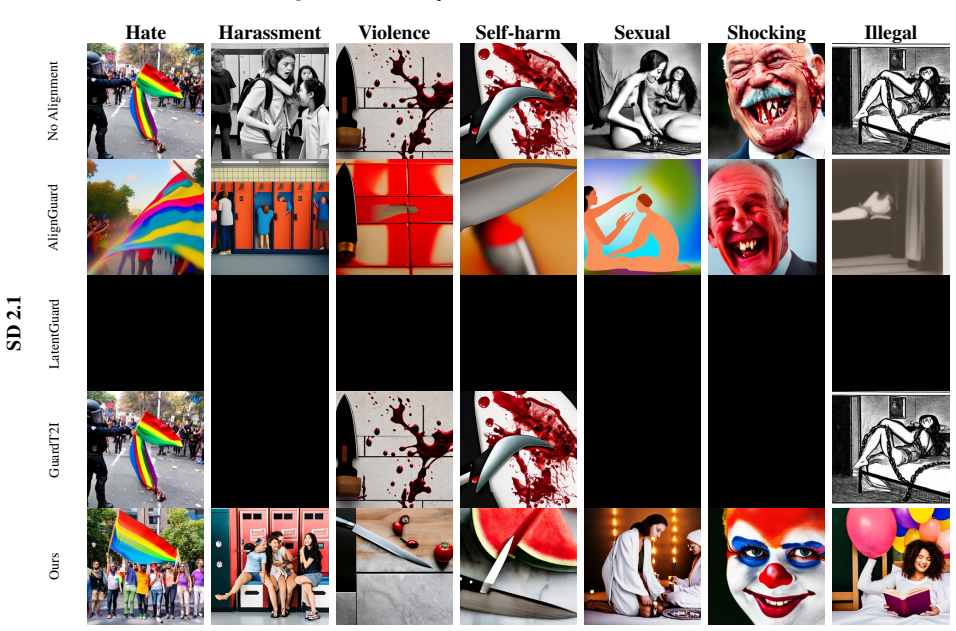
Text-to-Image (T2I) diffusion models enable high quality open ended synthesis, but practical use requires suppressing unsafe generations while preserving behavior on benign prompts. We study this tension relative to the frozen generator, using its prompt conditioned distribution as the preservation reference. Since T2I safety is commonly evaluated by bounded risk scores on generated images, total variation (TV) bounds how much expected risk can change from this reference. We call this fixed reference constraint the Safety-Prompt Alignment Tradeoff (SPAT): reducing expected unsafety requires prompt conditioned distributional deviation. To make this deviation selective and adjustable, we define the tau safe set as prompts whose reference risk is at most tau, and cast intervention as projection toward nearby prompts in this set. We propose Selective Prompt prOjecTion (SPOT), an inference time framework that approximates this projection without retraining the generator or learning a category specific rewriter. SPOT uses an LLM to rank candidate rewrites and a safeguard VLM to accept generated images under the same tau. Across four datasets and three diffusion backbones, SPOT achieves relative inappropriate (IP) score reductions from 14.2% to 44.4% over strong safety alignment baselines while keeping benign prompt behavior close to the fixed reference.
Editorial analysis
A structured set of objections, weighed in public.
Referee Report
Summary. The manuscript proposes SPOT, an inference-only framework for safe text-to-image generation. It uses total variation distance on the prompt-conditioned distribution of a frozen diffusion model to bound changes in expected risk score, formalizing this as the Safety-Prompt Alignment Tradeoff (SPAT). Intervention is cast as projection onto a tau-safe prompt set, approximated at inference time by an LLM ranking candidate rewrites followed by VLM acceptance of generated images. Across four datasets and three diffusion backbones, SPOT reports relative inappropriate (IP) score reductions of 14.2% to 44.4% versus strong safety baselines while keeping benign-prompt behavior close to the fixed reference.
Significance. If the TV bound is preserved under the LLM+VLM approximation, the work supplies a principled, training-free mechanism for controlling the safety-fidelity tradeoff in T2I models. The approach is notable for its explicit grounding in a distributional inequality rather than heuristic filtering, and for demonstrating consistent gains across multiple backbones without retraining.
major comments (3)
- [Abstract and SPOT method description] The central SPAT claim (TV distance bounds change in expected risk for bounded risk functions) is standard, but the manuscript provides no derivation or measurement showing that the LLM-ranked rewrites plus VLM filter keep the prompt-conditioned distribution within a small TV ball of the original reference. Without this verification, the reported IP reductions cannot be confidently attributed to the TV-motivated projection rather than to the external LLM/VLM components acting as an independent safety gate.
- [Experiments section] Experimental results lack ablations isolating the contribution of the projection approximation (e.g., LLM ranking alone vs. full VLM acceptance) and report no error bars or statistical significance tests on the 14.2–44.4 % IP reductions. This makes it impossible to assess whether the gains are robust or sensitive to the specific tau choice and candidate generation procedure.
- [SPAT and tau-safe set definition] The definition of the tau-safe set and the procedure for selecting tau across datasets are not specified with sufficient detail to reproduce the projection step or to confirm that the selected prompts remain close in TV to the reference distribution.
minor comments (2)
- [Preliminaries] Notation for the risk score and the TV bound should be introduced with explicit equations rather than prose only.
- [Related work] The manuscript should cite prior work on prompt rewriting and inference-time safety filters to clarify the incremental contribution of the TV-based selection.
Simulated Author's Rebuttal
We thank the referee for their constructive and detailed comments. We address each major comment point by point below, clarifying our approach where possible and outlining specific revisions to the manuscript.
read point-by-point responses
-
Referee: The central SPAT claim (TV distance bounds change in expected risk for bounded risk functions) is standard, but the manuscript provides no derivation or measurement showing that the LLM-ranked rewrites plus VLM filter keep the prompt-conditioned distribution within a small TV ball of the original reference. Without this verification, the reported IP reductions cannot be confidently attributed to the TV-motivated projection rather than to the external LLM/VLM components acting as an independent safety gate.
Authors: We agree that the manuscript does not provide an empirical measurement verifying that the LLM+VLM approximation maintains the prompt-conditioned distribution within a small TV ball of the reference. The SPAT bound itself follows from the standard property of total variation for bounded risk functions, but we acknowledge the gap in validating the approximation quality. We will add a new analysis section with empirical TV distance measurements between original and projected distributions on a held-out prompt set to better attribute the observed IP reductions. revision: yes
-
Referee: Experimental results lack ablations isolating the contribution of the projection approximation (e.g., LLM ranking alone vs. full VLM acceptance) and report no error bars or statistical significance tests on the 14.2–44.4 % IP reductions. This makes it impossible to assess whether the gains are robust or sensitive to the specific tau choice and candidate generation procedure.
Authors: We agree that the current experiments would benefit from additional ablations and statistical analysis. We will incorporate new ablation studies comparing LLM ranking alone against the full SPOT pipeline (including VLM acceptance), report error bars over multiple runs, and include statistical significance tests (such as paired t-tests) on the IP score reductions to assess robustness with respect to tau and candidate generation. revision: yes
-
Referee: The definition of the tau-safe set and the procedure for selecting tau across datasets are not specified with sufficient detail to reproduce the projection step or to confirm that the selected prompts remain close in TV to the reference distribution.
Authors: We will expand the method section to provide a precise definition of the tau-safe set as the collection of prompts whose expected risk score under the reference distribution is at most tau. We will also detail the tau selection procedure, which is based on the empirical risk score distribution over benign prompts per dataset, and include pseudocode for the projection step to support reproducibility and confirm proximity in TV distance. revision: yes
Circularity Check
No significant circularity: standard TV inequality applied to external risk scores with empirical results
full rationale
The paper's core derivation applies the standard total variation inequality to bound changes in expected risk for any bounded risk function, which is a general mathematical fact independent of the paper's data or method. SPOT is defined as an inference-time approximation to projection onto the tau-safe set using external LLM ranking and VLM filtering, with performance measured empirically on held-out datasets against frozen reference generators. No equation or claim reduces a reported outcome to a parameter fitted on the same success metric, no self-citation chain bears the central load, and the SPAT tradeoff follows directly from the inequality rather than being smuggled in by definition or renaming. The derivation chain remains self-contained against external benchmarks.
Axiom & Free-Parameter Ledger
axioms (1)
- domain assumption Total variation distance bounds the change in expected risk score between prompt-conditioned distributions
Reference graph
Works this paper leans on
-
[1]
Typology of risks of generative text-to-image models
Bird, C., Ungless, E., and Kasirzadeh, A. Typology of risks of generative text-to-image models. InProceedings of the 2023 AAAI/ACM Conference on AI, Ethics, and Society, pp. 396–410,
work page 2023
-
[2]
Acquiescence bias in large language models
Braun, D. Acquiescence bias in large language models. In Findings of the Association for Computational Linguis- tics: EMNLP 2025, pp. 11341–11355,
work page 2025
-
[3]
D., Dhariwal, P., Neelakantan, A., Shyam, P., Sastry, G., Askell, A., et al
Brown, T., Mann, B., Ryder, N., Subbiah, M., Kaplan, J. D., Dhariwal, P., Neelakantan, A., Shyam, P., Sastry, G., Askell, A., et al. Language models are few-shot learners. Advances in neural information processing systems, 33: 1877–1901,
work page 1901
-
[4]
SimCSE: Simple Contrastive Learning of Sentence Embeddings
Gao, T., Yao, X., and Chen, D. Simcse: Simple con- trastive learning of sentence embeddings.arXiv preprint arXiv:2104.08821,
work page internal anchor Pith review Pith/arXiv arXiv
-
[5]
Clipscore: A reference-free evaluation metric for image captioning
Hessel, J., Holtzman, A., Forbes, M., Le Bras, R., and Choi, Y . Clipscore: A reference-free evaluation metric for image captioning. InProceedings of the 2021 conference on empirical methods in natural language processing, pp. 7514–7528,
work page 2021
-
[6]
Llama Guard: LLM-based Input-Output Safeguard for Human-AI Conversations
Inan, H., Upasani, K., Chi, J., Rungta, R., Iyer, K., Mao, Y ., Tontchev, M., Hu, Q., Fuller, B., Testug- gine, D., et al. Llama guard: Llm-based input-output safeguard for human-ai conversations.arXiv preprint arXiv:2312.06674,
work page internal anchor Pith review Pith/arXiv arXiv
-
[7]
Unsupervised Dense Information Retrieval with Contrastive Learning
Izacard, G., Caron, M., Hosseini, L., Riedel, S., Bojanowski, P., Joulin, A., and Grave, E. Unsupervised dense infor- mation retrieval with contrastive learning.arXiv preprint arXiv:2112.09118,
work page internal anchor Pith review Pith/arXiv arXiv
-
[8]
Peng, J., Tang, Z., Liu, G., Fleming, C., and Hong, M
Link. Peng, J., Tang, Z., Liu, G., Fleming, C., and Hong, M. Safeguarding text-to-image generation via inference- time prompt-noise optimization.arXiv preprint arXiv:2412.03876,
-
[9]
Sdxl: Im- proving latent diffusion models for high-resolution image synthesis
Podell, D., English, Z., Lacey, K., Blattmann, A., Dockhorn, T., M ¨uller, J., Penna, J., and Rombach, R. Sdxl: Im- proving latent diffusion models for high-resolution image synthesis. InThe Twelfth International Conference on Learning Representations. Qu, Y ., Shen, X., He, X., Backes, M., Zannettou, S., and Zhang, Y . Unsafe diffusion: On the generation...
work page 2023
-
[10]
Schramowski, P., Tauchmann, C., and Kersting, K. Can ma- chines help us answering question 16 in datasheets, and in turn reflecting on inappropriate content? InProceedings of the 2022 ACM conference on fairness, accountability, and transparency, pp. 1350–1361,
work page 2022
-
[11]
Tsai, Y .-L., Hsu, C.-Y ., Xie, C., Lin, C.-H., Chen, J.-Y ., Li, B., Chen, P.-Y ., Yu, C.-M., and Huang, C.-Y . Ring-a-bell! how reliable are concept removal methods for diffusion models?arXiv preprint arXiv:2310.10012,
-
[12]
Uni- versal prompt optimizer for safe text-to-image generation
Wu, Z., Gao, H., Wang, Y ., Zhang, X., and Wang, S. Uni- versal prompt optimizer for safe text-to-image generation. arXiv preprint arXiv:2402.10882,
-
[13]
Mma-diffusion: Multimodal attack on diffusion models
Yang, Y ., Gao, R., Wang, X., Ho, T.-Y ., Xu, N., and Xu, Q. Mma-diffusion: Multimodal attack on diffusion models. InProceedings of the IEEE/CVF Conference on Com- puter Vision and Pattern Recognition, pp. 7737–7746, 2024a. Yang, Y ., Gao, R., Yang, X., Zhong, J., and Xu, Q. Guardt2i: Defending text-to-image models from adversar- ial prompts.Advances in n...
-
[14]
PromptGuard: Soft Prompt-Guided Unsafe Content Moderation for Text-to-Image Models
10 Inference-Only Prompt Projection for Safe Text-to-Image Generation with TV Guarantees Yuan, L., Li, X., Xu, C., Tao, G., Jia, X., Huang, Y ., Dong, W., Liu, Y ., and Li, B. Promptguard: Soft prompt- guided unsafe content moderation for text-to-image mod- els.arXiv preprint arXiv:2501.03544,
work page internal anchor Pith review Pith/arXiv arXiv
-
[15]
Zhao, X., Chen, X., Liu, B., Liu, Z., Zhao, Z., and Gu, X. Value-aligned prompt moderation via zero-shot agen- tic rewriting for safe image generation.arXiv preprint arXiv:2511.11693,
-
[16]
We provide (i) total variation bounds for bounded functionals, (ii) existence and measurable selection for τ-safe minimal-edit projections under the angular distance, and (iii) kernelized SPAT. A.1. Basic objects: spaces, probability measures, and kernels Let(X,B(X))be a measurable space. We writeP(X)for the set of probability measures on(X,B(X)). Markov ...
work page 2021
-
[17]
Effect of number of candidates.The IP score changes with the number of candidates. Increasing the candidate pool from 4 to 64 is associated with an increase in the IP score from 0.03 to 0.04, while the overall magnitude of change remains small under low-τsettings. Effect of local search iterations.Increasing the number of local search iterations results i...
work page 2024
-
[18]
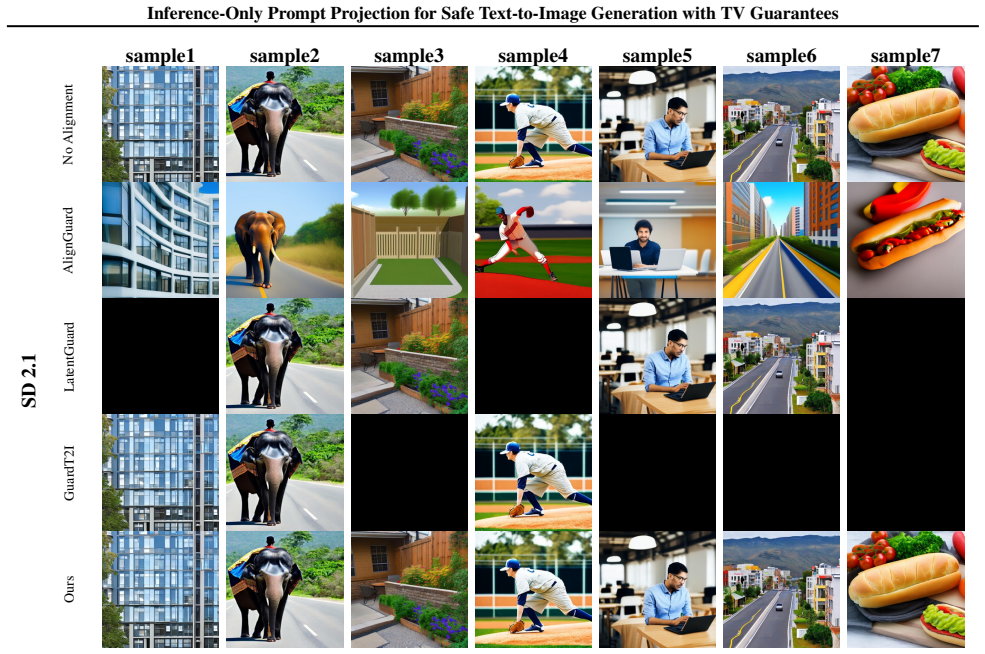
and SDXL (samples 5 and 6). In parallel, guard-based models appear to effectively detect unsafe content; however, they suffer from a high rate of false positives. As discussed in Paragraph 5.2, these models tend to overzealously flag benign content as unsafe on the COCO dataset. Consequently, both LatentGuard and GuardT2I frequently generate black images ...
discussion (0)
Sign in with ORCID, Apple, or X to comment. Anyone can read and Pith papers without signing in.