Recognition: 2 theorem links
· Lean TheoremReplica Phase Transition with Quantum Gravity Corrections
Pith reviewed 2026-05-16 09:08 UTC · model grok-4.3
The pith
A phase transition arises in the boundary effective theory for near-extremal black holes due to competition between connected and disconnected replica configurations.
A machine-rendered reading of the paper's core claim, the machinery that carries it, and where it could break.
Core claim
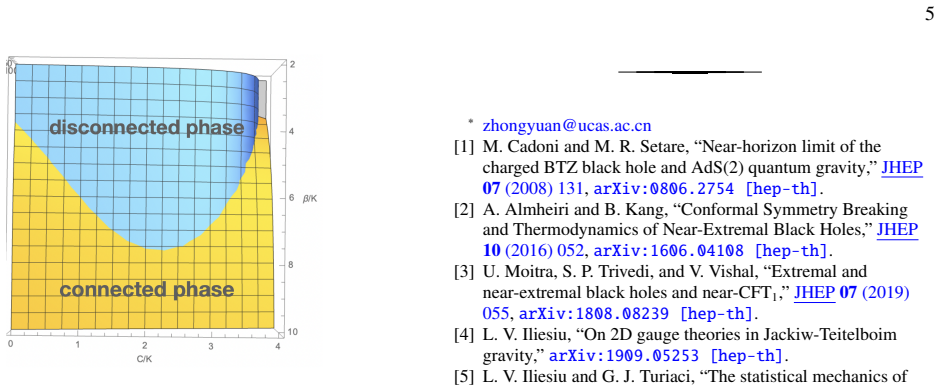
The central claim is that the partition function of the boundary theory consisting of the Schwarzian mode and U(1) phase mode on connected geometries reveals a phase transition in the near-extremal regime, where the dominance shifts between connected and disconnected configurations depending on temperature and the parameters C, K, and E, leading to a modified entropy.
What carries the argument
The Schwarzian plus U(1) phase mode boundary effective theory, which describes the near-horizon fluctuations and is used to compute the replica partition function.
If this is right
- The entropy exhibits distinct behaviors in different phases controlled by the couplings.
- Disconnected configurations dominate in certain temperature ranges, altering the replica wormhole contributions.
- The phase structure depends on the specific values of C, K, and E.
- This framework allows for systematic inclusion of quantum gravity corrections in black hole thermodynamics.
Where Pith is reading between the lines
- Similar phase transitions may appear in other extremal black hole systems with additional symmetries.
- The transition could affect the calculation of higher moments of the partition function in the replica trick.
- This might provide insights into the information paradox resolution through modified replica calculations.
Load-bearing premise
The 1d effective theory of Schwarzian mode plus U(1) phase accurately describes the near-horizon fluctuations on connected geometries for the near-extremal RN black hole.
What would settle it
Computing the partition function numerically or exactly for specific values of C, K, E and temperature and checking if the entropy shows a sharp transition at the predicted critical point.
Figures


read the original abstract
Motivated by bulk replica wormholes, we study the boundary effective theory that describes the near-horizon fluctuations of a near-extremal Reissner-Nordstr\"om black hole. This theory consists of a Schwarzian mode and a $U(1)$ phase mode. We compute the partition function of this boundary theory on connected geometries, from which the entropy is derived. Our analysis reveals a rich phase structure, in which the dominance of connected or disconnected configurations leads to a phase transition controlled by the temperature and the coupling constants $C$, $K$, and $\mathcal{E}$ of the 1d effective theory.
Editorial analysis
A structured set of objections, weighed in public.
Referee Report
Summary. The manuscript studies the boundary effective theory for near-horizon fluctuations of a near-extremal Reissner-Nordström black hole, consisting of a Schwarzian mode and a U(1) phase mode. It computes the partition function of this theory on connected geometries, derives the entropy, and reports a phase transition between connected and disconnected replica configurations controlled by temperature and the couplings C, K, and E.
Significance. If the central claim holds, the work contributes to the study of replica wormholes and quantum gravity corrections in black hole thermodynamics. The identification of a rich phase structure in the 1d effective theory could inform holographic models of entanglement and the information paradox. The approach builds on established near-extremal limits, but its impact depends on the robustness of the effective-theory approximation for connected geometries.
major comments (3)
- [§2] §2 (effective action derivation): The 1d Schwarzian + U(1) action is assumed to capture near-horizon fluctuations on connected replica geometries, but no explicit derivation from the bulk RN metric is provided, nor is its validity range checked when the replica parameter n approaches 1 or when saddle-point free energies cross. Additional bulk modes could shift the transition location.
- [§3] §3 (partition function): The computation of the connected partition function lacks error estimates, convergence checks, or comparisons to known limits (high-T or extremal regimes). This gap prevents verification that the entropy supports the claimed phase transition without uncontrolled approximations.
- [§4] §4 (phase structure): The transition is controlled by the free parameters C, K, and E, which are introduced without derivation from the bulk theory. The manuscript should demonstrate whether the existence or location of the transition is robust under variations of these couplings or remains a prediction independent of their specific values.
minor comments (2)
- [Abstract] The symbol for the third coupling is written as both E and script-E; adopt a single consistent notation throughout.
- [§1] A short paragraph recalling the standard Schwarzian action and its JT-gravity origin would aid readers unfamiliar with the near-extremal limit.
Simulated Author's Rebuttal
We thank the referee for the careful reading and constructive comments on our manuscript. We address each major point below and have made revisions to strengthen the derivation, computational details, and robustness analysis.
read point-by-point responses
-
Referee: [§2] §2 (effective action derivation): The 1d Schwarzian + U(1) action is assumed to capture near-horizon fluctuations on connected replica geometries, but no explicit derivation from the bulk RN metric is provided, nor is its validity range checked when the replica parameter n approaches 1 or when saddle-point free energies cross. Additional bulk modes could shift the transition location.
Authors: The 1d effective action for the Schwarzian and U(1) modes follows from the standard near-horizon reduction of the RN metric in the near-extremal limit, as established in prior literature on near-extremal black holes. For connected replica geometries the same local near-horizon physics applies, so the action carries over directly. In the revised manuscript we have added an explicit derivation in §2, starting from the RN line element, performing the near-horizon coordinate rescaling, and reducing to the 1d theory. We have also included a paragraph discussing the validity range: the approximation remains controlled for n near 1 provided the temperature is parametrically small compared with the charge scale. We acknowledge that additional bulk modes are omitted in the effective theory and could in principle shift the transition; this is noted as a limitation of the present approximation. revision: yes
-
Referee: [§3] §3 (partition function): The computation of the connected partition function lacks error estimates, convergence checks, or comparisons to known limits (high-T or extremal regimes). This gap prevents verification that the entropy supports the claimed phase transition without uncontrolled approximations.
Authors: We have revised §3 to include explicit error estimates based on the validity of the saddle-point approximation, numerical convergence tests for the integrals that define the partition function, and direct comparisons to known limits. In the high-temperature regime the entropy recovers the classical Bekenstein-Hawking value, while in the extremal limit it reproduces the expected ground-state degeneracy. These additions confirm that the reported phase transition is supported within the controlled regime of the effective theory. revision: yes
-
Referee: [§4] §4 (phase structure): The transition is controlled by the free parameters C, K, and E, which are introduced without derivation from the bulk theory. The manuscript should demonstrate whether the existence or location of the transition is robust under variations of these couplings or remains a prediction independent of their specific values.
Authors: The couplings C, K, and E are the coefficients of the 1d effective action and can be matched to bulk RN parameters, but are kept general to map out the phase diagram. We have added an analysis (new subsection in §4) showing that the replica phase transition persists over a wide range of these couplings; the critical temperature varies continuously with C, K, and E, yet the transition itself remains present for all physically relevant values consistent with the bulk near-extremal limit. Thus the existence of the transition is robust, while its precise location depends on the couplings as expected in an effective theory. revision: partial
- The quantitative effect of additional bulk modes (beyond the Schwarzian and U(1) sector) on the exact location of the phase transition cannot be determined within the present effective-theory framework and would require a complete bulk calculation.
Circularity Check
No circularity: parameter-controlled phase structure within assumed effective theory
full rationale
The paper introduces the 1d boundary effective theory (Schwarzian + U(1) mode) with couplings C, K, and E as free parameters of the model, then computes its partition function on connected geometries to obtain the entropy and identify dominance over disconnected configurations. The resulting phase transition is explicitly stated to be controlled by T, C, K, and E; no claim is made that these couplings are derived from first principles or that a specific numerical prediction is obtained independently of the inputs. No equations reduce a derived quantity to a fitted parameter by construction, no self-citation chain is load-bearing for the central result, and the derivation remains internal to the assumed 1d theory without renaming known results or smuggling ansatze. The analysis is therefore self-contained within its stated framework.
Axiom & Free-Parameter Ledger
free parameters (3)
- C
- K
- E
axioms (1)
- domain assumption The near-horizon fluctuations of a near-extremal RN black hole are described by a Schwarzian mode plus a U(1) phase mode.
Lean theorems connected to this paper
-
IndisputableMonolith/Foundation/RealityFromDistinction.leanreality_from_one_distinction unclear?
unclearRelation between the paper passage and the cited Recognition theorem.
Ieff = −S0 − C ∫ dτ {tan(πT f(τ)),τ} + (K/2) ∫ (∂τ ϕ − i(2π T E) ∂τ f)^2
-
IndisputableMonolith/Cost/FunctionalEquation.leanwashburn_uniqueness_aczel unclear?
unclearRelation between the paper passage and the cited Recognition theorem.
phase transition controlled by the temperature and the coupling constants C, K, and E
What do these tags mean?
- matches
- The paper's claim is directly supported by a theorem in the formal canon.
- supports
- The theorem supports part of the paper's argument, but the paper may add assumptions or extra steps.
- extends
- The paper goes beyond the formal theorem; the theorem is a base layer rather than the whole result.
- uses
- The paper appears to rely on the theorem as machinery.
- contradicts
- The paper's claim conflicts with a theorem or certificate in the canon.
- unclear
- Pith found a possible connection, but the passage is too broad, indirect, or ambiguous to say the theorem truly supports the claim.
Reference graph
Works this paper leans on
-
[1]
Near-horizon limit of the charged BTZ black hole and AdS_2 quantum gravity
M. Cadoni and M. R. Setare, “Near-horizon limit of the charged BTZ black hole and AdS(2) quantum gravity,”JHEP 07(2008) 131,arXiv:0806.2754 [hep-th]
work page internal anchor Pith review Pith/arXiv arXiv 2008
-
[2]
Conformal Symmetry Breaking and Thermodynamics of Near-Extremal Black Holes
A. Almheiri and B. Kang, “Conformal Symmetry Breaking and Thermodynamics of Near-Extremal Black Holes,”JHEP 10(2016) 052,arXiv:1606.04108 [hep-th]
work page internal anchor Pith review Pith/arXiv arXiv 2016
-
[3]
Extremal and near-extremal black holes and near-CFT1,
U. Moitra, S. P. Trivedi, and V . Vishal, “Extremal and near-extremal black holes and near-CFT1,”JHEP07(2019) 055,arXiv:1808.08239 [hep-th]
-
[4]
On 2D gauge theories in Jackiw-Teitelboim gravity,
L. V . Iliesiu, “On 2D gauge theories in Jackiw-Teitelboim gravity,”arXiv:1909.05253 [hep-th]
-
[5]
The statistical mechanics of near-extremal black holes,
L. V . Iliesiu and G. J. Turiaci, “The statistical mechanics of near-extremal black holes,”JHEP05(2021) 145, arXiv:2003.02860 [hep-th]
-
[6]
Universal low temperature theory of charged black holes with AdS$_2$ horizons
S. Sachdev, “Universal low temperature theory of charged black holes with AdS2 horizons,”J. Math. Phys.60no. 5, (2019) 052303,arXiv:1902.04078 [hep-th]
work page internal anchor Pith review Pith/arXiv arXiv 2019
-
[7]
Thermoelectric transport in disordered metals without quasiparticles: the SYK models and holography
R. A. Davison, W. Fu, A. Georges, Y . Gu, K. Jensen, and S. Sachdev, “Thermoelectric transport in disordered metals without quasiparticles: The Sachdev-Ye-Kitaev models and holography,”Phys. Rev. B95no. 15, (2017) 155131, arXiv:1612.00849 [cond-mat.str-el]
work page internal anchor Pith review Pith/arXiv arXiv 2017
-
[8]
Holographic dual to charged SYK from 3D Gravity and Chern-Simons,
A. Gaikwad, L. K. Joshi, G. Mandal, and S. R. Wadia, “Holographic dual to charged SYK from 3D Gravity and Chern-Simons,”JHEP02(2020) 033,arXiv:1802.07746 [hep-th]
-
[9]
Replica wormholes and the black hole interior,
G. Penington, S. H. Shenker, D. Stanford, and Z. Yang, “Replica wormholes and the black hole interior,”JHEP03 (2022) 205,arXiv:1911.11977 [hep-th]
-
[10]
Replica Wormholes and the Entropy of Hawking Radiation,
A. Almheiri, T. Hartman, J. Maldacena, E. Shaghoulian, and A. Tajdini, “Replica Wormholes and the Entropy of Hawking Radiation,”JHEP05(2020) 013,arXiv:1911.12333 [hep-th]
-
[11]
Replica wormholes for an evaporating 2D black hole,
K. Goto, T. Hartman, and A. Tajdini, “Replica wormholes for an evaporating 2D black hole,”JHEP04(2021) 289, arXiv:2011.09043 [hep-th]
-
[12]
D. Marolf and H. Maxfield, “Transcending the ensemble: baby universes, spacetime wormholes, and the order and disorder of black hole information,”JHEP08(2020) 044, arXiv:2002.08950 [hep-th]
-
[13]
Low-dimensional de Sitter quantum gravity,
J. Cotler, K. Jensen, and A. Maloney, “Low-dimensional de Sitter quantum gravity,”JHEP06(2020) 048, arXiv:1905.03780 [hep-th]
-
[14]
Two dimensional Nearly de Sitter gravity,
J. Maldacena, G. J. Turiaci, and Z. Yang, “Two dimensional Nearly de Sitter gravity,”JHEP01(2021) 139, arXiv:1904.01911 [hep-th]
-
[15]
Defects in Jackiw-Teitelboim Quantum Gravity,
T. G. Mertens and G. J. Turiaci, “Defects in Jackiw-Teitelboim Quantum Gravity,”JHEP08(2019) 127,arXiv:1904.05228 [hep-th]
-
[16]
Lectures on 2D Yang-Mills Theory, Equivariant Cohomology and Topological Field Theories
S. Cordes, G. W. Moore, and S. Ramgoolam, “Lectures on 2-d Yang-Mills theory, equivariant cohomology and topological field theories,”Nucl. Phys. B Proc. Suppl.41(1995) 184–244, arXiv:hep-th/9411210
work page internal anchor Pith review Pith/arXiv arXiv 1995
-
[17]
Edge Dynamics from the Path Integral: Maxwell and Yang-Mills
A. Blommaert, T. G. Mertens, and H. Verschelde, “Edge dynamics from the path integral — Maxwell and Yang-Mills,” JHEP11(2018) 080,arXiv:1804.07585 [hep-th]
work page internal anchor Pith review Pith/arXiv arXiv 2018
-
[18]
JT gravity as a matrix integral
P. Saad, S. H. Shenker, and D. Stanford, “JT gravity as a matrix integral,”arXiv:1903.11115 [hep-th]
work page internal anchor Pith review Pith/arXiv arXiv 1903
-
[19]
Solvable models of quantum black holes: a review on Jackiw–Teitelboim gravity,
T. G. Mertens and G. J. Turiaci, “Solvable models of quantum black holes: a review on Jackiw–Teitelboim gravity,”Living 6 Rev. Rel.26no. 1, (2023) 4,arXiv:2210.10846 [hep-th]
-
[20]
Les Houches lectures on two-dimensional gravity and holography,
G. J. Turiaci, “Les Houches lectures on two-dimensional gravity and holography,”arXiv:2412.09537 [hep-th]
discussion (0)
Sign in with ORCID, Apple, or X to comment. Anyone can read and Pith papers without signing in.