Electronic band structure and exciton properties of Pna2₁ CaSnN₂
Pith reviewed 2026-05-16 08:15 UTC · model grok-4.3
The pith
CaSnN2 in the Pna21 structure has a direct band gap of 2.59 eV at the gamma point suitable for blue LEDs without gallium or indium.
A machine-rendered reading of the paper's core claim, the machinery that carries it, and where it could break.
Core claim
The electronic band structure of CaSnN2 in the wurtzite-based Pna21 structure is calculated using the Quasiparticle Self-consistent GW^BSE method, including ladder diagrams in the screened Coulomb interaction W^BSE, and is found to have a direct gap of 2.59 eV at Gamma, corresponding to blue light of 478 nm. The valence band maximum has a1 symmetry and gives allowed transitions to the conduction band minimum for light polarized along the c-direction. The crystal field splitting between the a1 and b1 states reverses under an applied uniaxial tensile strain of 3.7 percent along the c direction. The optical dielectric function including electron-hole interaction effects is reported, and the exc
What carries the argument
The quasiparticle self-consistent GW approximation with ladder diagrams included in the screened Coulomb interaction (W^BSE) that simultaneously yields quasiparticle energies and the excitonic optical response.
If this is right
- The 2.59 eV direct gap places CaSnN2 in the blue spectral range, offering a route to Ga- and In-free LEDs.
- Valence-band transitions are dipole-allowed only for c-polarized light from the basal plane, requiring non-basal surfaces for efficient emission.
- A 3.7 percent uniaxial tensile strain along the c-axis reverses the a1-b1 valence-band ordering and could improve polarization properties.
- The calculated optical spectra contain both bright and dark excitons that shape the absorption and emission lineshapes.
- Effective-mass tensors are obtained for the bands at Gamma, providing input for transport and device modeling.
Where Pith is reading between the lines
- Substrate-induced biaxial compression in the basal plane could be used to realize the favorable strain state that flips the valence-band ordering.
- If the calculated gap holds, CaSnN2 would provide an earth-abundant alternative to conventional III-nitride blue emitters.
- The presence of dark excitons implies that device efficiency may depend on how carriers are injected and relaxed into bright states.
- Growth of oriented films on non-basal planes would be required to exploit the allowed c-polarized transitions in practical devices.
Load-bearing premise
The QS GW^BSE method without material-specific adjustments accurately predicts the quasiparticle energies, excitonic effects, and band ordering for CaSnN2 in the assumed Pna21 structure.
What would settle it
An experimental measurement of the fundamental absorption edge or photoluminescence peak on high-quality Pna21 CaSnN2 crystals that deviates substantially from 2.59 eV would falsify the predicted gap value and its assignment to blue emission.
Figures


read the original abstract
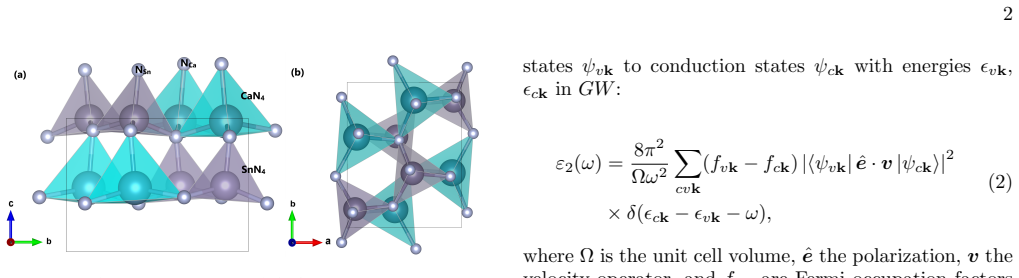
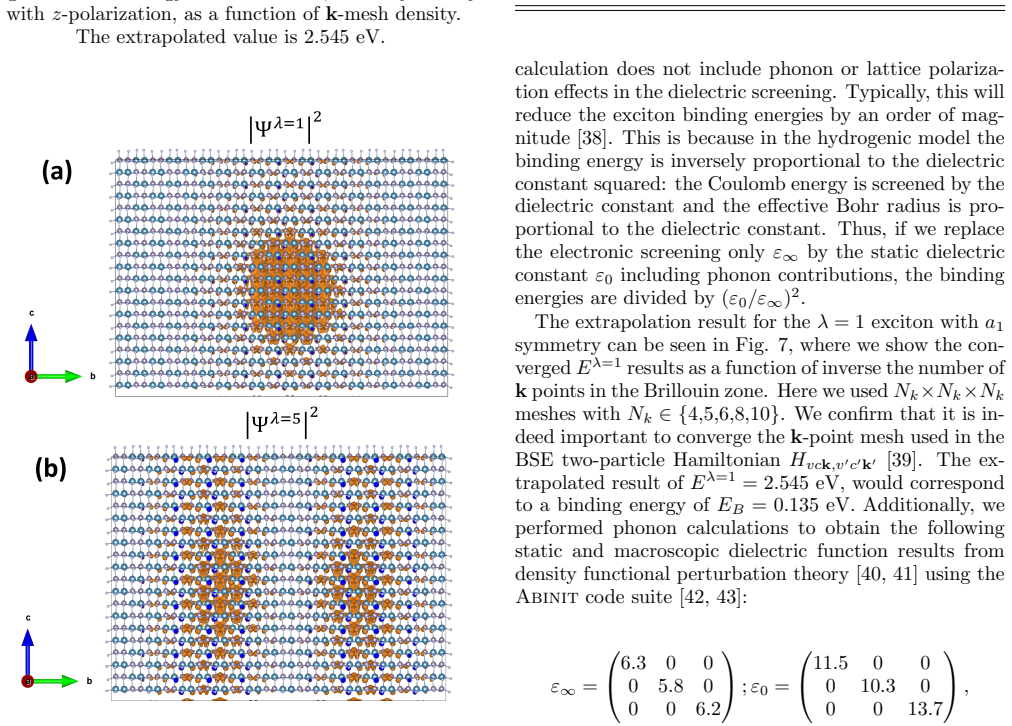
The electronic band structure of CaSnN$_2$ in the wurtzite-based $Pna2_1$ structure is calculated using the Quasiparticle Self-consistent (QS)GW$^{BSE}$ method, including ladder diagrams in the screened Coulomb interaction W$^{BSE}$ and is found to have a direct gap of 2.59 eV at {\Gamma}, which corresponds to blue light wavelength of 478 nm and makes it an attractive candidate for sustainable blue light-emitting diodes (LEDs), avoiding Ga and In. The valence band splitting is analyzed in terms of symmetry labeling, and the effective mass tensor is calculated for several bands at {\Gamma}. The valence band maximum has a1 symmetry and gives allowed transitions to the conduction band minimum for light polarized along the {\bf c}-direction. While this is unfavorable for light emission with transverse electric (TE) or s-polarization from the basal plane, this would not be an impediment if another surface other than the basal plane is used. Furthermore, the crystal field splitting between the $a_1$ and $b_1$ states, corresponding to polarizations along {\bf c} and {\bf a} respectively, reverses under an applied uniaxial tensile strain of 3.7% along the {\bf c} direction, which might occur under biaxial compressive strain in the basal plane. The optical dielectric function, including electron-hole interaction effects is also reported, and the excitons are analyzed, including several dark excitons.
Editorial analysis
A structured set of objections, weighed in public.
Referee Report
Summary. The manuscript computes the electronic band structure and excitonic properties of CaSnN₂ in the wurtzite-derived Pna2₁ structure via the quasiparticle self-consistent GW method augmented with BSE ladder diagrams in W. It reports a direct gap of 2.59 eV at Γ (corresponding to 478 nm), analyzes valence-band symmetry labels and effective-mass tensors, discusses polarization selection rules for optical transitions, shows reversal of crystal-field splitting under 3.7 % uniaxial tensile strain along c, and presents the optical dielectric function together with bright and dark excitons.
Significance. If the numerical result holds, the work supplies a concrete, parameter-free prediction for a Ga/In-free candidate for blue LEDs, together with actionable information on polarization and strain engineering. The inclusion of ladder diagrams and explicit treatment of dark excitons adds technical value beyond standard GW calculations for this class of ternary nitrides.
major comments (2)
- [Computational Methods] Computational Methods section: explicit documentation of k-point mesh density, number of bands retained in the GW and BSE steps, and convergence tests for the 2.59 eV gap value is absent; without these data the quoted precision cannot be independently verified.
- [Results] Results, paragraph on the 2.59 eV gap: the manuscript does not compare the QS GW^BSE gap against independent calculations (e.g., hybrid-functional or standard GW) or against measured gaps of isostructural nitrides, leaving the absolute accuracy of the central prediction unbenchmarked.
minor comments (2)
- [Figures] Figure captions and axis labels should explicitly state the polarization directions (a, b, c) used for the dielectric function plots.
- [Abstract] The abstract states the gap “corresponds to blue light wavelength of 478 nm”; the conversion formula or reference wavelength should be given once in the main text for consistency.
Simulated Author's Rebuttal
We thank the referee for the positive assessment of our work and the recommendation for minor revision. The comments are constructive and help strengthen the verifiability of the results. We address each major comment below.
read point-by-point responses
-
Referee: [Computational Methods] Computational Methods section: explicit documentation of k-point mesh density, number of bands retained in the GW and BSE steps, and convergence tests for the 2.59 eV gap value is absent; without these data the quoted precision cannot be independently verified.
Authors: We agree that these parameters are necessary for reproducibility. In the revised manuscript we will add an explicit subsection to Computational Methods reporting the k-point mesh (8×8×6 Monkhorst-Pack grid), the number of bands retained (250 bands for the GW step and 40 valence + 40 conduction bands for BSE), and convergence tests confirming that the Γ-point gap changes by less than 0.03 eV upon doubling the k-mesh or increasing the band cutoff. revision: yes
-
Referee: [Results] Results, paragraph on the 2.59 eV gap: the manuscript does not compare the QS GW^BSE gap against independent calculations (e.g., hybrid-functional or standard GW) or against measured gaps of isostructural nitrides, leaving the absolute accuracy of the central prediction unbenchmarked.
Authors: We acknowledge the benefit of explicit benchmarking. While the manuscript emphasizes the QS GW^BSE methodology, we will insert a brief comparison in the Results section to prior hybrid-functional calculations on CaSnN2 (typically yielding 2.3–2.7 eV) and to experimental gaps of isostructural compounds such as ZnSnN2 (~2.1 eV for ordered phases). We will also note the known tendency of QS GW to overestimate gaps by 0.1–0.2 eV in related nitrides, thereby placing the 2.59 eV value in context. revision: yes
Circularity Check
No significant circularity
full rationale
The central result is a numerical band gap of 2.59 eV obtained by applying the established QS GW^BSE many-body perturbation method to the Pna2_1 structure of CaSnN2. The method is parameter-free once the structure, k-mesh and basis are specified, and the reported gap follows directly from the standard implementation without any self-definitional equations, fitted parameters renamed as predictions, or load-bearing self-citations that reduce the claim to the paper's own inputs. The derivation chain is self-contained against external benchmarks for the GW and BSE approximations.
Axiom & Free-Parameter Ledger
axioms (2)
- domain assumption The Pna21 structure is the relevant phase for CaSnN2
- domain assumption QS GW^BSE including ladder diagrams in W accurately predicts the direct gap and optical response
Reference graph
Works this paper leans on
-
[1]
(2014), the Nobel Prize in Physics 2014. NobelPrize.org. Nobel Prize Outreach 2025. Fri. 19 Dec 2025.https:// www.nobelprize.org/prizes/physics/2014/summary/. [2]https://pubs.usgs.gov/fs/2002/fs087-02/
work page 2014
-
[2]
W. R. L. Lambrecht and A. Punya, Heterovalent ternary II-IV-N2 compounds: perspectives for a new class of wide-band-gap nitrides, inIII-Nitride Semiconductors and their Modern Devices, edited by B. Gill (Oxford Uni- versity Press, 2013) Chap. 15, pp. 519–585
work page 2013
-
[3]
S. Lyu, D. Skachkov, K. Kash, E. W. Blanton, and W. R. L. Lambrecht, Band Gaps, Band-Offsets, Disorder, Stability Region, and Point Defects in II-IV-N2 Semicon- ductors, physica status solidi (a)216, 1800875 (2019)
work page 2019
-
[4]
A. D. Martinez, A. N. Fioretti, E. S. Toberer, and A. C. Tamboli, Synthesis, structure, and optoelectronic prop- erties of II–IV–V2 materials, J. Mater. Chem. A5, 11418 (2017)
work page 2017
-
[5]
A. P. Jaroenjittichai and W. R. L. Lambrecht, Elec- tronic band structure of Mg−IV−N 2 compounds in the quasiparticle-self-consistentGWapproximation, Phys. Rev. B94, 125201 (2016)
work page 2016
- [6]
-
[7]
J. B. Quirk, M. R˚ asander, C. M. McGilvery, R. Palgrave, and M. A. Moram, Band gap and electronic structure of MgSiN2, Applied Physics Letters105, 112108 (2014)
work page 2014
-
[8]
F. Arab, F. A. Sahraoui, K. Haddadi, A. Bouhemadou, and L. Louail, Phase stability, mechanical and thermody- namic properties of orthorhombic and trigonal MgSiN2: an ab initio study, Phase Transitions: A Multinational Journal89, 480 (2016)
work page 2016
- [9]
-
[10]
S. Pramchu, A. P. Jaroenjittichai, and Y. Laosiritaworn, Phonon and phonon-related properties of mgsin2 and mggen2 ceramics: First principles studies, Ceramics In- ternational43, S444 (2017), the 10th Asian Meeting on Electroceramics (AMEC-10)
work page 2017
-
[11]
L. W¨ ohler and O. Bock, Das Silicium-Analogon des Kalk- stickstoffs, Zeitschrift f¨ ur anorganische und allgemeine Chemie134, 221 (1924)
work page 1924
-
[12]
H. H. Franck and V. Louis, Calciumsilicide und Stickstoff, 10 Zeitschrift f¨ ur anorganische und allgemeine Chemie242, 128 (1939)
work page 1939
-
[13]
Laurent, Contribution ` a l’´ etude des syst` emes calcium- azote et calcium-silicium-azote, Rev
Y. Laurent, Contribution ` a l’´ etude des syst` emes calcium- azote et calcium-silicium-azote, Rev. Chim. Min.5, 1019 (1968)
work page 1968
-
[14]
J. Guyader and J. Lang, ´Etude du syst` eme Ca 3N2- Ge3N4, Rev. Chim. Min.3, 937 (1967)
work page 1967
-
[15]
M. Maunaye, J. Guyader, Y. Laurent, and J. Lang,´Etude structurale de CaGeN 2 et Ca 1xGeN2, Bulletin de la So- ciet´ e Francaise de Min´ eralogie et de Cristallographie94, 347 (1971)
work page 1971
-
[16]
T. de Boer, T. D. Boyko, C. Braun, W. Schnick, and A. Moewes, Bandgap and electronic structure of CaSiN2: Experiment and theory, International Journal of Applied Ceramic Technology20, 197 (2023)
work page 2023
-
[17]
Z. A. G´ al, P. M. Mallinson, H. J. Orchard, and S. J. Clarke, Synthesis and Structure of Alkaline Earth Sili- con Nitrides: BaSiN2, SrSiN2, and CaSiN2, Inorganic Chemistry43, 3998 (2004), pMID: 15206881
work page 2004
-
[18]
F. Kawamura, H. Murata, M. Imura, N. Yamada, and T. Taniguchi, Synthesis of CaSnN2 via a High-Pressure Metathesis Reaction and the Properties of II-Sn-N2 (II = Ca, Mg, Zn) Semiconductors, Inorganic Chemistry60, 1773 (2021), pMID: 33480682. [20]https://next-gen.materialsproject.org/materials/ mp-1029633?formula=CaSnN2
work page 2021
- [19]
-
[20]
J. P. Perdew, A. Ruzsinszky, G. I. Csonka, O. A. Vy- drov, G. E. Scuseria, L. A. Constantin, X. Zhou, and K. Burke, Restoring the Density-Gradient Expansion for Exchange in Solids and Surfaces, Phys. Rev. Lett.100, 136406 (2008)
work page 2008
-
[21]
M. van Schilfgaarde, T. Kotani, and S. Faleev, Quasipar- ticle Self-ConsistentGWTheory, Phys. Rev. Lett.96, 226402 (2006)
work page 2006
- [22]
-
[23]
L. Hedin, New method for calculating the one-particle green’s function with application to the electron-gas problem, Phys. Rev.139, A796 (1965)
work page 1965
-
[24]
B. Cunningham, M. Gr¨ uning, D. Pashov, and M. van Schilfgaarde, QSG ˆ W : Quasiparticle self-consistentGW with ladder diagrams inW, Phys. Rev. B108, 165104 (2023)
work page 2023
- [25]
-
[26]
G. Strinati, Application of the Green’s functions method to the study of the optical properties of semiconductors, La Rivista del Nuovo Cimento (1978-1999)11, 1 (1988)
work page 1978
-
[27]
Hanke, Dielectric theory of elementary excitations in crystals, Advances in Physics27, 287 (1978)
W. Hanke, Dielectric theory of elementary excitations in crystals, Advances in Physics27, 287 (1978)
work page 1978
-
[28]
B. Cunningham, M. Gr¨ uning, P. Azarhoosh, D. Pashov, and M. van Schilfgaarde, Effect of ladder diagrams on op- tical absorption spectra in a quasiparticle self-consistent GWframework, Phys. Rev. Materials2, 034603 (2018)
work page 2018
-
[29]
K. Momma and F. Izumi,VESTA3for three-dimensional visualization of crystal, volumetric and morphology data, Journal of Applied Crystallography44, 1272 (2011)
work page 2011
-
[30]
M. Rohlfing and S. G. Louie, Electron-hole excitations and optical spectra from first principles, Phys. Rev. B 62, 4927 (2000)
work page 2000
-
[31]
I. K. Turan, W. R. L. Lambrecht, and J. Jackson, Elec- tronic structure and exchange interactions in altermag- netic mngep˙2 in the quasiparticle self-consistent gw ap- proach, Phys. Rev. B112, 144443 (2025)
work page 2025
- [32]
-
[33]
M. Cardona and M. L. W. Thewalt, Isotope effects on the optical spectra of semiconductors, Rev. Mod. Phys. 77, 1173 (2005)
work page 2005
-
[34]
A. Jain, S. P. Ong, G. Hautier, W. Chen, W. D. Richards, S. Dacek, S. Cholia, D. Gunter, D. Skinner, G. Ceder, and K. A. Persson, Commentary: The Materials Project: A materials genome approach to accelerating materials innovation, APL Materials1, 011002 (2013), https://pubs.aip.org/aip/apm/article- pdf/doi/10.1063/1.4812323/13163869/011002 1 online.pdf
-
[35]
A. Mintairov, J. Merz, A. Osinsky, V. Fuflyigin, and L. D. Zhu, Infrared spectroscopy of ZnSiN2 single- crystalline films on r-sapphire, Applied Physics Letters 76, 2517 (2000), https://pubs.aip.org/aip/apl/article- pdf/76/18/2517/18548997/2517˙1˙online.pdf
work page 2000
-
[36]
O. Dernek and W. R. L. Lambrecht, Comparison of inter- band related optical transitions and excitons in ZnGeN 2 and GaN, Phys. Rev. B109, 125133 (2024)
work page 2024
-
[37]
N. Dadkhah, W. R. L. Lambrecht, D. Pashov, and M. van Schilfgaarde, Improved quasiparticle self-consistent elec- tronic band structure and excitons inβ−ligao 2, Phys. Rev. B107, 165201 (2023)
work page 2023
-
[38]
X. Gonze, First-principles responses of solids to atomic displacements and homogeneous electric fields: Imple- mentation of a conjugate-gradient algorithm, Phys. Rev. B55, 10337 (1997)
work page 1997
-
[39]
X. Gonze and C. Lee, Dynamical matrices, born effective charges, dielectric permittivity tensors, and interatomic force constants from density-functional perturbation the- ory, Phys. Rev. B55, 10355 (1997)
work page 1997
-
[40]
X. Gonze, B. Amadon, G. Antonius, F. Arnardi, L. Baguet, J.-M. Beuken, J. Bieder, F. Bottin, J. Bouchet, E. Bousquet, N. Brouwer, F. Bruneval, G. Brunin, T. Cavignac, J.-B. Charraud, W. Chen, M. Cˆ ot´ e, S. Cottenier, J. Denier, G. Geneste, P. Ghosez, M. Giantomassi, Y. Gillet, O. Gingras, D. R. Hamann, G. Hautier, X. He, N. Helbig, N. Holzwarth, Y. Jia,...
work page 2020
-
[41]
M. Torrent, F. Jollet, F. Bottin, G. Z´ erah, and X. Gonze, Implementation of the projector augmented- wave method in the abinit code: Application to the study of iron under pressure, Computational Materials Science 42, 337 (2008). [44]https://github.com/Electronic-Structure-Group/ 11 CaSnN2
work page 2008
discussion (0)
Sign in with ORCID, Apple, or X to comment. Anyone can read and Pith papers without signing in.