REVIEW 2 major objections 6 minor 1 cited by
MobileManiBench is a simulation-generated benchmark with 300K trajectories meant to verify mobile-manipulation VLA models before real-world deployment.
Reviewed by Pith at T0; open to challenge. T0 means a machine referee read the full paper against a public rubric. the ladder, T0–T4 →
T0 review · deepseek-v4-flash
2026-08-03 04:17 UTC pith:VBD7YZVY
load-bearing objection A substantial new mobile-manipulation benchmark with real utility; the sim-to-real verification claim is the one part that outruns the evidence. the 2 major comments →
MobileManiBench: Simplifying Model Verification for Mobile Manipulation
The pith
A machine-rendered reading of the paper's core claim, the machinery that carries it, and where it could break.
Core claim
The paper's central claim is that a keypoint-parameterized RL teacher can generate a large, diverse, richly annotated dataset for mobile manipulation without teleoperation, and that this dataset is sufficient to train and evaluate universal vision-language-action (VLA) policies. For each of 1,182 robot-object-skill combinations, a single state-based policy learns to move hand points to an object grasp point and then to a goal point under one shared reward with a 5 cm success threshold; deployed in 100 scenes, these policies produce 300K successful trajectories with language, multi-view RGB-D-segmentation images, states, and actions. A VLA model trained on the data reaches 56.7% (gripper robo
What carries the argument
The key mechanism is the keypoint-based universal reward: every task is reduced to three point sets — robot gripper/hand points, the object grasp point, and the goal point — so that one reward formula (distance, approach, grasp, move, success) trains every robot-object-skill combination. This abstraction makes 1,182 combinations trainable without per-task rewards, which is what allows the benchmark's data generation to scale. The second mechanism is the action-chunking diffusion-transformer policy that consumes multi-view RGB-D and wrist-pose state and predicts 16-step action chunks; ablations show that this multi-modal conditioning is the main driver of generalization from the state-based t
Load-bearing premise
The load-bearing premise is that simulation physics, rendered sensors, and the 5 cm success threshold predict real-world mobile-manipulation performance; the paper's only current evidence is one task — opening a laptop — with 40% success over 10 trials.
What would settle it
Deploy the same policies on a physical mobile manipulator across all five skills and compare real success rates with simulated rates. If a model with high simulated success consistently underperforms one with lower simulated success — or if the 5 cm threshold is met in simulation yet the object is not functionally opened, closed, pulled, pushed, or picked in reality — the verification claim fails.
If this is right
- Researchers can use MobileManiBench to compare VLA architectures, sensor suites, and robot embodiments under standardized conditions without collecting teleoperated data.
- The 300K-trajectory dataset with synchronized language, multi-view RGB-D-segmentation, states, and actions supports training universal mobile-manipulation policies that generalize to unseen objects and scenes.
- Multi-view, multi-modal perception is required for competitive mobile manipulation: head-view RGB alone gives 7.9% success on the challenge subset, while head+wrist RGB-D plus wrist pose gives 28.2%.
- Base mobility is a necessary part of the task: fixing the base drops the state-based teacher from 82.8% to 25.4% success.
- Existing vision-language-action models can be fine-tuned and ranked within a single evaluation protocol, giving the field a common yardstick for mobile-manipulation progress.
Where Pith is reading between the lines
- If the sim-to-real fidelity holds beyond the single laptop task, the pipeline's real payoff is cheap embodiment studies: changing the hand or adding a camera means retraining an RL teacher, not re-collecting human teleoperation data.
- The 5 cm keypoint-distance success criterion measures pose error, not function; a door brought within 5 cm of closed may still be unlatched, so a functional success metric could change model rankings.
- The appendix's 40% success on one real-world task (10 trials) suggests a substantial sim-to-real gap; a public leaderboard of real-robot transfer results across the five skills would turn the benchmark from a simulation testbed into a true verification platform.
- Because unseen objects cost more performance than unseen scenes, the data-generation strategy should probably weight object and articulation diversity over scene variety — a testable prediction given the benchmark's held-out splits.
Editorial analysis
A structured set of objections, weighed in public.
Referee Report
Summary. MobileManiBench is a simulation benchmark and dataset for mobile manipulation built in NVIDIA Isaac Sim. It provides two robot embodiments (G1 with parallel gripper, XHand with 12-DOF dexterous hand), 630 objects in 20 categories, five skills, and 100 scenes. The authors train per-robot-object-skill RL policies and use them to generate 300K annotated trajectories with language instructions, multi-view RGB-D and segmentation, states, and actions. They introduce MobileManiVLA, a PaliGemma-2/Gemma-2 + DiT model, train it per robot on the generated data, and evaluate on unseen objects/scenes, reporting sim success rates, ablations, and comparisons with OpenVLA, CogACT, π0, and π0.5. One real-world deployment pilot (opening a laptop on the G1 robot) is reported in Appendix C with 10 trials and 40% success.
Significance. I see the contribution as potentially significant: the field lacks large, publicly available simulation benchmarks for mobile platforms with articulated objects and dexterous hands, and a scalable RL-based data generation pipeline with released code/data/models would be a reusable asset. The paper's internal evaluations are largely consistent in direction (multi-view helps, state helps, unseen-object generalization harder than unseen-scene), and the train/test splits are object- and scene-based, which is a genuine generalization test. The main weakness is that the advertised 'verify before real-world deployment' claim is not supported by a single 10-trial pilot. With the claims scoped to a simulation benchmark plus a pilot sanity check, this could be a strong contribution.
major comments (2)
- [Abstract; §1; Appendix C] The central framing of the paper is that MobileManiBench enables verification of VLA architectures 'before real-world deployment.' The only real-world evidence is Appendix C: one task (open laptop), 10 trials, 40% success. For 10 trials the 95% binomial CI is roughly 12-74%, so the simulated 40.8% success rate (Table 10) and the real-world 40% success rate are statistically indistinguishable, and no rank-order predictive claim can be validated. Moreover, the real-world success criterion is not defined and is not aligned with the 5 cm keypoint success threshold used in simulation (Eq. 10, A.2). This overclaim is load-bearing because the abstract and introduction motivate the benchmark as a verification framework. Please either provide multi-task, higher-n real-world validation with a defined success metric, or revise the central claim to describe a sim-only benchmark with a pilot sanity c
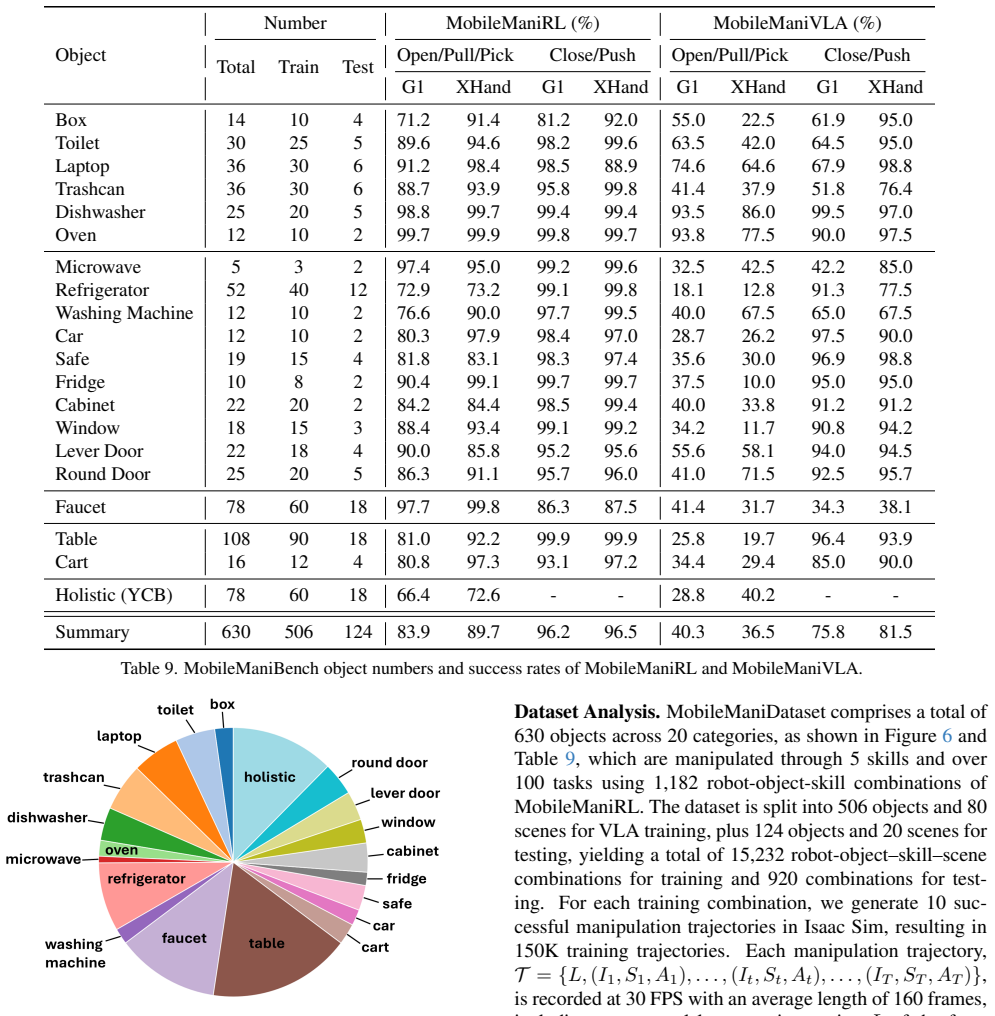
- [Table 3] The 'Mean' row of Table 3 is not the arithmetic mean of the five skill rows. For the G1 robot, (86.6 + 96.2 + 80.8 + 93.1 + 66.4) / 5 = 84.6%, not 89.6%; for XHand, (91.9 + 96.5 + 97.3 + 97.2 + 72.6) / 5 = 91.1%, not 92.9%. If the reported mean is weighted by episodes or by robot-object-skill combinations, the weighting must be stated. As printed, the table supports Takeaway 3 and the headline RL numbers poorly and misleads readers.
minor comments (6)
- [A.3, Eq. (4)] The grasp flag is defined with threshold λ_c = 0.1 in the text, but Eq. (4) uses λ_g. Use consistent notation.
- [§3; Appendix C.1] The AgiBot robot reference appears as '[?]' in two places. A proper citation is needed.
- [§4.2; Abstract] The abstract states 300K trajectories, while §4.2 says each robot has 15,232 train/test combinations with 10 trajectories each, resulting in 150K training trajectories. Clarify that 150K is per robot and 300K is the total across both robots.
- [§5.2; Tables 4-6; Table 10] VLA success rates are based on 10 episodes per robot-object-skill-scene combination. Category-level numbers in Table 10 are therefore coarse (e.g., 40.8% corresponds to roughly 4 successes per 10 episodes). Reporting 95% confidence intervals, or at least the number of episodes underlying each aggregate, would make the model comparisons in Table 6 more interpretable.
- [Appendix C] The real-world model is described as the 'RGB only' variant, citing the 40.8% open-laptop result in Table 10, but the real-world deployment also feeds wrist-pose state. Table 10 appears to vary only image inputs; specify whether the sim reference number includes the wrist-pose state, and define how real-world success was judged.
- [Throughout] Typos: 'Uneen' in Table 5 header, 'utlizes' in A.3, 'vallina' in B.3, 'usded' in C.2, and 'dependents' in §1.
Circularity Check
No significant circularity; benchmark construction is self-consistent and only a minor non-load-bearing self-citation is present.
full rationale
MobileManiBench is a dataset/benchmark construction paper rather than a derivation. The RL reward (Eqs. 1 and 10) uses the 5 cm keypoint threshold to define task success and to filter which trajectories are recorded (Secs. 4.1–4.2), and the VLA evaluation (Sec. 5.1, Table 3) uses the same threshold. This alignment is task conditioning, not circularity: at inference MobileManiVLA receives only language, multi-view RGB-D, and wrist pose, not the privileged object-grasp/goal keypoint state used by the reward, so its success measures generalization under the same task definition. No fitted parameter is later renamed as a prediction. The single real-world probe (Appendix C: one task, 10 trials, 40% success) is an external datapoint, not a parameter fitted back into the simulator; the paper explicitly states its real-world inferences 'focus exclusively on the open laptop task' (App. C.1). The self-citation to CogACT [23] is used for the MobileManiVLA architecture ('Following the design of CogACT [23]', Sec. 4.3), but this is a design choice rather than a load-bearing uniqueness theorem or evidence chain, and it does not force the benchmark results. Thus the central construction is self-contained; the main risk is sim-to-real validity, which is an evidence limitation, not a circular derivation.
Axiom & Free-Parameter Ledger
free parameters (5)
- Reward weights ω_d, ω_a, ω_g, ω_m, ω_s =
1.0, 0.2, 1.0, 0.2, 2.0
- Grasp/success thresholds λ_c=0.1, λ_g=0.05 (m) =
0.1 chamfer; 0.05 m
- Goal-state definitions (60% open for open skill; 40%-80% open initialization for close) =
60%; 40-80%
- Trajectory horizon T=300 steps and 10 trajectories per training combination =
T=300; 10
- VLA inference window K=4 and action chunk N=16 =
K=4, N=16
axioms (4)
- domain assumption The 5 cm keypoint-distance success metric is a valid proxy for 'task correctly performed' across all five skills and 630 objects.
- domain assumption Isaac Sim with the converted URDF/USD assets and Genie/Isaac scene assets is dynamically and visually faithful enough that policies trained on it transfer to the physical G1/XHand robots.
- standard math PPO with the given input features, reward shaping, and 4K iterations obtains adequate policies for each robot-object-skill combination.
- domain assumption The data-generation procedure of running the RL policies in scenes and recording 10 successful trajectories per training combination yields a diverse-enough dataset for VLA training.
read the original abstract
Vision-language-action models have advanced robotic manipulation but remain constrained by reliance on the large, teleoperation-collected datasets dominated by the static, tabletop scenes. We propose a simulation-first framework to verify VLA architectures before real-world deployment and introduce MobileManiBench, a large-scale benchmark for mobile-based robotic manipulation. Built on NVIDIA Isaac Sim and powered by reinforcement learning, our pipeline autonomously generates diverse manipulation trajectories with rich annotations (language instructions, multi-view RGB-depth-segmentation images, synchronized object/robot states and actions). MobileManiBench features 2 mobile platforms (parallel-gripper and dexterous-hand robots), 2 synchronized cameras (head and right wrist), 630 objects in 20 categories, 5 skills (open, close, pull, push, pick) with over 100 tasks performed in 100 realistic scenes, yielding 300K trajectories. This design enables controlled, scalable studies of robot embodiments, sensing modalities, and policy architectures, accelerating research on data efficiency and generalization. We benchmark representative VLA models and report insights into perception, reasoning, and control in complex simulated environments, with all code, datasets, and models publicly released.
Figures




Forward citations
Cited by 1 Pith paper
-
AnnotateAnything: Automatic Annotation of 3D Assets for Robot Manipulation
AnnotateAnything converts passive 3D assets into manipulation-ready assets by combining vision-language reasoning for semantics with parallel physics pipelines for executable action annotations such as grasps and arti...
Reference graph
Works this paper leans on
-
[1]
Agi- bot world colosseo: A large-scale manipulation platform for scalable and intelligent embodied systems, 2025
AgiBot-World-Contributors, Qingwen Bu, Jisong Cai, Li Chen, Xiuqi Cui, Yan Ding, Siyuan Feng, Shenyuan Gao, Xindong He, Xuan Hu, Xu Huang, Shu Jiang, Yuxin Jiang, Cheng Jing, Hongyang Li, Jialu Li, Chiming Liu, Yi Liu, Yuxiang Lu, Jianlan Luo, Ping Luo, Yao Mu, Yuehan Niu, Yixuan Pan, Jiangmiao Pang, Yu Qiao, Guanghui Ren, Cheng Ruan, Jiaqi Shan, Yongjian...
2025
-
[2]
Dexart: Benchmarking generalizable dexterous manipula- tion with articulated objects, 2023
Chen Bao, Helin Xu, Yuzhe Qin, and Xiaolong Wang. Dexart: Benchmarking generalizable dexterous manipula- tion with articulated objects, 2023. 2, 3
2023
-
[3]
Paligemma: A versatile 3b vlm for trans- fer.arXiv preprint arXiv:2407.07726, 2024
Lucas Beyer, Andreas Steiner, Andr ´e Susano Pinto, Alexan- der Kolesnikov, Xiao Wang, Daniel Salz, Maxim Neumann, Ibrahim Alabdulmohsin, Michael Tschannen, Emanuele Bugliarello, et al. Paligemma: A versatile 3b vlm for trans- fer.arXiv preprint arXiv:2407.07726, 2024. 3
Pith/arXiv arXiv 2024
-
[4]
Johan Bjorck, Fernando Casta ˜neda, Nikita Cherniadev, Xingye Da, Runyu Ding, Linxi Fan, Yu Fang, Dieter Fox, Fengyuan Hu, Spencer Huang, et al. Gr00t n1: An open foundation model for generalist humanoid robots.arXiv preprint arXiv:2503.14734, 2025. 2, 3
Pith/arXiv arXiv 2025
-
[5]
Kevin Black, Noah Brown, Danny Driess, Adnan Es- mail, Michael Equi, Chelsea Finn, Niccolo Fusai, Lachy Groom, Karol Hausman, Brian Ichter, et al.π 0: A vision-language-action flow model for general robot control. arXiv:2410.24164, 2024. 2, 3, 8
Pith/arXiv arXiv 2024
-
[6]
RT-1: Robotics transformer for real-world control at scale
Anthony Brohan, Noah Brown, Justice Carbajal, Yevgen Chebotar, Joseph Dabis, Chelsea Finn, Keerthana Gopalakr- ishnan, Karol Hausman, Alex Herzog, Jasmine Hsu, et al. RT-1: Robotics transformer for real-world control at scale. arXiv:2212.06817, 2022. 2, 3
Pith/arXiv arXiv 2022
-
[7]
Srinivasa, Pieter Abbeel, and Aaron M
Berk Calli, Arjun Singh, Aaron Walsman, Siddhartha S. Srinivasa, Pieter Abbeel, and Aaron M. Dollar. The ycb ob- ject and model set: Towards common benchmarks for manip- ulation research. InProceedings of the IEEE International Conference on Advanced Robotics (ICAR), pages 510–517,
-
[8]
Gr-3 technical report.arXiv preprint arXiv:2507.15493, 2025
Chilam Cheang, Sijin Chen, Zhongren Cui, Yingdong Hu, Liqun Huang, Tao Kong, Hang Li, Yifeng Li, Yuxiao Liu, Xiao Ma, et al. Gr-3 technical report.arXiv preprint arXiv:2507.15493, 2025. 2, 3
Pith/arXiv arXiv 2025
-
[9]
Owmm-agent: Open world mobile manipulation with multi-modal agentic data synthe- sis, 2025
Junting Chen, Haotian Liang, Lingxiao Du, Weiyun Wang, Mengkang Hu, Yao Mu, Wenhai Wang, Jifeng Dai, Ping Luo, Wenqi Shao, and Lin Shao. Owmm-agent: Open world mobile manipulation with multi-modal agentic data synthe- sis, 2025. 2, 3
2025
-
[10]
Robotwin 2.0: A scalable data generator and bench- mark with strong domain randomization for robust bimanual robotic manipulation, 2025
Tianxing Chen, Zanxin Chen, Baijun Chen, Zijian Cai, Yibin Liu, Zixuan Li, Qiwei Liang, Xianliang Lin, Yiheng Ge, Zhenyu Gu, Weiliang Deng, Yubin Guo, Tian Nian, Xuan- bing Xie, Qiangyu Chen, Kailun Su, Tianling Xu, Guodong Liu, Mengkang Hu, Huan ang Gao, Kaixuan Wang, Zhix- uan Liang, Yusen Qin, Xiaokang Yang, Ping Luo, and Yao Mu. Robotwin 2.0: A scalab...
2025
-
[11]
Pali-x: On scaling up a multilingual vision and language model.arXiv preprint arXiv:2305.18565, 2023
Xi Chen, Josip Djolonga, Piotr Padlewski, Basil Mustafa, Soravit Changpinyo, Jialin Wu, Carlos Riquelme Ruiz, Se- bastian Goodman, Xiao Wang, Yi Tay, et al. Pali-x: On scaling up a multilingual vision and language model.arXiv preprint arXiv:2305.18565, 2023. 3
Pith/arXiv arXiv 2023
-
[12]
Isaac lab, 2023
NVIDIA Corporation. Isaac lab, 2023. Accessed: 2025-11-
2023
-
[13]
Palm-e: An embodied multimodal language model
Danny Driess, Fei Xia, Mehdi SM Sajjadi, Corey Lynch, Aakanksha Chowdhery, Ayzaan Wahid, Jonathan Tompson, Quan Vuong, Tianhe Yu, Wenlong Huang, et al. Palm-e: An embodied multimodal language model. 2023. 3
2023
-
[14]
Zhao, and Chelsea Finn
Zipeng Fu, Tony Z. Zhao, and Chelsea Finn. Mobile aloha: Learning bimanual mobile manipulation with low- cost whole-body teleoperation, 2024. 2, 3
2024
-
[15]
Maniskill2: A unified benchmark for generalizable manipulation skills, 2023
Jiayuan Gu, Fanbo Xiang, Xuanlin Li, Zhan Ling, Xiqiang Liu, Tongzhou Mu, Yihe Tang, Stone Tao, Xinyue Wei, Yun- chao Yao, Xiaodi Yuan, Pengwei Xie, Zhiao Huang, Rui Chen, and Hao Su. Maniskill2: A unified benchmark for generalizable manipulation skills, 2023. 2, 3
2023
-
[16]
Rekep: Spatio-temporal reasoning of rela- tional keypoint constraints for robotic manipulation, 2024
Wenlong Huang, Chen Wang, Yunzhu Li, Ruohan Zhang, and Li Fei-Fei. Rekep: Spatio-temporal reasoning of rela- tional keypoint constraints for robotic manipulation, 2024. 4
2024
-
[17]
Physical Intelligence, Kevin Black, Noah Brown, James Darpinian, Karan Dhabalia, Danny Driess, Adnan Esmail, Michael Equi, Chelsea Finn, Niccolo Fusai, et al.π 0.5: a vision-language-action model with open-world generaliza- tion.arXiv:2504.16054, 2025. 2, 3, 8
Pith/arXiv arXiv 2025
-
[18]
Stephen James, Zicong Ma, David Rovick Arrojo, and An- drew J. Davison. Rlbench: The robot learning benchmark & learning environment, 2019. 2, 3
2019
-
[19]
Prismatic vlms: Investigating the design space of visually-conditioned language models
Siddharth Karamcheti, Suraj Nair, Ashwin Balakrishna, Percy Liang, Thomas Kollar, and Dorsa Sadigh. Prismatic vlms: Investigating the design space of visually-conditioned language models. InForty-first International Conference on Machine Learning, 2024. 3
2024
-
[20]
Alexander Khazatsky, Karl Pertsch, Suraj Nair, Ashwin Bal- akrishna, Sudeep Dasari, Siddharth Karamcheti, Soroush Nasiriany, Mohan Kumar Srirama, Lawrence Yunliang Chen, Kirsty Ellis, Peter David Fagan, Joey Hejna, Masha Itkina, Marion Lepert, Yecheng Jason Ma, Patrick Tree Miller, Jimmy Wu, Suneel Belkhale, Shivin Dass, Huy Ha, Arhan Jain, Abraham Lee, Y...
-
[21]
OpenVLA: An open- source vision-language-action model.arXiv:2406.09246,
Moo Jin Kim, Karl Pertsch, Siddharth Karamcheti, Ted Xiao, Ashwin Balakrishna, Suraj Nair, Rafael Rafailov, Ethan Fos- ter, Grace Lam, Pannag Sanketi, et al. OpenVLA: An open- source vision-language-action model.arXiv:2406.09246,
-
[22]
Fine-tuning vision-language-action models: Optimizing speed and suc- cess.arXiv:2502.19645, 2025
Moo Jin Kim, Chelsea Finn, and Percy Liang. Fine-tuning vision-language-action models: Optimizing speed and suc- cess.arXiv:2502.19645, 2025. 2, 3
Pith/arXiv arXiv 2025
-
[23]
Qixiu Li, Yaobo Liang, Zeyu Wang, Lin Luo, Xi Chen, Mozheng Liao, Fangyun Wei, Yu Deng, Sicheng Xu, Yizhong Zhang, et al. CogACT: A foundational vision- language-action model for synergizing cognition and action in robotic manipulation.arXiv:2411.19650, 2024. 2, 3, 5, 6, 8
Pith/arXiv arXiv 2024
-
[24]
Qixiu Li, Yu Deng, Yaobo Liang, Lin Luo, Lei Zhou, Chengtang Yao, Lingqi Zeng, Zhiyuan Feng, Huizhi Liang, Sicheng Xu, et al. Scalable vision-language-action model pretraining for robotic manipulation with real-life human ac- tivity videos.arXiv preprint arXiv:2510.21571, 2025
arXiv 2025
-
[25]
Vision-language foundation models as effective robot imitators
Xinghang Li, Minghuan Liu, Hanbo Zhang, Cunjun Yu, Jie Xu, Hongtao Wu, Chilam Cheang, Ya Jing, Weinan Zhang, Huaping Liu, et al. Vision-language foundation models as effective robot imitators. InICLR, 2022. 2, 3
2022
-
[26]
Xuanlin Li, Kyle Hsu, Jiayuan Gu, Karl Pertsch, Oier Mees, Homer Rich Walke, Chuyuan Fu, Ishikaa Lunawat, Isabel Sieh, Sean Kirmani, Sergey Levine, Jiajun Wu, Chelsea Finn, Hao Su, Quan Vuong, and Ted Xiao. Evaluating real-world robot manipulation policies in simulation.arXiv preprint arXiv:2405.05941, 2024. 3
Pith/arXiv arXiv 2024
-
[27]
Unidoormanip: Learn- ing universal door manipulation policy over large-scale and diverse door manipulation environments, 2024
Yu Li, Xiaojie Zhang, Ruihai Wu, Zilong Zhang, Yiran Geng, Hao Dong, and Zhaofeng He. Unidoormanip: Learn- ing universal door manipulation policy over large-scale and diverse door manipulation environments, 2024. 2, 3, 4, 12
2024
-
[28]
Libero: Benchmarking knowl- edge transfer for lifelong robot learning, 2023
Bo Liu, Yifeng Zhu, Chongkai Gao, Yihao Feng, Qiang Liu, Yuke Zhu, and Peter Stone. Libero: Benchmarking knowl- edge transfer for lifelong robot learning, 2023. 3
2023
-
[29]
Visual instruction tuning.NeurIPS, 2023
Haotian Liu, Chunyuan Li, Qingyang Wu, and Yong Jae Lee. Visual instruction tuning.NeurIPS, 2023. 3
2023
-
[30]
RDT-1B: A diffusion foundation model for bimanual manip- ulation.ICLR, 2025
Songming Liu, Lingxuan Wu, Bangguo Li, Hengkai Tan, Huayu Chen, Zhengyi Wang, Ke Xu, Hang Su, and Jun Zhu. RDT-1B: A diffusion foundation model for bimanual manip- ulation.ICLR, 2025. 2, 3
2025
-
[31]
Calvin: A benchmark for language- conditioned policy learning for long-horizon robot manip- ulation tasks, 2022
Oier Mees, Lukas Hermann, Erick Rosete-Beas, and Wol- fram Burgard. Calvin: A benchmark for language- conditioned policy learning for long-horizon robot manip- ulation tasks, 2022. 3
2022
-
[32]
Robocasa: Large-scale simulation of every- day tasks for generalist robots, 2024
Soroush Nasiriany, Abhiram Maddukuri, Lance Zhang, Adeet Parikh, Aaron Lo, Abhishek Joshi, Ajay Mandlekar, and Yuke Zhu. Robocasa: Large-scale simulation of every- day tasks for generalist robots, 2024. 2, 3
2024
-
[33]
Isaac Sim
NVIDIA. Isaac Sim. 2, 3, 5, 12, 14
-
[34]
Open X- Embodiment: Robotic learning datasets and RT-X models
Abby O’Neill, Abdul Rehman, Abhiram Maddukuri, Ab- hishek Gupta, Abhishek Padalkar, Abraham Lee, Acorn Pooley, Agrim Gupta, Ajay Mandlekar, et al. Open X- Embodiment: Robotic learning datasets and RT-X models. InICRA, 2024. 2, 3
2024
-
[35]
Delin Qu, Haoming Song, Qizhi Chen, Yuanqi Yao, Xinyi Ye, Yan Ding, Zhigang Wang, JiaYuan Gu, Bin Zhao, et al. SpatialVLA: Exploring spatial representations for visual- language-action model.arXiv:2501.15830, 2025. 2, 3
Pith/arXiv arXiv 2025
-
[36]
Xhand, 2025.https://www.robotera
Robotera. Xhand, 2025.https://www.robotera. com/en/. 3, 12
2025
-
[37]
Proximal policy optimization algo- rithms, 2017
John Schulman, Filip Wolski, Prafulla Dhariwal, Alec Rad- ford, and Oleg Klimov. Proximal policy optimization algo- rithms, 2017. 2, 12
2017
-
[38]
Memoryvla: Perceptual-cognitive memory in vision-language-action models for robotic manipulation
Hao Shi, Bin Xie, Yingfei Liu, Lin Sun, Fengrong Liu, Tiancai Wang, Erjin Zhou, Haoqiang Fan, Xiangyu Zhang, and Gao Huang. Memoryvla: Perceptual-cognitive memory in vision-language-action models for robotic manipulation. arXiv preprint arXiv:2508.19236, 2025. 2, 3
Pith/arXiv arXiv 2025
-
[39]
Paligemma 2: A family of versatile vlms for transfer.arXiv preprint arXiv:2412.03555, 2024
Andreas Steiner, Andr ´e Susano Pinto, Michael Tschannen, Daniel Keysers, Xiao Wang, Yonatan Bitton, Alexey Grit- senko, Matthias Minderer, Anthony Sherbondy, Shangbang Long, et al. Paligemma 2: A family of versatile vlms for transfer.arXiv preprint arXiv:2412.03555, 2024. 5
Pith/arXiv arXiv 2024
-
[40]
Gemini: a family of highly capable multimodal models
Gemini Team, Rohan Anil, Sebastian Borgeaud, Jean- Baptiste Alayrac, Jiahui Yu, Radu Soricut, Johan Schalk- wyk, Andrew M Dai, Anja Hauth, Katie Millican, et al. Gemini: a family of highly capable multimodal models. arXiv:2312.11805, 2023. 3
Pith/arXiv arXiv 2023
-
[41]
Gemma 2: Improving open language models at a practical size.arXiv preprint arXiv:2408.00118,
Gemma Team, Morgane Riviere, Shreya Pathak, Pier Giuseppe Sessa, Cassidy Hardin, Surya Bhupati- raju, L´eonard Hussenot, Thomas Mesnard, Bobak Shahriari, Alexandre Ram´e, et al. Gemma 2: Improving open language models at a practical size.arXiv preprint arXiv:2408.00118,
-
[42]
Gemini robotics: Bringing ai into the physical world.arXiv preprint arXiv:2503.20020, 2025
Gemini Robotics Team, Saminda Abeyruwan, Joshua Ainslie, Jean-Baptiste Alayrac, Montserrat Gonzalez Are- nas, Travis Armstrong, Ashwin Balakrishna, Robert Baruch, Maria Bauza, Michiel Blokzijl, et al. Gemini robotics: Bringing ai into the physical world.arXiv preprint arXiv:2503.20020, 2025. 2, 3
Pith/arXiv arXiv 2025
-
[43]
Genie sim assets.https://github
Genie Sim Team. Genie sim assets.https://github. com/AgibotTech/genie_sim, 2025. 5, 12, 14
2025
-
[44]
Octo: An open- source generalist robot policy.arXiv:2405.12213, 2024
Octo Model Team, Dibya Ghosh, Homer Walke, Karl Pertsch, Kevin Black, Oier Mees, Sudeep Dasari, Joey Hejna, Tobias Kreiman, Charles Xu, et al. Octo: An open- source generalist robot policy.arXiv:2405.12213, 2024. 2, 3
Pith/arXiv arXiv 2024
-
[45]
Grutopia: Dream general robots in a city at scale, 2024
Hanqing Wang, Jiahe Chen, Wensi Huang, Qingwei Ben, Tai Wang, Boyu Mi, Tao Huang, Siheng Zhao, Yilun Chen, Sizhe Yang, Peizhou Cao, Wenye Yu, Zichao Ye, Jialun Li, Junfeng Long, Zirui Wang, Huiling Wang, Ying Zhao, Zhongying Tu, Yu Qiao, Dahua Lin, and Jiangmiao Pang. Grutopia: Dream general robots in a city at scale, 2024. 3
2024
-
[46]
Trtm: Template-based reconstruction and target-oriented manipulation of crumpled cloths, 2024
Wenbo Wang, Gen Li, Miguel Zamora, and Stelian Coros. Trtm: Template-based reconstruction and target-oriented manipulation of crumpled cloths, 2024. 2
2024
-
[47]
Unigrasptransformer: Simplified policy distillation for scalable dexterous robotic grasping, 2025
Wenbo Wang, Fangyun Wei, Lei Zhou, Xi Chen, Lin Luo, Xiaohan Yi, Yizhong Zhang, Yaobo Liang, Chang Xu, Yan Lu, Jiaolong Yang, and Baining Guo. Unigrasptransformer: Simplified policy distillation for scalable dexterous robotic grasping, 2025. 3
2025
-
[48]
Unified vision-language-action model
Yuqi Wang, Xinghang Li, Wenxuan Wang, Junbo Zhang, Yingyan Li, Yuntao Chen, Xinlong Wang, and Zhaox- iang Zhang. Unified vision-language-action model. arXiv:2506.19850, 2025. 2, 3
Pith/arXiv arXiv 2025
-
[49]
DexVLA: Vision-language model with plug-in diffusion expert for general robot control
Junjie Wen, Yichen Zhu, Jinming Li, Zhibin Tang, Chaomin Shen, and Feifei Feng. DexVLA: Vision-language model with plug-in diffusion expert for general robot control. In CoRL, 2025. 2, 3
2025
-
[50]
Guibas, Jingwei Xiao, Hao Dong, Ye Yuan, et al
Fan Xiang, Kaichun Mo, Ye Xia, Hao Liu, Fangyin Zhang, Liang Han, Leonidas J. Guibas, Jingwei Xiao, Hao Dong, Ye Yuan, et al. Partnet-mobility: A large-scale database for ar- ticulated objects.Proceedings of the IEEE/CVF Conference on Computer Vision and Pattern Recognition (CVPR), pages 11359–11368, 2020. 4, 12
2020
-
[51]
Magma: A foundation model for multi- modal ai agents
Jianwei Yang, Reuben Tan, Qianhui Wu, Ruijie Zheng, Baolin Peng, Yongyuan Liang, Yu Gu, Mu Cai, Seonghyeon Ye, Joel Jang, et al. Magma: A foundation model for multi- modal ai agents. InProceedings of the Computer Vision and Pattern Recognition Conference, pages 14203–14214, 2025. 2, 3
2025
-
[52]
GraspXL: Generating grasping motions for di- verse objects at scale
Hui Zhang, Sammy Christen, Zicong Fan, Otmar Hilliges, and Jie Song. GraspXL: Generating grasping motions for di- verse objects at scale. InEuropean Conference on Computer Vision (ECCV), 2024. 4
2024
-
[53]
Vlabench: A large-scale benchmark for language-conditioned robotics manipulation with long-horizon reasoning tasks, 2024
Shiduo Zhang, Zhe Xu, Peiju Liu, Xiaopeng Yu, Yuan Li, Qinghui Gao, Zhaoye Fei, Zhangyue Yin, Zuxuan Wu, Yu- Gang Jiang, and Xipeng Qiu. Vlabench: A large-scale benchmark for language-conditioned robotics manipulation with long-horizon reasoning tasks, 2024. 2, 3
2024
-
[54]
Wenyao Zhang, Hongsi Liu, Zekun Qi, Yunnan Wang, Xin- qiang Yu, Jiazhao Zhang, Runpei Dong, Jiawei He, Fan Lu, He Wang, et al. Dreamvla: a vision-language-action model dreamed with comprehensive world knowledge.arXiv preprint arXiv:2507.04447, 2025. 2, 3
Pith/arXiv arXiv 2025
-
[55]
Humanoid everyday: A compre- hensive robotic dataset for open-world humanoid manipula- tion, 2025
Zhenyu Zhao, Hongyi Jing, Xiawei Liu, Jiageng Mao, Abha Jha, Hanwen Yang, Rong Xue, Sergey Zakharor, Vitor Guizilini, and Yue Wang. Humanoid everyday: A compre- hensive robotic dataset for open-world humanoid manipula- tion, 2025. 2, 3
2025
-
[56]
X-vla: Soft-prompted transformer as scalable cross-embodiment vision-language-action model
Jinliang Zheng, Jianxiong Li, Zhihao Wang, Dongxiu Liu, Xirui Kang, Yuchun Feng, Yinan Zheng, Jiayin Zou, Yilun Chen, Jia Zeng, et al. X-vla: Soft-prompted transformer as scalable cross-embodiment vision-language-action model. arXiv preprint arXiv:2510.10274, 2025. 3
Pith/arXiv arXiv 2025
-
[57]
DexGraspVLA: A vision-language-action framework towards general dexterous grasping.arXiv:2502.20900,
Yifan Zhong, Xuchuan Huang, Ruochong Li, Ceyao Zhang, Zhang Chen, Tianrui Guan, Fanlian Zeng, Ka Num Lui, et al. DexGraspVLA: A vision-language-action framework towards general dexterous grasping.arXiv:2502.20900,
-
[58]
robosuite: A modular simulation framework and benchmark for robot learning
Yuke Zhu, Josiah Wong, Ajay Mandlekar, Roberto Mart ´ın- Mart´ın, Abhishek Joshi, Kevin Lin, Abhiram Maddukuri, Soroush Nasiriany, and Yifeng Zhu. robosuite: A modular simulation framework and benchmark for robot learning. In arXiv preprint arXiv:2009.12293, 2020. 3
Pith/arXiv arXiv 2009
-
[59]
<skill> <object>
Brianna Zitkovich, Tianhe Yu, Sichun Xu, Peng Xu, Ted Xiao, Fei Xia, Jialin Wu, Paul Wohlhart, Stefan Welker, Ayzaan Wahid, et al. RT-2: Vision-language-action models transfer web knowledge to robotic control. InCoRL, 2023. 2, 3 MobileManiBench: Simplifying Model Verification for Mobile ManipulationSupplementary Material Figure 5. Initialization of the ro...
2023
discussion (0)
Sign in with ORCID, Apple, or X to comment. Anyone can read and Pith papers without signing in.