REVIEW 3 major objections 8 minor 4 cited by
Frontier AI models can apply rules they are given but rarely discover them from experience, a four-environment benchmark shows.
Reviewed by Pith at T0; open to challenge. T0 means a machine referee read the full paper against a public rubric. the ladder, T0–T4 →
T0 review · deepseek-v4-flash
2026-08-03 04:04 UTC pith:OOWKQSR2
load-bearing objection A genuinely useful benchmark for long-horizon inductive agent evaluation, with an overgeneralized 'inductive bottleneck' claim that the w/ rules control only partly supports. the 3 major comments →
OdysseyArena: Benchmarking Large Language Models For Long-Horizon, Active and Inductive Interactions
The pith
A machine-rendered reading of the paper's core claim, the machinery that carries it, and where it could break.
Core claim
The central claim is that LLM agents are strong deductive reasoners but weak inductive reasoners: given explicit transition rules they approach ceiling performance, but with the same rules hidden they plateau at a fraction of that, and additional interaction steps do not close the gap. The paper locates the bottleneck in the discovery step—the agent's ability to hypothesize and test latent environment mechanics—rather than in the complexity of applying them. This is supported by the w/ versus w/o rules contrast and by behavioral analysis of trajectories, which shows persistent action loops, error credit-assignment failures, and long-horizon dependence decay.
What carries the argument
The central object is the environment transition function T, defined by (s_{t+1}, r_t) = T(s_t, a_t), which encodes the latent regularities an agent must infer. OdysseyArena decomposes T into four orthogonal structural primitives—discrete Boolean rules, continuous stochastic dynamics, periodic temporal patterns, and relational graph structures—each realized as a lightweight interactive environment. The benchmark's diagnostic lever is the w/ versus w/o rules contrast: identical tasks run with the latent rules exposed or hidden, which is meant to isolate inductive capacity from task logic.
Load-bearing premise
The load-bearing premise is that revealing the latent rules leaves everything else unchanged, so the w/ versus w/o rules gap isolates inductive discovery; Energy Dispatch (Table 4) shows Gemini 3 Pro Preview and GPT-5 scoring lower with rules (16.67% and 13.33%) than without (30.00% and 23.33%), so that premise fails for at least one environment.
What would settle it
Run the Energy Dispatch environment with all latent efficiency periods and constraints spelled out in the prompt: if Gemini 3 Pro Preview and GPT-5 still score near 16.67% and 13.33% under full rule disclosure, then the bottleneck in that environment is not rule discovery but long-horizon constrained optimization, and the paper's general inductive-bottleneck inference would need to be scoped or revised.
If this is right
- Scaling model size and reasoning effort improves deductive compliance but does not remove the inductive bottleneck; the best proprietary model still fails most inductive tasks.
- Giving agents explicit rules lifts success to near-ceiling in three environments, so future gains depend on closing the discovery gap rather than on better instruction-following.
- Extending the interaction budget beyond an initial exploration phase yields negligible gains, meaning the limitation is rule synthesis, not interaction volume.
- Failure analysis attributes most errors to action loops and credit-assignment breakdowns, pointing to memory and hypothesis-testing mechanisms as the targets for improvement.
- The Challenge suite shows the gap widens with horizons beyond 200 steps, indicating error accumulation compounds the inductive deficit.
Where Pith is reading between the lines
- If the w/ versus w/o contrast holds, the same tasks could double as a training signal: environments could reward explicit rule hypotheses, not just final success, and the benchmark could measure inductive efficiency—how quickly an agent identifies the rule—rather than only whether it succeeds.
- The Energy Dispatch anomaly—models scoring lower with rules than without—suggests that in multi-objective, periodic settings the bottleneck may be long-horizon constrained optimization rather than rule discovery; a clean test would run that environment with full rule disclosure and perfect rule recall.
- A direct extension would turn the four primitives into a compositional curriculum and measure whether agents that discover rule set A transfer more quickly to rule set B, testing whether the bottleneck is per-environment search or a general inductive capability.
- The step-saturation curves imply a diagnostic metric separate from final success: success per interaction step, which would distinguish agents that solve tasks from those that stumble on solutions.
Editorial analysis
A structured set of objections, weighed in public.
Referee Report
Summary. The paper introduces OdysseyArena, a benchmark suite of four interactive environments (Turn On Lights, AI Trading, Energy Dispatch, Repo System) designed to evaluate long-horizon, active, and inductive interaction with latent transition dynamics. The authors instantiate four structural primitives, provide OdysseyArena-Lite (120 standardized tasks) and OdysseyArena-Challenge (extreme horizons), and evaluate 15+ LLMs. The main empirical claim, stated in the abstract and sharpened in §5.2, is that frontier LLMs are proficient at deductive rule-following but deficient at inductively discovering environment rules, as evidenced by a w/ rules versus w/o rules comparison. The paper also reports human performance, complexity scaling, action-loop analyses, and token-efficiency results. Code and data are made publicly available.
Significance. If the central claim held, this would be a useful contribution: it targets an underexplored capability—autonomous discovery of latent environment dynamics—and provides deterministic, reproducible tasks plus a concrete control (rules provided vs. not provided) for separating discovery from execution. The paper's strengths include public code/data, deterministic task metadata, evaluation of 15+ models with multiple reasoning efforts, and a sensible decomposition of transition dynamics into four primitives. However, the central inference is currently overgeneralized: the w/ rules control fails in one of the four environments, and the human reference scores are undermined by low inter-annotator agreement. The benchmark itself is promising, but the headline conclusion needs to be either re-scoped or supported by additional controls.
major comments (3)
- [§5.2 and Table 4] The central claim that LLMs are 'strong deductive reasoners, weak inductive reasoners' rests on the w/ rules versus w/o rules contrast. Table 4 shows the intended pattern in Turn On Lights and Repo System, but not in Energy Dispatch: Gemini 3 Pro Preview drops from 30.00 Avg@4 without rules to 16.67 with rules, GPT-5 drops from 23.33 to 13.33, and most open models remain at 0.00 in both conditions. If explicit rules remove the discovery requirement, performance should rise substantially; instead it falls or stays flat. This indicates that in Energy Dispatch the bottleneck may be multi-objective optimization, long-horizon planning, or prompt complexity rather than rule discovery. Figure 4, cited in §5.2, plots only Turn On Lights, so the visual evidence is narrower than the general conclusion drawn in the abstract and §7. The authors should either provide a rule-informed optimal/oracle po
- [§5.2 / Appendix B.1] The w/ rules condition is not specified in sufficient detail. The main text and Appendix B.1 report results in Table 4 but never state exactly what information the model receives for each environment. For Energy Dispatch, is the full latent efficiency vector E_t provided for every day, or only the functional form (e.g., 'wind and solar have hidden periods')? For AI Trading, is the exact matrix W given? Without this specification, the control is not reproducible, and the surprising Energy Dispatch drop cannot be diagnosed (e.g., prompt-format confusion, overly verbose rule dumps, or rules that conflict with the model's learned heuristics). The paper should describe the w/ rules prompts fully and, if possible, analyze token/context effects.
- [Table 7 / §D.5] Human performance is used as a reference point in Table 2 and §6.1, but the reported inter-annotator reliability is low: Fleiss' κ = 0.42 for Turn On Lights, 0.40 for Energy Dispatch, 0.18 for Repo System, and ICC = 0.12 for AI Trading. These values are far below the conventional threshold for reliable labels, especially for Repo System and AI Trading. The manuscript should report agreement on the binary success metric used in Table 2, provide consensus-based human scores, or discuss why low agreement does not affect the aggregate human success rates. As written, the 'humans achieve perfect success (30/30)' claim in §6.1 is not backed by stable human annotations.
minor comments (8)
- [Table 6] The column header 'Lete' should be 'Lite'.
- [Appendix D.5] Typographical error: 'Repo Syetem' in the appendix heading should be 'Repo System'.
- [References] The reference 'V odrahalli' has a stray space; should be 'Vodrahalli'.
- [Author affiliations] 'Nanyang Techonological University' should be 'Nanyang Technological University'.
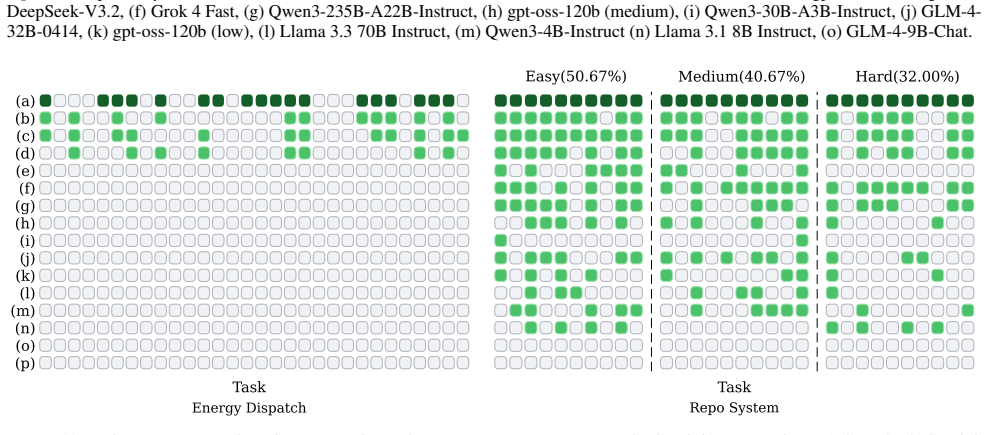
- [Figures 5 and 10] The grayscale task-success maps are hard to read; using distinct symbols or hatched patterns for human/LLM/unsolved cells would improve clarity.
- [Figure 6 / Appendix B.3] The 'random' baseline is mentioned but never defined. Specify the random policy (e.g., uniform over actions) and report its variance, since several models underperform it.
- [§3.1] The four primitives are described as 'orthogonal' and 'comprehensive', but no formal definition or coverage argument is provided. Consider softening this claim or adding a brief justification.
- [Table 4] For AI Trading, only profit rates are shown in the w/ rules comparison; including Pass@4 or a normalized metric would make the table consistent with Table 2.
Circularity Check
No significant circularity: the benchmark conclusions are empirical evaluation results, not derivations built from their own inputs.
full rationale
OdysseyArena's central claims are produced by running LLMs on the authors' own environments and comparing against human, random, and algorithmic baselines (e.g., Optimal/Conservative/Progressive strategies in Table 5). No free parameter is fitted to force the conclusion, and no equation in the paper equates the target result with an input by construction. The w/ rules versus w/o rules comparison in §5.2 is an experimental control, not a self-definitional identity: it directly tests what happens when latent rules are revealed, and the results in Turn On Lights (Table 4) support the deductive-versus-inductive asymmetry claimed there. The Energy Dispatch rows of Table 4 do contradict the general 'primary bottleneck is discovery' inference (Gemini 3 Pro falls from 30.00 to 16.67 with rules, GPT-5 from 23.33 to 13.33), but that is a validity/confound concern about whether the control isolates induction, not a circular reduction of the claim to its inputs. The paper's self-citations (φ-decoding, Genius, TIDE, OS-Genesis) appear only as related-work context or motivation and are not load-bearing evidence for the benchmark's validity or for the inductive-bottleneck conclusion. The benchmark is self-contained, externally checkable through released code and data, and its headline result is an evaluation outcome rather than a fitted prediction. Therefore no significant circularity is found.
Axiom & Free-Parameter Ledger
free parameters (1)
- Easy/Medium/Hard task split thresholds =
Proxy-based (e.g., number of lights); exact cutoffs not specified
axioms (3)
- ad hoc to paper The four primitive transition structures (discrete Boolean, continuous stochastic, periodic, relational graph) are orthogonal and jointly cover latent world dynamics.
- ad hoc to paper The w/ rules vs w/o rules contrast isolates induction from deduction; any performance drop is attributed to missing rule knowledge rather than differences in prompt format, task complexity, or environment state.
- domain assumption Human annotators provide a reliable upper-bound estimate of task solvability.
read the original abstract
The rapid advancement of Large Language Models (LLMs) has catalyzed the development of autonomous agents capable of navigating complex environments. However, existing evaluations primarily adopt a deductive paradigm, where agents execute tasks based on explicitly provided rules and static goals, often within limited planning horizons. Crucially, this neglects the inductive necessity for agents to discover latent transition laws from experience autonomously, which is the cornerstone for enabling agentic foresight and sustaining strategic coherence. To bridge this gap, we introduce OdysseyArena, which re-centers agent evaluation on long-horizon, active, and inductive interactions. We formalize and instantiate four primitives, translating abstract transition dynamics into concrete interactive environments. Building upon this, we establish OdysseyArena-Lite for standardized benchmarking, providing a set of 120 tasks to measure an agent's inductive efficiency and long-horizon discovery. Pushing further, we introduce OdysseyArena-Challenge to stress-test agent stability across extreme interaction horizons (e.g., > 200 steps). Extensive experiments on 15+ leading LLMs reveal that even frontier models exhibit a deficiency in inductive scenarios, identifying a critical bottleneck in the pursuit of autonomous discovery in complex environments. Our code and data are available at https://github.com/xufangzhi/Odyssey-Arena
Figures




Forward citations
Cited by 4 Pith papers
-
OSReward: Instituting Standardized Evaluation for Cross-Platform Computer-Use Reward Models
VLM judges of CUA trajectories are systematically lenient; OSReward measures this with human gold, and OS-Shepherd open models close most of the reliability gap cheaply.
-
SEED: Self-Evolving On-Policy Distillation for Agentic Reinforcement Learning
SEED improves agentic RL by converting a policy's own completed trajectories into natural-language skills and distilling the skill-induced probability shift back into the policy as dense token-level supervision.
-
Data-Driven Boundary Control of Distributed Port-Hamiltonian Systems
GP-dPHS learning plus interconnection boundary control yields probabilistic boundedness conditions for closed-loop trajectories under Hamiltonian model mismatch.
-
OPID: On-Policy Skill Distillation for Agentic Reinforcement Learning
OPID distills episode- and step-level skills from completed on-policy trajectories, routes them via critical-first mechanism, and combines the resulting log-probability shift advantage with outcome advantage for polic...
Reference graph
Works this paper leans on
-
[1]
write newline
" write newline "" before.all 'output.state := FUNCTION n.dashify 't := "" t empty not t #1 #1 substring "-" = t #1 #2 substring "--" = not "--" * t #2 global.max substring 't := t #1 #1 substring "-" = "-" * t #2 global.max substring 't := while if t #1 #1 substring * t #2 global.max substring 't := if while FUNCTION format.date year duplicate empty "emp...
-
[2]
Akata, E., Schulz, L., Coda-Forno, J., Oh, S. J., Bethge, M., and Schulz, E. Playing repeated games with large language models. Nature Human Behaviour, 9 0 (7): 0 1380–1390, May 2025. ISSN 2397-3374. doi:10.1038/s41562-025-02172-y. URL http://dx.doi.org/10.1038/s41562-025-02172-y
-
[3]
The claude 3 model family: Opus, sonnet, haiku
Anthropic\;AI. The claude 3 model family: Opus, sonnet, haiku. Claude-3 Model Card, 1: 0 1, 2024. URL https://assets.anthropic.com/m/61e7d27f8c8f5919/original/Claude-3-Model-Card.pdf
2024
-
[4]
H., and Bengio, Y
Chevalier-Boisvert, M., Bahdanau, D., Lahlou, S., Willems, L., Saharia, C., Nguyen, T. H., and Bengio, Y. Babyai: A platform to study the sample efficiency of grounded language learning. In International Conference on Learning Representations, 2019. URL https://iclr.cc/virtual/2019/poster/733
2019
-
[5]
On the measure of intelligence
Chollet, F. On the measure of intelligence. arXiv preprint arXiv:1911.01547, 2019. URL https://arxiv.org/abs/1911.01547
Pith/arXiv arXiv 1911
-
[6]
Evaluating long-context reasoning in llm-based webagents
Chung, A., Zhang, Y., Lin, K., Rawal, A., Gao, Q., and Chai, J. Evaluating long-context reasoning in llm-based webagents. In NeurIPS 2025 Workshop on Bridging Language, Agent, and World Models for Reasoning and Planning, 2025. URL https://openreview.net/forum?id=oxj422wRvO
2025
-
[7]
The dynamical challenge
Clark, A. The dynamical challenge. Cognitive science, 21 0 (4): 0 461--481, 1997. URL https://www.sciencedirect.com/science/article/abs/pii/S0364021399800305
1997
-
[8]
Mind2web: Towards a generalist agent for the web
Deng, X., Gu, Y., Zheng, B., Chen, S., Stevens, S., Wang, B., Sun, H., and Su, Y. Mind2web: Towards a generalist agent for the web. Advances in Neural Information Processing Systems, 36: 0 28091--28114, 2023. URL https://openreview.net/forum?id=kiYqbO3wqw
2023
-
[9]
Gemini Team . Gemini 2.5: Pushing the frontier with advanced reasoning, multimodality, long context, and next generation agentic capabilities. arXiv preprint arXiv:2507.06261, 2025. URL https://arxiv.org/abs/2507.06261
Pith/arXiv arXiv 2025
-
[10]
Chatglm: A family of large language models from glm-130b to glm-4 all tools
GLM, T., Zeng, A., Xu, B., Wang, B., Zhang, C., Yin, D., Zhang, D., Rojas, D., Feng, G., Zhao, H., et al. Chatglm: A family of large language models from glm-130b to glm-4 all tools. arXiv preprint arXiv:2406.12793, 2024. URL https://arxiv.org/abs/2406.12793
Pith/arXiv arXiv 2024
-
[11]
Grattafiori, A., Dubey, A., Jauhri, A., Pandey, A., Kadian, A., Al-Dahle, A., Letman, A., Mathur, A., Schelten, A., Vaughan, A., et al. The llama 3 herd of models. arXiv preprint arXiv:2407.21783, 2024. URL https://arxiv.org/abs/2407.21783
Pith/arXiv arXiv 2024
-
[12]
and Schmidhuber, J
Ha, D. and Schmidhuber, J. Recurrent world models facilitate policy evolution. Advances in neural information processing systems, 31, 2018. URL https://proceedings.neurips.cc/paper_files/paper/2018/file/2de5d16682c3c35007e4e92982f1a2ba-Paper.pdf
2018
-
[13]
Kwon, W., Li, Z., Zhuang, S., Sheng, Y., Zheng, L., Yu, C. H., Gonzalez, J. E., Zhang, H., and Stoica, I. Efficient memory management for large language model serving with pagedattention. In Proceedings of the ACM SIGOPS 29th Symposium on Operating Systems Principles, 2023. URL https://dl.acm.org/doi/abs/10.1145/3600006.3613165
arXiv 2023
-
[14]
Lake, B. M., Ullman, T. D., Tenenbaum, J. B., and Gershman, S. J. Building machines that learn and think like people. Behavioral and brain sciences, 40: 0 e253, 2017. URL https://pubmed.ncbi.nlm.nih.gov/27881212/
arXiv 2017
-
[15]
State space models on temporal graphs: A first-principles study
Li, J., Wu, R., Jin, X., Ma, B., Chen, L., and Zheng, Z. State space models on temporal graphs: A first-principles study. Advances in Neural Information Processing Systems, 37: 0 127030--127058, 2024. URL https://openreview.net/forum?id=UaJErAOssN
2024
-
[16]
Y., Le Bras, R., Richardson, K., Sabharwal, A., Poovendran, R., Clark, P., and Choi, Y
Lin, B. Y., Le Bras, R., Richardson, K., Sabharwal, A., Poovendran, R., Clark, P., and Choi, Y. Zebralogic: On the scaling limits of llms for logical reasoning. In Forty-second International Conference on Machine Learning, 2025. URL https://openreview.net/forum?id=sTAJ9QyA6l
2025
-
[17]
Liu, A., Mei, A., Lin, B., Xue, B., Wang, B., Xu, B., Wu, B., Zhang, B., Lin, C., Dong, C., et al. Deepseek-v3. 2: Pushing the frontier of open large language models. arXiv preprint arXiv:2512.02556, 2025. URL https://arxiv.org/abs/2512.02556
Pith/arXiv arXiv 2025
-
[18]
Agentbench: Evaluating llms as agents
Liu, X., Yu, H., Zhang, H., Xu, Y., Lei, X., Lai, H., Gu, Y., Ding, H., Men, K., Yang, K., et al. Agentbench: Evaluating llms as agents. In ICLR, 2024. URL https://openreview.net/forum?id=zAdUB0aCTQ
2024
-
[19]
Gaia: a benchmark for general ai assistants
Mialon, G., Fourrier, C., Wolf, T., LeCun, Y., and Scialom, T. Gaia: a benchmark for general ai assistants. In The Twelfth International Conference on Learning Representations, 2023
2023
-
[20]
gpt-oss-120b & gpt-oss-20b model card
OpenAI. gpt-oss-120b & gpt-oss-20b model card. gpt-oss model card, 1: 0 1, 2025. URL https://arxiv.org/abs/2508.10925
Pith/arXiv arXiv 2025
-
[21]
G., Mao, H., Yan, F., Ji, C
Patil, S. G., Mao, H., Yan, F., Ji, C. C.-J., Suresh, V., Stoica, I., and Gonzalez, J. E. The berkeley function calling leaderboard (bfcl): From tool use to agentic evaluation of large language models. In Forty-second International Conference on Machine Learning, 2025. URL https://openreview.net/pdf?id=2GmDdhBdDk
2025
-
[22]
E., Li, W., Campbell-Ajala, F., Toyama, D
Rawles, C., Clinckemaillie, S., Chang, Y., Waltz, J., Lau, G., Fair, M., Li, A., Bishop, W. E., Li, W., Campbell-Ajala, F., Toyama, D. K., Berry, R. J., Tyamagundlu, D., Lillicrap, T. P., and Riva, O. Androidworld: A dynamic benchmarking environment for autonomous agents. In The Thirteenth International Conference on Learning Representations, 2025. URL ht...
2025
-
[23]
Reflexion: Language agents with verbal reinforcement learning
Shinn, N., Cassano, F., Gopinath, A., Narasimhan, K., and Yao, S. Reflexion: Language agents with verbal reinforcement learning. Advances in Neural Information Processing Systems, 36: 0 8634--8652, 2023. URL https://openreview.net/pdf?id=vAElhFcKW6
2023
-
[24]
Alfworld: Aligning text and embodied environments for interactive learning
Shridhar, M., Yuan, X., Cote, M.-A., Bisk, Y., Trischler, A., and Hausknecht, M. Alfworld: Aligning text and embodied environments for interactive learning. In International Conference on Learning Representations, 2021. URL https://openreview.net/pdf?id=0IOX0YcCdTn
2021
-
[25]
Corex: Pushing the boundaries of complex reasoning through multi-model collaboration
Sun, Q., Yin, Z., Li, X., Wu, Z., Qiu, X., and Kong, L. Corex: Pushing the boundaries of complex reasoning through multi-model collaboration. arXiv preprint arXiv:2310.00280, 2023
Pith/arXiv arXiv 2023
-
[26]
Os-genesis: Automating gui agent trajectory construction via reverse task synthesis
Sun, Q., Cheng, K., Ding, Z., Jin, C., Wang, Y., Xu, F., Wu, Z., Jia, C., Chen, L., Liu, Z., et al. Os-genesis: Automating gui agent trajectory construction via reverse task synthesis. In Proceedings of the 63rd Annual Meeting of the Association for Computational Linguistics (Volume 1: Long Papers), pp.\ 5555--5579, 2025 a
2025
-
[27]
Scienceboard: Evaluating multimodal autonomous agents in realistic scientific workflows
Sun, Q., Liu, Z., Ma, C., Ding, Z., Xu, F., Yin, Z., Zhao, H., Wu, Z., Cheng, K., Liu, Z., et al. Scienceboard: Evaluating multimodal autonomous agents in realistic scientific workflows. arXiv preprint arXiv:2505.19897, 2025 b
Pith/arXiv arXiv 2025
-
[28]
Mars: Situated inductive reasoning in an open-world environment
Tang, X., Li, J., Liang, Y., Zhu, S.-C., Zhang, M., and Zheng, Z. Mars: Situated inductive reasoning in an open-world environment. In The Thirty-eight Conference on Neural Information Processing Systems Datasets and Benchmarks Track, 2024. URL https://openreview.net/forum?id=3qoQ6AolAz
2024
-
[29]
Michelangelo: Long context evaluations beyond haystacks via latent structure queries
Vodrahalli, K., Ontanon, S., Tripuraneni, N., Xu, K., Jain, S., Shivanna, R., Hui, J., Dikkala, N., Kazemi, M., Fatemi, B., et al. Michelangelo: Long context evaluations beyond haystacks via latent structure queries. CoRR, 2024. URL https://openreview.net/forum?id=jdc57bqY3u
2024
-
[30]
Large language models for robotics: Opportunities, challenges, and perspectives
Wang, J., Shi, E., Hu, H., Ma, C., Liu, Y., Wang, X., Yao, Y., Liu, X., Ge, B., and Zhang, S. Large language models for robotics: Opportunities, challenges, and perspectives. Journal of Automation and Intelligence, 4 0 (1): 0 52--64, 2025 a . URL https://www.sciencedirect.com/science/article/pii/S2949855424000613
2025
-
[31]
M., Xu, J., R \"u hle, V., and Rajmohan, S
Wang, W., Han, D., Diaz, D. M., Xu, J., R \"u hle, V., and Rajmohan, S. Odysseybench: Evaluating llm agents on long-horizon complex office application workflows. arXiv preprint arXiv:2508.09124, 2025 b . URL https://arxiv.org/abs/2508.09124
Pith/arXiv arXiv 2025
-
[32]
Wei, J., Sun, Z., Papay, S., McKinney, S., Han, J., Fulford, I., Chung, H. W., Passos, A. T., Fedus, W., and Glaese, A. Browsecomp: A simple yet challenging benchmark for browsing agents. arXiv preprint arXiv:2504.12516, 2025. URL https://arxiv.org/pdf/2504.12516
Pith/arXiv arXiv 2025
-
[33]
J., Cheng, Z., Shin, D., Lei, F., et al
Xie, T., Zhang, D., Chen, J., Li, X., Zhao, S., Cao, R., Hua, T. J., Cheng, Z., Shin, D., Lei, F., et al. Osworld: Benchmarking multimodal agents for open-ended tasks in real computer environments. Advances in Neural Information Processing Systems, 37: 0 52040--52094, 2024. URL https://openreview.net/forum?id=tN61DTr4Ed#discussion
2024
-
[34]
-decoding: Adaptive foresight sampling for balanced inference-time exploration and exploitation
Xu, F., Yan, H., Ma, C., Zhao, H., Liu, J., Lin, Q., and Wu, Z. -decoding: Adaptive foresight sampling for balanced inference-time exploration and exploitation. In Proceedings of the 63rd Annual Meeting of the Association for Computational Linguistics (Volume 1: Long Papers), pp.\ 13214--13227, Vienna, Austria, July 2025 a . Association for Computational ...
-
[35]
Genius: A generalizable and purely unsupervised self-training framework for advanced reasoning
Xu, F., Yan, H., Ma, C., Zhao, H., Sun, Q., Cheng, K., He, J., Liu, J., and Wu, Z. Genius: A generalizable and purely unsupervised self-training framework for advanced reasoning. In Proceedings of the 63rd Annual Meeting of the Association for Computational Linguistics (Volume 1: Long Papers), pp.\ 13153--13167, Vienna, Austria, July 2025 b . Association ...
-
[36]
F., Song, Y., Li, B., Tang, Y., Jain, K., Bao, M., Wang, Z
Xu, F. F., Song, Y., Li, B., Tang, Y., Jain, K., Bao, M., Wang, Z. Z., Zhou, X., Guo, Z., Cao, M., Yang, M., Lu, H. Y., Martin, A., Su, Z., Maben, L. M., Mehta, R., Chi, W., Jang, L. K., Xie, Y., Zhou, S., and Neubig, G. Theagentcompany: Benchmarking LLM agents on consequential real world tasks. In The Thirty-ninth Annual Conference on Neural Information ...
2025
-
[37]
Tide: Trajectory-based diagnostic evaluation of test-time improvement in llm agents
Yan, H., Che, X., Xu, F., Sun, Q., Ding, Z., Cheng, K., Zhang, J., Qin, T., Liu, J., and Lin, Q. Tide: Trajectory-based diagnostic evaluation of test-time improvement in llm agents. arXiv preprint arXiv:2602.02196, 2025. URL https://arxiv.org/abs/2602.02196
arXiv 2025
-
[38]
Yang, A., Li, A., Yang, B., Zhang, B., Hui, B., Zheng, B., Yu, B., Gao, C., Huang, C., Lv, C., et al. Qwen3 technical report. arXiv preprint arXiv:2505.09388, 2025. URL https://arxiv.org/abs/2505.09388
Pith/arXiv arXiv 2025
-
[39]
R., and Cao, Y
Yao, S., Zhao, J., Yu, D., Du, N., Shafran, I., Narasimhan, K. R., and Cao, Y. React: Synergizing reasoning and acting in language models. In The eleventh international conference on learning representations, 2023. URL https://openreview.net/forum?id=WE_vluYUL-X
2023
-
[40]
Yao, S., Shinn, N., Razavi, P., and Narasimhan, K. R. \ \ tau\ \ -bench: A benchmark for underline\ T\ ool- underline\ A\ gent- underline\ U\ ser interaction in real-world domains. In The Thirteenth International Conference on Learning Representations, 2025. URL https://openreview.net/forum?id=roNSXZpUDN
2025
-
[41]
F., Zhu, H., Zhou, X., Lo, R., Sridhar, A., Cheng, X., Ou, T., Bisk, Y., Fried, D., et al
Zhou, S., Xu, F. F., Zhu, H., Zhou, X., Lo, R., Sridhar, A., Cheng, X., Ou, T., Bisk, Y., Fried, D., et al. Webarena: A realistic web environment for building autonomous agents. In The Twelfth International Conference on Learning Representations, 2024. URL https://openreview.net/forum?id=oKn9c6ytLx
2024
discussion (0)
Sign in with ORCID, Apple, or X to comment. Anyone can read and Pith papers without signing in.