REVIEW 3 major objections 6 minor 24 references
By grounding LLM-generated instructions into hierarchical temporal logic and replanning on a rolling horizon, this paper shows that multi-robot teams can execute long-horizon human-facing tasks like object handovers while preserving formal
Reviewed by Pith at T0; open to challenge. T0 means a machine referee read the full paper against a public rubric. the ladder, T0–T4 →
A neuro-symbolic planner that grounds LLM instructions into hierarchical temporal logic and re-plans in a rolling horizon outperforms an LLM-only baseline in dynamic multi-robot handover tasks.
T0 review reviewed 2026-08-03 challenge →
load-bearing objection A credible integration of H-LTLf and LLM grounding with real robot demos, but the headline 'grounding' claim rests on an unverified LLM-to-spec translation. the 3 major comments →
LLM-Grounded Dynamic Task Planning with Hierarchical Temporal Logic for Human-Aware Multi-Robot Handover
The pith
A machine-rendered reading of the paper's core claim, the machinery that carries it, and where it could break.
The reading
Core claim
The authors claim that hierarchical LTLf team models—where each leaf specification becomes a product automaton of robot transition systems and a nondeterministic finite automaton, connected by in-spec and inter-spec switch transitions—reduce the search space enough to enable A* optimal path finding in real time, and that wrapping this in a progress-triggered receding horizon loop with reactive safety constraints and predictive horizon adaptation lets the system resolve stochastic environmental changes while keeping formal guarantees. They report success rates of 93% in the hardest simulation setting versus 19% for the baseline, a 50% execution-time reduction in a dynamic interruption scenari
What carries the argument
Hierarchical Team Models: a graph of product automata, each combining a robot's weighted transition system with an NFA of a leaf H-LTLf specification, linked by sequential and simultaneous in-spec switches and by task-switching and progression inter-spec switches. A* search over this graph yields the optimal path; progress-triggered replanning re-solves whenever an atomic action or switch transition completes, a safety shield halts execution on kinematic infeasibility or predicted intrusion risk, and predictive planning precomputes suffix plans for forecast human positions and takes over only when the observed state converges to the prediction.
Load-bearing premise
The load-bearing premise is that the LLM's translation of a free-form instruction into a correct H-LTLf hierarchy faithfully captures the user's intent—if it emits a plausible but wrong hierarchy, the formal planner guarantees correctness only for the wrong task.
What would settle it
Run a scenario with two robots and one moving person, and give an instruction whose LLM-generated hierarchy omits a safety proposition such as 'stay out of the person's workspace during handover.' If the resulting plan lets a robot intrude into the person's predicted position, the claim that the system resolves stochastic environmental changes fails. Alternatively, make a person move adversarially faster than the trajectory predictor; if success rate collapses while a constant-replanning baseline holds, the predictive adaptation claim is falsified.
If this is right
- If the 93%-versus-19% simulation gap holds, the hierarchical formal structure is the key to scaling LLM-based multi-robot planning to long horizons.
- The 80–94% token reduction suggests that closed-loop formal grounding makes LLM queries cheap enough for real-time replanning cycles.
- Correct-by-construction mutual exclusion, such as blocking simultaneous-hold handovers, means safety properties are enforced by the automaton rather than by prompt engineering.
- Predictive horizon adaptation removes planning latency at the moment a handover target changes, which is the bottleneck in human-aware interaction.
- The framework's deployment on two heterogeneous real manipulators shows the approach is not confined to simulation.
Where Pith is reading between the lines
- Because the LLM's translation of an instruction into an H-LTLf hierarchy is unverified, the formal guarantees hold only relative to the generated specification; a testable extension is adding a semantic verification or repair step that checks the hierarchy against the instruction's intent.
- The approach could generalize beyond handovers to any domain with hierarchical task decompositions and stochastic human behavior, such as assembly or service robotics, where the same product-team-model structure applies.
- The receding-horizon re-solving over a product graph resembles model-predictive control; one could derive formal bounds on how replanning frequency trades off against plan suboptimality as environmental dynamics change.
- The prediction horizon is an unanalyzed tunable parameter; adversarial human motion that outruns the predictor could stress the safety shield in ways the current experiments do not measure.
Editorial analysis
A structured set of objections, weighed in public.
Referee Report
Summary. The paper proposes a neuro-symbolic framework for multi-robot task planning in dynamic human environments. A perception module builds a semantic 3D scene, an LLM converts natural-language instructions into hierarchical LTLf (sc-LTL) specifications, and a hierarchical team model combines robot transition systems with automata for each leaf specification. An A* search solves the resulting STAP problem, and a receding horizon loop with reactive safety constraints and predictive trajectory planning handles stochastic human motion and task updates. The system is evaluated in simulation against a single LLM baseline and in real-world experiments with two manipulators and human participants, reporting success rate, time cost, token usage, replanning counts, and HRC fluency metrics.
Significance. If the claims are substantiated, this would be a notable step toward scalable formal planning with LLM-based task specification in dynamic human-centric environments. The paper makes a concrete engineering contribution by integrating H-LTLf formal planning, receding-horizon replanning, perception, and physical handover skills in a real system, which is relatively rare. The token-usage reduction and the real-world deployment with heterogeneous manipulators are strengths. However, the central end-to-end claim that the LLM reliably grounds human instructions into correct hierarchical specifications is not directly validated, and the statistical support for 'significantly outperforms' is weak. These issues are load-bearing for the paper's stated value proposition.
major comments (3)
- [Sec. III-B/III-C and Sec. V] The central claim that the system 'grounds human instructions' into H-LTLf specifications and provides 'correct-by-construction safety and feasibility' depends on an unverified LLM translation step. Section III stage (2) only states that 'an LLM reason about the scene, and output hierarchical team models' with no semantic verification, consistency check, or fallback mechanism. The formal planner guarantees correctness only for the specification it is given; a hallucinated hierarchy (wrong goal, missing safety proposition, incorrect decomposition) would be executed with high confidence. None of the experiments in Sec. V isolate or measure translation fidelity: simulation tasks appear to be procedurally generated with known specifications, and the real-world T1–T6 scenarios are reported without formula-level ground truth. To support the end-to-end claim, the paper should specify the prompt
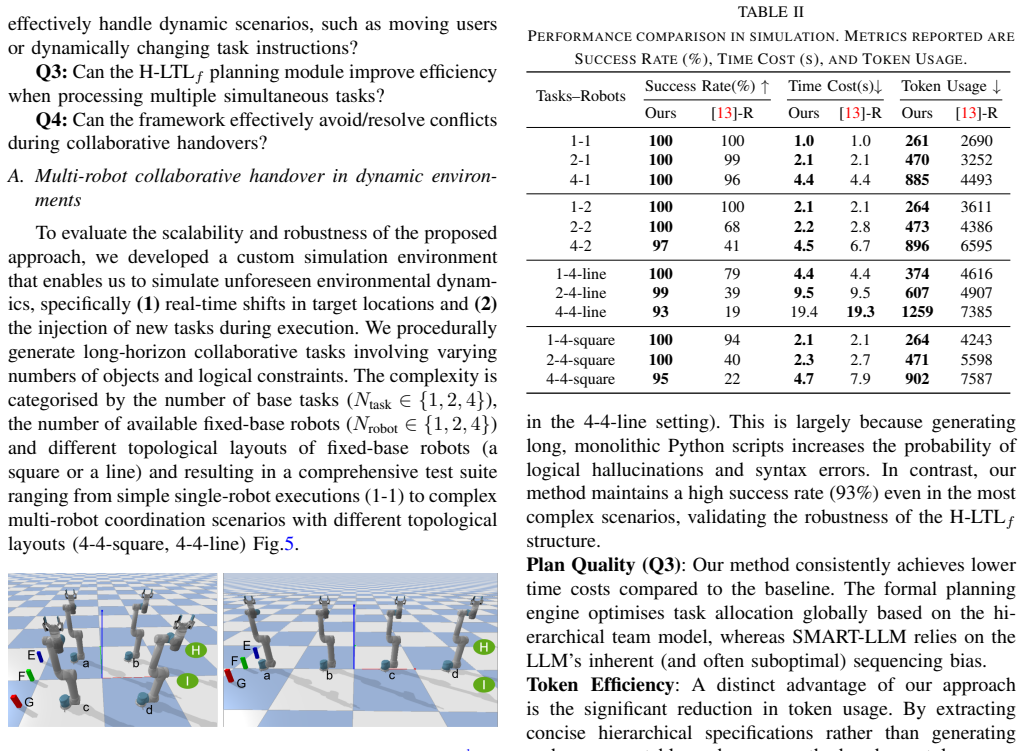
- [Table II and Sec. V-B] The abstract claims the approach 'significantly outperforms baseline methods in success rate and interaction fluency', but no statistical tests are reported. Table II gives point estimates of success rates without confidence intervals or p-values; some differences are small (e.g., 2-1: 100 vs 99, 4-1: 100 vs 96). In the real-world experiments (Fig. 7), 20 trials per task are run but no significance testing is reported for execution time, success, or replanning count. The claim of a 'significantly lower replanning count' in T5/T6 is also unsupported. Add appropriate statistical analyses (e.g., paired bootstrap or exact tests across trials) or soften the 'significant' wording to 'consistent improvements' where significance is not established.
- [Sec. III-D, Sec. V-A, Sec. V-C] The contribution 'extend H-LTLf based formal planning ... via integrating it with RHP' is not isolated in the evaluation. The only baseline, SMART-LLM [13]-R, is a script-generation LLM planner and does not use hierarchical formal specifications; the comparison therefore conflates the H-LTLf formal planning layer with the RHP loop. The paper does not compare against an open-loop H-LTLf planner (e.g., Nl2HLTL2Plan [9]) or an H-LTLf planner with periodic full replanning, so the specific benefit of progress-triggered re-optimization over the remaining horizon is not demonstrated. Table III ablates the predictive trigger and parallel motion planning, but not the absence of the RHP loop. I recommend adding an ablation that fixes the initial H-LTLf plan and executes it open-loop (or replans only on failure) under the same dynamic disturbances; this would directly support the claim that the RHP
minor comments (6)
- [Abstract and Sec. III-B] The paper alternates between 'H-LTLf' (abstract, title) and 'Hierarchical sc-LTL' (Sec. III-B). Since LTLf and sc-LTL are distinct formalisms, clarify the relationship and use one consistent name.
- [Sec. III-D] Typo: 're-solv' should be 're-solve'. In Sec. III-B, 'donated as' should be 'denoted as'.
- [Sec. V-A] The task notation such as '1-1', '4-4-square' is undefined. State explicitly that the first number is N_task, the second is N_robot, and the suffix is the topological layout.
- [Fig. 7 / Sec. V-B] Define how 'replanning count' is computed and whether Fig. 7 shows means over the 20 trials. Add error bars and clarify the criterion 'trials exceeding 3 are marked as failures'.
- [Sec. V-D / Table III] The caption uses 'P.T.' while the table rows use 'w/o P.P.' for predictive planning/trigger. Use one abbreviation consistently.
- [Sec. III-C] The A* search is described without specifying the heuristic or how edge costs c_r are determined. If optimality is claimed, state the heuristic's admissibility and the source of c_r.
Circularity Check
No significant circularity: the formal backbone is imported from external prior work, and the reported gains are measured against external baselines rather than fitted parameters renamed as predictions.
full rationale
The paper's derivation chain is not circular. The hierarchical sc-LTL/H-LTLf formalism is taken from [5] (Luo & Liu) and [9] (Xu, Luo, et al.), which are external works with no author overlap with the present paper; the paper's contribution is the dynamic receding-horizon integration, not a reformulation of its own conclusions as premises. The planning pipeline (LLM -> H-LTLf -> NFA -> product team model -> A* search) is a standard compositional synthesis construction, and the safety/feasibility properties in Sec. V-C are explicitly presented as 'Correct-by-Construction' outcomes of the transition-system design, not as empirical discoveries. The success-rate and time-cost comparisons are measured against SMART-LLM and a replanning variant [13]-R in both procedurally generated simulation tasks and real-world trials; no parameter is fit to the evaluation metric and then reported as a prediction. The self-citations present ([1], [6], [22]) are background surveys or a handover-motion component and are not load-bearing for the central claim. The main weakness identified by the skeptic is a semantic-verification gap: the LLM's translation of natural language into H-LTLf is not checked against user intent, so the formal guarantees apply to the generated specification rather than the original instruction. That is an external-validity or correctness-risk concern, not a circularity, because the paper does not define the specification in terms of the measured outcome or derive the outcome from the specification it is supposed to explain. Overall, no step reduces, by definition or self-citation, to its own inputs.
Axiom & Free-Parameter Ledger
free parameters (4)
- Transition-system edge costs c_r
- Person-trajectory prediction horizon T_pred and observation window T_obs
- Reactive safety thresholds (workspace intrusion distance, high-velocity maneuver definition)
- Plan-takeover convergence criterion
axioms (5)
- standard math sc-LTL formulas convert to equivalent NFAs, and the product of a robot transition system with an NFA preserves task satisfaction.
- domain assumption Fixed-base arms with spherical reachability models and cylindrical objects are a sufficient abstraction of the task domain.
- ad hoc to paper LLM-generated H-LTLf hierarchies are semantically faithful to the natural-language instruction.
- ad hoc to paper Predicted human trajectories are accurate enough to trigger useful pre-plans.
- ad hoc to paper Progress-triggered replanning over the remaining horizon preserves global correctness and optimality.
Cite this review
Pith. "Pith review of LLM-Grounded Dynamic Task Planning with Hierarchical Temporal Logic for Human-Aware Multi-Robot Handover." pith.science (2026). https://pith.science/paper/BYLIOKFR
@misc{pith2026260209472,
  author       = {Pith},
  title        = {Pith review of: LLM-Grounded Dynamic Task Planning with Hierarchical Temporal Logic for Human-Aware Multi-Robot Handover},
  year         = {2026},
  howpublished = {\url{https://pith.science/paper/BYLIOKFR}},
  note         = {Machine review of arXiv:2602.09472}
}
read the original abstract
Large Language Models (LLMs) enable non-experts to specify open-world multi-robot tasks, but the generated plans are often kinematically infeasible and inefficient in long-horizon settings. Formal methods such as Linear Temporal Logic (LTL) offer correctness and optimality guarantees, yet they are typically offline and scale poorly. To bridge this gap, we propose a neuro-symbolic framework that grounds human instructions into hierarchical LTLf specifications (i.e., LTL on finite traces) and solves the resulting Simultaneous Task Allocation and Planning (STAP) problem. Unlike static approaches, our system handles stochastic environmental changes-such as user motion or updated instructions-through a receding horizon planning (RHP) loop with real-time perception, dynamically refining plans over a hierarchical state space. Experiments in simulation and on real robots demonstrate that our approach significantly outperforms baseline methods in success rate and interaction fluency while reducing replanning overhead.
Figures




Reference graph
Works this paper leans on
-
[1]
Robot manipulation based on embodied visual perception: A survey,
S. Wang, M. N. Nikoli ´c, T. L. Lam, Q. Gao, R. Ding, and T. Zhang, “Robot manipulation based on embodied visual perception: A survey,” CAAI Transactions on Intelligence Technology, 2025. 1
2025
-
[2]
Dynamic open-vocabulary 3d scene graphs for long-term language- guided mobile manipulation,
Z. Yan, S. Li, Z. Wang, L. Wu, H. Wang, J. Zhu, L. Chen, and J. Liu, “Dynamic open-vocabulary 3d scene graphs for long-term language- guided mobile manipulation,” IEEE Robotics and Automation Letters, vol. 10, no. 5, pp. 4252–4259, 2025. 1
2025
-
[3]
Dart-llm: Dependency-aware multi- robot task decomposition and execution using large language models,
Y . Wang, R. Xiao, J. Y . L. Kasahara, R. Yajima, K. Nagatani, A. Yamashita, and H. Asama, “Dart-llm: Dependency-aware multi- robot task decomposition and execution using large language models,”
-
[4]
Dexter-llm: Dynamic and explainable coordination of multi-robot systems in unknown environments via large language models,
Y . Zhu, J. Chen, X. Zhang, M. Guo, and Z. Li, “Dexter-llm: Dynamic and explainable coordination of multi-robot systems in unknown environments via large language models,” 2025. 1, 2
2025
-
[5]
Simultaneous task allocation and planning for multi-robots under hierarchical temporal logic specifications,
X. Luo and C. Liu, “Simultaneous task allocation and planning for multi-robots under hierarchical temporal logic specifications,” IEEE Transactions on Robotics, 2025. 1, 2, 4
2025
-
[6]
A survey on the visual perception of humanoid robot,
T. Bin, H. Yan, N. Wang, M. N. Nikoli ´c, J. Yao, and T. Zhang, “A survey on the visual perception of humanoid robot,” Biomimetic Intelligence and Robotics, p. 100197, 2024. 2
2024
-
[7]
Temporal logic motion planning with convex op- timization via graphs of convex sets,
V . Kurtz and H. Lin, “Temporal logic motion planning with convex op- timization via graphs of convex sets,” IEEE Transactions on Robotics, vol. 39, no. 5, pp. 3791–3804, 2023. 2
2023
-
[8]
Lamma-p: Gen- eralizable multi-agent long-horizon task allocation and planning with lm-driven pddl planner,
X. Zhang, H. Qin, F. Wang, Y . Dong, and J. Li, “Lamma-p: Gen- eralizable multi-agent long-horizon task allocation and planning with lm-driven pddl planner,” in 2025 IEEE International Conference on Robotics and Automation (ICRA). IEEE, 2025. 2
2025
-
[9]
Nl2hltl2plan: Scaling up natural language understanding for multi-robots through hierarchical temporal logic task representation,
S. Xu, X. Luo, Y . Huang, L. Leng, R. Liu, and C. Liu, “Nl2hltl2plan: Scaling up natural language understanding for multi-robots through hierarchical temporal logic task representation,” 2024. 2, 6
2024
-
[10]
Octo: An open-source generalist robot policy,
Octo Model Team, D. Ghosh, H. Walke, K. Pertsch, K. Black, O. Mees, S. Dasari, J. Hejna, C. Xu, J. Luo, T. Kreiman, Y . Tan, L. Y . Chen, P. Sanketi, Q. Vuong, T. Xiao, D. Sadigh, C. Finn, and S. Levine, “Octo: An open-source generalist robot policy,” in Proceedings of Robotics: Science and Systems, Delft, Netherlands, 2024. 2
2024
-
[11]
Openvla: An open-source vision-language-action model,
M. Kim, K. Pertsch, S. Karamcheti, T. Xiao, A. Balakrishna, S. Nair, R. Rafailov, E. Foster, G. Lam, P. Sanketi, Q. Vuong, T. Kollar, B. Burchfiel, R. Tedrake, D. Sadigh, S. Levine, P. Liang, and C. Finn, “Openvla: An open-source vision-language-action model,” arXiv preprint arXiv:2406.09246, 2024. 2
Pith/arXiv arXiv 2024
-
[12]
Coherent: Collaboration of heterogeneous multi-robot system with large language models,
K. Liu, Z. Tang, D. Wang, Z. Wang, B. Zhao, and X. Li, “Coherent: Collaboration of heterogeneous multi-robot system with large language models,” arXiv preprint arXiv:2409.15146, 2024. 2
Pith/arXiv arXiv 2024
-
[13]
Smart-llm: Smart multi-agent robot task planning using large language models,
S. S. Kannan, V . L. Venkatesh, and B.-C. Min, “Smart-llm: Smart multi-agent robot task planning using large language models,” arXiv preprint arXiv:2309.10062, 2023. 2, 6
Pith/arXiv arXiv 2023
-
[14]
Roco: Dialectic multi-robot col- laboration with large language models,
Z. Mandi, S. Jain, and S. Song, “Roco: Dialectic multi-robot col- laboration with large language models,” in 2024 IEEE International Conference on Robotics and Automation (ICRA). IEEE, 2024, pp. 286–299. 2
2024
-
[15]
Handover control for human-robot and robot-robot collaboration,
M. Costanzo, G. De Maria, and C. Natale, “Handover control for human-robot and robot-robot collaboration,” Frontiers in Robotics and AI, vol. 8, p. 672995, 2021. 2
2021
-
[16]
HOI4ABOT: Human- object interaction anticipation for human intention reading assistive roBOTs,
E. V . Mascaro, D. Sliwowski, and D. Lee, “HOI4ABOT: Human- object interaction anticipation for human intention reading assistive roBOTs,” in 7th Annual Conference on Robot Learning, 2023. 2
2023
-
[17]
Recognize anything: A strong image tagging model,
Y . Zhang, X. Huang, J. Ma, Z. Li, Z. Luo, Y . Xie, Y . Qin, T. Luo, Y . Li, S. Liu, et al., “Recognize anything: A strong image tagging model,” in Proceedings of the IEEE/CVF Conference on Computer Vision and Pattern Recognition, 2024, pp. 1724–1732. 3
2024
-
[18]
Grounding dino: Marrying dino with grounded pre-training for open-set object detection,
S. Liu, Z. Zeng, T. Ren, F. Li, H. Zhang, J. Yang, Q. Jiang, C. Li, J. Yang, H. Su, et al., “Grounding dino: Marrying dino with grounded pre-training for open-set object detection,” in European conference on computer vision. Springer, 2024, pp. 38–55. 3
2024
-
[19]
Sam 2: Segment anything in images and videos,
N. Ravi, V . Gabeur, Y .-T. Hu, R. Hu, C. Ryali, T. Ma, H. Khedr, R. R¨adle, C. Rolland, L. Gustafson, et al., “Sam 2: Segment anything in images and videos,” arXiv preprint arXiv:2408.00714, 2024. 3
Pith/arXiv arXiv 2024
-
[20]
Learning transferable visual models from natural language supervision,
A. Radford, J. W. Kim, C. Hallacy, A. Ramesh, G. Goh, S. Agarwal, G. Sastry, A. Askell, P. Mishkin, J. Clark, et al., “Learning transferable visual models from natural language supervision,” in International conference on machine learning. PmLR, 2021, pp. 8748–8763. 3
2021
-
[21]
Yolov11: An overview of the key architectural enhancements,
R. Khanam and M. Hussain, “Yolov11: An overview of the key architectural enhancements,” 2024. [Online]. Available: https: //arxiv.org/abs/2410.17725 3
Pith/arXiv arXiv 2024
-
[22]
Fast and comfort- able robot-to-human handover for mobile cooperation robot system,
C. Meng, T. Zhang, D. Zhao, and T. L. Lam, “Fast and comfort- able robot-to-human handover for mobile cooperation robot system,” Cyborg and Bionic Systems, vol. 5, p. 0120, 2024. 5
2024
-
[23]
Human-robot collaboration based on cyber-physical production system and mqtt,
C. A. Garcia, W. Montalvo-Lopez, and M. V . Garcia, “Human-robot collaboration based on cyber-physical production system and mqtt,” Procedia manufacturing, vol. 42, pp. 315–321, 2020. 8
2020
-
[2025]
Higher C–ACT is better; lower H–IDLE, R–IDLE, F–DEL are better
1, 2, 6 2H–IDLE/R–IDLE: percentage of total task time the respective agent is inactive; C–ACT: percentage of time at least two agents are concurrently active; F–DEL: percentage of time between one robot finishing and the other starting. Higher C–ACT is better; lower H–IDLE, R–IDLE, F–DEL are better
This paper was first reviewed by deepseek-v4-flash on August 3, 2026.
discussion (0)
Sign in with ORCID, Apple, or X to comment. Anyone can read and Pith papers without signing in.