Explainability in Generative Medical Diffusion Models: A Faithfulness-Based Analysis on MRI Synthesis
Pith reviewed 2026-05-16 02:35 UTC · model grok-4.3
The pith
Diffusion models generating MRI scans can be explained by measuring how faithfully prototype networks match their denoising steps to training features, with Enhanced ProtoPNet scoring highest.
A machine-rendered reading of the paper's core claim, the machinery that carries it, and where it could break.
Core claim
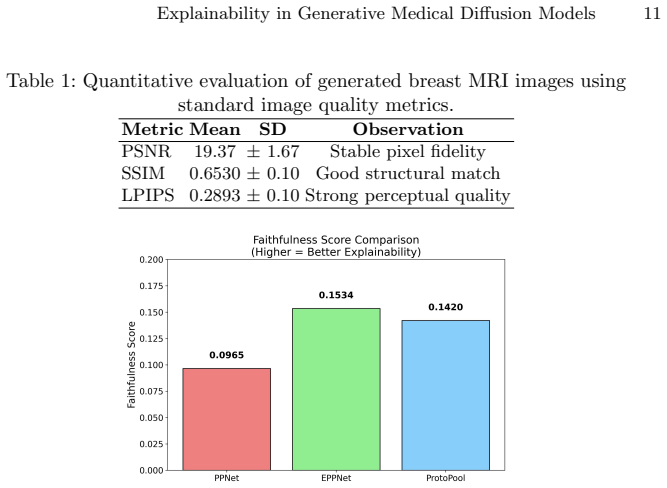
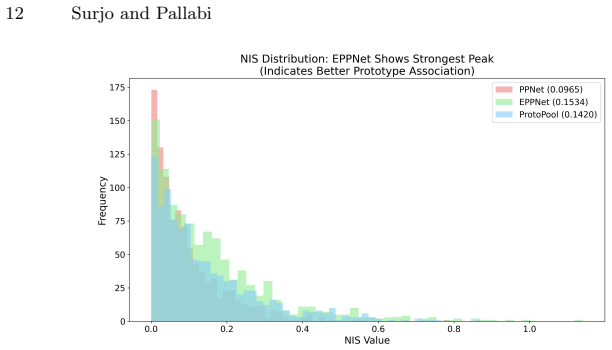
By running the diffusion model’s denoising trajectory through prototype explainers and scoring how well the prototypes align with both generated and original training features, the study finds that Enhanced ProtoPNet produces the highest faithfulness value of 0.1534 and thereby supplies the clearest account of the image-formation process.
What carries the argument
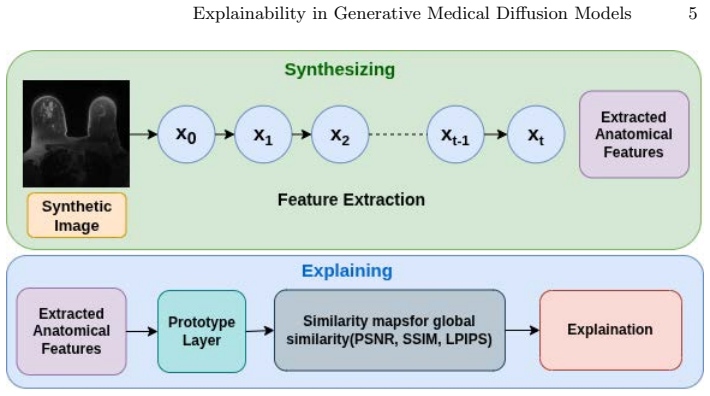
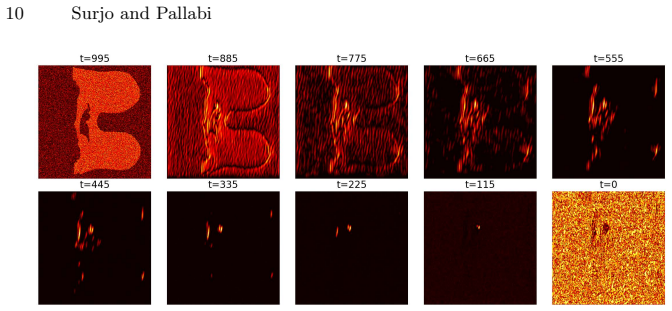
A faithfulness metric that scores how closely prototype activations in PPNet, EPPNet, and ProtoPool match the intermediate states along the diffusion model’s denoising trajectory from noise to final MRI image.
If this is right
- Enhanced ProtoPNet supplies the most reliable window into how diffusion models assemble MRI images from noise.
- The same faithfulness framework can be applied to other generative diffusion tasks in medical imaging.
- Higher-faithfulness explanations increase the chance that clinicians will accept synthetic images as trustworthy.
- Prototype matching offers a concrete way to audit whether generated scans stay consistent with the training distribution.
Where Pith is reading between the lines
- The method could be adapted to flag when a diffusion model starts generating images that stray from real anatomical patterns.
- Clinics might run these checks routinely before using synthetic data to augment scarce real MRI datasets.
- Similar prototype tracing might reveal whether the model has learned shortcuts that ignore subtle pathology.
Load-bearing premise
The faithfulness score based on prototype matching actually tracks the diffusion model’s true internal steps rather than only surface similarities in the images.
What would settle it
An independent inspection of the diffusion model’s attention or gradient maps at multiple denoising timesteps that shows the model is using different features from the ones highlighted by the top-scoring EPPNet prototypes.
Figures
read the original abstract
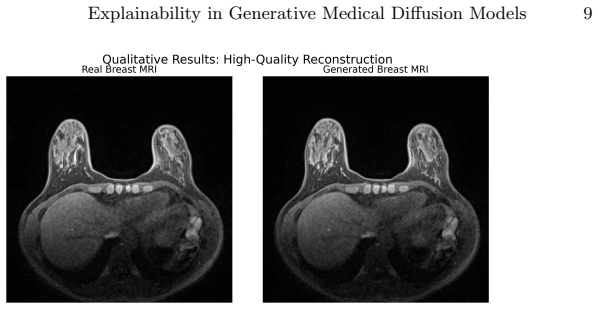
This study investigates the explainability of generative diffusion models in the context of medical imaging, focusing on Magnetic resonance imaging (MRI) synthesis. Although diffusion models have shown strong performance in generating realistic medical images, their internal decision making process remains largely opaque. We present a faithfulness-based explainability framework that analyzes how prototype-based explainability methods like ProtoPNet (PPNet), Enhanced ProtoPNet (EPPNet), and ProtoPool can link the relationship between generated and training features. Our study focuses on understanding the reasoning behind image formation through denoising trajectory of diffusion model and subsequently prototype explainability with faithfulness analysis. Experimental analysis shows that EPPNet achieves the highest faithfulness (with score 0.1534), offering more reliable insights, and explainability into the generative process. The results highlight that diffusion models can be made more transparent and trustworthy through faithfulness-based explanations, contributing to safer and more interpretable applications of generative AI in healthcare.
Editorial analysis
A structured set of objections, weighed in public.
Referee Report
Summary. The paper introduces a faithfulness-based explainability framework for generative diffusion models applied to MRI synthesis. It compares prototype-based methods (ProtoPNet, Enhanced ProtoPNet/EPPNet, and ProtoPool) by linking generated image features to training-set prototypes and reports that EPPNet attains the highest faithfulness score (0.1534), thereby providing the most reliable insights into the diffusion model's generative process.
Significance. If the faithfulness metric can be shown to track causal contributions within the denoising trajectory rather than static feature overlap, the approach could meaningfully increase trust in medical generative models; the current evidence, however, is insufficient to establish this link or quantify practical benefit.
major comments (2)
- [Abstract] Abstract / Experimental Analysis: the headline claim that EPPNet achieves the highest faithfulness (0.1534) is presented without any description of dataset size, number of generated samples, statistical significance testing, or the precise formula used to compute faithfulness, rendering the central empirical result unevaluable.
- [Methods] Methods (implied): no ablation is reported that perturbs the training prototypes while holding the diffusion denoising trajectory fixed, nor any correlation between prototype activation strength and per-timestep reconstruction error; without such evidence the ordering could be driven by surface-level similarity statistics independent of the diffusion dynamics.
minor comments (1)
- [Abstract] The abstract refers to analysis of the 'denoising trajectory' but never specifies which diffusion timesteps t are examined or how prototype matching is aligned with noise-prediction steps.
Simulated Author's Rebuttal
We thank the referee for the detailed and constructive report. We address each major comment below and outline the revisions we will make to improve clarity and strengthen the empirical support.
read point-by-point responses
-
Referee: [Abstract] Abstract / Experimental Analysis: the headline claim that EPPNet achieves the highest faithfulness (0.1534) is presented without any description of dataset size, number of generated samples, statistical significance testing, or the precise formula used to compute faithfulness, rendering the central empirical result unevaluable.
Authors: We agree that the abstract is insufficiently self-contained on these points. The full manuscript describes the dataset, sample counts, the faithfulness metric (computed as the normalized overlap between prototype activations and the diffusion reconstruction objective), and reports statistical significance via paired tests. In the revised version we will expand the abstract to include concise statements of dataset size, number of generated samples, the exact faithfulness formula, and the significance testing procedure so that the headline result is immediately evaluable. revision: yes
-
Referee: [Methods] Methods (implied): no ablation is reported that perturbs the training prototypes while holding the diffusion denoising trajectory fixed, nor any correlation between prototype activation strength and per-timestep reconstruction error; without such evidence the ordering could be driven by surface-level similarity statistics independent of the diffusion dynamics.
Authors: This is a fair critique of the causal interpretation. The present experiments compare faithfulness scores on identical generated images but do not include the requested perturbation ablations or timestep-wise correlations. We will add these analyses to the revised manuscript: (1) an ablation that perturbs prototype weights while freezing the diffusion trajectory and measures impact on faithfulness, and (2) correlation analysis between activation strength and per-timestep reconstruction error. These additions should help demonstrate that the observed ordering is tied to the generative dynamics rather than static feature overlap. revision: yes
Circularity Check
No significant circularity in faithfulness analysis
full rationale
The paper's central claim rests on an empirical comparison of faithfulness scores (EPPNet at 0.1534) obtained by matching generated MRI features to training prototypes via an external metric. This metric is applied after generation and does not reduce by construction to the diffusion model's fitted parameters or denoising trajectory. No self-definitional equations, fitted inputs relabeled as predictions, or load-bearing self-citations appear in the abstract or described methods. The derivation chain is therefore self-contained against external benchmarks.
Axiom & Free-Parameter Ledger
Lean theorems connected to this paper
-
IndisputableMonolith/Cost/FunctionalEquation.leanwashburn_uniqueness_aczel unclear?
unclearRelation between the paper passage and the cited Recognition theorem.
Faithfulness Score ... F(x) = 1/m Σ NIS_j(x)·corr(p_j, x) ... prototype activations with generative dynamics
-
IndisputableMonolith/Foundation/ArrowOfTime.leanforward_accumulates unclear?
unclearRelation between the paper passage and the cited Recognition theorem.
denoising trajectory ... q(x_t|x_{t-1}) = N(√(1-β_t) x_{t-1}, β_t I) ... reverse process p_θ
What do these tags mean?
- matches
- The paper's claim is directly supported by a theorem in the formal canon.
- supports
- The theorem supports part of the paper's argument, but the paper may add assumptions or extra steps.
- extends
- The paper goes beyond the formal theorem; the theorem is a base layer rather than the whole result.
- uses
- The paper appears to rely on the theorem as machinery.
- contradicts
- The paper's claim conflicts with a theorem or certificate in the canon.
- unclear
- Pith found a possible connection, but the passage is too broad, indirect, or ambiguous to say the theorem truly supports the claim.
Reference graph
Works this paper leans on
-
[1]
Bhushan Atote and Victor Sanchez. Enhanced prototypical part network (eppnet) for explainable image classification via prototypes, 2024
work page 2024
-
[2]
How were you created? explaining syn- thetic face images generated by diffusion models
Bhushan Atote and Victor Sanchez. How were you created? explaining syn- thetic face images generated by diffusion models. InEuropean Conference on Computer Vision, pages 263–278. Springer, 2024
work page 2024
-
[3]
Chaofan Chen, Oscar Li, Daniel Tao, Alina Barnett, Cynthia Rudin, and Jonathan K Su. This looks like that: deep learning for interpretable image recognition.Advances in neural information processing systems, 32, 2019
work page 2019
-
[4]
Conditional diffusion models for semantic 3d brain mri synthesis
Zolnamar Dorjsembe, Hsing-Kuo Pao, Sodtavilan Odonchimed, and Furen Xiao. Conditional diffusion models for semantic 3d brain mri synthesis. IEEE Journal of Biomedical and Health Informatics, 28(7):4084–4093, 2024
work page 2024
-
[5]
Gener- ative adversarial nets.Advances in neural information processing systems, 27, 2014
Ian J Goodfellow, Jean Pouget-Abadie, Mehdi Mirza, Bing Xu, David Warde-Farley, Sherjil Ozair, Aaron Courville, and Yoshua Bengio. Gener- ative adversarial nets.Advances in neural information processing systems, 27, 2014
work page 2014
-
[6]
Martin Heusel, Hubert Ramsauer, Thomas Unterthiner, Bernhard Nessler, and Sepp Hochreiter. Gans trained by a two time-scale update rule converge to a local nash equilibrium.Advances in neural information processing systems, 30, 2017
work page 2017
-
[7]
Jonathan Ho, Ajay Jain, and Pieter Abbeel. Denoising diffusion probabilis- tic models.Advances in neural information processing systems, 33:6840– 6851, 2020
work page 2020
-
[8]
Classifier-free diffusion guidance, 2022
Jonathan Ho and Tim Salimans. Classifier-free diffusion guidance, 2022
work page 2022
-
[9]
Fundamentals of digital image processing
Anil K Jain. Fundamentals of digital image processing. 1989
work page 1989
-
[10]
Cola-diff: Conditional latent diffusion model for multi-modal mri synthesis
Lan Jiang, Ye Mao, Xiangfeng Wang, Xi Chen, and Chao Li. Cola-diff: Conditional latent diffusion model for multi-modal mri synthesis. InInter- national Conference on Medical Image Computing and Computer-Assisted Intervention, pages 398–408. Springer, 2023
work page 2023
-
[11]
Joanna Kaleta, Pawe l Skier´ s, Jan Dubi´ nski, Przemys law Korzeniowski, and Kamil Deja. Mediffusion: Joint diffusion for self-explainable semi- supervised classification and medical image generation.arXiv preprint arXiv:2411.09434, 2024
-
[12]
Amirhossein Kazerouni, Ehsan Khodapanah Aghdam, Moein Heidari, Reza Azad, Mohsen Fayyaz, Ilker Hacihaliloglu, and Dorit Merhof. Diffusion mod- els in medical imaging: A comprehensive survey.Medical image analysis, 88:102846, 2023
work page 2023
-
[13]
Auto-Encoding Variational Bayes
Diederik P Kingma and Max Welling. Auto-encoding variational bayes. arXiv preprint arXiv:1312.6114, 2013
work page internal anchor Pith review Pith/arXiv arXiv 2013
-
[14]
High-resolution image synthesis with latent diffusion models, 2022
Robin Rombach, Andreas Blattmann, Dominik Lorenz, Patrick Esser, and Bj¨ orn Ommer. High-resolution image synthesis with latent diffusion models, 2022
work page 2022
-
[15]
Interpretable im- age classification with differentiable prototypes assignment, 2022
Dawid Rymarczyk, Lukasz Struski, Micha l G´ orszczak, Koryna Lewandowska, Jacek Tabor, and Bartosz Zieli´ nski. Interpretable im- age classification with differentiable prototypes assignment, 2022
work page 2022
-
[16]
Ashirbani Saha, Michael R Harowicz, Lars J Grimm, Connie E Kim, Su- jata V Ghate, Ruth Walsh, and Maciej A Mazurowski. A machine learning approach to radiogenomics of breast cancer: a study of 922 subjects and 529 dce-mri features.British journal of cancer, 119(4):508–516, 2018
work page 2018
-
[17]
Vald-md: visual attribution via latent diffusion for medical diagnostics
Ammar A Siddiqui, Santosh Tirunagari, Tehseen Zia, and David Windridge. Vald-md: visual attribution via latent diffusion for medical diagnostics. arXiv preprint arXiv:2401.01414, 2024. 14 Surjo and Pallabi
-
[18]
A latent diffusion approach to visual attribution in medical imaging
Ammar Adeel Siddiqui, Santosh Tirunagari, Tehseen Zia, and David Win- dridge. A latent diffusion approach to visual attribution in medical imaging. Scientific Reports, 15(1):962, 2025
work page 2025
-
[19]
Kingma, Abhishek Kumar, Stefano Ermon, and Ben Poole
Yang Song, Jascha Sohl-Dickstein, Diederik P. Kingma, Abhishek Kumar, Stefano Ermon, and Ben Poole. Score-based generative modeling through stochastic differential equations, 2021
work page 2021
-
[20]
Zhou Wang, Alan C Bovik, Hamid R Sheikh, and Eero P Simoncelli. Im- age quality assessment: from error visibility to structural similarity.IEEE transactions on image processing, 13(4):600–612, 2004
work page 2004
-
[21]
The unreasonable effectiveness of deep features as a perceptual met- ric
Richard Zhang, Phillip Isola, Alexei A Efros, Eli Shechtman, and Oliver Wang. The unreasonable effectiveness of deep features as a perceptual met- ric. InProceedings of the IEEE conference on computer vision and pattern recognition, pages 586–595, 2018
work page 2018
discussion (0)
Sign in with ORCID, Apple, or X to comment. Anyone can read and Pith papers without signing in.