REVIEW 4 major objections 4 minor 2 references
A constructive proof for the simple connectedness of finite subset spaces
T0 review · 4 major / 4 minor · reviewed 2026-08-03 · deepseek-v4-flash
Pith's one-line read The paper proves, by explicit drawn homotopies, that the space of subsets of size at most n is simply connected for n≥4 whenever X is path connected, and that the inclusion to size n+2 kills all loops for every n.
desk verdict Plausible and genuinely constructive in spirit, but the central Lemma 3 is not proved, so the main theorem is not established as written. read the letter →
The pith
A machine-rendered reading of the paper's core claim, the machinery that carries it, and where it could break.
The reading
What carries the argument
The load-bearing device is the decomposition of an arbitrary loop σ:S^1→Ran_≤n(X) into n coordinate loops σ̂_j:S^1→X (Lemma 3), obtained by declaring a basepoint b and using homotopies to push every branch point (where a point of the configuration splits) and every merge point (where two points collide) to b. A reparametrization trick (Theorem 7) then staggers the coordinate loops so that at each time at most one of them is moving, forcing the image into Ran_≤2(X). The final ingredient is the explicit drawn homotopy of Figure 3, which shows that in Ran_≤3(S^1) a single loop around the circle is homotopic to the constant loop; functoriality transfers this cancellation to arbitrary X. The two
What would settle it
Find a path-connected space X with a large fundamental group, for instance the Hawaiian earring, and compute π_1(Ran_≤4(X)); a non-zero class would refute Theorem 8 and would point directly at the unproved branch-point push of Lemma 3.
Extended reading notes
Core claim
The paper's central claim is that for every path-connected topological space X and every integer n≥4, π_1(Ran_≤n(X))=0, and moreover the map π_1(Ran_≤n(X))→π_1(Ran_≤n+2(X)) induced by inclusion is trivial for all n≥1. The proof works by showing, first, that every loop in Ran_≤n(X) is homotopic to one that factors through X^n (Lemma 3); second, that such a loop can be reparametrized so its image lies in Ran_≤2(X) (Theorem 7); and third, that a loop in Ran_≤1(X) becomes trivial after passage to Ran_≤3(X) by an explicit cancellation drawn in Figure 3 (Proposition 5). Since n≥4 leaves two spare slots, the cancellation can be performed inside Ran_≤n(X). This extends earlier CW-complex results and
Load-bearing premise
The proof depends on Lemma 3's assertion that every loop in Ran_≤n(X) can be homotoped—by pushing branch and merge points to the basepoint—into a loop that factors through X^n; that assertion is stated with a picture rather than a fully constructed homotopy, and the paper's Section 2 adds a finite-π_1(X) hypothesis that the main theorem does not repeat.
Editorial extensions
If this is right
- For n≥4, Ran_≤n(X) is simply connected for every path-connected X; the result no longer requires X to be a CW-complex.
- The inclusion map Ran_≤n(X)→Ran_≤n+2(X) induces the zero map on π_1 for every n, so any loop in a finite-subset space is killed two admissible points later.
- Every loop in Ran_≤n(X) is homotopic, within Ran_≤n(X), to a loop whose image lies in Ran_≤2(X); the complexity of a loop's fundamental class is carried by at most two moving points.
- The proof is constructive in a visual sense: it gives an explicit sequence of intermediate paths for the contraction, not just an existence argument.
- The threshold is sharp for this argument: for n=1,2 the conclusion fails (X=S^1 gives a circle and a Möbius band), and the case n=3 for arbitrary spaces is not settled by these methods.
Reading between the lines
- If Lemma 3 can be made fully rigorous, the same three-stage pattern—decompose into coordinate maps, stagger them, cancel via a universal picture—may apply to higher homotopy groups, with the branch/merge loci becoming higher-dimensional; that is not claimed in the paper.
- The paper's Section 2 sets up X as path-connected with finite π_1(X), but Theorem 8 omits that condition; if the condition is genuinely needed, spaces with large fundamental groups become the natural test case.
- The drawn contractions are close to an algorithm: with a finite simplicial model of X and of a loop, one could in principle trace the stages of Figure 3 to output a nullhomotopy; formalizing this would make the constructivity claim machine-checkable.
- The n≥4 threshold is an artifact of needing two spare points for the cancellation; the same argument visibly fails for n=1,2 and leaves n=3 as the sharp unsettled case for arbitrary path-connected spaces.
Editorial analysis
A structured set of objections, weighed in public.
Referee Report
Summary. The paper studies the space Ran_≤n(X) of finite non-empty subsets of X of size at most n, with the Lurie/Vietoris-type topology, for path-connected topological spaces X. It claims three main results: (i) the inclusion-induced map π1(Ran_≤n(X)) → π1(Ran_≤n+2(X)) is trivial for every positive integer n (Theorem 6); (ii) every loop in Ran_≤n(X) is homotopic to one factoring through Ran_≤2(X) (Theorem 7); and (iii) π1(Ran_≤n(X)) = 0 for all n ≥ 4, for arbitrary path-connected X as stated (Theorem 8). The proof strategy is: Lemma 3 asserts that any loop in Ran_≤n(X) factorizes through X^n up to homotopy; Lemma 4, via the visual homotopy in Figure 3, proves the n = 1 base case for S^1; Proposition 5 extends that base case to arbitrary X; Theorem 6 iterates the factorization; Theorem 7 reparametrizes the coordinate loops so that the image lies in Ran_≤2(X); and Theorem 8 contracts the resulting loops using Figure 3. Section 2 also introduces, without later use, the standing assumption that X has a finite first homotopy group.
Significance. If the central factorization lemma were proved rigorously, the paper would provide a constructive proof of simple connectivity of finite subset spaces for n ≥ 4, extending known CW-complex results of Tuffley and Kallel–Sjerve to arbitrary path-connected spaces and making the homotopies explicit. The strategy is attractive: reducing to the case S^1 via functoriality and then to Ran_≤2 via reparametrization is a genuine idea, and Theorem 7 is a neat reduction. The paper is also honest about the n = 3 case. However, the proof is currently contingent on Lemma 3, which is only asserted rather than proved, and on a visual base-case argument that is not formalized. The unexplained 'finite first homotopy group' hypothesis in Section 2 further obscures the exact scope of the claims. The significance is therefore moderate and conditional.
major comments (4)
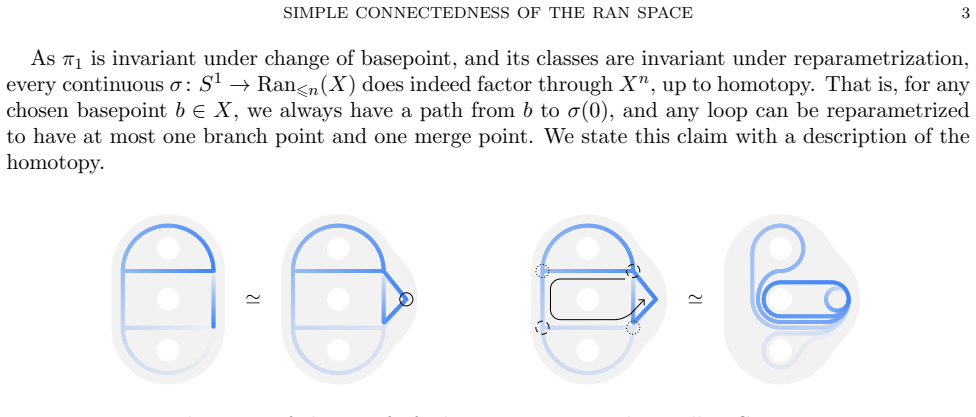
- [Section 2, Lemma 3] Lemma 3 is the load-bearing step for Theorems 6, 7, and 8, but its proof is not a proof. Definition 2 defines a branch point only as a point p ∈ X, not 'at t0', so the sentence 'let p be a branch point or a merge point of σ′ at t0 ∈ (0,1]' is under-specified. The path τ is chosen with τ(t) ∈ σ′(t), but no argument is given that such a continuous selection exists, and the following clause 'Since τ(t0) ≠ τ(1)' is not generally true. The claim that there is a homotopy contracting the image of τ to the basepoint b is asserted without construction, and no check is made that the bound |σ″(t)| ≤ n is preserved at intermediate stages. The phrase 'Doing this for all branch points and merge points' assumes, without proof, that the set of such points is finite and can be handled one at a time. These are exactly the point-set difficulties acknowledged in Observation 1. Because Lemma 3 is used to dec
- [Section 2, paragraph after Observation 1] The paragraph states that 'every continuous σ: S^1 → Ran_≤n(X) does indeed factor through X^n, up to homotopy' and that 'any loop can be reparametrized to have at most one branch point and one merge point.' This is asserted without proof and is not a consequence of π1 invariance or reparametrization. It directly contradicts Observation 1, which says that not every loop factors through X^n because of monodromy and pathological branch points. The passage appears to announce the content of Lemma 3 rather than to prove it; as written, it is a circular or unsupported claim at the point where the reader needs a construction.
- [Section 2 vs Theorems 6–8] Section 2 begins with 'Let X be a path connected topological space with finite first homotopy group.' This hypothesis is never used afterward and is absent from the statements of Theorems 6, 7, and 8, as well as from the abstract. If the proof actually requires finiteness of π1(X), the theorems are misstated; if it does not, the hypothesis is a misleading leftover. The phrase 'finite first homotopy group' also needs clarification if retained. This ambiguity affects the scope of the main claim and must be resolved before the paper can be evaluated as a proof for arbitrary path-connected X.
- [Lemma 4 and Figure 3] The proof of Lemma 4 is entirely visual: the homotopies are described by operations such as 'stretch', 'pinch', 'cut and glue', and 'squeeze'. No parametrization of the intermediate loops or of the homotopies is given. Since Lemma 4 supplies the n = 1 base case for Proposition 5 and hence for Theorem 6, this is not merely a stylistic matter. For a paper whose advertised contribution is constructivity, the visual argument needs to be translated into a precise description of the maps involved, at least for S^1 (from which the general case follows by functoriality). The note that a 'small separation' is used 'to visually distinguish' suggests the drawing is schematic, so it is not independently sufficient as the proof of a rigorous theorem.
minor comments (4)
- [Definition 2] The definition of a merge point refers to 'q' rather than 'p', and the quantifiers over t and ε are not made explicit. Please also define what it means for a branch/merge point to occur 'at t0'.
- [Throughout] There are several typos and small errors: 'satsfies' in Lemma 3, 'besepoint' in the proof of Lemma 3, an incomplete sentence beginning 'and τ.' in Lemma 3, and 'π1 is invariant under change of basepoint' where more precision about based vs unbased groups is needed.
- [Theorem 8 and Example 9] The phrase 'for every positive integer n ≥ 4' is redundant. In Example 9, the computation for Ran_≤2(S^1) is correct, but it may be worth citing Tuffley's original computation more explicitly in the text.
- [Equation (4)] In the sentence after Lemma 4, 'factors through Ran_≤1(X)' should presumably be 'factors through Ran_≤1(S^1)', since the ambient space in Lemma 4 is S^1.
Circularity Check
No significant circularity: the central derivation does not assume its target, and the sole self-citation is background, not load-bearing.
full rationale
The paper's main claim, Theorem 8, is derived from Lemma 3 (factorization of loops through X^n), Theorem 7 (reparameterization to factor through Ran_{<=2}(X)), and Proposition 5/Figure 3 (contractibility of a loop in Ran_{<=1}(X) after inclusion into Ran_{<=3}(X)). None of these inputs already contains the conclusion pi_1(Ran_{<=n}(X))=0 for n>=4. Lemma 3 is not circular: it asserts a homotopy to a loop factoring through X^n, and although its proof is under-specified (branch/merge points are pushed to the basepoint by assertion, with no verification that the set of branch points is finite or that the bound |sigma''(t)|<=n is preserved at intermediate stages), this is a missing construction, not a circular reduction. Proposition 5 follows functoriality from the S^1 case in Figure 3, not from the final theorem. The paper uses no fitted parameters and does not rename a known result as a new derivation; it presents new diagrams and a claimed constructive argument. The only self-citation is the acknowledgement that the note is based in part on the author's PhD thesis [Laz19], and that citation is background, not load-bearing. The unexplained Section 2 hypothesis 'finite first homotopy group' is unused and appears to be an oversight rather than a circular input. Therefore, under the circularity standard requiring a concrete reduction to the paper's own assumptions or self-citations, no specific circular step can be exhibited.
Assumptions & free parameters
assumptions (3)
- domain assumption X is path-connected
- ad hoc to paper Lemma 3: loops in Ran≤n(X) factor through Xⁿ up to homotopy
- domain assumption The visual homotopies of Figure 3 (Lemma 4) are valid for arbitrary X via the functoriality argument in Proposition 5
Cite this review
Pith. "Pith review of A constructive proof for the simple connectedness of finite subset spaces." pith.science (2026). https://pith.science/paper/A6PWKD5S
@misc{pith2026260209815,
  author       = {Pith},
  title        = {Pith review of: A constructive proof for the simple connectedness of finite subset spaces},
  year         = {2026},
  howpublished = {\url{https://pith.science/paper/A6PWKD5S}},
  note         = {Machine review of arXiv:2602.09815}
}
abstract
The space of all finite non-empty subsets of a topological space $X$, also known as the Ran space of $X$, is weakly contractible for $X$ path connected. We consider subspaces $\mathrm{Ran}_{\leqslant n}(X)$ of the Ran space given by all subsets of $X$ of size at most $n$, and their first homotopy groups. These groups are known to be trivial for $n\geqslant 3$ when $X$ is a path connected CW-complex, though the proofs are not constructive. We show that the induced map $\pi_1(\mathrm{Ran}_{\leqslant n}(X)) \to \pi_1(\mathrm{Ran}_{\leqslant n+2}(X))$ is trivial for all positive integers $n$, by explicitly drawing the path homotopies that contract any loop in $X$ to a point. From this we get a constructive proof for the triviality of $\pi_1(\mathrm{Ran}_{\leqslant n}(X))$, for all $n\geqslant 4$.
Figures


Reference graph
Works this paper leans on
-
[1]
American Mathematical Society, Providence, RI, 2004
[BD04] Alexander Beilinson and Vladimir Drinfeld.Chiral algebras, volume 51 ofAmerican Mathematical Society Col- loquium Publications. American Mathematical Society, Providence, RI, 2004. [Bir74] Joan S. Birman.Braids, links, and mapping class groups, volume No. 82 ofAnnals of Mathematics Studies. Princeton University Press, Princeton, NJ; University of T...
2004
-
[2]
Providence, RI, 2010. [Han00] David Handel. Some homotopy properties of spaces of finite subsets of topological spaces.Houston J. Math., 26(4):747–764, 2000. [KS09] Sadok Kallel and Denis Sjerve. Remarks on finite subset spaces.Homology, Homotopy and Applications, 11(2):229 – 250, 2009. [Laz19] J¯ anis Lazovskis.Stability of Universal Constructions for Pe...
arXiv 2010
Reviewed August 3, 2026 · model on record in the stance chip above.
Discussion (0). Continue with ORCID to comment.