pith. machine review for the scientific record. sign in

math.GN

General Topology

Continuum theory, point-set topology, spaces with algebraic structure, foundations, dimension theory, local and global properties

0
math.GN 2026-05-11 Recognition

GSI2-convergence is topological exactly in strongly QI2-continuous T0-spaces

On GSI2-convergence in T0-spaces

The equivalence holds for every irreducible complete T0-space, giving a direct link between a new convergence and a continuity property.

abstract click to expand
In this paper,we introduce the concept of GSI$_2$-convergence in $T_0$ spaces and the related concept of (strongly) QI$_2$-continuous spaces. It is proved that if GSI$_2$-convergence in $X$ is topological iff $X$ is strongly QI$_2$-continuous for any irreducible complete $T_0$ space $X$.
0
0
math.GN 2026-05-08 1 theorem

Graph intersections fix Nielsen bound for multi-valued map coincidences

Nielsen coincidence theory of (n,m)-valued pairs of maps

Corrected invariant gives sharp lower bound on coincidence points for n- and m-valued maps on the circle.

Figure from the paper full image
abstract click to expand
We consider pairs of maps $(f,g)$, where $f$ is an $n$-valued map and $g$ is an $m$-valued map, defined on connected finite polyhedra. A point $x$ such that $f(x)\cap g(x)\neq \emptyset$ is called a coincidence point of $f$ and $g$. A useful device for studying coincidence points would be a Nielsen-type invariant which provides a lower bound for the number of coincidence points of all $(n, m)$-valued pairs of maps homotopic to $(f,g)$. The construction of such an invariant $N(f:g)$ was proposed in [J. Fixed Point Theory Appl. 14, 309--324 (2013)]. Unfortunately, this approach has some flaws. In this paper, we present a modified construction that yields a corrected form of the invariant, defined in terms of the intersection points of the graphs of $f$ and $g$. In the case of $(n, m)$-valued pairs of maps of the circle our invariant provides a sharp lower bound, which we precisely determine.
0
0
math.GN 2026-05-06

Transitive distributive binary G-spaces classified for compact G

On the Transitive Binary G-Spaces

Subgroups from distributive sets stay distributive and a criterion is given, with full classification for compact groups.

abstract click to expand
Distributive subsets of the group of all invertible continuous binary operations on a topological space are considered, and it is proved that the subgroups generated by them are also distributive. A criterion for the distributivity of a binary action of a topological group $G$ on a space $X$ is obtained. The concept of transitive binary $G$-space is introduced, and a classification of transitive distributive binary $G$-spaces is given in the case of a compact group $G$.
0
0
math.GN 2026-05-04

Duality theorem connects binary group actions to topological fields

Binary transformation groups and topological fields

Semitransitive distributive binary G-spaces correspond to topological fields with multiplicative group G, giving category equivalence andnew

abstract click to expand
The notion of a semitransitive binary action of a group $G$ on a topological space is introduced. A duality theorem is proved, establishing a bijective correspondence between semitransitive distributive binary $G$-spaces and topological fields whose multiplicative group is isomorphic to $G$. This result yields an equivalence between the category of semitransitive distributive binary $G$-spaces and the category of topological fields with multiplicative group $G$. As applications of the duality theorem, two important results are established. It is shown that a finite group can act semitransitively, distributively, and binarily only on finite sets whose cardinality is a power of a prime number. A complete characterization of those groups that can appear as multiplicative groups of topological fields is also obtained.
0
0
math.GN 2026-05-04 1 theorem

Coarser metrics preserve perfect maps between paracompact spaces

Perfect maps between submetrizable spaces

A positive answer shows that perfectness survives when choosing metrizable coarsenings compatible with the map.

abstract click to expand
We investigate a question posed by Huaipeng Chen: if $X$ and $Y$ are paracompact submetrizable spaces and $f:X\to Y$ is a perfect map, can $X$ and $Y$ be submetrized by metrics $\rho$ and $d$ respectively such that $f$ remains perfect with respect to the induced topologies?
0
0
math.GN 2026-05-01

Countable centered local π-bases bound ccc Hausdorff spaces to size 𝔠

On centered local π-bases

This improves the Hajnal-Juhász theorem by weakening first-countability to the centered local π-base condition.

abstract click to expand
In 1967 Hajnal and Juh{\'a}sz showed that the cardinality of a first-countable Hausdorff space with the countable chain condition has cardinality at most $\mathfrak{c}$, the cardinality of the real line. We give an improvement of this celebrated theorem by replacing ``first-countable" with the weaker condition ``each point has a countable centered local $\pi$-base". Given a point $p$ in a topological space $X$, a \emph{local} $\pi$-\emph{base} $\scr{B}$ at $p$ acts like a neighborhood base at $p$ except that $p$ may not be in any member of $\scr{B}$. A local $\pi$-base $\scr{B}$ has the \emph{finite intersection property} if any finite intersection of members of $\scr{B}$ is nonempty. We call this type of local $\pi$-base \emph{centered}. A centered local $\pi$-base behaves even more like a neighborhood base in a sense. A space has the \emph{countable chain condition} if every family of pairwise disjoint open sets is countable. We also improve a theorem of Pospi{\v s}il from 1937 using centered local $\pi$-bases. As is customary, examples are given to demonstrate these improvements are strict. Compact Hausdorff spaces are also explored in this connection, along with variations on the notion of a centered local $\pi$-base.
0
0
math.GN 2026-04-29

Continuity at zero defines strong quasi-pseudometric aggregators

Strongly quasi-pseudometric aggregation functions

The condition ensures product topology preservation on Cartesian products and allows necessary and sufficient checks for fixed-set cases.

Figure from the paper full image
abstract click to expand
Metric-preserving functions (here, metric aggregation functions) offer a natural method for constructing metrics on Cartesian products of metric spaces or for aggregating multiple metrics defined on a common set. Strongly metric-preserving functions represent a more specialized subset of these functions, ensuring that the new metric aligns with the product topology, in the Cartesian product case. However, these strong functions have not been previously explored for quasi-pseudometrics. Furthermore, in the case where all metrics are defined on the same set, the problem has not been addressed previously. In this paper, we investigate the class of strongly (quasi-)(pseudo)metric aggregation functions, extending the classical concept. We begin by examining the case where the aggregation function produces (quasi-)(pseudo)metrics on Cartesian products, characterizing these functions through continuity at zero and a minimal zero preimage condition. In addition, we will examine the scenario where the aggregation function produces a (quasi-)(pseudo)metric defined on a fixed set. Within this context, we will demonstrate that the appropriate topology to consider is the supremum topology. We will also provide both necessary and sufficient conditions for an (quasi-)(pseudo)metric aggregation function on sets to qualify as a strongly one, thereby addressing a gap in the existing literature.
0
0
math.GN 2026-04-29

Uniform homeomorphisms of C_p^* spaces preserve pseudocompactness

Uniform homeomorphisms between C_p^*-spaces preserve pseudocompactness

If the bounded pointwise function spaces are uniformly equivalent then the domains are equivalent in pseudocompactness.

abstract click to expand
For any Tychonoff space $X$ let $C_p(X)$ (resp., $C^*_p(X)$) be the set of all continuous (resp., and bounded) functions on $X$ with the pointwise convergence topology. Given Tychonoff spaces $X$ and $Y$, Uspenskij \cite{us} proved that if $C_p(X)$ is uniformly homeomorphic to $C_p(Y)$, then $X$ is pseudocompact if and only if $Y$ is pseudocompact. The author and Vuma \cite{valvu} have shown that linear homeomorphisms between $C_p^*(X)$ and $C_p^*(Y)$ preserve pseudocompactness. Recently Baars-van Mill-Tkachuk \cite{bmt} gave another proof of that result and raised the question if the same remains true provided $C_p^*(X)$ and $C_p^*(Y)$ are uniformly homeomorphic. In the present paper we answer that question positively. This, together with a result of Krupski \cite{k}, implies that $\kappa$-pseudocompactness is also preserved by uniform homeomorphisms between $C_p^*$-spaces.
0
0
math.GN 2026-04-29

Bounded supports in linear maps give dim Y ≤ m dim X

Linear continuous operators with bounded supports

For Tychonoff spaces X and Y, a continuous linear surjection between D_p spaces with |supp(y)|≤m forces the dimension bound dim Y ≤ m·dim X.

abstract click to expand
For any Tychonoff space $X$ let $D(X)$ be either the set $C(X)$ of all continuous functions on $X$ or the set $C^*(X)$ of all bounded continuous functions on $X$. When $D(X)$ is endowed with the point convergence topology, we write $D_p(X)$. Zakrzewski \cite[Theorem 3.12]{kz} proved that if $X$ and $Y$ are $\sigma$-compact spaces and there is a continuous linear map $T:C_p(X)\to C_p(Y)$ such that $T(C_p(X))$ is dense in $C_p(Y)$ and $|\supp(y)|\leq m$ for every $y\in Y$, then $\dim Y\leq m\cdot\dim X+m+m!-1$. Here, $\supp(y)$ denotes the support of the linear continuous map $l_y:C_p(X)\to\mathbb R$, defined by $l_y(f)=T(f)(y)$. In the present paper we improve the last inequality by showing that $\dim Y\leq m\cdot\dim X$ provided $X,Y$ are Tychonoff spaces and there is a continuous linear surjection $T:D_p(X)\to D_p(Y)$ with $|\supp(y)|\leq m$ for every $y\in Y$. This implies the following generalization of \cite[Theorem 1.4]{ev}: If $T:D_p(X)\to D_p(Y)$ is a continuous linear surjection with $X,Y$ Tychonoff spaces and $\dim X=0$, then $\dim Y=0$. Our proofs are obtained by refining the techniques developed in \cite{ev}.
0
0
math.GN 2026-04-28

Limiter assigns a canonical limit to every real sequence

Limiter Spaces: A Universal Extension for Limits of Real Sequences

The extension matches classical convergence, depends only on cluster points, and changes continuously with small perturbations to the set of

abstract click to expand
We introduce the Limiter, a universal extension of the real numbers and of the limit functional that assigns a canonical limit in an enlarged space to every real sequence. Motivated by generalized summation methods such as Borel summation and Ramanujan's assignments to divergent series, we require our extension to respect classical limits and assign limits in a way that depends only on the cluster points of a sequence and varies continuously when the cluster set is slightly modified.
0
0
math.GN 2026-04-28

Descriptive proximity breaks Banks theorem for Devaney chaos

A Descriptive Perspective on Devaney's Chaos and Some Results on Topologically Conjugate Systems

Transitivity and dense periodic points no longer guarantee sensitivity once nearness is described by sets rather than open neighborhoods.

Figure from the paper full image
abstract click to expand
In this study, Devaney's chaos conditions are revisited within the framework of descriptive proximity. The concepts of descriptive transitivity, the density of descriptive periodic objects, and descriptive sensitivity are defined. The most notable finding of the study is that Banks Theorem, which establishes the hierarchy among these conditions in classical topology, does not generally hold in the descriptive perspective, and some of the concepts above remain invariant under topological conjugacy certain conditions.
0
0
math.GN 2026-04-27

Ω-Menger win on X equals fan tightness win on C_p(X

Countable Fan Tightness and Selection Games in Group-Valued Function Spaces

The equivalence holds for every non-trivial metrizable arc-connected group G and lifts prior real-valued results to full games.

abstract click to expand
Game-theoretic characterizations of selection principles provide a powerful framework for analyzing covering properties through strategic interactions. For a Tychonoff space $X$ and a non-trivial metrizable arc-connected topological group $G$, we prove that Player~II has a winning strategy in the $\Omega$-Menger game on $X$ if and only if Player~II has a winning strategy in the countable fan tightness game on $C_p(X, G)$ at the identity function. The analogous equivalence is established between the $\Omega$-Rothberger game on $X$ and the countable strong fan tightness game on $C_p(X, G)$ at the identity function. These results extend the game-theoretic characterizations of Clontz from $G = \mathbb{R}$ to arbitrary metrizable arc-connected groups, and lift the selection-principle equivalences of Ko\v{c}inac to the game-theoretic setting. As consequences, we establish that the game-theoretic tightness properties of $C_p(X,G)$ are independent of $G$, preserved under $G$-equivalence, and remain valid for Markov strategies.
0
0
math.GN 2026-04-27

C1-smooth Clifford semigroups have discrete idempotent semilattices

Topological and differentiable aspects of Clifford semigroups

The rigidity theorem shows that local differentiability at idempotents eliminates continuous variation in the semilattice.

abstract click to expand
This paper investigates the interplay between algebraic structure, topology, and differentiability in Clifford semigroups. The study is developed along three main themes. First, in the compact Hausdorff setting, we provide an explicit construction of a compatible metric for the Bowman topology. Second, we address Hilbert-fifth-type questions by establishing criteria under which the maximal subgroups are forced to be Lie groups. Finally, we prove a structural rigidity theorem: $C^1$-regularity at the idempotents implies that the idempotent semilattice is discrete.
0
0
math.GN 2026-04-27

Graph methods describe Roelcke

On proper compactifications of topological groups

The same descriptions let dichotomy theorems reveal topological features of the added points outside the original group.

abstract click to expand
In the present paper, we examine in detail the method of "graph compactifications" of topological groups. The graph and Ellis methods of constructing proper compactifications of topological groups are applied for the investigation of possible extensions of algebraic operations on a topological group to its compactifications, and give descriptions of Roelcke, Ellis, WAP, and graph compactifications of topological groups. Additionally, using dichotomy theorems of A.V.Arhangelskii, we show that the description of compactifications can be effectively used in the investigation of topological properties of their remainders. As examples, subgroups of the permutation group (in the permutation topology) and the automorphism group of a LOTS (in the topology of pointwise convergence) are examined.
0
0
math.GN 2026-04-24

Manifolds with tensor metrics stay metrizable over complex fields

Advanced manifold-metric pairs

Functional constructions unify topology, probability and entropy for consistent models of expanding spacetime.

abstract click to expand
This article presents a novel mathematical formalism for advanced manifold--metric pairs, enhancing the frameworks of geometry and topology. We construct various D-dimensional manifolds and their associated metric spaces using functional methods, with a focus on integrating concepts from mathematical physics, field theory, topology, algebra, probability, and statistics. Our methodology employs rigorous mathematical construction proofs and logical foundations to develop generalized manifold--metric pairs, including homogeneous and isotropic expanding manifolds, as well as probabilistic and entropic variants. Key results include the establishment of metrizability for topological manifolds via the Urysohn Metrization Theorem, the formulation of higher-rank tensor metrics, and the exploration of complex and quaternionic codomains with applications to cosmological models like the expanding spacetime. By combining spacetime generalized sets with information-theoretic and probabilistic approaches, we achieve a unified framework that advances the understanding of manifold--metric interactions and their physical implications.
0
0
math.GN 2026-04-21

Generalized fixed point theorems reduce to Banach principle

JAI functional contractions in relational metric spaces

The 2015 Alam-Imdad result on rs-relational metric spaces and two earlier theorems are equivalent to the 1922 classical contraction theorem.

abstract click to expand
The 2015 fixed point result on rs-relational metric spaces due to Alam and Imdad [J. Fixed Point Th. Appl., 17 (2015), 693-702] is equivalent with the classical Banach Contraction Principle [Fund. Math., 3 (1922), 133-181]. This is also valid for the 1961 statement in metric spaces due to Edelstein [Proc. Amer. Math. Soc., 12 (1961), 7-10], or the 2005 fixed point result in quasi-ordered metric spaces obtained by Nieto and Rodriguez-Lopez [Order, 22 (2005), 223-239].
0
0
math.GN 2026-04-21

Graph labelings bound induced ultrametrics to |E| + 1 distances

The Gomory-Hu inequality and trees

The number of distinct distances is at most one more than the edge count, with exact conditions for equality identified.

abstract click to expand
Let $G=(V,E)$ be a finite connected graph with vertex set $V$ and edge set $E$, and let $U(G)$ be the set of all ultrametric spaces $(V,d_l)$ generated by vertex labelings $l\colon V \to \mathbb R^+$. We prove that the inequality $$ |D(V)| \le |E| + 1 $$ holds for all $(V,d_l) \in U(G)$, where $D(V)$ is the distance set of $(V,d_l)$. The necessary and sufficient conditions under which the above inequality turns to an equality are found. Moreover, we prove that each connected graph with non-negative vertex labeling generates a pseudoultrametric space and find some sufficient conditions under which this space is ultrametric.
0
0
math.GN 2026-04-20

End spaces of graphs are spaces with winning game on subbase

A topological characterization of end space of infinite graphs via games, subspaces and products

Characterization proves end spaces are hereditarily Baire and closed under Gδ subspaces but not products.

abstract click to expand
In 1992, Diestel asked which topological spaces could be represented as the end space of some graph. In 2023, Pitz provided a solution to this question by giving a topological characterization of end spaces using a hereditarily complete special subbase. In this paper, we present an alternative topological characterization of end spaces, in which we employ a special subbase and a topological game. Furthermore, we provide several applications of this characterization: we show that every end space is hereditarily Baire, that $G_{\delta}$ subspaces of end spaces are also end spaces, and that the product of end spaces is not always an end space.
0
0
math.GN 2026-04-17

Transfinite wild ranks are homotopy invariants realizable by Peano continua

Transfinitely iterated wild sets

The sequence of homotopy types from iterated π_n-wild sets depends only on homotopy type, and free ranks are always countable but attain any

Figure from the paper full image
abstract click to expand
In this paper, we study homotopical analogues of the Cantor-Bendixson derivative. For each $n\geq 0$, the "$\pi_n$-wild set" $\mathbf{w}_n(X)$ of a topological space $X$ is the subspace of $X$ consisting of the points at which there exists a shrinking sequence of essential based maps $S^n\to X$. Since the operator $\mathbf{w}_n$ permits iteration, every given space $X$ yields a descending transfinite sequence of nested subspaces $\{\mathbf{w}_n^{\kappa}(X)\}_{\kappa}$ that stabilizes at some smallest ordinal $\mathbf{wrk}_n(X)$ called the "$\pi_n$-wild rank" of $X$. We show that the entire transfinite sequence $\{ho(\mathbf{w}_n^{\kappa}(X))\}_{\kappa}$ of homotopy types is a homotopy invariant of $X$ and that $\mathbf{wrk}_n(X)$ can be an arbitrary countable ordinal when $X$ is an $n$-dimensional Peano continuum. It remains open if there exists a continuum $X$ with uncountable $\pi_n$-wild rank. This difficulty motivates the parallel study a basepoint-free version $\mathbf{fwrk}_n(X)$, called the "free $\pi_n$-wild rank" of $X$. We show that for every continuum $X$, $\mathbf{fwrk}_n(X)$ is always countable and can be any countable ordinal.
0
0
math.GN 2026-04-16

Modulus density points recover Lebesgue density theorem

A generalization of the Lebesgue density theorem via modulus density

When the modulus satisfies Condition (A), the γ-density points of a measurable set differ from the set by a null set and generate the same拓扑

abstract click to expand
In this paper, we introduce the notion of a $\gamma$-density point for Lebesgue-measurable subsets of $\mathbb{R}$, where $\gamma$ is a modulus function, and study its basic measure-theoretic properties. We show that every $\gamma$-density point is a Lebesgue density point, while under Condition~(A) the two notions coincide. Consequently, for such modulus functions, the set of $\gamma$-density points of a measurable set differs from the set itself only by a null set, yielding a modulus version of the Lebesgue Density Theorem. We then define the associated $\gamma$-density topology $\tau_\gamma$ and investigate its structure. In general, $\tau_\gamma$ is contained in the classical Lebesgue density topology, and if $\gamma$ satisfies Condition~(A), then $\tau_\gamma=\tau_d$. We also compare $\tau_\gamma$ with $\psi$-density topologies and establish several topological properties of $\tau_\gamma$, including that countable sets are $\tau_\gamma$-closed and that $(\mathbb{R},\tau_\gamma)$ is nonseparable, nonregular, and nonmetrizable. Finally, we introduce $\gamma$-approximately continuous functions, prove that they form a vector space, and show that the bounded class of such functions is a Banach space under the supremum norm.
0
0
math.GN 2026-04-15

1-cycles in crypto phase space track risk

Topological Complexity and Phase Space Stability: A Persistent Homology Approach to Cryptocurrency Risk

A scalar built from lifetimes of loops in reconstructed attractors gives a noise-robust signal for leverage adjustment.

Figure from the paper full image
abstract click to expand
Traditional risk measures in finance, predominantly based on the second moment of return distributions or tail risk heuristics (VaR/CVaR), fail to account for the intrinsic geometric structure of market dynamics. This paper introduces a rigorous mathematical framework utilizing Topological Data Analysis (TDA) to quantify risk as the structural instability of the reconstructed phase space. By applying Takens' Delay Embedding Theorem to cryptocurrency log-returns, we generate a point cloud representation of the underlying attractor. We analyze the evolution of the filtration of Vietoris-Rips complexes to compute persistent homology groups $H_k$. We define a "Topological Persistence Norm" to characterize market regimes and propose a leverage calibration heuristic based on the persistence of 1-dimensional cycles. This approach provides a coordinate-free, stability-invariant metric for risk assessment that is robust to high-frequency noise.
0
0
math.GN 2026-04-15

Counterexample disproves converse of Borsuk fan theorem

The converse to Borsuk's result on fans fails

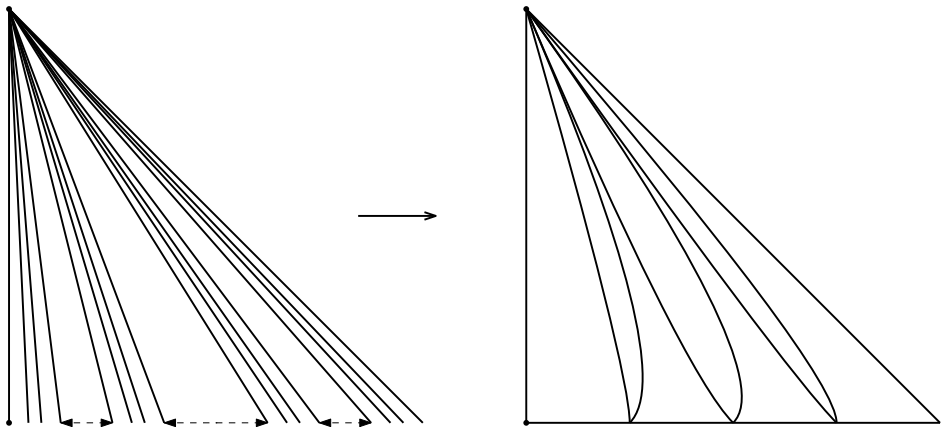
A one-dimensional continuum of arcs meeting at one point need not be hereditarily unicoherent and thus need not be a fan.

Figure from the paper full image
abstract click to expand
A fan is an arc-wise connected hereditarily unicoherent continuum with exactly one branching point. By a result of Borsuk, every fan is a 1-dimensional continuum that can be expressed as the union of a family of arcs, each pair of which intersects in the branching point. In this paper, we prove that the converse does not hold by providing a more general result.
0
0
math.GN 2026-04-08 Recognition

Real line carries 2^c non-homeomorphic coarse topologies

Many coarse topologies on the real line

Among them 2^c are Baire and 2^c are first category, all completely normal and coarser than the standard topology.

abstract click to expand
Let c denote the cardinality of the continuum. Let L denote the family of all Hausdorff topologies on the real line coarser than the natural topology. We construct 2^c pairwise non-homeomorphic completely normal topologies in L among which 2^c are Baire and 2^c are of first category. We also construct c pairwise non-homeomorphic completely metrizable topologies in L. Furthermore, we investigate complete lattices of topologies in L and construct extremely long chains of homeomorphic topologies in L.
0
0
math.GN 2026-04-08 Recognition

New extension property identifies universal retractions on Urysohn space

Topological size of the set of universal and ultrahomogeneous retractions on the Urysohn space

The property (UR*) matches universality plus ultrahomogeneity and lets the Borel complexity and density of the set be computed in the pointw

abstract click to expand
In this paper, we investigate the set $\mathcal{U}(\mathbb{U})$ of universal and ultrahomogeneous $1$-Lipschitz retractions acting on the Urysohn space as the subspace of the space $\mathcal{R}(\mathbb{U})$ of all $1-$Lipschitz retractions defined on the Urysohn space. Especially, we study Borel complexity and density $\mathcal{U}(\mathbb{U})$ in $\mathcal{R}(\mathbb{U}).$ In order to do that, we introduce a new extension property $(UR^*)$ that is equivalent to the universality and ultrahomogeneity of a retraction, and a new pointwise retract topology.
0
0
math.GN 2026-04-08 2 theorems

Forcing notions prove some graphs have no countable alpha-Borel colorings

Topology, forcing, and graph colourings

New constructions also yield weakly minimal graphs that sit at the boundary of this non-colorability.

abstract click to expand
We introduce a family of forcing notions that are helpful in showing that certain graphs do not have countable colourings of (additive) Borel class alpha. We construct graphs that are ''weakly minimal'' for such colourings.
0

browse all of math.GN → full archive · search · sub-categories