Recognition: no theorem link
Forged by Feedback: Stellar Properties of Brightest Group Galaxies in Cosmological Simulations
Pith reviewed 2026-05-16 02:24 UTC · model grok-4.3
The pith
OBSIDIAN's three-regime AGN feedback model reproduces the stellar properties of brightest group galaxies more closely than the other simulations tested.
A machine-rendered reading of the paper's core claim, the machinery that carries it, and where it could break.
Core claim
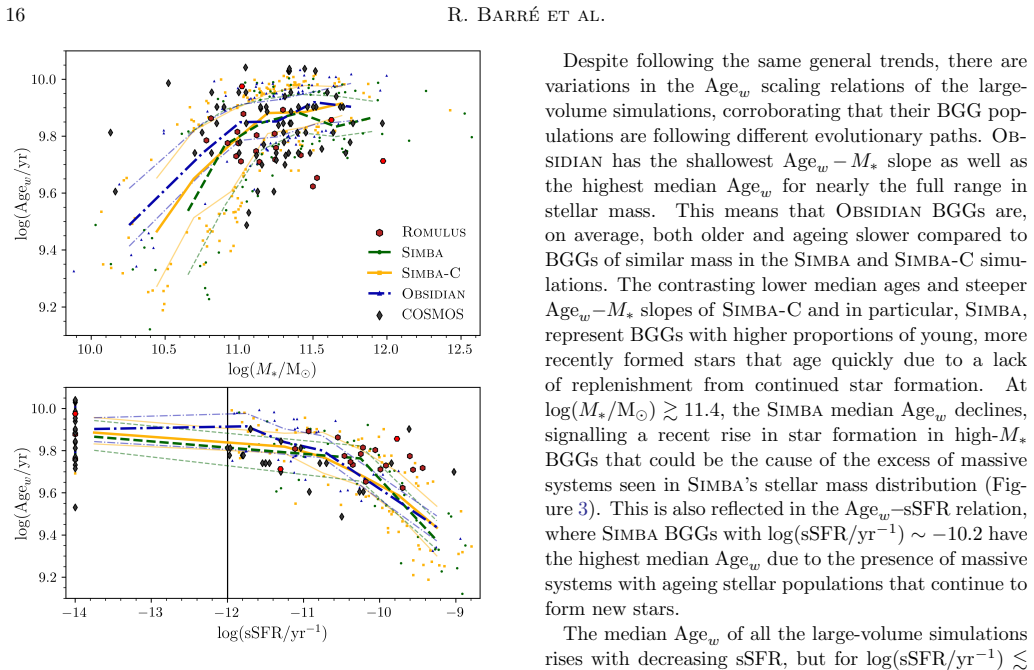
OBSIDIAN's three-regime AGN feedback model produces BGG populations whose stellar mass distributions, specific star formation rates, mass-weighted ages, and quenched fractions match those measured for X-ray-selected groups in COSMOS, while ROMULUS leaves BGGs overly star-forming, and SIMBA and SIMBA-C produce overly rapid quenching once powerful jet feedback begins.
What carries the argument
The three-regime AGN feedback implementation in OBSIDIAN, which switches between different modes of energy injection and black-hole growth regulation to control gas cooling and star formation in massive galaxies.
If this is right
- BGGs in OBSIDIAN and COSMOS exhibit gradual rather than abrupt decline in star formation with increasing stellar mass.
- Powerful jet feedback in SIMBA and SIMBA-C triggers rapid quenching once it activates, unlike the more gradual effect in OBSIDIAN.
- ROMULUS thermal AGN feedback fails to suppress cooling flows, leaving BGGs under-quenched and highly star-forming.
- Physically motivated multi-regime AGN prescriptions are required to capture the observed diversity of BGG evolutionary paths in group environments.
Where Pith is reading between the lines
- The results imply that future simulations need to incorporate condition-dependent AGN modes to avoid either under- or over-quenching at the high-mass end.
- If the gradual quenching trend holds in wider surveys, it would constrain the timing when jet feedback becomes dominant in group-scale halos.
- The comparison suggests that group environments amplify small differences in feedback efficiency into large differences in central galaxy properties.
Load-bearing premise
Differences in BGG stellar properties between the simulations are caused mainly by variations in their AGN feedback models rather than by differences in resolution, hydrodynamics solvers, or other subgrid choices.
What would settle it
A larger observational sample of BGGs showing a sharp drop in star formation rate at a specific stellar mass threshold that matches SIMBA but deviates from OBSIDIAN would falsify the claim that the three-regime model provides the best match.
Figures



read the original abstract
We investigate how different galaxy formation models impact the stellar properties of brightest group galaxies (BGGs) in four cosmological simulations: ROMULUS, SIMBA, SIMBA-C, and OBSIDIAN. The stellar masses, specific star formation rates, and mass-weighted stellar ages of the simulated BGGs are analysed alongside those of observed BGGs from X-ray-selected galaxy groups in the COSMOS field. We find that the global properties and underlying evolutionary pathways of simulated BGG populations are strongly impacted by the strength and mechanism of their respective active galactic nucleus (AGN) feedback models, which play a critical role in regulating the growth of massive galaxies. OBSIDIAN's sophisticated three-regime AGN feedback model achieves the highest overall agreement with COSMOS observations, matching stellar property distributions, quenched fractions, and the evolution of star formation in increasingly massive systems. We find evidence suggesting that BGG populations of OBSIDIAN and COSMOS undergo a gradual decline in star formation with stellar mass, in contrast to SIMBA and SIMBA-C, which display rapid quenching linked to the onset of powerful AGN jet feedback. By comparison, ROMULUS produces highly star-forming, under-quenched BGGs due to the inefficiency of its thermal AGN feedback in preventing cooling flows from fuelling BGG growth. The success of the OBSIDIAN simulation demonstrates the importance of physically motivated subgrid prescriptions for realistically capturing the processes that shape BGGs and their dynamic group environments.
Editorial analysis
A structured set of objections, weighed in public.
Referee Report
Summary. The manuscript compares stellar properties (masses, sSFRs, ages, quenched fractions, and star-formation evolution) of brightest group galaxies (BGGs) in four cosmological simulations—ROMULUS, SIMBA, SIMBA-C, and OBSIDIAN—against X-ray-selected groups in the COSMOS field. It concludes that AGN feedback strength and mechanism dominate BGG evolution, with OBSIDIAN’s three-regime model providing the closest match to observations while ROMULUS under-quenches and SIMBA/SIMBA-C quench too rapidly.
Significance. If the causal attribution to AGN feedback is robust, the work supplies a useful benchmark for how sub-grid prescriptions regulate massive-galaxy growth in groups and demonstrates that more physically detailed feedback can reproduce observed quenching trends with mass.
major comments (2)
- [Section 2] Section 2 (Simulation descriptions) and the abstract: the central claim that differences in BGG properties are “strongly impacted by the strength and mechanism of their respective AGN feedback models” is not isolated from other simulation variations. ROMULUS, SIMBA, SIMBA-C, and OBSIDIAN differ in hydrodynamics solvers, resolution, and additional sub-grid physics; no controlled experiment (same code base, only AGN varied) is reported. Consequently the attribution of ROMULUS under-quenching or SIMBA rapid jet quenching specifically to their AGN regimes remains untested.
- [§4.3] §4.3 (Star-formation evolution with mass): the statement that OBSIDIAN and COSMOS show a “gradual decline” while SIMBA/SIMBA-C show “rapid quenching” is presented qualitatively. No quantitative measure (e.g., slope of sSFR–M⋆ relation or KS-test p-values between distributions) is given to substantiate the distinction or to rank the models objectively.
minor comments (2)
- [Figure 1] Figure 1 caption: the mass range and selection cuts applied to the COSMOS BGG sample are not stated explicitly; please add the exact stellar-mass and group-mass limits used for the observational comparison.
- [Introduction] Notation: the abbreviation “BGG” is introduced in the abstract but the first use in the main text should be spelled out for clarity.
Simulated Author's Rebuttal
We thank the referee for their constructive and detailed report. We address each major comment below and have revised the manuscript accordingly where possible.
read point-by-point responses
-
Referee: [Section 2] Section 2 (Simulation descriptions) and the abstract: the central claim that differences in BGG properties are “strongly impacted by the strength and mechanism of their respective AGN feedback models” is not isolated from other simulation variations. ROMULUS, SIMBA, SIMBA-C, and OBSIDIAN differ in hydrodynamics solvers, resolution, and additional sub-grid physics; no controlled experiment (same code base, only AGN varied) is reported. Consequently the attribution of ROMULUS under-quenching or SIMBA rapid jet quenching specifically to their AGN regimes remains untested.
Authors: We agree that the four simulations differ in multiple respects beyond AGN feedback prescriptions, including hydrodynamics solvers, resolution, and other sub-grid physics, and that a controlled experiment isolating only the AGN model would provide the cleanest attribution. Our choice of these particular simulations was driven by their distinct AGN feedback implementations, which span a range of current approaches in the literature. In the revised manuscript we will expand Section 2 to explicitly list and discuss these additional differences, moderate the language in the abstract and conclusions to state that AGN feedback is a dominant rather than the sole driver, and note the absence of a same-code controlled comparison as a limitation of the present study. revision: partial
-
Referee: [§4.3] §4.3 (Star-formation evolution with mass): the statement that OBSIDIAN and COSMOS show a “gradual decline” while SIMBA/SIMBA-C show “rapid quenching” is presented qualitatively. No quantitative measure (e.g., slope of sSFR–M⋆ relation or KS-test p-values between distributions) is given to substantiate the distinction or to rank the models objectively.
Authors: We thank the referee for this suggestion. In the revised §4.3 we will add quantitative measures: the fitted slopes of the sSFR–M⋆ relation for each simulation and the COSMOS sample, together with Kolmogorov-Smirnov p-values comparing the sSFR distributions across mass bins. These statistics will allow an objective ranking of model agreement with the observed gradual decline. revision: yes
Circularity Check
No significant circularity in simulation-observation comparison
full rationale
The paper compares stellar masses, sSFRs, ages, quenched fractions and SF evolution of BGGs from four independent cosmological simulations (ROMULUS, SIMBA, SIMBA-C, OBSIDIAN) directly against external COSMOS observational data. No equations, fitted parameters, or self-citations are invoked to derive the target results; the attribution of differences to AGN feedback regimes rests on comparative analysis of pre-existing simulation outputs rather than any self-definitional loop or prediction that reduces to its own inputs by construction. The derivation chain is therefore self-contained against external benchmarks.
Axiom & Free-Parameter Ledger
free parameters (1)
- AGN feedback parameters
axioms (1)
- domain assumption The subgrid AGN feedback models capture the essential physics regulating galaxy growth
Reference graph
Works this paper leans on
-
[1]
Abazajian, K. N., Adelman-McCarthy, J. K., Ag¨ ueros, M. A., et al. 2009, ApJS, 182, 543, doi: 10.1088/0067-0049/182/2/543
-
[2]
Ade, P. a. R., Aghanim, N., Arnaud, M., et al. 2016, A&A, 594, A13, doi: 10.1051/0004-6361/201525830
-
[3]
Aghanim, N., Akrami, Y., Ashdown, M., et al. 2020, A&A, 641, A6, doi: 10.1051/0004-6361/201833910 Angl´ es-Alc´ azar, D., Dav´ e, R., Faucher-Gigu` ere, C.-A.,¨Ozel, F., & Hopkins, P. F. 2017a, MNRAS, 464, 2840, doi: 10.1093/mnras/stw2565 Angl´ es-Alc´ azar, D., Faucher-Gigu` ere, C.-A., Quataert, E., et al. 2017b, MNRAS: Letters, 472, L109, doi: 10.1093/...
-
[4]
2023, MNRAS, 519, 5514, doi: 10.1093/mnras/stad025
Appleby, S., Dav´ e, R., Sorini, D., Cui, W., & Christiansen, J. 2023, MNRAS, 519, 5514, doi: 10.1093/mnras/stad025
-
[5]
Coleman and Hamilton, Douglas P
Arnouts, S., Moscardini, L., Vanzella, E., et al. 2002, MNRAS, 329, 355, doi: 10.1046/j.1365-8711.2002.04988.x
-
[6]
1991, MNRAS, 248, 177, doi: 10.1093/mnras/248.2.177
Babul, A. 1991, MNRAS, 248, 177, doi: 10.1093/mnras/248.2.177
-
[7]
Coleman and Hamilton, Douglas P
Babul, A., Balogh, M. L., Lewis, G. F., & Poole, G. B. 2002, MNRAS, 330, 329, doi: 10.1046/j.1365-8711.2002.05044.x
-
[8]
2009, MNRAS, 395, 1391, doi: 10.1111/j.1365-2966.2009.14471.x
Benson, A. J., & Babul, A. 2009, MNRAS, 397, 1302, doi: 10.1111/j.1365-2966.2009.15087.x
-
[9]
Bianconi, M., Smith, G. P., Haines, C. P., et al. 2018, MNRAS: Letters, 473, L79, doi: 10.1093/mnrasl/slx167
-
[10]
2008, MNRAS, 389, 1637, doi: 10.1111/j.1365-2966.2008.13699.x
Bildfell, C., Hoekstra, H., Babul, A., & Mahdavi, A. 2008, MNRAS, 389, 1637, doi: 10.1111/j.1365-2966.2008.13699.x
-
[11]
1952, MNRAS, 112, 195, doi: 10.1093/mnras/112.2.195
Bondi, H. 1952, MNRAS, 112, 195, doi: 10.1093/mnras/112.2.195
-
[12]
2009, MNRAS, 395, 1391, doi: 10.1111/j.1365-2966.2009.14471.x
Booth, C. M., & Schaye, J. 2009, MNRAS, 398, 53, doi: 10.1111/j.1365-2966.2009.15043.x
-
[13]
Bothwell, M. S., Kenicutt, R. C., Johnson, B. D., et al. 2011, MNRAS, 415, 1815, doi: 10.1111/j.1365-2966.2011.18829.x
-
[14]
Bower, R. G., Benson, A. J., Malbon, R., et al. 2006, MNRAS, 370, 645, doi: 10.1111/j.1365-2966.2006.10519.x
-
[15]
2003, MNRAS, 344, 1000, doi: 10.1046/j.1365-8711.2003.06897.x
Bruzual, G., & Charlot, S. 2003, MNRAS, 344, 1000, doi: 10.1046/j.1365-8711.2003.06897.x
-
[16]
Caleb, M., Flynn, C., & Stappers, B. W. 2019, MNRAS, 485, 2281, doi: 10.1093/mnras/stz571
-
[17]
Calzetti, D. 2013, in Secular Evolution of Galaxies (Cambridge University Press), 419–458, doi: 10.1017/CBO9781139547420.008
-
[18]
2003, PASP, 115, 763, doi: 10.1086/376392
Chabrier, G. 2003, PASP, 115, 763, doi: 10.1086/376392
work page internal anchor Pith review doi:10.1086/376392 2003
-
[19]
COLIBRE: calibrating subgrid feedback in cosmological simulations that include a cold gas phase
Chaikin, E., Schaye, J., Schaller, M., et al. 2025a, arXiv, doi: 10.48550/arXiv.2509.04067
work page internal anchor Pith review Pith/arXiv arXiv doi:10.48550/arxiv.2509.04067
-
[20]
Chaikin, E., Schaye, J., Schaller, M., et al. 2025b, arXiv, doi: 10.48550/arXiv.2509.07960
work page internal anchor Pith review Pith/arXiv arXiv doi:10.48550/arxiv.2509.07960
-
[21]
Choi, E., Ostriker, J. P., Naab, T., & Johansson, P. H. 2012, ApJ, 754, 125, doi: 10.1088/0004-637X/754/2/125
-
[22]
R., Governato, F., Quinn, T., et al
Christensen, C. R., Governato, F., Quinn, T., et al. 2014, MNRAS, 440, 2843, doi: 10.1093/mnras/stu399
-
[23]
2018, A&A, 617, A58, doi: 10.1051/0004-6361/201832582
Volonteri, M. 2018, A&A, 617, A58, doi: 10.1051/0004-6361/201832582
-
[24]
2013, ARA&A, 51, 393, doi: 10.1146/annurev-astro-082812-141017
Conroy, C. 2013, ARA&A, 51, 393, doi: 10.1146/annurev-astro-082812-141017
work page internal anchor Pith review doi:10.1146/annurev-astro-082812-141017 2013
-
[25]
Cougo, J., Rembold, S. B., Ferrari, F., & Kaipper, A. L. P. 2020, MNRAS, 498, 4433, doi: 10.1093/mnras/staa2688
-
[26]
1982, American Psychologist, 37, 553, doi: 10.1037/0003-066X.37.5.553 26R
Cowles, M., & Davis, C. 1982, American Psychologist, 37, 553, doi: 10.1037/0003-066X.37.5.553 26R. Barr ´e et al
-
[27]
Crain, R. A., & van de Voort, F. 2023, ARA&A, 61, 473, doi: 10.1146/annurev-astro-041923-043618
-
[28]
Crain, R. A., Schaye, J., Bower, R. G., et al. 2015, MNRAS, 450, 1937, doi: 10.1093/mnras/stv725
-
[29]
Croton, D. J. 2013, PASA, 30, e052, doi: 10.1017/pasa.2013.31
-
[30]
Croton, D. J., Springel, V., White, S. D. M., et al. 2006, MNRAS, 365, 11, doi: 10.1111/j.1365-2966.2005.09675.x Dav´ e, R., Angl´ es-Alc´ azar, D., Narayanan, D., et al. 2019, MNRAS, 486, 2827, doi: 10.1093/mnras/stz937 Dav´ e, R., Crain, R. A., Stevens, A. R. H., et al. 2020, MNRAS, 497, 146, doi: 10.1093/mnras/staa1894 Dav´ e, R., Thompson, R., & Hopki...
-
[31]
2021, MNRAS, 506, 4760, doi: 10.1093/mnras/stab1950
Donnari, M., Pillepich, A., Nelson, D., et al. 2021, MNRAS, 506, 4760, doi: 10.1093/mnras/stab1950
-
[32]
2019, MNRAS, 485, 4817, doi: 10.1093/mnras/stz712
Donnari, M., Pillepich, A., Nelson, D., et al. 2019, MNRAS, 485, 4817, doi: 10.1093/mnras/stz712
-
[33]
Dubois, Y., Devriendt, J., Teyssier, R., & Slyz, A. 2011, MNRAS, 417, 1853, doi: 10.1111/j.1365-2966.2011.19381.x
-
[34]
Edwards, L. O. V., Salinas, M., Stanley, S., et al. 2020, MNRAS, 491, 2617, doi: 10.1093/mnras/stz2706
-
[35]
2024, A&A, 681, A91, doi: 10.1051/0004-6361/202347504
Einasto, M., Einasto, J., Tenjes, P., et al. 2024, A&A, 681, A91, doi: 10.1051/0004-6361/202347504
-
[36]
2022, A&A, 667, A29, doi: 10.1051/0004-6361/202141701
Figueira, M., Pollo, A., Ma lek, K., et al. 2022, A&A, 667, A29, doi: 10.1051/0004-6361/202141701
-
[37]
2007, ApJS, 172, 182, doi: 10.1086/516577
Finoguenov, A., Guzzo, L., Hasinger, G., et al. 2007, ApJS, 172, 182, doi: 10.1086/516577
-
[38]
Finoguenov, A., Connelly, J. L., Parker, L. C., et al. 2009, ApJ, 704, 564, doi: 10.1088/0004-637X/704/1/564
-
[39]
Finoguenov, A., Watson, M. G., Tanaka, M., et al. 2010, MNRAS, 403, 2063, doi: 10.1111/j.1365-2966.2010.16256.x
-
[40]
2015, A&A, 576, A130, doi: 10.1051/0004-6361/201323053 Flores Vel´ azquez, J
Finoguenov, A., Tanaka, M., Cooper, M., et al. 2015, A&A, 576, A130, doi: 10.1051/0004-6361/201323053 Flores Vel´ azquez, J. A., Gurvich, A. B., Faucher-Gigu` ere, C.-A., et al. 2021, MNRAS, 501, 4812, doi: 10.1093/mnras/staa3893
-
[41]
Foster, A., Smith, R. K., Brickhouse, N. S., & Cui, X. 2016, in AAS/High Energy Astrophysics Division #15, Vol. 15, 116.18
work page 2016
-
[42]
Foster, A. R., & Heuer, K. 2020, Atoms, 8, 49, doi: 10.3390/atoms8030049
- [43]
-
[44]
2003, MNRAS, 344, 1000, doi: 10.1046/j.1365-8711.2003.06897.x
Fukugita, M., & Kawasaki, M. 2003, MNRAS, 340, L7, doi: 10.1046/j.1365-8711.2003.06507.x
-
[45]
Furnell, K. E., Collins, C. A., Kelvin, L. S., et al. 2018, MNRAS, 478, 4952, doi: 10.1093/mnras/sty991
-
[46]
Kelson, D. D. 2014, ApJ, 788, 72, doi: 10.1088/0004-637X/788/1/72
-
[47]
2006, AJ, 132, 546, doi: 10.1086/504593
Pedlar, A. 2006, AJ, 132, 546, doi: 10.1086/504593
-
[48]
2025, arXiv, doi: 10.48550/arXiv.2512.22268
Gawade, G. 2025, arXiv, doi: 10.48550/arXiv.2512.22268
-
[49]
R., Leauthaud, A., Bundy, K., et al
George, M. R., Leauthaud, A., Bundy, K., et al. 2011, ApJ, 742, 125, doi: 10.1088/0004-637X/742/2/125
-
[50]
Gozaliasl, G., Finoguenov, A., Khosroshahi, H. G., et al. 2016, MNRAS, 458, 2762, doi: 10.1093/mnras/stw448
-
[51]
Gozaliasl, G., Finoguenov, A., Khosroshahi, H. G., et al. 2014, A&A, 566, A140, doi: 10.1051/0004-6361/201322459
-
[52]
Gozaliasl, G., Finoguenov, A., Khosroshahi, H. G., et al. 2018, MNRAS, 475, 2787, doi: 10.1093/mnras/sty003
-
[53]
2019, MNRAS, 483, 3545, doi: 10.1093/mnras/sty3203
Gozaliasl, G., Finoguenov, A., Tanaka, M., et al. 2019, MNRAS, 483, 3545, doi: 10.1093/mnras/sty3203
-
[54]
Gozaliasl, G., Finoguenov, A., Khosroshahi, H. G., et al. 2020, A&A, 635, A36, doi: 10.1051/0004-6361/201936745
-
[55]
2024, A&A, 690, A315, doi: 10.1051/0004-6361/202449543
Gozaliasl, G., Finoguenov, A., Babul, A., et al. 2024, A&A, 690, A315, doi: 10.1051/0004-6361/202449543
-
[56]
Gozaliasl, G., Yang, L., Kartaltepe, S. J., et al. 2025, A&A, doi: 10.1051/0004-6361/202556085
-
[57]
Hough, R. T. 2025, arXiv, doi: 10.48550/arXiv.2510.19924
-
[58]
2017, MNRAS, 468, 3935, doi: 10.1093/mnras/stx666
Habouzit, M., Volonteri, M., & Dubois, Y. 2017, MNRAS, 468, 3935, doi: 10.1093/mnras/stx666
-
[59]
2019, MNRAS, 488, 1248, doi: 10.1093/mnras/stz1773
Hafen, Z., Faucher-Gigu` ere, C.-A., Angl´ es-Alc´ azar, D., et al. 2019, MNRAS, 488, 1248, doi: 10.1093/mnras/stz1773
-
[60]
Hahn, C., Tinker, J. L., & Wetzel, A. 2017, ApJ, 841, 6, doi: 10.3847/1538-4357/aa6d6b
-
[61]
A., Puchwein, E., Shen, S., & Sijacki, D
Henden, N. A., Puchwein, E., Shen, S., & Sijacki, D. 2018, MNRAS, 479, 5385, doi: 10.1093/mnras/sty1780
work page internal anchor Pith review doi:10.1093/mnras/sty1780 2018
-
[62]
A., Puchwein, E., & Sijacki, D
Henden, N. A., Puchwein, E., & Sijacki, D. 2020, MNRAS, 498, 2114, doi: 10.1093/mnras/staa2235
-
[63]
Hopkins, P. F. 2015, MNRAS, 450, 53, doi: 10.1093/mnras/stv195
-
[64]
Hopkins, P. F. 2017, arXiv, doi: 10.48550/arXiv.1712.01294
work page internal anchor Pith review Pith/arXiv arXiv doi:10.48550/arxiv.1712.01294 2017
-
[65]
Hopkins, P. F., & Quataert, E. 2011, MNRAS, 415, 1027, doi: 10.1111/j.1365-2966.2011.18542.x
-
[66]
F., Wellons, S., Angl´ es-Alc´ azar, D., Faucher-Gigu` ere, C.-A., & Grudi´ c, M
Hopkins, P. F., Wellons, S., Angl´ es-Alc´ azar, D., Faucher-Gigu` ere, C.-A., & Grudi´ c, M. Y. 2022, MNRAS, 510, 630, doi: 10.1093/mnras/stab3458
-
[67]
Hopkins, P. F., Grudic, M. Y., Su, K.-Y., et al. 2024, OJAp, 7, doi: 10.48550/arXiv.2309.13115
-
[68]
T., Rennehan, D., Kobayashi, C., et al
Hough, R. T., Rennehan, D., Kobayashi, C., et al. 2023, MNRAS, 525, 1061, doi: 10.1093/mnras/stad2394
-
[69]
Hough, R. T., Shao, Z., Cui, W., et al. 2024, MNRAS, 532, 476, doi: 10.1093/mnras/stae1435 BGGs in Cosmological Simulations27
-
[70]
Hunt, L. K., Looze, I. D., Boquien, M., et al. 2019, A&A, 621, A51, doi: 10.1051/0004-6361/201834212 Huˇ sko, F., Lacey, C. G., Schaye, J., et al. 2025, arXiv, doi: 10.48550/arXiv.2509.05179
-
[71]
Ilbert, O., Arnouts, S., McCracken, H. J., et al. 2006, A&A, 457, 841, doi: 10.1051/0004-6361:20065138
work page internal anchor Pith review doi:10.1051/0004-6361:20065138 2006
-
[72]
2015, A&A, 579, A2, doi: 10.1051/0004-6361/201425176
Ilbert, O., Arnouts, S., Le Floc’h, E., et al. 2015, A&A, 579, A2, doi: 10.1051/0004-6361/201425176
-
[73]
G., Tacchella, S., Genel, S., et al
Iyer, K. G., Tacchella, S., Genel, S., et al. 2020, MNRAS, 498, 430, doi: 10.1093/mnras/staa2150
-
[74]
M., Pasquali, A., Pacifici, C., et al
Jackson, T. M., Pasquali, A., Pacifici, C., et al. 2020, MNRAS, 497, 4262, doi: 10.1093/mnras/staa2306
-
[75]
2023, MNRAS, 526, 1367, doi: 10.1093/mnras/stad2666
Jennings, F., & Dav´ e, R. 2023, MNRAS, 526, 1367, doi: 10.1093/mnras/stad2666
-
[76]
2025, arXiv, doi: 10.48550/arXiv.2512.11694
Yue, B. 2025, arXiv, doi: 10.48550/arXiv.2512.11694
-
[77]
L., Rennehan, D., Saeedzadeh, V., et al
Jung, S. L., Rennehan, D., Saeedzadeh, V., et al. 2022, MNRAS, 515, 22, doi: 10.1093/mnras/stac1622
-
[78]
2021, MNRAS, 500, 2036, doi: 10.1093/mnras/staa3236
Katsianis, A., Xu, H., Yang, X., et al. 2021, MNRAS, 500, 2036, doi: 10.1093/mnras/staa3236
-
[79]
1998, ApJ, 498, 541, doi: 10.1086/305588
Kennicutt, R. 1998, ApJ, 498, 541, doi: 10.1086/305588
-
[80]
Knebe, A., Knollmann, S. R., Muldrew, S. I., et al. 2011, MNRAS, 415, 2293, doi: 10.1111/j.1365-2966.2011.18858.x
discussion (0)
Sign in with ORCID, Apple, or X to comment. Anyone can read and Pith papers without signing in.