Recognition: 2 theorem links
· Lean TheoremCapture Timing-Attention of Events in Clinical Time Series
Pith reviewed 2026-05-16 06:11 UTC · model grok-4.3
The pith
LITT aligns clinical events on a virtual relative timeline to focus attention on their timing for personalized predictions.
A machine-rendered reading of the paper's core claim, the machinery that carries it, and where it could break.
Core claim
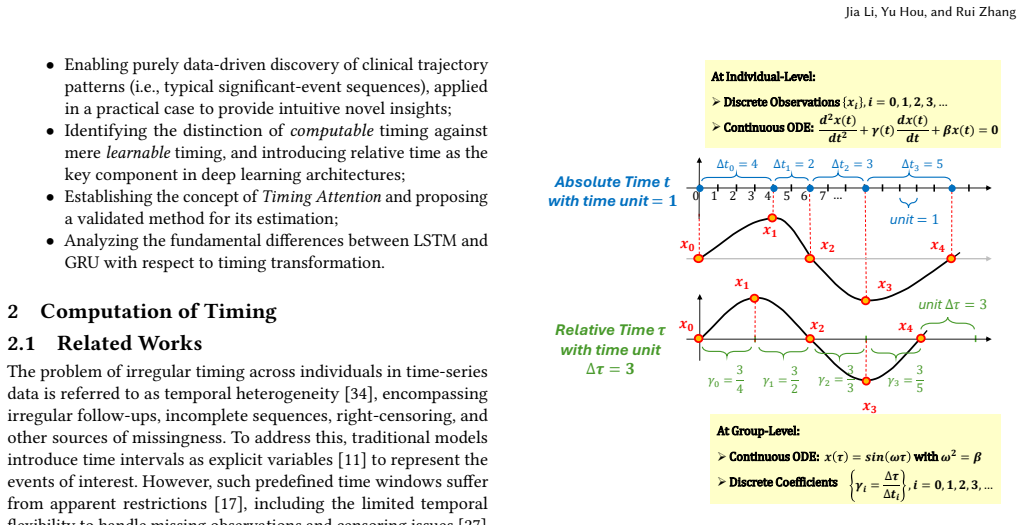
LITT (Individual-Level Time Transformation) is an architecture that places patient-specific events onto a temporary virtual relative timeline. By doing so it supplies relative timestamps that let attention mechanisms operate directly on event timing and ordering rather than on raw physical times. This produces both stronger predictive performance for the timing of cardiotoxicity onset and more interpretable, patient-level views of clinical trajectories when evaluated on longitudinal EHR data from 3,276 breast cancer cases.
What carries the argument
Individual-Level Time Transformation (LITT), which computes relative timestamps for events and aligns them on a shared virtual timeline so that attention can focus on timing patterns across trajectories.
If this is right
- Event ordering and timing become usable dimensions for causal-style reasoning inside clinical AI models.
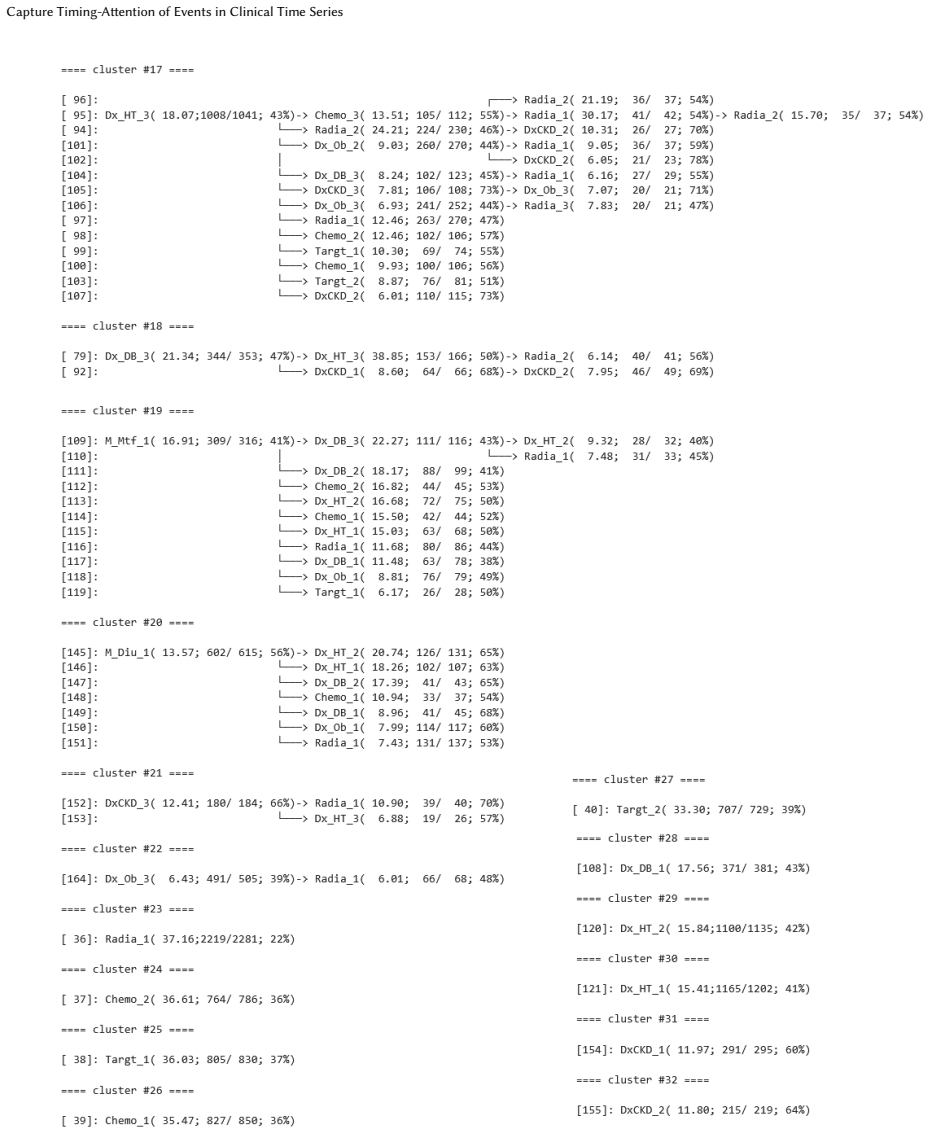
- Shared significant event sequences can be identified across patients even when their absolute times differ.
- Prediction of disease onset timing improves beyond what current survival analysis methods achieve.
- Personalized trajectory interpretations become feasible because each patient's events are mapped to a common relative scale.
- The same architecture shows gains on additional public longitudinal datasets.
Where Pith is reading between the lines
- The relative-timeline idea could be tested on other longitudinal medical records such as diabetes progression or post-surgical recovery data.
- Pairing LITT with explicit causal discovery algorithms might strengthen claims about which timed events drive later outcomes.
- The same transformation step could be applied to non-clinical sequential data, for example sensor streams or financial transaction logs, to surface timing alignments.
Load-bearing premise
That relative timestamps on a virtual timeline capture real alignments and causal patterns in the data without adding artifacts or discarding useful information from the original observed times.
What would settle it
A head-to-head test on the same 3,276-patient breast cancer EHR dataset in which a standard transformer or survival model without any virtual timeline produces equal or higher accuracy for cardiotoxicity onset timing and equal or better interpretability.
Figures


read the original abstract
Automatically discovering personalized sequential events from large-scale time-series data is crucial for enabling precision medicine in clinical research, yet it remains a formidable challenge even for contemporary AI models. For example, while transformers capture rich associations, they are mostly agnostic to event timing and ordering, thereby bypassing potential causal reasoning. Intuitively, we need a method capable of evaluating the "degree of alignment" among patient-specific trajectories and identifying their shared patterns, i.e., the significant events in a consistent sequence. This necessitates treating timing as a true \emph{computable} dimension, allowing models to assign ``relative timestamps'' to candidate events beyond their observed physical times. In this work, we introduce LITT (Individual-Level Time Transformation), a novel architecture that enables temporary alignment of sequential events on a virtual ``relative timeline'', thereby enabling \emph{event-timing-focused attention} and personalized interpretations of clinical trajectories. Its interpretability and effectiveness are validated on real-world longitudinal EHR data from 3,276 breast cancer patients to predict the onset timing of cardiotoxicity-induced heart disease. Furthermore, LITT outperforms both the benchmark and state-of-the-art survival analysis methods on public datasets, positioning it as a significant step forward for precision medicine in clinical AI.
Editorial analysis
A structured set of objections, weighed in public.
Referee Report
Summary. The paper introduces LITT (Individual-Level Time Transformation), a novel architecture that maps clinical events to a virtual relative timeline to enable event-timing-focused attention mechanisms in transformers for irregular longitudinal data. It claims this allows discovery of personalized sequential patterns and validates the approach on real-world EHR from 3,276 breast cancer patients to predict cardiotoxicity-induced heart disease onset timing, while also reporting outperformance over benchmarks and SOTA survival methods on public datasets.
Significance. If the central claims hold, the work offers a concrete mechanism for treating timing as a computable dimension in attention-based models, which could improve causal reasoning and interpretability in clinical time series where events are sparse and irregular. The real-world EHR validation and public dataset comparisons provide a practical testbed, though the absence of detailed method exposition limits immediate assessment of generalizability.
major comments (3)
- [§3.2, Eq. (3)] §3.2, Eq. (3): The relative timestamp transformation is defined via normalization to a patient-specific virtual timeline, but no proof or empirical check of strict monotonicity or invertibility is supplied; without this, it is unclear whether absolute timing information critical for onset prediction is preserved or if artifacts are introduced in sparse sequences.
- [§4.2, Table 1] §4.2, Table 1: The breast cancer cohort results report improved AUC and C-index over baselines, yet no ablation isolating the timing-alignment component from standard self-attention is presented, making it impossible to attribute gains specifically to the virtual timeline mechanism rather than other architectural choices.
- [§4.3] §4.3: The public dataset comparisons claim superiority over SOTA survival methods, but lack reported statistical significance tests (e.g., paired t-tests or DeLong tests) and confidence intervals on the performance deltas, weakening the cross-dataset generalization claim.
minor comments (2)
- The abstract states outperformance but supplies no numerical metrics or baseline names; these should be added for completeness.
- [§3] Notation for the virtual timeline embedding (e.g., how relative timestamps are injected into the attention keys/queries) is introduced without a clear diagram or pseudocode in §3.
Simulated Author's Rebuttal
We thank the referee for the constructive comments, which help clarify key aspects of our work. We address each major point below and will incorporate revisions to strengthen the manuscript.
read point-by-point responses
-
Referee: [§3.2, Eq. (3)] The relative timestamp transformation is defined via normalization to a patient-specific virtual timeline, but no proof or empirical check of strict monotonicity or invertibility is supplied; without this, it is unclear whether absolute timing information critical for onset prediction is preserved or if artifacts are introduced in sparse sequences.
Authors: We agree that a formal demonstration was omitted. The transformation in Eq. (3) is a per-patient affine rescaling of observed timestamps to the unit interval [0,1], which is strictly monotonic and invertible by construction (the inverse is the corresponding denormalization using the patient's min/max times). We will add a short proof of bijectivity and monotonicity to §3.2, together with an empirical check on the breast-cancer cohort confirming that relative timestamps recover the original ordering and that absolute inter-event intervals are preserved up to a patient-specific scale factor. revision: yes
-
Referee: [§4.2, Table 1] The breast cancer cohort results report improved AUC and C-index over baselines, yet no ablation isolating the timing-alignment component from standard self-attention is presented, making it impossible to attribute gains specifically to the virtual timeline mechanism rather than other architectural choices.
Authors: We acknowledge the absence of this ablation. In the revision we will add a controlled ablation that replaces the LITT alignment module with standard self-attention (identical embedding, feed-forward, and output layers) while keeping all other hyperparameters fixed. Results will be reported as an additional column or supplementary table alongside the existing Table 1, allowing direct attribution of performance differences to the timing-alignment step. revision: yes
-
Referee: [§4.3] The public dataset comparisons claim superiority over SOTA survival methods, but lack reported statistical significance tests (e.g., paired t-tests or DeLong tests) and confidence intervals on the performance deltas, weakening the cross-dataset generalization claim.
Authors: We thank the referee for this observation. The revised manuscript will include 95 % bootstrap confidence intervals for all reported AUC and C-index values. In addition, we will apply DeLong tests for pairwise AUC comparisons and report the resulting p-values (with Bonferroni correction) to quantify the statistical significance of the observed improvements over the SOTA baselines. revision: yes
Circularity Check
No circularity: LITT introduced as independent mechanism with external validation
full rationale
The paper presents LITT as a novel architecture that adds a virtual relative timeline for event alignment and timing-focused attention. The abstract and description frame this as an added capability rather than a quantity derived from or defined in terms of its own outputs. Validation occurs on held-out real-world EHR data from 3,276 patients and public datasets, with direct comparison to benchmarks and survival methods. No equations, self-citations, or fitted-parameter renamings are shown that would reduce the central claim to its inputs by construction. The derivation chain remains self-contained against external benchmarks.
Axiom & Free-Parameter Ledger
invented entities (1)
-
virtual relative timeline
no independent evidence
Lean theorems connected to this paper
-
IndisputableMonolith/Cost/FunctionalEquation.lean; IndisputableMonolith/Foundation/ArithmeticFromLogic.leanJcost uniqueness (washburn_uniqueness_aczel); embed_eq_pow and embed_strictMono_of_one_lt echoes?
echoesECHOES: this paper passage has the same mathematical shape or conceptual pattern as the Recognition theorem, but is not a direct formal dependency.
τ_i = exp(−∑(W_γ t_l + b_γ)) = exp(−V·T_i); continuous: τ'(t) = C exp(−∫γ(t) dt); reduces ODE to x''(τ) + β x(τ) = 0 with solution A cos(√β τ) + B sin(√β τ)
-
IndisputableMonolith/Foundation/ArrowOfTime.leanz_monotone_absolute; arrow_from_z echoes?
echoesECHOES: this paper passage has the same mathematical shape or conceptual pattern as the Recognition theorem, but is not a direct formal dependency.
LSTM cell-state additive update preserves global timeline for alignment across individuals; GRU exponential decay fails
What do these tags mean?
- matches
- The paper's claim is directly supported by a theorem in the formal canon.
- supports
- The theorem supports part of the paper's argument, but the paper may add assumptions or extra steps.
- extends
- The paper goes beyond the formal theorem; the theorem is a base layer rather than the whole result.
- uses
- The paper appears to rely on the theorem as machinery.
- contradicts
- The paper's claim conflicts with a theorem or certificate in the canon.
- unclear
- Pith found a possible connection, but the passage is too broad, indirect, or ambiguous to say the theorem truly supports the claim.
Reference graph
Works this paper leans on
-
[1]
Mohammad Al Olaimat, Serdar Bozdag, and Alzheimer’s Disease Neuroimaging Initiative. 2024. TA-RNN: an attention-based time-aware recurrent neural net- work architecture for electronic health records.Bioinformatics40, Supplement_1 (2024), i169–i179
work page 2024
-
[2]
Kay H Brodersen, Fabian Gallusser, Jim Koehler, Nicolas Remy, and Steven L Scott. 2015. Inferring causal impact using Bayesian structural time-series models. (2015)
work page 2015
-
[3]
Zhengping Che, Sanjay Purushotham, Kyunghyun Cho, David Sontag, and Yan Liu. 2018. Recurrent neural networks for multivariate time series with missing values.Scientific reports8, 1 (2018), 6085
work page 2018
-
[4]
Ricky TQ Chen, Yulia Rubanova, Jesse Bettencourt, and David K Duvenaud. 2018. Neural ordinary differential equations.Advances in neural information processing systems31 (2018)
work page 2018
-
[5]
Junyoung Chung, Caglar Gulcehre, KyungHyun Cho, and Yoshua Bengio. 2014. Empirical evaluation of gated recurrent neural networks on sequence modeling. arXiv preprint arXiv:1412.3555(2014)
work page internal anchor Pith review Pith/arXiv arXiv 2014
-
[6]
Taane G Clark, Michael J Bradburn, Sharon B Love, and Douglas G Altman. 2003. Survival analysis part I: basic concepts and first analyses.British journal of cancer 89, 2 (2003), 232–238
work page 2003
-
[7]
Seana Coulson and Cristobal Pagán Cánovas. 2009. Understanding timelines: Conceptual metaphor and conceptual integration.Cognitive Semiotics5, 1-2 (2009), 198–219
work page 2009
-
[8]
Yinan Huang, Jieni Li, Mai Li, and Rajender R Aparasu. 2023. Application of machine learning in predicting survival outcomes involving real-world data: a scoping review.BMC medical research methodology23, 1 (2023), 268
work page 2023
-
[9]
Jared L Katzman, Uri Shaham, Alexander Cloninger, Jonathan Bates, Tingting Jiang, and Yuval Kluger. 2018. DeepSurv: personalized treatment recommender system using a Cox proportional hazards deep neural network.BMC medical research methodology18, 1 (2018), 24
work page 2018
-
[10]
Seyed Mehran Kazemi, Rishab Goel, Sepehr Eghbali, Janahan Ramanan, Jaspreet Sahota, Sanjay Thakur, Stella Wu, Cathal Smyth, Pascal Poupart, and Marcus Brubaker. 2019. Time2vec: Learning a vector representation of time.arXiv preprint arXiv:1907.05321(2019)
work page internal anchor Pith review Pith/arXiv arXiv 2019
-
[11]
Philippe Laborie and Jerome Rogerie. 2008. Reasoning with Conditional Time- Intervals.. InFLAIRS. 555–560
work page 2008
-
[12]
Changhee Lee, William Zame, Jinsung Yoon, and Mihaela Van Der Schaar. 2018. Deephit: A deep learning approach to survival analysis with competing risks. In Proceedings of the AAAI conference on artificial intelligence, Vol. 32
work page 2018
-
[13]
Laxmi S Mehta, Karol E Watson, Ana Barac, Theresa M Beckie, Vera Bittner, Salvador Cruz-Flores, Susan Dent, Lavanya Kondapalli, Bonnie Ky, Tochukwu Okwuosa, et al. 2018. Cardiovascular disease and breast cancer: where these entities intersect: a scientific statement from the American Heart Association. Circulation137, 8 (2018), e30–e66
work page 2018
-
[14]
James D Murray. 2002.Mathematical Biology: I. An Introduction(3rd ed.). Interdisciplinary Applied Mathematics, Vol. 17. Springer-Verlag, New York. doi:10.1007/b98868
-
[15]
Chirag Nagpal, Xinyu Li, and Artur Dubrawski. 2021. Deep survival machines: Fully parametric survival regression and representation learning for censored data with competing risks.IEEE Journal of Biomedical and Health Informatics25, 8 (2021), 3163–3175
work page 2021
-
[16]
Seo Young Park, Ji Eun Park, Hyungjin Kim, and Seong Ho Park. 2021. Review of statistical methods for evaluating the performance of survival or other time- to-event prediction models (from conventional to deep learning approaches). Korean Journal of Radiology22, 10 (2021), 1697
work page 2021
-
[17]
MS Rose, AM Gillis, and RS Sheldon. 1999. Evaluation of the bias in using the time to the first event when the inter-event intervals have a Weibull distribution. Statistics in medicine18, 2 (1999), 139–154
work page 1999
-
[18]
Jakob Runge, Andreas Gerhardus, Gherardo Varando, Veronika Eyring, and Gustau Camps-Valls. 2023. Causal inference for time series.Nature Reviews Earth & Environment4, 7 (2023), 487–505
work page 2023
-
[19]
Pedro Sanchez, Jeremy P Voisey, Tian Xia, Hannah I Watson, Alison Q O’Neil, and Sotirios A Tsaftaris. 2022. Causal machine learning for healthcare and precision medicine.Royal Society Open Science9, 8 (2022), 220638
work page 2022
-
[20]
Mona Schirmer, Mazin Eltayeb, Stefan Lessmann, and Maja Rudolph. 2022. Mod- eling irregular time series with continuous recurrent units. InInternational conference on machine learning. PMLR, 19388–19405
work page 2022
-
[21]
Bernhard Schölkopf, Francesco Locatello, Stefan Bauer, Nan Rosemary Ke, Nal Kalchbrenner, Anirudh Goyal, and Yoshua Bengio. 2021. Toward causal repre- sentation learning.IEEE109, 5 (2021), 612–634
work page 2021
-
[22]
Benjamin Shickel, Patrick James Tighe, Azra Bihorac, and Parisa Rashidi. 2017. Deep EHR: a survey of recent advances in deep learning techniques for electronic health record (EHR) analysis.IEEE journal of biomedical and health informatics 22, 5 (2017), 1589–1604
work page 2017
-
[23]
Amy Sitapati, Hyeoneui Kim, Barbara Berkovich, Rebecca Marmor, Siddharth Singh, Robert El-Kareh, Brian Clay, and Lucila Ohno-Machado. 2017. Integrated precision medicine: the role of electronic health records in delivering personal- ized treatment.Wiley Interdisciplinary Reviews: Systems Biology and Medicine9, 3 (2017), e1378
work page 2017
- [24]
-
[25]
Corentin Tallec and Yann Ollivier. 2018. Can recurrent neural networks warp time?arXiv preprint arXiv:1804.11188(2018)
work page internal anchor Pith review Pith/arXiv arXiv 2018
-
[26]
Li Tong, Wenqi Shi, Monica Isgut, Yishan Zhong, Peter Lais, Logan Gloster, Jimin Sun, Aniketh Swain, Felipe Giuste, and May D Wang. 2023. Integrating multi-omics data with EHR for precision medicine using advanced artificial intelligence.IEEE Reviews in Biomedical Engineering17 (2023), 80–97
work page 2023
-
[27]
Anthony Joe Turkson, Francis Ayiah-Mensah, and Vivian Nimoh. 2021. Han- dling censoring and censored data in survival analysis: a standalone systematic literature review.International journal of mathematics and mathematical sciences 2021, 1 (2021), 9307475
work page 2021
-
[28]
Ping Wang, Yan Li, and Chandan K Reddy. 2019. Machine learning for survival analysis: A survey.ACM Computing Surveys (CSUR)51, 6 (2019), 1–36
work page 2019
-
[29]
Zifeng Wang and Jimeng Sun. 2022. Survtrace: Transformers for survival analysis with competing events. InProceedings of the 13th ACM international conference on bioinformatics, computational biology and health informatics. 1–9
work page 2022
-
[30]
Gabriele Wulf, Timothy D Lee, and Richard A Schmidt. 1994. Reducing knowledge of results about relative versus absolute timing: Differential effects on learning. Journal of motor behavior26, 4 (1994), 362–369
work page 1994
-
[31]
Feng Xie, Han Yuan, Yilin Ning, Marcus Eng Hock Ong, Mengling Feng, Wynne Hsu, Bibhas Chakraborty, and Nan Liu. 2022. Deep learning for temporal data representation in electronic health records: A systematic review of challenges and methodologies.Journal of biomedical informatics126 (2022), 103980
work page 2022
-
[32]
Shudong Yang, Xueying Yu, and Ying Zhou. 2020. Lstm and gru neural network performance comparison study: Taking yelp review dataset as an example. In 2020 International workshop on electronic communication and artificial intelligence (IWECAI). IEEE, 98–101
work page 2020
-
[33]
Krzysztof Zarzycki and Maciej Ławryńczuk. 2021. LSTM and GRU neural net- works as models of dynamical processes used in predictive control: A comparison of models developed for two chemical reactors.Sensors21, 16 (2021), 5625
work page 2021
-
[34]
Jing Zhao, Panagiotis Papapetrou, Lars Asker, and Henrik Boström. 2017. Learn- ing from heterogeneous temporal data in electronic health records.Journal of biomedical informatics65 (2017), 105–119
work page 2017
-
[35]
Sicheng Zhou, Anne Blaes, Chetan Shenoy, Ju Sun, and Rui Zhang. 2024. Risk prediction of heart diseases in patients with breast cancer: A deep learning approach with longitudinal electronic health records data.Iscience27, 7 (2024)
work page 2024
-
[36]
Yu Zhu, Hao Li, Yikang Liao, Beidou Wang, Ziyu Guan, Haifeng Liu, and Deng Cai. 2017. What to do next: Modeling user behaviors by time-LSTM.. InIJCAI, Vol. 17. Melbourne, VIC, 3602–3608. Capture Timing-Attention of Events in Clinical Time Series A Appendix A: Why LSTM Enables Timing Computation While GRU Cannot Two prominent recurrent architectures, LSTM ...
work page 2017
discussion (0)
Sign in with ORCID, Apple, or X to comment. Anyone can read and Pith papers without signing in.