Better Diameter Bounds for Efficient Shortcuts and a Structural Criterion for Constructiveness
Pith reviewed 2026-05-16 03:27 UTC · model grok-4.3
The pith
Certified shortcuts are precisely the ones constructible in near-linear time, and no almost-linear-size certified shortcut can reduce diameter below n^{1/4-o(1)}.
A machine-rendered reading of the paper's core claim, the machinery that carries it, and where it could break.
Core claim
A shortcut H can be constructed in t time by repeatedly spending ℓ time on shortcutting a path of length ℓ, if and only if, there exists a certified shortcut H' ⊇ H of size Õ(t). Furthermore, no certified shortcut construction with almost-linear size can reduce a graph's diameter below n^{1/4-o(1)}.
Load-bearing premise
The model of constructibility is restricted to repeatedly shortcutting a single path of length ℓ in exactly ℓ time; if more powerful parallel or batched construction primitives are allowed, the equivalence to certification may fail.
Figures
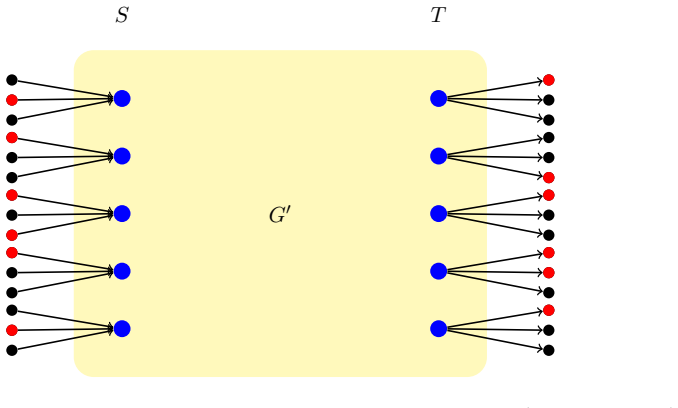
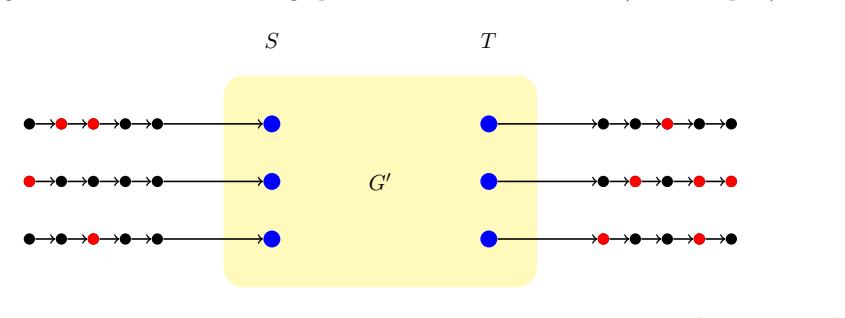
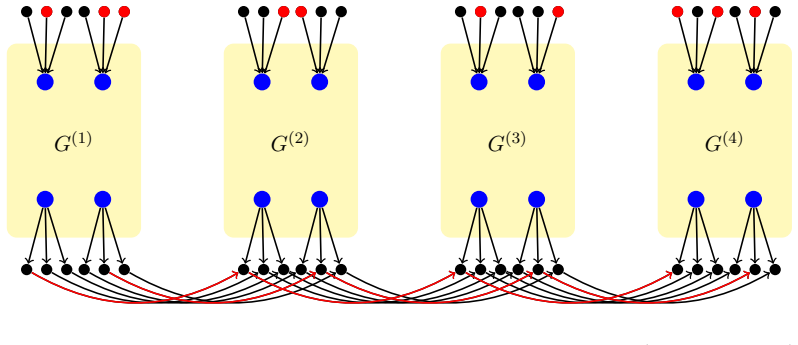
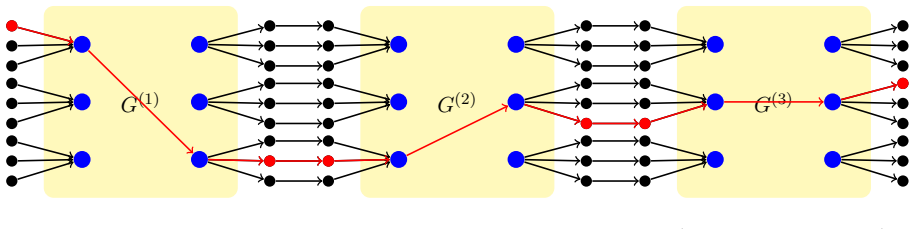
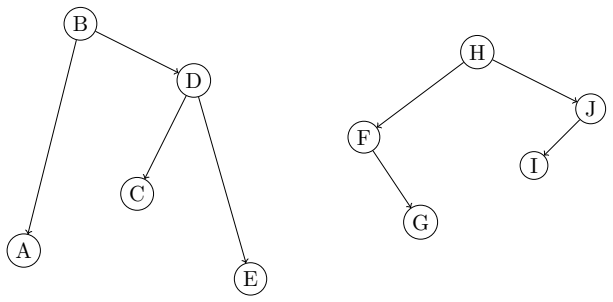
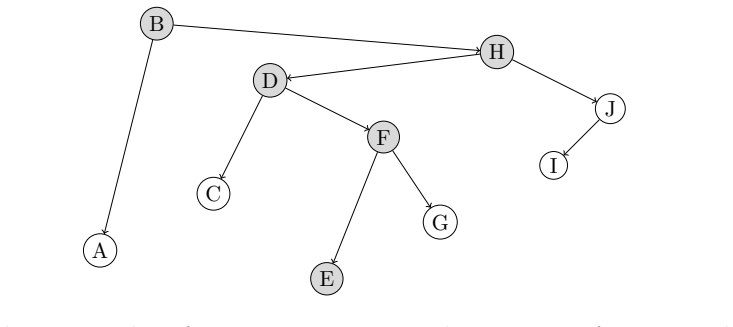
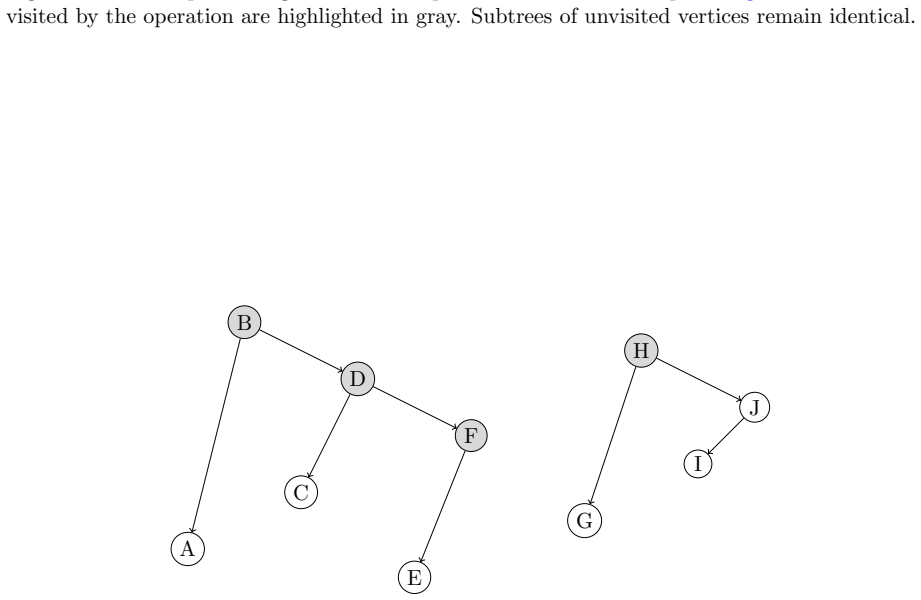
read the original abstract
All parallel algorithms for directed reachability and shortest paths crucially rely on efficient shortcut constructions. These constructions find directed paths and shortcut them by adding edges, with the goal to reduce the diameter of the graph. A long sequence of works has studied (efficient) shortcut constructions as well as impossibility results on the best diameter and therefore the best parallelism that can be achieved via this approach. This paper introduces a new conceptual tool for this line of research in the form of a simple and natural structural criterion: A shortcut $H$ for a graph $G$ is certified if for any shortcut edge $(u, v) \in H$, there exists a vertex $w$ such that the edges $(u, w)$ and $(w, v)$ are also in $G \cup H$. We show that this criterion captures constructiveness in the following sense: A shortcut $H$ can be constructed in $t$ time by repeatedly spending $\ell$ time on shortcutting a path of length $\ell$, if and only if, there exists a certified shortcut $H' \supseteq H$ of size $\tilde{O}(t)$. Furthermore, all known shortcut constructions with efficient algorithms can be extended to produce certified shortcuts of size $\tilde{O}(m)$. On the other hand, for shortcut constructions for which attempts to find efficient implementations have failed, we can show that this is impossible. We also obtain stronger diameter lower bounds for certified shortcuts and hopsets. For example, no certified shortcut construction with almost-linear size can reduce a graph's diameter below $n^{1/4-o(1)}$. This seems to be the best bound one can hope for with current techniques.
Editorial analysis
A structured set of objections, weighed in public.
Axiom & Free-Parameter Ledger
axioms (2)
- standard math The underlying graph is a directed graph with m edges and n vertices; standard adjacency-list representation is assumed.
- domain assumption Construction time is measured by the number of rounds in which a single path of length ℓ can be shortcut in exactly ℓ time.
invented entities (1)
-
certified shortcut
no independent evidence
Lean theorems connected to this paper
-
IndisputableMonolith/Cost/FunctionalEquation.leanwashburn_uniqueness_aczel unclear?
unclearRelation between the paper passage and the cited Recognition theorem.
A shortcut H is certified if for any edge (u,v)∈H, there exist two edges (u,w),(w,v)∈E∪H for some vertex w∈V.
-
IndisputableMonolith/Foundation/DimensionForcing.leanreality_from_one_distinction unclear?
unclearRelation between the paper passage and the cited Recognition theorem.
Any certified shortcut H can be constructed by a 2-hop certified shortcutting procedure.
What do these tags mean?
- matches
- The paper's claim is directly supported by a theorem in the formal canon.
- supports
- The theorem supports part of the paper's argument, but the paper may add assumptions or extra steps.
- extends
- The paper goes beyond the formal theorem; the theorem is a base layer rather than the whole result.
- uses
- The paper appears to rely on the theorem as machinery.
- contradicts
- The paper's claim conflicts with a theorem or certificate in the canon.
- unclear
- Pith found a possible connection, but the passage is too broad, indirect, or ambiguous to say the theorem truly supports the claim.
Reference graph
Works this paper leans on
-
[1]
Faster and Unified Algorithms for Diameter Reducing Shortcuts and Minimum Chain Covers , booktitle =
URL:https://doi.org/10.1137/1.9781611977554.ch9,doi:10.1137/1. 9781611977554.CH9. 4, 5, 6, 12, 14, 15, 18 [LVWX22] Kevin Lu, Virginia Vassilevska Williams, Nicole Wein, and Zixuan Xu. Better lower bounds for shortcut sets and additive spanners via an improved alternation product. In Joseph (Seffi) Naor and Niv Buchbinder, editors,Proceedings of the 2022 A...
-
[2]
, Hk ofk=O(logn) shortcuts of total size P i |Hi|=O(|H|logn) such that •H⊆E∪H 1 ∪ · · · ∪H k
5, 6, 7 A Extending a Certified Shortcut to have Low Certification Depth In this section, we show the following: Lemma A.1.For anyn-vertex DAGG= (V, E) and certified shortcutHonG, there exists a sequenceH 1, H2, . . . , Hk ofk=O(logn) shortcuts of total size P i |Hi|=O(|H|logn) such that •H⊆E∪H 1 ∪ · · · ∪H k. •For every edgee= (u, v)∈H i, there is a pair...
-
[3]
Each tree has asymptotically optimal depthO(log|P e|)
-
[4]
The total number ofdistinctsubtrees over all the treesT e (e∈H) is at mostO(|H|logn). Such an assignment can be achieved by using a standard persistent balanced binary tree structure such as a treap [AS89] that supports the join-operation on two trees (this operation combines the two input trees so that in the resulting tree, every node of the first tree ...
-
[5]
It hasn= Θ(dD d+1rd+1) vertices andm= Θ(n∆) edges, where ∆ = Θ(r 2/3) is the maximum degree
-
[6]
It has a setPof Θ(n∆ d/(dD)) critical paths such that: (a) Each path hasdDedges. (b) Each path is the unique shortest path between its endpoints. (c) The intersection between any two paths is a subpath with at mostd−1 edges. Proof.The graphGis constructed as follows. For simplicity, we first consider the directed setting by constructing DAGs for anyd >0. ...
-
[7]
for somev ′ 1 ∈ V(r) in the forward direction, or traverses an edge corresponding toe 2(v′
-
[8]
In the former case, ⟨e1(v′ 1),v ′⟩>0 andv ′ 1 =v 1 is the unique maximizer due to strict convexity
for somev ′ 2 ∈ V(r) in the backward direction. In the former case, ⟨e1(v′ 1),v ′⟩>0 andv ′ 1 =v 1 is the unique maximizer due to strict convexity. In the latter case, we always have⟨−e 2(v′ 2),v ′⟩<0 becausev ′ 2 ∈ V(r) can only have positive coordinates by definition. Thus,P ′ can maximize⟨u ′′ −u,v ′⟩only if it traverses the edge corresponding toe 1(v1...
-
[9]
It hasD=n 1/7−Θ(ε) layers
-
[10]
The first and the last layers each haven 3/7+Θ(ε) ≤n 1/2 vertices
-
[11]
(b) Each path is the unique path between its endpoints
It has a setPof Θ(n 1+2ε/D) critical paths such that: (a) Each path is from the first layer to the last layer. (b) Each path is the unique path between its endpoints. (c) The intersection between any two paths is at most one edge. Proof.The starting point is a construction of [Bod21], originally introduced in the context of reachability and distance prese...
-
[12]
Suppose this is the root of the left treap
Set the root of the result to be the lower-priority root of the two input treaps. Suppose this is the root of the left treap
-
[13]
Recursivelyjointhe right subtree of the left treap’s root and the right treap, to form the treap for the subsequence right of the root
-
[14]
Thesplitoperation on a treap and a split pointkcan be performed as follows:
Set the right subtree of the root to be the result of this merge. Thesplitoperation on a treap and a split pointkcan be performed as follows:
-
[15]
If the left subtree has size at leastk, recursively split it, set the right tree of the recursive split to be the new left subtree, and return the left tree of the recursive split and the old root
-
[16]
Otherwise, if the left subtree has size strictly less thank, recursively split the right subtree atk−size of the left subtree−1. Set the left tree of the recursive split to be the new right subtree, and return the old root and the right tree of the recursive split. The subtree sizes can be maintained by updating the size whenever a child is changed or rec...
discussion (0)
Sign in with ORCID, Apple, or X to comment. Anyone can read and Pith papers without signing in.