Recognition: no theorem link
Emulation of large-scale qubit registers with a phase-space approach
Pith reviewed 2026-05-16 03:19 UTC · model grok-4.3
The pith
A mean-field phase-space method emulates continuous-time dynamics of up to thousands of qubits with quadratic cost, capturing single-qubit observables qualitatively on transverse-field Ising models.
A machine-rendered reading of the paper's core claim, the machinery that carries it, and where it could break.
Core claim
The approach only involves at worse a quadratic cost in the system size, allowing to simulate up to several thousands of qubits on a classical computer. It provides qualitatively accurate description of one-qubit observables evolutions.
Load-bearing premise
Substituting quantum fluctuations and correlations with classical ones at the mean-field level remains sufficient for qualitative accuracy on one-qubit observables across the tested coupling regimes.
Figures






read the original abstract
A phase-space approach is used and benchmarked for the simulation of the continuous-time evolution of large registers of qubits. It is based on a statistical ensemble of independent mean-field trajectories, where mean field is introduced at the level of the qubits, substituting quantum fluctuations/correlations with classical ones. The approach only involves at worse a quadratic cost in the system size, allowing to simulate up to several thousands of qubits on a classical computer. It provides qualitatively accurate description of one-qubit observables evolutions, making it a useful reference in comparison to techniques limited to small qubit numbers. The predictive power is, however, less robust for multi-qubits observables. We benchmark the method on the $k$-local transverse-field Ising model, considering a large variety of systems ranging from local to all-to-all interactions, and from weak to strong coupling regimes, with up to 2000 qubits. To showcase the versatility of the approach, simulations on 2D and 3D Ising models are also made.
Editorial analysis
A structured set of objections, weighed in public.
Referee Report
Summary. The paper introduces a phase-space approach for emulating the continuous-time dynamics of large qubit registers via an ensemble of independent mean-field trajectories that replace quantum fluctuations and correlations with classical ones. It claims at-worst quadratic scaling in system size, enabling classical simulation of up to several thousand qubits, and reports qualitatively accurate results for one-qubit observables on the k-local transverse-field Ising model across local to all-to-all couplings, weak to strong regimes, and 1D/2D/3D lattices (benchmarked up to 2000 qubits), while noting reduced robustness for multi-qubit observables.
Significance. If the qualitative accuracy for single-qubit observables holds under the stated conditions, the method would supply a scalable classical reference tool for regimes where exact or tensor-network methods become intractable, offering a practical benchmark for smaller-scale quantum simulations. The explicit quadratic-cost scaling and broad benchmarking across interaction topologies constitute concrete strengths.
major comments (2)
- [Abstract and benchmarking section] Abstract and benchmarking section: the claim of 'qualitatively accurate description of one-qubit observables' is stated without any quantitative error metrics (e.g., mean absolute deviation from exact diagonalization on small-N instances), convergence tests with ensemble size, or explicit baseline comparisons. This absence leaves the degree of accuracy unquantified, particularly near the 1D TFIM critical point g=1 where mean-field approximations are known to distort the transition and magnetization dynamics.
- [Method description] Method description (phase-space construction): substituting quantum correlations with classical mean-field ones at the trajectory level is introduced without a supporting bound or derivation demonstrating why single-qubit observables remain qualitatively faithful across the tested coupling regimes, including strong coupling and criticality; the central claim therefore rests entirely on empirical observation rather than controlled analysis.
minor comments (2)
- [Abstract] The abstract could briefly define the operational meaning of 'qualitative accuracy' (e.g., correct sign of magnetization or location of inflection points) to aid readers.
- [Benchmarking section] Consider adding a short table or paragraph comparing wall-clock scaling and memory use against exact or MPS methods for N=10–20 to make the quadratic-cost advantage concrete.
Simulated Author's Rebuttal
We thank the referee for the constructive comments, which help clarify the presentation of our heuristic method. We address each point below.
read point-by-point responses
-
Referee: [Abstract and benchmarking section] Abstract and benchmarking section: the claim of 'qualitatively accurate description of one-qubit observables' is stated without any quantitative error metrics (e.g., mean absolute deviation from exact diagonalization on small-N instances), convergence tests with ensemble size, or explicit baseline comparisons. This absence leaves the degree of accuracy unquantified, particularly near the 1D TFIM critical point g=1 where mean-field approximations are known to distort the transition and magnetization dynamics.
Authors: We agree that quantitative metrics strengthen the claims. In the revised manuscript we will add (i) tables of mean absolute deviation from exact diagonalization for N≤20 across the tested regimes, (ii) convergence plots versus ensemble size, and (iii) explicit comparisons to standard mean-field theory. We will also insert a dedicated paragraph discussing the known distortions near the 1D critical point g=1 and how our results behave in that regime. revision: yes
-
Referee: [Method description] Method description (phase-space construction): substituting quantum correlations with classical mean-field ones at the trajectory level is introduced without a supporting bound or derivation demonstrating why single-qubit observables remain qualitatively faithful across the tested coupling regimes, including strong coupling and criticality; the central claim therefore rests entirely on empirical observation rather than controlled analysis.
Authors: The substitution is a defining feature of the mean-field phase-space construction; we do not claim or derive a rigorous error bound for general k-local Hamiltonians. The manuscript’s contribution is the demonstration of quadratic scaling together with extensive empirical validation. We will revise the method section to state explicitly that the approach is heuristic and that single-qubit observables are observed to remain qualitatively faithful under the tested conditions. We disagree that an analytical bound is required for publication, as the paper positions the method as a practical reference tool rather than an exact solver. revision: partial
Circularity Check
No significant circularity detected
full rationale
The derivation relies on a standard phase-space representation of qubit states combined with an ensemble of independent mean-field trajectories that replace quantum correlations by classical ones. This construction directly yields the claimed quadratic scaling in system size and the focus on one-qubit observables; no equation or central claim is shown to reduce by definition, fitted input, or self-citation chain to its own inputs. Benchmarks on transverse-field Ising models are presented as empirical validation rather than as part of a self-referential loop. The method is therefore self-contained against external benchmarks.
Axiom & Free-Parameter Ledger
axioms (1)
- domain assumption Quantum fluctuations and correlations can be replaced by classical statistics in an ensemble of independent mean-field trajectories while preserving qualitative accuracy for one-qubit observables
Reference graph
Works this paper leans on
-
[1]
Key figures of equilibration We turn to an aspect of dynamics for which PSA is be- lieved to provide particularly good estimates: the equi- libration process. Our goal here is to characterize the equilibration process of one-qubit degrees of freedom in thek-local TFIM described by Eq. (1). We focus on the possibility of extending our exact analysis of sma...
work page 2000
-
[2]
Results We show these quantities for different length chainsL, ranging fromL= 10 toL= 2000 qubits in Fig. 10. Over- all, we see that the PSA estimations of both the long- time entanglement entropy and the characteristic raising time are, although not equal, consistent with the MPS calculation. Given that the two techniques are vastly different in nature, ...
work page 2000
-
[3]
R. Or´ us, A practical introduction to tensor networks: Matrix product states and projected entangled pair states, Ann. Phys.349, 117 (2014)
work page 2014
-
[4]
F. Verstraete and J. I. Cirac, Matrix product states represent ground states faithfully, Physical Review B—Condensed Matter and Materials Physics73, 094423 (2006)
work page 2006
-
[5]
U. Schollw¨ ock, The density-matrix renormalization group in the age of matrix product states, Annals of physics 326, 96 (2011)
work page 2011
-
[6]
J. I. Cirac, D. Perez-Garcia, N. Schuch, and F. Ver- straete, Matrix product states and projected entangled pair states: Concepts, symmetries, theorems, Reviews of Modern Physics93, 045003 (2021)
work page 2021
-
[7]
F. Verstraete, V. Murg, and J. I. Cirac, Matrix prod- uct states, projected entangled pair states, and varia- tional renormalization group methods for quantum spin systems, Adv. Phys.57, 143 (2008)
work page 2008
-
[8]
Renormalization algorithms for Quantum-Many Body Systems in two and higher dimensions
F. Verstraete and J. I. Cirac, Renormalization algorithms for quantum-many body systems in two and higher di- mensions, arXiv:cond-mat/0407066 (2004)
work page internal anchor Pith review Pith/arXiv arXiv 2004
-
[9]
Vidal, Entanglement renormalization, Phys
G. Vidal, Entanglement renormalization, Phys. Rev. Lett.99, 220405 (2007)
work page 2007
-
[10]
Vidal, Class of quantum many-body states that can be efficiently simulated, Phys
G. Vidal, Class of quantum many-body states that can be efficiently simulated, Phys. Rev. Lett.101, 110501 (2008)
work page 2008
-
[11]
The Heisenberg Representation of Quantum Computers
D. Gottesman, The heisenberg representation of quan- tum computers (1998), arXiv:quant-ph/9807006 [quant- ph]
work page internal anchor Pith review Pith/arXiv arXiv 1998
-
[12]
T. Beguˇ si´ c, J. Gray, and G. K.-L. Chan, Fast and converged classical simulations of evidence for the utility of quantum computing before fault tolerance, Science Advances10, eadk4321 (2024), https://www.science.org/doi/pdf/10.1126/sciadv.adk4321. 13
-
[13]
A. Angrisani, A. Schmidhuber, M. S. Rudolph, M. Cerezo, Z. Holmes, and H.-Y. Huang, Classically es- timating observables of noiseless quantum circuits, Phys. Rev. Lett.135, 170602 (2025)
work page 2025
-
[14]
P. Rall, D. Liang, J. Cook, and W. Kretschmer, Simu- lation of qubit quantum circuits via pauli propagation, Physical Review A99, 062337 (2019)
work page 2019
-
[15]
C. Gardiner and P. Zoller,Quantum noise: a handbook of Markovian and non-Markovian quantum stochastic meth- ods with applications to quantum optics(Springer Science & Business Media, 2004)
work page 2004
-
[16]
R. E. Wyatt,Quantum Dynamics with Trajectories: In- troduction to Quantum Hydrodynamics(Springer, New York, 2005)
work page 2005
-
[17]
´A. S. Sanz and S. Miret-Art´ es,A Trajectory Descrip- tion of Quantum Processes. I. Fundamentals: A Bohmian Perspective, Lecture Notes in Physics, Vol. 850 (Springer, Berlin, 2012)
work page 2012
-
[18]
´A. S. Sanz and S. Miret-Art´ es,A Trajectory Description of Quantum Processes. II. Applications, Lecture Notes in Physics, Vol. 831 (Springer, Berlin, 2014)
work page 2014
-
[19]
X. Oriols and J. Mompart,Applied Bohmian Mechan- ics: From Nanoscale Systems to Cosmology(CRC Press, Boca Raton, 2019)
work page 2019
-
[20]
Nelson, Derivation of the Schr¨ odinger equation from Newtonian mechanics, Phys
E. Nelson, Derivation of the Schr¨ odinger equation from Newtonian mechanics, Phys. Rev.150, 1079 (1966)
work page 1966
-
[21]
Nelson,Quantum Fluctuations(Princeton University Press, Princeton, NJ, 1985)
E. Nelson,Quantum Fluctuations(Princeton University Press, Princeton, NJ, 1985)
work page 1985
-
[22]
Bohm, A suggested interpretation of the quantum the- ory in terms of “hidden” variables
D. Bohm, A suggested interpretation of the quantum the- ory in terms of “hidden” variables. I, Phys. Rev.85, 166 (1952)
work page 1952
-
[23]
Bohm, A suggested interpretation of the quantum the- ory in terms of “hidden” variables
D. Bohm, A suggested interpretation of the quantum the- ory in terms of “hidden” variables. II, Phys. Rev.85, 180 (1952)
work page 1952
-
[24]
E. Deotto and G. Ghirardi, Bohmian mechanics revisited, Foundations of Physics28, 1 (1998)
work page 1998
-
[25]
D. D¨ urr and S. Teufel, Bohmian mechanics, inBohmian Mechanics: The Physics and Mathematics of Quantum Theory(Springer, 2009) pp. 145–171
work page 2009
-
[26]
S. M. Davidson, D. Sels, and A. Polkovnikov, Semiclassi- cal approach to dynamics of interacting fermions, Annals of Physics384, 128 (2017)
work page 2017
- [27]
-
[28]
A. Braemer, J. Vahedi, and M. G¨ arttner, Cluster trun- cated wigner approximation for bond-disordered heisen- berg spin models, Physical Review B110, 054204 (2024)
work page 2024
-
[29]
R. P. Feynman, Space-time approach to non-relativistic quantum mechanics, Rev. Mod. Phys.20, 367 (1948)
work page 1948
-
[30]
R. P. Feynman, An operator calculus having applications in quantum electrodynamics, Phys. Rev.84, 108 (1951)
work page 1951
-
[31]
R. P. Feynman and A. R. Hibbs,Quantum Mechanics and Path Integrals(McGraw-Hill, New York, 1965)
work page 1965
-
[32]
R. Feynman and A. H. Q. Mechanics, Path integrals, Lec- ture Notes Phys106, 64 (1979)
work page 1979
-
[33]
C. Grosche, F. Steiner, and F. Steiner,Handbook of Feyn- man path integrals, Vol. 145 (Springer, 1998)
work page 1998
-
[34]
S. A. Albeverio, R. J. Høegh-Krohn, and S. Mazzucchi, Mathematical theory of Feynman path integrals: an in- troduction(Springer, 2008)
work page 2008
-
[35]
Mori, Transport, collective motion, and brownian mo- tion, Prog
H. Mori, Transport, collective motion, and brownian mo- tion, Prog. Theor. Phys.33, 423 (1965)
work page 1965
-
[36]
Ayik, A stochastic mean-field approach for nuclear dy- namics, Phys
S. Ayik, A stochastic mean-field approach for nuclear dy- namics, Phys. Lett. B658, 174 (2008)
work page 2008
-
[37]
D. Lacroix and S. Ayik, Stochastic quantum dynamics beyond mean field, Eur. Phys. J. A50, 95 (2014)
work page 2014
-
[38]
D. Lacroix, S. Ayik, and B. Yilmaz, Symmetry breaking and fluctuations within stochastic mean-field dynamics: Importance of initial quantum fluctuations, Phys. Rev. C85, 041602 (2012)
work page 2012
-
[39]
D. Lacroix, D. Gambacurta, and S. Ayik, Quantal cor- rections to mean-field dynamics including pairing, Phys. Rev. C87, 061302 (2013)
work page 2013
-
[40]
D. Lacroix, S. Hermanns, C. M. Hinz, and M. Bonitz, Ul- trafast dynamics of finite hubbard clusters: A stochastic mean-field approach, Phys. Rev. B90, 125112 (2014)
work page 2014
- [41]
- [42]
-
[43]
D. Lacroix, A. B. Balantekin, M. J. Cervia, A. V. Pat- wardhan, and P. Siwach, Role of non-gaussian quantum fluctuations in neutrino entanglement, Phys. Rev. D106, 123006 (2022)
work page 2022
-
[44]
D. Lacroix, A. Bauge, B. Yilmaz, M. Mangin-Brinet, A. Roggero, and A. B. Balantekin, Phase-space meth- ods for neutrino oscillations: Extension to multibeams, Phys. Rev. D110, 103027 (2024)
work page 2024
- [45]
-
[46]
M. Mangin-Brinet, A. Bauge, and D. Lacroix, Three- flavor neutrino oscillations using the phase space ap- proach (2025), arXiv:2507.18482 [hep-ph]
-
[47]
J. Schachenmayer, A. Pikovski, and A. M. Rey, Many- body quantum spin dynamics with monte carlo trajec- tories on a discrete phase space, Physical Review X5, 011022 (2015)
work page 2015
- [48]
-
[49]
R. Khasseh, A. Russomanno, M. Schmitt, M. Heyl, and R. Fazio, Discrete truncated wigner approach to dynam- ical phase transitions in ising models after a quantum quench, Physical Review B102, 014303 (2020)
work page 2020
-
[50]
V. P. Singh and H. Weimer, Driven-dissipative critical- ity within the discrete truncated wigner approximation, Physical Review Letters128, 200602 (2022)
work page 2022
-
[51]
H. Hosseinabadi, O. Chelpanova, and J. Marino, User- friendly truncated wigner approximation for dissipative spin dynamics, PRX Quantum6, 030344 (2025)
work page 2025
-
[52]
H. J. Lipkin, N. Meshkov, and A. Glick, Validity of many- body approximation methods for a solvable model: (i). exact solutions and perturbation theory, Nucl. Phys.62, 188 (1965)
work page 1965
-
[53]
N. Meshkov, A. Glick, and H. J. Lipkin, Validity of many- body approximation methods for a solvable model: (ii). linearization procedures, Nucl. Phys.62, 199 (1965). 14
work page 1965
- [54]
-
[55]
Holzwarth, Four approaches to the function of inertia in a solvable model, Nucl
G. Holzwarth, Four approaches to the function of inertia in a solvable model, Nucl. Phys. A207, 545 (1973)
work page 1973
-
[56]
L. M. Robledo, Characterization of octupole correlations in the lipkin model, Phys. Rev. C46, 238 (1992)
work page 1992
-
[57]
A. P. Severyukhin, M. Bender, and P.-H. Heenen, Beyond mean field study of excited states: Analysis within the lipkin model, Phys. Rev. C74, 024311 (2006)
work page 2006
-
[58]
A brief account of the Ising and Ising-like models: Mean-field, effective-field and exact results
J. Strecka and M. Jascur, A brief account of the ising and ising-like models: Mean-field, effective-field and ex- act results, arXiv preprint arXiv:1511.03031 (2015)
work page internal anchor Pith review Pith/arXiv arXiv 2015
-
[59]
J. W. Negele, The mean-field theory of nuclear struc- ture and dynamics, Reviews of Modern Physics54, 913 (1982)
work page 1982
-
[60]
M. H. Jensen and P. Bak, Mean-field theory of the three- dimensional anisotropic ising model as a four-dimensional mapping, Physical Review B27, 6853 (1983)
work page 1983
-
[61]
M. F. Zimmer, Ising model in an oscillating magnetic field: Mean-field theory, Physical Review E47, 3950 (1993)
work page 1993
-
[62]
L. Waldorp, T. Pham, and H. L. van der Maas, Mean- field theory of the general-spin ising model, The Euro- pean Physical Journal B98, 1 (2025)
work page 2025
-
[63]
L. Wang, B. Teng, Y. Rong, Y. L¨ u, and Z. Wang, Phase transition properties for the kinetic ising model in an os- cillating magnetic field, Solid state communications152, 1641 (2012)
work page 2012
-
[64]
G. S. Grest, C. Soukoulis, and K. Levin, Comparative monte carlo and mean-field studies of random-field ising systems, Physical Review B33, 7659 (1986)
work page 1986
- [65]
-
[66]
M. A. Nielsen and I. L. Chuang,Quantum computation and quantum information(Cambridge university press, 2010)
work page 2010
-
[67]
H. Rademacher, Einige s¨ atze ¨ uber reihen von allgemeinen orthogonalfunktionen, Mathematische Annalen87, 112 (1922)
work page 1922
-
[68]
D. Lacroix, Y. Tanimura, S. Ayik, and P. Chomaz, A simplified BBGKY hierarchy for correlated fermions from a stochastic mean-field approach, Eur. Phys. J. A52, 94 (2016)
work page 2016
-
[69]
D. Regnier, D. Lacroix, G. Scamps, and Y. Hashimoto, Microscopic description of pair transfer between two su- perfluid fermi systems: Combining phase-space averaging and combinatorial techniques, Phys. Rev. C97, 034627 (2018)
work page 2018
-
[70]
D. Regnier and D. Lacroix, Microscopic description of pair transfer between two superfluid fermi systems. ii. quantum mixing of time-dependent hartree-fock- bogolyubov trajectories, Phys. Rev. C99, 064615 (2019)
work page 2019
-
[71]
C. H. Bennett, D. P. DiVincenzo, J. A. Smolin, and W. K. Wootters, Mixed-state entanglement and quantum error correction, Physical Review A54, 3824 (1996), publisher: American Physical Society
work page 1996
-
[72]
W. K. Wootters, Entanglement of Formation of an Arbi- trary State of Two Qubits, Physical Review Letters80, 2245 (1998), publisher: American Physical Society
work page 1998
- [73]
-
[74]
P. Calabrese and J. Cardy, Evolution of entanglement en- tropy in one-dimensional systems, J. Stat. Mech. , P04010 (2005)
work page 2005
-
[75]
V. Alba and P. Calabrese, Entanglement dynamics after quantum quenches in generic integrable systems, SciPost Phys.4(2018)
work page 2018
-
[76]
B. A. Martin, T. Ayral, F. Jamet, M. J. Rancic, and P. Simon, Combining matrix product states and noisy quantum computers for quantum simulation, Phys. Rev. A109, 062437 (2024)
work page 2024
-
[77]
M. Fr´ ıas-P´ erez, L. Tagliacozzo, and M. C. Ba˜ nuls, Con- verting long-range entanglement into mixture: Tensor- network approach to local equilibration, Phys. Rev. Lett. 132, 100402 (2024). 15 Appendix A: Discussion of exact versus approximate MPS simulations We discuss here the current frontier between exact and approximate simulation using the MPS te...
work page 2024
-
[78]
If the MPS has varying bond dimensions along the sites, considerχto be the maximal one
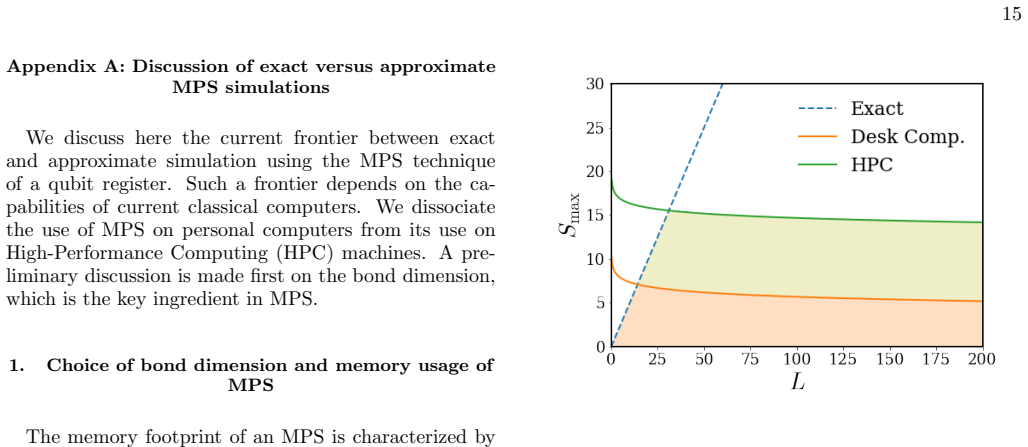
Choice of bond dimension and memory usage of MPS The memory footprint of an MPS is characterized by the number of sitesL, the dimension of the Hilbert space of a sited, and the bond dimensionχ. If the MPS has varying bond dimensions along the sites, considerχto be the maximal one. Then, an upper bound of the memory usage of the MPS is M=Ldχ 2,(A1) in unit...
-
[79]
On a laptop, we can assume the memory can fit a state vector of about 19 qubits (A complex number in double precision is 16 bytes, so that a 19 qubits state vector represents about 10MB), i.e.M= 2 19. This givesχ max = 29/ √ L. ForL= 64 = 2 6 this givesχ max = 64. ForL= 1024 = 2 10 this givesχ max = 16
-
[80]
On a large HPC machine, we can assume the mem- ory can fit a state vector of about 37 qubits ( a 37 qubit state vector represents about 2TB), i.e., M= 2 37. This givesχ max = 218/ √ L. ForL= 1024 = 2 10 this givesχ max ≈8000. ForL≈65000≈2 16 this givesχ max ≈1000. 2.k-local TFIM model exactly solved on classical computers For moderateLvalues, direct diago...
discussion (0)
Sign in with ORCID, Apple, or X to comment. Anyone can read and Pith papers without signing in.