REVIEW 3 major objections 4 minor 80 references
SoftMatcha 2: A Fast and Soft Pattern Matcher for Trillion-Scale Corpora
T0 review · 3 major / 4 minor · reviewed 2026-08-03 · deepseek-v4-flash
Pith's one-line read The paper claims that semantic search over a trillion-token corpus can run in well under 0.3 seconds without the search space exploding in query length.
desk verdict Engineering result is real and worth referee time; the theoretical guarantee is weaker than advertised and should be re-scoped. read the letter →
The pith
A machine-rendered reading of the paper's core claim, the machinery that carries it, and where it could break.
The reading
What carries the argument
Two mechanisms carry the method. The disk-aware, staged suffix array is a two-level index: a RAM-resident sparse table narrows the binary search to a small disk block, so each exact string match costs one random disk access; run-length compression shrinks the index to 21.6 TB for the full corpus. Dynamic corpus-aware pruning is the anti-explosion mechanism: the algorithm expands the query prefix, generates all words within a similarity threshold, filters to corpus-occurring prefixes via the fast lookup, and uses two extra techniques—precomputed RAM tables for common 2-grams and 3-grams, and direct enumeration when a prefix is rare. The similarity itself is a smooth minimum of per-word cosine
What would settle it
Run the released implementation on the full 1.4-trillion-token index with queries built from deliberately polysemous high-frequency words (e.g., "get make set run") at a low similarity threshold, and count exact lookups per prefix; if the per-step candidate count rises steadily with query length instead of staying flat, Theorem 1's hypothesis fails. Alternatively, plot the distribution of |W_w| across the vocabulary: if high-frequency words average thousands of embedding-near alternatives, the constant-order assumption is false.
Extended reading notes
Core claim
SoftMatcha 2 is a search algorithm that, given a short token query, returns phrases in a corpus that are similar to the query under a word-embedding-based similarity measure, allowing substitutions as well as inserted and deleted tokens. Rather than scanning documents, it generates candidate token sequences prefix by prefix, keeps only those that actually occur in the corpus—checked by exact lookup in a suffix-array index—and prunes the rest. The central claim is that this generate-and-filter loop tolerates semantic variation at trillion-token scale: p95 latency is 278 ms for soft search and 0.34 ms for exact lookup on FineWeb-Edu, with essentially flat scaling from 1B to 1.4T tokens. It fur
Load-bearing premise
The efficiency guarantee rests on the assumption that the average number of semantically similar candidate words per surviving prefix stays roughly constant—Hypothesis 2 in Appendix J—rather than growing with vocabulary size; the authors concede in the conclusion that the theoretical analysis presupposes statistical regularities of natural language, and they also note the method is word-level and cannot catch multi-word paraphrases like "U.S." vs "United States".
Editorial extensions
If this is right
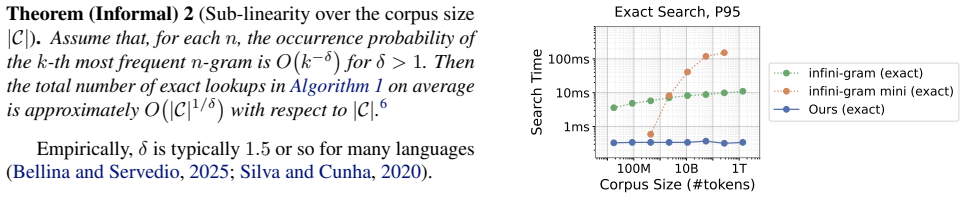
- Exact string search on a 1.4-trillion-token corpus takes 0.34 ms at p95, about 33 times faster than the previous suffix-array engine, and the soft-search index builds faster than the exact-only index.
- Soft search p95 latency is 278 ms on the full English corpus, stays under 400 ms for Japanese and Chinese corpora, and remains almost flat as corpus size grows from 1B to 1.4T tokens.
- Queries and results no longer need the same token count: insertions and deletions are handled with penalties tuned by word informativeness, enabling matches like "importance of machine learning" against "importance of the machine learning".
- The paper argues that the number of exact lookups is approximately constant in query length for fixed threshold and moderate insertion-deletion penalty, and grows like |C|^{1/δ} in corpus size under Zipf n-gram statistics.
- Soft matching identifies 36 benchmark items as contaminated that exact matching misses, and 29 of 36 are confirmed by manual inspection as semantic contamination or template leakage.
Reading between the lines
- Editorial inference: the paper's own limitation—multi-word paraphrases like "U.S." vs "United States" are invisible—suggests a natural extension: composing word vectors into phrase representations, though the authors note this would enlarge the substitution candidate set.
- Editorial inference: the observed growth of 2.27x in lookups per token under full pruning is still exponential, just with a small base; a testable prediction is that repetitive domains such as code or boilerplate legal text will show a larger base and higher latency than narrative prose.
- Editorial inference: the template-leakage examples imply a cheap contamination audit: run soft search on perturbed versions of benchmark questions with numbers and entities substituted, and the method automatically surfaces near-matches that exact tools miss.
- Editorial inference: because exact lookup is roughly 33 times faster than the previous engine, the same disk-aware suffix-array design could accelerate exact n-gram mining and retrieval tasks beyond the soft-search application presented.
Editorial analysis
A structured set of objections, weighed in public.
Referee Report
Summary. The paper presents SoftMatcha 2, a system for soft (semantic) full-text search over trillion-token corpora. It combines a disk-aware staged suffix array (one random disk access per exact lookup) with dynamic corpus-aware pruning (iterative, k-gram, last-bits) to enumerate candidate variants with substitution/insertion/deletion. On FineWeb-Edu (1.4T tokens) it reports 0.34 ms p95 exact lookup and 278 ms p95 soft search, substantially faster than infini-gram, infini-gram mini, and SoftMatcha. The paper also provides an informal theoretical analysis (Theorems 1-2) claiming that total exact lookups are O(1) in query length under a hypothesis about natural-language occurrence statistics, and O(|C|^{1/δ}) in corpus size under Zipf's law. As an application, it detects 36 benchmark-contamination cases missed by exact matching, 29 confirmed by manual inspection.
Significance. If the empirical results and the system's design are reproducible, this is a valuable engineering contribution to large-scale corpus search and contamination auditing. The latency measurement methodology is careful (cache cleared before each query, p95/median, baseline failures reported). The 36-case contamination study with manual verification is a concrete, useful demonstration. However, the theoretical claims as stated are not established: the two hypotheses on which Theorems 1-2 rest are close to the conclusions and are not empirically validated, and the observed per-token growth of 2.27× in lookups (Figure 5) under the actual adaptive protocol shows that the exponential growth is only mitigated, not provably eliminated. The contribution is therefore primarily empirical and systems-oriented; the theory needs substantial revision or removal.
major comments (3)
- [Appendix J, Hypothesis 1 and proof of Theorem 1 (Informal)] The formal statement of Hypothesis 1 is E[|Li|] ≈ O(E[|Si||C*_i|/|V|^i]). The proof of Theorem 1 proceeds by bounding |C*_i| ≤ |C| and using E[|Si|/|V|^i]=O(r^i) to get E[|Li|]=O(r^i). This is only valid if the occurrence ratio for similar patterns is comparable to the uniform ratio |C*_i|/|V^i|. For natural-language queries, S_i is not a uniform sample of V^i; it is biased toward grammatical/collocational sequences, so |Li|/|Si| can be orders of magnitude larger than the uniform ratio. The 'We believe...' justification (p.5) is not empirical. Figure 5 shows 2.27× per-token growth with all pruning, which is hard to reconcile with the O(1) total-lookup claim. The authors should directly measure |Li|/|Si| and |C*_i|/|V^i| as a function of i on their corpus to validate Hypothesis 1, or remove the formal theorem.
- [Appendix J, Hypothesis 2 and Lemma 2] Hypothesis 2 states E[|L'_i|] ≈ O(E[|L_{i-1}|]), i.e., the branching factor |W_w| is constant-order. This is structurally the same as the conclusion of Theorem 1. Lemma 2 then simply sums this assumption over i. The justification (p.25) 'we assume that |W_w| on average is approximately up to constant order' is an assumption, not a derivation. Without a mechanism (e.g., embedding dimension, threshold α, corpus redundancy) that yields this bound, the result is circular. Since both Theorems 1 and 2 depend on Lemma 2, the theoretical contribution is currently an assumption rather than a theorem.
- [§5.3, Figure 5 and Theorem 1 (Informal)] The theorem applies to fixed α and moderate γ, as the paper notes in footnote 5. The deployed system uses adaptive α relaxing until K results, and Figure 5 shows 2.27× per-token growth under that protocol. The abstract and conclusion claim the method 'suppresses exponential growth' and 'mitigates exponential growth' without qualifying that the theoretical guarantee is for a different protocol. The empirical 0.3 s latency is an impressive engineering result, but the theoretical explanation does not cover the measured behavior. The authors should either extend the analysis to adaptive α or explicitly scope the claim.
minor comments (4)
- [Abstract] Typo: 'handlingsemanticvariations' appears to be a missing-space error.
- [§3.1] The smooth-min similarity formula is hard to parse; the parenthesization should be clarified for readability.
- [Appendix J] The use of '≈' and 'O' inside expectations without rigorous constants makes the theorems informal. If the goal is a theoretical guarantee, precise statements with explicit constants are needed.
- [§6] The contamination thresholds (0.6 and 0.8) and the parameters β, γ' are chosen on a single corpus; a sensitivity analysis would strengthen the claims.
Circularity Check
No significant circularity: theorems are conditional on explicit statistical hypotheses; latency and contamination results are measured or verified, not derived from fitted constants.
full rationale
The central efficiency claim (Theorem 1, Informal, §4) is explicitly conditional on Hypothesis 1 and Hypothesis 2, which are stated as assumptions rather than derived from the conclusion. Hypothesis 2 bounds per-step candidate growth, and Hypothesis 1 supplies the exponential decay of |L_i|; the O(1) total-lookup conclusion follows from their conjunction, so it is not identical to either premise. Calibrated constants (β=10^4, γ′≈21.70, the 0.45 output floor, and the 0.6/0.8 contamination thresholds) are disclosed fitting or choice parameters, not predictions, and the headline latencies are direct measurements on FineWeb-Edu. Citations to the authors' prior SoftMatcha and Zipfian-whitening work provide context and reusable tools, but they are not used as a uniqueness theorem or as the justification for the theoretical claim. The main weakness—Hypothesis 1 is supported only by 'We believe that this hypothesis is valid from a linguistic perspective' and is not empirically validated—is a robustness/correctness concern, not a circular-dependency concern. Consequently, no step reduces by construction to its own inputs.
Assumptions & free parameters
free parameters (9)
- β (smooth-min temperature) =
β = 10^4
- γ' (insertion/deletion penalty scale) =
γ'≈21.70 for FineWeb-Edu
- Similarity floor for output =
0.45
- Top-K output count =
K=20
- Contamination thresholds =
sim ≥ 0.6; η ≥ 0.8
- Max query length L =
L=12 in experiments; queries ≤10 tokens
- Staged-index block size B =
B between 128 and 256
- Last-bits pruning trigger =
≤50 occurrences
- k-gram pruning frequency ranks =
2-grams in top 100K words; 3-gram rank-sum ≤10K
assumptions (6)
- domain assumption Hypothesis 1: E[|Li|] ≈ O(E[|Si||C*_i|/|V|^i]) — corpus occurrence ratio among query-similar word sequences is about the same as among all V^i sequences.
- ad hoc to paper Hypothesis 2: E[|L'_i|] ≈ O(E[|L_{i-1}|]) — the per-step candidate set stays within a constant factor of the previous step's surviving set.
- domain assumption Zipf's law for n-gram occurrence probabilities with exponent δ>1 (δ≈1.5 empirically).
- domain assumption Independence of n-gram occurrences in Lemma 3's expectation computation.
- domain assumption Cosine similarity of word embeddings approximates semantic similarity for substitution/insertion/deletion scoring.
- domain assumption Tokenizer-embedding compatibility across languages and corpora.
Cite this review
Pith. "Pith review of SoftMatcha 2: A Fast and Soft Pattern Matcher for Trillion-Scale Corpora." pith.science (2026). https://pith.science/paper/VHTOSQO4
@misc{pith2026260210908,
  author       = {Pith},
  title        = {Pith review of: SoftMatcha 2: A Fast and Soft Pattern Matcher for Trillion-Scale Corpora},
  year         = {2026},
  howpublished = {\url{https://pith.science/paper/VHTOSQO4}},
  note         = {Machine review of arXiv:2602.10908}
}
read the original abstract
We present SoftMatcha 2, an ultra-fast and flexible search algorithm that enables search over trillion-scale natural language corpora in under 0.3 seconds while allowing semantic variations in the form of substitution, insertion, and deletion. Our approach employs string matching based on suffix arrays that scales well with corpus size, and represents words as vectors, which underpin its semantic flexibility. To mitigate the combinatorial explosion induced by the semantic relaxation of queries, our method is built on two key algorithmic ideas: dynamic corpus-aware pruning and fast exact lookup enabled by a disk-aware design. We theoretically analyze the efficiency of the proposed method, indicating that it can mitigate exponential growth in the search space. Empirically, on FineWeb-Edu (Lozhkov et al., 2024) (1.4T tokens), it attains substantially lower search latency than existing methods: infini-gram (Liu et al., 2024), infini-gram mini (Xu et al., 2025), and SoftMatcha (Deguchi et al., 2025). As a practical application, our method uncovers benchmark contamination in training corpora that existing approaches miss, and it also benefits information retrieval and paraphrase detection. We also provide an online demo of fast, soft search across corpora in seven languages.
Figures


Figures from the paper (10 more)


Reference graph
Works this paper leans on
-
[1]
D. Adjeroh, T. Bell, and A. Mukherjee. Exact and approximate pattern matching, pages 187--263. Springer, Boston, MA, 2008. ISBN 978-0-387-78909-5. doi:10.1007/978-0-387-78909-5_7. URL https://doi.org/10.1007/978-0-387-78909-5_7
-
[2]
E. Akyurek, T. Bolukbasi, F. Liu, B. Xiong, I. Tenney, J. Andreas, and K. Guu. Towards tracing knowledge in language models back to the training data . In Findings of the Association for Computational Linguistics: EMNLP 2022 , pages 2429--2446. Association for Computational Linguistics, Dec. 2022. doi:10.18653/v1/2022.findings-emnlp.180. URL http://dx.doi...
-
[3]
A. Andoni and P. Indyk. Near-optimal hashing algorithms for approximate nearest neighbor in high dimensions . Commun. ACM, 51 0 (1): 0 117--122, 1 Jan. 2008. doi:10.1145/1327452.1327494. URL http://dx.doi.org/10.1145/1327452.1327494
arXiv 2008
-
[4]
R. Baeza-Yates and G. Navarro. Block addressing indices for approximate text retrieval. page 1–8, 1997. doi:10.1145/266714.266719. URL https://doi.org/10.1145/266714.266719
arXiv 1997
-
[5]
A. Bellina and V. D. P. Servedio. Cognitive limits shape language statistics, 2025. URL https://arxiv.org/abs/2503.17512
arXiv 2025
-
[6]
Y. Bengio, A. Courville, and P. Vincent. Representation learning: a review and new perspectives . IEEE Trans. Pattern Anal. Mach. Intell., 35 0 (8): 0 1798--1828, 1 Aug. 2013. doi:10.1109/TPAMI.2013.50. URL http://dx.doi.org/10.1109/TPAMI.2013.50
-
[7]
DWDS -- Digitales W \"o rterbuch der deutschen Sprache
Berlin-Brandenburgische Akademie der Wissenschaften . DWDS -- Digitales W \"o rterbuch der deutschen Sprache. Das Wortauskunftssystem zur deutschen Sprache in Geschichte und Gegenwart . https://www.dwds.de/, 2026. abgerufen am 28.01.2026
2026
-
[8]
L. Bottou. Large-scale machine learning with stochastic gradient descent . In Proceedings of COMPSTAT'2010 , pages 177--186. Physica-Verlag HD, 2010. doi:10.1007/978-3-7908-2604-3\_16. URL http://dx.doi.org/10.1007/978-3-7908-2604-3_16
Show all 80 references
-
[9]
S. Ceri, A. Bozzon, M. Brambilla, E. Della Valle, P. Fraternali, and S. Quarteroni. An Introduction to Information Retrieval . In Web Information Retrieval , pages 3--11. Springer Berlin Heidelberg, 2013. doi:10.1007/978-3-642-39314-3\_1. URL http://dx.doi.org/10.5555/1394399
2013 doi
-
[10]
Chang, J
F. Chang, J. Dean, S. Ghemawat, W. C. Hsieh, D. A. Wallach, M. Burrows, T. Chandra, A. Fikes, and R. E. Gruber. Bigtable: A distributed storage system for structured data. ACM Transactions on Computer Systems (TOCS), 26 0 (2): 0 1--26, 2008
2008
-
[11]
M. Chen. Evaluating large language models trained on code. arXiv preprint arXiv:2107.03374, 2021
2021 arXiv
-
[12]
Clark, I
P. Clark, I. Cowhey, O. Etzioni, T. Khot, A. Sabharwal, C. Schoenick, and O. Tafjord. Think you have solved question answering? try arc, the ai2 reasoning challenge. arXiv preprint arXiv:1803.05457, 2018
2018 arXiv
-
[13]
Cobbe, V
K. Cobbe, V. Kosaraju, M. Bavarian, M. Chen, H. Jun, L. Kaiser, M. Plappert, J. Tworek, J. Hilton, R. Nakano, et al. Training verifiers to solve math word problems. arXiv preprint arXiv:2110.14168, 2021
2021 arXiv
-
[14]
Deguchi, G
H. Deguchi, G. Kamoda, Y. Matsushita, C. Taguchi, K. Suenaga, M. Waga, and S. Yokoi. SoftMatcha: A Soft and Fast Pattern Matcher for Billion-Scale Corpus Searches . In The Thirteenth International Conference on Learning Representations , 4 Mar. 2025. URL https://openreview.net...
2025
-
[15]
C. Deng, Y. Zhao, X. Tang, M. Gerstein, and A. Cohan. Benchmark Probing: Investigating Data Leakage in Large Language Models . In NeurIPS 2023 Workshop on Backdoors in Deep Learning - The Good, the Bad, and the Ugly , 28 Oct. 2023. URL https://openreview.net/forum?id=a34bgvner1
2023
-
[16]
Devlin, M.-W
J. Devlin, M.-W. Chang, K. Lee, and K. Toutanova. BERT: Pre-training of Deep Bidirectional Transformers for Language Understanding . In Proceedings of the 2019 Conference of the North , pages 4171--4186. Association for Computational Linguistics, 2019. doi:10.18653/v1/n19-1423...
2019 doi
-
[17]
Dodge, M
J. Dodge, M. Sap, A. Marasović, W. Agnew, G. Ilharco, D. Groeneveld, M. Mitchell, and M. Gardner. Documenting large webtext corpora: A case study on the colossal clean crawled corpus . In Proceedings of the 2021 Conference on Empirical Methods in Natural Language Processing , ...
2021 doi
- [18]
-
[19]
Ferragina and G
P. Ferragina and G. Manzini. Indexing compressed text. J. ACM , 52 0 (4): 0 552--581, 2005. doi:10.1145/1082036.1082039. URL https://doi.org/10.1145/1082036.1082039
2005
-
[20]
Fukushima
K. Fukushima. Neocognitron: A self-organizing neural network model for a mechanism of pattern recognition unaffected by shift in position . Biological Cybernetics, 36: 0 193--202, 1980. URL https://api.semanticscholar.org/CorpusID:206775608
1980
-
[21]
T. Gao, X. Yao, and D. Chen. SimCSE: Simple Contrastive Learning of Sentence Embeddings . In Proceedings of the 2021 Conference on Empirical Methods in Natural Language Processing , pages 6894--6910. Association for Computational Linguistics, Nov. 2021. doi:10.18653/v1/2021.em...
2021 doi
-
[22]
Kamath, J
Gemma Team , A. Kamath, J. Ferret, S. Pathak, N. Vieillard, R. Merhej, S. Perrin, T. Matejovicova, A. Ramé, M. Rivière, L. Rouillard, T. Mesnard, G. Cideron, J.-B. Grill, S. Ramos, E. Yvinec, M. Casbon, E. Pot, I. Penchev, G. Liu, F. Visin, K. Kenealy, L. Beyer, X. Zhai, A. Ts...
-
[23]
Gokaslan, V
A. Gokaslan, V. Cohen, E. Pavlick, and S. Tellex. OpenWebText Corpus . http://Skylion007.github.io/OpenWebTextCorpus, 2019
2019
-
[24]
Gormley and Z
C. Gormley and Z. Tong. Elasticsearch: The Definitive Guide . O'Reilly Media, 30 Jan. 2015
2015
-
[25]
Grave, P
E. Grave, P. Bojanowski, P. Gupta, A. Joulin, and T. Mikolov. Learning Word Vectors for 157 Languages . In N. Calzolari, K. Choukri, C. Cieri, T. Declerck, S. Goggi, K. Hasida, H. Isahara, B. Maegaard, J. Mariani, H. Mazo, A. Moreno, J. Odijk, S. Piperidis, and T. Tokunaga, ed...
2018
-
[26]
Z. Guo, M. Schlichtkrull, and A. Vlachos. A survey on automated fact-checking . Trans. Assoc. Comput. Linguist., 10: 0 178--206, 9 Feb. 2022. doi:10.1162/tacl\_a\_00454. URL http://dx.doi.org/10.1162/tacl_a_00454
2022 doi
-
[27]
GutmannMichael and HyvärinenAapo
U. GutmannMichael and HyvärinenAapo . Noise-contrastive estimation of unnormalized statistical models, with applications to natural image statistics . J. Mach. Learn. Res., 1 Feb. 2012. doi:10.5555/2188385.2188396. URL http://dx.doi.org/10.5555/2188385.2188396
2012
-
[28]
Hendrycks, C
D. Hendrycks, C. Burns, S. Basart, A. Zou, M. Mazeika, D. Song, and J. Steinhardt. Measuring massive multitask language understanding. arXiv preprint arXiv:2009.03300, 2020
2009 arXiv
-
[29]
Hendrycks, C
D. Hendrycks, C. Burns, S. Kadavath, A. Arora, S. Basart, E. Tang, D. Song, and J. Steinhardt. Measuring mathematical problem solving with the math dataset. arXiv preprint arXiv:2103.03874, 2021
2021 arXiv
-
[30]
G. E. Hinton, S. Osindero, and Y.-W. Teh. A fast learning algorithm for deep belief nets . Neural Comput., 18 0 (7): 0 1527--1554, July 2006. doi:10.1162/neco.2006.18.7.1527. URL http://dx.doi.org/10.1162/neco.2006.18.7.1527
2006 doi
-
[31]
Indyk and R
P. Indyk and R. Motwani. Approximate nearest neighbors: towards removing the curse of dimensionality . In Proceedings of the thirtieth annual ACM symposium on Theory of computing - STOC '98 , pages 604--613. ACM Press, 1998. doi:10.1145/276698.276876. URL http://dx.doi.org/10....
1998
-
[32]
Ippolito, F
D. Ippolito, F. Tramer, M. Nasr, C. Zhang, M. Jagielski, K. Lee, C. Choquette Choo, and N. Carlini. Preventing generation of verbatim memorization in language models gives a false sense of privacy . In Proceedings of the 16th International Natural Language Generation Conferenc...
2023 doi
- [33]
-
[34]
Karpukhin, B
V. Karpukhin, B. Oguz, S. Min, P. Lewis, L. Wu, S. Edunov, D. Chen, and W.-T. Yih. Dense passage retrieval for open-domain question answering . In Proceedings of the 2020 Conference on Empirical Methods in Natural Language Processing (EMNLP) , pages 6769--6781. Association for...
2020 doi
-
[35]
B. W. Kernighan and M. M. Douglas. UNIX Programmer's Manual (Seventh Edition) . Bell Telephone Laboratories, 1979
1979
- [36]
-
[37]
D. Knight. Corpus linguistics: Methods, theory and practice by Tony McEnery and Andrew Hardie . In Yearbook of Corpus Linguistics and Pragmatics 2013 , volume 1, pages 275--277. Springer Netherlands, 9 Apr. 2013. doi:10.1007/978-94-007-6250-3\_13. URL http://dx.doi.org/10.1007...
2013 doi
-
[38]
Koehn, H
P. Koehn, H. Hoang, A. Birch, C. Callison-Burch, M. Federico, N. Bertoldi, B. Cowan, W. Shen, C. Moran, R. Zens, C. Dyer, O. Bojar, A. Constantin, and E. Herbst. M oses: Open source toolkit for statistical machine translation. In Proceedings of the 45th Annual Meeting of the A...
2007
-
[39]
T. Kudo, H. Kazawa, and Y. Matsumoto. Japanese morphological analysis with conditional random fields. In Proceedings of the 10th Annual Meeting of the Association for Natural Language Processing, pages 592--595, 2004. (in Japanese)
2004
-
[40]
Kučera and W
H. Kučera and W. N. Francis. Computational Analysis of Present-Day American English . Brown University Press, 1967
1967
-
[41]
Lewis, E
P. Lewis, E. Perez, A. Piktus, F. Petroni, V. Karpukhin, N. Goyal, H. Küttler, M. Lewis, W.-T. Yih, T. Rocktäschel, S. Riedel, and D. Kiela. Retrieval-augmented generation for knowledge-intensive NLP tasks . arXiv [cs.CL], 22 May 2020. URL http://arxiv.org/abs/2005.11401
2020 arXiv
-
[42]
BROWN Corpus
Lexical Computing . BROWN Corpus . https://www.sketchengine.eu/brown-corpus/, 26 May 2015
2015
-
[43]
J. Liu, S. Min, L. Zettlemoyer, Y. Choi, and H. Hajishirzi. Infini-gram: Scaling Unbounded n-gram Language Models to a Trillion Tokens . In First Conference on Language Modeling , 26 Aug. 2024. URL https://openreview.net/forum?id=u2vAyMeLMm
2024
-
[44]
Lozhkov, L
A. Lozhkov, L. Ben Allal, L. von Werra, and T. Wolf. FineWeb-Edu: the Finest Collection of Educational Content , 2024. URL http://dx.doi.org/10.57967/hf/2497
2024 doi
-
[45]
H. P. Luhn. Key word‐in‐context index for technical literature (kwic index) . Am. Doc., 11 0 (4): 0 288--295, 1 Oct. 1960. doi:10.1002/asi.5090110403. URL http://dx.doi.org/10.1002/asi.5090110403
1960 doi
-
[46]
Y. A. Malkov and D. A. Yashunin. Efficient and robust approximate nearest neighbor search using hierarchical Navigable Small World graphs . IEEE Trans. Pattern Anal. Mach. Intell., 42 0 (4): 0 824--836, 1 Apr. 2020. doi:10.1109/TPAMI.2018.2889473. URL http://dx.doi.org/10.1109...
2020
-
[47]
Manber and G
U. Manber and G. Myers. Suffix arrays: A new method for on-line string searches. In Proceedings of the First Annual ACM-SIAM Symposium on Discrete Algorithms, SODA '90, page 319–327, USA, 1990. Society for Industrial and Applied Mathematics. ISBN 0898712513
1990
-
[48]
Manning and H
C. Manning and H. Schuetze. Foundations of statistical natural language processing . Foundations of Statistical Natural Language Processing. MIT Press, 28 May 1999
1999
-
[49]
The Llama 4 herd: The beginning of a new era of natively multimodal AI innovation
Meta . The Llama 4 herd: The beginning of a new era of natively multimodal AI innovation . https://ai.meta.com/blog/llama-4-multimodal-intelligence/, 25 Apr. 2025
2025
-
[50]
Mikolov, K
T. Mikolov, K. Chen, G. Corrado, and J. Dean. Efficient estimation of word representations in vector space . arXiv [cs.CL], 16 Jan. 2013. URL http://arxiv.org/abs/1301.3781
2013 arXiv
-
[51]
NINJAL . 中納言 . https://chunagon.ninjal.ac.jp/, 2011
2011
-
[52]
Oyama, S
M. Oyama, S. Yokoi, and H. Shimodaira. Norm of word embedding encodes information gain . In Proceedings of the 2023 Conference on Empirical Methods in Natural Language Processing , pages 2108--2130. Association for Computational Linguistics, Dec. 2023. doi:10.18653/v1/2023.emn...
2023 doi
-
[53]
Parker, D
R. Parker, D. Graff, J. Kong, K. Chen, and K. Maeda. English Gigaword Fifth Edition . Web Download, 2011. URL http://dx.doi.org/10.35111/wk4f-qt80
2011 doi
-
[54]
Penedo, H
G. Penedo, H. Kydl \' c ek, A. Lozhkov, M. Mitchell, C. A. Raffel, L. Von Werra, T. Wolf, et al. The fineweb datasets: Decanting the web for the finest text data at scale. Advances in Neural Information Processing Systems, 37: 0 30811--30849, 2024 a
2024
-
[55]
Penedo, H
G. Penedo, H. Kydlíček, L. B. Allal, A. Lozhkov, M. Mitchell, C. Raffel, L. V. Werra, and T. Wolf. The FineWeb Datasets: Decanting the Web for the Finest Text Data at Scale . In The Thirty-eight Conference on Neural Information Processing Systems Datasets and Benchmarks Track ...
2024
-
[56]
Pennington, R
J. Pennington, R. Socher, and C. D. Manning. GloVe: Global Vectors for Word Representation . In Proceedings of the 2014 Conference on Empirical Methods in Natural Language Processing (EMNLP) , pages 1532--1543, Oct. 2014. doi:10.3115/v1/D14-1162. URL https://aclanthology.org/D...
2014 doi
-
[57]
Radford, J
A. Radford, J. Wu, R. Child, D. Luan, D. Amodei, and I. Sutskever. Language Models are Unsupervised Multitask Learners . OpenAI blog, 1 0 (8): 0 9, 2019. URL https://insightcivic.s3.us-east-1.amazonaws.com/language-models.pdf
2019
-
[58]
Raffel, N
C. Raffel, N. Shazeer, A. Roberts, K. Lee, S. Narang, M. Matena, Y. Zhou, W. Li, and P. J. Liu. Exploring the limits of transfer learning with a unified text-to-text transformer . arXiv [cs.LG], 23 Oct. 2019. URL http://arxiv.org/abs/1910.10683
2019 arXiv
-
[59]
Raffel, N
C. Raffel, N. Shazeer, A. Roberts, K. Lee, S. Narang, M. Matena, Y. Zhou, W. Li, and P. J. Liu. Exploring the limits of transfer learning with a unified text-to-text transformer. Journal of machine learning research, 21 0 (140): 0 1--67, 2020
2020
-
[60]
Reimers and I
N. Reimers and I. Gurevych. Sentence-BERT: Sentence embeddings using Siamese BERT-networks . In Proceedings of the 2019 Conference on Empirical Methods in Natural Language Processing and the 9th International Joint Conference on Natural Language Processing (EMNLP-IJCNLP) , pag...
2019 doi
-
[61]
D. Rein, B. L. Hou, A. C. Stickland, J. Petty, R. Y. Pang, J. Dirani, J. Michael, and S. R. Bowman. Gpqa: A graduate-level google-proof q&a benchmark. In First Conference on Language Modeling, 2024
2024
-
[62]
S. E. Robertson, S. Walker, S. Jones, M. Hancock-Beaulieu, and M. Gatford. Okapi at TREC-3 . In D. K. Harman, editor, Proceedings of The Third Text REtrieval Conference, TREC 1994, Gaithersburg, Maryland, USA, November 2-4, 1994 , volume 500-225 of NIST Special Publication, pa...
1994
-
[63]
D. E. Rumelhart, G. E. Hinton, and R. J. Williams. Learning representations by back-propagating errors . Nature, 323 0 (6088): 0 533--536, Oct. 1986. doi:10.1038/323533a0. URL http://dx.doi.org/10.1038/323533a0
1986 doi
-
[64]
Salton and C
G. Salton and C. Buckley. Term-weighting approaches in automatic text retrieval . Inf. Process. Manag., 24 0 (5): 0 513--523, 1 Jan. 1988. doi:10.1016/0306-4573(88)90021-0. URL http://dx.doi.org/10.1016/0306-4573(88)90021-0
1988 doi
-
[65]
J. F. Silva and J. C. Cunha. An empirical model for n-gram frequency distribution in large corpora. In Advances in Knowledge Discovery and Data Mining: 24th Pacific-Asia Conference, PAKDD 2020, Singapore, May 11–14, 2020, Proceedings, Part II, page 840–851, Berlin, Heidelberg,...
2020 doi
-
[66]
Singh, A
A. Singh, A. Fry, A. Perelman, A. Tart, A. Ganesh, A. El-Kishky, A. McLaughlin, A. Low, A. J. Ostrow, A. Ananthram, A. Nathan, A. Luo, A. Helyar, A. Madry, A. Efremov, A. Spyra, A. Baker-Whitcomb, A. Beutel, A. Karpenko, A. Makelov, A. Neitz, A. Wei, A. Barr, A. Kirchmeyer, A....
-
[67]
Soldaini, R
L. Soldaini, R. Kinney, A. Bhagia, D. Schwenk, D. Atkinson, R. Authur, B. Bogin, K. Chandu, J. Dumas, Y. Elazar, V. Hofmann, A. H. Jha, S. Kumar, L. Lucy, X. Lyu, N. Lambert, I. Magnusson, J. Morrison, N. Muennighoff, A. Naik, C. Nam, M. E. Peters, A. Ravichander, K. Richardso...
2024
-
[68]
Y. Sun, Y. Gai, L. Chen, A. Ravichander, Y. Choi, N. Dziri, and D. Song. Why and How LLMs Hallucinate: Connecting the Dots with Subsequence Associations . In The Thirty-ninth Annual Conference on Neural Information Processing Systems , 29 Oct. 2025. URL https://openreview.net/...
2025
-
[69]
Sutskever, O
I. Sutskever, O. Vinyals, and Q. V. Le. Sequence to Sequence Learning with Neural Networks . In Z. Ghahramani, M. Welling, C. Cortes, N. D. Lawrence, and K. Q. Weinberger, editors, Advances in Neural Information Processing Systems 27: Annual Conference on Neural Information Pr...
2014
-
[70]
International components for unicode
The ICU Project . International components for unicode. https://icu.unicode.org/, 2024
2024
-
[71]
Touvron, L
H. Touvron, L. Martin, K. Stone, P. Albert, A. Almahairi, Y. Babaei, N. Bashlykov, S. Batra, P. Bhargava, S. Bhosale, et al. Llama 2: Open foundation and fine-tuned chat models. arXiv preprint arXiv:2307.09288, 2023
2023 arXiv
-
[72]
D. C. van Leijenhorst and T. P. van der Weide. A formal derivation of heaps' law. Inf. Sci., 170 0 (2-4): 0 263--272, 2005. doi:10.1016/J.INS.2004.03.006. URL https://doi.org/10.1016/j.ins.2004.03.006
2005 doi
-
[73]
Vaswani, N
A. Vaswani, N. Shazeer, N. Parmar, J. Uszkoreit, L. Jones, A. N. Gomez, . Kaiser, and I. Polosukhin. Attention is All you Need . Advances in Neural Information Processing Systems, 30, 2017. URL https://proceedings.neurips.cc/paper_files/paper/2017/file/3f5ee243547dee91fbd053c1...
2017
-
[74]
R. A. Wagner and M. J. Fischer. The string-to-string correction problem. J. ACM , 21 0 (1): 0 168--173, 1974. doi:10.1145/321796.321811. URL https://doi.org/10.1145/321796.321811
1974
-
[75]
Y. Wang, X. Ma, G. Zhang, Y. Ni, A. Chandra, S. Guo, W. Ren, A. Arulraj, X. He, Z. Jiang, et al. Mmlu-pro: A more robust and challenging multi-task language understanding benchmark. Advances in Neural Information Processing Systems, 37: 0 95266--95290, 2024
2024
-
[76]
Wu and U
S. Wu and U. Manber. Agrep--a fast approximate pattern-matching tool. In Usenix Winter 1992 Technical Conference, pages 153--162, 1992
1992
-
[77]
H. Xu, J. Liu, Y. Choi, N. A. Smith, and H. Hajishirzi. Infini-gram mini: Exact n-gram Search at the Internet Scale with FM-Index . In Proceedings of the 2025 Conference on Empirical Methods in Natural Language Processing , pages 24955--24980. Association for Computational Lin...
2025 doi
- [78]
-
[79]
Yokoi, H
S. Yokoi, H. Bao, H. Kurita, and H. Shimodaira. Zipfian Whitening . In The Thirty-eighth Annual Conference on Neural Information Processing Systems , 6 Nov. 2024. URL https://openreview.net/forum?id=pASJxzMJb7
2024
-
[80]
Zobel and A
J. Zobel and A. Moffat. Inverted files for text search engines. ACM Comput. Surv. , 38 0 (2): 0 6, 2006. doi:10.1145/1132956.1132959. URL https://doi.org/10.1145/1132956.1132959
2006
Reviewed August 3, 2026 · model on record in the stance chip above.
Discussion (0). Sign in to comment.