REVIEW 3 major objections 5 minor 2 cited by
The paper proposes SAVAA (called AdaVBoost in the manuscript body), a training-free method that adaptively scales visual attention per token based on a hallucination-risk score, and reports that it outperforms fixed-strength visual boosting
Reviewed by Pith at T0; open to challenge. T0 means a machine referee read the full paper against a public rubric. the ladder, T0–T4 →
T0 review · deepseek-v4-flash
2026-08-02 23:28 UTC pith:FQGFWFD4
load-bearing objection A useful, cheap adaptive-boosting method for LVLM hallucinations, but the grounding-risk component is less validated than the headline claims, and the name/code inconsistencies need fixing. the 3 major comments →
SAVAA: Mitigating Hallucinations in LVLMs via Step-wise Adaptive Visual Attention Amplification
The pith
A machine-rendered reading of the paper's core claim, the machinery that carries it, and where it could break.
Core claim
The central claim is that visual attention reliance in LVLMs is uneven across tokens during autoregressive generation, so hallucination mitigation should determine per-token boost strength rather than applying a uniform scaling. The paper first shows that a fixed boost factor leaves some hallucinated tokens unfixed (under-boosted) while creating new ones (over-boosted), with both types coexisting in the same response. It then defines a risk score from Visual Grounding Entropy, where VGE_t = alpha * normalized predictive entropy + (1 - alpha) * (1 - G_t), with G_t being the visual grounding score of the predicted token read from a prefill-computed vocabulary-level vector. The boost factor m_t
What carries the argument
Visual Grounding Entropy (VGE), defined as a weighted combination of normalized predictive entropy and the complement of a visual grounding score, serves as the hallucination-risk estimator governing all intervention strength. The grounding score comes from a static vocabulary-level vector G[v] = max over visual tokens of Softmax(visual-token logits)[v], computed during prefill, and is assigned to each generated token after decoding. A risk score r_t = min(VGE_t / gamma, 1) is mapped through m_t = 1 + (m_max_vis - 1) r_t to scale pre-softmax attention scores for visual tokens in a chosen layer range, while a companion suppression factor divides the pre-softmax scores of input text tokens. Th
Load-bearing premise
The whole adaptive scaling chain relies on the prefill-time visual grounding vector G[v] = max over visual tokens of the softmaxed LM-head logits staying a faithful and stable measure of whether a generated token is supported by the image throughout decoding; if that static max is miscalibrated, high-risk tokens will not get the boost they need and low-risk tokens will be over-boosted.
What would settle it
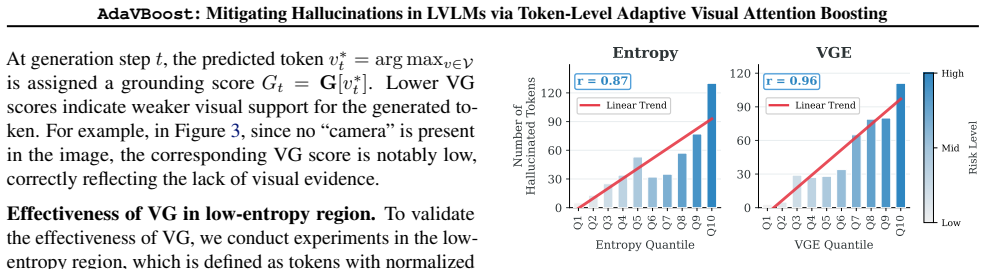
On a fresh LVLM, measure whether tokens with high VGE are actually more likely to be judged hallucinated than tokens with low VGE; if the near-monotone VGE-hallucination correlation shown in Figure 4 does not reproduce, the risk signal loses its load-bearing role. Alternatively, run the method against a fixed boost factor tuned to the best average strength on the same benchmarks; if fixed boosting matches or beats the adaptive scheme, the paper's central trade-off is not decisive.
If this is right
- Fixed-strength visual attention boosting methods have a dual failure mode, and any single scaling factor will leave some hallucinations unresolved while creating others; adaptive per-token scaling is necessary to avoid both under-boosting and over-boosting.
- Guided by VGE, adaptive scaling consistently reduces hallucination rates on CHAIR, SHR, and AMBER across three different LVLM architectures, without sacrificing F1 or discriminative accuracy on POPE and AMBER discriminative tasks.
- The grounding vector is computed once during prefill and VGE uses the model's own output logits, so the risk signal adds negligible inference-time overhead, making the method practical for deployment.
- Suppressing attention to input text tokens acts as a complementary mechanism to visual boosting, converting a substantial fraction of otherwise unfixable hallucinations into correct tokens, as shown in the paper's proof-of-concept analysis.
Where Pith is reading between the lines
- A natural next experiment is to test whether VGE can serve as a general token-level risk filter outside the attention-boosting framework, for example by gating beam search or candidate rejection; the near-monotone VGE-hallucination relationship suggests it would transfer.
- Because the grounding vector G takes a max over all visual tokens and is computed only once, high-resolution models with many visual tokens may yield optimistic grounding scores; recomputing or normalizing G could keep the risk signal calibrated as resolutions grow.
- The paper's use of an LLM judge for token-level hallucination labels highlights a methodological issue: rule-based metrics can misclassify verbs like 'building' and benign narrative elaborations, so benchmark results on open-ended descriptions may depend heavily on the choice of judge.
- A direct stress test would compare the adaptive scheme against a fixed boost factor tuned to the best average strength on the same benchmark; if adaptive still wins, the improvement comes from the modulation itself rather than from choosing a better global strength.
Editorial analysis
A structured set of objections, weighed in public.
Referee Report
Summary. The paper proposes a training-free, inference-time method (SAVAA in the abstract, AdaVBoost in the body) for mitigating hallucinations in LVLMs. It identifies a trade-off in fixed visual-attention-boosting methods: a constant boost factor is too weak for some tokens and too strong for others. The method introduces Visual Grounding Entropy (VGE), a token-level hallucination risk estimator that combines predictive entropy with a static visual grounding score computed once at prefill. VGE is used to modulate the visual attention boost strength at each generation step, with additional suppression of text-input attention. Experiments on LLaVA-NeXT-7B, Qwen3-VL-8B, and InternVL3.5-8B on CHAIR, SHR, and AMBER show consistent improvements over fixed-boosting baselines (PAI, VAF, VGA).
Significance. If the results hold, the paper makes a useful contribution to training-free hallucination mitigation by showing that the appropriate visual attention boost strength varies per token and can be estimated by a lightweight signal computed from the model's own logits. The method is simple, efficient, and code is provided. The main caveat is that the specific contribution of the visual grounding component over entropy-only risk is not rigorously established; the empirical support for VGE's advantage is mixed and partly based on an unvalidated LLM judge. Nevertheless, the adaptive boosting mechanism itself appears to deliver substantial improvements over uniform boosting, which is valuable regardless of the precise risk estimator.
major comments (3)
- [§3.1, Eq. (1)] The grounding vector G[v] is computed once at prefill as a max over all visual tokens and is never updated during generation. This makes VGE_t blind to the generated prefix and to which visual region the current query attends. For example, a color word that appears somewhere in the image receives a high grounding score even when applied to the wrong object. The motivating example in Figure 3 covers only an object entirely absent from the image, not the common case of contextually misplaced grounding. Since VGE is the core risk estimator driving the adaptive factor m_t (Eq. 5), the validity of this static score is load-bearing for the method's mechanism. Please provide evidence that G is well-calibrated (e.g., compare risk quantiles against fine-grained human/rule-based annotations) or evaluate a dynamic variant that recomputes grounding using current-step attention.
- [§4.4, Table 8; §3.1, Figure 4] The sensitivity analysis over α in Table 8 is the only evidence that the visual-grounding term contributes beyond entropy, since α=1.0 reduces VGE to normalized entropy. The differences on LLaVA-NeXT (28.80 vs 29.80 CHAIR_s) and InternVL3.5 (34.40 vs 34.20) are small and likely within sampling noise; only Qwen3-VL shows a clear gap (46.00 vs 50.20). The paper does not frame this as an ablation, report multiple seeds, or compute significance. Moreover, Figure 4's correlation comparison (r=0.96 vs 0.87) is based on GPT-5-mini judgments with no inter-annotator agreement or error bars. Thus the paper's central claim that visual grounding, rather than adaptive boosting itself, drives the improvements is not currently supported. Please add an explicit ablation: adaptive boosting with entropy-only vs. with VGE on all benchmarks, with seeds and significance tests.
- [§4.1, Appendix B.1] All main results in Tables 1–3 are single-run with sampling-based decoding (Algorithm 1, line 18: y_t ∼ p_t), and no variances or confidence intervals are reported. Since some margins are small (e.g., SHR HSR for LLaVA-NeXT: 30.7 vs. 31.1 for VGA), the consistency claim across models/benchmarks needs repeated-seed experiments. Additionally, the hyperparameters are tuned on a 500-image CHAIR subset and the main CHAIR numbers come from a different 500-image subset; while the split is disjoint, the same benchmark is used for selection and reporting. Please clarify the exact split and report variance; ideally, tune all baselines on the same validation set for a fair comparison.
minor comments (5)
- [Title/Abstract] The abstract refers to 'SAVAA' and the GitHub URL is SAVVA, while the body title and code link are 'AdaVBoost'. This inconsistency must be fixed before submission.
- [§3.2, Algorithm 1] Equation (5) defines m_t in terms of r_t, but Algorithm 1 line 9 uses r_{t-1}. The text implies the boost for step t is based on the previous token's risk; please reconcile the notation.
- [§2, References] The related work names 'Visual Amplification Fusion (VAF)' but the cited Yin et al. (2025) reference is 'Clearsight'. Please reconcile the method name and reference.
- [§4.1] Typo: 'ending layer for 16' should be 'ending layer to 16'.
- [§3.2] The pre-softmax attention scores Z^{(t)}_ℓ are not explicitly defined; please refer back to the attention equation in Section 2 or define them locally.
Circularity Check
No significant circularity: the adaptive VGE-guided boosting loop is empirically evaluated against independent benchmarks, not forced by construction.
full rationale
The paper's derivation chain is self-contained and non-circular. The risk estimator VGE (Eq. 3) combines predictive entropy with a static prefill visual-grounding vector G[v]=max_i Softmax(h_i)[v] (Eq. 1). Neither VGE nor the adaptive modulation factor m_t=1+(m_max_vis-1)r_t (Eq. 5) is defined in terms of the hallucination benchmark labels or the final CHAIR/SHR/AMBER metrics. The claim that VGE correlates with hallucinated tokens is tested empirically in Figure 4, not assumed. The boosting intervention (Eq. 6) is a concrete modification of pre-softmax attention scores, and its effect is measured against external benchmarks. Hyperparameters (alpha, gamma, m_max_vis, m_max_txt) are tuned on a separate 500-image validation subset, as explicitly stated: 'Following Zhao et al. (2025), we additionally select another 500 samples for hyperparameter tuning.' This is standard model selection, not a fitted parameter renamed as a prediction. GPT-5-mini is used as a judge for motivation and SHR, but the main CHAIR and AMBER results are rule-based and do not depend on that judge. No load-bearing self-citation appears; prior work is cited for baselines and benchmarks. The paper's central contribution is an empirical improvement, and no equation reduces to its own inputs.
Axiom & Free-Parameter Ledger
free parameters (5)
- α (balance coefficient) =
LLaVA-NeXT: 0.5; Qwen3-VL: 0.6; InternVL3.5: 0.8
- γ (risk scale) =
LLaVA-NeXT: 0.5; Qwen3-VL: 0.6; InternVL3.5: 0.7
- m_max_vis (max visual boost factor) =
LLaVA-NeXT: 1.1; Qwen3-VL: 1.3; InternVL3.5: 1.3
- m_max_txt (max text suppression factor) =
LLaVA-NeXT: 1.7; Qwen3-VL: 1.3; InternVL3.5: 1.6
- layer range [L_s, L_e) =
LLaVA-NeXT: [0,16); Qwen3-VL: [4,16); InternVL3.5: [4,16)
axioms (5)
- domain assumption Amplifying pre-softmax attention scores of visual tokens during autoregressive decoding reduces hallucinations in LVLMs.
- ad hoc to paper G[v] = max_i Softmax(h_i)[v] computed once at prefill is a valid measure of visual grounding for vocabulary token v.
- domain assumption VGE correlates monotonically with token-level hallucination risk.
- domain assumption Suppressing attention to text input tokens helps resolve hallucinations that visual boosting cannot fix.
- ad hoc to paper Hyperparameters tuned on a 500-image CHAIR validation subset generalize to other benchmarks and models without re-tuning.
invented entities (1)
-
Visual Grounding Entropy (VGE)
no independent evidence
read the original abstract
A line of recent training-free methods for mitigating hallucinations in large vision-language models (LVLMs) operates by amplifying attention to visual tokens during autoregressive generation within a single forward pass. We refer to this paradigm as visual attention amplification (VAA). In this paper, we identify a dual failure pattern in existing VAA methods caused by their use of a fixed amplification factor across generation steps: it can be too weak at some steps, leaving hallucinations unresolved, while too strong at others, introducing new hallucinations. Motivated by this finding, we propose Step-wise Adaptive Visual Attention Amplification (SAVAA), a new VAA framework that estimates hallucination risk for each generated token and uses the estimated risk to adaptively amplify visual attention at the next generation step. Specifically, we introduce Visual Grounding Entropy (VGE), a lightweight hallucination-risk estimator that augments predictive entropy with visual grounding, assigning higher risk to tokens that are uncertain, weakly grounded in the image, or both. Guided by VGE, SAVAA uses the estimated risk to calibrate the VAA factor for the next generation step, applying stronger amplification to higher-risk steps and weaker amplification to lower-risk steps. Across LLaVA-NeXT-7B, Qwen3-VL-8B, and InternVL3.5-8B, SAVAA significantly outperforms baseline methods on generative hallucination benchmarks such as CHAIR, SHR and AMBER. Code is available at: https://github.com/JiachengZ01/SAVVA.
Figures




Forward citations
Cited by 2 Pith papers
-
Attending to Multimodal Generation One Token at a Time
MLLMs attend to the relevant modality at the exact generation steps that need it; causal blocking of those peaks breaks answers while timed boosting improves multimodal performance.
-
Listening makes Vision Clear for VLMs
PV-TAM uses prompt-side semantics and a bias filter to improve attention-based and IoU localization metrics for vision-language models over answer-side baselines.
Reference graph
Works this paper leans on
-
[1]
Bai, S., Cai, Y ., Chen, R., Chen, K., Chen, X.-H., Cheng, Z., Deng, L., Ding, W., Fang, R., Gao, C., Ge, C., Ge, W., Guo, Z., Huang, Q., Huang, J., Huang, F., Hui, B., Jiang, S., Li, Z., Li, M., Li, M., Li, K., Lin, Z., Lin, J., Liu, X., Liu, J., Liu, C., Liu, Y ., Liu, D., Liu, S., Lu, D., Luo, R., Lv, C., Men, R., Meng, L. Y ., Ren, X., yi Ren, X., Son...
-
[8]
An llm-free multi-dimensional benchmark for mllms hallucination evaluation.ArXiv, abs/2311.07397,
Wang, J., Wang, Y ., Xu, G., Zhang, J., Gu, Y ., Jia, H., Xu, H., Yan, M., Zhang, J., and Sang, J. An llm-free multi-dimensional benchmark for mllms hallucination evaluation.ArXiv, abs/2311.07397,
-
[9]
Wang, W., Gao, Z., Gu, L., Pu, H., Cui, L., Wei, X., Liu, Z., Jing, L., Ye, S., Shao, J., Wang, Z., Chen, Z., Zhang, H., Yang, G., Wang, H., Wei, Q., Yin, J., Li, W., Cui, E., Chen, G., Ding, Z., Tian, C., Wu, Z., Xie, J., Li, Z., Yang, B., Duan, Y ., Wang, X., Hao, H., Li, S., Zhao, X., Duan, H., Deng, N., Fu, B., He, Y ., Wang, Y ., He, C., Shi, B., He,...
-
[10]
Zhao, H., Si, S., Chen, L., Zhang, Y ., Sun, M., Zhang, M., and Chang, B. Looking beyond text: Reducing lan- guage bias in large vision-language models via multi- modal dual-attention and soft-image guidance.ArXiv, abs/2411.14279,
-
[11]
Zhao, J., Zhang, F., Sun, X., Feng, C., and Tan, Z. Tell model where to look: Mitigating hallucinations in mllms by vision-guided attention.ArXiv, abs/2511.20032,
-
[12]
Zhao, Y ., Yan, L., Sun, W., Xing, G., Meng, C., Wang, S., Cheng, Z., Ren, Z., and Yin, D. Knowing what llms do not know: A simple yet effective self-detection method. ArXiv, abs/2310.17918, 2023a. Zhao, Z., Wang, B., Ouyang, L., wen Dong, X., Wang, J., and He, C. Beyond hallucinations: Enhancing lvlms through hallucination-aware direct preference optimiz...
-
[13]
Please describe the image in detail
and measures hallucination from two complementary perspectives: CHAIRi= |Ohall| |Oall| , and CHAIRs= |Chall| |Call| . Here, Ohall denotes the set of hallucinated object mentions that appear in the generated captions but are not present in the ground-truth annotations, and Oall denotes the set of all object mentions in the generated captions. Chall denotes...
2025
-
[14]
Is there a chair in the image?
provides a discriminative evaluation protocol for object hallucinations in multimodal large language models. Instead of relying on free-form image captions, POPE reformulates hallucination assessment as a binary visual question answering task, where models are asked to answer simple yes-or-no questions about the existence of specific objects in an image (...
2025
-
[15]
for Qwen3-VL and InternVL3.5. 15 AdaVBoost: Mitigating Hallucinations in LVLMs via Token-Level Adaptive Visual Attention Boosting C. Additional Experiments C.1. Full Experiment Results on AMBER Table 4.Results on AMBER benchmark. The AMBER metric is calculated as(1−CHAIR+F1)/2. MLLM Method CHAIR↓Cover↑Hal↓Cog↓ Acc.↑Prec.↑Rec.↑F1↑AMBER↑ LLaV A-NeXT Vanilla...
arXiv 1975
-
[2014]
Liu, C., Xu, Z., Wei, Q., Wu, J., Zou, J. Y ., Wang, X. E., Zhou, Y ., and Liu, S. More thinking, less seeing? as- sessing amplified hallucination in multimodal reasoning models.ArXiv, abs/2505.21523,
-
[2019]
Huo, F., Xu, W., Zhang, Z., Wang, H., Chen, Z., and Zhao, P. Self-introspective decoding: Alleviating hallucinations for large vision-language models.ArXiv, abs/2408.02032,
-
[2021]
Nikitin, A., Kossen, J., Gal, Y ., and Marttinen, P. Ker- nel language entropy: Fine-grained uncertainty quan- tification for llms from semantic similarities.ArXiv, abs/2405.20003,
-
[2023]
Liu, H., Li, C., Li, Y ., Li, B., Zhang, Y ., Shen, S., and Lee, Y . J. Llava-next: Improved reason- ing, ocr, and world knowledge, 2024a. URL https://llava-vl.github.io/blog/ 2024-01-30-llava-next/. 9 AdaVBoost: Mitigating Hallucinations in LVLMs via Token-Level Adaptive Visual Attention Boosting Liu, S., Zheng, K., and Chen, W. Paying more attention to ...
2024
-
[2024]
Kang, S., Bakman, Y . F., Yaldiz, D. N., Buyukates, B., and Avestimehr, A. S. Uncertainty quantification for hallucination detection in large language models: Foun- dations, methodology, and future directions.ArXiv, abs/2510.12040,
-
[2025]
Bai, Z., Wang, P., Xiao, T., He, T., Han, Z., Zhang, Z., and Shou, M. Z. Hallucination of multimodal large language models: A survey.ArXiv, abs/2404.18930,
discussion (0)
Sign in with ORCID, Apple, or X to comment. Anyone can read and Pith papers without signing in.