Recognition: 2 theorem links
· Lean TheoremEvolving Multi-Channel Confidence-Aware Activation Functions for Missing Data with Channel Propagation
Pith reviewed 2026-05-15 22:06 UTC · model grok-4.3
The pith
Evolved activation functions that take feature values, missingness indicators and confidence scores improve neural network classification on incomplete data.
A machine-rendered reading of the paper's core claim, the machinery that carries it, and where it could break.
Core claim
Three-Channel Evolved Activations (3C-EA) are multivariate functions f(x, m, c) produced by genetic programming that act on the triple of feature value x, missingness indicator m and confidence score c; when these functions are used together with ChannelProp, which deterministically propagates m and c through linear layers according to weight magnitudes, the resulting networks achieve better classification performance under missing data than networks that rely on conventional activations.
What carries the argument
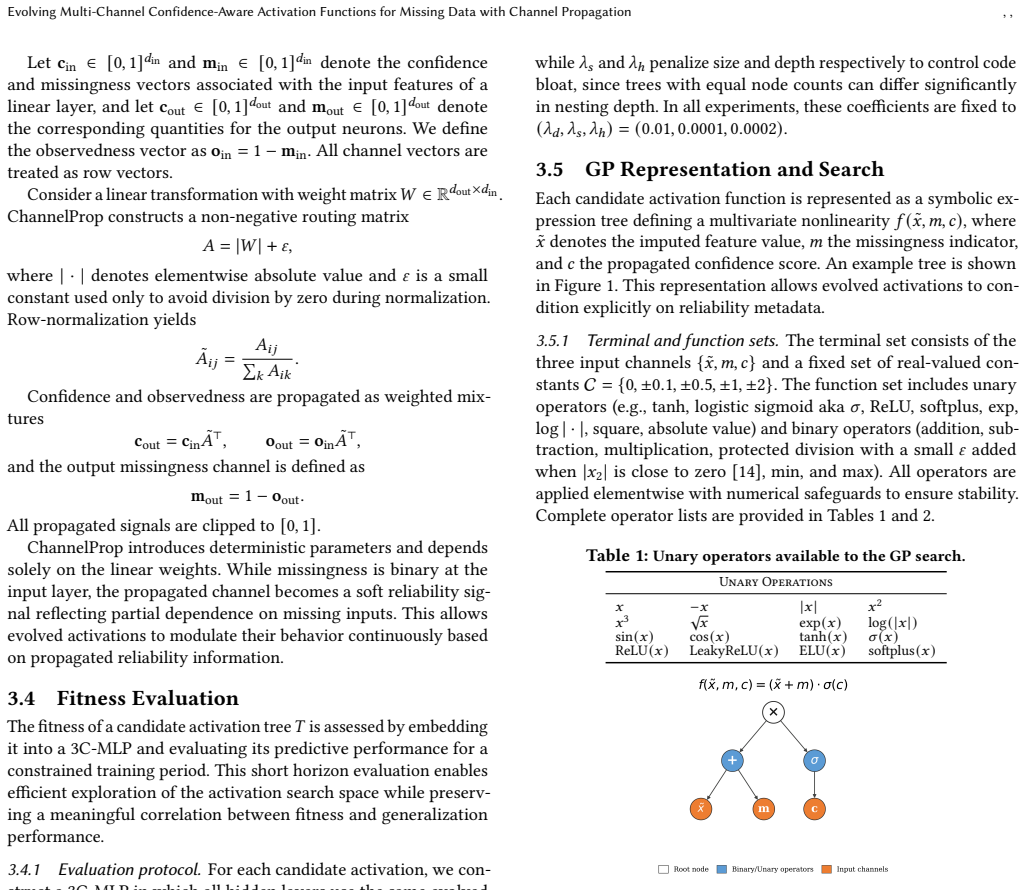
3C-EA are tree-structured functions evolved by genetic programming on the input triple (feature value, missingness indicator, confidence score), with ChannelProp providing deterministic forward propagation of the missingness and confidence channels through subsequent layers.
If this is right
- Activation functions can be made to respond explicitly to data reliability signals rather than treating every input as equally trustworthy.
- Missingness information can be retained and used in hidden layers instead of being discarded after the first layer.
- The same evolutionary search works across MCAR, MAR and MNAR mechanisms at multiple missing rates.
- Genetic programming can discover useful multivariate nonlinearities that standard hand-designed activations do not provide.
Where Pith is reading between the lines
- The same multi-input activation idea could be extended to other data-quality signals such as noise variance or outlier flags.
- If the evolved functions prove robust, they might reduce reliance on separate, computationally heavy imputation stages.
- Transfer tests to regression or sequence modeling tasks would clarify whether the benefit is limited to classification.
Load-bearing premise
The activation functions evolved on the particular training datasets and missingness patterns will transfer to new data without requiring re-evolution or retraining.
What would settle it
A controlled experiment in which standard activations such as ReLU combined with advanced imputation achieve equal or higher test accuracy than 3C-EA on the same held-out datasets and missingness rates would falsify the claimed performance gain.
Figures


read the original abstract
Learning in the presence of missing data can result in biased predictions and poor generalizability, among other difficulties, which data imputation methods only partially address. In neural networks, activation functions significantly affect performance yet typical options (e.g., ReLU, Swish) operate only on feature values and do not account for missingness indicators or confidence scores. We propose Three-Channel Evolved Activations (3C-EA), which we evolve using Genetic Programming to produce multivariate activation functions f(x, m, c) in the form of trees that take (i) the feature value x, (ii) a missingness indicator m, and (iii) an imputation confidence score c. To make these activations useful beyond the input layer, we introduce ChannelProp, an algorithm that deterministically propagates missingness and confidence values via linear layers based on weight magnitudes, retaining reliability signals throughout the network. We evaluate 3C-EA and ChannelProp on datasets with natural and injected (MCAR/MAR/MNAR) missingness at multiple rates under identical preprocessing and splits. Results indicate that integrating missingness and confidence inputs into the activation search improves classification performance under missingness.
Editorial analysis
A structured set of objections, weighed in public.
Referee Report
Summary. The paper proposes Three-Channel Evolved Activations (3C-EA) evolved via Genetic Programming to produce multivariate activation functions f(x, m, c) that incorporate feature values, missingness indicators, and imputation confidence scores. It introduces ChannelProp to deterministically propagate missingness and confidence signals through linear layers based on weight magnitudes. The approach is evaluated on classification datasets with natural and injected (MCAR/MAR/MNAR) missingness at multiple rates under identical preprocessing and splits, with the claim that integrating missingness and confidence into the activation search improves performance under missingness.
Significance. If the empirical gains hold under proper controls, this offers a data-driven method for embedding missing-data awareness directly into network activations rather than relying solely on imputation, which could improve robustness in domains with incomplete observations.
major comments (2)
- [Abstract] Abstract: the claim of improved classification performance is stated without any quantitative results, baseline comparisons, statistical tests, or details on how missingness was handled during training, so the central claim cannot be verified from the provided text.
- [Evaluation] Evaluation section: no cross-dataset or cross-missingness-mechanism transfer experiments are reported. Because the GP search directly optimizes classification loss on the specific missingness realizations present in the training split, the evolved trees may embed dataset-specific correlations between x, m, and c rather than a general mechanism; without such tests the applicability beyond the evaluated cases remains unestablished.
minor comments (1)
- [Abstract] Ensure all acronyms (3C-EA, ChannelProp) are defined at first use.
Simulated Author's Rebuttal
We thank the referee for their constructive feedback on our manuscript. We address each major comment point by point below, indicating the revisions we will incorporate in the next version.
read point-by-point responses
-
Referee: [Abstract] Abstract: the claim of improved classification performance is stated without any quantitative results, baseline comparisons, statistical tests, or details on how missingness was handled during training, so the central claim cannot be verified from the provided text.
Authors: We agree that the abstract would benefit from more concrete details to make the central claim verifiable. In the revised version, we will expand the abstract to include key quantitative highlights (e.g., average accuracy gains over baselines across datasets and missingness rates), a brief reference to the evaluation protocol (identical preprocessing and splits), and mention of the handling of missingness via imputation with confidence scores. This will strengthen the summary without exceeding typical abstract length constraints. revision: yes
-
Referee: [Evaluation] Evaluation section: no cross-dataset or cross-missingness-mechanism transfer experiments are reported. Because the GP search directly optimizes classification loss on the specific missingness realizations present in the training split, the evolved trees may embed dataset-specific correlations between x, m, and c rather than a general mechanism; without such tests the applicability beyond the evaluated cases remains unestablished.
Authors: We acknowledge the concern that per-dataset GP optimization could lead to functions capturing split-specific patterns rather than broadly applicable mechanisms. Our evaluation already spans multiple datasets with both natural missingness and injected MCAR/MAR/MNAR mechanisms at several rates, using fixed splits and preprocessing to ensure fair comparisons. The evolved activations are symbolic expressions operating on general (x, m, c) inputs, and ChannelProp uses a deterministic, weight-based propagation rule that does not depend on particular data realizations. In the revision, we will add a dedicated discussion subsection analyzing the evolved function structures for signs of generality and include a limited cross-dataset transfer experiment (applying activations evolved on one dataset to others) where space permits, to better establish broader applicability. revision: partial
Circularity Check
No circularity: empirical GP search with held-out evaluation
full rationale
The paper describes an empirical method: genetic programming evolves tree-based activation functions f(x, m, c) on training data with specific missingness patterns, followed by ChannelProp propagation and evaluation on held-out splits. No equations, derivations, or first-principles claims are presented that reduce the reported performance gains to a fitted parameter or self-defined quantity by construction. The central result is an experimental outcome on fixed datasets and splits, not an analytical prediction forced by the method's inputs. Self-citations, if present, are not load-bearing for any uniqueness theorem or ansatz that would create circularity. This is a standard non-circular empirical search result.
Axiom & Free-Parameter Ledger
axioms (1)
- domain assumption Genetic programming search can produce activation functions that outperform standard ones when given missingness and confidence channels
invented entities (2)
-
3C-EA
no independent evidence
-
ChannelProp
no independent evidence
Lean theorems connected to this paper
-
IndisputableMonolith/Cost/FunctionalEquation.leanwashburn_uniqueness_aczel unclear?
unclearRelation between the paper passage and the cited Recognition theorem.
We propose Three-Channel Evolved Activations (3C-EA), which we evolve using Genetic Programming to produce multivariate activation functions f(x, m, c) in the form of trees
-
IndisputableMonolith/Foundation/RealityFromDistinction.leanreality_from_one_distinction unclear?
unclearRelation between the paper passage and the cited Recognition theorem.
ChannelProp, an algorithm that deterministically propagates missingness and confidence values via linear layers based on weight magnitudes
What do these tags mean?
- matches
- The paper's claim is directly supported by a theorem in the formal canon.
- supports
- The theorem supports part of the paper's argument, but the paper may add assumptions or extra steps.
- extends
- The paper goes beyond the formal theorem; the theorem is a base layer rather than the whole result.
- uses
- The paper appears to rely on the theorem as machinery.
- contradicts
- The paper's claim conflicts with a theorem or certificate in the canon.
- unclear
- Pith found a possible connection, but the passage is too broad, indirect, or ambiguous to say the theorem truly supports the claim.
Reference graph
Works this paper leans on
-
[1]
Andrea Apicella, Francesco Donnarumma, Francesco Isgrò, and Roberto Prevete
-
[2]
A Survey on Modern Trainable Activation Functions.Neural Networks138 (2021), 14–32
work page 2021
-
[3]
Arthur Asuncion and David Newman. 2007. UCI machine learning repository
work page 2007
-
[4]
Ibrahim Berkan Aydilek and Ahmet Arslan. 2013. A Hybrid Method for Impu- tation of Missing Values using Optimized Fuzzy C-Means with Support Vector Regression and a Genetic Algorithm.Information Sciences233 (2013), 25–35
work page 2013
-
[5]
Gustavo EAPA Batista and Maria Carolina Monard. 2003. An Analysis of Four Missing Data Treatment Methods for Supervised Learning.Applied Artificial Intelligence17, 5-6 (2003), 519–533
work page 2003
-
[6]
Garrett Bingham, William Macke, and Risto Miikkulainen. 2020. Evolutionary Optimization of Deep Learning Activation Functions. InProceedings of the 2020 Genetic and Evolutionary Computation Conference(Cancún, Mexico)(GECCO ’20). Association for Computing Machinery, New York, NY, USA, 289–296. doi:10. 1145/3377930.3389841
-
[7]
Zhengping Che, Sanjay Purushotham, Kyunghyun Cho, David Sontag, and Yan Liu. 2018. Recurrent Neural Networks for Multivariate Time Series with Missing Values.Scientific Reports8, 1 (2018), 6085
work page 2018
-
[8]
Joaquín Derrac, Salvador García, Daniel Molina, and Francisco Herrera. 2011. A practical tutorial on the use of nonparametric statistical tests as a methodology for comparing evolutionary and swarm intelligence algorithms.Swarm and Evolutionary Computation1, 1 (2011), 3–18
work page 2011
-
[9]
Shiv Ram Dubey, Satish Kumar Singh, and Bidyut Baran Chaudhuri. 2022. Acti- vation Functions in Deep Learning: A Comprehensive Survey and Benchmark. Evolving Multi-Channel Confidence-Aware Activation Functions for Missing Data with Channel Propagation , , Neurocomputing503 (2022), 92–108
work page 2022
-
[10]
Tlamelo Emmanuel, Thabiso Maupong, Dimane Mpoeleng, Thabo Semong, Bany- atsang Mphago, and Oteng Tabona. 2021. A Survey on Missing Data in Machine Learning.Journal of Big data8, 1 (2021), 140
work page 2021
-
[11]
Xavier Glorot and Yoshua Bengio. 2010. Understanding the Difficulty of Training Deep Feedforward Neural Networks. InProceedings of the Thirteenth International Conference on Artificial Intelligence and Statistics (Proceedings of Machine Learning Research, Vol. 9). JMLR Workshop and Conference Proceedings, PMLR, Chia Laguna Resort, Sardinia, Italy, 249–256
work page 2010
-
[12]
David J. Hand and Robert J. Till. 2001. A Simple Generalisation of the Area Under the ROC Curve for Multiple Class Classification Problems.Machine Learning45, 2 (2001), 171–186
work page 2001
-
[13]
José M Jerez, Ignacio Molina, Pedro J García-Laencina, Emilio Alba, Nuria Ribelles, Miguel Martín, and Leonardo Franco. 2010. Missing Data Imputation using Statistical and Machine Learning Methods in a Real Breast Cancer Problem. Artificial Intelligence in Medicine50, 2 (2010), 105–115
work page 2010
-
[14]
Adam: A Method for Stochastic Optimization
Diederik P. Kingma and Jimmy Ba. 2015. Adam: A Method for Stochastic Opti- mization. In3rd International Conference on Learning Representations, ICLR 2015, San Diego, CA, USA, May 7-9, 2015, Conference Track Proceedings, Yoshua Bengio and Yann LeCun (Eds.). http://arxiv.org/abs/1412.6980
work page internal anchor Pith review Pith/arXiv arXiv 2015
-
[15]
John R Koza. 1994. Genetic Programming as a Means for Programming Computers by Natural Selection.Statistics and Computing4, 2 (1994), 87–112
work page 1994
- [16]
-
[17]
Zachary C Lipton, David Kale, and Randall Wetzel. 2016. Directly Modeling Missing Data in Sequences with RNNs: Improved Classification of Clinical Time Series. InMachine Learning for Healthcare Conference. PMLR, JMLR.org, Los Angeles, California, USA, 253–270
work page 2016
-
[18]
Roderick J. A. Little and Donald B. Rubin. 2019.Statistical Analysis with Missing Data(2 ed.). John Wiley & Sons, Hoboken, NJ, USA
work page 2019
-
[19]
Fábio MF Lobato, Vincent W Tadaiesky, Igor M Araújo, and Ádamo L de Santana
-
[20]
An Evolutionary Missing Data Imputation Method for Pattern Classification. InProceedings of the Companion Publication of the 2015 Annual Conference on Genetic and Evolutionary Computation. Association for Computing Machinery, New York, NY, USA, 1013–1019
work page 2015
-
[21]
Alfredo Nazabal, Pablo M Olmos, Zoubin Ghahramani, and Isabel Valera. 2020. Handling Incomplete Heterogeneous Data Using VAEs.Pattern Recognition107 (2020), 107501
work page 2020
-
[22]
Luca Parisi, Ciprian Daniel Neagu, Narrendar RaviChandran, Renfei Ma, and Felician Campean. 2024. Optimal Evolutionary Framework-Based Activation Function for Image Classification.Knowledge-Based Systems299 (2024), 112025
work page 2024
-
[23]
David M. W. Powers. 2011. Evaluation: From Precision, Recall and F-Measure to ROC, Informedness, Markedness and Correlation.Journal of Machine Learning Technologies2, 1 (2011), 37–63
work page 2011
-
[24]
Prajit Ramachandran, Barret Zoph, and Quoc V Le. 2017. Searching for Activation Functions.arXiv preprint arXiv:1710.05941(2017), 1–13
work page internal anchor Pith review Pith/arXiv arXiv 2017
-
[25]
2025.Neuroevo- lution: Harnessing Creativity in AI Agent Design
Sebastian Risi, Yujin Tang, David Ha, and Risto Miikkulainen. 2025.Neuroevo- lution: Harnessing Creativity in AI Agent Design. MIT Press, Cambridge, MA. https://neuroevolutionbook.com
work page 2025
-
[26]
Donald B Rubin. 1976. Inference and Missing Data.Biometrika63, 3 (1976), 581–592
work page 1976
-
[27]
Joseph L Schafer and John W Graham. 2002. Missing Data: Our View of the State of the Art.Psychological Methods7, 2 (2002), 147
work page 2002
-
[28]
Yige Sun, Jing Li, Yifan Xu, Tingting Zhang, and Xiaofeng Wang. 2023. Deep Learning Versus Conventional Methods for Missing Data Imputation: A Review and Comparative Study.Expert Systems with Applications227 (2023), 120201
work page 2023
-
[29]
2012.Flexible Imputation of Missing Data
Stef Van Buuren. 2012.Flexible Imputation of Missing Data. CRC Press, Boca Raton, FL
work page 2012
-
[30]
Stef Van Buuren and Karin Groothuis-Oudshoorn. 2011. MICE: Multivariate Imputation by Chained Equations in R.Journal of Statistical Software45 (2011), 1–67
work page 2011
-
[31]
Jinsung Yoon, James Jordon, and Mihaela Schaar. 2018. Gain: Missing Data Imputation using Generative Adversarial Nets. InInternational Conference on Machine Learning. PMLR, PMLR, Stockholm, Sweden, 5689–5698
work page 2018
discussion (0)
Sign in with ORCID, Apple, or X to comment. Anyone can read and Pith papers without signing in.