Recognition: 1 theorem link
· Lean TheoremEstimation of neutron star mass and radius of FRB 20240114A by identification of crustal oscillations
Pith reviewed 2026-05-15 22:21 UTC · model grok-4.3
The pith
QPOs observed in FRB 20240114A match crustal torsional oscillations, constraining the neutron star mass to 1.00-1.76 solar masses and radius to roughly 13 km.
A machine-rendered reading of the paper's core claim, the machinery that carries it, and where it could break.
Core claim
Identifying the reported low-order QPO frequencies in FRB 20240114A as fundamental crustal torsional oscillations and the 567.7 Hz or 655.5 Hz frequencies as first-overtone candidates, together with experimental constraints on K0, yields neutron-star masses of 1.00-1.55 solar masses or 1.17-1.76 solar masses, respectively, with a self-consistent radius near 13 km and symmetry-energy slope L between 59.5 and 96.8 MeV.
What carries the argument
Mapping of observed QPO frequencies to specific crustal torsional oscillation modes (fundamental and first overtone) combined with nuclear saturation parameters K0 and L to obtain mass-radius relations.
Load-bearing premise
The observed quasi-periodic oscillations arise from crustal torsional oscillations in the neutron star.
What would settle it
Detection of additional QPO frequencies in the same source whose ratios do not match the predicted torsional-mode spacing at any mass and radius allowed by the current K0 constraints.
Figures


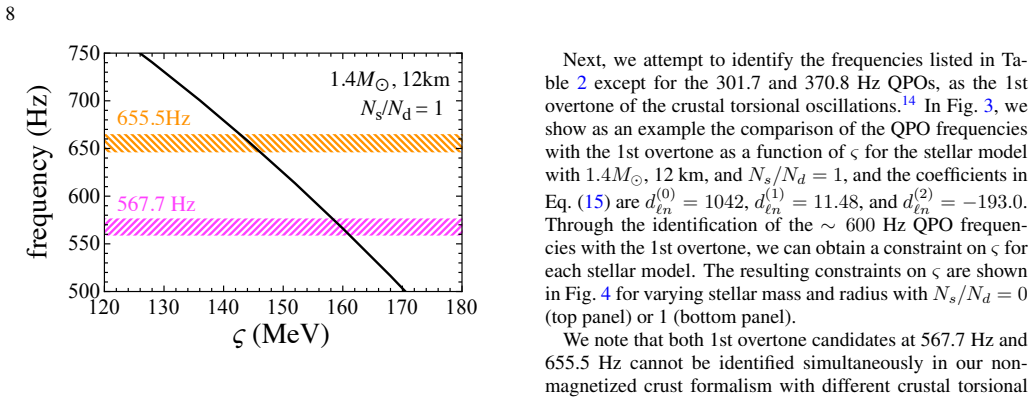


read the original abstract
By identifying quasi-periodic oscillations (QPOs) reported in FRB 20240114A (from the Five-hundred-meter Aperture Spherical Telescope) with neutron star crustal torsional oscillations, together with experimental constraints on the incompressibility $K_0$ of symmetric nuclear matter at saturation density, we constrain the mass and radius of an extragalactic neutron star at redshift $z\approx0.13$. Identifying the low-order QPO frequencies as fundamental oscillations, and frequencies of $567.7\,\mathrm{Hz}$ or $655.5\,\mathrm{Hz}$ (rest frame) as first overtone candidates, implies neutron star mass ranges of $1.00$--$1.55\,M_\odot$ or $1.17$--$1.76\,M_\odot$, respectively. The radius is also constrained, with a self-consistent value around $13$~km, consistent with the calculation of the NS structure within the low-mass/low-central density regime. Simultaneously, we also constrain another nuclear saturation parameter, namely the density dependence of the nuclear symmetry energy at saturation density (i.e., the slope parameter), $L$, and determine it to be $L=59.5-96.8$ MeV with $\sim 10\%$ systematic uncertainty, which is broadly consistent with previous constraints on $L$ obtained from experiments and astronomical observations. Thus, a mapping of FRB QPOs to crustal torsional modes seems reasonable. This interpretation will be tested with the discovery of additional QPOs in upcoming FRB surveys.
Editorial analysis
A structured set of objections, weighed in public.
Referee Report
Summary. The manuscript claims that QPOs reported in FRB 20240114A can be identified with fundamental and first-overtone crustal torsional oscillations of a neutron star. Using experimental constraints on the nuclear incompressibility K0, this identification yields neutron-star mass ranges of 1.00–1.55 M⊙ or 1.17–1.76 M⊙, a radius of ~13 km, and a constraint on the symmetry-energy slope L = 59.5–96.8 MeV (with ~10% systematic uncertainty). The result is presented as consistent with prior nuclear and astrophysical bounds on L and is offered as a testable interpretation for future FRB surveys.
Significance. If the mode identification holds, the work provides a novel route to extragalactic neutron-star mass-radius constraints from FRB data and produces an L range that overlaps existing experimental and observational limits. The approach is parameter-light once the mode assignment is fixed and demonstrates how FRB QPOs could serve as interior probes, but the significance is conditional on the central assumption that the observed frequencies are crustal torsional modes rather than magnetospheric or Alfvénic.
major comments (2)
- [Abstract] Abstract: The mass (1.00–1.55 M⊙ or 1.17–1.76 M⊙) and radius (~13 km) ranges are obtained only after assigning the reported QPO frequencies to specific fundamental and first-overtone crustal torsional modes; no independent observable (spin frequency, glitch recovery, or multi-messenger signature) is used to confirm this assignment, so the derived M–R–L constraints are conditional on an unverified identification.
- [Abstract] Abstract and nuclear-parameter section: The value of L = 59.5–96.8 MeV is extracted by fitting the same observed frequencies to the torsional-mode formulas under the assumed K0 range; this procedure is circular because the nuclear inputs and mode labels are chosen to reproduce the data, leaving no external test of whether the frequencies must be crustal torsional oscillations.
minor comments (2)
- [Abstract] The redshift z ≈ 0.13 is stated without an explicit reference or error bar; adding the source of this value would improve traceability.
- [Abstract] The ~10% systematic uncertainty on L is quoted but not derived in detail; a short paragraph showing how this figure is obtained from the frequency-to-mode mapping would clarify the error budget.
Simulated Author's Rebuttal
We thank the referee for the careful review and constructive feedback. We agree that the mode identification is an assumption without independent confirmation from other observables, and we will revise the manuscript to make this conditional nature more explicit in the abstract and discussion. We address each major comment below.
read point-by-point responses
-
Referee: [Abstract] Abstract: The mass (1.00–1.55 M⊙ or 1.17–1.76 M⊙) and radius (~13 km) ranges are obtained only after assigning the reported QPO frequencies to specific fundamental and first-overtone crustal torsional modes; no independent observable (spin frequency, glitch recovery, or multi-messenger signature) is used to confirm this assignment, so the derived M–R–L constraints are conditional on an unverified identification.
Authors: We agree that the derived mass, radius, and L ranges are conditional on the assumed identification of the observed QPOs with the fundamental and first-overtone crustal torsional modes. No independent observables are currently available to confirm this assignment. The manuscript already states that the interpretation will be tested with future FRB surveys. We will revise the abstract to explicitly note that the quoted M–R ranges follow from this specific mode assignment and add a sentence in the discussion emphasizing the lack of independent verification at present. This revision clarifies the conditional nature without changing the scientific results. revision: partial
-
Referee: [Abstract] Abstract and nuclear-parameter section: The value of L = 59.5–96.8 MeV is extracted by fitting the same observed frequencies to the torsional-mode formulas under the assumed K0 range; this procedure is circular because the nuclear inputs and mode labels are chosen to reproduce the data, leaving no external test of whether the frequencies must be crustal torsional oscillations.
Authors: We disagree that the procedure is circular. K0 is taken as an independent experimental input from nuclear physics (not adjusted to fit the FRB data), while the observed frequencies are used to solve for M, R, and L within the standard torsional-oscillation model. The mode labels are chosen to provide a match, which is standard practice when testing possible identifications in asteroseismology. The resulting L range is then compared for consistency against independent experimental and observational bounds on L, providing an external check. We will revise the abstract and nuclear-parameter section to state explicitly that K0 is an independent constraint and that the derived L is an output of the fit, while retaining the consistency statement as supporting evidence. revision: partial
Circularity Check
No significant circularity; standard model-based inference from assumed mode identification
full rationale
The derivation begins with an explicit assumption that observed QPO frequencies in FRB 20240114A correspond to low-order crustal torsional modes (fundamental and first overtone candidates at 567.7 Hz or 655.5 Hz). Frequency expressions depending on neutron star structure (M, R) and nuclear parameters are then evaluated with experimental K0 constraints to obtain output ranges for M (1.00-1.55 or 1.17-1.76 M⊙), R (~13 km), and L (59.5-96.8 MeV). This is parameter estimation under stated assumptions, not a reduction of outputs to inputs by construction. No self-citations, fitted inputs renamed as predictions, or ansatzes smuggled via prior work are present in the abstract or described chain. The result is falsifiable via future QPO detections and remains independent of the target values.
Axiom & Free-Parameter Ledger
axioms (2)
- ad hoc to paper QPOs in FRB 20240114A correspond to fundamental and first-overtone crustal torsional oscillations
- domain assumption Experimental K0 of symmetric nuclear matter applies directly to the NS crust equation of state
Lean theorems connected to this paper
-
IndisputableMonolith/Cost/FunctionalEquation.leanwashburn_uniqueness_aczel unclear?
unclearRelation between the paper passage and the cited Recognition theorem.
Identifying the low-order QPO frequencies as fundamental oscillations... implies neutron star mass ranges of 1.00-1.55 M⊙... L=59.5-96.8 MeV
What do these tags mean?
- matches
- The paper's claim is directly supported by a theorem in the formal canon.
- supports
- The theorem supports part of the paper's argument, but the paper may add assumptions or extra steps.
- extends
- The paper goes beyond the formal theorem; the theorem is a base layer rather than the whole result.
- uses
- The paper appears to rely on the theorem as machinery.
- contradicts
- The paper's claim conflicts with a theorem or certificate in the canon.
- unclear
- Pith found a possible connection, but the passage is too broad, indirect, or ambiguous to say the theorem truly supports the claim.
Reference graph
Works this paper leans on
-
[1]
Abbott, B. P., Abbott, R., Abbott, T. D., et al. 2017, Phys. Rev. Lett., 119, 161101, doi: 10.1103/PhysRevLett.119.161101 5.3
-
[2]
Adhikari, D., Albataineh, H., Androic, D., et al. 2021, Phys. Rev. Lett., 126, 172502, doi: 10.1103/PhysRevLett.126.172502 11
-
[3]
Andersson, N., & Kokkotas, K. D. 1996, Phys. Rev. Lett., 77, 4134, doi: 10.1103/PhysRevLett.77.4134 2 14 Table 6.Same as Table 4, but withτ= 6.0ms. The values in the bracket next to each entry indicate the relative deviation from the value when τ= 3.0ms (c.f. Table 4). QPO (Hz)N s/Nd R(km)M max/M⊙ Mmin/M⊙ Lmax (MeV)L min (MeV) 567.7 0 14 1.66 (7.13%) 1.25...
-
[4]
Andersson, N., & Kokkotas, K. D. 1998, Monthly Notices of the Royal Astronomical Society, 299, 1059, doi: 10.1046/j.1365-8711.1998.01840.x 2
-
[5]
Annala, E., Gorda, T., Kurkela, A., & Vuorinen, A. 2018, Phys. Rev. Lett., 120, 172703, doi: 10.1103/PhysRevLett.120.172703 5.3
-
[6]
Beloborodov, A. M. 2017, ApJL, 843, L26, doi: 10.3847/2041-8213/aa78f3 1
-
[7]
Beloborodov, A. M. 2020, ApJ, 896, 142, doi: 10.3847/1538-4357/ab83eb 1
-
[8]
2020, MNRAS, 498, 651, doi: 10.1093/mnras/staa2489 1
Beniamini, P., & Kumar, P. 2020, MNRAS, 498, 651, doi: 10.1093/mnras/staa2489 1
-
[9]
2025, ApJ, 982, 45, doi: 10.3847/1538-4357/adb8e6 1
Beniamini, P., & Kumar, P. 2025, ApJ, 982, 45, doi: 10.3847/1538-4357/adb8e6 1
-
[10]
2023, MNRAS, 520, 1872, doi: 10.1093/mnras/stad208 1
Beniamini, P., Wadiasingh, Z., Hare, J., et al. 2023, MNRAS, 520, 1872, doi: 10.1093/mnras/stad208 1
-
[11]
Beniamini, P., Wadiasingh, Z., & Metzger, B. D. 2020, MNRAS, 496, 3390, doi: 10.1093/mnras/staa1783 1
-
[12]
2025, ApJ, 980, 211, doi: 10.3847/1538-4357/ada947 1, 6
Beniamini, P., Wadiasingh, Z., Trigg, A., et al. 2025, ApJ, 980, 211, doi: 10.3847/1538-4357/ada947 1, 6
-
[13]
Bethapudi, S., Li, D. Z., Spitler, L. G., et al. 2025, A&A, 702, A248, doi: 10.1051/0004-6361/202556347 1
-
[14]
2024, The Astronomer’s Telegram, 16613, 1 3
Bhardwaj, M., Kirichenko, A., & Gil de Paz, A. 2024, The Astronomer’s Telegram, 16613, 1 3
work page 2024
-
[15]
Bhardwaj, M., Snelders, M. P., Hessels, J. W. T., et al. 2025, ApJL, 992, L35, doi: 10.3847/2041-8213/ae0b68 3
-
[16]
V ., van Leeuwen, J., Maan, Y ., et al
Bilous, A. V ., van Leeuwen, J., Maan, Y ., et al. 2025, A&A, 696, A194, doi: 10.1051/0004-6361/202451413 1
-
[17]
Bochenek, C. D., Ravi, V ., Belov, K. V ., et al. 2020, Nature, 587, 59, doi: 10.1038/s41586-020-2872-x 1
- [18]
-
[19]
2017, APS April Meeting Abstracts, Y4.007 2
Abstracts, V ol. 2017, APS April Meeting Abstracts, Y4.007 2
work page 2017
-
[20]
Bretz, J., van Eysden, C. A., & Link, B. 2021, MNRAS, 504, 5880, doi: 10.1093/mnras/stab1220 2
-
[21]
2025, A&A, 695, L12, doi: 10.1051/0004-6361/202453233 3
Bruni, G., Piro, L., Yang, Y .-P., et al. 2025, A&A, 695, L12, doi: 10.1051/0004-6361/202453233 3
-
[22]
Burnaz, L., Most, E. R., & Bransgrove, A. 2025, ApJL, 995, L57, doi: 10.3847/2041-8213/ae2466 7, 9, 6
-
[23]
2021, Universe, 7, 453, doi: 10.3390/universe7110453 1
Caleb, M., & Keane, E. 2021, Universe, 7, 453, doi: 10.3390/universe7110453 1
-
[24]
Chamel, N. 2012, Phys. Rev. C, 85, 035801, doi: 10.1103/PhysRevC.85.035801 4
-
[25]
Chen, X.-L., Tsai, C.-W., Li, D., et al. 2025, The Host Galaxy of the Hyperactive Repeating FRB 20240114A: Behind a Galaxy Cluster, https://arxiv.org/abs/2502.05587 3 CHIME/FRB Collaboration, Andersen, B. C., Bandura, K. M., et al. 2020, Nature, 587, 54, doi: 10.1038/s41586-020-2863-y 1 CHIME/FRB Collaboration, Andersen, B. C., Bandura, K., et al. 2022, N...
-
[26]
Chirenti, C., Dichiara, S., Lien, A., Miller, M. C., & Preece, R. 2023, Nature, 613, 253, doi: 10.1038/s41586-022-05497-0 5.3
-
[27]
Cooper, A. J., & Wadiasingh, Z. 2024, MNRAS, 533, 2133, doi: 10.1093/mnras/stae1813 1
-
[28]
2022, MNRAS, 515, 3698, doi: 10.1093/mnras/stac2101 1 de Souza, G
Crawford, F., Hisano, S., Golden, M., et al. 2022, MNRAS, 515, 3698, doi: 10.1093/mnras/stac2101 1 de Souza, G. H., & Chirenti, C. 2019, PhRvD, 100, 043017, doi: 10.1103/PhysRevD.100.043017 2
-
[29]
Hessels, J. W. T. 2010, Nature, 467, 1081, doi: 10.1038/nature09466 2
-
[30]
Dial, T., Deller, A. T., Uttarkar, P. A., et al. 2025, MNRAS, 536, 3220, doi: 10.1093/mnras/stae2756 1
-
[31]
Dittmann, A. J., Miller, M. C., Lamb, F. K., et al. 2024, ApJ, 974, 295, doi: 10.3847/1538-4357/ad5f1e 5.3
-
[32]
Doneva, D. D., Gaertig, E., Kokkotas, K. D., & Kr¨uger, C. 2013, Phys. Rev. D, 88, 044052, doi: 10.1103/PhysRevD.88.044052 2
-
[33]
Estee, J., Lynch, W. G., Tsang, C. Y ., et al. 2021, Phys. Rev. Lett., 126, 162701, doi: 10.1103/PhysRevLett.126.162701 11
-
[34]
Fonseca, E., Cromartie, H. T., Pennucci, T. T., et al. 2021, ApJL, 915, L12, doi: 10.3847/2041-8213/ac03b8 2 15
-
[35]
A., M¨uller, E., & Stergioulas, N
Gabler, M., Cerd´a-Dur´an, P., Font, J. A., M¨uller, E., & Stergioulas, N. 2013, Monthly Notices of the Royal Astronomical Society, 430, 1811, doi: 10.1093/mnras/sts721 2
-
[36]
Gabler, M., Cerd´a-Dur´an, P., Stergioulas, N., Font, J. A., & M¨uller, E. 2018, Monthly Notices of the Royal Astronomical Society, 476, 4199, doi: 10.1093/mnras/sty445 2
-
[37]
Ge, M. Y ., Liu, C. Z., Zhang, S. N., et al. 2023, ApJ, 953, 67, doi: 10.3847/1538-4357/acda1d 1
-
[38]
Gearheart, M., Newton, W. G., Hooker, J., & Li, B.-A. 2011, Monthly Notices of the Royal Astronomical Society, 418, 2343, doi: 10.1111/j.1365-2966.2011.19628.x 2
-
[39]
Giri, U., Andersen, B. C., Chawla, P., et al. 2023, arXiv e-prints, arXiv:2310.16932, doi: 10.48550/arXiv.2310.16932 1
-
[40]
2025, The Astrophysical Journal, 983, 88, doi: 10.3847/1538-4357/adc101 5.3
Guedes, V ., Radice, D., Chirenti, C., & Yagi, K. 2025, The Astrophysical Journal, 983, 88, doi: 10.3847/1538-4357/adc101 5.3
-
[41]
The DSA-2000 -- A Radio Survey Camera
Hallinan, G., Ravi, V ., Weinreb, S., et al. 2019, in Bulletin of the American Astronomical Society, V ol. 51, 255, doi: 10.48550/arXiv.1907.07648 1, 6
work page internal anchor Pith review Pith/arXiv arXiv doi:10.48550/arxiv.1907.07648 2019
-
[42]
Hansen, C. J., & Cioffi, D. F. 1980, ApJ, 238, 740, doi: 10.1086/158031 5.2
-
[43]
Hessels, J. W. T., Spitler, L. G., Seymour, A. D., et al. 2019, ApJL, 876, L23, doi: 10.3847/2041-8213/ab13ae 1
-
[44]
2024, Nature, 626, 500, doi: 10.1038/s41586-023-07012-5 1
Hu, C.-P., Narita, T., Enoto, T., et al. 2024, Nature, 626, 500, doi: 10.1038/s41586-023-07012-5 1
-
[45]
Hu, C.-P., Wadiasingh, Z., Ho, W. C. G., et al. 2025, ApJ, 989, 63, doi: 10.3847/1538-4357/adea4e 1
-
[46]
Huppenkothen, D., Heil, L. M., Watts, A. L., & G¨o˘g¨us ¸, E. 2014a, ApJ, 795, 114, doi: 10.1088/0004-637X/795/2/114 1
-
[47]
Huppenkothen, D., D’Angelo, C., Watts, A. L., et al. 2014b, ApJ, 787, 128, doi: 10.1088/0004-637X/787/2/128 1
-
[48]
Huppenkothen, D., Brewer, B. J., Hogg, D. W., et al. 2015, ApJ, 810, 66, doi: 10.1088/0004-637X/810/1/66 1
-
[49]
Jahns, J. N., Spitler, L. G., Nimmo, K., et al. 2023, MNRAS, 519, 666, doi: 10.1093/mnras/stac3446 1
-
[50]
Katz, J. I. 2025, arXiv e-prints, arXiv:2512.24936, doi: 10.48550/arXiv.2512.24936 1
-
[51]
Kramer, M., Liu, K., Desvignes, G., Karuppusamy, R., & Stappers, B. W. 2024, Nature Astronomy, 8, 230, doi: 10.1038/s41550-023-02125-3 1
-
[52]
2025, arXiv e-prints, arXiv:2512.21889, doi: 10.48550/arXiv.2512.21889 1
Kumar, A., Maan, Y ., Lal, B., et al. 2025, arXiv e-prints, arXiv:2512.21889, doi: 10.48550/arXiv.2512.21889 1
-
[53]
2017, MNRAS, 468, 2726, doi: 10.1093/mnras/stx665 1
Kumar, P., Lu, W., & Bhattacharya, M. 2017, MNRAS, 468, 2726, doi: 10.1093/mnras/stx665 1
-
[54]
Lander, S. K. 2024, MNRAS, 535, 2449, doi: 10.1093/mnras/stae2453 6
-
[55]
2026, The Astrophysical Journal Letters, 997, L7, doi: 10.3847/2041-8213/ae31f5 1, 6
Antonopoulou, D. 2026, The Astrophysical Journal Letters, 997, L7, doi: 10.3847/2041-8213/ae31f5 1, 6
-
[56]
Lattimer, J. M. 2012, Annual Review of Nuclear and Particle Science, 62, 485, doi: https://doi.org/10.1146/annurev-nucl-102711-095018 4, 5.3
-
[57]
Li, B.-A., Krastev, P. G., Wen, D.-H., & Zhang, N.-B. 2019, Eur. Phys. J. A, 55, 117, doi: 10.1140/epja/i2019-12780-8 4, 2, 5.1, 7
-
[58]
Li, C. K., Lin, L., Xiong, S. L., et al. 2021, Nature Astronomy, 5, 378, doi: 10.1038/s41550-021-01302-6 1
-
[59]
2022, ApJ, 931, 56, doi: 10.3847/1538-4357/ac6587 1
Li, X., Ge, M., Lin, L., et al. 2022, ApJ, 931, 56, doi: 10.3847/1538-4357/ac6587 1
-
[60]
Link, B., & van Eysden, C. A. 2016a, ApJL, 823, L1, doi: 10.3847/2041-8205/823/1/L1 2
-
[61]
Link, B., & van Eysden, C. A. 2016b, ApJS, 224, 6, doi: 10.3847/0067-0049/224/1/6 2
-
[62]
Linscott, I. R., & Erkes, J. W. 1980, ApJL, 236, L109, doi: 10.1086/183209 1
-
[63]
2007, Science, 318, 777, doi: 10.1126/science.1147532 1
Crawford, F. 2007, Science, 318, 777, doi: 10.1126/science.1147532 1
-
[64]
Lorimer, D. R., McLaughlin, M. A., & Bailes, M. 2024, Ap&SS, 369, 59, doi: 10.1007/s10509-024-04322-6 1
-
[65]
2014, MNRAS, 442, L9, doi: 10.1093/mnrasl/slu046 1
Lyubarsky, Y . 2014, MNRAS, 442, L9, doi: 10.1093/mnrasl/slu046 1
-
[66]
2021, ApJ, 922, 166, doi: 10.3847/1538-4357/ac1b32 1
Lyutikov, M. 2021, ApJ, 922, 166, doi: 10.3847/1538-4357/ac1b32 1
-
[67]
2025, Nature, 637, 43, doi: 10.1038/s41586-024-08184-4 1
Mckinven, R., Bhardwaj, M., Eftekhari, T., et al. 2025, Nature, 637, 43, doi: 10.1038/s41586-024-08184-4 1
-
[68]
2020, ApJL, 898, L29, doi: 10.3847/2041-8213/aba2cf 1
Mereghetti, S., Savchenko, V ., Ferrigno, C., et al. 2020, ApJL, 898, L29, doi: 10.3847/2041-8213/aba2cf 1
-
[69]
Metzger, B. D., Margalit, B., & Sironi, L. 2019, MNRAS, 485, 4091, doi: 10.1093/mnras/stz700 1
-
[70]
C., Chirenti, C., & Strohmayer, T
Miller, M. C., Chirenti, C., & Strohmayer, T. E. 2019, The Astrophysical Journal, 871, 95, doi: 10.3847/1538-4357/aaf5ce 1, 3, 6
-
[71]
Miller, M. C., Lamb, F. K., Dittmann, A. J., et al. 2019, ApJL, 887, L24, doi: 10.3847/2041-8213/ab50c5 5.3
-
[72]
2011, International Journal of Modern Physics D, 20, 989, doi: 10.1142/S0218271811019335 1
Nan, R., Li, D., Jin, C., et al. 2011, International Journal of Modern Physics D, 20, 989, doi: 10.1142/S0218271811019335 1
-
[73]
Newton, William G., Hooker, Joshua, Gearheart, Michael, et al. 2014, Eur. Phys. J. A, 50, 41, doi: 10.1140/epja/i2014-14041-x 4, 2, 5.1, 7
-
[74]
2025, Nature, 637, 48, doi: 10.1038/s41586-024-08297-w 1
Nimmo, K., Pleunis, Z., Beniamini, P., et al. 2025, Nature, 637, 48, doi: 10.1038/s41586-024-08297-w 1
-
[75]
2022, Research in Astronomy and Astrophysics, 22, 124004, doi: 10.1088/1674-4527/ac995d 1
Niu, J.-R., Zhu, W.-W., Zhang, B., et al. 2022, Research in Astronomy and Astrophysics, 22, 124004, doi: 10.1088/1674-4527/ac995d 1
-
[76]
Niu, J. R., Wang, W. Y ., Jiang, J. C., et al. 2024, ApJL, 972, L20, doi: 10.3847/2041-8213/ad7023 1
-
[77]
Oertel, M., Hempel, M., Kl¨ahn, T., & Typel, S. 2017, Rev. Mod. Phys., 89, 015007, doi: 10.1103/RevModPhys.89.015007 4 16
-
[78]
Ogata, S., & Ichimaru, S. 1990, Phys. Rev. A, 42, 4867, doi: 10.1103/PhysRevA.42.4867 4
-
[79]
2003, Progress of Theoretical Physics, 109, 631, doi: 10.1143/PTP.109.631 4
Oyamatsu, K., & Iida, K. 2003, Progress of Theoretical Physics, 109, 631, doi: 10.1143/PTP.109.631 4
-
[80]
Oyamatsu, K., & Iida, K. 2007, Phys. Rev. C, 75, 015801, doi: 10.1103/PhysRevC.75.015801 4
discussion (0)
Sign in with ORCID, Apple, or X to comment. Anyone can read and Pith papers without signing in.