REVIEW 4 major objections 6 minor 16 references
This paper shows that standard scanpath metrics overstate how human-like a vision model's gaze is on object-centric datasets because a trivial center-fixation baseline scores nearly as well as learned policies, and proposes a debiased score
Reviewed by Pith at T0; open to challenge. T0 means a machine referee read the full paper against a public rubric. the ladder, T0–T4 →
Proposes GCS, a center-debiased scanpath score, and claims a peripheral sweet spot at moderate patch sizes for MRAM on Gaze-CIFAR-10, while very wide fields of view induce shortcuts.
T0 review reviewed 2026-08-02 challenge →
load-bearing objection The center-bias caution is real, but Eq. 1's sign error flips the debiased DTW term and, as written, the peripheral sweet spot does not survive. the 4 major comments →
Debiasing Central Fixation Confounds Reveals a Peripheral "Sweet Spot" for Human-like Scanpaths in Hard-Attention Vision
The pith
A machine-rendered reading of the paper's core claim, the machinery that carries it, and where it could break.
The reading
Core claim
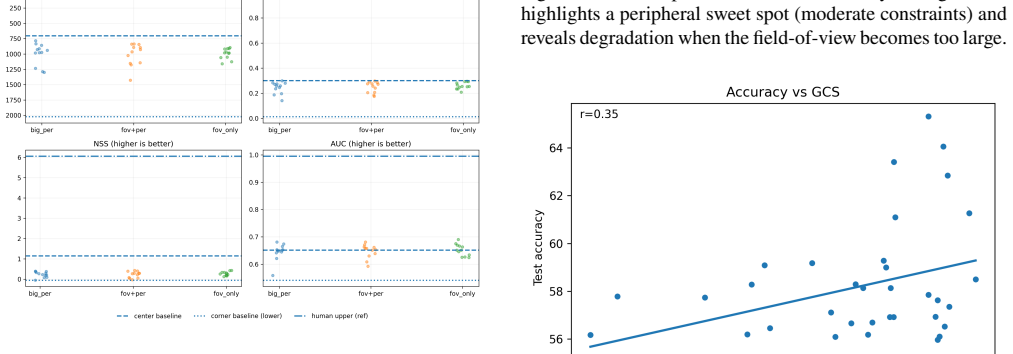
On Gaze-CIFAR-10, the paper establishes three coupled findings. First, the dataset is strongly center-biased: a policy that always fixates the center achieves NSS=1.145 and AUC=0.6515, close to many trained models, so raw scanpath scores are inflated. Second, after normalizing each metric by human-human upper and corner lower bounds and explicitly subtracting the center baseline, the GCS score reveals that only intermediate sensory configurations — the best being a foveal patch of 8 pixels plus a moderate peripheral channel — produce scanpaths that remain above the center baseline and match human movement statistics such as path length, saccade amplitude, and coverage. Third, when the field-
What carries the argument
GCS (Gaze Consistency Score) is the central evaluation object. For each of four standard scanpath metrics (DTW, ScanMatch, NSS, AUC), scores are min-max normalized between a corner-fixation lower bound and an identical-human upper bound, then the normalized score of a center-fixation baseline is subtracted; a movement-similarity term, based on a relative-error distance over run-level statistics (total path, mean saccade amplitude, mean distance-to-center, spatial coverage, direction entropy, collapse rate), is added with weight 0.1. GCS isolates behavioral alignment beyond central tendency. The model side is a hierarchical recurrent attention agent (MRAM) with a stochastic location policy tr
Load-bearing premise
GCS assumes that the center-bias contribution to a scanpath score is additively separable from genuine alignment, so subtracting the center baseline leaves true behavioral similarity; if center bias interacts with strategy rather than adding to it, the debiased score is a residual that could manufacture or erase sweet spots.
What would settle it
Recompute GCS on the same model sweep using an inter-human upper bound (mean pairwise score between different humans' scanpaths on the same image) instead of the identical-human bound; if fov+per patch size 8 no longer ranks highest, or if the sweet spot disappears, the result depends on the self-match normalization rather than on debiasing itself.
If this is right
- Raw scanpath metrics on object-centric datasets should be reported with center and corner baselines; without them, 'human-like' claims are uninterpretable.
- Recognition accuracy and human-likeness of gaze are partially decoupled; the best-accuracy configuration (foveal-only, patch 8) has a much lower GCS than the sweet spot (foveal+peripheral, patch 8).
- A narrow range of sensory constraints induces human-like exploration; too-small patches cause excessive movement without evidence gain, while too-large fields-of-view remove the need to explore.
- Evaluating active vision models on single-viewport human data can misattribute viewport mismatch to behavior mismatch; future gaze benchmarks should vary human viewing geometry.
Where Pith is reading between the lines
- If the mechanistic-regime view is right, then 'human-like gaze' is not a fixed target: a model trained under a different acuity/field-of-view relationship should be compared against human data collected under the corresponding viewing geometry, a testable prediction the paper leaves to future data collection.
- The GCS construction could transfer to other object-centric gaze datasets (e.g., images with natural center bias) to re-examine prior claims of human-like attention; a drop in previously reported alignment after debiasing would confirm the confound is widespread.
- Because GCS subtracts the center baseline additively, its ranking may be sensitive to how the upper bound is defined; using inter-human agreement instead of identical-self would make the normalization more conservative and might shift the sweet-spot magnitude.
Editorial analysis
A structured set of objections, weighed in public.
Referee Report
Summary. The paper studies center-bias confounding in scanpath evaluation on the object-centric Gaze-CIFAR-10 dataset. It first demonstrates that a trivial center-fixation baseline achieves surprisingly high scores under DTW, ScanMatch, NSS, and AUC (Table 1), arguing that standard metrics overestimate human-likeness. It then introduces GCS, a composite score that normalizes each metric by human-human (self) upper and corner lower bounds, subtracts a center baseline, and adds a movement-similarity term. Applying GCS to a hard-attention classifier with varied foveal patch size and peripheral context, the paper reports a peripheral 'sweet spot' at fov+per with patch size 8 (GCS=0.0291), and a 'shortcut regime' for large fields of view. The central claim is that only intermediate sensory constraints yield scanpaths exceeding the center baseline after debiasing and displaying human-like movement dynamics.
Significance. The paper addresses a real and important confound: on object-centric datasets, center bias can make trivial policies look human-like under standard scanpath metrics. The calibrated baseline analysis in Table 1 is a useful contribution, and the movement-statistics comparison adds a needed dynamic dimension. If the sweet-spot result is valid, it would be a valuable mechanistic finding linking sensory constraints to emergent gaze strategies. However, the current manuscript has several load-bearing technical issues, most critically an inverted normalization in Eq. (1) that flips the sign of the DTW debiased term, directly compromising the computed GCS values and the resulting sweet-spot claim.
major comments (4)
- [Method, GCS section] The DTW normalization is inverted. As written, Eq. (1) gives (Dmin - D)/(Dmin - Dmax) = (D - Dmin)/(Dmax - Dmin), so an identical sequence (D = Dmin) maps to 0 and a corner sequence (D = Dmax) maps to 1. This is a lower-is-better transform, contradicting the stated 'higher is better after transform'. The correct form is (Dmax - D)/(Dmax - Dmin). Since Eq. (4) sums this term as higher-is-better, the debiased DTW component has the opposite sign for every run. For the headline fov+per ps=8 run, this flips the DTW debiased term from +0.066 to -0.066, changing the 1/4-sum contribution by -0.033. Reported GCS is only 0.029, so this sign error can reverse the 'above center baseline after debiasing' conclusion and change the identity of the sweet spot. The authors must correct Eq. (1) and rerun all GCS analyses.
- [Method, GCS section] The upper bound is computed by comparing each human scanpath to itself (identical sequence), not by human–human agreement. This yields Dmin = 0.003 for DTW, making normalized DTW scores extremely small and compressing the DTW component relative to other metrics. The stated goal of 'human–human agreement as upper bound' (Introduction) is not achieved. A proper upper bound would use held-out human–human comparisons (e.g., split-half reliability or mean pairwise agreement across different observers). This affects all normalized scores and therefore the magnitude and even the sign of the debiased terms in Eq. (3), so the sweet-spot threshold is not trustworthy.
- [Method, Eq. (4)] The movement term Sim_move = exp(-d/tau) uses a time constant tau that is never defined or estimated. The sensitivity analysis varies lambda (0 to 0.5) but not tau, so the claim that GCS is robust to the movement-term weighting is incomplete. Reproducibility also requires specifying tau, or estimating it from the data. Additionally, no error bars are provided; the figures report single runs per configuration, and the text states 'keeping the number of steps and seed fixed', implying one seed. Without confidence intervals or multiple seeds, it is unclear whether the reported sweet-spot GCS value is statistically distinguishable from neighboring configurations or from zero.
- [Method, Eqs. (2)-(3)] The debiasing procedure assumes center bias is additively separable from genuine alignment: GCS subtracts the centered baseline after per-metric min-max normalization. This assumption is not tested. Human scanpaths themselves are center-biased, so the center baseline may reflect part of the true behavioral signal, not just dataset artifact. If the contribution is multiplicative or entangled with strategy, the residual can over-correct and manufacture a sweet spot. The authors should validate GCS on synthetic or permuted scanpaths with known center-bias structure, or demonstrate empirically that the debiased score is invariant to injected center bias.
minor comments (6)
- [Table 1] The corner-human NSS value of -0.053 is unusual; NSS is often defined as zero for a random baseline, and negative values are possible but should be explained. Please clarify the NSS formula and why a corner policy gives a negative mean NSS.
- [Method, Eq. (1)] Dmin and Dmax are not explicitly defined before Eq. (1). In the text they are referenced as bounds, but their concrete values (0.003 and 2023.87 from Table 1) appear only later. Please define them clearly.
- [Results, Figure 2] The caption and legend for Figure 2 should be self-contained; describe what each dashed/dotted/dash-dot line represents directly in the caption, not only in the text.
- [Discussion] The Discussion acknowledges the viewport-mismatch limitation but does not address how it affects the GCS comparison quantitatively. A more cautious interpretation is needed; at minimum, state explicitly that the sweet-spot comparison is between different model viewports and a single human viewport, which confounds sensory constraint with viewing geometry.
- [General] There is no code or data release. Given the sensitivity of the results to the exact normalization in Eq. (1), releasing code and a reproducibility checklist would be important for verification.
- [Method, movement statistics] The movement-statistics list includes 'collapse rate' and 'direction entropy', but these are not defined. Please provide formulas or citations.
Circularity Check
No circularity: GCS is an external calibration metric; the sweet spot is a data-dependent empirical maximum, not an input-output equivalence.
full rationale
The paper's derivation chain is not circular. The center/corner/human baselines are external calibrations computed from Gaze-CIFAR-10 scanpath data, not from GCS. GCS subtracts these baselines and adds a movement term; it is defined before the patch-size sweep and is not fitted to make a particular configuration the maximum. The reported sweet spot is an empirical maximum of this fixed metric over model runs, and the paper checks that the pattern is not obvious from raw metrics or accuracy, giving independent content. The only self-citation (Pan et al., 2026) supplies the MRAM architecture, but the sweet-spot claim is not imported from that paper; it is obtained by sweeping this architecture under sensory constraints and evaluating with GCS, so the self-citation is not load-bearing. The additive center-bias assumption and viewport mismatch are validity limitations, not circularity: they concern whether GCS measures what it claims, not whether the conclusion is equivalent to its inputs. The skeptical note about Eq. 1 is a correctness/reproducibility concern (the normalization as written maps identical-human to 0 and corner to 1, opposite to the 'higher is better' label), but that is not a self-definitional reduction of the result to its inputs. Therefore no circular step is identified.
Axiom & Free-Parameter Ledger
free parameters (3)
- lambda =
0.1
- tau =
not specified
- epsilon in relative-error distance =
not specified
axioms (6)
- domain assumption Gaze-CIFAR-10 human fixation sequences are a valid ground truth for human-like scanpath behavior in classification.
- ad hoc to paper Center bias contributes additively to each scanpath metric and can be removed by subtracting the center baseline.
- domain assumption The listed movement statistics (path length, mean saccade amplitude, distance-to-center, coverage, direction entropy, collapse rate) capture temporal human-likeness.
- domain assumption A single-seed REINFORCE run represents the behavior of the hard-attention classifier.
- ad hoc to paper The metric upper bound can be estimated by comparing each human scanpath to itself.
- standard math Standard implementations of DTW, ScanMatch, NSS, and AUC are correct.
Cite this review
Pith. "Pith review of Debiasing Central Fixation Confounds Reveals a Peripheral "Sweet Spot" for Human-like Scanpaths in Hard-Attention Vision." pith.science (2026). https://pith.science/paper/OKLUEXJZ
@misc{pith2026260214834,
  author       = {Pith},
  title        = {Pith review of: Debiasing Central Fixation Confounds Reveals a Peripheral "Sweet Spot" for Human-like Scanpaths in Hard-Attention Vision},
  year         = {2026},
  howpublished = {\url{https://pith.science/paper/OKLUEXJZ}},
  note         = {Machine review of arXiv:2602.14834}
}
read the original abstract
Human eye movements in visual recognition reflect a balance between foveal sampling and peripheral context. Task-driven hard-attention models for vision are often evaluated by how well their scanpaths match human gaze. However, common scanpath metrics can be strongly confounded by dataset-specific center bias, especially on object-centric datasets. Using Gaze-CIFAR-10, we show that a trivial center-fixation baseline achieves surprisingly strong scanpath scores, approaching many learned policies. This makes standard metrics optimistic and blurs the distinction between genuine behavioral alignment and mere central tendency. We then analyze a hard-attention classifier under constrained vision by sweeping foveal patch size and peripheral context, revealing a peripheral sweet spot: only a narrow range of sensory constraints yields scanpaths that are simultaneously (i) above the center baseline after debiasing and (ii) temporally human-like in movement statistics. To address center bias, we propose GCS (Gaze Consistency Score), a center-debiased composite metric augmented with movement similarity. GCS uncovers a robust sweet spot at medium patch size with both foveal and peripheral vision, that is not obvious from raw scanpath metrics or accuracy alone, and also highlights a "shortcut regime" when the field-of-view becomes too large. We discuss implications for evaluating active perception on object-centric datasets and for designing gaze benchmarks that better separate behavioral alignment from center bias.
Figures



Reference graph
Works this paper leans on
-
[1]
Ba, J., Mnih, V., & Kavukcuoglu, K. (2014). Multiple object recognitionwithvisualattention.3rdInternationalConfer- ence on Learning Representations, ICLR 2015, San Diego,
2014
-
[2]
CA, USA, May 7-9, 2015, Conference Track Proceedings
2015
-
[3]
Bajcsy, R. (1988). Active perception.Proceedings of the IEEE,76(8), 966–1005. https://doi.org/10.1109/5.5968
doi:10.1109/5.5968 1988
-
[4]
Ballard, D. H. (1991). Animate vision.Artificial Intelligence, 48(1), 57–86. https://doi.org/https://doi.org/10.1016/0004- 3702(91)90080-4 Bindemann,M.(2010).Sceneandscreencenterbiasearlyeye movements in scene viewing [Vision Research Reviews]. Vision Research,50(23), 2577–2587. https://doi.org/https: //doi.org/10.1016/j.visres.2010.08.016 Borji,A.(2021)....
arXiv 1991
-
[5]
Borji, A., & Itti, L. (2013). State-of-the-art in visual at- tention modeling.IEEE Transactions on Pattern Analy- sis and Machine Intelligence,35, 185–207. https://api. semanticscholar.org/CorpusID:641747
2013
-
[6]
Cristino, F., Mathôt, S., Theeuwes, J., & Gilchrist, I. (2010). Scanmatch: A novel method for comparing fixation se- quences.Behavior Research Methods,42, 692–700. Dynamic time warping. (2007). InInformation retrieval for musicandmotion(pp.69–84).SpringerBerlinHeidelberg. https://doi.org/10.1007/978-3-540-74048-3_4 Geirhos,R.,Jacobsen,J.-H.,Michaelis,C.,Z...
-
[7]
Geisler, W. S. (2008). Visual perception and the statistical properties of natural scenes.Annual review of psychology, 59, 167–92. https://api.semanticscholar.org/CorpusID: 523591
2008
-
[8]
Judd, T., Durand, F., & Torralba, A. (2012). A benchmark of computational models of saliency to predict human fixa- tions. Li,J.,Xue,S.,&Su,Y.(2025).Gaze-guidedlearning:Avoid- ing shortcut bias in visual classification.arXiv preprint arXiv:2504.05583
Pith/arXiv arXiv 2012
-
[9]
Mnih, V., Heess, N., Graves, A., & Kavukcuoglu, K. (2014). Recurrentmodelsofvisualattention.InZ.Ghahramani,M
2014
-
[10]
Najemnik, J., & Geisler, W. (2005). Optimal eye movement strategiesinvisualsearch.Nature,434,387–91.https://doi. org/10.1038/nature03390
-
[11]
Pan, P., Yonekura, S., & Kuniyoshi, Y. (2026). Emergence of fixationalandsaccadicmovementsinamulti-levelrecurrent attentionmodelforvision.InT.Taniguchi,C.S.A.Leung, T. Kozuno, J. Yoshimoto, M. Mahmud, M. Doborjeh, & K. Doya(Eds.),Neuralinformationprocessing(pp.299–313). Springer Nature Singapore
2026
-
[12]
J., Iyer, A., Itti, L., & Koch, C
Peters, R. J., Iyer, A., Itti, L., & Koch, C. (2005). Compo- nents of bottom-up gaze allocation in natural images.Vi- sion Research,45(18), 2397–2416. https://doi.org/https: //doi.org/10.1016/j.visres.2005.03.019
-
[13]
Smith, T. J., & Mital, P. K. (2013). Attentional synchrony andtheinfluenceofviewingtaskongazebehaviorinstatic anddynamicscenes.JournalofVision,13(8),16–16.https: //doi.org/10.1167/13.8.16
-
[14]
Tatler, B. W. (2007). The central fixation bias in scene view- ing: Selecting an optimal viewing position independently of motor biases and image feature distributions.Journal of Vision,7(14), 4–4. https://doi.org/10.1167/7.14.4
doi:10.1167/7.14.4 2007
-
[15]
W., Hayhoe, M
Tatler, B. W., Hayhoe, M. M., Land, M. F., & Ballard, D.H.(2011).Eyeguidanceinnaturalvision:Reinterpreting salience.Journal of Vision,11(5), 5–5. https://doi.org/10. 1167/11.5.5 Yarbus,A.L.,&Yarbus,A.L.(1967).Eyemovementsduring perception of moving objects.Eye Movements and Vision, 159–170
2011
-
[16]
Zanca, D., Serchi, V., Piu, P., Rosini, F., & Rufa, A. (2018). Fixatons:Acollectionofhumanfixationsdatasetsandmet- rics for scanpath similarity. https://arxiv.org/abs/1802. 02534
2018
This paper was first reviewed by deepseek-v4-flash on August 2, 2026.
discussion (0)
Sign in with ORCID, Apple, or X to comment. Anyone can read and Pith papers without signing in.