Recognition: no theorem link
How to have your wormholes and factorize, too
Pith reviewed 2026-05-15 21:43 UTC · model grok-4.3
The pith
Modifying the semiclassical holographic dictionary enables an extended gravitational path integral that factorizes, follows the Page curve for entropy, and includes operators for closed baby universes.
A machine-rendered reading of the paper's core claim, the machinery that carries it, and where it could break.
Core claim
By using a modified semiclassical holographic dictionary as scaffolding, the authors outline a program to build an extended semiclassical gravitational path integral that is manifestly factorizing, computes a von Neumann entropy satisfying the Page curve, and incorporates new operators that create closed baby universe states. The construction preserves core aspects of the standard holographic correspondence while allowing interpretations as imposing semiclassical background independence, a modified large N limit, an ensemble of dual theories, or observer rules enforced by gravitational degrees of freedom.
What carries the argument
The modified semiclassical holographic dictionary, which acts as scaffolding to extend the gravitational path integral with manifest factorization and baby-universe creation operators.
If this is right
- The extended path integral is manifestly factorizing across disconnected regions.
- The computed von Neumann entropy follows the Page curve rather than the semiclassical Hawking result.
- New operators exist that create closed baby universe states within the path integral.
- The setup can be interpreted as enforcing a semiclassical version of no global symmetry or background independence.
- The construction prepares an ensemble of dual theories rather than a single one.
Where Pith is reading between the lines
- The same dictionary adjustment might be tested in other holographic models involving replica wormholes to see if factorization emerges more generally.
- If successful, the approach could reduce reliance on full non-perturbative quantum gravity for resolving these paradoxes at leading semiclassical order.
- The ensemble interpretation suggests possible links to random-matrix descriptions of black-hole microstates without invoking additional structures.
- Observer rules enforced by gravitational degrees of freedom could be probed by examining how the new operators affect late-time correlation functions.
Load-bearing premise
That adjusting the semiclassical holographic dictionary supplies enough freedom to resolve the factorization, information, and closed-universe problems simultaneously while leaving other established features of the correspondence intact.
What would settle it
An explicit computation in a controlled toy model, such as a simple wormhole geometry, that checks whether the extended path integral produces a factorized partition function whose entropy follows the Page curve and whether the new baby-universe operators remain consistent with the rest of the construction.
Figures



read the original abstract
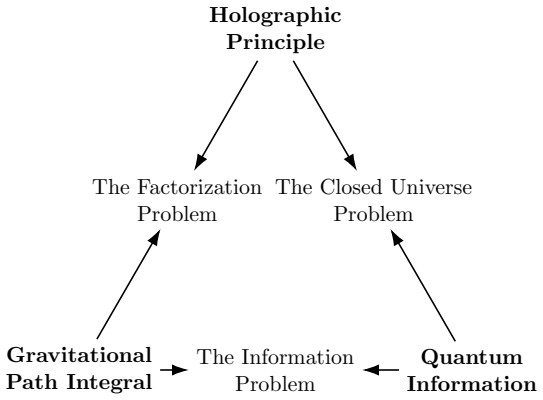
We review three well known inconsistencies in the standard mathematical formulation of semiclassical gravity: the factorization problem, the information problem, and the closed universe problem. Building upon recent work, we explore how modifying the semiclassical holographic dictionary may provide the necessary freedom to resolve these three problems in a unified manner while maintaining more well established aspects of the standard correspondence. Using the modified semiclassical holographic dictionary as a scaffolding, we propose a program for constructing an `extended' semiclassical gravitational path integral which (i) is manifestly factorizing, (ii) computes a von Neumann entropy which satisfies the Page curve, and (iii) incorporates new operators that create closed baby universe states. Our construction may be interpreted as imposing a semiclassical version of background independence/a no global symmetry condition, defining a modified large N limit, preparing an ensemble of dual theories, or enforcing observer rules using gravitational degrees of freedom.
Editorial analysis
A structured set of objections, weighed in public.
Referee Report
Summary. The paper reviews three inconsistencies in the standard formulation of semiclassical gravity—the factorization problem, the information problem, and the closed universe problem—and proposes that a suitable modification of the semiclassical holographic dictionary can resolve them simultaneously while preserving established aspects of the correspondence. Using this modified dictionary as scaffolding, it outlines a program to construct an 'extended' semiclassical gravitational path integral that (i) is manifestly factorizing, (ii) yields a von Neumann entropy obeying the Page curve, and (iii) includes new operators creating closed baby-universe states; the construction is interpreted as a semiclassical version of background independence, a modified large-N limit, an ensemble of dual theories, or observer rules enforced by gravitational degrees of freedom.
Significance. If the proposed program can be made concrete, it would offer a unified conceptual framework for addressing longstanding puzzles in holographic quantum gravity, potentially reconciling wormhole contributions with factorization and unitarity while incorporating gravitational degrees of freedom for observers and closed universes.
major comments (2)
- [Abstract and proposal section] The manuscript presents the modified semiclassical holographic dictionary only programmatically (see abstract and the proposal for the extended path integral) without supplying explicit rules, an altered measure, or the operator algebra that would simultaneously enforce manifest factorization, Page-curve compliance for von Neumann entropy, and the inclusion of baby-universe operators. This absence leaves the central claim that the three resolutions are compatible unverified.
- [Construction program] No explicit equations, calculations, or verification steps are provided for the extended path integral (see the construction program), so it is impossible to check whether the claimed properties hold or whether hidden inconsistencies with bulk locality or boundary unitarity are introduced.
minor comments (1)
- [Abstract] The abstract could more sharply separate the review of the three problems from the new proposal to aid readability.
Simulated Author's Rebuttal
We thank the referee for their careful reading and insightful comments. Our manuscript is intended as a conceptual proposal for a program rather than a complete explicit construction, and we respond to the major comments below.
read point-by-point responses
-
Referee: [Abstract and proposal section] The manuscript presents the modified semiclassical holographic dictionary only programmatically (see abstract and the proposal for the extended path integral) without supplying explicit rules, an altered measure, or the operator algebra that would simultaneously enforce manifest factorization, Page-curve compliance for von Neumann entropy, and the inclusion of baby-universe operators. This absence leaves the central claim that the three resolutions are compatible unverified.
Authors: We agree that the presentation is programmatic. The manuscript reviews the three inconsistencies and uses the modified semiclassical holographic dictionary as scaffolding to outline how an extended path integral could resolve them simultaneously. Explicit rules, measures, and operator algebras are deliberately not supplied at this stage because the focus is on establishing the conceptual compatibility of the resolutions while preserving established aspects of the correspondence. The central claim is that the modified dictionary provides the necessary freedom for such a construction; explicit verification is left for future work building on this proposal. revision: no
-
Referee: [Construction program] No explicit equations, calculations, or verification steps are provided for the extended path integral (see the construction program), so it is impossible to check whether the claimed properties hold or whether hidden inconsistencies with bulk locality or boundary unitarity are introduced.
Authors: We agree that the construction program is presented at a high level without explicit equations or calculations. It serves as an outline indicating the steps needed to build an extended path integral that is manifestly factorizing, yields a Page curve for the von Neumann entropy, and incorporates baby-universe operators. Verification of the properties and checks for potential inconsistencies with bulk locality or boundary unitarity form part of the subsequent development of the program. The proposal is designed to maintain consistency with established features of the holographic correspondence. revision: no
Circularity Check
Extended path integral defined by construction to be factorizing, Page-curve compliant, and baby-universe inclusive
specific steps
-
self definitional
[Abstract]
"Using the modified semiclassical holographic dictionary as a scaffolding, we propose a program for constructing an `extended' semiclassical gravitational path integral which (i) is manifestly factorizing, (ii) computes a von Neumann entropy which satisfies the Page curve, and (iii) incorporates new operators that create closed baby universe states."
The extended path integral is introduced with the three resolving properties built directly into its definition. Claiming that the modified dictionary resolves the factorization, information, and closed-universe problems therefore reduces to restating the definition; no independent derivation or explicit dictionary map is given that would demonstrate the properties emerge rather than being imposed.
full rationale
The manuscript's core proposal is a program that, by explicit definition, produces an extended semiclassical path integral possessing the three desired properties (manifest factorization, Page curve for von Neumann entropy, and closed baby-universe operators). This is presented as following from a modified holographic dictionary whose concrete rules are not supplied; the resolution of the three inconsistencies is therefore stipulated rather than independently derived. The text frames the construction as scaffolding rather than a derivation with explicit measure or operator algebra, rendering the central claim self-definitional. No load-bearing external theorem or parameter-free computation is invoked to establish that the modification simultaneously achieves all three outcomes without hidden inconsistencies.
Axiom & Free-Parameter Ledger
axioms (2)
- domain assumption The standard semiclassical holographic dictionary leads to the factorization, information, and closed universe inconsistencies.
- ad hoc to paper A suitable modification of the dictionary exists that resolves the inconsistencies while preserving established aspects of the correspondence.
invented entities (2)
-
extended semiclassical gravitational path integral
no independent evidence
-
new operators that create closed baby universe states
no independent evidence
Reference graph
Works this paper leans on
-
[1]
H. Liu, “”Filtering” CFTs at large N: Euclidean Wormholes, Closed Universes, and Black Hole Interiors,”arXiv:2512.13807 [hep-th]
-
[2]
L. Susskind, “The World as a hologram,”J. Math. Phys.36(1995) 6377–6396, arXiv:hep-th/9409089
work page internal anchor Pith review Pith/arXiv arXiv 1995
-
[3]
The Large N Limit of Superconformal Field Theories and Supergravity
J. M. Maldacena, “The LargeNlimit of superconformal field theories and supergravity,”Adv. Theor. Math. Phys.2(1998) 231–252,arXiv:hep-th/9711200
work page internal anchor Pith review Pith/arXiv arXiv 1998
-
[4]
Quantum Gravity and Path Integrals,
S. W. Hawking, “Quantum Gravity and Path Integrals,”Phys. Rev. D18(1978) 1747–1753
work page 1978
-
[5]
Topological quantum field theories,
M. Atiyah, “Topological quantum field theories,”Publications Math´ ematiques de l’IH ´ES68(1988) 175–186
work page 1988
-
[6]
E. Colafranceschi, X. Dong, D. Marolf, and Z. Wang, “Algebras and Hilbert spaces from gravitational path integrals. Understanding Ryu-Takayanagi/HRT as entropy without AdS/CFT,” JHEP10(2024) 063,arXiv:2310.02189 [hep-th]
-
[7]
Black hole microstate counting from the gravitational path integral,
L. V. Iliesiu, S. Murthy, and G. J. Turiaci, “Black hole microstate counting from the gravitational path integral,”JHEP08(2025) 152,arXiv:2209.13602 [hep-th]
-
[8]
A Nonperturbative Toolkit for Quantum Gravity,
V. Balasubramanian and T. Yildirim, “A Nonperturbative Toolkit for Quantum Gravity,” arXiv:2504.16986 [hep-th]
-
[9]
How to Count States in Gravity,
V. Balasubramanian and T. Yildirim, “How to Count States in Gravity,”arXiv:2506.15767 [hep-th]
-
[10]
Building up spacetime with quantum entanglement,
M. Van Raamsdonk, “Building up spacetime with quantum entanglement,”Gen. Rel. Grav.42 (2010) 2323–2329,arXiv:1005.3035 [hep-th]
-
[11]
Bulk Locality and Quantum Error Correction in AdS/CFT
A. Almheiri, X. Dong, and D. Harlow, “Bulk Locality and Quantum Error Correction in AdS/CFT,” JHEP04(2015) 163,arXiv:1411.7041 [hep-th]
work page internal anchor Pith review Pith/arXiv arXiv 2015
-
[12]
The entropy of Hawking radiation,
A. Almheiri, T. Hartman, J. Maldacena, E. Shaghoulian, and A. Tajdini, “The entropy of Hawking radiation,”Rev. Mod. Phys.93(2021) no. 3, 035002,arXiv:2006.06872 [hep-th]
-
[13]
Entanglement Wedge Reconstruction via Universal Recovery Channels,
J. Cotler, P. Hayden, G. Penington, G. Salton, B. Swingle, and M. Walter, “Entanglement Wedge Reconstruction via Universal Recovery Channels,”Phys. Rev. X9(2019) no. 3, 031011, arXiv:1704.05839 [hep-th]
-
[14]
Holographic Derivation of Entanglement Entropy from AdS/CFT
S. Ryu and T. Takayanagi, “Holographic derivation of entanglement entropy from AdS/CFT,”Phys. Rev. Lett.96(2006) 181602,arXiv:hep-th/0603001
work page internal anchor Pith review Pith/arXiv arXiv 2006
-
[15]
Connectedness Of The Boundary In The AdS/CFT Correspondence
E. Witten and S.-T. Yau, “Connectedness of the boundary in the AdS / CFT correspondence,”Adv. Theor. Math. Phys.3(1999) 1635–1655,arXiv:hep-th/9910245
work page internal anchor Pith review Pith/arXiv arXiv 1999
-
[16]
J. M. Maldacena and L. Maoz, “Wormholes in AdS,”JHEP02(2004) 053,arXiv:hep-th/0401024
work page internal anchor Pith review Pith/arXiv arXiv 2004
-
[17]
Replica wormholes and the black hole interior,
G. Penington, S. H. Shenker, D. Stanford, and Z. Yang, “Replica wormholes and the black hole interior,”JHEP03(2022) 205,arXiv:1911.11977 [hep-th]
-
[18]
Replica Wormholes and the Entropy of Hawking Radiation,
A. Almheiri, T. Hartman, J. Maldacena, E. Shaghoulian, and A. Tajdini, “Replica Wormholes and the Entropy of Hawking Radiation,”JHEP05(2020) 013,arXiv:1911.12333 [hep-th]. 33
-
[19]
A no-go theorem for largeNclosed universes,
E. Gesteau, “A no-go theorem for largeNclosed universes,”arXiv:2509.14338 [hep-th]
-
[20]
Do holographic CFT states have unique semiclassical bulk duals?,
S. Antonini and P. Rath, “Do holographic CFT states have unique semiclassical bulk duals?,”Int. J. Mod. Phys. D34(2025) no. 16, 2544025,arXiv:2408.02720 [hep-th]
-
[21]
Baby Universes, Holography, and the Swampland,
J. McNamara and C. Vafa, “Baby Universes, Holography, and the Swampland,”arXiv:2004.06738 [hep-th]
-
[22]
Towards a holographic description of closed universes,
H. Liu, “Towards a holographic description of closed universes,”arXiv:2509.14327 [hep-th]
-
[23]
Emergent geometry from quantum probability,
S. Ali Ahmad and M. S. Klinger, “Emergent geometry from quantum probability,”Phys. Rev. D 111(2025) no. 10, 105015,arXiv:2411.07288 [hep-th]
-
[24]
S. Ali Ahmad and M. S. Klinger, “Extensions from within,”arXiv:2503.02944 [hep-th]
-
[25]
The Many Faces of Non-invertible Symmetries,
S. Ali Ahmad, M. S. Klinger, and Y. Wang, “The Many Faces of Non-invertible Symmetries,” arXiv:2509.18072 [hep-th]
-
[26]
A Theory of Backgrounds and Background Independence,
M. Klinger, “A Theory of Backgrounds and Background Independence,”arXiv:2512.05043 [hep-th]
-
[27]
R. Renner and J. Wang, “The black hole information puzzle and the quantum de Finetti theorem,” arXiv:2110.14653 [hep-th]
-
[28]
Quantum mechanics and observers for gravity in a closed universe,
D. Harlow, M. Usatyuk, and Y. Zhao, “Quantum mechanics and observers for gravity in a closed universe,”arXiv:2501.02359 [hep-th]
-
[29]
The baby universe is fine and the CFT knows it: on holography for closed universes,
S. Antonini, P. Rath, M. Sasieta, B. Swingle, and A. Vilar L´ opez, “The baby universe is fine and the CFT knows it: on holography for closed universes,”JHEP12(2025) 159,arXiv:2507.10649 [hep-th]
-
[30]
Baby Universes from Thermal Pure States in SYK,
M. Sasieta, B. Swingle, and A. Vilar L´ opez, “Baby Universes from Thermal Pure States in SYK,” arXiv:2512.00149 [hep-th]
-
[31]
Emergent Mixed States for Baby Universes and Black Holes,
J. Kudler-Flam and E. Witten, “Emergent Mixed States for Baby Universes and Black Holes,” arXiv:2510.06376 [hep-th]
-
[32]
The gravitational path integral from an observer’s point of view,
A. I. Abdalla, S. Antonini, L. V. Iliesiu, and A. Levine, “The gravitational path integral from an observer’s point of view,”JHEP05(2025) 059,arXiv:2501.02632 [hep-th]
-
[33]
Observer complementarity for black holes and holography,
N. Engelhardt, E. Gesteau, and D. Harlow, “Observer complementarity for black holes and holography,”arXiv:2507.06046 [hep-th]
-
[34]
On observers in holographic maps,
C. Akers, G. Bueller, O. DeWolfe, K. Higginbotham, J. Reinking, and R. Rodriguez, “On observers in holographic maps,”JHEP05(2025) 201,arXiv:2503.09681 [hep-th]
-
[35]
Helping observers in closed universes reach their full potential,
K. Higginbotham, “Helping observers in closed universes reach their full potential,” arXiv:2512.17993 [hep-th]
-
[36]
Cosmology from random entanglement,
S. Antonini, M. Sasieta, and B. Swingle, “Cosmology from random entanglement,”JHEP11(2023) 188,arXiv:2307.14416 [hep-th]
-
[37]
A duality for Hopf algebras and for subfactors. 1.,
R. Longo, “A duality for Hopf algebras and for subfactors. 1.,”Commun. Math. Phys.159(1994) 133–150. 34
work page 1994
-
[38]
Index of subfactors and statistics of quantum fields. I,
R. Longo, “Index of subfactors and statistics of quantum fields. I,”Commun. Math. Phys.126 (1989) 217–247
work page 1989
-
[39]
M. Bischoff, R. Longo, Y. Kawahigashi, and K.-H. Rehren, “Tensor categories and endomorphisms of von Neumann algebras (with applications to Quantum Field Theory),”Physics3(2015) 1–94, arXiv:1407.4793 [math.OA]
-
[40]
Infinite index extensions of local nets and defects
S. Del Vecchio and L. Giorgetti, “Infinite index extensions of local nets and defects,”Rev. Math. Phys.30(2017) no. 02, 1850002,arXiv:1703.03605 [math.OA]
work page internal anchor Pith review Pith/arXiv arXiv 2017
-
[41]
Non-invertible global symmetries and completeness of the spectrum,
B. Heidenreich, J. McNamara, M. Montero, M. Reece, T. Rudelius, and I. Valenzuela, “Non-invertible global symmetries and completeness of the spectrum,”JHEP09(2021) 203, arXiv:2104.07036 [hep-th]
-
[42]
Gravitational Solitons and Completeness,
J. McNamara, “Gravitational Solitons and Completeness,”arXiv:2108.02228 [hep-th]
-
[43]
E. Gesteau, M. Marcolli, and J. McNamara, “Wormhole Renormalization: The gravitational path integral, holography, and a gauge group for topology change,”arXiv:2407.20324 [hep-th]
-
[44]
A. Blommaert, L. V. Iliesiu and J. Kruthoff, JHEP09, 080 (2022) doi:10.1007/JHEP09(2022)080 [arXiv:2111.07863 [hep-th]]
-
[45]
P. Saad, S. H. Shenker, D. Stanford and S. Yao, JHEP09, 133 (2024) doi:10.1007/JHEP09(2024)133 [arXiv:2103.16754 [hep-th]]
-
[46]
Mukhametzhanov, JHEP04, 122 (2023) doi:10.1007/JHEP04(2023)122 [arXiv:2110.06221 [hep-th]]
B. Mukhametzhanov, JHEP04, 122 (2023) doi:10.1007/JHEP04(2023)122 [arXiv:2110.06221 [hep-th]]
-
[47]
N. Benjamin, S. Collier, A. L. Fitzpatrick, A. Maloney and E. Perlmutter, JHEP09, 174 (2021) doi:10.1007/JHEP09(2021)174 [arXiv:2107.10744 [hep-th]]
-
[48]
G. Di Ubaldo and E. Perlmutter, JHEP12, 179 (2023) doi:10.1007/JHEP12(2023)179 [arXiv:2307.03707 [hep-th]]
-
[49]
Black holes as red herrings: Topological fluctuations and the loss of quantum coherence,
S. R. Coleman, “Black holes as red herrings: Topological fluctuations and the loss of quantum coherence,”Nucl. Phys. B307(1988) 867–882
work page 1988
-
[50]
Baby Universes, Third Quantization and the Cosmological Constant,
S. B. Giddings and A. Strominger, “Baby Universes, Third Quantization and the Cosmological Constant,”Nucl. Phys. B321(1989) 481–508
work page 1989
-
[51]
Observations of Hawking radiation: the Page curve and baby universes,
D. Marolf and H. Maxfield, “Observations of Hawking radiation: the Page curve and baby universes,”JHEP04(2021) 272,arXiv:2010.06602 [hep-th]
- [52]
-
[53]
Black hole microstate cosmology,
S. Cooper, M. Rozali, B. Swingle, M. Van Raamsdonk, C. Waddell, and D. Wakeham, “Black hole microstate cosmology,”JHEP07(2019) 065,arXiv:1810.10601 [hep-th]
- [54]
-
[55]
M. Van Raamsdonk, “Cosmology from confinement?,”JHEP03(2022) 039,arXiv:2102.05057 [hep-th]
-
[56]
Can one hear the shape of a wormhole?,
S. Antonini, P. Simidzija, B. Swingle, and M. Van Raamsdonk, “Can one hear the shape of a wormhole?,”JHEP09(2022) 241,arXiv:2207.02225 [hep-th]. 35
-
[57]
Comments on wormholes, ensembles, and cosmology,
M. Van Raamsdonk, “Comments on wormholes, ensembles, and cosmology,”JHEP12(2021) 156, arXiv:2008.02259 [hep-th]
-
[58]
SymTFT Entanglement and Holographic (Non)-Factorization,
E. Torres and X. Yu, “SymTFT Entanglement and Holographic (Non)-Factorization,” arXiv:2510.06319 [hep-th]
-
[59]
Positive functions onC*-algebras,
W. F. Stinespring, “Positive functions onC*-algebras,”Proc. Am. Math. Soc.6(1955) no. 2, 211–216
work page 1955
-
[60]
A dual in von Neumann algebras with weights,
D. Petz, “A dual in von Neumann algebras with weights,”The Quarterly Journal of Mathematics35 (1984) no. 4, 475–483.https://doi.org/10.1093/qmath/35.4.475
-
[61]
A radon-nikodym theorem for completely positive maps,
V. Belavkin and P. Staszewski, “A radon-nikodym theorem for completely positive maps,”Reports on Mathematical Physics24(1986) no. 1, 49–55. https://www.sciencedirect.com/science/article/pii/003448778690039X
-
[62]
A. Berlinet and C. Thomas-Agnan,Reproducing Kernel Hilbert Spaces in Probability and Statistics. Springer Science+Business Media, Dordrecht, The Netherlands, 2004. https://link.springer.com/book/10.1007/978-1-4419-9096-9
-
[63]
Coherent states and geometric quantization,
A. Odzijewicz, “Coherent states and geometric quantization,”Communications in Mathematical Physics150(1992) no. 2, 385–413
work page 1992
-
[64]
Coherent states for arbitrary lie groups,
A. M. Perelomov, “Coherent states for arbitrary lie groups,”Commun. Math. Phys.26(1972) 222–236
work page 1972
-
[65]
Deformation quantization of Poisson manifolds, I
M. Kontsevich, “Deformation quantization of Poisson manifolds. 1.,”Lett. Math. Phys.66(2003) 157–216,arXiv:q-alg/9709040
work page internal anchor Pith review Pith/arXiv arXiv 2003
-
[66]
The theory of a general quantum system interacting with a linear dissipative system,
R. Feynman and F. Vernon, “The theory of a general quantum system interacting with a linear dissipative system,”Annals of Physics24(1963) 118–173. https://www.sciencedirect.com/science/article/pii/000349166390068X. 36
discussion (0)
Sign in with ORCID, Apple, or X to comment. Anyone can read and Pith papers without signing in.