Band splitting in altermagnet CrSb
Pith reviewed 2026-05-15 21:32 UTC · model grok-4.3
The pith
Magnetic groups formalism uncovers additional spin splitting in CrSb bands missed by exchange approximation.
A machine-rendered reading of the paper's core claim, the machinery that carries it, and where it could break.
Core claim
The magnetic groups formalism allows to establish the additional spin splitting missed in frame of exchange approximation for the hexagonal altermagnet CrSb. Altermagnets lack spontaneous bulk magnetisation yet exhibit spin-split bands; the spin groups approach suffices when relativistic interactions are neglected, but the magnetic groups treatment reveals the further splitting terms present in CrSb.
What carries the argument
Magnetic groups formalism, which incorporates symmetry operations that include time reversal combined with spatial transformations to derive relativistic corrections to spin splitting.
If this is right
- The electron bands in CrSb contain spin splitting contributions beyond those obtained from exchange-only models.
- Relativistic effects must be included via magnetic groups to obtain the complete momentum dependence of spin splitting in hexagonal altermagnets.
- Transport and magnetic response calculations for CrSb require the full set of splitting terms identified by magnetic groups.
- Symmetry analysis of altermagnets benefits from magnetic groups when relativistic interactions are relevant.
Where Pith is reading between the lines
- The same magnetic groups treatment could be applied to other hexagonal or lower-symmetry altermagnets to locate missed relativistic splittings.
- Device models that rely on spin-split bands in CrSb may need revision once the additional terms are included.
- Comparison with fully relativistic band-structure calculations would test whether the magnetic groups terms reproduce the observed splittings.
Load-bearing premise
Relativistic interactions produce additional spin splitting terms in CrSb that magnetic groups capture but the exchange-only spin groups approach misses.
What would settle it
ARPES or quantum oscillation data on CrSb showing band splittings whose symmetry and magnitude match the extra terms from magnetic groups but contradict predictions limited to exchange approximation.
Figures


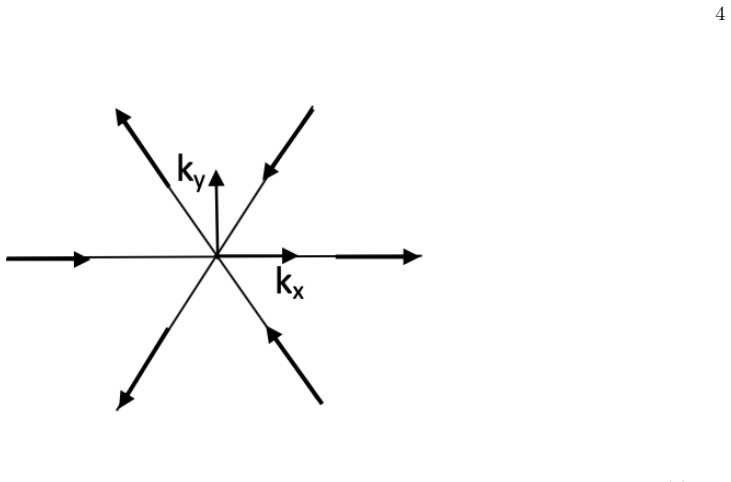
read the original abstract
Altermegnets are a class of metallic magnets characterized by spin-split electron bands. Like antiferromagnets they lack spontaneous bulk magnetisation. The standard description of the momentum dependent spin splitting of electron bands in altermagnets is based on the spin groups approach, which is valid when relativistic interactions are neglected. The problem of electron bands spin splitting in hexagonal altermagnet CrSb is discussed using magnetic groups formalism that allows to establish the additional spin splitting missed in frame of exchange approximation.
Editorial analysis
A structured set of objections, weighed in public.
Referee Report
Summary. The paper claims that the magnetic groups formalism applied to the hexagonal altermagnet CrSb reveals additional momentum-dependent spin splitting in the electron bands arising from relativistic interactions, which is missed by the conventional spin-groups approach restricted to the exchange approximation.
Significance. If the central claim is substantiated, the result would clarify the role of relativistic corrections in altermagnet band structures and show that magnetic-group symmetry analysis can identify splitting channels inaccessible to spin-group methods, with potential relevance for spintronic applications in metallic magnets lacking net magnetization.
major comments (2)
- [Symmetry analysis section] The symmetry analysis asserts that magnetic groups permit additional k-dependent spin-splitting terms forbidden under spin-group symmetry in the exchange approximation, but the manuscript provides neither the explicit effective Hamiltonian (e.g., linear or cubic k·p terms near high-symmetry points) nor the corresponding matrix elements, leaving the physical observability of the splitting unestablished.
- [Results and discussion] No explicit band-structure calculations, DFT results, or quantitative estimates of the additional splitting magnitude or location relative to the Fermi surface are presented; without these, the claim reduces to a classification exercise rather than a demonstrated physical effect.
minor comments (2)
- [Abstract] The abstract would benefit from a concise statement of the specific additional splitting term identified.
- [Introduction] Notation for the magnetic point group of CrSb should be cross-referenced to standard tables (e.g., Litvin or Bradley-Cracknell) for clarity.
Simulated Author's Rebuttal
We thank the referee for the careful reading and constructive comments on our manuscript. We address each major point below and have revised the text to provide greater explicitness and context while preserving the focus on symmetry analysis.
read point-by-point responses
-
Referee: [Symmetry analysis section] The symmetry analysis asserts that magnetic groups permit additional k-dependent spin-splitting terms forbidden under spin-group symmetry in the exchange approximation, but the manuscript provides neither the explicit effective Hamiltonian (e.g., linear or cubic k·p terms near high-symmetry points) nor the corresponding matrix elements, leaving the physical observability of the splitting unestablished.
Authors: We agree that an explicit effective Hamiltonian strengthens the presentation. In the revised manuscript we derive and display the k·p Hamiltonian near the relevant high-symmetry points, writing out the additional linear and cubic terms allowed by the magnetic group but forbidden within the spin-group exchange approximation. The associated matrix elements are now given explicitly, permitting a direct discussion of the momentum dependence and experimental accessibility of the splitting. revision: yes
-
Referee: [Results and discussion] No explicit band-structure calculations, DFT results, or quantitative estimates of the additional splitting magnitude or location relative to the Fermi surface are presented; without these, the claim reduces to a classification exercise rather than a demonstrated physical effect.
Authors: The central result is the symmetry-allowed identification of previously overlooked splitting channels. To address the request for quantitative context we have added order-of-magnitude estimates (several meV) for the additional relativistic splitting, together with a discussion of their location relative to the Fermi surface based on the known band structure of CrSb. Full self-consistent DFT calculations lie beyond the scope of this symmetry-focused work but are noted as a natural direction for follow-up. revision: partial
Circularity Check
No circularity: symmetry classification via magnetic groups is independent of inputs
full rationale
The paper applies the established magnetic groups formalism to classify additional k-dependent spin-splitting terms permitted once relativistic effects are included, terms forbidden under the spin-groups exchange approximation. No self-definitional steps, no fitted parameters renamed as predictions, and no load-bearing self-citations that reduce the central claim to a prior result by the same authors. The derivation consists of enumerating symmetry-allowed invariants; it does not presuppose the size or location of the splitting and remains self-contained against external benchmarks.
Axiom & Free-Parameter Ledger
axioms (1)
- domain assumption Magnetic group theory captures relativistic contributions to spin splitting missed by spin groups in the exchange approximation
Reference graph
Works this paper leans on
-
[1]
L. M. Roth, S. H. Groves, and P. W. Wyatt,Inversion asymmetry effects on oscillatory magnetoresistance in HgSe, Phys. Rev. Lett.19, 576 (1967)
work page 1967
-
[2]
V. P. Mineev and K. V. Samokhin,De Haas-van Alphen effect in metals without inversion center, Phys. Rev. B72, 212504 (2005)
work page 2005
-
[3]
T. Terashima, M. Kimata, S. Uji, T. Sugawara, N. Kimura, H. Aoki, and H. Harima,Fermi surface in LaRhSi 3 and CeRhSi3, Phys. Rev. B78, 205107 (2008)
work page 2008
- [4]
-
[5]
A.Maurya, H.Harima, A.Nakamura, Y.Shimizu, Y.Homma, DeXin Li, F.Honda1, Y.J. Sato, and D.Aoki,Splitting Fermi Surfaces and Heavy Electronic States in Non-Centrosymmetric U 3Ni3Sn4, J.Phys. Soc. Jpn.87, 044703 (2018)
work page 2018
-
[6]
Y. Noda, K. Ohno, and S. Nakamura,Momentum-dependent band spin splitting in semiconducting MnO 2: A density functional calculation, Phys. Chem. Chem. Phys.18, 13294 (2016)
work page 2016
-
[7]
T. Okugawa, K. Ohno, Y. Noda, and S. Nakamura,Weakly spin-dependent band structures of antiferromagnetic perovskite LaMO3 (M = Cr, Mn, Fe), J. Phys.: Condens. Matter30, 075502 (2018). 5
work page 2018
-
[8]
K.-H.Ahn, A. Hariki, K.-W. Lee, and J. Kuneˇ s,Antiferromagnetism in RuO2 as d-wave Pomeranchuk instability, Phys. Rev. B99, 184432 (2019)
work page 2019
-
[9]
S.Hayami, Y.Yanagi, and H.Kusunose,Momentum-Dependent Spin Splitting by Collinear Antiferromagnetic Ordering, Journal of the Physical Society of Japan 88, 123702 (2019)
work page 2019
-
[10]
L. ˇSmejkal, J. Sinova, T. Jungwirth, Phys. Rev.X12,Beyond Conventional Ferromagnetism and Antiferromagnetism: A Phase with Nonrelativistic Spin and Crystal Rotation Symmetry, 031042 (2022)
work page 2022
-
[11]
W. F. Brinkman and R. J. Elliott,Theory of Spin-Space Groups, Proc. R. Soc. A294, 343 (1966)
work page 1966
-
[12]
A. F. Andreev and V. Marchenko,Symmetry and the Macroscopic Dynamics of Magnetic Materials, Usp. Fiz. Nauk130, 39 (1980)
work page 1980
-
[13]
8: Electrodynamics of Continuous Media (Pergamon, Oxford, 1984)
L.D.Landau and E.M.Lifshitz, Course of Theoretical Physics, Vol. 8: Electrodynamics of Continuous Media (Pergamon, Oxford, 1984)
work page 1984
- [14]
-
[15]
V.P.Mineev,URhGe - Altermagnetic Ferromagnet, Pis’ma v ZhETF122, 351 (2025)[ JETP Letters122, 361 (2025)]
work page 2025
- [16]
-
[17]
J. Du, X. Peng, Y. Wang, S. Zhang, Y. Sun, C. Wu, T. Zhou, L. Liu, H. Wang, J. Yang, B. Chen, C. Xi, Z. Jiao, Q. Wu, and M. Fang,Topological nontrivial Berry phase in altermagnet CrSb, arXiv:2509.21303 (2025)
work page internal anchor Pith review Pith/arXiv arXiv 2025
- [18]
-
[19]
T.Terashima, Y. Hattori, D. Graf, T.Urata, T. Yoshioka,W.Hattori, H.Ikuta,and H.Ikeda,Altermagnetic spin-split Fermi surfaces in CrSb revealed by quantum oscillation measurements, arXiv:2601.19105 (2026)
-
[20]
T. Osumi,S. Souma, T. Aoyama,K. Yamauchi, A. Honma, K.Nakayama, T.Takahashi, K.Ohgushi, and T.Sato,Observation of giant band splitting in altermagnetic MnTe, Phys.Rev.B109,10117 (2024)
work page 2024
-
[21]
S.Reimers, L.Odenbreit,L. ˇSmejkal,V.N.Strocov, P. Constantinou, A. B. Hellenes, R. Jaeschke Ubiergo, W. H. Campos, V. K. Bharadwa j, A. Chakraborty, T. Denneulin, W. Shi, R. E. Dunin-Borkowski, S. Das, M. Kla ´’ui, J. Sinova, and M. Jourdan,Direct observation of altermagnetic band splitting in CrSb thin films, Nat. Commun.15, 2116 (2024)
work page 2024
-
[22]
G. Yang, Z. Li, S. Yang, J. Li, H. Zheng, W. Zhu, Z. Pan, Y. Xu, S. Cao, W. Zhao, A. Jana, J. Zhang, M. Ye, Y. Song, L.-H. Hu, L. Yang, J. Fujii, I. Vobornik, M. Shi, H. Yuan, Y. Zhang, Y. Xu, and Y. Liu,Three- dimensional mapping of the altermagnetic spin splitting in CrSb, Nat. Commun.16, 1442 (2025)
work page 2025
-
[23]
M. Zeng, M.-Y. Zhu, Y.-P. Zhu, X.-R. Liu, X.-M. Ma, Y.- J. Hao, P. Liu, G. Qu, Y. Yang, Z. Jiang, K. Yamagami, M. Arita, X. Zhang, T.-H. Shao, Y. Dai, K. Shimada, Z. Liu, M. Ye, Y. Huang, Q. Liu, and C. Liu,Observation of spin splitting in room-temperature metallic antiferro- magnet CrSb, Adv. Sci.11, 2406529 (2024)
work page 2024
-
[24]
J. Ding, Z. Jiang, X. Chen, Z. Tao, Z. Liu, T. Li, J. Liu, J. Sun, J. Cheng, J. Liu, Y. Yang, R. Zhang, L. Deng, W. Jing, Y. Huang, Y. Shi, M. Ye, S. Qiao, Y. Wang, Y. Guo, D. Feng, and D. Shen,Large band splitting in g-wave altermagnet CrSb, Phys. Rev. Lett.133, 206401 (2024)
work page 2024
-
[25]
W. Li, W. Li, M. Zou, Y. Yin, H. Li, G. Qu, Y. Huang, R. Yu, H. Yang, and B. Wang,Large anisotropic x-ray magnetic circular dichroism in altermagnetic CrSb with collinear antiferromagnetic structure at room temperature, Phys. Rev. B 111, 224417 (2025)
work page 2025
-
[26]
C. Li, M. Hu, Z. Li, Y. Wang, W. Chen, B. Thiagara- jan, M. Leandersson, C. Polley, T. Kim, H. Liu, C. Fulga, M. G. Vergniory, O. Janson, O. Tjernberg, and J. van den Brink,Topological Weyl altermagnetism in CrSb, Commun. Phys.8, 311 (2025)
work page 2025
-
[27]
Sen Liao, Xianglin Li, Xiuhua Chen, Ziyan Yu, Jianghao Yao, Rui Xu, Jiexiong Sun, Zhengtai Liu, Dawei Shen, Yilin Wang, Donglai Feng, and Juan Jiang,Direct Observation of Large Altermagnetic Splitting in CrSb (100) Thin Film, Chinese Phys. Lett.42, 067503 (2025)
work page 2025
-
[28]
Xinlu Li, Meng Zhu, Jianting Dong, Kun Wu, Fanxing Zheng and Jia Zhang,Tunneling Magnetoresistance Effect in Altermagnetic Tunnel Junctions with g-Wave Splitting, Chinese Phys. Lett.42, 100701 2025
work page 2025
-
[29]
Coherent high-velocity chiral magnons in the metallic altermagnet CrSb
A.K. Singh, N.Heinsdorf, A.A. Mancilla, J. Bannies, A.Maity, A.I. Kolesnikov, M.Matsuda, M.B.Stone, M.Franz, J. Gaudet, and A.M. Hallas,Chiral Spin-Split Magnons in the Metallic Altermagnet CrSb, arXiv:2511.16086
work page internal anchor Pith review Pith/arXiv arXiv
-
[30]
R.M. Fernandes, V.S. de Carvalho, T. Birol, and R.G. Pereira,Topological transition from nodal to nodeless Zeeman splitting in altermagnets, Phys.Rev.B109, 024404 (20124)
discussion (0)
Sign in with ORCID, Apple, or X to comment. Anyone can read and Pith papers without signing in.