Recognition: 2 theorem links
· Lean TheoremGiant atoms coupled to waveguide: Continuous coupling and multiple excitations
Pith reviewed 2026-05-15 22:01 UTC · model grok-4.3
The pith
Continuous coupling of giant atoms to waveguides breaks constant phase differences and weakens interference effects
A machine-rendered reading of the paper's core claim, the machinery that carries it, and where it could break.
Core claim
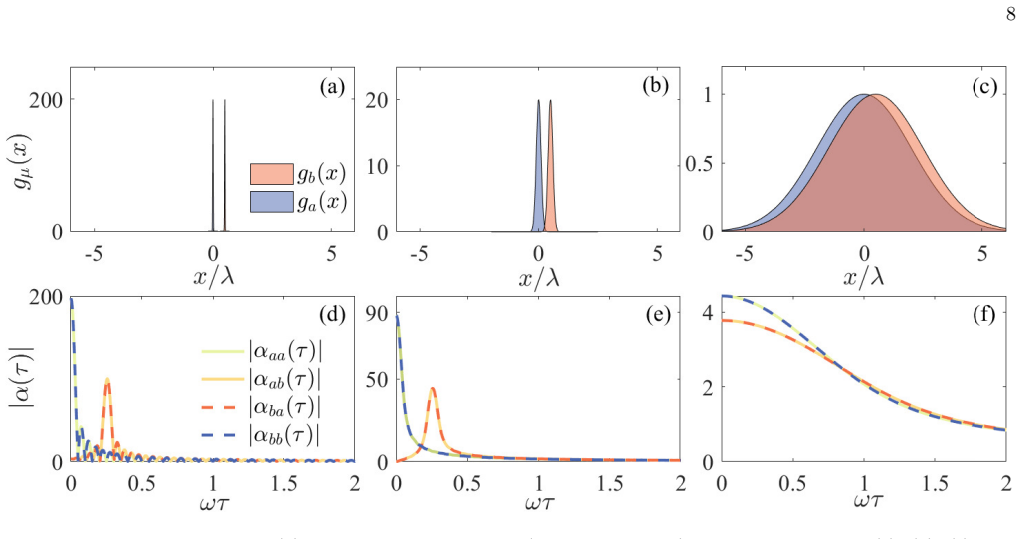
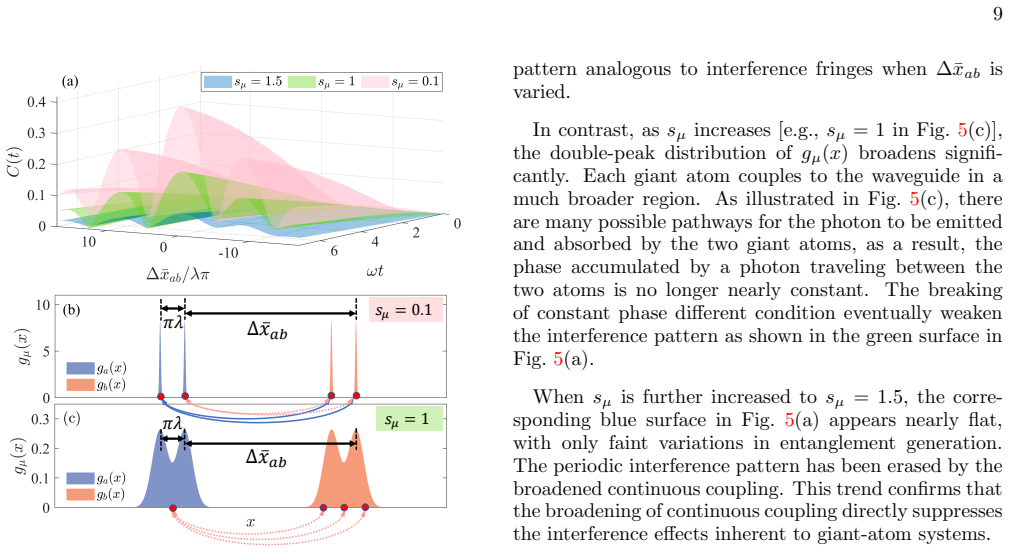
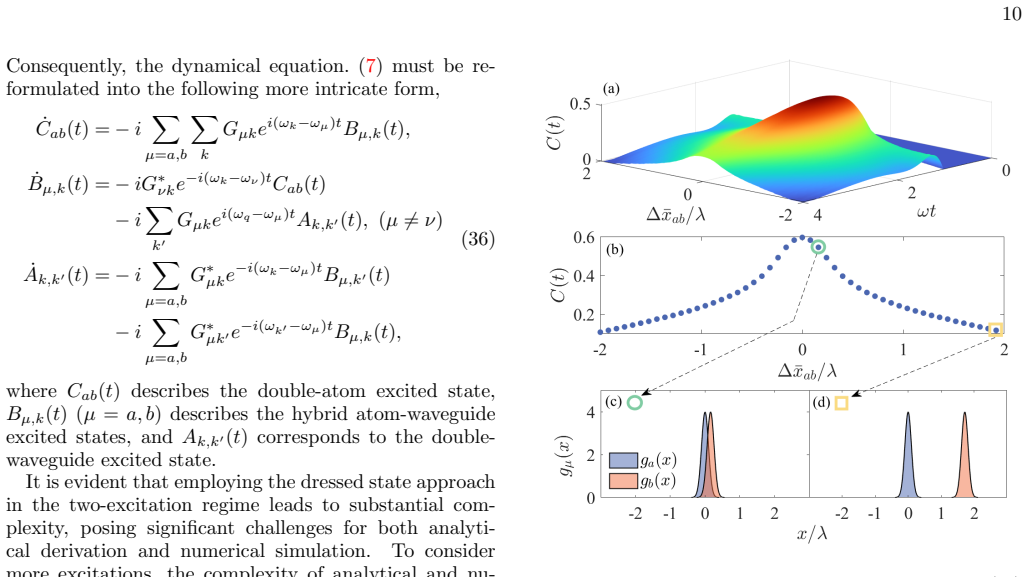
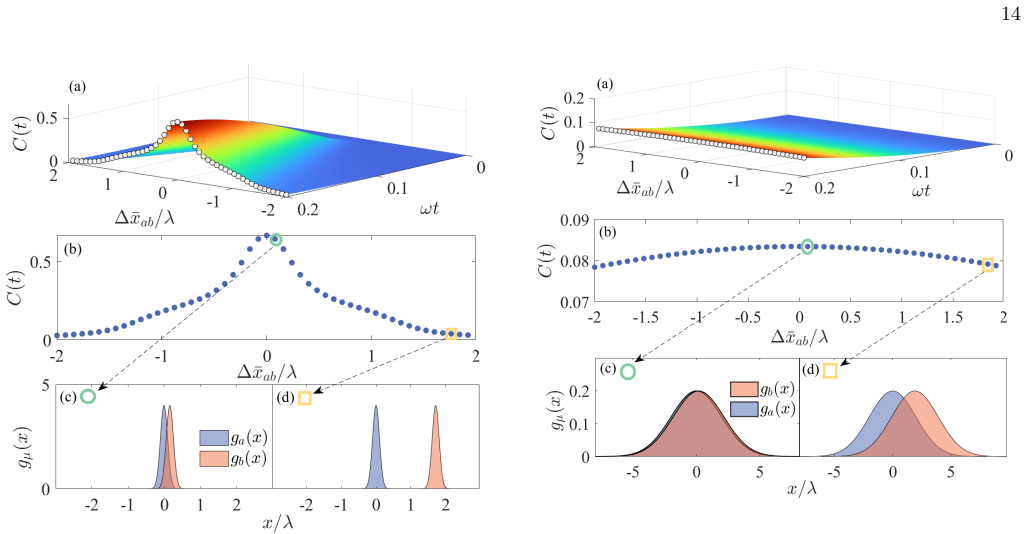
Continuous coupling, unlike discrete coupling at finite points, breaks the constant phase difference condition, thereby weakening the interference effects in giant atom-waveguide systems. The stochastic Schrödinger equation approach supplies correlation functions that capture the full photon processes and time delays while naturally accommodating multiple excitations without added equation complexity, enabling study of thermal and squeezed initial states of the waveguide.
What carries the argument
Stochastic Schrödinger equation for giant atoms with continuous waveguide coupling, which directly produces correlation functions and scales unchanged to arbitrary excitation numbers.
If this is right
- Auto- and cross-correlation functions directly display the photon emission, absorption, and time-delay processes.
- Multi-excitation initial states such as thermal and squeezed fields can be treated without increasing equation complexity.
- Interference is weakened because the constant phase difference between coupling points no longer holds.
- The method supplies a practical route to compute dynamics for any continuous coupling profile.
Where Pith is reading between the lines
- Varying the spatial profile of the continuous coupling could serve as a tunable knob to control the degree of interference in waveguide quantum optics experiments.
- The approach may extend naturally to networks of several giant atoms where continuous couplings determine collective decay rates.
- Circuit-QED implementations could test the predicted reduction in interference visibility by comparing discrete versus distributed coupling geometries.
- Because the method handles non-classical light states efficiently, it offers a route to simulate giant-atom interactions with squeezed or thermal fields in open waveguides.
Load-bearing premise
The stochastic Schrödinger equation remains accurate for continuous coupling distributions and matches the master equation without uncontrolled approximations.
What would settle it
Numerical agreement between the stochastic Schrödinger equation and the master equation on the second-order correlation function for a chosen continuous coupling profile and a single-excitation initial state would confirm the method; mismatch would falsify it.
Figures




read the original abstract
We propose a stochastic Schr\"odinger equation (SSE) approach to investigate the dynamics of giant atoms coupled to a waveguide, addressing two critical gaps in existing research, namely insufficient exploration on continuous coupling and multiple excitations. A key finding is that continuous coupling, unlike discrete coupling at finite points, breaks the constant phase difference condition, thereby weakening the interference effects in giant atom-waveguide systems. In addition, a key technical advantage of the SSE approach is that auto- and cross-correlation functions can directly reflect the complex photon emission/absorption processes and time-delay effects in giant atom-waveguide systems. Moreover, the SSE approach also naturally handles multiple excitations, without increasing equation complexity as the number of excitations grows. This feature enables the investigation of multi-excitation initial states of the waveguide, such as thermal and squeezed initial states. Overall, our approach provides a powerful tool for studying the dynamics of giant atoms coupled to waveguide, particularly for continuous coupling and multi-excitation systems.
Editorial analysis
A structured set of objections, weighed in public.
Referee Report
Summary. The manuscript proposes a stochastic Schrödinger equation (SSE) framework for modeling giant atoms coupled to a waveguide. It focuses on two regimes: continuous (distributed) atom-waveguide coupling and systems with multiple excitations. The central claims are that continuous coupling breaks the constant phase-difference condition that holds for discrete point couplings, thereby weakening interference; that SSE directly yields auto- and cross-correlation functions capturing emission/absorption and time-delay effects; and that the SSE formulation handles multi-excitation initial states (including thermal and squeezed waveguide states) without a combinatorial increase in equation complexity.
Significance. If the SSE remains exact for continuously distributed coupling, the approach would supply a practical route to multi-excitation dynamics in giant-atom systems that is otherwise intractable with the standard master equation. The reported weakening of interference under continuous coupling, if confirmed, would also revise the design rules for suppressing or enhancing collective decay in waveguide QED.
major comments (2)
- [Abstract, §2] Abstract and §2 (method): The assertion that continuous coupling 'breaks the constant phase difference condition' is stated without an explicit derivation or a side-by-side comparison of the SSE against the underlying master equation in the continuous-coupling limit. A concrete benchmark (e.g., recovery of the known single-excitation decay rate or phase relation for a two-point giant atom) is required to establish that the stochastic unraveling remains faithful when the coupling is distributed.
- [§3] §3 (results): No error analysis or convergence test is supplied for the stochastic trajectories when the number of excitations is increased or when the waveguide is prepared in a thermal or squeezed state. Without such controls it is unclear whether the reported correlation functions remain accurate or accumulate uncontrolled sampling noise.
minor comments (2)
- [§2] Notation for the continuous coupling function g(x) should be introduced with an explicit integral definition in the Hamiltonian before the SSE is written.
- [Figure captions] Figure captions should state the number of stochastic trajectories used for each plotted correlation function.
Simulated Author's Rebuttal
We thank the referee for the constructive feedback on our manuscript. We address the two major comments below and have revised the manuscript to strengthen the presentation of the continuous-coupling limit and the numerical controls on the stochastic trajectories.
read point-by-point responses
-
Referee: [Abstract, §2] Abstract and §2 (method): The assertion that continuous coupling 'breaks the constant phase difference condition' is stated without an explicit derivation or a side-by-side comparison of the SSE against the underlying master equation in the continuous-coupling limit. A concrete benchmark (e.g., recovery of the known single-excitation decay rate or phase relation for a two-point giant atom) is required to establish that the stochastic unraveling remains faithful when the coupling is distributed.
Authors: We agree that an explicit benchmark strengthens the claim. In the revised §2 we now derive the phase-difference condition for continuously distributed coupling from the underlying interaction Hamiltonian and show analytically that it reduces to the familiar constant-phase case only in the discrete-point limit. We have added a new benchmark subsection that compares SSE trajectories against the exact master-equation solution for a two-point giant atom (the discrete limit of our continuous model). The single-excitation decay rates and the interference-induced suppression of collective decay are recovered to within statistical error, confirming that the stochastic unraveling remains faithful. revision: yes
-
Referee: [§3] §3 (results): No error analysis or convergence test is supplied for the stochastic trajectories when the number of excitations is increased or when the waveguide is prepared in a thermal or squeezed state. Without such controls it is unclear whether the reported correlation functions remain accurate or accumulate uncontrolled sampling noise.
Authors: We accept that quantitative error controls are necessary. In the revised §3 we now include convergence plots that vary the number of trajectories from 5×10² to 10⁵ for both thermal and squeezed waveguide states. Error bars (one standard deviation of the mean) are shown on all reported auto- and cross-correlation functions. The plots demonstrate that the correlation functions stabilize for ≥10⁴ trajectories and that residual sampling noise lies well below the scale of the physical features we discuss. revision: yes
Circularity Check
Derivation chain self-contained with no circular reductions
full rationale
The paper introduces the stochastic Schrödinger equation as an established framework and applies it to continuous coupling and multi-excitation regimes in giant atom-waveguide systems. The central claim that continuous coupling breaks the constant phase difference condition follows directly from this application rather than from any self-definitional loop, fitted parameter renamed as prediction, or load-bearing self-citation. No equations are shown that reduce outputs to inputs by construction, no uniqueness theorems are imported from the authors' prior work, and no ansatz is smuggled via citation. The approach remains independent of the target results and self-contained against external benchmarks for the SSE method.
Axiom & Free-Parameter Ledger
axioms (1)
- standard math Standard quantum mechanics and the stochastic Schrödinger equation formalism for open systems
Forward citations
Cited by 1 Pith paper
-
Enabling Deterministic Passive Quantum State Transfer with Giant Atoms
Giant atoms in waveguides enable high-fidelity passive quantum state transfer via optimized nonlocal couplings, reaching 87% with two points and over 99% with ten or more.
Reference graph
Works this paper leans on
-
[1]
Giant atoms coupled to waveguide: Continuous coupling and multiple excitations
is rarely discussed, particularly for the multi-photon initial states in the waveguide. Notably, waveguides support a complete continuum of modes, including ultra-low-frequency modes with vanish- ingly small energies. At finite temperatures, the thermal occupation of these low-frequency modes becomes non- negligible. Therefore, the single-excitation assum...
work page internal anchor Pith review Pith/arXiv arXiv 2026
-
[2]
B. Kannan, M. J. Ruckriegel, D. L. Campbell, A. Frisk Kockum, J. Braum¨ uller, D. K. Kim, M. Kjaer- gaard, P. Krantz, A. Melville, B. M. Niedzielski, A. Veps¨ al¨ ainen, R. Winik, J. L. Yoder, F. Nori, T. P. Orlando, S. Gustavsson, and W. D. Oliver, Waveguide quantum electrodynamics with superconducting artificial giant atoms, Nature583, 775 (2020)
work page 2020
- [3]
-
[4]
D. Cilluffo, A. Carollo, S. Lorenzo, J. A. Gross, G. M. Palma, and F. Ciccarello, Collisional picture of quantum optics with giant emitters, Phys. Rev. Res.2, 043070 (2020)
work page 2020
-
[5]
A. C. Santos and R. Bachelard, Generation of Maxi- mally Entangled Long-Lived States with Giant Atoms in a Waveguide, Phys. Rev. Lett.130, 053601 (2023)
work page 2023
-
[6]
L. Guo, A. Grimsmo, A. F. Kockum, M. Pletyukhov, and G. Johansson, Giant acoustic atom: A single quantum system with a deterministic time delay, Phys. Rev. A 95, 053821 (2017)
work page 2017
-
[7]
G. Andersson, B. Suri, L. Guo, T. Aref, and P. Delsing, Non-exponential decay of a giant artificial atom, Nat. Phys.15, 1123 (2019)
work page 2019
-
[8]
A. Gonz´ alez-Tudela, C. S. Mu˜ noz, and J. I. Cirac, Engineering and Harnessing Giant Atoms in High- Dimensional Baths: A Proposal for Implementation with Cold Atoms, Phys. Rev. Lett.122, 203603 (2019)
work page 2019
-
[9]
A. Soro and A. F. Kockum, Chiral quantum optics with giant atoms, Phys. Rev. A105, 023712 (2022)
work page 2022
-
[10]
L. Leonforte, X. Sun, D. Valenti, B. Spagnolo, F. Illumi- nati, A. Carollo, and F. Ciccarello, Quantum optics with giant atoms in a structured photonic bath, Quantum Sci. Technol.10, 015057 (2024)
work page 2024
-
[11]
S. Terradas-Brians´ o, C. A. Gonz´ alez-Guti´ errez, F. Nori, L. Mart´ ın-Moreno, and D. Zueco, Ultrastrong waveguide QED with giant atoms, Phys. Rev. A106, 063717 (2022)
work page 2022
-
[12]
A. Frisk Kockum, P. Delsing, and G. Johansson, De- signing frequency-dependent relaxation rates and lamb shifts for a giant artificial atom, Phys. Rev. A90, 013837 (2014)
work page 2014
-
[13]
W. Zhao and Z. Wang, Single-photon scattering and bound states in an atom-waveguide system with two or multiple coupling points, Phys. Rev. A101, 053855 (2020)
work page 2020
-
[14]
L. Du, Y. Zhang, J.-H. Wu, A. F. Kockum, and Y. Li, Giant Atoms in a Synthetic Frequency Dimension, Phys. Rev. Lett.128, 223602 (2022)
work page 2022
-
[15]
L. Du, L. Guo, Y. Zhang, and A. F. Kockum, Giant emit- ters in a structured bath with non-hermitian skin effect, Phys. Rev. Research5, L042040 (2023)
work page 2023
- [16]
-
[17]
M. Weng, X. Wang, and Z. Wang, Interaction and entan- glement engineering in a driven-giant-atom setup with a coupled resonator waveguide, Phys. Rev. A110, 023721 (2024)
work page 2024
-
[18]
W. Gu, L. Chen, Z. Yi, S. Liu, and G.-x. Li, Tun- able photon-photon correlations in waveguide qed sys- tems with giant atoms, Phys. Rev. A109, 023720 (2024)
work page 2024
-
[19]
H. Yu, Z. Wang, and J.-H. Wu, Entanglement prepa- ration and nonreciprocal excitation evolution in giant atoms by controllable dissipation and coupling, Phys. Rev. A104, 013720 (2021)
work page 2021
-
[20]
A. F. Kockum, G. Johansson, and F. Nori, Decoherence- free interaction between giant atoms in waveguide quan- tum electrodynamics, Phys. Rev. Lett.120, 140404 (2018)
work page 2018
-
[21]
J. W. Yu, K. X. Yan, Y. Qiu, J. Song, Y. H. Chen, and Y. Xia, Efficient generation of arbitrary photon-number- squeezed light via shortcuts to adiabaticity, Opt. Express 33, 26356 (2025)
work page 2025
-
[22]
Y. Qiu, K. X. Yan, J. H. Lin, J. Song, Y. H. Chen, and 18 Y. Xia, Efficient protocol for exploring the quantum in- terference and entanglement of dirac particles, New J. Phys.27, 084503 (2025)
work page 2025
-
[23]
S. W. Xu, Z. Y. Zhang, J. T. Ye, Z. Z. Zhang, Y. Y. Guo, K. X. Yan, Y. H. Chen, and Y. Xia, Optimal robust con- trol of cat-state qubits against parameter imperfections, Opt. Express33, 40755 (2025)
work page 2025
-
[24]
Y. Xiao, Y. H. Kang, R. H. Zheng, J. Song, Y. H. Chen, and Y. Xia, Effective nonadiabatic holonomic swap gate with rydberg atoms using invariant-based reverse engi- neering, Phys. Rev. A109, 062610 (2024)
work page 2024
-
[25]
Y. Xiao, Y. H. Kang, R. H. Zheng, Y. Liu, Y. Wang, J. Song, and Y. Xia, Precise nondestructive parity mea- surement of artificial atoms using a superconducting resonator and homodyne measurement, Adv. Quantum Technol.6, 2200192 (2023)
work page 2023
-
[26]
K. X. Yan, Y. Qiu, Y. Xiao, Y. H. Chen, and Y. Xia, Gen- erating three-photon rabi oscillations without a large- detuning condition, Phys. Rev. A110, 043711 (2024)
work page 2024
-
[27]
K. X. Yan, Y. Qiu, Y. Xiao, J. Song, Y. H. Chen, and Y. Xia, Spontaneous emission in casimir-rabi oscillations through a weak optomechanical coupling, Opt. Express 33, 39283 (2025)
work page 2025
-
[28]
Z. C. Shi, J. T. Ding, Y. H. Chen, J. T. Ding, J. Song, Y. Xia, X. Yi, and F. Nori, Supervised learning for robust quantum control in composite-pulse systems, Phys. Rev. Applied21, 044012 (2024)
work page 2024
-
[29]
Z. C. Shi, J. H. Wang, C. Zhang, J. Song, and Y. Xia, Universal composite pulses for robust quantum state en- gineering in four-level systems, Phys. Rev. A109, 022441 (2024)
work page 2024
-
[30]
Y. H. Chen, Z. C. Shi, F. Nori, and Y. Xia, Error- tolerant amplification and simulation of the ultrastrong- coupling quantum rabi model, Phys. Rev. Lett.133, 033603 (2024)
work page 2024
-
[31]
R. H. Zheng, S. L. Su, J. Song, W. B. Li, and Y. Xia, Thermal-dephasing-tolerant generation of mesoscopic su- perposition states with rydberg dressed blockade, Phys. Rev. A108, 042405 (2023)
work page 2023
-
[32]
D. S. Li, Y. H. Kang, Y. H. Chen, Y. Liu, C. Zhang, Y. Wang, J. Song, and Y. Xia, One-step parity measure- ment of n cat-state qubits via reverse engineering and optimal control, Phys. Rev. A109, 022437 (2024)
work page 2024
-
[33]
Q.-Y. Qiu, Y. Wu, and X.-Y. L¨ u, Collective radiance of giant atoms in non-Markovian regime, Sci. China Phys. Mech. Astron.66, 224212 (2023)
work page 2023
-
[34]
Z. Y. Li and H. Z. Shen, Non-Markovian dynamics with a giant atom coupled to a semi-infinite photonic waveguide, Phys. Rev. A109, 023712 (2024)
work page 2024
- [35]
-
[36]
S. L. Feng and W. Z. Jia, Manipulating single-photon transport in a waveguide-qed structure containing two giant atoms, Phys. Rev. A104, 063712 (2021)
work page 2021
- [37]
-
[38]
Y.-T. Chen, L. Du, L. Guo, Z. Wang, Y. Zhang, Y. Li, and J.-H. Wu, Nonreciprocal and chiral single-photon scattering for giant atoms, Commun. Phys.5, 215 (2022)
work page 2022
-
[39]
J. Zhou, X.-L. Yin, and J.-Q. Liao, Chiral and nonrecip- rocal single-photon scattering in a chiral-giant-molecule waveguide-qed system, Phys. Rev. A107, 063703 (2023)
work page 2023
-
[40]
A. Carollo, D. Cilluffo, and F. Ciccarello, Mechanism of decoherence-free coupling between giant atoms, Phys. Rev. Res.2, 043184 (2020)
work page 2020
-
[41]
L. Du, L. Guo, and Y. Li, Complex decoherence-free interactions between giant atoms, Phys. Rev. A107, 023705 (2023)
work page 2023
-
[42]
A. Soro, C. S. Mu˜ noz, and A. F. Kockum, Interaction between giant atoms in a one-dimensional structured en- vironment, Phys. Rev. A107, 013710 (2023)
work page 2023
-
[43]
S. Guo, Y. Wang, T. Purdy, and J. Taylor, Beyond spon- taneous emission: Giant atom bounded in the continuum, Phys. Rev. A102, 033706 (2020)
work page 2020
- [44]
-
[45]
L. Guo, A. F. Kockum, F. Marquardt, and G. Johansson, Oscillating bound states for a giant atom, Phys. Rev. Res. 2, 043014 (2020)
work page 2020
-
[46]
X. Wang, T. Liu, A. F. Kockum, H.-R. Li, and F. Nori, Tunable chiral bound states with giant atoms, Phys. Rev. Lett.126, 043602 (2021)
work page 2021
-
[47]
C. Vega, M. Bello, D. Porras, and A. Gonz´ alez-Tudela, Qubit-photon bound states in topological waveguides with long-range hoppings, Phys. Rev. A104, 053522 (2021)
work page 2021
-
[48]
K. H. Lim, W.-K. Mok, and L.-C. Kwek, Oscillating bound states in non-markovian photonic lattices, Phys. Rev. A107, 023716 (2023)
work page 2023
- [49]
-
[50]
Q. Y. Cai and W. Z. Jia, Coherent single-photon scat- tering spectra for a giant-atom waveguide-QED system beyond the dipole approximation, Phys. Rev. A104, 033710 (2021)
work page 2021
- [51]
-
[52]
K. Lalumi` ere, B. C. Sanders, A. F. van Loo, A. Fedorov, A. Wallraff, and A. Blais, Input-output theory for waveg- uide QED with an ensemble of inhomogeneous atoms, Phys. Rev. A88, 043806 (2013)
work page 2013
-
[53]
D. Mukhopadhyay and G. S. Agarwal, Multiple Fano interferences due to waveguide-mediated phase coupling between atoms, Phys. Rev. A100, 013812 (2019)
work page 2019
-
[54]
A. M. Vadiraj, A. Ask, T. G. McConkey, I. Nsanzineza, C. W. S. Chang, A. F. Kockum, and C. M. Wilson, En- gineering the level structure of a giant artificial atom in waveguide quantum electrodynamics, Phys. Rev. A103, 023710 (2021)
work page 2021
-
[55]
X.-L. Yin and J.-Q. Liao, Generation of two-giant-atom entanglement in waveguide-qed systems, Phys. Rev. A 108, 023728 (2023)
work page 2023
- [56]
-
[57]
X. Li, W. Zhao, and Z. Wang, Controlling photons by phonons via giant atom in a waveguide QED setup, Opt. Lett.48, 3595 (2023)
work page 2023
- [58]
-
[59]
F. Roccati and D. Cilluffo, Controlling markovianity with chiral giant atoms, Phys. Rev. Lett.133, 063603 (2024)
work page 2024
- [60]
- [61]
-
[62]
L. Di´ osi, N. Gisin, and W. T. Strunz, Non-Markovian quantum state diffusion, Phys. Rev. A58, 1699 (1998)
work page 1998
-
[63]
W. T. Strunz, L. Di´ osi, and N. Gisin, Open System Dynamics with Non-Markovian Quantum Trajectories, Phys. Rev. Lett.82, 1801 (1999)
work page 1999
-
[64]
T. Yu, L. Di´ osi, N. Gisin, and W. T. Strunz, Non- Markovian quantum-state diffusion: Perturbation ap- proach, Phys. Rev. A60, 91 (1999)
work page 1999
-
[65]
L. Chen, D. I. G. Bennett, and A. Eisfeld, Calculating nonlinear response functions for multidimensional elec- tronic spectroscopy using dyadic non-Markovian quan- tum state diffusion, J. Chem. Phys.157, 114104 (2022)
work page 2022
- [66]
-
[67]
J. Jing, X. Zhao, J. Q. You, and T. Yu, Time-local quantum-state-diffusion equation for multilevel quantum systems, Phys. Rev. A85, 042106 (2012)
work page 2012
-
[68]
X. Zhao, J. Jing, B. Corn, and T. Yu, Dynamics of interacting qubits coupled to a common bath: Non- Markovian quantum-state-diffusion approach, Phys. Rev. A84, 032101 (2011)
work page 2011
-
[69]
X. Zhao, W. Shi, L.-A. Wu, and T. Yu, Fermionic stochastic Schr¨ odinger equation and master equation: An open-system model, Phys. Rev. A86, 032116 (2012)
work page 2012
-
[70]
X. Zhao, W. Shi, J. You, and T. Yu, Non-Markovian dynamics of quantum open systems embedded in a hybrid environment, Ann. Phys.381, 121 (2017)
work page 2017
-
[71]
Zhao, Macroscopic entanglement in optomechanical system induced by non-Markovian environment, Opt
X. Zhao, Macroscopic entanglement in optomechanical system induced by non-Markovian environment, Opt. Ex- press27, 29082 (2019)
work page 2019
-
[72]
X. Zhao, Y.-h. Ma, and Y. Xia, Noise-assisted quantum coherence protection in a hierarchical environment, Phys. Rev. A105, 042217 (2022)
work page 2022
-
[73]
X. Zhao and Y. Xia, Non-Markovian environment in- duced Schr¨ odinger cat state transfer in an optical New- ton’s cradle, Opt. Express33, 619 (2025)
work page 2025
-
[74]
Y.-L. Xiang, X. Zhao, and Y. Xia, Non-markovian- environment-induced chaos in an optomechanical system, Physical Review A112, 10.1103/knfq-17nw (2025)
-
[75]
Y. L. Xiang, X. Y. Zhao, and Y. Xia, Chaotic behavior in optomechanical system embedded in non-markovian environment, Laser Phys.35, 045204 (2025)
work page 2025
-
[76]
Yu, Non-Markovian quantum trajectories versus mas- ter equations: Finite-temperature heat bath, Phys
T. Yu, Non-Markovian quantum trajectories versus mas- ter equations: Finite-temperature heat bath, Phys. Rev. A69, 062107 (2004)
work page 2004
-
[77]
W. Shi, Q. Ding, and Y. Chen, Non-Markovian open quantum dynamics in squeezed environments: Coherent- state unraveling, Phys. Rev. A108, 012206 (2023)
work page 2023
-
[78]
X. Wang, H.-B. Zhu, T. Liu, and F. Nori, Realizing quan- tum optics in structured environments with giant atoms, Phys. Rev. Res.6, 013279 (2024)
work page 2024
-
[79]
D. D. Noachtar, J. Kn¨ orzer, and R. H. Jonsson, Nonper- turbative treatment of giant atoms using chain transfor- mations, Phys. Rev. A106, 013702 (2022)
work page 2022
-
[80]
W. T. Strunz and T. Yu, Convolutionless Non-Markovian master equations and quantum trajectories: Brownian motion, Phys. Rev. A69, 052115 (2004)
work page 2004
discussion (0)
Sign in with ORCID, Apple, or X to comment. Anyone can read and Pith papers without signing in.